


What is the Rice Starch Market Size and Growth Rate?
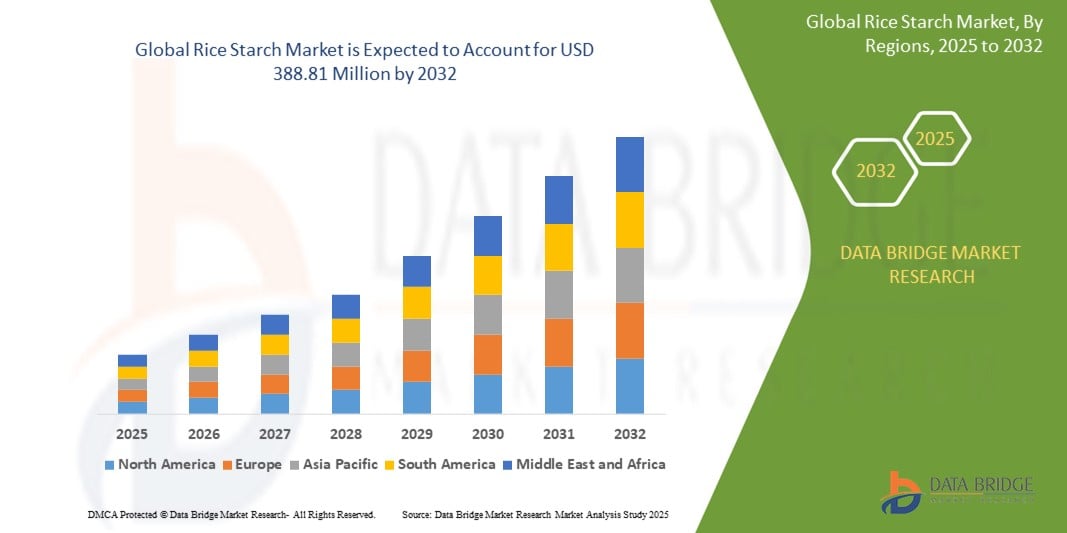
- As per Data Bridge Market Research Analysis the global rice starch market size was valued at USD 224.61 million in 2024 and is expected to reach USD 388.81 million by 2032, at a CAGR of 7.10% during the forecast period
- The rice starch market is witnessing significant advancement with the adoption of the latest methods and technologies, fueling its growth
- Innovations in extraction techniques and processing machinery are enhancing efficiency and quality. Increased utilization across industries such as food, pharmaceuticals, and textiles is propelling market expansion. This trend underscores the dynamic evolution and promising future of the rice starch sector
Market Size & Forecast
Global Market Value (2024): USD 224.61 million
Expected Market Value (2032): USD 388.81 million
Forecast CAGR (2025–2032): 7.10%
What are the Major Takeaways of Rice Starch Market?
- The escalating demand for processed and convenience foods worldwide is propelling the market for rice starch, renowned for its role as a versatile thickening agent and texture enhancer. In soups, sauces, desserts, and baked goods, rice starch contributes to desired textures and stability
- With consumers increasingly opting for ready-to-eat and easy-to-prepare meals, the use of rice starch as a key ingredient continues to surge, driving market growth exponentially
- North America dominated the rice starch market with the largest revenue share of 34.9% in 2024, driven by strong consumer demand for sustainable, plant-based, and biodegradable packaging solutions across food, beverage, and personal care sectors
- Asia-Pacific rice starch market is poised to grow at the fastest CAGR of 14.2% from 2025 to 2032, supported by rapid urbanization, expanding middle-class population, and increasing emphasis on sustainable consumptions
- The Native segment dominated the rice starch market with the largest revenue share of 51.6% in 2024, driven by its natural origin, clean-label appeal, and widespread use across food, personal care, and pharmaceutical applications
Report Scope and Rice Starch Market Segmentation
|
Attributes |
Rice Starch Key Market Insights |
|
Segments Covered |
|
|
Countries Covered |
North America
Europe
Asia-Pacific
Middle East and Africa
South America
|
|
Key Market Players |
|
|
Market Opportunities |
|
|
Value Added Data Infosets |
In addition to the insights on market scenarios such as market value, growth rate, segmentation, geographical coverage, and major players, the market reports curated by the Data Bridge Market Research also include in-depth expert analysis, pricing analysis, brand share analysis, consumer survey, demography analysis, supply chain analysis, value chain analysis, raw material/consumables overview, vendor selection criteria, PESTLE Analysis, Porter Analysis, and regulatory framework. |
What is the Key Trend in the Rice Starch Market?
“Growing Utilization of Rice Starch in Clean-Label and Plant-Based Food Products”
- A significant and accelerating trend in the global rice starch market is the increasing incorporation of rice starch as a natural, clean-label ingredient in plant-based, organic, and minimally processed food products. Rising consumer preference for recognizable, simple ingredients is reshaping formulation strategies across multiple food categories
- For instance, in April 2024, BENEO expanded its range of clean-label rice starches with improved functional properties for dairy alternatives and ready-to-eat meals, supporting manufacturers in achieving cleaner ingredient lists without compromising product quality
- Rice starch offers excellent texturizing, thickening, and stabilization properties, making it ideal for applications such as dairy alternatives, plant-based meats, infant nutrition, and convenience foods, where clean-label formulations are in high demand
- Food manufacturers are leveraging rice starch to replace modified starches and artificial additives, promoting products as non-GMO, allergen-free, and suitable for sensitive diets, including gluten-free and plant-based consumers
- The clean-label movement is particularly strong in North America and Europe, where consumers increasingly scrutinize product labels and seek transparency, driving demand for natural, functional ingredients such as rice starch
- Global food brands are aligning with this trend by reformulating products with rice-derived ingredients that meet evolving health, sustainability, and transparency standards, contributing to the market's steady growth
- As the plant-based and health-focused food sectors expand, the role of rice starch as a multifunctional, clean-label solution is expected to gain momentum, offering opportunities for manufacturers to innovate across diverse product categories
What are the Key Drivers of Rice Starch Market?
- The rising demand for clean-label, natural, and allergen-friendly food products is a primary driver of rice starch adoption, with manufacturers increasingly seeking alternatives to artificial additives and modified starches
- For instance, in February 2024, Ingredion launched a new range of functional rice starches targeting the growing market for plant-based dairy and ready meals, emphasizing texture improvement and label-friendly formulations
- Growing consumer awareness regarding digestive health, food allergies, and sustainable sourcing is pushing brands to incorporate rice starch as a safe, easily digestible, and eco-conscious ingredient across food, beverage, and personal care applications
- The surge in plant-based diets, vegan product development, and gluten-free food consumption is creating new opportunities for rice starch as a functional, non-GMO ingredient that aligns with dietary preferences
- In addition, advancements in rice processing technologies have enhanced the performance and versatility of rice starch, making it suitable for use in high-moisture, freeze-thaw stable, and heat-treated food products
- The personal care and pharmaceutical industries are also adopting rice starch for its absorbent, hypoallergenic, and skin-friendly properties, contributing to market expansion beyond the food sector
Which Factor is challenging the Growth of the Rice Starch Market?
- One of the primary challenges facing the rice starch market is the higher production costs associated with rice-derived ingredients compared to conventional starches such as corn or tapioca, limiting affordability in price-sensitive markets
- For instance, manufacturers in developing regions may opt for more economical starch alternatives due to cost pressures, particularly in mass-market food applications where price competitiveness is critical
- Supply chain fluctuations, seasonal variations in rice production, and raw material availability can impact pricing and product consistency, posing risks for large-scale industrial users
- In addition, rice starch's functionality may be limited in certain food formulations compared to chemically modified starches, affecting its suitability in highly processed or complex products requiring specific performance characteristics
- Regulatory disparities across regions concerning ingredient labeling, organic certifications, and non-GMO claims can create market entry barriers and complicate product standardization for multinational manufacturers
- To overcome these challenges, industry stakeholders are focusing on improving processing efficiencies, expanding raw material sourcing, and investing in R&D to enhance rice starch functionality and competitiveness globally
How is the Rice Starch Market Segmented?
The market is segmented on the basis of type, nature, product, and application.
- By Type
On the basis of type, the rice starch market is segmented into Native, Modified, and Others. The Native segment dominated the Rice Starch market with the largest revenue share of 51.6% in 2024, driven by its natural origin, clean-label appeal, and widespread use across food, personal care, and pharmaceutical applications. Native rice starch is favored for its excellent texturizing, thickening, and stabilizing properties, aligning with the growing consumer preference for minimally processed ingredients.
The Modified segment is expected to witness the fastest growth rate from 2025 to 2032, supported by increasing demand for enhanced functional properties in processed food, dairy, and convenience products. Modified rice starch offers superior heat stability, improved shelf life, and versatility, making it ideal for complex formulations and ready-to-eat meals.
- By Nature
On the basis of nature, the rice starch market is segmented into Conventional and Organic. The Conventional segment accounted for the largest market revenue share of 76.4% in 2024, owing to its affordability, broad availability, and extensive application across mainstream food, beverage, and personal care products.
The Organic segment is projected to experience the fastest CAGR from 2025 to 2032, fueled by rising consumer demand for clean-label, sustainably sourced, and certified organic ingredients. The organic rice starch market is gaining momentum across premium food, baby nutrition, and eco-conscious personal care segments.
- By Product
On the basis of product, the rice starch market is segmented into Food Grade, Cosmetic Grade, and Pharmaceutical Grade. The Food Grade segment dominated the market with the largest revenue share of 63.8% in 2024, attributed to rice starch's growing use in bakery, dairy, confectionery, and ready-to-eat meals as a natural thickener, stabilizer, and texturizer.
The Cosmetic Grade segment is expected to register the fastest growth rate from 2025 to 2032, driven by increasing demand for natural, allergen-free, and skin-friendly ingredients in body powders, dry shampoos, and skincare products. Rice starch's absorbent and hypoallergenic properties are fueling its adoption in clean beauty formulations.
- By Application
On the basis of application, the rice starch market is segmented into Bakery Goods and Bakery Fillings, Confectionery Coatings and Liquorice, Dairy Dessert and Yogurt, Dairy Fruit Preparations, Body Powder, Dry Shampoo, and Others. The Bakery Goods and Bakery Fillings segment held the largest market revenue share of 29.3% in 2024, driven by the growing consumption of bakery products and the need for natural stabilizers and texturizers that enhance texture, mouthfeel, and shelf life.
The Dry Shampoo segment is anticipated to witness the fastest CAGR from 2025 to 2032, supported by increasing popularity of convenient, waterless haircare solutions. Rice starch's natural absorbency, oil control, and gentle properties make it a preferred ingredient in clean-label dry shampoos across global markets.
Which Region Holds the Largest Share of the Rice Starch Market?
- North America dominated the rice starch market with the largest revenue share of 34.9% in 2024, driven by strong consumer demand for sustainable, plant-based, and biodegradable packaging solutions across food, beverage, and personal care sectors. Heightened regulatory pressure to reduce single-use plastics and increasing adoption of circular economy practices are key growth contributors in the region
- The U.S., Canada, and Mexico are experiencing significant uptake of rice starch-based products in packaging, owing to rising environmental awareness, advancements in material innovation, and the presence of major global packaging manufacturers. The growing demand for organic food, clean-label products, and sustainable packaging in retail and foodservice industries is reinforcing North America's leadership position
- Furthermore, large corporations in North America are aggressively pursuing sustainability goals, investing in bio-based, recyclable, and compostable packaging alternatives, creating favorable growth conditions for the rice starch market across the region
U.S. Rice Starch Market Insight
U.S. rice starch market captured the largest revenue share within North America in 2024, fueled by strong consumer preference for eco-friendly packaging, expanding food processing activities, and regulatory mandates aimed at reducing plastic waste. Companies across food, beverage, and personal care industries are integrating biodegradable and compostable packaging materials such as rice starch to meet evolving consumer expectations and comply with stringent environmental standards.
Asia-Pacific Rice Starch Market
Asia-Pacific rice starch market is poised to grow at the fastest CAGR of 14.2% from 2025 to 2032, supported by rapid urbanization, expanding middle-class population, and increasing emphasis on sustainable consumption. Rising disposable incomes, growing packaged food demand, and government initiatives promoting eco-friendly packaging alternatives are accelerating Rice Starch adoption across the region. China, India, Japan, and Southeast Asian countries are leading the shift toward biodegradable, compostable, and reusable packaging to address plastic pollution and align with global sustainability targets. Moreover, increasing investments from domestic and international players in advanced packaging technologies and bio-based materials are further propelling market growth.
China Rice Starch Market Insight
The China rice starch market accounted for the largest revenue share within Asia-Pacific in 2024, driven by the country’s vast food production industry, growing environmental regulations, and consumer preference for sustainable packaging. Leading manufacturers are adopting plant-based, biodegradable materials to align with national plastic reduction policies and evolving market expectations.
Japan Rice Starch Market Insight
The Japan rice starch market is witnessing steady growth, fueled by a highly developed packaging sector, advanced recycling infrastructure, and strong consumer demand for minimalistic, eco-conscious packaging. The integration of rice starch-based materials across food, beverage, and personal care applications is gaining momentum as sustainability becomes a top priority among Japanese consumers and businesses.
Which are the Top Companies in Rice Starch Market?
The rice starch industry is primarily led by well-established companies, including:
- Cargill, Incorporated (U.S.)
- Dow (U.S.)
- BASF SE (Germany)
- Novozymes A/S (Denmark)
- DSM (Netherlands)
- DuPont (U.S.)
- Novus International, Inc. (U.S.)
- Alltech (U.S.)
- Associated British Foods plc (U.K.)
- Charoen Pokphand Foods PCL (Thailand)
- Nutreco (Netherlands)
- ForFarmers (Netherlands)
- De Heus Animal Nutrition (Netherlands)
- Land O'Lakes, Inc. (U.S.)
- Kent Nutrition Group (U.S.)
- Perdue Farms (U.S.)
- SunOpta (Canada)
- Scratch Peck Feeds (U.S.)
- MEGAMIX (Russia)
- Agrofeed (Hungary)
What are the Recent Developments in Global Rice Starch Market?
- In June 2023, BENEO invested USD 6.49 million to expand drying capacity at its Wijgmaal facility, aimed at meeting the rising global demand for specialty rice starch ingredients. This expansion strengthens BENEO’s ability to support clean-label and functional food markets worldwide
- In October 2022, BENEO inaugurated a new rice starch production line at its Wijgmaal site in Belgium, enhancing production capabilities to address the increasing global demand for clean-label rice-based solutions. This development reinforces BENEO’s position as a key player in the rice starch market
- In May 2022, Ingredion Incorporated launched organic native starches derived from rice, ideal for thickening in products such as frozen ready meals and sauces. These clean-label, functional starches align with evolving consumer expectations, boosting market competition and sales growth
- In July 2021, BENEO expanded its Remypure range with a second native functional rice starch, produced through a proprietary process that enhances functional performance without using chemicals. This innovation enables food manufacturers to deliver clean-label products without compromising on quality or functionality
- In August 2020, BENEO broadened its ingredient portfolio by introducing Remyline O AX DR and Orafti Organic, designed for bakery, dairy, and other food products, improving texture and flavor while aligning with consumer demand for natural and organic options. This launch expanded BENEO’s reach in the functional ingredient segment
- In July 2020, Ingredion Incorporated completed an expansion of its rice ingredient production facility in Banglen, Thailand, aimed at meeting growing global demand for rice-based ingredients. This strategic investment enhances Ingredion’s manufacturing footprint and ability to serve the food industry’s evolving needs

- Interactive Data Analysis Dashboard
- Company Analysis Dashboard for high growth potential opportunities
- Research Analyst Access for customization & queries
- Competitor Analysis with Interactive dashboard
- Latest News, Updates & Trend analysis
- Harness the Power of Benchmark Analysis for Comprehensive Competitor Tracking
Global Rice Starch Market, Supply Chain Analysis and Ecosystem Framework
To support market growth and help clients navigate the impact of geopolitical shifts, DBMR has integrated in-depth supply chain analysis into its Global Rice Starch Market research reports. This addition empowers clients to respond effectively to global changes affecting their industries. The supply chain analysis section includes detailed insights such as Global Rice Starch Market consumption and production by country, price trend analysis, the impact of tariffs and geopolitical developments, and import and export trends by country and HSN code. It also highlights major suppliers with data on production capacity and company profiles, as well as key importers and exporters. In addition to research, DBMR offers specialized supply chain consulting services backed by over a decade of experience, providing solutions like supplier discovery, supplier risk assessment, price trend analysis, impact evaluation of inflation and trade route changes, and comprehensive market trend analysis.
Data collection and base year analysis are done using data collection modules with large sample sizes. The stage includes obtaining market information or related data through various sources and strategies. It includes examining and planning all the data acquired from the past in advance. It likewise envelops the examination of information inconsistencies seen across different information sources. The market data is analysed and estimated using market statistical and coherent models. Also, market share analysis and key trend analysis are the major success factors in the market report. To know more, please request an analyst call or drop down your inquiry.
The key research methodology used by DBMR research team is data triangulation which involves data mining, analysis of the impact of data variables on the market and primary (industry expert) validation. Data models include Vendor Positioning Grid, Market Time Line Analysis, Market Overview and Guide, Company Positioning Grid, Patent Analysis, Pricing Analysis, Company Market Share Analysis, Standards of Measurement, Global versus Regional and Vendor Share Analysis. To know more about the research methodology, drop in an inquiry to speak to our industry experts.
Data Bridge Market Research is a leader in advanced formative research. We take pride in servicing our existing and new customers with data and analysis that match and suits their goal. The report can be customized to include price trend analysis of target brands understanding the market for additional countries (ask for the list of countries), clinical trial results data, literature review, refurbished market and product base analysis. Market analysis of target competitors can be analyzed from technology-based analysis to market portfolio strategies. We can add as many competitors that you require data about in the format and data style you are looking for. Our team of analysts can also provide you data in crude raw excel files pivot tables (Fact book) or can assist you in creating presentations from the data sets available in the report.













