


Segmentation du marché mondial des grues à écume, par type d'étalage (grues à empileurs à mât simple, grues à empileurs à deux mâts et grues à empileurs à trois mâts), mode d'exploitation (grues à écureuils automatiques (AGV) et grues à écureuils à commande manuelle), capacité de charge (grues à écureuils légers, grues à écureuils de service moyen et grues à écureuils lourds), hauteur de levage (grues à écureuils à écureuils, grues à écureuils de transport moyen et grues à écureuils de transport élevé), application (industrie automobile, industrie de l'alimentation et des boissons, industrie pharmaceutique, logistique et entreposage, industrie du travail des métaux) - Tendances et prévisions de l'industrie jusqu'en 2033
Taille du marché
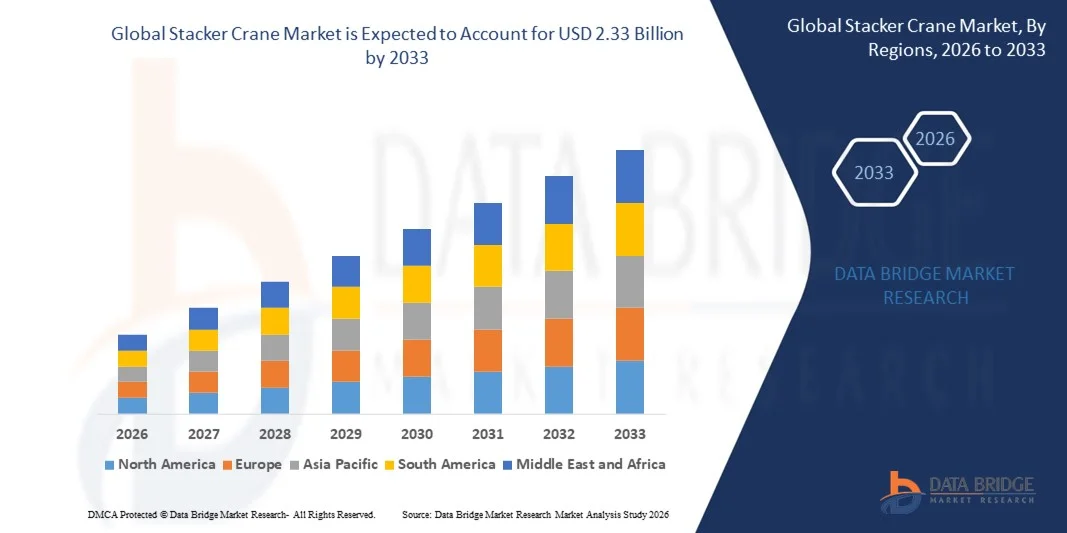
- La taille du marché mondial des grues empileuses a été évaluée à1,35 milliard de dollars en 2025et devrait atteindre2,33 milliards de dollars en 2033, à unTCAC de 7,01 %pendant la période de prévision
- La croissance du marché est largement alimentée par la demande croissante de systèmes automatisés de stockage et de récupération (AS/RS) dans les entrepôts, les centres de distribution et les installations de fabrication
- L'adoption croissante des technologies de l'industrie 4.0 et des entrepôts intelligents, conjuguée à l'augmentation des activités de commerce électronique, est à l'origine de la nécessité de solutions efficaces de manutention des matériaux.
Analyse du marché de la grue Stacker
- Les grues sont de plus en plus préférées en raison de leur capacité à automatiser les opérations de stockage et de récupération, à réduire les coûts de main-d'oeuvre et à améliorer la sécurité dans les entrepôts
- Le marché est témoin d'investissements importants dans des grues à empileurs de pointe avec des caractéristiques telles que le fonctionnement à grande vitesse, l'intégration IoT, et des capacités de surveillance à distance
- L'Amérique du Nord a dominé le marché des grues empileuses avec la plus grande part de revenus de 38,45 % en 2025, en raison de l'adoption croissante d'entrepôts automatisés, de l'expansion du commerce électronique et de la demande croissante de solutions efficaces de manutention des matériaux.
- La région Asie-Pacifique devrait connaître le taux de croissance le plus élevé du monde.grue empileusele marché, en raison de l'urbanisation rapide, de l'augmentation des activités de commerce électronique et de fabrication, et des initiatives gouvernementales appuyant les entrepôts intelligents. La demande croissante de systèmes de stockage à haute densité et de solutions automatisées rentables alimente l'expansion du marché dans toute la région
- En 2025, c'est le segment à mât unique qui détenait la plus grande part du marché en raison de sa rentabilité, de sa conception compacte et de son aptitude au stockage en entrepôt à densité moyenne. Les grues empileuses à mât unique sont largement adoptées dans les centres de distribution et les installations de fabrication où une optimisation modérée du débit et du stockage est nécessaire
Étendue du rapport et segmentation du marché de la grue
| Attributs | Stacker Crane Principales perspectives du marché |
| Segments couverts |
|
| Pays couverts | Amérique du Nord
Europe
Asie-Pacifique
Moyen-Orient et Afrique
Amérique du Sud
|
| Principaux acteurs du marché |
|
| Possibilités de marché |
|
| Infos sur la valeur ajoutée | Outre les perspectives du marché telles que la valeur du marché, le taux de croissance, les segments de marché, la couverture géographique, les acteurs du marché et le scénario du marché, le rapport de marché préparé par l'équipe de recherche sur le marché de Data Bridge comprend une analyse approfondie des experts, une analyse des importations et des exportations, une analyse des prix, une analyse de la consommation de production et une analyse des ravageurs. |
Tendances du marché de la Grue de Stacker
L'adoption croissante de solutions automatisées de manutention du matériel
- L'accent de plus en plus mis sur l'automatisation des entrepôts et des solutions de stockage efficaces façonne de façon significative le marché mondial des grues empileuses, les entreprises cherchant de plus en plus à réduire les coûts de main-d'oeuvre, à optimiser l'espace et à améliorer l'efficacité opérationnelle. Les grues d'arrimage gagnent en traction grâce à leur capacité à gérer le stockage à haute densité, à accélérer les opérations de récupération et à s'intégrer de façon transparente aux systèmes automatisés de stockage et de récupération (AS/RS). Cette tendance renforce leur adoption dans les industries du commerce électronique, de la fabrication et du stockage à froid, encourageant les fabricants à innover avec des solutions de grues intelligentes et à grande vitesse
- L'augmentation des investissements dans l'entreposage intelligent et l'automatisation industrielle a accéléré la demande de grues empileuses dans les centres de distribution, les entrepôts d'exécution et les usines de fabrication. Les entreprises déploient des grues empileuses équipées de capteurs, de connectivité IoT et de systèmes de contrôle logiciels pour améliorer la précision, réduire les erreurs et permettre le suivi des stocks en temps réel. Les exigences croissantes en matière de commerce électronique et de logistique omnicanal conduisent à des améliorations continues et à la modernisation des systèmes de manutention des matériaux
- L'intégration avec les systèmes de gestion des entrepôts (WMS) et les technologies d'Industrie 4.0 influence les décisions d'achat, les opérateurs mettant l'accent sur la compatibilité des systèmes, l'efficacité de l'automatisation et la surveillance en temps réel. Ces facteurs aident les entreprises à réduire les goulets d'étranglement opérationnels, à améliorer le débit et à maximiser l'utilisation du stockage, tout en favorisant l'adoption de solutions de grues à empiler avancées dans les installations nouvelles et existantes
- Par exemple, en 2024, Swisslog en Suisse et Dematic en Allemagne ont élargi leur gamme de produits en introduisant des grues empileuses à grande vitesse avec guidage automatisé et intégration logicielle intelligente. Ces déploiements ont été ciblés sur le commerce électronique et les entrepôts pharmaceutiques pour traiter le stockage à haute densité et la récupération rapide. Les solutions ont également mis l'accent sur la sécurité, la précision et l'efficacité énergétique, en soutenant l'amélioration des performances des entrepôts
- Bien que la demande de grues empileuses augmente, l'expansion soutenue du marché dépend de la recherche-développement continue, du déploiement rentable et de l'intégration à l'infrastructure d'entrepôt existante. Les fabricants se concentrent sur l'amélioration de l'évolutivité, de la capacité de charge, de l'intégration des logiciels et de la fiabilité opérationnelle pour une adoption plus large dans l'ensemble des industries.
Dynamique du marché de la Grue de Stacker
Chauffeur
Demande croissante d'automatisation des entrepôts et de stockage efficace
- Le besoin croissant de solutions automatisées de stockage et de récupération est un moteur majeur pour le marché des grues empileuses. Les entreprises déploient de plus en plus de grues pour améliorer la densité de stockage, réduire la dépendance à l'égard de la main-d'oeuvre et améliorer la vitesse opérationnelle. Cette tendance encourage également les innovations technologiques dans la conception des grues, les systèmes de contrôle et l'intégration avec les systèmes de gestion des entrepôts
- L'expansion des applications dans les centres d'exécution du commerce électronique, les installations de stockage à froid et les entrepôts de fabrication influence la croissance du marché. Les grues Stacker permettent d'optimiser l'espace, de réduire les temps de récupération et d'améliorer la précision de gestion des stocks. L'adoption croissante d'entrepôts intelligents dans le monde renforce encore cette tendance
- Les fournisseurs de logistique et de manutention des matériaux promeuvent activement les solutions basées sur les grues empileuses par des mises à niveau d'automatisation, l'intégration de logiciels et des conceptions de systèmes personnalisées. Ces efforts sont appuyés par une demande croissante pour l'exécution plus rapide des commandes, la réduction des erreurs et l'amélioration de la sécurité au travail, encourageant les partenariats entre les fabricants d'équipement et les exploitants d'entrepôts
- Par exemple, en 2023, Dematic en Allemagne et Swisslog en Suisse ont signalé des déploiements accrus de grues empileuses automatisées dans les installations de commerce électronique et de stockage à froid. L'adoption faisait suite à une demande accrue de manutention efficace des matériaux, de suivi des stocks en temps réel et de réduction des coûts opérationnels. Les deux entreprises ont mis l'accent sur l'intégration intelligente et l'efficacité énergétique dans les campagnes de marketing visant à renforcer la confiance des clients et les partenariats à long terme
- Bien que l'augmentation des tendances en matière d'automatisation favorise la croissance, l'adoption plus large dépend d'un investissement élevé en capital, de l'expertise technique et de la compatibilité des systèmes. L'investissement dans l'intégration des logiciels, la formation des opérateurs et les conceptions avancées de grues sera essentiel pour répondre à la demande mondiale et maintenir l'avantage concurrentiel
Restriction/Défi
Coûts d'investissement élevés et complexité technique
- Le coût relativement élevé des systèmes de grues empileuses par rapport aux solutions de stockage classiques demeure un défi majeur, limitant l'adoption parmi les petits et moyens entrepôts. Des coûts d'achat, d'installation et d'entretien plus élevés contribuent à ralentir l'adoption des marchés sensibles aux prix
- La complexité opérationnelle et le besoin de personnel qualifié posent également des défis, en particulier dans les régions où l'automatisation des entrepôts se fait jour. Une compréhension limitée des capacités du système et le manque d'opérateurs formés limitent l'adoption dans certaines industries
- L'intégration aux systèmes de gestion des entrepôts existants et à l'infrastructure de manutention des matériaux peut également avoir une incidence sur la croissance du marché. Les grues Stacker nécessitent une installation de précision, une compatibilité logicielle et une maintenance continue, une planification opérationnelle et des dépenses accrues
- Par exemple, en 2024, les exploitants d'entrepôts en Asie du Sud-Est et en Amérique latine ont signalé que l'adoption de grues empileuses à haute densité était plus lente en raison des coûts initiaux élevés, des compétences techniques requises et des difficultés d'intégration des systèmes. Ces facteurs ont également incité certaines entreprises à retarder les mises à niveau et à limiter les investissements dans l'automatisation.
- Pour surmonter ces défis, il faudra des solutions rentables, des conceptions évolutives et des programmes de formation des exploitants. La collaboration avec les fournisseurs de services logistiques, les développeurs de logiciels et les fabricants d'équipement peut aider à libérer le potentiel de croissance à long terme du marché mondial des grues empileuses. La mise au point de systèmes modulaires, économes en énergie et conviviaux sera essentielle pour une large adoption.
Étendue du marché de la grue à écureuil
Le marché est segmenté en fonction du type de gerbage, du mode de fonctionnement, de la capacité de charge, de la hauteur de levage et de l'application.
- Par type de positionnement
Sur la base du type d'empilement, le marché mondial des grues empileuses est segmenté en grues empileuses à mât unique, grues empileuses à mât double et grues empileuses à mât triple. En 2025, c'est le segment à mât unique qui détenait la plus grande part du marché en raison de sa rentabilité, de sa conception compacte et de son aptitude au stockage en entrepôt à densité moyenne. Les grues empileuses à mât unique sont largement adoptées dans les centres de distribution et les installations de fabrication où un débit modéré et une optimisation du stockage sont nécessaires.
Le segment Double-mast devrait connaître le taux de croissance le plus rapide de 2026 à 2033, alimenté par sa capacité à gérer des charges plus élevées et des systèmes de racking plus hauts. Les grues à double mât sont de plus en plus préférées pour les entrepôts à haute densité et les installations de stockage automatisées, offrant une stabilité, une vitesse et une efficacité opérationnelle accrues.
- Par mode de fonctionnement
Sur la base du mode d'exploitation, le marché est segmenté en grues empileuses automatique de véhicules guidés (AGV) et grues empileuses manuelles. Le segment des grues à empileurs AGV détenait la plus grande part du marché en 2025, grâce à l'adoption croissante de systèmes d'entreposage entièrement automatisés et de systèmes de manutention des matériaux compatibles avec l'industrie 4.0. Les grues empileuses AGV réduisent la dépendance au travail et améliorent la précision dans la gestion des stocks.
Le segment des grues à empileurs à commande manuelle devrait connaître le taux de croissance le plus rapide de 2026 à 2033, entraîné par la demande dans les petits et moyens entrepôts où la semi-automation est plus possible. Ces grues offrent une flexibilité, des coûts initiaux réduits et une intégration facile dans les configurations de stockage existantes.
- Par capacité de charge
Sur la base de la capacité de charge, le marché est segmenté en grues empileuses légères, grues empileuses moyennes et grues empileuses lourdes. En 2025, le segment des produits de consommation moyens détenait la plus grande part du marché, en raison de sa capacité de levage, de son efficacité opérationnelle et de sa capacité de stockage pour un large éventail d'applications. Les grues empileuses de moyenne capacité sont couramment utilisées dans les centres logistiques, les installations de fabrication et les entrepôts frigorifiques.
Le segment des véhicules utilitaires lourds devrait connaître le taux de croissance le plus rapide entre 2026 et 2033, alimenté par la demande croissante de la part d'industries telles que l'automobile, le travail des métaux et les centres de distribution à grande échelle qui exigent des capacités de levage à haute charge et de manutention robustes.
- En montant la hauteur
Sur la base de la hauteur de levage, le marché est segmenté en grues empileuses à faible élévateur, grues empileuses à moyen élévateur et grues empileuses à haut élévateur. En 2025, le segment des moyens de transport détenait la plus grande part du marché en raison de sa capacité à optimiser l'entreposage vertical dans des entrepôts de moyenne hauteur tout en maintenant la vitesse et la sécurité opérationnelle.
On s'attend à ce que le taux de croissance soit le plus rapide entre 2026 et 2033, en raison de l'adoption croissante de systèmes de stockage automatisés à grande échelle et de la nécessité de maximiser la densité de stockage dans les installations modernes de logistique et de distribution.
- Par demande
Sur la base de l'application, le marché est segmenté dans l'industrie automobile, l'industrie des aliments et boissons, l'industrie pharmaceutique, la logistique et l'entreposage, et l'industrie métallurgique. Le segment de la logistique et de l'entreposage détenait la plus grande part de revenus du marché en 2025, sous l'effet de la croissance du commerce électronique, de la distribution au détail et de l'expansion des centres d'exécution automatisés. Les grues Stacker aident à améliorer la gestion des stocks, la densité de stockage et l'efficacité opérationnelle dans les entrepôts.
Le secteur de l'industrie pharmaceutique devrait connaître le taux de croissance le plus rapide entre 2026 et 2033, alimenté par des exigences rigoureuses en matière de stockage et de récupération, de gestion de la chaîne du froid et d'adoption croissante de systèmes automatisés pour assurer la sécurité et la conformité des produits.
Analyse régionale du marché de la grue Stacker
- L'Amérique du Nord a dominé le marché des grues empileuses avec la plus grande part de revenus de 38,45 % en 2025, en raison de l'adoption croissante d'entrepôts automatisés, de l'expansion du commerce électronique et de la demande croissante de solutions efficaces de manutention des matériaux.
- Les entreprises de la région apprécient fortement la capacité des grues à empiler pour optimiser la densité de stockage, réduire les coûts de main-d'oeuvre et améliorer la vitesse opérationnelle et la sécurité
- Cette adoption généralisée est soutenue par des investissements élevés dans l'automatisation industrielle, l'infrastructure logistique technologiquement avancée et la préférence croissante pour les centres d'exécution à haut débit, l'établissement de grues empileuses comme solution privilégiée pour les entrepôts, la fabrication et les centres de distribution
Aperçu du marché américain de la grue Stacker
Le marché américain des grues empileuses a enregistré la plus grande part de revenus en 2025 en Amérique du Nord, alimentée par l'expansion rapide du commerce électronique, l'automatisation de la logistique et la nécessité de solutions de stockage efficaces dans l'espace. Les entreprises investissent de plus en plus dans les grues à empileurs automatiques pour véhicules guidés (AGV) et les grues à grande vitesse pour améliorer le débit des entrepôts et la précision des stocks. De plus, l'intégration des grues à empileurs avec les systèmes de gestion des entrepôts (WMS) et la surveillance basée sur l'IoT contribue de façon significative à la croissance du marché.
Perspectives du marché de la grue à écume
Le marché européen des grues à empileurs devrait connaître le taux de croissance le plus rapide de 2026 à 2033, principalement en raison de la modernisation des entrepôts, de l'augmentation des coûts de main-d'œuvre et de l'adoption croissante des technologies de l'Industrie 4.0. La demande croissante de systèmes automatisés de stockage et de récupération dans les secteurs de la logistique, de l'automobile et de la fabrication favorise l'adoption de grues empileuses. Les entreprises européennes se concentrent également sur les grues écoénergétiques et de haute précision, contribuant ainsi à une croissance rapide du marché pour de multiples applications.
Allemagne Stacker Crane Aperçu du marché
Le marché allemand des grues empileuses devrait connaître le taux de croissance le plus rapide entre 2026 et 2033, alimenté par l'automatisation croissante des entrepôts, l'innovation technologique et la demande de solutions de stockage à haute densité. Allemagne Une infrastructure industrielle robuste, axée sur l'efficacité, et l'accent sur les opérations durables favorisent l'adoption de grues empileuses dans la logistique, l'automobile et les installations de fabrication. L'intégration avec les systèmes d'entrepôt intelligents et la surveillance intégrée accélère l'adoption.
Aperçu du marché de la grue à écureuil en Asie-Pacifique
Le marché des grues à empileurs Asie-Pacifique devrait connaître le taux de croissance le plus rapide de 2026 à 2033, en raison de l'urbanisation rapide, de l'expansion du commerce électronique et de la demande croissante de solutions d'entreposage automatisées dans des pays comme la Chine, le Japon et l'Inde. Les initiatives gouvernementales en faveur de la numérisation et de la logistique intelligente encouragent le déploiement de grues empileuses. De plus, l'APAC devient un centre de fabrication pour le matériel de manutention des matériaux, ce qui améliore l'accessibilité et l'accessibilité des entrepôts et des installations industrielles.
China Stacker Crane Aperçu du marché
En 2025, le marché chinois des grues empileuses a représenté la plus grande part des revenus en Asie-Pacifique, attribuable à la croissance industrielle rapide, à la construction d'entrepôts à grande échelle et à l'augmentation des centres d'exécution du commerce électronique. Les grues sont de plus en plus déployées dans les installations de fabrication, de logistique et de stockage à froid pour optimiser l'espace et améliorer l'efficacité opérationnelle. De solides fabricants nationaux et le soutien du gouvernement aux initiatives d'entreposage intelligent sont des facteurs clés de l'expansion du marché en Chine.
Aperçu du marché japonais de la grue Stacker
Le marché japonais des grues empileuses devrait connaître le taux de croissance le plus rapide de 2026 à 2033 en raison de la forte adoption par le pays de l'automatisation industrielle, des progrès technologiques et de la demande de systèmes de stockage efficaces. Les entreprises japonaises se concentrent sur les grues empileuses automatisées à grande vitesse intégrées aux solutions IoT et WMS. En outre, la nécessité d'optimiser l'espace dans les régions densément peuplées et la tendance croissante des usines automatisées alimentent la croissance du marché.
Part de marché de la grue Stacker
L'industrie de la grue Stacker est principalement dirigée par des entreprises bien établies, notamment :
- Groupe Kion AG (Allemagne)
- Daifuku Co., Ltd. (Japon)
- Dematic Corporation (États-Unis)
- Jungheinrich AG (Allemagne)
- Groupe SSI Schafer (Allemagne)
- Toyota Industries (Japon)
- Mecalux S.A (Espagne)
- KUKA AG (Allemagne)
- Konecranes (Finlande)
Derniers développements sur le marché mondial de la grue Stacker
- En septembre 2025, Dematic s'est associé à une société de commerce électronique de premier plan pour développer un centre d'accomplissement automatisé de pointe, améliorer les capacités opérationnelles, permettre des informations basées sur les données et renforcer son positionnement concurrentiel sur le marché.
- En août 2025, Konecranes a mis en place un système automatisé de grues à empileurs à l'IA pour optimiser les opérations d'entreposage, améliorer la productivité et établir de nouveaux critères d'efficacité, favorisant l'adoption technologique dans l'ensemble de l'industrie.
- En juillet 2025, Mitsubishi Logisnext a élargi son empreinte manufacturière avec une nouvelle installation en Asie du Sud-Est, visant à répondre à la demande croissante sur le marché Asie-Pacifique, à optimiser les chaînes d'approvisionnement et à réduire les coûts.
- En janvier 2021, Toyota Industries a achevé l'acquisition de Vanderlande, un fournisseur néerlandais de solutions automatisées de manutention des matériaux, y compris les grues empileuses, afin de renforcer son portefeuille mondial, d'améliorer ses capacités d'automatisation et d'accroître sa présence sur le marché dans les opérations de logistique et d'entreposage.
- En mars 2021, Konecranes a lancé une nouvelle gamme de grues empileuses pour la manutention automatisée des conteneurs, conçue pour améliorer l'efficacité opérationnelle, la sécurité et l'automatisation dans les opérations portuaires et terminaux, renforçant ainsi son leadership industriel
SKU-
Accédez en ligne au rapport sur le premier cloud mondial de veille économique

- Tableau de bord d'analyse de données interactif
- Tableau de bord d'analyse d'entreprise pour les opportunités à fort potentiel de croissance
- Accès d'analyste de recherche pour la personnalisation et les requêtes
- Analyse de la concurrence avec tableau de bord interactif
- Dernières actualités, mises à jour et analyse des tendances
- Exploitez la puissance de l'analyse comparative pour un suivi complet de la concurrence
Méthodologie de recherche
La collecte de données et l'analyse de l'année de base sont effectuées à l'aide de modules de collecte de données avec des échantillons de grande taille. L'étape consiste à obtenir des informations sur le marché ou des données connexes via diverses sources et stratégies. Elle comprend l'examen et la planification à l'avance de toutes les données acquises dans le passé. Elle englobe également l'examen des incohérences d'informations observées dans différentes sources d'informations. Les données de marché sont analysées et estimées à l'aide de modèles statistiques et cohérents de marché. De plus, l'analyse des parts de marché et l'analyse des tendances clés sont les principaux facteurs de succès du rapport de marché. Pour en savoir plus, veuillez demander un appel d'analyste ou déposer votre demande.
La méthodologie de recherche clé utilisée par l'équipe de recherche DBMR est la triangulation des données qui implique l'exploration de données, l'analyse de l'impact des variables de données sur le marché et la validation primaire (expert du secteur). Les modèles de données incluent la grille de positionnement des fournisseurs, l'analyse de la chronologie du marché, l'aperçu et le guide du marché, la grille de positionnement des entreprises, l'analyse des brevets, l'analyse des prix, l'analyse des parts de marché des entreprises, les normes de mesure, l'analyse globale par rapport à l'analyse régionale et des parts des fournisseurs. Pour en savoir plus sur la méthodologie de recherche, envoyez une demande pour parler à nos experts du secteur.
Personnalisation disponible
Data Bridge Market Research est un leader de la recherche formative avancée. Nous sommes fiers de fournir à nos clients existants et nouveaux des données et des analyses qui correspondent à leurs objectifs. Le rapport peut être personnalisé pour inclure une analyse des tendances des prix des marques cibles, une compréhension du marché pour d'autres pays (demandez la liste des pays), des données sur les résultats des essais cliniques, une revue de la littérature, une analyse du marché des produits remis à neuf et de la base de produits. L'analyse du marché des concurrents cibles peut être analysée à partir d'une analyse basée sur la technologie jusqu'à des stratégies de portefeuille de marché. Nous pouvons ajouter autant de concurrents que vous le souhaitez, dans le format et le style de données que vous recherchez. Notre équipe d'analystes peut également vous fournir des données sous forme de fichiers Excel bruts, de tableaux croisés dynamiques (Fact book) ou peut vous aider à créer des présentations à partir des ensembles de données disponibles dans le rapport.











