



Segmentation du marché des aligneurs dentaires au Moyen-Orient et en Afrique, par produit et services, groupe d'âge (adultes, adolescents et enfants), matière première (polyuréthanes thermoplastiques (TPU), polyéthylène téréphtalate, polyéthylène téréphtalate glycol et autres), application (malocclusion, chevauchement, espacement excessif et autres), plan de traitement (aligneurs en cabinet et aligneurs à domicile), utilisateur final (cliniques dentaires, hôpitaux, cliniques orthodontiques et autres), canal de distribution (ventes directes et distributeurs tiers) - Tendances du secteur et prévisions jusqu'en 2033
Quelle est la taille et l'aperçu du marché des alignements dentaires au Moyen-Orient et en Afrique
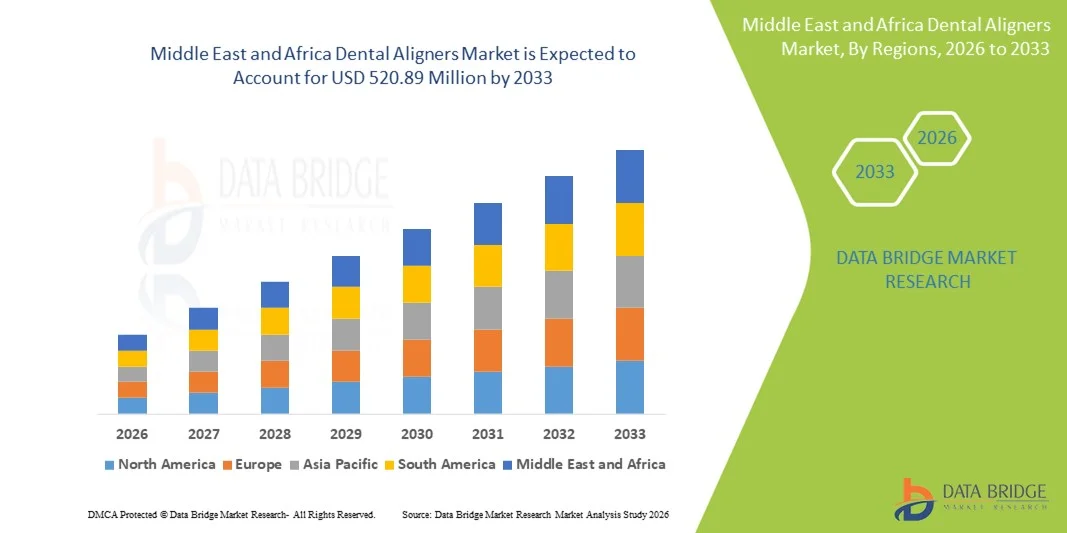
- La taille du marché des aligneurs dentaires au Moyen-Orient et en Afrique a été évaluée à200,15 millions de dollars en 2025et devrait atteindre520,89 millions de dollars en 2033, à unTCAC de 12,70%pendant la période de prévision
- La croissance du marché est largement alimentée par l'augmentation de la sensibilisation à l'esthétique dentaire, l'adoption croissante de technologies d'orthodontie numérique, l'expansion des cliniques dentaires privées et l'augmentation des investissements dans les traitements dentaires avancés dans les centres urbains des pays du CCG et en Afrique du Sud
- De plus, l'augmentation de la demande de solutions orthopédiques confortables et esthétiques par rapport aux appareils traditionnels, conjuguée à l'expansion du tourisme dentaire et à l'augmentation des revenus disponibles, favorise l'adoption d'aligneurs dentaires comme solution dentaire corrective préférée dans les cabinets dentaires résidentiels et commerciaux de la région.
Taille du marché et prévisions
- Moyen-Orient et Afrique Valeur marchande (2025):200,15 millions de dollars
- Valeur marchande prévue (2033) :520,89 millions de dollars
- Prévisions CAGR (2025-2033):12.70%
Moyen-Orient et Afrique Aligners dentaires Analyse du marché
- Les aligneurs dentaires, offrant des solutions orthodontiques claires et amovibles pour le lissage et l'alignement des dents, sont des composants de plus en plus essentiels des soins dentaires modernes dans les milieux cliniques et cosmétiques en raison de leur attrait esthétique, confort et compatibilité avec la planification numérique du traitement
- La demande croissante d'aligneurs dentaires est principalement alimentée par la sensibilisation croissante à l'esthétique dentaire, l'adoption croissante de plans de traitement avancés comme les aligners In-Office et At-Home, et la préférence pour des solutions de rechange moins visibles et pratiques aux appareils traditionnels
- L'Arabie saoudite a dominé le marché des aligneurs dentaires avec une part des revenus de 22,3 % en 2025, caractérisée par l'augmentation des cliniques dentaires, des revenus disponibles plus élevés et une forte présence de fournisseurs clés de technologie dentaire
- On s'attend à ce que l'Afrique du Sud soit le pays qui connaît la croissance la plus rapide sur le marché des alignements dentaires au cours de la période de prévision en raison de la sensibilisation accrue à la santé buccodentaire, de l'élargissement de l'accès aux établissements de soins dentaires privés et de l'urbanisation croissante.
- Le segment des adultes a dominé le marché des alignements dentaires avec la plus grande part de 68,4% en 2025, en raison de la capacité de dépenser accrue, de l'intérêt croissant pour la dentisterie cosmétique et de l'efficacité des alignements pour traiter des questions courantes telles que la malocclusion, l'encombrement et l'espacement excessif.
Portée du rapport et segmentation du marché des alignements dentaires au Moyen-Orient et en Afrique
|
Attributs |
Moyen-Orient et Afrique Aligneurs dentaires Principales perspectives du marché |
|
Segments couverts |
|
|
Pays couverts |
Moyen-Orient et Afrique
|
|
Principaux acteurs du marché |
|
|
Possibilités de marché |
|
|
Infos sur la valeur ajoutée |
|
Quelle est la tendance clé du marché des alignements dentaires au Moyen-Orient et en Afrique
L'adoption croissante de solutions de traitement numériques et à distance
- Une tendance significative et accélérée sur le marché des alignements dentaires au Moyen-Orient et en Afrique est l'adoption croissante de la planification numérique des traitements et de solutions orthodontiques à distance comme les alignements In-Office et At-Home, en améliorant la commodité, la personnalisation et l'efficacité du traitement pour les patients
- Par exemple, SmileDirectClub et les fournisseurs locaux des Émirats arabes unis offrent At‐Home Aligners qui permettent aux patients d'effectuer des traitements orthodontiques à distance avec des scans numériques et une surveillance virtuelle, réduisant ainsi le besoin de visites cliniques fréquentes
- L'intégration numérique dans les traitements d'alignement permet des fonctionnalités telles queNumérisation 3D fla modélisation des dents, la planification des traitements assistés par l'IA et la surveillance à distance des progrès du patient, l'amélioration de l'exactitude et de la conformité du patient
- La combinaison harmonieuse d'orthodontie numérique et d'applications mobiles permet aux patients de suivre les progrès, de recevoir des alertes pour les changements d'alignement et de communiquer virtuellement avec les orthodontistes, créant ainsi une expérience de traitement unique et pratique
- Cette tendance vers des soins orthodontiques numériques, centrés sur le patient et à distance modifie les attentes en matière de soins dentaires, ce qui incite des entreprises comme la technologie Aligner à développer- Oui.plans de traitement assisté et solutions de télésurveillance
- La demande de solutions d'alignement intégrées numériquement et accessibles à distance augmente rapidement dans les segments de patients adultes et adolescents, les consommateurs privilégiant de plus en plus la commodité, l'esthétique et les résultats de traitement efficaces.
- Accroître la collaboration entre les laboratoires dentaires et les fabricants d'alignement pour offrir des alignements entièrement personnalisés et plus rapides crée des solutions orthodontiques plus adaptées et plus efficaces, améliorant ainsi la satisfaction des patients
Moyen-Orient et Afrique Dynamique du marché
Chauffeur
Demande croissante en raison de la sensibilisation à l'esthétique et des besoins orthodontiques
- L'accent de plus en plus mis sur l'esthétique dentaire, l'augmentation de la prévalence de la malocclusion et l'intérêt croissant pour les traitements orthodontiques non invasifs sont des moteurs importants de la demande accrue d'alignements dentaires.
- Par exemple, en 2024, Align Technology a élargi ses activités en Arabie saoudite et aux Émirats arabes unis pour répondre à la demande croissante de traitements Invisalign, mettant en évidence le potentiel du marché pour des solutions d'alignement haut de gamme
- À mesure que les consommateurs prennent davantage conscience de l'apparence cosmétique et de la santé buccodentaire, les alignants offrent des alternatives discrètes, amovibles et confortables aux appareils traditionnels, conduisant l'adoption chez les adultes et les adolescents
- De plus, le nombre croissant de cliniques dentaires privées équipées de technologies d'orthodontie numérique facilite l'accès aux traitements d'alignement, en faisant partie intégrante des soins orthodontiques modernes
- La facilité de la surveillance à distance, la réduction des visites dans les cliniques et des plans de traitement adaptés aux besoins individuels des patients sont des facteurs clés qui propulsent l'adoption d'alignements dentaires à travers le Moyen-Orient et l'Afrique
- L'augmentation des initiatives gouvernementales et de l'aide en matière d'assurance pour la santé dentaire dans des pays comme les Émirats arabes unis et l'Arabie saoudite incite davantage les patients à choisir des alignements par rapport aux appareils traditionnels
- L'influence croissante des médias sociaux et le comportement esthétique des consommateurs incitent les adultes et les adolescents à opter pour des alignements invisibles comme solution orthodontique moderne et adaptée au mode de vie
Restriction/Défi
Coûts élevés et sensibilisation limitée dans les zones émergentes
- Le coût relativement élevé des traitements d'alignement avancés par rapport aux appareils traditionnels pose un défi important à l'adoption généralisée, en particulier sur les marchés sensibles aux prix au Moyen-Orient et en Afrique.
- Par exemple, les traitements invisalign en Arabie Saoudite et aux Émirats arabes unis sont plus chers que les orthodontiques classiques, limitant l'accès pour les patients soucieux du budget malgré les avantages cliniques
- En outre, une connaissance limitée des aligneurs et des solutions orthodontiques numériques dans les zones rurales et moins urbanisées limite la pénétration du marché, car les patients peuvent préférer les appareils traditionnels en raison de leur familiarité et de leur coût moindre.
- Il est essentiel de s'attaquer à ces obstacles par l'éducation des consommateurs, des campagnes de commercialisation locales et l'introduction d'options d'alignement plus abordables pour élargir le marché dans les régions émergentes.
- Alors que les dispensaires haut de gamme dans les centres urbains continuent de favoriser l'adoption de haut de gamme, l'élargissement des solutions rentables et la sensibilisation demeurent des défis majeurs pour une croissance soutenue dans la région
- Le besoin d'orthodontistes spécialisés formés aux systèmes d'alignement numérique peut ralentir l'adoption dans les pays où les compétences professionnelles sont limitées, en particulier en dehors des grandes villes
- Les perceptions culturelles et le scepticisme concernant les traitements orthodontiques à distance ou autogérés peuvent entraver l'acceptation, exigeant des initiatives éducatives ciblées pour renforcer la confiance des consommateurs.
Moyen-Orient et Afrique Aligneurs dentaires Portée du marché
Le marché est segmenté sur la base de produits et services, groupe d'âge, matière première, application, plan de traitement, utilisateur final et canal de distribution.
- Produits et services
Sur la base des produits et des services, le marché est segmenté en produits et services. Le segment Produits a dominé le marché en 2025, représentant la plus grande part des revenus. Cela est dû à la préférence croissante pour des alignements clairs préfabriqués et des solutions orthodontiques personnalisées parmi les cliniques et les utilisateurs individuels. Les produits comprennent les aligneurs eux-mêmes, les plateaux et les accessoires nécessaires au traitement. La forte adoption est alimentée par la sensibilisation à l'esthétique dentaire et le nombre croissant de cliniques dentaires privées en Arabie saoudite, aux Émirats arabes unis et en Afrique du Sud. Les patients préfèrent les produits tangibles qui peuvent être directement utilisés pour le traitement sous surveillance professionnelle. En outre, les entreprises innovent continuellement avec des matériaux améliorés et la personnalisation numérique, ce qui ajoute à la domination du segment.
Le segment des services devrait connaître la croissance la plus rapide de 2026 à 2033, en raison de la demande croissante de consultations orthodontiques professionnelles, de services de surveillance à distance et de services de télé-identification. Des services comme la numérisation virtuelle, la planification des traitements et les consultations de suivi permettent aux cliniques dentaires de s'occuper des patients à distance, en particulier des adolescents et des adultes qui préfèrent la commodité. L'expansion des services appuie également les plans de traitement à domicile, créant de nouvelles possibilités de modèles de revenus fondés sur les services. Les cliniques offrant des produits et des services groupés gagnent en compétitivité, ce qui améliore la satisfaction des patients et les résultats du traitement.
- Par groupe d'âge
Selon le groupe d'âge, le marché est divisé en adultes, adolescents et enfants. Le segment des adultes a dominé le marché en 2025 avec la plus grande part des revenus de 68,4%, car les adultes investissent de plus en plus dans les soins dentaires cosmétiques et correctifs. Les adultes sont plus disposés à dépenser sur les alignements premium pour des raisons esthétiques, et l'influence croissante des médias sociaux et des préoccupations d'apparence professionnelle conduit à l'adoption. Les populations urbaines des Émirats arabes unis, de l'Arabie saoudite et de l'Afrique du Sud ont une forte préférence pour les alignements invisibles en raison de leur mode de vie et de leur esthétique professionnelle. De plus, les adultes bénéficient à la fois de plans de traitement en cabinet et à domicile, ce qui en fait les principaux contributeurs de revenus. Les cliniques privilégient souvent les patients adultes pour les campagnes de marketing, contribuant ainsi à la domination de ce segment.
On s'attend à ce que le segment des adolescents enregistre la croissance la plus rapide au cours de la période de prévision, alimentée par la sensibilisation croissante des parents à l'intervention orthodontique précoce et par la disponibilité croissante d'alignements spécifiques aux adolescents. Les adolescents bénéficient de traitements confortables, amovibles et moins visibles socialement que les appareils traditionnels. Les écoles et les programmes dentaires pédiatriques qui favorisent la santé buccodentaire contribuent également à la croissance du marché. La planification numérique des traitements et les solutions de surveillance à distance augmentent la commodité pour les parents qui gèrent l'orthodontie de l'adolescence, en conduisant davantage l'adoption.
- Par matière première
Sur la base de la matière première, le marché est segmenté en polyuréthanes thermoplastiques (TPU), en téréphtalate de polyéthylène (PET),Polyéthylène Téréphtalate Glycol (PETG), et autres. Le segment des polyuréthanes thermoplastiques (TPU) a dominé le marché en 2025 en raison de sa flexibilité, de sa clarté et de sa durabilité supérieures, qui améliorent le confort et l'efficacité du traitement. En Arabie saoudite, aux Émirats arabes unis et en Afrique du Sud, les alignements du TPU sont largement préférés pour les traitements en cabinet et à domicile. Les cliniques favorisent TPU pour sa compatibilité avec la numérisation numérique etImpression 3Dles technologies, en assurant un ajustement précis et une meilleure conformité des patients. Sa résistance à la déformation sur de longues périodes de traitement assure des résultats orthodontiques prévisibles. Le matériel est largement disponible et adaptabilité dans les plans de traitement avancés.
On s'attend à ce que le segment du polyéthylène téréphtalate Glycol (PETG) enregistre la croissance la plus rapide au cours de la période de prévision, en raison de la rentabilité, de la facilité de fabrication et de la transparence. Les alignements PETG sont de plus en plus adoptés pour les plans de traitement à domicile, où l'abordabilité est un facteur clé. Les innovations dans les formulations PETG améliorent la durabilité et l'esthétique, ce qui en fait une alternative viable au TPU. La sensibilisation accrue des orthodontistes et des patients aux options matérielles alimente l'adoption.
- Par demande
Sur la base de l'application, le marché est segmenté en malocclusion, encombrement, espacement excessif, et autres. Le segment de la malocclusion a dominé le marché en 2025, représentant la plus grande part des revenus en raison de sa forte prévalence chez les adultes et les adolescents. Les alignements permettent une correction efficace de la malocclusion avec une visibilité et un malaise minimes par rapport aux appareils traditionnels. Les cliniques en Arabie Saoudite et aux Émirats arabes unis se concentrent sur cette application pour les patients adultes en quête d'amélioration cosmétique. Les traitements de malocclusion nécessitent une planification numérique précise, ce qui augmente la dépendance à l'égard des produits d'alignement avancés. L'augmentation de la préférence des patients pour des solutions non invasives renforce également la domination du segment. Les professionnels de la médecine dentaire recommandent souvent les alignés comme premier choix pour les cas de malocclusion légère à modérée, renforçant encore ce segment.
Le segment Espacement excessif devrait connaître la croissance la plus rapide au cours de la période de prévision, en raison de la sensibilisation esthétique croissante et de la demande de correction dentaire esthétique chez les adultes et les adolescents. Les problèmes d'espacement sont très visibles et motivent les patients à opter pour des traitements d'alignement discrets. Les progrès technologiques dans le balayage et les alignements personnalisés permettent une correction efficace, même dans les cas graves. L'influence des médias sociaux et le comportement esthétique des consommateurs amplifient la demande, en particulier dans les populations urbaines.
- Par plan de traitement
Sur la base du plan de traitement, le marché est segmenté en alignements internes et à domicile. En 2025, le segment des aligners en service a dominé le marché en raison de son adoption généralisée dans les cliniques dentaires établies en Arabie saoudite, aux Émirats arabes unis et en Afrique du Sud. Les alignements internes offrent une supervision professionnelle, une meilleure précision du traitement et un accès aux technologies dentaires de pointe, ce qui accroît la confiance et la préférence des patients. Les cliniques bénéficient d'offrir des traitements en bureau comme un service premium, entraînant des revenus plus élevés. Les patients préfèrent des options internes pour les cas orthodontiques complexes nécessitant une surveillance plus étroite. En outre, la dominance du segment est renforcée par de vastes campagnes de marketing et de sensibilisation menées par les principaux fournisseurs de soins dentaires.
On s'attend à ce que le segment des Aligneurs à domicile enregistre la croissance la plus rapide au cours de la période de prévision, alimentée par la demande croissante de solutions orthodontiques pratiques et éloignées qui permettent aux patients de gérer le traitement à domicile. Les plateformes de télé-identification, les applications mobiles pour le suivi des progrès et les consultations virtuelles améliorent l'expérience des patients. Ce segment fait particulièrement appel aux adultes et aux adolescents qui travaillent et qui recherchent des horaires de traitement souples. L'adoption numérique croissante et les technologies de télésurveillance accélèrent la croissance.
- Par Utilisateur final
Sur la base de l'utilisateur final, le marché est segmenté en cliniques dentaires, hôpitaux, cliniques d'orthodontie, et autres. Le segment des cliniques dentaires a dominé le marché en 2025 avec la plus grande part des revenus, car les cliniques privées des Émirats arabes unis, de l'Arabie saoudite et de l'Afrique du Sud servent de point de départ aux traitements orthodontiques. Les cliniques offrent des solutions d'alignement axées sur les produits et les services, appuyées par le personnel professionnel et l'infrastructure numérique. Une forte chute des patients, la confiance dans les traitements fournis par les cliniques et la disponibilité de multiples plans de traitement contribuent à la domination. Les cliniques s'engagent également dans le marketing et l'éducation des patients, en renforçant encore l'adoption. Les capacités avancées de numérisation numérique et de personnalisation font des cliniques un segment d'utilisateur final privilégié.
Le segment des cliniques d'orthodontie devrait connaître la croissance la plus rapide au cours de la période de prévision, grâce à une expertise spécialisée, de meilleurs résultats pour les patients et un nombre croissant de patients adolescents et adultes à la recherche de traitements cosmétiques. Les cliniques orthopédiques se concentrent sur des plans de traitement personnalisés et des solutions d'alignement de haute qualité, ce qui les rend de plus en plus attrayants. La collaboration avec les laboratoires numériques et les plateformes de télé-dentistrie améliore l'efficacité du service. La croissance des centres d'orthodontie privés dans les centres urbains contribue à l'expansion du segment.
- Par canal de distribution
Sur la base du canal de distribution, le marché est segmenté en ventes directes et en distributeurs tiers. Le segment des ventes directes a dominé le marché en 2025, représentant la plus grande part des revenus, car les fabricants fournissent de plus en plus d'alignements directement aux cliniques dentaires, aux hôpitaux et aux centres d'orthodontie. L'engagement direct assure de meilleures marges, une personnalisation et une livraison en temps opportun. Les cliniques préfèrent l'approvisionnement direct pour l'accès aux dernières innovations de produits, le support numérique et les avantages d'achat en vrac. Les fabricants offrent également une formation et un soutien technique aux cliniques dans le cadre d'accords de vente directe. Une forte adoption dans les centres urbains contribue à la domination du segment.
Le segment des distributeurs tiers devrait connaître la croissance la plus rapide au cours de la période de prévision, en raison de l'expansion des marchés émergents et des zones rurales où les ventes directes sont limitées. Les distributeurs permettent d'accéder à des cliniques et des hôpitaux plus petits qui ne peuvent pas se procurer directement des produits. Les partenariats avec les distributeurs locaux aident également les fabricants à relever les défis réglementaires et logistiques. La commodité, le rapport coût-efficacité et une plus grande couverture du marché offerte par les distributeurs sont des facteurs clés de croissance.
Moyen-Orient et Afrique Aligneurs dentaires Analyse régionale
- L'Arabie saoudite a dominé le marché des aligneurs dentaires avec une part des revenus de 22,3 % en 2025, caractérisée par l'augmentation des cliniques dentaires, des revenus disponibles plus élevés et une forte présence de fournisseurs clés de technologie dentaire
- Les patients de ces pays apprécient beaucoup la commodité, l'attrait esthétique et l'efficacité offerts par les alignements clairs par rapport aux appareils traditionnels, ainsi que la capacité de choisir entre les plans de traitement en cabinet et à domicile
- Cette adoption généralisée s'appuie en outre sur l'augmentation des revenus disponibles, des populations urbanisées et la préférence croissante pour les soins dentaires professionnels avec des technologies avancées, établissant des aligners comme solution orthodontique préférée pour les adultes et les adolescents de la région.
Le marché saoudien des alignements dentaires
Le marché des aligneurs dentaires saoudiens a enregistré la plus grande part de revenus de 22,3 % en 2025 au Moyen-Orient et en Afrique, alimentée par l'adoption croissante de solutions orthodontiques numériques et la sensibilisation croissante à la dentisterie cosmétique. Les consommateurs privilégient de plus en plus les soins dentaires esthétiques et les options pratiques et amovibles par rapport aux appareils traditionnels. Le nombre croissant de cliniques dentaires privées, associé à la disponibilité de plans de traitement en cabinet et à domicile, propulse le marché. De plus, l'urbanisation croissante, l'augmentation des revenus disponibles et l'influence des médias sociaux sur l'apparence cosmétique contribuent de façon significative à l'expansion du marché.
Émirats arabes unis Aligneurs dentaires Aperçu du marché
Le marché des alignements dentaires des EAU devrait se développer à un TCAC important au cours de la période de prévision, principalement en raison de la hausse du tourisme dentaire et de la demande de traitements orthopédiques cosmétiques. La sensibilisation accrue à la santé buccodentaire, conjuguée à la disponibilité d'alignements technologiquement avancés, favorise l'adoption chez les adultes et les adolescents. Les consommateurs des EAU sont également attirés par la commodité et la précision offertes par les alignements numérisés et imprimés en 3D. La région connaît une croissance importante dans les cliniques privées, les hôpitaux et les centres d'orthodontie spécialisés.
Afrique du Sud Aligneurs dentaires Aperçu du marché
Au cours de la période de prévision, le marché des aligneurs dentaires sud-africains devrait croître à un TCAC remarquable, en raison de la sensibilisation accrue à l'esthétique dentaire et du nombre croissant de cliniques d'orthodontie offrant des options de traitement avancées. De plus, l'accroissement de la population urbaine et l'augmentation des revenus disponibles encouragent les patients à adopter des aligners. Afrique du Sud L'industrie dentaire adopte l'orthodontie numérique, permettant une planification précise du traitement et une meilleure expérience du patient. Les plans de traitement en cabinet et à domicile gagnent en traction, en particulier chez les adultes et les adolescents qui travaillent.
Nigeria Aligneurs dentaires Aperçu du marché
On s'attend à ce que le marché des alignements dentaires au Nigéria s'étende à un TCAC considérable durant la période de prévision, alimenté par une sensibilisation accrue à la dentisterie esthétique et à la santé buccodentaire. La montée de l'urbanisation et l'augmentation de la population de la classe moyenne favorisent l'adoption d'alignements dans les régions métropolitaines comme Lagos et Abuja. L'intégration de la planification numérique des traitements et des plates-formes de télé-dentistrie rend les alignements plus accessibles. L'abordabilité demeure un défi, mais l'augmentation des investissements des cliniques locales et des chaînes dentaires stimule la croissance progressive du marché.
Quelles sont les meilleures entreprises au Moyen-Orient et en Afrique
L'industrie des aligners dentaires au Moyen-Orient et en Afrique est principalement dirigée par des entreprises bien établies, notamment :
- Align Technology, Inc. (États-Unis)
- AccuAligners (Arabie saoudite)
- Smartee Denti Technology Co., Ltd (Chine)
- ParisAline (EAU)
- SA Aligner (Arabie saoudite)
- Correct clair (Suisse)
- SparkAligners (États-Unis)
- Angelalign Technology Inc. (Chine)
- AlignerCo (États-Unis)
- OrthoFX (États-Unis)
- NewSmileUSA (États-Unis)
- Révéler les alignements clairs (États-Unis)
- CandidPro (États-Unis)
- SureSmile (États-Unis)
- SMILE2IMPRESS (Espagne)
- BASMA (Royaume-Uni)
- Essix (États-Unis)
- Systèmes uLab (États-Unis)
- Byte (États-Unis)
- 3M (États-Unis)
Quelles sont les évolutions récentes au Moyen-Orient et en Afrique
- En juin 2025, Align Technology a conclu avec succès son Invisalign® Roadshow à Riyad et à Dubaï, offrant des programmes d'éducation clinique d'une journée à des médecins formés, introduisant de nouveaux outils d'orthodontie numériques tels que le Palatal Expander System et les caractéristiques d'avancement mandibulaire, et renforçant l'expertise complexe en planification de cas dans la région
- En mai 2025, Align Technology a lancé une initiative de marketing professionnel mettant en vedette des médecins en orthodontie numérique à travers l'Europe, le Moyen-Orient et l'Afrique (EMEA), célébrant des histoires de transformation des sourires avec Invisalign des alignements clairs et soulignant l'écosystème croissant de l'orthodontie numérique au Moyen-Orient
- En juin 2024, Align Technology a organisé une série d'expositions itinérantes sur les patients en croissance à Riyad, à Jeddah, à Koweït et à Dubaï, dans le but d'éduquer les professionnels de la médecine dentaire sur les flux de travail numériques et d'accélérer les traitements pour les enfants et les adolescents en utilisant des alignements clairs, démontrant ainsi l'adoption clinique croissante sur les principaux marchés du Golfe.
- En février 2023, le groupe Straumann s'est associé à Al Hayat Pharmaceuticals pour introduire des aligners ClearCorrect aux Émirats arabes unis, élargissant de façon significative la gamme d'options d'alignage claires offertes aux cliniciens et aux patients du Moyen-Orient.
- En février 2023, Align Technology a annoncé le lancement de son paquet Invisalign Modéré au Moyen-Orient, y compris l'Arabie saoudite et les Émirats arabes unis, offrant aux cliniciens une nouvelle option de traitement pour les malocclusions légères à modérées et renforçant les offres d'orthodontie numérique de la région
SKU-
Accédez en ligne au rapport sur le premier cloud mondial de veille économique

- Tableau de bord d'analyse de données interactif
- Tableau de bord d'analyse d'entreprise pour les opportunités à fort potentiel de croissance
- Accès d'analyste de recherche pour la personnalisation et les requêtes
- Analyse de la concurrence avec tableau de bord interactif
- Dernières actualités, mises à jour et analyse des tendances
- Exploitez la puissance de l'analyse comparative pour un suivi complet de la concurrence
Méthodologie de recherche
La collecte de données et l'analyse de l'année de base sont effectuées à l'aide de modules de collecte de données avec des échantillons de grande taille. L'étape consiste à obtenir des informations sur le marché ou des données connexes via diverses sources et stratégies. Elle comprend l'examen et la planification à l'avance de toutes les données acquises dans le passé. Elle englobe également l'examen des incohérences d'informations observées dans différentes sources d'informations. Les données de marché sont analysées et estimées à l'aide de modèles statistiques et cohérents de marché. De plus, l'analyse des parts de marché et l'analyse des tendances clés sont les principaux facteurs de succès du rapport de marché. Pour en savoir plus, veuillez demander un appel d'analyste ou déposer votre demande.
La méthodologie de recherche clé utilisée par l'équipe de recherche DBMR est la triangulation des données qui implique l'exploration de données, l'analyse de l'impact des variables de données sur le marché et la validation primaire (expert du secteur). Les modèles de données incluent la grille de positionnement des fournisseurs, l'analyse de la chronologie du marché, l'aperçu et le guide du marché, la grille de positionnement des entreprises, l'analyse des brevets, l'analyse des prix, l'analyse des parts de marché des entreprises, les normes de mesure, l'analyse globale par rapport à l'analyse régionale et des parts des fournisseurs. Pour en savoir plus sur la méthodologie de recherche, envoyez une demande pour parler à nos experts du secteur.
Personnalisation disponible
Data Bridge Market Research est un leader de la recherche formative avancée. Nous sommes fiers de fournir à nos clients existants et nouveaux des données et des analyses qui correspondent à leurs objectifs. Le rapport peut être personnalisé pour inclure une analyse des tendances des prix des marques cibles, une compréhension du marché pour d'autres pays (demandez la liste des pays), des données sur les résultats des essais cliniques, une revue de la littérature, une analyse du marché des produits remis à neuf et de la base de produits. L'analyse du marché des concurrents cibles peut être analysée à partir d'une analyse basée sur la technologie jusqu'à des stratégies de portefeuille de marché. Nous pouvons ajouter autant de concurrents que vous le souhaitez, dans le format et le style de données que vous recherchez. Notre équipe d'analystes peut également vous fournir des données sous forme de fichiers Excel bruts, de tableaux croisés dynamiques (Fact book) ou peut vous aider à créer des présentations à partir des ensembles de données disponibles dans le rapport.











