Global Critical Care Equipment Market Size, Share, and Trends Analysis Report – Industry Overview and Forecast to 2032

Request for TOC TOC のリクエスト Speak to Analyst アナリストに相談する Free Sample Report 無料サンプルレポート Inquire Before Buying 事前に問い合わせる Buy Now今すぐ購入

Global Critical Care Equipment Market Size, Share, and Trends Analysis Report – Industry Overview and Forecast to 2032

  • Medical Devices
  • Upcoming Report
  • Jan 2023
  • Global
  • 350 ページ
  • テーブル数: 220
  • 図の数: 60

アジャイルなサプライチェーンコンサルティングで関税の課題を回避

サプライチェーンエコシステム分析は、現在DBMRレポートの一部です

Global Critical Care Equipment Market Size, Share, and Trends Analysis Report

Market Size in USD Billion

CAGR :  % Diagram

Chart Image USD 41.44 Billion USD 80.77 Billion 2024 2032
Diagram 予測期間
2025 –2032
Diagram 市場規模(基準年)
USD 41.44 Billion
Diagram Market Size (Forecast Year)
USD 80.77 Billion
Diagram CAGR
%
Diagram Major Markets Players
  • Koninklijke Philips N.V.
  • General Electric CompanyCoOK MEDICAL LLC
  • Abbott
  • Medtronic
  • Getinge AB

Global Critical Care Equipment Market Segmentation, By Product Type (Therapeutic Devices, Patient Monitoring Devices, Diagnostic Devices, ICU Units & System, and Other Devices), Patient Population (Neonatal, Pediatric, Adults, and Geriatric), End User (Hospitals, Specialty Clinics, Ambulatory Surgical Centers, and Others), Distribution Channel (Direct Tenders, Retail Sales, Third Party Distribution, and Others) - Industry Trends and Forecast to 2032

Critical Care Equipment Market z

Critical Care Equipment Market Size

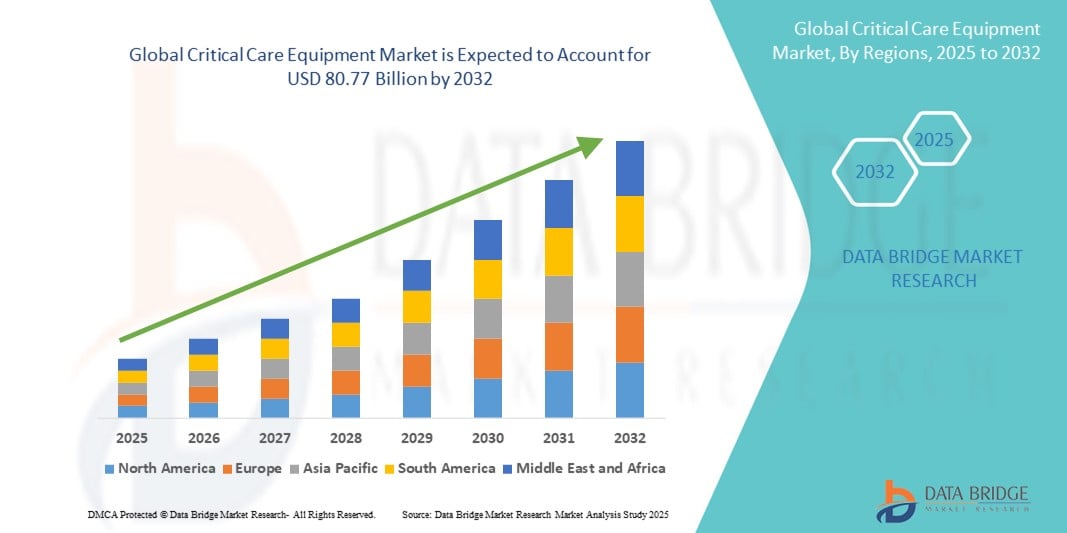
  • The global critical care equipment market size was valued at USD 41.44 billion in 2024 and is expected to reach USD 80.77 billion by 2032, at a CAGR of 8.7% during the forecast period
  • The market growth is largely driven by the rising incidence of chronic and life-threatening conditions, increasing demand for intensive care units (ICUs), and rapid advancements in life-support technologies across healthcare facilities worldwide
  • Furthermore, growing investments in healthcare infrastructure, rising focus on patient safety, and increasing adoption of advanced monitoring and ventilation systems are positioning critical care equipment as an indispensable component in modern hospitals. These converging factors are accelerating the demand for advanced ICU solutions, thereby significantly boosting the industry’s growth

Critical Care Equipment Market Analysis

  • Critical care equipment, including ventilators, patient monitoring devices, infusion pumps, and ICU systems, are increasingly vital in modern healthcare settings due to their role in sustaining life, managing emergencies, and enabling real-time monitoring for critically ill patients in both hospitals and specialty care units
  • The escalating demand for critical care equipment is primarily fueled by the rising burden of chronic diseases, increasing surgical procedures, and the growing need for advanced ICU infrastructure to manage respiratory and cardiovascular complications
  • North America dominated the critical care equipment market with the largest revenue share of 42% in 2024, supported by well-established healthcare facilities, high healthcare spending, and the strong presence of leading manufacturers, with the U.S. witnessing significant adoption of AI-enabled monitoring systems and next-generation ventilators
  • Asia-Pacific is expected to be the fastest-growing region in the critical care equipment market during the forecast period due to healthcare infrastructure expansion, rapid urbanization, and increasing investment in advanced hospital facilities
  • Patient Monitoring Devices segment dominated the critical care equipment market with a market share of 35.1% in 2024, driven by their essential role in continuous monitoring of vital signs, integration with digital health platforms, and growing adoption in ICUs worldwide

Report Scope and Critical Care Equipment Market Segmentation    

Attributes

Critical Care Equipment Key Market Insights

Segments Covered

  • By Product Type: Therapeutic Devices, Patient Monitoring Devices, Diagnostic Devices, ICU Units & System, and Other Devices
  • By Patient Population: Neonatal, Pediatric, Adults, and Geriatric
  • By End User: Hospitals, Specialty Clinics, Ambulatory Surgical Centers, and Others
  • By Distribution Channel: Direct Tenders, Retail Sales, Third Party Distribution, and Others

Countries Covered

North America

  • U.S.
  • Canada
  • Mexico

Europe

  • Germany
  • France
  • U.K.
  • Netherlands
  • Switzerland
  • Belgium
  • Russia
  • Italy
  • Spain
  • Turkey
  • Rest of Europe

Asia-Pacific

  • China
  • Japan
  • India
  • South Korea
  • Singapore
  • Malaysia
  • Australia
  • Thailand
  • Indonesia
  • Philippines
  • Rest of Asia-Pacific

Middle East and Africa

  • Saudi Arabia
  • U.A.E.
  • South Africa
  • Egypt
  • Israel
  • Rest of Middle East and Africa

South America

  • Brazil
  • Argentina
  • Rest of South America

Key Market Players

  • Medtronic (Ireland)
  • GE HealthCare (U.S.)
  • Koninklijke Philips N.V. (Netherlands)
  • Drägerwerk AG & Co. KGaA (Germany)
  • BD (U.S.)
  • Baxter International Inc. (U.S.)
  • Fresenius Medical Care AG & Co. KGaA (Germany)
  • Getinge AB (Sweden)
  • Hamilton Medical AG (Switzerland)
  • Nihon Kohden Corporation (Japan)
  • Mindray Bio-Medical Electronics Co., Ltd. (China)
  • ICU Medical, Inc. (U.S.)
  • Terumo Corporation (Japan)
  • Smiths Medical plc (U.K.)
  • Schiller AG (Switzerland)
  • ZOLL Medical Corporation (U.S.)
  • Skanray Technologies Ltd. (India)
  • Natus Medical Incorporated (U.S.)
  • Fisher & Paykel Healthcare Limited (New Zealand)
  • Eppendorf SE (Germany)

Market Opportunities

  • Integration of AI and IoT in Critical Care Devices
  • Expanding Critical Care Infrastructure in Emerging Markets

Value Added Data Infosets

In addition to the insights on market scenarios such as market value, growth rate, segmentation, geographical coverage, and major players, the market reports curated by the Data Bridge Market Research also include in-depth expert analysis, pricing analysis, brand share analysis, consumer survey, demography analysis, supply chain analysis, value chain analysis, raw material/consumables overview, vendor selection criteria, PESTLE Analysis, Porter Analysis, and regulatory framework.

Critical Care Equipment Market Trends

AI-Driven Monitoring and Remote ICU Integration

  • A significant and accelerating trend in the global critical care equipment market is the integration of artificial intelligence (AI), Internet of Things (IoT), and tele-ICU platforms to enhance patient monitoring, predictive analytics, and remote intensive care management. These technologies are transforming the way ICUs deliver care by enabling faster interventions and reducing clinician workload
    • For instance, Philips’ eICU program and GE Healthcare’s AI-enabled monitoring solutions allow clinicians to remotely monitor multiple ICU patients in real-time, offering predictive alerts for early detection of patient deterioration
  • AI algorithms in patient monitoring devices can analyze vital signs and historical data to forecast complications such as sepsis or cardiac arrest, providing caregivers with proactive decision support
  • IoT-enabled ventilators and infusion pumps are increasingly integrated with centralized hospital networks, enabling automated data transfer to electronic health records (EHRs) for better workflow efficiency
  • This convergence of AI, remote monitoring, and connected care is driving hospitals to adopt advanced ICU systems, particularly in regions facing a shortage of skilled critical care staff.
  • The demand for smart, data-driven, and remotely accessible critical care equipment is rising across developed and emerging markets, reshaping ICU operations and elevating standards of patient safety and care delivery

Critical Care Equipment Market Dynamics

Driver

Rising Burden of Chronic Diseases and ICU Demand

  • The increasing prevalence of chronic and life-threatening conditions, including cardiovascular diseases, respiratory disorders, and sepsis, is a major driver of critical care equipment demand. Rising hospitalization rates, aging populations, and higher surgical volumes are intensifying the need for advanced ICU systems
    • For instance, in March 2024, Medtronic launched an advanced ventilator system designed for both acute and long-term ICU care, reflecting the push to address surging global respiratory cases
  • Hospitals are increasingly prioritizing modern patient monitoring systems, infusion devices, and life-support equipment to enhance survival rates and reduce complications in critically ill patients
  • Growing awareness of early intervention and improved outcomes through continuous monitoring is further boosting adoption
  • In addition, government funding and private investment in expanding ICU capacity particularly highlighted during the COVID-19 pandemic have reinforced the need for long-term critical care infrastructure, sustaining equipment demand globally.

Restraint/Challenge

High Equipment Costs and Regulatory Barriers

  • One of the key restraints in the critical care equipment market is the high cost of advanced devices such as ventilators, hemodynamic monitors, and multi-parameter patient monitoring systems, which limits adoption in cost-sensitive markets
    • For instance, advanced ventilators with AI-enabled features can cost up to several tens of thousands of dollars, making them less accessible to smaller hospitals and rural healthcare centers in emerging economies
  • Stringent regulatory requirements for device approval and compliance with international quality standards also slow market entry and increase development costs for manufacturers
  • Concerns about interoperability across different devices and hospital IT systems pose additional challenges, as equipment from multiple vendors often struggles with seamless data integration
  • Furthermore, the shortage of trained ICU professionals to operate advanced equipment reduces the efficiency of deployment in many regions
  • Overcoming these barriers through affordable device innovations, public-private partnerships, and investments in training programs will be crucial for accelerating global adoption of critical care equipment

Critical Care Equipment Market Scope

The market is segmented on the basis of product type, patient population, end user, and distribution channel.

  • By Product Type

On the basis of product type, the critical care equipment market is segmented into therapeutic devices, patient monitoring devices, diagnostic devices, ICU units & systems, and other devices. Patient monitoring devices segment dominated the market with the largest revenue share of 35.1% in 2024, driven by their indispensable role in continuously tracking vital parameters such as heart rate, blood pressure, oxygen saturation, and respiratory rate. Their integration with hospital IT systems and EHR platforms provides clinicians with real-time data, enabling timely interventions and reducing mortality in ICU patients. The rising prevalence of chronic diseases and increasing ICU admissions have further amplified the demand for advanced multiparameter monitors across hospitals worldwide. Continuous innovations in AI-powered monitoring solutions and remote telemetry are reinforcing this segment’s market leadership.

The Therapeutic Devices segment is anticipated to witness the fastest growth rate of 7.9% CAGR from 2025 to 2032, primarily driven by the escalating need for ventilators, infusion pumps, and dialysis machines in ICUs. The COVID-19 pandemic highlighted the critical importance of therapeutic life-support devices in managing respiratory failures and multi-organ complications, leading to ongoing demand even in the post-pandemic era. The growing number of surgical procedures, rising geriatric population, and demand for technologically advanced ventilators with AI-driven automation are fueling this segment’s rapid expansion. Emerging economies investing in ICU modernization also present significant growth opportunities.

  • By Patient Population

On the basis of patient population, the critical care equipment market is segmented into neonatal, pediatric, adults, and geriatric. The Adults segment dominated the market with the largest share of 52.8% in 2024, owing to the higher prevalence of chronic illnesses such as cardiovascular diseases, respiratory disorders, and diabetes-related complications that often require intensive care. Adults also account for the majority of surgical interventions and trauma cases, further increasing ICU admissions. The combination of lifestyle-related disorders and increased demand for post-operative critical care has cemented adults as the largest consumer group for critical care equipment globally.

The Geriatric segment is expected to witness the fastest growth at a CAGR of 8.2% from 2025 to 2032, fueled by the rapidly aging global population and the associated rise in age-related complications requiring ICU support. Elderly patients often face multiple comorbidities, making them highly dependent on advanced monitoring, ventilators, and therapeutic devices. Improvements in life expectancy, coupled with greater healthcare spending on elderly care in developed and emerging nations, are accelerating demand in this segment. The surge in long-term ICU admissions among geriatric patients will sustain robust growth.

  • By End User

On the basis of end user, the critical care equipment market is segmented into hospitals, specialty clinics, ambulatory surgical centers, and others. Hospitals accounted for the largest share of 61.3% in 2024, as they remain the primary facilities for critical care admissions worldwide. Hospitals are typically equipped with advanced ICU infrastructure, multidisciplinary teams, and the largest demand for ventilators, monitoring devices, and infusion systems. The continuous rise in hospitalizations due to emergencies, accidents, and chronic disease management has established hospitals as the dominant end users. Government funding and private sector investments in hospital modernization further strengthen this segment’s leadership.

The Ambulatory Surgical Centers (ASCs) segment is expected to record the fastest CAGR of 7.5% from 2025 to 2032, supported by the increasing trend toward outpatient surgeries and day-care procedures. With the adoption of minimally invasive surgeries, ASCs are increasingly integrating compact and portable monitoring devices, along with post-surgical critical care equipment, to ensure patient safety. Their growing preference among patients due to cost efficiency, faster recovery, and convenience is accelerating equipment adoption in this setting.

  • By Distribution Channel

On the basis of distribution channel, the critical care equipment market is segmented into direct tenders, retail sales, third-party distribution, and others. Direct Tenders dominated the market with a share of 46.7% in 2024, owing to the bulk purchasing practices of hospitals and government healthcare systems that prefer long-term supplier contracts. Direct tenders provide healthcare providers with cost advantages, assured quality, and consistent supply of critical care devices. Large-scale procurement of ventilators, patient monitors, and infusion systems through centralized government tenders during the COVID-19 crisis further solidified this channel’s importance.

The Retail Sales segment is projected to grow at the fastest CAGR of 8.5% from 2025 to 2032, driven by increasing consumer preference for purchasing home-use critical care devices such as portable ventilators, oxygen concentrators, and monitoring devices. Rising awareness about home healthcare, combined with the growth of e-commerce platforms and medical device retail stores, is making advanced equipment more accessible to patients and caregivers. This trend aligns with the rising shift toward decentralized healthcare and home-based treatment options.

Critical Care Equipment Market Regional Analysis

  • North America dominated the critical care equipment market with the largest revenue share of 42% in 2024, supported by well-established healthcare facilities, high healthcare spending, and the strong presence of leading manufacturers
  • A favorable regulatory environment, strong presence of global medical device manufacturers, and growing investments in digital health integration further reinforce the region’s dominance
  • This strong adoption of advanced life-support systems, supported by government and private funding in critical care infrastructure, has firmly positioned North America as the leading market for critical care equipment worldwide

U.S. Critical Care Equipment Market Insight

The U.S. critical care equipment market captured the largest revenue share of 82% in 2024 within North America, driven by the high prevalence of chronic diseases, rising ICU admissions, and strong adoption of technologically advanced life-support systems. Demand is further propelled by hospitals’ emphasis on AI-enabled monitoring and next-generation ventilators that improve patient survival rates. The U.S. healthcare system’s focus on innovation, robust government funding, and a strong presence of global device manufacturers continue to strengthen its dominance. In addition, the surge in outpatient surgeries and aging population further supports long-term growth in advanced ICU equipment adoption.

Europe Critical Care Equipment Market Insight

The Europe critical care equipment market is projected to expand at a substantial CAGR throughout the forecast period, largely driven by strict regulatory standards for patient safety and rising ICU admissions. Growing healthcare spending, coupled with increasing demand for digital monitoring and infusion systems, is fueling adoption. European healthcare providers are particularly focused on upgrading ICU infrastructure with sustainable and eco-conscious solutions. Demand is growing across both public and private hospitals, with integration of AI-driven systems becoming more common in critical care. Renovation of older hospital facilities and rising chronic disease prevalence further strengthen the outlook.

U.K. Critical Care Equipment Market Insight

The U.K. critical care equipment market is anticipated to grow at a noteworthy CAGR during the forecast period, supported by increasing healthcare investments, the expansion of ICU capacity, and a focus on patient-centric digital solutions. Rising cases of cardiovascular and respiratory disorders are creating steady demand for ventilators and multiparameter monitors. The U.K.’s early adoption of AI-enabled monitoring systems and strong government initiatives to improve healthcare infrastructure are driving market growth. In addition, the NHS’ focus on enhancing critical care preparedness is stimulating consistent equipment procurement.

Germany Critical Care Equipment Market Insight

The Germany critical care equipment market is expected to expand at a considerable CAGR during the forecast period, fueled by the country’s emphasis on healthcare innovation, quality, and sustainability. German hospitals are early adopters of advanced patient monitoring systems, ventilators, and infusion technologies integrated with hospital IT platforms. The country’s strong engineering and medical device manufacturing ecosystem further boosts market penetration. Increasing ICU admissions from aging populations, alongside demand for eco-friendly, energy-efficient medical devices, is reinforcing long-term growth in the German market.

Asia-Pacific Critical Care Equipment Market Insight

The Asia-Pacific critical care equipment market is poised to grow at the fastest CAGR of 8.9% during 2025–2032, driven by rapid healthcare infrastructure expansion, increasing urbanization, and rising investments in ICU modernization across China, Japan, and India. Government-led initiatives to strengthen healthcare accessibility, combined with a growing burden of chronic and infectious diseases, are accelerating demand. APAC’s emergence as a cost-effective manufacturing hub for medical devices is improving affordability and accessibility, making advanced critical care equipment available to a broader patient base.

Japan Critical Care Equipment Market Insight

The Japan critical care equipment market is gaining momentum due to its aging population, high-tech healthcare ecosystem, and demand for advanced ICU solutions. The growing number of elderly patients with comorbidities is increasing the need for ventilators, dialysis machines, and monitoring systems. Japan’s focus on robotics, AI integration, and IoT-enabled hospital infrastructure strongly supports market expansion. Hospitals and specialty clinics are also investing heavily in remote ICU platforms, reflecting the country’s push for innovation in managing workforce shortages while improving patient outcomes.

India Critical Care Equipment Market Insight

The India critical care equipment market accounted for the largest market revenue share in Asia-Pacific in 2024, attributed to its rapidly expanding healthcare infrastructure, growing middle class, and government investments in smart hospitals and ICU modernization. Rising cases of trauma, respiratory illnesses, and chronic conditions are driving the adoption of ventilators and patient monitoring devices. The government’s focus on developing smart cities and healthcare digitalization, along with the growing presence of domestic device manufacturers, is boosting affordability and access. Increasing adoption of portable and cost-effective ICU devices for tier-2 and tier-3 cities is also propelling India’s growth in this sector.

Critical Care Equipment Market Share

The critical care equipment industry is primarily led by well-established companies, including:

  • Medtronic (Ireland)
  • GE HealthCare (U.S.)
  • Koninklijke Philips N.V. (Netherlands)
  • Drägerwerk AG & Co. KGaA (Germany)
  • BD (U.S.)
  • Baxter International Inc. (U.S.)
  • Fresenius Medical Care AG & Co. KGaA (Germany)
  • Getinge AB (Sweden)
  • Hamilton Medical AG (Switzerland)
  • Nihon Kohden Corporation (Japan)
  • Mindray Bio-Medical Electronics Co., Ltd. (China)
  • ICU Medical, Inc. (U.S.)
  • Terumo Corporation (Japan)
  • Smiths Medical plc (U.K.)
  • Schiller AG (Switzerland)
  • ZOLL Medical Corporation (U.S.)
  • Skanray Technologies Ltd. (India)
  • Natus Medical Incorporated (U.S.)
  • Fisher & Paykel Healthcare Limited (New Zealand)
  • Eppendorf SE (Germany)

What are the Recent Developments in Global Critical Care Equipment Market?

  • In August 2025, Starr Regional Medical Center launched 24/7 tele-ICU services at its Athens and Etowah campuses, leveraging a secure telehealth platform operated by Equum Medical in collaboration with Caregility. This service connects ICU and emergency department teams with board-certified intensivists remotely enabling around-the-clock specialist care without patient transfers, increasing ICU capacity, and modernizing critical care delivery
  • In June 2025, Madhubani District Hospital officially inaugurated its newly constructed Intensive Care Unit (ICU) in a noteworthy ceremony where a hospitalized patient, Mohini Devi, led the opening from her own hospital bed. The ICU is outfitted with modern medical equipment including ventilators, patient monitors, syringe pumps, defibrillators, air beds, and more
  • In February 2025, Etiometry, Inc. achieved its 10th FDA 510(k) clearance for the Etiometry Platform, a clinical decision-support software for ICUs, reinforcing its regulatory leadership and cybersecurity compliance
  • In November 2023, the use of tele-ICU services (virtual ICUs) notably expanded, enabling healthcare systems to allow clinicians to remotely see, monitor, and optimize care for ICU patients via audio, video, and data feeds. This development reflects growing adoption of remote critical care management practices to bolster quality and access
  • In June 2021, Etiometry raised US USD 9 million in Series A-3 funding, supporting leadership expansion, R&D acceleration, and broader adoption of its ICU clinical decision-support software


SKU-

世界初のマーケットインテリジェンスクラウドに関するレポートにオンラインでアクセスする

  • インタラクティブなデータ分析ダッシュボード
  • 成長の可能性が高い機会のための企業分析ダッシュボード
  • カスタマイズとクエリのためのリサーチアナリストアクセス
  • インタラクティブなダッシュボードによる競合分析
  • 最新ニュース、更新情報、トレンド分析
  • 包括的な競合追跡のためのベンチマーク分析のパワーを活用
デモのリクエスト

調査方法

データ収集と基準年分析は、大規模なサンプル サイズのデータ​​収集モジュールを使用して行われます。この段階では、さまざまなソースと戦略を通じて市場情報または関連データを取得します。過去に取得したすべてのデータを事前に調査および計画することも含まれます。また、さまざまな情報ソース間で見られる情報の不一致の調査も含まれます。市場データは、市場統計モデルと一貫性モデルを使用して分析および推定されます。また、市場シェア分析と主要トレンド分析は、市場レポートの主要な成功要因です。詳細については、アナリストへの電話をリクエストするか、お問い合わせをドロップダウンしてください。

DBMR 調査チームが使用する主要な調査方法は、データ マイニング、データ変数が市場に与える影響の分析、および一次 (業界の専門家) 検証を含むデータ三角測量です。データ モデルには、ベンダー ポジショニング グリッド、市場タイムライン分析、市場概要とガイド、企業ポジショニング グリッド、特許分析、価格分析、企業市場シェア分析、測定基準、グローバルと地域、ベンダー シェア分析が含まれます。調査方法について詳しくは、お問い合わせフォームから当社の業界専門家にご相談ください。

カスタマイズ可能

Data Bridge Market Research は、高度な形成的調査のリーダーです。当社は、既存および新規のお客様に、お客様の目標に合致し、それに適したデータと分析を提供することに誇りを持っています。レポートは、対象ブランドの価格動向分析、追加国の市場理解 (国のリストをお問い合わせください)、臨床試験結果データ、文献レビュー、リファービッシュ市場および製品ベース分析を含めるようにカスタマイズできます。対象競合他社の市場分析は、技術ベースの分析から市場ポートフォリオ戦略まで分析できます。必要な競合他社のデータを、必要な形式とデータ スタイルでいくつでも追加できます。当社のアナリスト チームは、粗い生の Excel ファイル ピボット テーブル (ファクト ブック) でデータを提供したり、レポートで利用可能なデータ セットからプレゼンテーションを作成するお手伝いをしたりすることもできます。


Frequently Asked Questions

市場は Segmentation, By Product Type (Therapeutic Devices, Patient Monitoring Devices, Diagnostic Devices, ICU Units & System, and Other Devices), Patient Population (Neonatal, Pediatric, Adults, and Geriatric), End User (Hospitals, Specialty Clinics, Ambulatory Surgical Centers, and Others), Distribution Channel (Direct Tenders, Retail Sales, Third Party Distribution, and Others) - Industry Trends and Forecast to 2032 に基づいて分類されます。
Global Critical Care Equipment Marketの規模は2024年にUSD 41.44 USD Billionと推定されました。
Global Critical Care Equipment Marketは2025年から2032年の予測期間にCAGR 8.7%で成長すると見込まれています。
市場で活動している主要プレーヤーはKoninklijke Philips N.V., General Electric CompanyCoOK MEDICAL LLC, Abbott, Medtronic, Getinge AB, heyer medical AG, Dr&auml,gerwerk AG &amp, Co. KGaA, ICU MedicalInc., NIHON KOHDEN CORPORATION, Fresenius Medical Care AG &amp, Co. KGaA, Skanray Technologies Ltd., Boston Scientific Corporation, STERIS, Advin Health Care, Baxter, SS TECHNOMED LTD., SCHILLER, Shenzhen Mindray Bio-Medical Electronics Co.Ltd., Nonin, Dixion distribution of medical devices GmbH, and Masimo and Compumedics Limited です。
この市場レポートはNorth Americaのデータを含みます。
Testimonial