


Global High-Flow Nasal Cannula Therapy Market Segmentation, By Component (Nasal Cannulas, Air/Oxygen Blenders, Active Humidifiers, Heated Inspiratory Circuits and Consumables), Medical Application (Acute Respiratory Failure (ARF), Chronic Obstructive Pulmonary Disease (COPD), Bronchiectasis, Carbon Monoxide Toxicity, Sleep Apnea, Acute Heart Failure and Others), End User (Hospitals, Specialty Clinics, Long-Term Care Centers, Ambulatory Care Centers and Homecare Settings), Age Group (Adult, Pediatric and Neonatal) - Industry Trends and Forecast to 2032
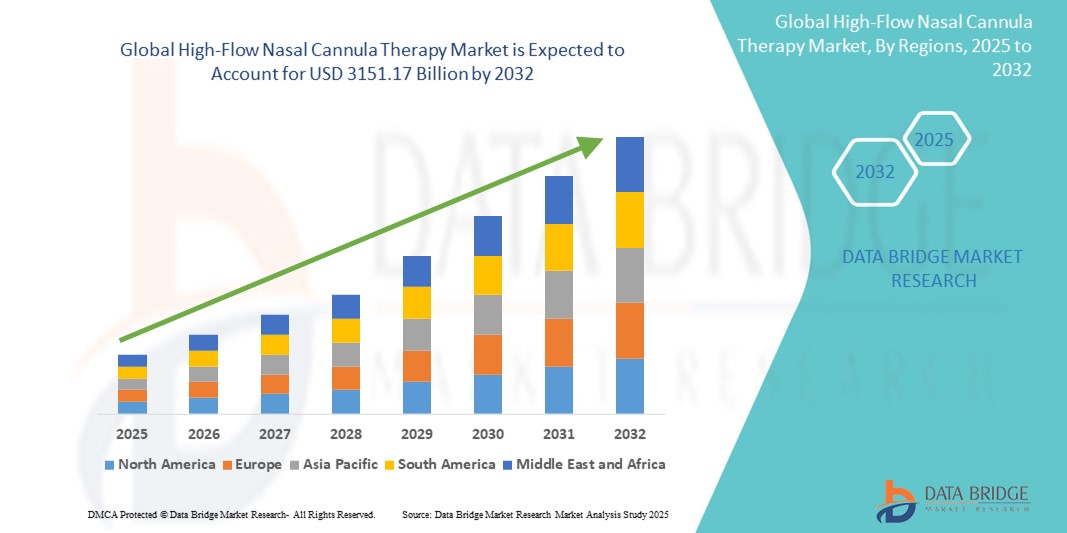
Global High-Flow Nasal Cannula Therapy Market Size
- The global high-flow nasal cannula therapy market size was valued at USD 1470.15 billion in 2024 and is expected to reach USD 3151.17 billion by 2032, at a CAGR of 10.00% during the forecast period
- The market growth is largely fueled by the increasing prevalence of respiratory diseases globally, including chronic obstructive pulmonary disease (COPD), acute respiratory failure, and asthma. This rise in respiratory illnesses, coupled with a growing aging population more susceptible to these conditions, significantly boosts the demand for effective respiratory support therapies
- Furthermore, continuous technological advancements in HFNC devices, such as the development of more comfortable nasal cannulas, integrated humidification systems, and portable designs, are enhancing patient compliance and therapeutic efficacy. The increasing adoption of non-invasive and user-friendly solutions in both clinical and homecare settings is establishing HFNC as a preferred modern respiratory support system. These converging factors are accelerating the uptake of global high-flow nasal cannula therapy solutions, thereby significantly boosting the industry's growth
Global High-Flow Nasal Cannula Therapy Market Analysis
- High-flow nasal cannula (HFNC) therapy involves delivering heated and humidified oxygen at high flow rates to patients with respiratory distress. It serves as a non-invasive respiratory support, offering enhanced patient comfort and clinical benefits compared to conventional oxygen therapy, making it a vital component in modern respiratory care across hospitals, specialty clinics, and increasingly, homecare settings
- 高流量鼻カニューラ療法の需要の高まりは、主にCOPD、喘息、急性呼吸不全などの呼吸器疾患の世界的な罹患率の上昇と、これらの疾患に罹患しやすい高齢化人口の増加によって促進されています。さらに、高流量鼻カニューラデバイスの継続的な技術進歩により、快適性、携帯性、有効性が向上し、非侵襲性換気補助として広く普及するようになりました。
- 北米は、確立された医療インフラ、一人当たりの医療費の高さ、高度な呼吸器治療の広範な認知、呼吸器疾患の有病率の高さを特徴とし、2024年には世界の高流量鼻カニューレ療法市場で40.11%の最大シェアを占める。
- アジア太平洋地域は、予測期間中、世界の高流量鼻カニューラ治療市場において最も急速な成長を遂げる地域となり、年平均成長率(CAGR)は11.7%と予測されています。この成長は、医療インフラの改善、医療費の増加、呼吸器疾患の患者数の増加と増加、先進的な治療法に対する意識の高まり、そして地域各国の経済発展に起因しています。
- 鼻カニューレセグメントは、世界の高流量鼻カニューレ療法市場を支配しており、市場シェアは35.7%です。この優位性は、酸素供給のための直接的な患者インターフェースとしての重要な役割、使いやすさ、患者の快適性、さまざまな臨床および在宅ケアの環境における消耗品の継続的な需要によって推進されています。
レポートの範囲と世界の高流量鼻カニューレ療法市場のセグメンテーション
|
属性 |
グローバル高流量鼻カニューレ療法の主要市場分析 |
|
対象セグメント |
|
|
対象国 |
北米
ヨーロッパ
アジア太平洋
中東およびアフリカ
南アメリカ
|
|
主要な市場プレーヤー |
|
|
Market Opportunities |
|
|
Value Added Data Infosets |
In addition to the insights on market scenarios such as market value, growth rate, segmentation, geographical coverage, and major players, the market reports curated by the Data Bridge Market Research also include in-depth expert analysis, pricing analysis, brand share analysis, consumer survey, demography analysis, supply chain analysis, value chain analysis, raw material/consumables overview, vendor selection criteria, PESTLE Analysis, Porter Analysis, and regulatory framework. |
Global High-Flow Nasal Cannula Therapy Market Trends
“Enhanced Personalization Through Integrated Monitoring”
- A significant and accelerating trend in the global high-flow nasal cannula therapy market is the deepening integration with advanced data analytics and sophisticated control systems. This fusion of technologies is significantly enhancing the personalization of therapy and optimizing clinical workflows, moving beyond static settings to adaptive, patient-centric care
- For instance, advanced HFNC systems are beginning to incorporate algorithms that can analyze real-time patient physiological data, such as respiratory rate, oxygen saturation, and inspiratory effort. This allows for dynamic adjustments to flow rate and oxygen concentration (FiO2) to precisely meet the patient's changing needs, thereby optimizing oxygen delivery and reducing the work of breathing
- Integrated monitoring in HFNC devices enables features such as learning individual patient respiratory patterns to anticipate changes in condition and potentially suggest proactive therapy adjustments. These smart systems can also provide more nuanced alerts based on subtle shifts in patient vitals, allowing clinicians to intervene more promptly. Furthermore, integrated sensors and advanced analytics offer clinicians a more streamlined approach to managing complex respiratory support, reducing manual adjustments and improving efficiency
- The seamless integration of HFNC devices with electronic health records (EHRs) and broader hospital information systems (HIS) facilitates centralized control and comprehensive data management. Through a single interface, healthcare providers can monitor multiple patients' HFNC parameters alongside other vital signs and medical history, creating a unified and automated care experience that supports informed decision-making
- This trend towards more intelligent, intuitive, and interconnected respiratory support systems is fundamentally reshaping clinical expectations for non-invasive ventilation. Consequently, leading companies in the respiratory care sector are developing advanced HFNC solutions with features such as adaptive flow delivery, predictive analytics for early detection of deterioration, and enhanced connectivity for remote monitoring
- The demand for HFNC systems that offer seamless integration and advanced monitoring capabilities is growing rapidly across both hospital and homecare settings, as healthcare providers and patients increasingly prioritize personalized patient care, improved clinical outcomes, and efficient resource utilization
Global High-Flow Nasal Cannula Therapy Market Dynamics
Driver
“Growing Need Due to Rising Prevalence of Respiratory Diseases and Advancements in Non-Invasive Care”
- The increasing prevalence of respiratory diseases globally, including chronic obstructive pulmonary disease (COPD), acute respiratory failure, and asthma, coupled with the accelerating adoption of non-invasive respiratory support technologies, is a significant driver for the heightened demand for high-flow nasal cannula therapy
- For instance, in March 2024, Vapotherm, Inc., a leading manufacturer in the HFNC market, announced the expansion of its clinical evidence portfolio with new data supporting the use of its Precision Flow Hi-VNI system in preventing escalation of respiratory distress in emergency department settings. Such continuous clinical validation and strategic focus on improving patient outcomes by key companies are expected to drive the global high-flow nasal cannula therapy industry growth in the forecast period
- As healthcare providers become more aware of the clinical benefits of HFNC therapy and seek enhanced solutions for managing respiratory distress, HFNC offers advanced features such as precise oxygen delivery, active humidification, and washout of nasopharyngeal dead space, providing a compelling alternative over traditional oxygen therapy or even non-invasive ventilation (NIV) in certain patient populations
- Furthermore, the growing focus on patient comfort and the desire for less invasive treatment modalities are making HFNC therapy an integral component of modern respiratory care protocols, offering seamless transition between different care settings and potentially reducing the need for mechanical ventilation
- The convenience for clinicians of easier patient management, reduced complexity compared to other ventilatory supports, and the ability to manage patients in various care settings are key factors propelling the adoption of HFNC therapy in both hospital and homecare sectors. The trend towards early intervention and the increasing availability of user-friendly HFNC devices further contribute to market growth
Restraint/Challenge
“Concerns Regarding Cybersecurity and High Initial Costs”
- Concerns surrounding the high initial cost of high-flow nasal cannula therapy systems pose a significant challenge to broader market penetration, particularly for healthcare facilities with budget constraints or in developing regions. As HFNC devices often incorporate advanced humidification and flow delivery technologies, their upfront investment can be substantial compared to conventional oxygen therapy
- For instance, the cost of acquiring and maintaining HFNC devices, along with associated consumables, can be a deterrent for smaller hospitals or clinics attempting to equip their facilities, impacting the overall accessibility of this advanced therapy
- Addressing these cost concerns through value-based purchasing agreements, bundle pricing strategies, and the development of more cost-effective HFNC models is crucial for building broader adoption. Companies are increasingly focused on demonstrating the long-term cost-effectiveness of HFNC by showcasing its potential to reduce intubation rates, shorten ICU stays, and decrease overall hospital expenditures. In addition, the relatively high initial cost of some advanced HFNC systems can be a barrier to adoption for price-sensitive healthcare systems, particularly in regions with limited reimbursement frameworks
- While the clinical benefits of HFNC are increasingly recognized, the perceived premium for this advanced technology can still hinder widespread adoption, especially in healthcare environments where the immediate return on investment for sophisticated equipment is scrutinized
Global High-Flow Nasal Cannula Therapy Market Scope
- By Component
On the basis of component, the global high-flow nasal cannula therapy market is segmented into nasal cannulas, air/oxygen blenders, active humidifiers, heated inspiratory circuits, and consumables. The nasal cannulas segment is anticipated to hold a major market share of 35.7%, driven by their essential role as the primary patient interface for oxygen delivery and their classification as a consumable, leading to continuous demand and replacement.
The Single Heated Tube segment is anticipated to witness the fastest growth rate from 2025 to 2032, with strong growth expected, as it is vital for ensuring heated and humidified oxygen delivery, enhancing patient comfort and therapeutic outcomes by preventing airway dryness.
- By Medical Application
On the basis of medical application, the global high-flow nasal cannula therapy market is segmented into acute respiratory failure (ARF), chronic obstructive pulmonary disease (COPD), bronchiectasis, carbon monoxide toxicity, sleep apnea, acute heart failure, and others. The acute respiratory failure (ARF) segment dominates the market with an estimated share of 42.0% in 2024, as HFNC is widely adopted as a first-line support method for ARF and post-extubation care due to its non-invasive nature and effectiveness.
The chronic obstructive pulmonary disease (COPD) segment is expected to witness the fastest growth rate, fueled by the rising global incidence of COPD and the increasing recognition of HFNC as an effective management tool to improve patient quality of life and reduce hospitalizations.
- By End User
On the basis of end user, the Global high-flow nasal cannula therapy market is segmented into hospitals, specialty clinics, long-term care centers, ambulatory care centers, and homecare settings. The hospitals segment accounted for a significant market share of 46.0% in 2024, driven by the high volume of critical and non-critical respiratory cases admitted, the availability of advanced equipment, and the established role of hospitals as primary care providers for acute respiratory conditions.
The ambulatory care centers segments are expected to witness the fastest growth from 2025 to 2032, propelled by the increasing preference for outpatient care, the growing demand for home healthcare services for chronic respiratory conditions, and the development of more portable HFNC devices.
- By Age Group
On the basis of age group, the global high-flow nasal cannula therapy market is segmented into adult, pediatric, and neonatal. The adult segment dominates the market with the largest revenue share in 2024, primarily due to the higher prevalence of chronic respiratory diseases (such as COPD and asthma) and acute respiratory conditions in the adult and geriatric populations, which are more susceptible to such illnesses.
The pediatric and neonatal segments are expected to witness the fastest growth, driven by increasing recognition of HFNC as an effective and gentle respiratory support for infants and children with conditions such as bronchiolitis, pneumonia, and respiratory distress syndrome, leading to increased adoption in pediatric hospitals and neonatal intensive care units (NICUs).
Global High-Flow Nasal Cannula Therapy Market Regional Analysis
- North America dominates the global high-flow nasal cannula therapy market, holding the largest revenue share of 40.11% in 2024. this dominance is primarily driven by the region's well-established and advanced healthcare infrastructure, high healthcare expenditure, and a significant prevalence of chronic and acute respiratory diseases
- Healthcare providers and patients in the region highly value the clinical efficacy, enhanced patient comfort, and the ability of HFNC to reduce the need for more invasive ventilatory support. The seamless integration of these devices with existing hospital IT systems and electronic health records further enhances their appeal
- This widespread adoption in North America is strongly supported by an aging population highly susceptible to respiratory illnesses, robust investments in medical research and development, and favorable reimbursement policies that facilitate the broader utilization of advanced respiratory therapies such as HFNC. These factors establish HFNC as a preferred solution for both acute and increasingly, post-acute and home care settings
U.S. High-Flow Nasal Cannula Therapy Market Insight
The U.S. high-flow nasal cannula therapy market captured the highest revenue share in 2024 within North America, reflecting its leading position in adopting advanced respiratory care. This dominance is fueled by a high prevalence of respiratory diseases, a well-established healthcare infrastructure, and substantial healthcare expenditure. Healthcare providers in the region prioritize the clinical effectiveness, patient comfort, and the ability of HFNC to improve patient outcomes, such as reducing intubation rates. This widespread adoption is further supported by the presence of key market players, robust research and development activities, and generally favorable reimbursement policies, establishing HFNC as a crucial solution in acute and post-acute care settings.
Europe High-Flow Nasal Cannula Therapy Market Insight
The Europe high-flow nasal cannula therapy market is projected to expand at a substantial CAGR throughout the forecast period. This growth is primarily driven by the increasing burden of respiratory diseases, an aging population, and the strong emphasis on non-invasive treatment modalities to improve patient comfort and reduce hospital stays.The region benefits from well-developed healthcare systems, increasing awareness among clinicians regarding the benefits of HFNC, and supportive clinical guidelines. European countries are also focused on technological advancements in medical devices and are increasingly incorporating HFNC into their standard respiratory care protocols for various conditions across hospitals and homecare.
U.K. High-Flow Nasal Cannula Therapy Market Insight
The U.K. high-flow nasal cannula therapy market is anticipated to grow at a noteworthy CAGR during the forecast period. This growth is driven by the escalating prevalence of chronic respiratory conditions such as COPD and asthma, coupled with the National Health Service (NHS)'s focus on efficient and patient-friendly respiratory support. In addition, the U.K.'s emphasis on evidence-based medicine and the increasing adoption of non-invasive therapies are encouraging healthcare providers to integrate HFNC into their treatment pathways. The country's strong commitment to healthcare innovation and its developed healthcare infrastructure are expected to continue to stimulate market expansion.
Germany High-Flow Nasal Cannula Therapy Market Insight
ドイツの高流量鼻カニューラ療法市場は、予測期間中に大幅な年平均成長率(CAGR)で拡大すると予想されています。この成長は、先進的な呼吸器療法への認知度の高まり、強力で十分な資金を備えた医療システム、そして高度な技術を備えた医療ソリューションへの需要によって推進されています。ドイツは、整備されたインフラに加え、医療機器における精密工学と品質へのこだわりが相まって、特に先進的な病院や専門医療の現場において、高流量鼻カニューラ療法(HFNC)の導入を促進しています。HFNCをより広範な患者管理システムと統合し、高品質で患者中心のケアを強く求める傾向は、地域の医療ニーズと一致しています。
アジア太平洋地域の高流量鼻カニューレ療法市場に関する洞察
アジア太平洋地域の高流量鼻カニューレ療法市場は、2025年から2032年にかけて11.6%という最も高い年平均成長率(CAGR)で成長すると見込まれています。この成長加速は、中国、日本、インドなどの国々における都市化の進展、医療インフラの急速な発展、そして呼吸器疾患の患者数の急増によって推進されています。先進医療技術へのアクセスを促進する政府の取り組みに支えられた、この地域の医療費の増加が、HFNCの普及を牽引しています。さらに、アジア太平洋地域が医療用部品およびシステムの重要な製造拠点として台頭するにつれ、HFNCデバイスの価格とアクセス性の向上により、多様な経済階層にわたるより幅広い患者層への普及が進んでいます。
日本における高流量鼻カニューレ療法市場に関する洞察
日本の高流量鼻カニューラ療法市場は、急速な人口高齢化に伴う呼吸器疾患の有病率の上昇と、患者に優しい先進的な医療技術への強い需要により、成長を加速させています。日本市場は、質の高い医療と継続的なイノベーションを重視しています。高流量鼻カニューラ(HFNC)の普及は、病院の呼吸ケアユニットにおけるこれらの機器の導入増加と、患者の快適性と転帰の改善への注力によって推進されています。さらに、日本の充実した医療制度と最新の医療技術の導入への取り組みは、特に効果的で非侵襲的な呼吸サポートを提供するソリューションの成長を牽引しています。
中国における高流量鼻カニューレ療法市場の洞察
中国の高流量鼻カニューラ療法市場は、アジア太平洋地域において最大の市場収益シェアを占めています。これは、同国の膨大な患者人口、医療インフラの急速な発展、そして医療機器における高い技術導入率に起因しています。中国は医療機器市場において世界最大かつ最も急速に成長している市場の一つであり、拡大する病院ネットワークに加え、初期段階ながら成長著しい在宅ケア分野でも、高流量鼻カニューラ療法(HFNC)の人気が高まっています。医療サービスの近代化への取り組み、ますます手頃な価格のHFNCオプションの提供、そして強力な国内メーカーの存在が、中国市場の成長を牽引する主要な要因となっています。
世界の高流量鼻カニューレ療法市場シェア
世界の高流量鼻カニューレ療法業界は、主に次のような定評ある企業によって牽引されています。
- フィッシャー&パイケル・ヘルスケア・リミテッド (ニュージーランド)
- ヴェイポサーム (米国)
- テレフレックス・インコーポレーテッド(米国)
- ハミルトンメディカル (スイス)
- ICUメディカル社(米国)
- フレキシケア(グループ)リミテッド(英国)
- マシモ(米国)
- 帝人株式会社(日本)
- Drägerwerk AG & Co. KGaA (ドイツ)
- インターサージカル社(英国)
- テレフレックス・インコーポレーテッド(米国)
- マーキュリーメディカル(米国)
- モヴェア(米国)
世界の高流量鼻カニューレ療法市場の最新動向
- 2025年3月、大手医療テクノロジー企業であるレスメドは、世界中のより多くの人々と医療提供者にサービスを提供するために、ブランドポートフォリオを統合することを目指した包括的なブランド変革を発表しました。この取り組みは、高流量鼻カニューラソリューションを含む呼吸療法におけるイノベーションの提供、そして睡眠と呼吸の健康を主流の優先事項として認識させるというレスメドのコミットメントを強調するものです。
- 2025年2月、Hospital Pediatrics誌に掲載された研究では、細気管支炎、肺炎、喘息のある小児におけるHFNCの使用を改善し、HFNCの治療期間と入院期間の短縮を目指す取り組みが強調されました。この取り組みは、HFNC療法を最適化し、多様な小児呼吸器疾患におけるその価値を確保するための継続的な臨床的取り組みを反映しています。
- 2025年2月、ERS Publications誌に掲載された研究では、健康なボランティアを対象とした持続的な高強度運動中の高流量鼻カニューラの生理学的効果について調査されました。この研究では、HFNC介入によって呼吸努力と呼吸困難が軽減され、時間的な換気分布が改善されることが結論付けられ、急性呼吸不全以外にもHFNCが幅広く応用できる可能性が示されました。
- In April 2025, Vapotherm, Inc. introduced the Unicorn Cannula, an innovative single-prong cannula designed to enhance CO2 clearance and patient comfort. This product highlights Vapotherm's commitment to developing cutting-edge patient interfaces that optimize HFNC delivery and improve clinical outcomes
- In October 2023, the FDA granted 510(k) clearance to the Bonhawa high-flow oxygen therapy system. Designed to enhance the treatment of patients with respiratory insufficiency, this approval signifies continued innovation and expansion of available HFNC devices in key markets
SKU-
世界初のマーケットインテリジェンスクラウドに関するレポートにオンラインでアクセスする

- インタラクティブなデータ分析ダッシュボード
- 成長の可能性が高い機会のための企業分析ダッシュボード
- カスタマイズとクエリのためのリサーチアナリストアクセス
- インタラクティブなダッシュボードによる競合分析
- 最新ニュース、更新情報、トレンド分析
- 包括的な競合追跡のためのベンチマーク分析のパワーを活用
調査方法
データ収集と基準年分析は、大規模なサンプル サイズのデータ収集モジュールを使用して行われます。この段階では、さまざまなソースと戦略を通じて市場情報または関連データを取得します。過去に取得したすべてのデータを事前に調査および計画することも含まれます。また、さまざまな情報ソース間で見られる情報の不一致の調査も含まれます。市場データは、市場統計モデルと一貫性モデルを使用して分析および推定されます。また、市場シェア分析と主要トレンド分析は、市場レポートの主要な成功要因です。詳細については、アナリストへの電話をリクエストするか、お問い合わせをドロップダウンしてください。
DBMR 調査チームが使用する主要な調査方法は、データ マイニング、データ変数が市場に与える影響の分析、および一次 (業界の専門家) 検証を含むデータ三角測量です。データ モデルには、ベンダー ポジショニング グリッド、市場タイムライン分析、市場概要とガイド、企業ポジショニング グリッド、特許分析、価格分析、企業市場シェア分析、測定基準、グローバルと地域、ベンダー シェア分析が含まれます。調査方法について詳しくは、お問い合わせフォームから当社の業界専門家にご相談ください。
カスタマイズ可能
Data Bridge Market Research は、高度な形成的調査のリーダーです。当社は、既存および新規のお客様に、お客様の目標に合致し、それに適したデータと分析を提供することに誇りを持っています。レポートは、対象ブランドの価格動向分析、追加国の市場理解 (国のリストをお問い合わせください)、臨床試験結果データ、文献レビュー、リファービッシュ市場および製品ベース分析を含めるようにカスタマイズできます。対象競合他社の市場分析は、技術ベースの分析から市場ポートフォリオ戦略まで分析できます。必要な競合他社のデータを、必要な形式とデータ スタイルでいくつでも追加できます。当社のアナリスト チームは、粗い生の Excel ファイル ピボット テーブル (ファクト ブック) でデータを提供したり、レポートで利用可能なデータ セットからプレゼンテーションを作成するお手伝いをしたりすることもできます。











