



Middle East and Africa Inorganic Scintillators Market Segmentation, By Scintillation Material (Sodium Iodide (NAI), Cesium Iodide (CSI), Lutetium Oxyorthosilicate (LSO) and Lutetium–Yttrium Oxyorthosilicate (LYSO), Bismuth Germanate (BGO), Barium Fluoride, Lead Tungstate (PBWO4), Cadmium Tungstate (CDWO4), Cerium Bromide (CEBR3), Lanthanum Bromide (LABR3), Gadolinium Orthosilicate (GSO), Yttrium Aluminum Garnet YAG (CE), Gadolinium Oxysulfide (GOS) and Other Scintillation Materials.), Type (Alkali Halides, Oxide Compounds, and Rare Earth Metals), Application (Medical Imaging, Nuclear Medicine, Radioprotection, Oil Exploration, Process Industry, Life Sciences, and Others), End User (Healthcare, Homeland Security and Defense, Nuclear Power Plants, Industrial Applications and Others)- Industry Trends and Forecast to 2033
Middle East and Africa Inorganic Scintillators Market Size
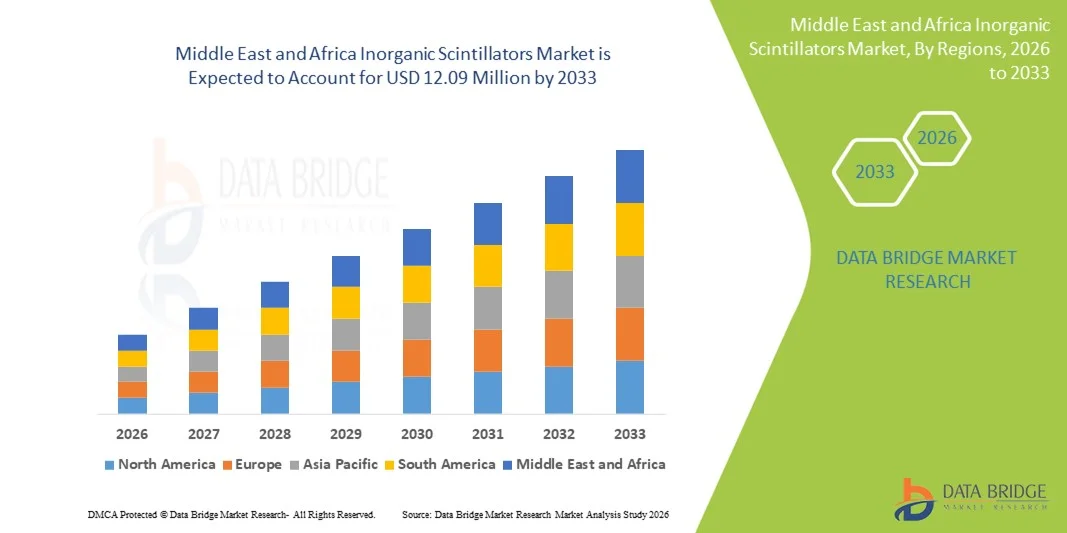
- The Middle East and Africa inorganic scintillators market size was valued at USD 9.33 million in 2025 and is expected to reach USD 12.09 million by 2033, at a CAGR of 3.3% during the forecast period
- The market growth is largely fueled by increasing adoption of advanced radiation detection and imaging technologies across healthcare security, and industrial applications, coupled with expanding investments in nuclear safety, defense infrastructure, and research facilities
- Furthermore, rising demand for precise diagnostic systems, enhanced radiation monitoring solutions, and government-led initiatives to strengthen security and healthcare infrastructure is creating strong pull for inorganic scintillators throughout the region. These converging factors are accelerating the uptake of inorganic scintillator solutions, thereby significantly boosting the industry’s growth
Middle East and Africa Inorganic Scintillators Market Analysis
- Inorganic scintillators, used for detecting and measuring ionizing radiation, are increasingly vital components in healthcare, security, and industrial applications across the Middle East and Africa due to their high detection efficiency, precision, and compatibility with advanced imaging and monitoring systems
- The escalating demand for inorganic scintillators is primarily fueled by growing investments in healthcare diagnostics, nuclear safety, defense infrastructure, and industrial radiation monitoring, along with increasing government initiatives to enhance security and research capabilities
- Saudi Arabia dominated the Middle East and Africa inorganic scintillators market with the largest revenue share of 28.5% in 2025, characterized by substantial government funding, adoption of advanced medical imaging systems, and the presence of regional distributors and key industry players supporting localized production and deployment of scintillator-based solutions
- UAE is expected to be the fastest growing country in the market during the forecast period due to rising investments in healthcare, energy, and security infrastructure, along with increasing adoption of radiation monitoring systems
- Cesium iodide (CsI) segment dominated the inorganic scintillators market with a market share of 38.7% in 2025, driven by its high light yield, reliability in medical imaging, and compatibility with various radiation detection systems
Report Scope and Middle East and Africa Inorganic Scintillators Market Segmentation
|
Attributes |
Middle East and Africa Inorganic Scintillators Key Market Insights |
|
Segments Covered |
|
|
Countries Covered |
Middle East and Africa
|
|
Key Market Players |
|
|
Market Opportunities |
|
|
Value Added Data Infosets |
In addition to the insights on market scenarios such as market value, growth rate, segmentation, geographical coverage, and major players, the market reports curated by the Data Bridge Market Research also include in-depth expert analysis, patient epidemiology, pipeline analysis, pricing analysis, and regulatory framework |
Middle East and Africa Inorganic Scintillators Market Trends
Integration with Advanced Medical Imaging and Security Systems
- A significant and accelerating trend in the Middle East and Africa inorganic scintillators market is the increasing integration with advanced medical imaging systems and industrial radiation monitoring platforms, enhancing detection accuracy and operational efficiency
- For instance, the Saudi Arabian King Faisal Specialist Hospital deployed high-performance cesium iodide (CsI) scintillators in PET-CT scanners, improving diagnostic precision and reducing scan times
- Integration with automated radiation monitoring systems enables features such as real-time dose tracking, predictive maintenance alerts, and enhanced imaging resolution for nuclear facilities, offering more intelligent and reliable performance
- The seamless compatibility of inorganic scintillators with digital imaging platforms and industrial safety systems facilitates centralized monitoring, allowing hospitals and nuclear plants to manage multiple sensors and devices through a unified interface
- This trend toward more precise, automated, and interconnected scintillator systems is reshaping operational standards in healthcare and security, with companies such as Saint-Gobain Crystals developing solutions optimized for AI-assisted imaging and radiation monitoring applications
- The demand for scintillators that integrate with advanced imaging and monitoring solutions is growing rapidly across hospitals, research centers, and nuclear facilities, as organizations increasingly prioritize accuracy and system interoperability
- In addition, partnerships between nuclear facilities and international suppliers are enabling the deployment of next-generation scintillator arrays, improving radiation safety and operational efficiency
Middle East and Africa Inorganic Scintillators Market Dynamics
Driver
Rising Adoption in Healthcare Diagnostics and Nuclear Applications
- The increasing prevalence of advanced medical diagnostics and expansion of nuclear energy and security infrastructure is a significant driver for the growing demand for inorganic scintillators
- For instance, in March 2025, UAE’s Barakah Nuclear Power Plant integrated cesium iodide and gadolinium-based scintillators in radiation detection units to enhance monitoring efficiency and safety compliance
- As hospitals, laboratories, and nuclear facilities seek higher precision in imaging and radiation detection, inorganic scintillators offer superior sensitivity, faster response times, and better energy resolution than traditional detectors
- Furthermore, government initiatives to upgrade healthcare infrastructure and strengthen security monitoring are making inorganic scintillators an essential component in national diagnostic and radiation safety programs
- The ability to detect and quantify radiation accurately, combined with compatibility with automated monitoring and reporting systems, is key to driving adoption in both medical and industrial applications
- For instance, increased deployment of portable scintillator devices in border security and customs operations in Saudi Arabia and UAE is driving market growth
- Rising collaborations between regional research institutions and global scintillator manufacturers are accelerating R&D for high-performance materials tailored to Middle East and Africa conditions
Restraint/Challenge
High Material Costs and Technical Expertise Requirements
- The relatively high production cost of inorganic scintillators and the need for specialized technical expertise in handling and installation pose significant challenges to broader market penetration
- For instance, high-purity cesium iodide crystals used in advanced PET-CT scanners and security detectors require precise manufacturing and quality control, limiting accessibility for smaller hospitals or facilities in developing regions
- Addressing these challenges through local manufacturing, technology transfer, and training programs is crucial for increasing adoption across the region. Companies such as Saint-Gobain Crystals and Hamamatsu emphasize supply chain support and technical assistance to facilitate market growth
- In addition, limited availability of skilled technicians to calibrate, maintain, and operate complex scintillator-based systems can hinder deployment in some countries
- While prices and technical barriers are gradually improving with regional partnerships and innovations, the initial investment and expertise requirements remain key constraints, particularly for smaller healthcare providers and industrial facilities
- For instance, high installation costs for multi-detector PET and SPECT systems in Egypt and South Africa restrict adoption in private hospitals and research labs
- Complex regulatory approvals and import licensing requirements for high-purity scintillator materials in certain Middle Eastern and African countries can delay market entry and affect supply chain reliability
Middle East and Africa Inorganic Scintillators Market Scope
The market is segmented on the basis of material, type, application, and end user.
- By Scintillation Material
On the basis of scintillation material, the market is segmented into Sodium Iodide (NaI), Cesium Iodide (CsI), Lutetium Oxyorthosilicate (LSO) and Lutetium–Yttrium Oxyorthosilicate (LYSO), Bismuth Germanate (BGO), Barium Fluoride, Lead Tungstate (PbWO4), Cadmium Tungstate (CdWO4), Cerium Bromide (CeBr3), Lanthanum Bromide (LaBr3), Gadolinium Orthosilicate (GSO), Yttrium Aluminum Garnet YAG (Ce), Gadolinium Oxysulfide (GOS), and Other Scintillation Materials. The Cesium Iodide (CsI) segment dominated the market with the largest revenue share of 38.7% in 2025, driven by its high light yield, excellent detection efficiency, and wide use in medical imaging systems such as PET and SPECT scanners. Hospitals in Saudi Arabia and UAE prefer CsI due to its cost-effectiveness compared with other high-performance materials and its compatibility with digital imaging systems. The material’s versatility in radiation detection across healthcare, nuclear facilities, and industrial safety applications further strengthens its dominance. Strong regional supply chains and established manufacturer presence also contribute to market leadership.
The Cerium Bromide (CeBr3) segment is anticipated to witness the fastest growth from 2026 to 2033, fueled by increasing adoption in advanced nuclear detection and homeland security applications. CeBr3 offers superior energy resolution, fast decay time, and lower intrinsic radioactivity, making it highly suitable for precise radiation monitoring. Its growing usage in border security, portable radiation detectors, and research facilities in the Middle East and Africa is expanding rapidly. In addition, collaborations between regional nuclear authorities and global suppliers are accelerating the deployment of CeBr3-based detectors, further driving its adoption.
- By Type
On the basis of type, the market is segmented into alkali halides, oxide compounds, and rare earth metals. The Alkali Halides segment dominated the market with the largest revenue share in 2025 due to its cost-effectiveness, high scintillation efficiency, and long-standing adoption in medical imaging and nuclear monitoring. Sodium Iodide (NaI) and Cesium Iodide (CsI) crystals, key components of this segment, are widely used in hospitals, nuclear power plants, and industrial radiation monitoring applications. Their adaptability to various detector configurations and compatibility with existing imaging equipment contributes to sustained demand.
The Rare Earth Metals segment is expected to witness the fastest growth from 2026 to 2033, driven by increasing investments in advanced PET imaging systems, homeland security, and high-performance industrial radiation detectors. Materials such as LSO, LYSO, and GSO offer high light yield, excellent timing resolution, and enhanced radiation tolerance, making them ideal for precision applications. Rapid adoption in research facilities, nuclear energy projects, and medical centers in UAE and South Africa is supporting growth.
- By Application
On the basis of application, the market is segmented into medical imaging, nuclear medicine, radioprotection, oil exploration, process industry, life sciences, and others. The Medical Imaging segment dominated the market in 2025, attributed to the widespread deployment of PET, SPECT, and CT imaging systems in hospitals and diagnostic centers across Saudi Arabia, UAE, and South Africa. Inorganic scintillators are critical for high-resolution imaging, enabling accurate diagnosis and early disease detection. The growing focus on advanced diagnostic services, coupled with government healthcare investments, supports the continued dominance of this application.
The Radioprotection segment is anticipated to witness the fastest growth from 2026 to 2033, driven by expanding nuclear energy projects and stricter workplace radiation safety regulations in the Middle East and Africa. Facilities in UAE, Saudi Arabia, and Egypt are increasingly adopting scintillator-based systems for environmental monitoring and occupational safety. The rising use of portable radiation detectors for mining, border security, and industrial applications further propels growth in this segment.
- By End User
On the basis of end user, the market is segmented into healthcare, homeland security and defense, nuclear power plants, industrial applications, and others. The Healthcare segment dominated the market with the largest revenue share in 2025, fueled by the rapid expansion of hospitals and diagnostic imaging centers in Saudi Arabia, UAE, and South Africa. Hospitals and clinics increasingly deploy PET, SPECT, and CT scanners with inorganic scintillators for precise disease diagnosis and treatment planning. Strong government healthcare initiatives and rising investments in advanced imaging technologies further support the dominance of this end-user segment.
The Homeland Security and Defense segment is expected to witness the fastest growth from 2026 to 2033, driven by increasing adoption of portable radiation detectors, border security monitoring systems, and nuclear threat detection units in UAE, Saudi Arabia, and Egypt. Rising security concerns, coupled with collaborations with global scintillator manufacturers, are accelerating the deployment of high-performance inorganic scintillator-based solutions. The integration of advanced materials such as CeBr3 and LYSO in defense and security applications further fuels segment growth.
Middle East and Africa Inorganic Scintillators Market Regional Analysis
- Saudi Arabia dominated the Middle East and Africa inorganic scintillators market with the largest revenue share of 28.5% in 2025, characterized by substantial government funding, adoption of advanced medical imaging systems, and the presence of regional distributors and key industry players supporting localized production and deployment of scintillator-based solutions
- Hospitals, diagnostic centers, and nuclear facilities in the region highly value the precision, reliability, and high detection efficiency offered by inorganic scintillators, which are critical for accurate medical imaging, nuclear safety, and industrial applications
- This widespread adoption is further supported by government initiatives to strengthen healthcare and security infrastructure, collaborations with global scintillator manufacturers, and increasing deployment of PET, SPECT, and CT imaging systems, establishing inorganic scintillators as the preferred choice across both healthcare and industrial sectors
The Saudi Arabia Inorganic Scintillators Market Insight
The Saudi Arabia inorganic scintillators market captured the largest revenue share of 28.5% in 2025, fueled by substantial investments in advanced medical imaging, nuclear energy, and industrial radiation monitoring. Hospitals, diagnostic centers, and nuclear facilities are increasingly prioritizing high-performance scintillators for PET, SPECT, and CT imaging systems. The growing focus on healthcare infrastructure development, coupled with government initiatives to strengthen radiation safety and security, is significantly propelling market growth. Moreover, collaborations with global scintillator manufacturers are enabling access to cutting-edge materials such as CsI and LYSO, further expanding adoption across healthcare and industrial applications.
UAE Inorganic Scintillators Market Insight
The UAE inorganic scintillators market is expected to grow at a substantial CAGR during the forecast period, driven by rising investments in medical diagnostics, nuclear safety, and homeland security. The country is witnessing rapid deployment of advanced PET and SPECT imaging systems in hospitals and research centers, creating strong demand for high-resolution scintillators. Government-led nuclear projects and stringent radiation safety regulations are further boosting adoption. In addition, UAE-based institutions are increasingly integrating scintillator-based radiation detectors into border security and industrial monitoring systems, ensuring comprehensive utilization across sectors.
South Africa Inorganic Scintillators Market Insight
The South Africa inorganic scintillators market is anticipated to expand at a noteworthy CAGR during the forecast period, fueled by growing adoption in healthcare, mining, and industrial radiation monitoring applications. Hospitals and imaging centers are deploying high-performance CsI and CeBr3 scintillators to improve diagnostic accuracy, while mining and industrial sectors increasingly rely on scintillator-based radiation detectors for safety compliance. Furthermore, partnerships between local distributors and global manufacturers are facilitating technology transfer, training, and supply chain efficiency, driving market expansion across the country.
Egypt Inorganic Scintillators Market Insight
The Egypt inorganic scintillators market is expected to grow at a considerable CAGR during the forecast period, supported by increasing investments in medical infrastructure and industrial radiation monitoring. Hospitals and diagnostic centers are expanding their imaging capabilities with high-sensitivity scintillators, while nuclear research facilities and industrial plants adopt these materials for precise radiation detection. Government initiatives to improve healthcare services, along with collaborations with international suppliers, are further encouraging adoption. The focus on cost-effective yet high-performance scintillators is helping Egypt emerge as a growing market within the region.
Middle East and Africa Inorganic Scintillators Market Share
The Middle East and Africa Inorganic Scintillators industry is primarily led by well-established companies, including:
- Hamamatsu Photonics K.K. (Japan)
- Hitachi High Tech Corporation (Japan)
- Mirion Technologies, Inc. (U.S.)
- Dynasil Corporation (U.S.)
- Scintacor (U.K.)
- Epic Crystal Co.,Ltd (China)
- Alpha Spectra, Inc. (U.S.)
- Radiation Monitoring Devices, Inc. (U.S.)
- Kromek Group plc (U.K.)
- Toshiba Materials Co., Ltd. (Japan)
- Scionix Holland B.V. (Netherlands)
- Hitachi Metals, Ltd. (Japan)
- Saint Gobain S.A. (France)
- Crytur a.s. (Czech Republic)
- Detec Electronic (Germany)
- Rexon Components, Inc. (U.S.)
- Eljen Technology (U.S.)
- Photonic Materials Ltd. (U.K.)
- Hilger Crystals Ltd. (U.K.)
What are the Recent Developments in Middle East and Africa Inorganic Scintillators Market?
- In October 2025, Siemens Healthineers showcased its expanded diagnostic imaging portfolio, including advanced PET/CT systems and related technologies, at the Global Health Exhibition in Riyadh a major regional event highlighting medical imaging technologies often dependent on inorganic scintillators for gamma‑ray detection
- In June 2025, the Saudi Nuclear and Radiological Regulatory Commission announced that “no radioactive effects were detected” in Saudi Arabia and the Gulf following regional tensions underscoring the active role of radiological monitoring in national safety screening and environmental surveillance
- In June 2025, Nairobi West Hospital in Kenya announced it had started local production of radioactive isotopes after acquiring a cyclotron machine, enabling locally generated tracers for PET/CT scans and significantly reducing delays in advanced nuclear medicine imaging services a key boost for radiation detection and diagnostic capabilities in the region
- In February 2025, the International Atomic Energy Agency (IAEA) and the Jordanian Government inaugurated a new advanced PET‑CT scanner at Al‑Bashir Hospital in Amman, significantly expanding access to nuclear medicine diagnostic services and improving early cancer detection in public healthcare increasing deployment of scintillator‑dependent imaging technology
- In May 2024, industry analysis highlighted rapid growth in nuclear medicine and radioisotope demand in Saudi Arabia and the Middle East, signaling increased adoption of imaging modalities (PET/SPECT) that rely on inorganic scintillators for radiation detection
SKU-
世界初のマーケットインテリジェンスクラウドに関するレポートにオンラインでアクセスする

- インタラクティブなデータ分析ダッシュボード
- 成長の可能性が高い機会のための企業分析ダッシュボード
- カスタマイズとクエリのためのリサーチアナリストアクセス
- インタラクティブなダッシュボードによる競合分析
- 最新ニュース、更新情報、トレンド分析
- 包括的な競合追跡のためのベンチマーク分析のパワーを活用
調査方法
データ収集と基準年分析は、大規模なサンプル サイズのデータ収集モジュールを使用して行われます。この段階では、さまざまなソースと戦略を通じて市場情報または関連データを取得します。過去に取得したすべてのデータを事前に調査および計画することも含まれます。また、さまざまな情報ソース間で見られる情報の不一致の調査も含まれます。市場データは、市場統計モデルと一貫性モデルを使用して分析および推定されます。また、市場シェア分析と主要トレンド分析は、市場レポートの主要な成功要因です。詳細については、アナリストへの電話をリクエストするか、お問い合わせをドロップダウンしてください。
DBMR 調査チームが使用する主要な調査方法は、データ マイニング、データ変数が市場に与える影響の分析、および一次 (業界の専門家) 検証を含むデータ三角測量です。データ モデルには、ベンダー ポジショニング グリッド、市場タイムライン分析、市場概要とガイド、企業ポジショニング グリッド、特許分析、価格分析、企業市場シェア分析、測定基準、グローバルと地域、ベンダー シェア分析が含まれます。調査方法について詳しくは、お問い合わせフォームから当社の業界専門家にご相談ください。
カスタマイズ可能
Data Bridge Market Research は、高度な形成的調査のリーダーです。当社は、既存および新規のお客様に、お客様の目標に合致し、それに適したデータと分析を提供することに誇りを持っています。レポートは、対象ブランドの価格動向分析、追加国の市場理解 (国のリストをお問い合わせください)、臨床試験結果データ、文献レビュー、リファービッシュ市場および製品ベース分析を含めるようにカスタマイズできます。対象競合他社の市場分析は、技術ベースの分析から市場ポートフォリオ戦略まで分析できます。必要な競合他社のデータを、必要な形式とデータ スタイルでいくつでも追加できます。当社のアナリスト チームは、粗い生の Excel ファイル ピボット テーブル (ファクト ブック) でデータを提供したり、レポートで利用可能なデータ セットからプレゼンテーションを作成するお手伝いをしたりすることもできます。











