



North America Hearing Aid Market Segmentation, Type (Behind the Ear (BTE), Receiver in the Ear (RITE), In the Ear (ITE), Canal Hearing Aids (CHA), Canal Hearing Aids, Cochlear Implants and Bone Anchored Systems), Product (Hearing Aids Devices and Hearing Implants), Hearing Loss (Sensorineural Hearing Loss and Conductive Hearing Loss), Technology (Conventional Hearing Aids and Digital Hearing Aids), Patient Type (Adults and Paediatrics) – Industry Trends and Forecast to 2032
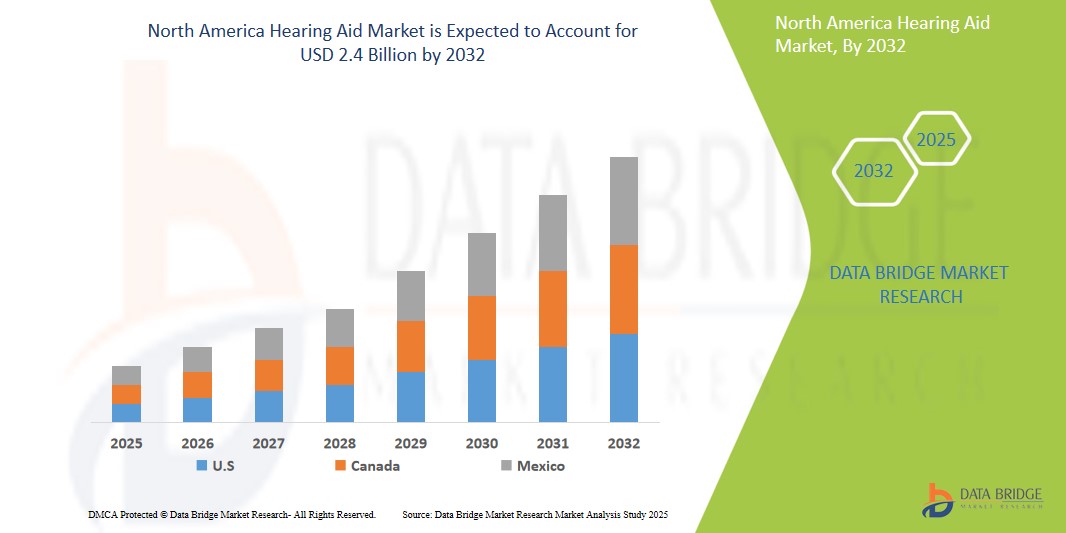
North America Hearing Aid Market Size
- The North America Hearing Aid Market was valued atUSD2.58 Billion in 2024 and is expected to reachUSD4.52 Billion by 2032
- Drivers of the North America Hearing Aid Market include include the rising prevalence of hearing loss among the aging population, increasing awareness and acceptance of hearing aids as essential health devices, and advancements in technology leading to more discreet, user-friendly, and connected hearing aid options. Additionally, supportive government initiatives and healthcare policies aimed at improving access to hearing care further propel market growth.
North America Hearing Aid Market Analysis
- The North America Hearing Aid Market is experiencing significant growth driven by a rapidly aging population, with a rising incidence of hearing loss among older adults. The increasing awareness of hearing health and the importance of early intervention contribute to higher demand for hearing aids.
- Innovations in hearing aid technology, such as Bluetooth connectivity, rechargeable batteries, and advanced sound processing algorithms, have improved the functionality and user experience. These advancements attract consumers looking for modern, effective solutions for hearing impairment.
- The market features a diverse range of products, including behind-the-ear (BTE), in-the-ear (ITE), and completely-in-canal (CIC) hearing aids, catering to varying degrees of hearing loss and consumer preferences. This variety allows users to choose devices that best suit their lifestyles and needs.
Report Scope andNorth America Hearing Aid MarketSegmentation
|
Attributes |
North America Hearing Aid MarketInsights |
|
Segments Covered |
|
|
Countries Covered |
North America
|
|
Key Market Players |
|
|
Market Opportunities |
|
|
Value Added Data Infosets |
In addition to the insights on market scenarios such as market value, growth rate, segmentation, geographical coverage, and major players, the market reports curated by the Data Bridge Market Research also include import export analysis, production capacity overview, production consumption analysis, price trend analysis, climate change scenario, supply chain analysis, value chain analysis, raw material/consumables overview, vendor selection criteria, PESTLE Analysis, Porter Analysis, and regulatory framework. |
North America Hearing Aid Market Trends
“Increased Adoption of Wireless and Connected Hearing Aids”
- The advent of wireless and connected hearing aids allows users to seamlessly connect their devices to smartphones, tablets, and other Bluetooth-compatible devices. This connectivity enables users to stream music, phone calls, and other audio directly to their hearing aids, significantly enhancing the overall user experience and convenience.
- Connected hearing aids are part of a broader trend towards smart technology integration in healthcare. These devices can often be controlled via mobile applications, allowing users to customize settings, adjust sound profiles, and receive real-time feedback. This integration empowers users to have more control over their hearing experience.
- Manufacturers are increasingly offering remote monitoring capabilities, allowing audiologists to adjust settings and provide support without requiring in-person visits. This trend not only improves convenience for users but also enhances access to professional care, particularly for individuals in remote or underserved areas.
North America Hearing Aid Market Dynamics
Driver
“Increasing Prevalence of Hearing Loss”
- One of the most significant drivers of the North American hearing aid market is the aging population. As the baby boomer generation continues to age, the prevalence of age-related hearing loss (presbycusis) increases. This demographic shift leads to a growing demand for hearing aids to address auditory challenges associated with aging.
- There is growing awareness about the impacts of untreated hearing loss, not only on communication but also on cognitive health and overall quality of life. Increased screening and diagnostic efforts, particularly in primary care settings, lead to earlier detection of hearing loss. As more people become aware of their hearing difficulties, they are more likely to seek out hearing aids as a solution.
Opportunity
“Direct-to-Consumer (DTC) Sales Model”
- The DTC sales model allows consumers to purchase hearing aids directly from manufacturers or online retailers without needing to go through traditional audiologist channels. This increases accessibility for individuals who may face barriers in accessing professional audiological services due to cost, inconvenience, or lack of nearby providers.
- DTC hearing aids often come at a lower price point compared to those sold through audiologists. By eliminating the middleman, manufacturers can reduce costs associated with distribution and marketing, making hearing aids more affordable for consumers. This price advantage can attract a broader audience, including those who previously may not have considered purchasing hearing aids.
- With DTC sales, consumers can take control of their purchasing decisions, researching products and comparing options online. This access to information can empower users to make informed choices based on their specific needs and preferences, fostering a more personalized approach to hearing health.
Restraint/Challenge
“High Cost and Affordability Issues”
- Hearing aids are often expensive, with costs ranging from hundreds to thousands of dollars. Many insurance plans offer limited coverage or none at all for hearing aids, forcing consumers to pay out-of-pocket. This high pricing can deter potential buyers and limit market penetration, particularly among lower-income populations.
- The perception of hearing aids as luxury items or a sign of aging can contribute to stigma, causing individuals to delay purchasing or avoid seeking help altogether. The challenge lies in changing these perceptions and making hearing aids more socially acceptable, thereby increasing demand in the market.
- While there is a growing demand for more affordable hearing aids, the availability of lower-cost options that do not compromise on quality can be limited. The focus on high-end technology often leaves budget-conscious consumers with few viable choices, creating a gap in the market that needs to be addressed.
North America Hearing Aid Market Scope
The market is segmented on the basis of product type, type, usability, procedure, function, age group, application, end user, distribution channel.
|
Segmentation |
Sub-Segmentation |
|
By Type |
Behind-the-ear (BTE), in-the-ear (ITE), receiver-in-canal (RIC), completely-in-canal (CIC), and hearing implants |
|
By Distribution Channel |
Hospitals & clinics, retail stores, and e-commerce |
North America Hearing Aid Market Analysis
“U.S. is the Dominant Country in the North America Hearing Aid Market”
- The United States holds the largest share of the North American hearing aid market, owing to a high prevalence of hearing loss among its aging population. With millions of adults experiencing varying degrees of hearing impairment, demand for advanced hearing solutions is significant, making the U.S. market a key player in the global context.
- The U.S. is home to many leading hearing aid manufacturers, renowned for their innovation and technological advancements. Companies in the U.S. invest heavily in research and development, resulting in cutting-edge products featuring wireless connectivity, artificial intelligence, and personalized sound experiences. This focus on innovation attracts consumers seeking the latest technology in hearing aids.
- Although challenges remain regarding affordability, the U.S. has various reimbursement policies that support hearing aid acquisition. Some private insurers and Medicare Advantage plans are beginning to provide coverage for hearing aids and related services, which can enhance accessibility for consumers and contribute to market growth.
“U.S. is Projected to Register the Highest Growth Rate in theNorth America Hearing Aid Market”
- The U.S. has a rapidly aging population, with a significant percentage of older adults experiencing hearing loss. As Baby Boomers continue to age, the demand for hearing aids is expected to rise substantially, driving growth in the market. This demographic trend will likely contribute to an increased focus on hearing health services and assistive devices.
- The U.S. market is characterized by continuous advancements in hearing aid technology, including features like Bluetooth connectivity, smartphone compatibility, and personalized settings through smartphone apps. These innovations attract tech-savvy consumers and improve user experiences, leading to higher adoption rates and projected growth in sales.
- Recent regulatory changes in the U.S., including the introduction of over-the-counter (OTC) hearing aids, are expected to broaden consumer access to hearing solutions. By improving accessibility and reducing costs, these changes may encourage more individuals to seek hearing aids, which can significantly contribute to market growth.
North America Hearing Aid Market Share
The market competitive landscape provides details by competitor. Details included are company overview, company financials, revenue generated, market potential, investment in research and development, new market initiatives, global presence, production sites and facilities, production capacities, company strengths and weaknesses, product launch, product width and breadth, application dominance. The above data points provided are only related to the companies' focus related to market.
The Major Market Leaders Operating in the Market Are:
- Sonova Holding AG
- Demant A/S
- GN Store Nord A/S
- Cochlear Limited
- WS Audiology A/S
- Amplifon S.p.A
- Eargo, Inc.
- Starkey Hearing Technologies
- Unitron (a division of Sonova Holding AG)
- EarIQ
Latest Developments in North America Hearing Aid Market
- In 2023, Starkey launched Genesis AI, the world's first hearing aid with integrated health sensors and AI-powered sound optimization
- In 2022, Oticon introduced Real, the first hearing aid with a deep neural network that mimics brain processing
- In 2021, Phonak released Paradise, featuring Bluetooth LE Audio and enhanced speech understanding in noise
SKU-
世界初のマーケットインテリジェンスクラウドに関するレポートにオンラインでアクセスする

- インタラクティブなデータ分析ダッシュボード
- 成長の可能性が高い機会のための企業分析ダッシュボード
- カスタマイズとクエリのためのリサーチアナリストアクセス
- インタラクティブなダッシュボードによる競合分析
- 最新ニュース、更新情報、トレンド分析
- 包括的な競合追跡のためのベンチマーク分析のパワーを活用
調査方法
データ収集と基準年分析は、大規模なサンプル サイズのデータ収集モジュールを使用して行われます。この段階では、さまざまなソースと戦略を通じて市場情報または関連データを取得します。過去に取得したすべてのデータを事前に調査および計画することも含まれます。また、さまざまな情報ソース間で見られる情報の不一致の調査も含まれます。市場データは、市場統計モデルと一貫性モデルを使用して分析および推定されます。また、市場シェア分析と主要トレンド分析は、市場レポートの主要な成功要因です。詳細については、アナリストへの電話をリクエストするか、お問い合わせをドロップダウンしてください。
DBMR 調査チームが使用する主要な調査方法は、データ マイニング、データ変数が市場に与える影響の分析、および一次 (業界の専門家) 検証を含むデータ三角測量です。データ モデルには、ベンダー ポジショニング グリッド、市場タイムライン分析、市場概要とガイド、企業ポジショニング グリッド、特許分析、価格分析、企業市場シェア分析、測定基準、グローバルと地域、ベンダー シェア分析が含まれます。調査方法について詳しくは、お問い合わせフォームから当社の業界専門家にご相談ください。
カスタマイズ可能
Data Bridge Market Research は、高度な形成的調査のリーダーです。当社は、既存および新規のお客様に、お客様の目標に合致し、それに適したデータと分析を提供することに誇りを持っています。レポートは、対象ブランドの価格動向分析、追加国の市場理解 (国のリストをお問い合わせください)、臨床試験結果データ、文献レビュー、リファービッシュ市場および製品ベース分析を含めるようにカスタマイズできます。対象競合他社の市場分析は、技術ベースの分析から市場ポートフォリオ戦略まで分析できます。必要な競合他社のデータを、必要な形式とデータ スタイルでいくつでも追加できます。当社のアナリスト チームは、粗い生の Excel ファイル ピボット テーブル (ファクト ブック) でデータを提供したり、レポートで利用可能なデータ セットからプレゼンテーションを作成するお手伝いをしたりすることもできます。











