


North America Hearing Aid Market Size
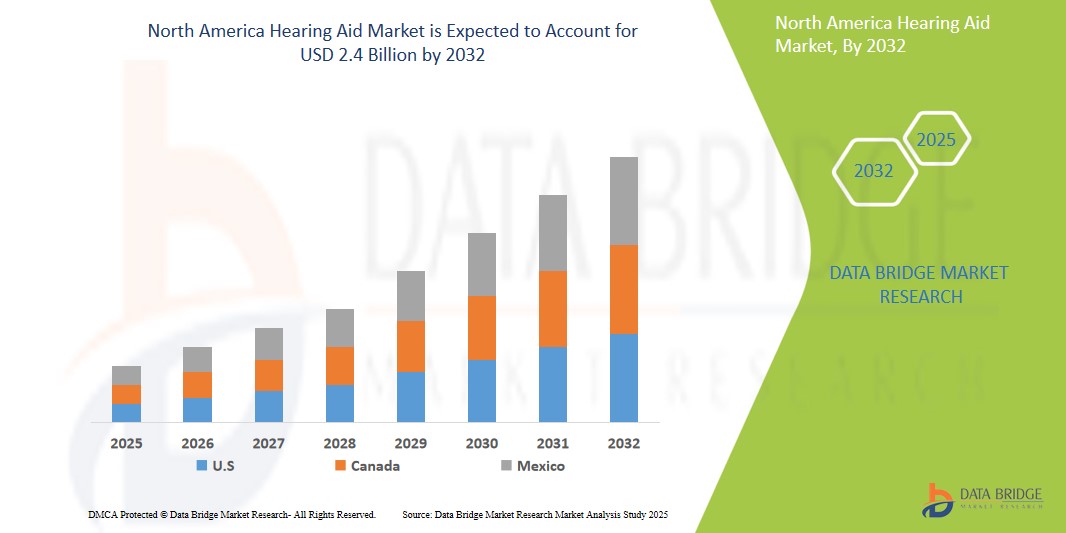
- The North America Hearing Aid Market was valued at USD 2.58 Billion in 2024 and is expected to reach USD 4.52 Billion by 2032
- Drivers of the North America Hearing Aid Market include include the rising prevalence of hearing loss among the aging population, increasing awareness and acceptance of hearing aids as essential health devices, and advancements in technology leading to more discreet, user-friendly, and connected hearing aid options. Additionally, supportive government initiatives and healthcare policies aimed at improving access to hearing care further propel market growth.
North America Hearing Aid Market Analysis
- The North America Hearing Aid Market is experiencing significant growth driven by a rapidly aging population, with a rising incidence of hearing loss among older adults. The increasing awareness of hearing health and the importance of early intervention contribute to higher demand for hearing aids.
- Innovations in hearing aid technology, such as Bluetooth connectivity, rechargeable batteries, and advanced sound processing algorithms, have improved the functionality and user experience. These advancements attract consumers looking for modern, effective solutions for hearing impairment.
- The market features a diverse range of products, including behind-the-ear (BTE), in-the-ear (ITE), and completely-in-canal (CIC) hearing aids, catering to varying degrees of hearing loss and consumer preferences. This variety allows users to choose devices that best suit their lifestyles and needs.
Report Scope and North America Hearing Aid Market Segmentation
|
Attributes |
North America Hearing Aid Market Insights |
|
Segments Covered |
|
|
Countries Covered |
North America
|
|
Key Market Players |
|
|
Market Opportunities |
|
|
Value Added Data Infosets |
In addition to the insights on market scenarios such as market value, growth rate, segmentation, geographical coverage, and major players, the market reports curated by the Data Bridge Market Research also include import export analysis, production capacity overview, production consumption analysis, price trend analysis, climate change scenario, supply chain analysis, value chain analysis, raw material/consumables overview, vendor selection criteria, PESTLE Analysis, Porter Analysis, and regulatory framework. |
North America Hearing Aid Market Trends
“Increased Adoption of Wireless and Connected Hearing Aids”
- The advent of wireless and connected hearing aids allows users to seamlessly connect their devices to smartphones, tablets, and other Bluetooth-compatible devices. This connectivity enables users to stream music, phone calls, and other audio directly to their hearing aids, significantly enhancing the overall user experience and convenience.
- Connected hearing aids are part of a broader trend towards smart technology integration in healthcare. These devices can often be controlled via mobile applications, allowing users to customize settings, adjust sound profiles, and receive real-time feedback. This integration empowers users to have more control over their hearing experience.
- Manufacturers are increasingly offering remote monitoring capabilities, allowing audiologists to adjust settings and provide support without requiring in-person visits. This trend not only improves convenience for users but also enhances access to professional care, particularly for individuals in remote or underserved areas.
North America Hearing Aid Market Dynamics
Driver
“Increasing Prevalence of Hearing Loss”
- One of the most significant drivers of the North American hearing aid market is the aging population. As the baby boomer generation continues to age, the prevalence of age-related hearing loss (presbycusis) increases. This demographic shift leads to a growing demand for hearing aids to address auditory challenges associated with aging.
- There is growing awareness about the impacts of untreated hearing loss, not only on communication but also on cognitive health and overall quality of life. Increased screening and diagnostic efforts, particularly in primary care settings, lead to earlier detection of hearing loss. As more people become aware of their hearing difficulties, they are more likely to seek out hearing aids as a solution.
Opportunity
“Direct-to-Consumer (DTC) Sales Model”
- The DTC sales model allows consumers to purchase hearing aids directly from manufacturers or online retailers without needing to go through traditional audiologist channels. This increases accessibility for individuals who may face barriers in accessing professional audiological services due to cost, inconvenience, or lack of nearby providers.
- DTC hearing aids often come at a lower price point compared to those sold through audiologists. By eliminating the middleman, manufacturers can reduce costs associated with distribution and marketing, making hearing aids more affordable for consumers. This price advantage can attract a broader audience, including those who previously may not have considered purchasing hearing aids.
- With DTC sales, consumers can take control of their purchasing decisions, researching products and comparing options online. This access to information can empower users to make informed choices based on their specific needs and preferences, fostering a more personalized approach to hearing health.
Restraint/Challenge
“High Cost and Affordability Issues”
- Hearing aids are often expensive, with costs ranging from hundreds to thousands of dollars. Many insurance plans offer limited coverage or none at all for hearing aids, forcing consumers to pay out-of-pocket. This high pricing can deter potential buyers and limit market penetration, particularly among lower-income populations.
- The perception of hearing aids as luxury items or a sign of aging can contribute to stigma, causing individuals to delay purchasing or avoid seeking help altogether. The challenge lies in changing these perceptions and making hearing aids more socially acceptable, thereby increasing demand in the market.
- While there is a growing demand for more affordable hearing aids, the availability of lower-cost options that do not compromise on quality can be limited. The focus on high-end technology often leaves budget-conscious consumers with few viable choices, creating a gap in the market that needs to be addressed.
North America Hearing Aid Market Scope
The market is segmented on the basis of product type, type, usability, procedure, function, age group, application, end user, distribution channel.
|
Segmentation |
Sub-Segmentation |
|
By Type |
Behind-the-ear (BTE), in-the-ear (ITE), receiver-in-canal (RIC), completely-in-canal (CIC), and hearing implants |
|
By Distribution Channel |
Hospitals & clinics, retail stores, and e-commerce |
North America Hearing Aid Market Analysis
“U.S. is the Dominant Country in the North America Hearing Aid Market”
- The United States holds the largest share of the North American hearing aid market, owing to a high prevalence of hearing loss among its aging population. With millions of adults experiencing varying degrees of hearing impairment, demand for advanced hearing solutions is significant, making the U.S. market a key player in the global context.
- The U.S. is home to many leading hearing aid manufacturers, renowned for their innovation and technological advancements. Companies in the U.S. invest heavily in research and development, resulting in cutting-edge products featuring wireless connectivity, artificial intelligence, and personalized sound experiences. This focus on innovation attracts consumers seeking the latest technology in hearing aids.
- Although challenges remain regarding affordability, the U.S. has various reimbursement policies that support hearing aid acquisition. Some private insurers and Medicare Advantage plans are beginning to provide coverage for hearing aids and related services, which can enhance accessibility for consumers and contribute to market growth.
“U.S. is Projected to Register the Highest Growth Rate in the North America Hearing Aid Market”
- The U.S. has a rapidly aging population, with a significant percentage of older adults experiencing hearing loss. As Baby Boomers continue to age, the demand for hearing aids is expected to rise substantially, driving growth in the market. This demographic trend will likely contribute to an increased focus on hearing health services and assistive devices.
- The U.S. market is characterized by continuous advancements in hearing aid technology, including features like Bluetooth connectivity, smartphone compatibility, and personalized settings through smartphone apps. These innovations attract tech-savvy consumers and improve user experiences, leading to higher adoption rates and projected growth in sales.
- Recent regulatory changes in the U.S., including the introduction of over-the-counter (OTC) hearing aids, are expected to broaden consumer access to hearing solutions. By improving accessibility and reducing costs, these changes may encourage more individuals to seek hearing aids, which can significantly contribute to market growth.
North America Hearing Aid Market Share
The market competitive landscape provides details by competitor. Details included are company overview, company financials, revenue generated, market potential, investment in research and development, new market initiatives, global presence, production sites and facilities, production capacities, company strengths and weaknesses, product launch, product width and breadth, application dominance. The above data points provided are only related to the companies' focus related to market.
The Major Market Leaders Operating in the Market Are:
- Sonova Holding AG
- Demant A/S
- GN Store Nord A/S
- Cochlear Limited
- WS Audiology A/S
- Amplifon S.p.A
- Eargo, Inc.
- Starkey Hearing Technologies
- Unitron (a division of Sonova Holding AG)
- EarIQ
Latest Developments in North America Hearing Aid Market
- In 2023, Starkey launched Genesis AI, the world's first hearing aid with integrated health sensors and AI-powered sound optimization
- In 2022, Oticon introduced Real, the first hearing aid with a deep neural network that mimics brain processing
- In 2021, Phonak released Paradise, featuring Bluetooth LE Audio and enhanced speech understanding in noise

- Interactive Data Analysis Dashboard
- Company Analysis Dashboard for high growth potential opportunities
- Research Analyst Access for customization & queries
- Competitor Analysis with Interactive dashboard
- Latest News, Updates & Trend analysis
- Harness the Power of Benchmark Analysis for Comprehensive Competitor Tracking
Data collection and base year analysis are done using data collection modules with large sample sizes. The stage includes obtaining market information or related data through various sources and strategies. It includes examining and planning all the data acquired from the past in advance. It likewise envelops the examination of information inconsistencies seen across different information sources. The market data is analysed and estimated using market statistical and coherent models. Also, market share analysis and key trend analysis are the major success factors in the market report. To know more, please request an analyst call or drop down your inquiry.
The key research methodology used by DBMR research team is data triangulation which involves data mining, analysis of the impact of data variables on the market and primary (industry expert) validation. Data models include Vendor Positioning Grid, Market Time Line Analysis, Market Overview and Guide, Company Positioning Grid, Patent Analysis, Pricing Analysis, Company Market Share Analysis, Standards of Measurement, Global versus Regional and Vendor Share Analysis. To know more about the research methodology, drop in an inquiry to speak to our industry experts.
Data Bridge Market Research is a leader in advanced formative research. We take pride in servicing our existing and new customers with data and analysis that match and suits their goal. The report can be customized to include price trend analysis of target brands understanding the market for additional countries (ask for the list of countries), clinical trial results data, literature review, refurbished market and product base analysis. Market analysis of target competitors can be analyzed from technology-based analysis to market portfolio strategies. We can add as many competitors that you require data about in the format and data style you are looking for. Our team of analysts can also provide you data in crude raw excel files pivot tables (Fact book) or can assist you in creating presentations from the data sets available in the report.













