



Asia-Pacific Cosmetics Market, By Product Type (Skin Care, Hair Care, Make Up, Fragrances, Others), Nature (Inorganic, Organic), Form (Creams & Gels, Lotions, Sprays, Solid and Others), Category (Mass Product, Premium Product, Professional Product), Packaging Type (Bottles and Jars, Tubes, Containers, Pumps & Dispensers, Sticks, Aerosol Cans, Pouches, Blisters and Strip Packs and Others), Distribution Channel (Offline and Online), End-User (Women, Men and Kids) - Industry Trends and Forecast to 2029.
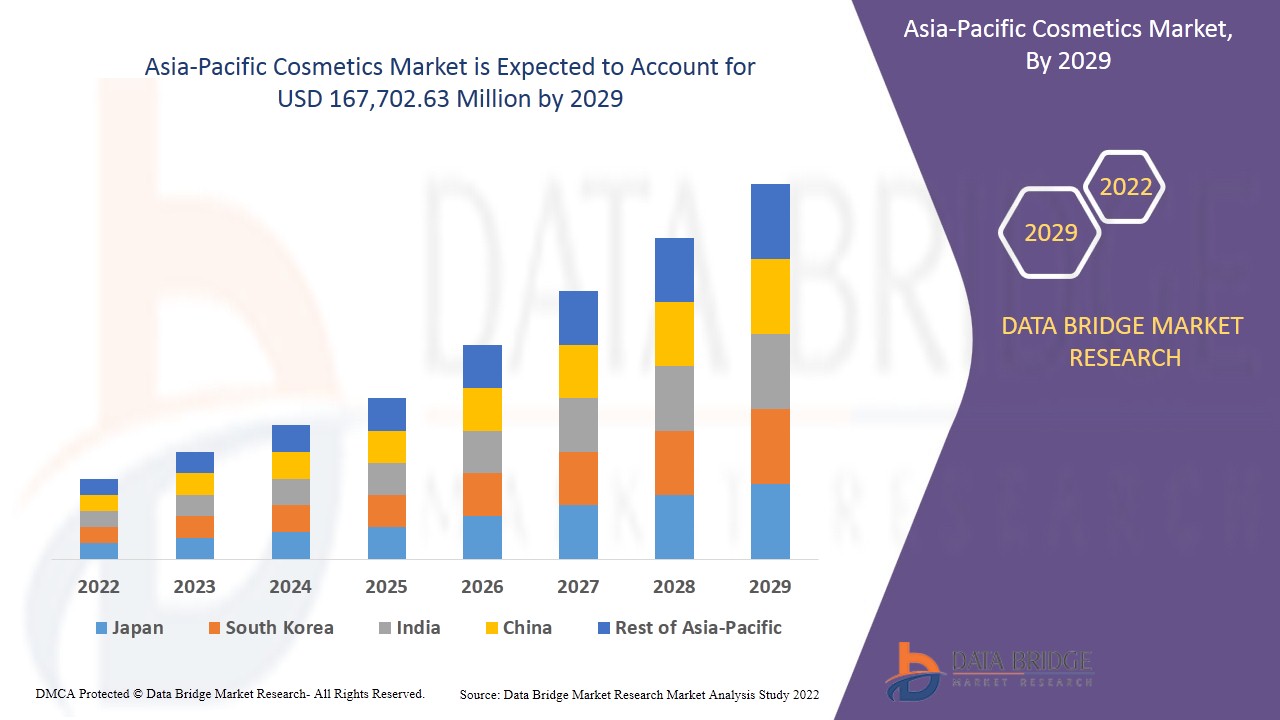
Market Analysis and Insights: Asia-Pacific Cosmetics Market
The cosmetic industry has a very important role in every developed and developing economy. Accelerated urbanization and increasing urban population with changing lifestyle demands are important drivers for the increasing demand for cosmetic skin care beauty products in the market. The growing global economy has increased disposable income with the global population in urban areas. This has increased the spending capacity of the urban population.
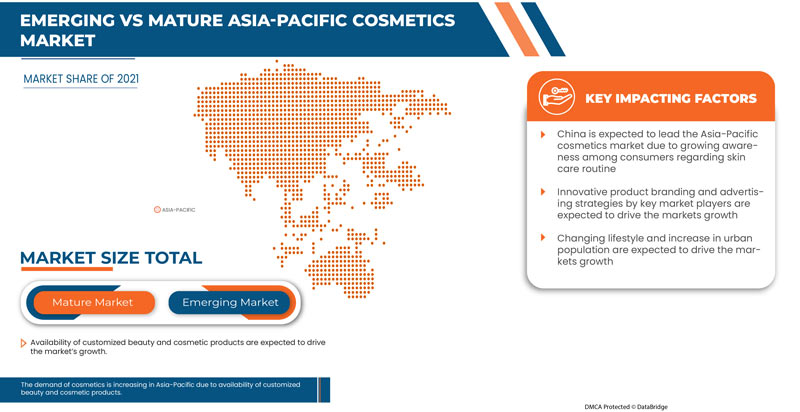
A busy lifestyle in urban areas is a major factor driving the growth of the cosmetic skin care products market across the region. People often lead hectic and fast-paced lives, so they face much stress. Hence, people want face creams to offer a fresh appearance and hide the signs of exhaustion on their faces. Millennials form a major part of the urban population and consumer spending. They are at the forefront of the beauty athleisure trend. It constitutes a major significant factor in spending on beauty products and cosmetics. Increasing social media trends and the need to look good are expected to boost market demand.
Asia-Pacific cosmetics market is expected to gain significant growth in the forecast period of 2022 to 2029. Data Bridge Market Research analyses that the market is growing with a CAGR of 6.5% in the forecast period of 2022 to 2029 and is expected to reach USD 167,702.63 million by 2029. The major factor driving the growth of the cosmetics market is the increasing demand for self-care products to combat stress & anxiety and the tendency of consumers to increase their engagement in self-care routines as a means for feeling good and looking better by using natural and organic ingredients.
Asia-Pacific cosmetics market report provides details of market share, new developments and the impact of domestic and localized market players, analyses opportunities in terms of emerging revenue pockets, changes in market regulations, products approvals, strategic decisions, product launches, geographic expansions and technological innovations in the market. To understand the analysis and the market scenario, contact us for an Analyst Brief. Our team will help you create a revenue impact solution to achieve your desired goal.
|
Report Metric |
Details |
|
Forecast Period |
2022 to 2029 |
|
Base Year |
2021 |
|
Historic Years |
2020 (Customizable to 2019 - 2014) |
|
Quantitative Units |
Revenue in USD Million |
|
Segments Covered |
By Product Type (Skin Care, Hair Care, Make Up, Fragrances, Others), Nature (Inorganic, Organic), Form (Creams & Gels, Lotions, Sprays, Solid and Others), Category (Mass Product, Premium Product, Professional Product), Packaging Type (Bottles and Jars, Tubes, Containers, Pumps & Dispensers, Sticks, Aerosol Cans, Pouches, Blisters and Strip Packs and Others), Distribution Channel (Offline and Online), End-User (Women, Men and Kids) |
|
Regions Covered |
China, Japan, Australia & New Zealand, India, Philippines, Indonesia, Singapore, South Korea, Malaysia, Thailand and the Rest of Asia-Pacific |
|
Market Players Covered |
Unilever, L'Oreal S.A., Shiseido Company, Limited, The Estée Lauder Companies, Procter & Gamble, Kao Corporation, Colgate-Palmolive Company, Oriflame Cosmetics Global SA, Beiersdorf AG, Johnson & Johnson Services, Inc., Amorepacific, Coty Inc., AVON PRODUCTS, Revlon, Inc. and The Body Shop International Limited among others |
Market Definition
Cosmetics are largely designed to use or applied in order to enhance the beauty and physical appearance of a person. Chiefly, these cosmetic products are manufactured from artificial sources. The purpose of cosmetic products is mainly intended for external cleaning, perfumes, changing appearances, correcting body odor, protecting the skin and conditioning among others. Ranging from antiperspirants, fragrances, make-up and shampoos, to soaps, sunscreens and toothpaste, cosmetics and personal care products play an essential role in all stages of a consumer's life.
Cosmetics are manufactured using mixtures of chemical compounds. These compounds are either derived from natural sources or are artificial in nature. The use of cosmetics can be for personal use for retail buyers or for professional uses in the beauty and entertainment industry. In the entertainment industry, cosmetics are heavily used for enhancing one's natural features, adding color to a person's face and can be used to change the appearance of the face entirely to resemble a different person, creature or object.
Asia-Pacific Cosmetics Market Dynamics
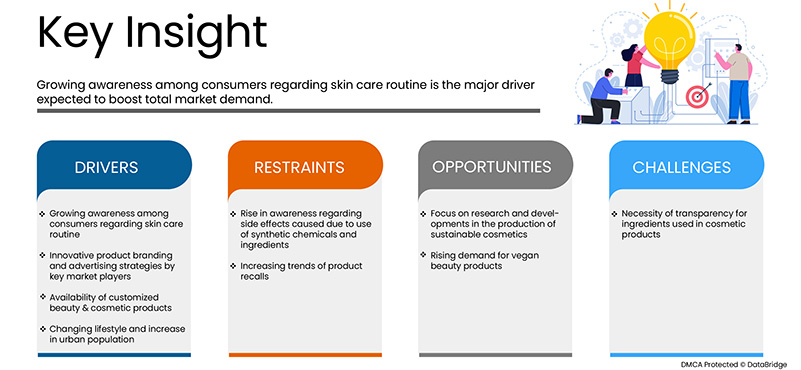
This section deals with understanding the market drivers, opportunities, restraints and challenges. All of this is discussed in detail below:
Drivers
- Growing awareness among consumers regarding skin care routine
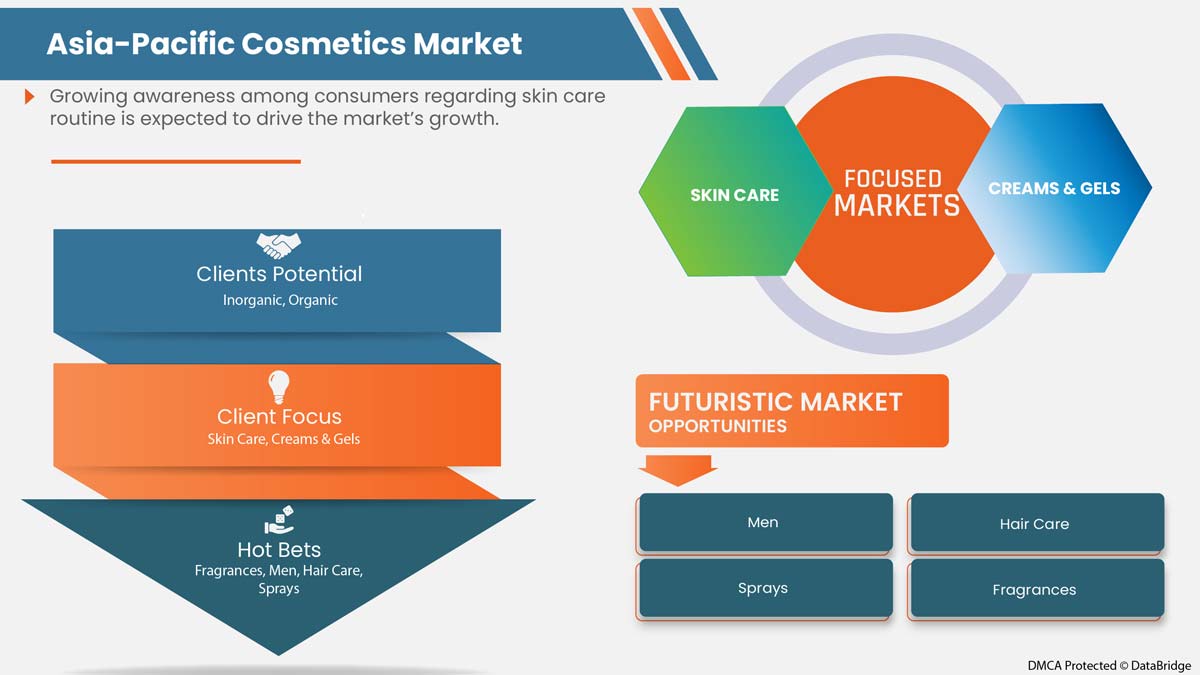
In recent years, the cosmetics market has benefitted from the renewed focus on hygiene and self-care routines. The increasing demand for self-care products to combat stress & anxiety and the tendency of consumers to increase their engagement in self-care routines as a means of feeling good and looking better, has been the major driver for the cosmetics market. The interest in natural and organic ingredients has further increased the awareness and demand for skin care products such as face masks, body scrubs, toners and serums among users, as it emphasizes changing their existing skin care.
- Innovative product branding and advertising strategies by key market players
The advent of digital technologies has influenced consumers' buying behavior in the cosmetics market across the globe. The major cosmetics brands in the market are leveraging digital technologies to enable consumers to experience brands in an entirely new way, as the modern consumer expects a two-way conversation to connect more with the brand. Technological advancements, innovative branding and advertising strategies have made it easy for beauty lovers to access trends, looks, content and experiences.
Major beauty companies and brands are continuously involved in innovating their product branding and advertising strategies to reach a wider audience base and increase customer engagement. Many brands use social media platforms to enhance brand reach, which has been the major strategy in recent years. This has enabled the brands to increase their user base and popularity in the cosmetics market which is expected to drive the market's growth.
- Availability of customized beauty & cosmetic products
Beauty companies and manufacturers are continuously introducing customization and digitalization in cosmetic products, attributed to the increasing demand for personalized skin care. Consumers are becoming aware of the beauty and skin care products in the market. The technological advancements in the industry are leading consumers away from the cosmetic product just made for the generic skin type. Consumers are becoming extremely careful about choosing the product according to their skin type. As a result, beauty companies focus on catering to such consumers with products that are ideal for their use, enabling them to increase consumer engagement in the market.
Opportunities
-
Focus on research and developments in the production of sustainable cosmetics
Sustainability is becoming a key priority for several brands across the ever-evolving beauty industry. Companies are constantly focusing on moving forward with greener initiatives without compromising the product's quality and reach to appeal to a growing population of eco-conscious consumers. Many major players are making efforts and setting goals to reach carbon neutrality. Companies are actively involved in reducing the environmental impact of their packaging processes across the lifecycle. The beauty industry is witnessing valuable collaborations and partnerships for exploring alternative materials and more responsible concepts in packaging design.
-
Rising demand for vegan beauty products
In recent years, the adoption of an alternative vegan lifestyle among the world population has increased. People are taking up the lifestyle to improve their overall health while benefitting their bodies both inside and out. Such developments are influencing the cosmetic industry also. Consumers are actively trying to search and switch to vegan cosmetic products as awareness about the same increases. This can be attributed to the ease of accessibility to online information about benefits and environmental impact.
The awareness regarding animal products such as hair, fur and others in cosmetics brands is increasing among consumers. Consumers find cruelty towards animals unethical and are spreading awareness against this act. This has set the trend in the global cosmetics marketplace to embrace plant-based personal care products. Major cosmetics manufacturing companies across the globe realize the importance of making products that use ingredients that are mineral-based or plant-based rather than manufacturing products that are infused with animal-extracted ingredients.
Restraints/Challenges
- Increasing trends in product recall
Recalling cosmetics and beauty products from a marketplace is an expeditious and effective method of removing products that violate norms and regulations, particularly those that present a danger to health. Recall of such a product can be initiated for several reasons, such as many consumer complaints, violation of norms set by the regulating bodies regarding the use of ingredients, voluntary company recalls and others.
For instance,
- In November 2021, Procter & Gamble recalled more than 15 different deodorant and aerosol sprays manufactured under its Old Spice and Secret brands. The recall was initiated after the company found that the sampling of its aerosol products detected benzene, a known carcinogen, in a suite of deodorants. Such recalls impact the pockets of the company and may impact the revenue. It also impacts the company's brand value and thus affects its reputation in the market, which may restrain its growth in the market
- Rise in awareness regarding side effects caused due to use of synthetic chemicals and ingredients
There are many instances in the beauty industry where the users have claimed not getting the result as projected by the brand. Substandard quality, grade and harmful compositions can result in allergies, discoloration, texture alteration, or permanent damage to the skin or hair. Increased usage and unregulated production have led to a steep rise in side effects suffered by consumers.
It is important for the consumer to thoroughly inspect and study the cosmetic product before using it, as it may contain ingredients not suited for one's skin or to which one is allergic. The product's chemical may get absorbed into the skin and cause irritation and other side effects. The increasing awareness regarding such instances may restrain the growth of the market.
Post-COVID-19 Impact on Asia-Pacific Cosmetics Market
The cosmetics industry has been directly impacted by the coronavirus (COVID-19) pandemic's dramatic shifts in consumer behavior. The COVID-19 pandemic has increased customers' concern for sustainability and health. The industry has responded positively to the crisis, with brands switching their manufacturing to produce hand sanitizers and cleaning agents and offering free beauty services for frontline response workers.
Recent Developments
- In August 2021, Unilever announced the acquisition of Paula's Choice, the digital-led skin care brand. The brand is famous for its industry-leading innovation, accessible jargon-free science, high-performing ingredients and cruelty-free products. With the acquisition, the company integrated the band into its product portfolio and hence increased the brand's visibility to a larger consumer base. This catered to the company's strategic priorities of expanding the company's portfolio of premium skin care products in the cosmetics market
- In March 2021, Coty Inc. announced the partnership with LanzaTech, a producer of next-generation green and sustainable ingredients. Accordingly, the companies will invest in introducing sustainable ethanol made from captured-carbon emissions into their fragrance products. This move supported the company's goals of developing clean and green products in the market
Asia-Pacific Cosmetics Market Scope
Asia-Pacific cosmetics market is segmented based on product type, nature, form, category, packaging type, distribution channel and end-user. The growth amongst these segments will help you analyze major growth segments in the industries and provide the users with a valuable market overview and market insights to make strategic decisions to identify core market applications.
Product Type
- Skin Care
- Hair Care
- Fragrances
- Make Up
- Others
On the basis of type, the Asia-Pacific cosmetics market is segmented into skin care, hair care, fragrances, make up and others.
Nature
- Organic
- Inorganic
On the basis of nature, the Asia-Pacific cosmetics market is segmented into organic and inorganic.
Form
- Creams & Gels
- Lotions
- Sprays
- Solid
- Others
On the basis of form, the Asia-Pacific cosmetics market is segmented into creams & gels, lotions, sprays, solid and others.
Category
- Mass Product
- Premium Product
- Professional Product
On the basis of application, the Asia-Pacific cosmetics market is segmented into mass product, premium product and professional product.
Packaging Type
- Bottles And Jars
- Tubes
- Containers
- Pouches
- Sticks
- Pumps & Dispensers
- Blisters & Strip Packs
- Aerosol Cans
- Others
On the basis of application, the Asia-Pacific cosmetics market is segmented into bottles and jars, tubes, containers, pouches, sticks, pumps & dispensers, blisters and strip packs, aerosol cans and others.
Distribution Channel
- Offline
- Online
On the basis of distribution channel, the Asia-Pacific cosmetics market is segmented into offline and online.
End-User
- Women
- Men
- Kids
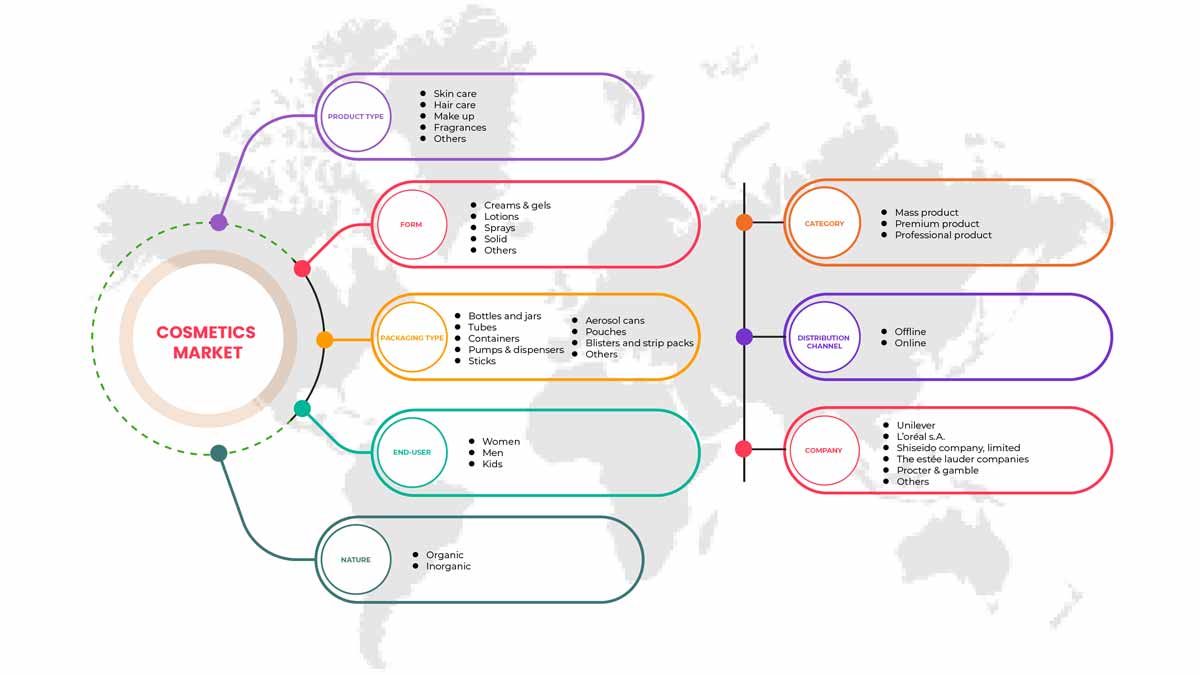
On the basis of end-user, the Asia-Pacific cosmetics market is classified into women, men and kids.
Asia-Pacific Cosmetics Market Regional Analysis/Insights
Asia-Pacific cosmetics market is segmented on the basis of product type, nature, form, category, packaging type, distribution channel and end-user
The countries in the Asia-Pacific cosmetics market are Japan, China, South Korea, India, Singapore, Thailand, Indonesia, Malaysia, Philippines, Australia and the rest of Asia-Pacific.
- In 2022, China is expected to dominate the Asia-Pacific cosmetics market in terms of market share and market revenue due to the strong presence of key market players in the region.
The country section of the report also provides individual market-impacting factors and changes in market regulation that impact the current and future trends of the market. Data point downstream and upstream value chain analysis, technical trends, porter's five forces analysis and case studies are some of the pointers used to forecast the market scenario for individual countries. Also, the presence and availability of Europe brands and the challenges faced due to large or scarce competition from local and domestic brands, the impact of domestic tariffs and trade routes are considered while providing forecast analysis of the country data.
Competitive Landscape and Asia-Pacific Cosmetics Market Share Analysis
The competitive Asia-Pacific cosmetics market provides details about the competitors. Details include company overview, company financials, revenue generated, market potential, investment in research and development, new market initiatives, Asia-Pacific presence, production sites and facilities, production capacities, company strengths and weaknesses, product launch, product width and breadth and application dominance. The above data points are only related to the companies focus on the Asia-Pacific cosmetics market.
Some of the major players operating in the Asia-Pacific cosmetics market are Unilever, L'Oreal S.A., Shiseido Company, Limited, The Estée Lauder Companies, Procter & Gamble, Kao Corporation, Colgate-Palmolive Company, Oriflame Cosmetics Global SA, Beiersdorf AG, Johnson & Johnson Services, Inc., Amorepacific, Coty Inc., AVON PRODUCTS, Revlon, Inc. and The Body Shop International Limited among others.
Research Methodology
Data collection and base year analysis are done using data collection modules with large sample sizes. The market data is analyzed and estimated using market statistical and coherent models. In addition, market share analysis and key trend analysis are the major success factors in the market report. The key research methodology used by the DBMR research team is data triangulation which involves data mining, analysis of the impact of data variables on the market and primary (industry expert) validation. Apart from this, data models include Vendor Positioning grids, Market Time Line Analysis, Market Overview and Guide, Company Positioning Grid, Company Market Share Analysis, Standards of Measurement, Asia-Pacific Vs Regional and Vendor Share Analysis. Please request an analyst call in case of further inquiry.
SKU-
세계 최초의 시장 정보 클라우드 보고서에 온라인으로 접속하세요

- 대화형 데이터 분석 대시보드
- 높은 성장 잠재력 기회를 위한 회사 분석 대시보드
- 사용자 정의 및 질의를 위한 리서치 분석가 액세스
- 대화형 대시보드를 통한 경쟁자 분석
- 최신 뉴스, 업데이트 및 추세 분석
- 포괄적인 경쟁자 추적을 위한 벤치마크 분석의 힘 활용
목차
1 서론
1.1 연구 목적
1.2 시장 정의
1.3 아시아 태평양 화장품 시장 개요
1.4 제한 사항
1.5 대상 시장
2 시장 세분화
2.1 대상 시장
2.2 지리적 범위
연구에 2.3년이 고려됨
2.4 통화 및 가격
2.5 BMR TRIPOD 데이터 검증 모델
2.6 형태선 곡선
2.7 다변량 모델링
2.8 주요 여론 선도자와의 1차 인터뷰
2.9 DBMR 시장 위치 그리드
2.1 시장 적용 범위 그리드
2.11 DBMR 시장 도전 매트릭스
2.12 DBMR 공급업체 점유율 분석
2.13 수입-수출 데이터
2.14 2차 소스
2.15 가정
3 요약
4가지 프리미엄 인사이트
5 시장 개요
5.1 드라이버
5.1.1 소비자들 사이에서 스킨케어 루틴에 대한 인식이 높아지고 있습니다.
5.1.2 주요 시장 참여자의 혁신적인 제품 브랜딩 및 광고 전략
5.1.3 맞춤형 뷰티 및 화장품 제품의 가용성
5.1.4 변화하는 생활양식과 도시인구 증가
5.2 제약
5.2.1 합성화학물질 및 합성성분 사용으로 인한 부작용에 대한 인식 증가
5.2.2 제품 리콜 증가 추세
5.3 기회
5.3.1 지속 가능한 화장품 생산에 대한 연구 및 개발에 집중
5.3.2 비건 뷰티 제품에 대한 수요 증가
5.4 도전
5.4.1 화장품에 사용되는 성분의 투명성 필요성
6 아시아 태평양 화장품 시장, 제품 유형별
6.1 개요
6.2 스킨 케어
6.2.1 마스크
6.2.2 보습제
6.2.3 바디로션
6.2.4 토너
6.2.5 클렌징 크림
6.2.6 얼굴 리무버
6.2.7 자외선 차단제
6.2.8 바디워시
6.2.9 나이트 세럼
6.2.10 데이크림
6.2.11 핸드&풋 크림
6.2.12 기타
6.3 헤어 케어
6.3.1 샴푸
6.3.2 컨디셔너
6.3.3 헤어 컬러
6.3.3.1 헤어 염색제 및 컬러
6.3.3.2 모발 표백제
6.3.3.3 헤어 틴트
6.3.3.4 기타
6.3.3.4.1 정상
6.3.3.4.2 기름진
6.3.3.4.3 건조
6.4 혈청
6.5 오일
6.6 스프레이
6.7 기타
6.8 메이크업
6.8.1 립스틱
6.8.2 아이섀도
6.8.3 마스카라
6.9 기초
6.9.1 브론저
6.9.2 블러쉬
6.9.3 기타
6.1 향수
6.11 기타
7 아시아 태평양 화장품 시장, 본질별
7.1 개요
7.2 무기질
7.3 유기농
8 아시아 태평양 화장품 시장, 형태별
8.1 개요
8.2 크림 & 젤
8.3 로션
8.4 스프레이
8.5 솔리드
8.6 기타
9 아시아 태평양 화장품 시장, 카테고리별
9.1 개요
9.2 대량 생산
9.3 프리미엄 제품
9.4 전문가용 제품
10 아시아 태평양 화장품 시장, 포장 유형별
10.1 개요
10.2 병과 항아리
10.3 튜브
10.4 컨테이너
10.5 펌프 및 디스펜서
10.6 스틱
10.7 에어로졸 캔
10.8 파우치
10.9 블리스터 및 스트립 팩
10.1 기타
11 아시아 태평양 화장품 시장, 유통 채널별
11.1 개요
11.2 오프라인
11.2.1 전문점
11.2.2 슈퍼마켓/하이퍼마켓
11.2.3 약국
11.2.4 살롱
11.2.5 기타
11.3 온라인
12 아시아 태평양 화장품 시장, 최종 사용자별
12.1 개요
12.2 여성
12.2.1 스킨 케어
12.2.2 헤어 케어
12.2.3 메이크업
12.2.4 향수
12.2.5 기타
12.3 남자
12.3.1 스킨 케어
12.3.2 헤어 케어
12.3.3 향수
12.3.4 메이크업
12.3.5 기타
12.4 어린이
12.4.1 스킨 케어
12.4.2 헤어 케어
12.4.3 향수
12.4.4 메이크업
12.4.5 기타
13 아시아 태평양 화장품 시장, 국가별
13.1 중국
13.2 일본
13.3 인도
13.4 대한민국
13.5 호주 및 뉴질랜드
13.6 인도네시아
13.7 필리핀
13.8 태국
13.9 말레이시아
13.1 싱가포르
13.11 아시아 태평양의 나머지 지역
14 아시아 태평양 화장품 시장, 기업 환경
14.1 회사 점유율 분석: 아시아 태평양
14.2 협업
14.3 확장
14.4 제품 출시
14.5 인수
15 SWOT 분석
16개 회사 프로필
16.1 유니레버
16.1.1 회사 스냅샷
16.1.2 수익 분석
16.1.3 제품 포트폴리오
16.1.4 최근 업데이트
16.2 로레알 SA
16.2.1 회사 스냅샷
16.2.2 수익 분석
16.2.3 제품 포트폴리오
16.2.4 최근 업데이트
16.3 시세이도 주식회사
16.3.1 회사 스냅샷
16.3.2 수익 분석
16.3.3 제품 포트폴리오
16.3.4 최근 업데이트
16.4 에스티로더 회사
16.4.1 회사 스냅샷
16.4.2 수익 분석
16.4.3 제품 포트폴리오
16.4.4 최근 업데이트
16.5 프록터 앤드 갬블
16.5.1 회사 스냅샷
16.5.2 수익 분석
16.5.3 제품 포트폴리오
16.5.4 최근 업데이트
16.6 아모레퍼시픽
16.6.1 회사 스냅샷
16.6.2 수익 분석
16.6.3 제품 포트폴리오
16.6.4 최근 업데이트
16.7 에이본 제품
16.7.1 회사 스냅샷
16.7.2 제품 포트폴리오
16.7.3 최근 업데이트
16.8 바이어스도르프 그룹
16.8.1 회사 스냅샷
16.8.2 수익 분석
16.8.3 제품 포트폴리오
16.8.4 최근 업데이트
16.9 콜게이트-팔몰리브 회사
16.9.1 회사 스냅샷
16.9.2 수익 분석
16.9.3 제품 포트폴리오
16.9.4 최근 업데이트
16.1 코티 주식회사
16.10.1 회사 스냅샷
16.10.2 수익 분석
16.10.3 제품 포트폴리오
16.10.4 최근 업데이트
16.11 존슨앤존슨서비스 주식회사
16.11.1 회사 스냅샷
16.11.2 수익 분석
16.11.3 제품 포트폴리오
16.11.4 최근 업데이트
16.12 KAO 주식회사
16.12.1 회사 스냅샷
16.12.2 수익 분석
16.12.3 제품 포트폴리오
16.12.4 최근 업데이트
16.13 오리플레임 코스메틱스 글로벌 SA
16.13.1 회사 스냅샷
16.13.2 제품 포트폴리오
16.13.3 최근 업데이트
16.14 레블론 주식회사
16.14.1 회사 스냅샷
16.14.2 수익 분석
16.14.3 제품 포트폴리오
16.14.4 최근 업데이트
16.15 더바디샵 인터내셔널 리미티드
16.15.1 회사 스냅샷
16.15.2 제품 포트폴리오
16.15.3 최근 업데이트
17 설문지
18 관련 보고서
표 목록
표 1 미용 또는 메이크업 제품 및 피부 관리용 제품의 수입 데이터; HS 코드 – 3304(USD 천)
표 2 미용 또는 메이크업 제품 및 피부 관리용 제품의 수출 데이터; HS 코드 – 3304(USD 천)
표 3 아시아 태평양 화장품 시장, 제품 유형별, 2020-2029년(백만 달러)
표 4 아시아 태평양 화장품 시장 내 스킨 케어, 유형별, 2020-2029년(백만 달러)
표 5 아시아 태평양 헤어케어 화장품 시장, 유형별, 2020-2029 (백만 달러)
표 6 아시아 태평양 헤어 컬러 화장품 시장, 유형별, 2020-2029년(백만 달러)
표 7 아시아 태평양 헤어 컬러 화장품 시장, 헤어 유형별, 2020-2029년(백만 달러)
표 8 아시아 태평양 화장품 시장 규모, 유형별, 2020-2029년(백만 달러)
표 9 아시아 태평양 화장품 시장, 자연별, 2020-2029 (백만 달러)
표 10 아시아 태평양 화장품 시장, 형태별, 2020-2029 (백만 달러)
표 11 아시아 태평양 화장품 시장, 카테고리별, 2020-2029년(백만 달러)
표 12 아시아 태평양 화장품 시장, 포장 유형별, 2020-2029년(백만 달러)
표 13 아시아 태평양 화장품 시장, 유통 채널별, 2020-2029년(백만 달러)
표 14 아시아 태평양 지역 화장품 시장의 오프라인 시장, 유형별, 2020-2029 (백만 달러)
표 15 아시아 태평양 화장품 시장, 최종 사용자별, 2020-2029년(백만 달러)
표 16 제품 유형별 화장품 시장에서 아시아 태평양 여성, 2020-2029년(백만 달러)
표 17 아시아 태평양 남성 화장품 시장, 제품 유형별, 2020-2029 (백만 달러)
표 18 아시아 태평양 지역 어린이 화장품 시장, 제품 유형별, 2020-2029년(백만 달러)
표 19 아시아 태평양 화장품 시장, 국가별, 2020-2029 (백만 달러)
표 20 중국 화장품 시장, 제품 유형별, 2020-2029년(백만 달러)
표 21 중국 화장품 시장의 스킨 케어, 유형별, 2020-2029 (백만 달러)
표 22 중국 화장품 시장의 헤어케어, 유형별, 2020-2029 (백만 달러)
표 23 중국 화장품 시장에서의 헤어 컬러, 유형별, 2020-2029 (백만 달러)
표 24 중국 화장품 시장에서의 헤어 컬러, 헤어 타입별, 2020-2029 (백만 달러)
표 25 중국 화장품 시장 유형별, 2020-2029 (백만 달러)
표 26 중국 화장품 시장, 자연별, 2020-2029 (백만 달러)
표 27 중국 화장품 시장, 형태별, 2020-2029 (백만 달러)
표 28 중국 화장품 시장, 카테고리별, 2020-2029 (백만 달러)
표 29 중국 화장품 시장, 포장 유형별, 2020-2029 (백만 달러)
표 30 중국 화장품 시장, 유통 채널별, 2020-2029년(백만 달러)
표 31 2020-2029년 유형별 화장품 시장에서의 중국 오프라인 시장(백만 달러)
표 32 중국 화장품 시장, 최종 사용자별, 2020-2029 (백만 달러)
표 33 제품 유형별 중국 여성 화장품 시장, 2020-2029년(백만 달러)
표 34 중국 남성 화장품 시장, 제품 유형별, 2020-2029 (백만 달러)
표 35 중국 어린이 화장품 시장, 제품 유형별, 2020-2029 (백만 달러)
표 36 제품 유형별 일본 화장품 시장, 2020-2029년(백만 달러)
표 37 화장품 시장에서의 일본 스킨 케어, 유형별, 2020-2029 (백만 달러)
표 38 화장품 시장에서의 일본 헤어케어, 유형별, 2020-2029 (백만 달러)
표 39 화장품 시장에서의 일본 헤어 컬러, 유형별, 2020-2029 (백만 달러)
표 40 2020-2029년 헤어 타입별 화장품 시장에서의 일본 헤어 컬러(백만 달러)
표 41 일본 화장품 시장 유형별 메이크업, 2020-2029 (백만 달러)
표 42 일본 화장품 시장, 자연별, 2020-2029 (백만 달러)
표 43 일본 화장품 시장, 형태별, 2020-2029 (백만 달러)
표 44 일본 화장품 시장, 카테고리별, 2020-2029 (백만 달러)
표 45 일본 화장품 시장, 포장 유형별, 2020-2029년(백만 달러)
표 46 유통 채널별 일본 화장품 시장, 2020-2029년(백만 달러)
표 47 화장품 시장에서 일본 오프라인 시장, 유형별, 2020-2029 (백만 달러)
표 48 최종 사용자별 일본 화장품 시장, 2020-2029년(백만 달러)
표 49 화장품 시장에서의 일본 여성, 제품 유형별, 2020-2029 (백만 달러)
표 50 일본 남성 화장품 시장, 제품 유형별, 2020-2029 (백만 달러)
표 51 2020-2029년 제품 유형별 일본 어린이 화장품 시장(백만 달러)
표 52 인도 화장품 시장, 제품 유형별, 2020-2029년(백만 달러)
표 53 인도 화장품 시장의 스킨 케어, 유형별, 2020-2029 (백만 달러)
표 54 인도 화장품 시장의 헤어케어, 유형별, 2020-2029 (백만 달러)
표 55 인도 화장품 시장의 헤어 컬러, 유형별, 2020-2029 (백만 달러)
표 56 인도 화장품 시장에서의 헤어 컬러, 헤어 타입별, 2020-2029 (백만 달러)
표 57 인도 화장품 시장 유형별, 2020-2029년(백만 달러)
표 58 인도 화장품 시장, 자연별, 2020-2029 (백만 달러)
표 59 인도 화장품 시장, 형태별, 2020-2029 (백만 달러)
표 60 인도 화장품 시장, 카테고리별, 2020-2029년(백만 달러)
표 61 인도 화장품 시장, 포장 유형별, 2020-2029년(백만 달러)
표 62 인도 화장품 시장, 유통 채널별, 2020-2029년(백만 달러)
표 63 인도 오프라인 화장품 시장, 유형별, 2020-2029 (백만 달러)
표 64 최종 사용자별 인도 화장품 시장, 2020-2029년(백만 달러)
표 65 인도 화장품 시장의 여성, 제품 유형별, 2020-2029 (백만 달러)
표 66 인도 남성 화장품 시장, 제품 유형별, 2020-2029 (백만 달러)
표 67 인도 어린이 화장품 시장, 제품 유형별, 2020-2029 (백만 달러)
표 68 한국 화장품 시장, 제품 유형별, 2020-2029 (백만 달러)
표 69 한국 화장품 시장의 스킨 케어, 유형별, 2020-2029 (백만 달러)
표 70 한국 화장품 시장의 헤어케어 유형별, 2020-2029 (백만 달러)
표 71 한국 화장품 시장에서의 헤어 컬러, 유형별, 2020-2029 (백만 달러)
표 72 한국 화장품 시장에서의 헤어 컬러, 헤어 타입별, 2020-2029 (백만 달러)
표 73 한국 화장품 시장 유형별, 2020-2029 (백만 달러)
표 74 한국 화장품 시장, 자연별, 2020-2029 (백만 달러)
표 75 한국 화장품 시장, 형태별, 2020-2029 (백만 달러)
표 76 한국 화장품 시장, 카테고리별, 2020-2029 (백만 달러)
표 77 한국 화장품 시장, 포장 유형별, 2020-2029 (백만 달러)
표 78 유통채널별 한국 화장품 시장, 2020-2029년 (백만 달러)
표 79 한국 화장품 시장의 오프라인 유형별, 2020-2029 (백만 달러)
표 80 한국 화장품 시장, 최종 사용자별, 2020-2029 (백만 달러)
표 81 한국 여성 화장품 시장, 제품 유형별, 2020-2029 (백만 달러)
표 82 한국 남성 화장품 시장, 제품 유형별, 2020-2029 (백만 달러)
표 83 한국 어린이 화장품 시장, 제품 유형별, 2020-2029 (백만 달러)
표 84 호주 및 뉴질랜드 화장품 시장, 제품 유형별, 2020-2029년(백만 달러)
표 85 호주 및 뉴질랜드 화장품 시장의 스킨 케어, 유형별, 2020-2029 (백만 달러)
표 86 호주 및 뉴질랜드의 화장품 시장에서의 헤어케어, 유형별, 2020-2029 (백만 달러)
표 87 호주 및 뉴질랜드의 화장품 시장에서의 헤어 컬러, 유형별, 2020-2029년(백만 달러)
표 88 호주 및 뉴질랜드 화장품 시장에서의 헤어 컬러, 헤어 타입별, 2020-2029 (백만 달러)
표 89 호주 및 뉴질랜드 화장품 시장 유형별, 2020-2029(백만 달러)
표 90 호주 및 뉴질랜드 화장품 시장, 자연별, 2020-2029 (백만 달러)
표 91 호주 및 뉴질랜드 화장품 시장, 형태별, 2020-2029 (백만 달러)
표 92 호주 및 뉴질랜드 화장품 시장, 카테고리별, 2020-2029(백만 달러)
표 93 호주 및 뉴질랜드 화장품 시장, 포장 유형별, 2020-2029년(백만 달러)
표 94 호주 및 뉴질랜드 화장품 시장, 유통 채널별, 2020-2029년(백만 달러)
표 95 호주 및 뉴질랜드의 화장품 시장에서 오프라인, 유형별, 2020-2029 (백만 달러)
표 96 호주 및 뉴질랜드 화장품 시장, 최종 사용자별, 2020-2029(백만 달러)
표 97 호주 및 뉴질랜드 화장품 시장의 여성, 제품 유형별, 2020-2029 (백만 달러)
표 98 호주 및 뉴질랜드 화장품 시장의 남성, 제품 유형별, 2020-2029 (백만 달러)
표 99 호주 및 뉴질랜드 화장품 시장의 어린이, 제품 유형별, 2020-2029 (백만 달러)
표 100 인도네시아 화장품 시장, 제품 유형별, 2020-2029 (백만 달러)
표 101 인도네시아 화장품 시장의 스킨 케어, 유형별, 2020-2029 (백만 달러)
표 102 인도네시아 화장품 시장의 헤어케어, 유형별, 2020-2029 (백만 달러)
표 103 인도네시아 화장품 시장에서의 헤어 컬러, 유형별, 2020-2029 (백만 달러)
표 104 인도네시아 화장품 시장에서의 헤어 컬러, 헤어 타입별, 2020-2029 (백만 달러)
표 105 인도네시아 화장품 시장 유형별, 2020-2029 (백만 달러)
표 106 인도네시아 화장품 시장, 자연별, 2020-2029 (백만 달러)
표 107 인도네시아 화장품 시장, 형태별, 2020-2029 (백만 달러)
표 108 인도네시아 화장품 시장, 카테고리별, 2020-2029년(백만 달러)
표 109 인도네시아 화장품 시장, 포장 유형별, 2020-2029 (백만 달러)
표 110 인도네시아 화장품 시장, 유통 채널별, 2020-2029년(백만 달러)
표 111 인도네시아 화장품 시장의 오프라인, 유형별, 2020-2029 (백만 달러)
표 112 인도네시아 화장품 시장, 최종 사용자별, 2020-2029년(백만 달러)
표 113 인도네시아 화장품 시장의 여성, 제품 유형별, 2020-2029 (백만 달러)
표 114 인도네시아 남성 화장품 시장, 제품 유형별, 2020-2029 (백만 달러)
표 115 인도네시아 어린이 화장품 시장, 제품 유형별, 2020-2029 (백만 달러)
표 116 필리핀 화장품 시장, 제품 유형별, 2020-2029년(백만 달러)
표 117 필리핀 화장품 시장의 스킨 케어, 유형별, 2020-2029 (백만 달러)
표 118 필리핀 화장품 시장의 헤어케어, 유형별, 2020-2029 (백만 달러)
표 119 필리핀 화장품 시장에서의 헤어 컬러, 유형별, 2020-2029 (백만 달러)
표 120 필리핀 화장품 시장에서의 헤어 컬러, 헤어 타입별, 2020-2029 (백만 달러)
표 121 필리핀 화장품 시장 구성, 유형별, 2020-2029 (백만 달러)
표 122 필리핀 화장품 시장, 자연별, 2020-2029 (백만 달러)
표 123 필리핀 화장품 시장, 형태별, 2020-2029 (백만 달러)
표 124 필리핀 화장품 시장, 카테고리별, 2020-2029 (백만 달러)
표 125 필리핀 화장품 시장, 포장 유형별, 2020-2029 (백만 달러)
표 126 필리핀 화장품 시장, 유통 채널별, 2020-2029년(백만 달러)
표 127 필리핀 화장품 시장에서 오프라인, 유형별, 2020-2029 (백만 달러)
표 128 필리핀 화장품 시장, 최종 사용자별, 2020-2029 (백만 달러)
표 129 필리핀 화장품 시장의 여성, 제품 유형별, 2020-2029 (백만 달러)
표 130 필리핀 남성 화장품 시장, 제품 유형별, 2020-2029 (백만 달러)
표 131 필리핀 어린이 화장품 시장, 제품 유형별, 2020-2029 (백만 달러)
표 132 태국 화장품 시장, 제품 유형별, 2020-2029 (백만 달러)
표 133 태국 화장품 시장에서의 스킨 케어, 유형별, 2020-2029 (백만 달러)
표 134 태국 화장품 시장에서의 헤어케어, 유형별, 2020-2029 (백만 달러)
표 135 태국 화장품 시장에서의 헤어 컬러, 유형별, 2020-2029 (백만 달러)
표 136 태국 화장품 시장에서의 헤어 컬러, 헤어 타입별, 2020-2029 (백만 달러)
표 137 태국 화장품 시장 규모, 유형별, 2020-2029 (백만 달러)
표 138 태국 화장품 시장, 자연별, 2020-2029 (백만 달러)
표 139 태국 화장품 시장, 형태별, 2020-2029 (백만 달러)
표 140 태국 화장품 시장, 카테고리별, 2020-2029 (백만 달러)
표 141 태국 화장품 시장, 포장 유형별, 2020-2029 (백만 달러)
표 142 태국 화장품 시장, 유통 채널별, 2020-2029 (백만 달러)
표 143 태국 오프라인 화장품 시장, 유형별, 2020-2029 (백만 달러)
표 144 태국 화장품 시장, 최종 사용자별, 2020-2029 (백만 달러)
표 145 태국 화장품 시장의 여성, 제품 유형별, 2020-2029 (백만 달러)
표 146 태국 남성 화장품 시장, 제품 유형별, 2020-2029 (백만 달러)
표 147 태국 어린이 화장품 시장, 제품 유형별, 2020-2029 (백만 달러)
표 148 말레이시아 화장품 시장, 제품 유형별, 2020-2029년(백만 달러)
표 149 말레이시아 스킨 케어 화장품 시장, 유형별, 2020-2029 (백만 달러)
표 150 말레이시아 헤어케어 화장품 시장, 유형별, 2020-2029 (백만 달러)
표 151 말레이시아 헤어 컬러 화장품 시장, 유형별, 2020-2029 (백만 달러)
표 152 말레이시아 헤어 컬러 화장품 시장, 헤어 타입별, 2020-2029 (백만 달러)
표 153 말레이시아 화장품 시장 유형별, 2020-2029 (백만 달러)
표 154 말레이시아 화장품 시장, 자연별, 2020-2029 (백만 달러)
표 155 말레이시아 화장품 시장, 형태별, 2020-2029 (백만 달러)
표 156 말레이시아 화장품 시장, 카테고리별, 2020-2029년(백만 달러)
표 157 말레이시아 화장품 시장, 포장 유형별, 2020-2029년(백만 달러)
표 158 말레이시아 화장품 시장, 유통 채널별, 2020-2029년(백만 달러)
표 159 말레이시아 오프라인 화장품 시장, 유형별, 2020-2029 (백만 달러)
표 160 말레이시아 화장품 시장, 최종 사용자별, 2020-2029년(백만 달러)
표 161 말레이시아 여성 화장품 시장, 제품 유형별, 2020-2029 (백만 달러)
표 162 말레이시아 남성 화장품 시장, 제품 유형별, 2020-2029 (백만 달러)
표 163 말레이시아 어린이 화장품 시장, 제품 유형별, 2020-2029 (백만 달러)
표 164 싱가포르 화장품 시장, 제품 유형별, 2020-2029년(백만 달러)
표 165 싱가포르 스킨 케어 화장품 시장, 유형별, 2020-2029 (백만 달러)
표 166 싱가포르 화장품 시장의 헤어케어, 유형별, 2020-2029 (백만 달러)
표 167 싱가포르 헤어 컬러 화장품 시장, 유형별, 2020-2029 (백만 달러)
표 168 싱가포르 헤어 컬러 화장품 시장, 헤어 타입별, 2020-2029 (백만 달러)
표 169 싱가포르 화장품 시장 유형별, 2020-2029 (백만 달러)
표 170 싱가포르 화장품 시장, 자연별, 2020-2029 (백만 달러)
표 171 싱가포르 화장품 시장, 형태별, 2020-2029 (백만 달러)
표 172 싱가포르 화장품 시장, 카테고리별, 2020-2029 (백만 달러)
표 173 싱가포르 화장품 시장, 포장 유형별, 2020-2029년(백만 달러)
표 174 싱가포르 화장품 시장, 유통 채널별, 2020-2029년(백만 달러)
표 175 싱가포르 오프라인 화장품 시장, 유형별, 2020-2029 (백만 달러)
표 176 최종 사용자별 싱가포르 화장품 시장, 2020-2029년(백만 달러)
표 177 2020-2029년 제품 유형별 화장품 시장에서의 싱가포르 여성(백만 달러)
표 178 싱가포르 남성 화장품 시장, 제품 유형별, 2020-2029 (백만 달러)
표 179 싱가포르 어린이 화장품 시장, 제품 유형별, 2020-2029 (백만 달러)
표 180 아시아 태평양 화장품 시장의 나머지 지역, 제품 유형별, 2020-2029년(백만 달러)
그림 목록
그림 1 아시아 태평양 화장품 시장
그림 2 아시아 태평양 화장품 시장: 데이터 삼각 측량
그림 3 아시아 태평양 화장품 시장: DROC 분석
그림 4 아시아 태평양 화장품 시장: 지역 시장 분석
그림 5 아시아 태평양 화장품 시장: 회사 연구 분석
그림 6 아시아 태평양 화장품 시장: 형태선 곡선
그림 7 아시아 태평양 화장품 시장: 다변량 모델링
그림 8 아시아 태평양 화장품 시장: 인터뷰 인구 통계
그림 9 아시아 태평양 화장품 시장: DBMR 시장 위치 그리드
그림 10 아시아 태평양 화장품 시장: 시장 최종 사용자 범위 그리드
그림 11 아시아 태평양 화장품 시장: 시장 과제 매트릭스
그림 12 아시아 태평양 화장품 시장: 공급업체 점유율 분석
그림 13 아시아 태평양 화장품 시장: 세분화
그림 14 피부 관리 루틴에 대한 소비자들의 인식 증가가 2022-2029년 예측 기간 동안 아시아 태평양 화장품 시장 성장을 견인할 것으로 예상됨
그림 15 스킨 케어 부문은 2022년 및 2029년에 아시아 태평양 화장품 시장에서 가장 큰 점유율을 차지할 것으로 예상됩니다.
그림 16 아시아 태평양 화장품 시장의 동인, 제약, 기회 및 과제
그림 17 아시아 태평양 화장품 시장, 제품 유형별, 2021
그림 18 아시아 태평양 화장품 시장, 자연별, 2021
그림 19 아시아 태평양 화장품 시장: 형태별, 2021
그림 20 아시아 태평양 화장품 시장: 카테고리별, 2021
그림 21 아시아 태평양 화장품 시장: 포장 유형별, 2021
그림 22 아시아 태평양 화장품 시장: 유통 채널별, 2021
그림 23 아시아 태평양 화장품 시장: 최종 사용자별, 2021
그림 24 아시아 태평양 화장품 시장: 스냅샷(2021)
그림 25 아시아 태평양 화장품 시장: 국가별(2021)
그림 26 아시아 태평양 화장품 시장: 국가별(2022년 및 2029년)
그림 27 아시아 태평양 화장품 시장: 국가별(2021년 및 2029년)
그림 28 아시아 태평양 화장품 시장: 제품 유형별(2022-2029)
그림 29 아시아 태평양 화장품 시장: 회사 점유율 2021(%)

연구 방법론
데이터 수집 및 기준 연도 분석은 대규모 샘플 크기의 데이터 수집 모듈을 사용하여 수행됩니다. 이 단계에는 다양한 소스와 전략을 통해 시장 정보 또는 관련 데이터를 얻는 것이 포함됩니다. 여기에는 과거에 수집한 모든 데이터를 미리 검토하고 계획하는 것이 포함됩니다. 또한 다양한 정보 소스에서 발견되는 정보 불일치를 검토하는 것도 포함됩니다. 시장 데이터는 시장 통계 및 일관된 모델을 사용하여 분석하고 추정합니다. 또한 시장 점유율 분석 및 주요 추세 분석은 시장 보고서의 주요 성공 요인입니다. 자세한 내용은 분석가에게 전화를 요청하거나 문의 사항을 드롭하세요.
DBMR 연구팀에서 사용하는 주요 연구 방법론은 데이터 마이닝, 시장에 대한 데이터 변수의 영향 분석 및 주요(산업 전문가) 검증을 포함하는 데이터 삼각 측량입니다. 데이터 모델에는 공급업체 포지셔닝 그리드, 시장 타임라인 분석, 시장 개요 및 가이드, 회사 포지셔닝 그리드, 특허 분석, 가격 분석, 회사 시장 점유율 분석, 측정 기준, 글로벌 대 지역 및 공급업체 점유율 분석이 포함됩니다. 연구 방법론에 대해 자세히 알아보려면 문의를 통해 업계 전문가에게 문의하세요.
사용자 정의 가능
Data Bridge Market Research는 고급 형성 연구 분야의 선두 주자입니다. 저희는 기존 및 신규 고객에게 목표에 맞는 데이터와 분석을 제공하는 데 자부심을 느낍니다. 보고서는 추가 국가에 대한 시장 이해(국가 목록 요청), 임상 시험 결과 데이터, 문헌 검토, 재생 시장 및 제품 기반 분석을 포함하도록 사용자 정의할 수 있습니다. 기술 기반 분석에서 시장 포트폴리오 전략에 이르기까지 타겟 경쟁업체의 시장 분석을 분석할 수 있습니다. 귀하가 원하는 형식과 데이터 스타일로 필요한 만큼 많은 경쟁자를 추가할 수 있습니다. 저희 분석가 팀은 또한 원시 엑셀 파일 피벗 테이블(팩트북)로 데이터를 제공하거나 보고서에서 사용 가능한 데이터 세트에서 프레젠테이션을 만드는 데 도움을 줄 수 있습니다.











