



Asia-Pacific Mango Market, By Variety (Alphonso, Kesar, Dashehari, Chausa, Langra, Banganapali (BADAMI), Neelum, Totapuri and Others), Packaging Size (Less Than 4 Kg, 4kg to 8 Kg and More than 8kg), Distribution Channel (Offline and Online), Application (B2B and B2C) - Industry Trends and Forecast to 2030.
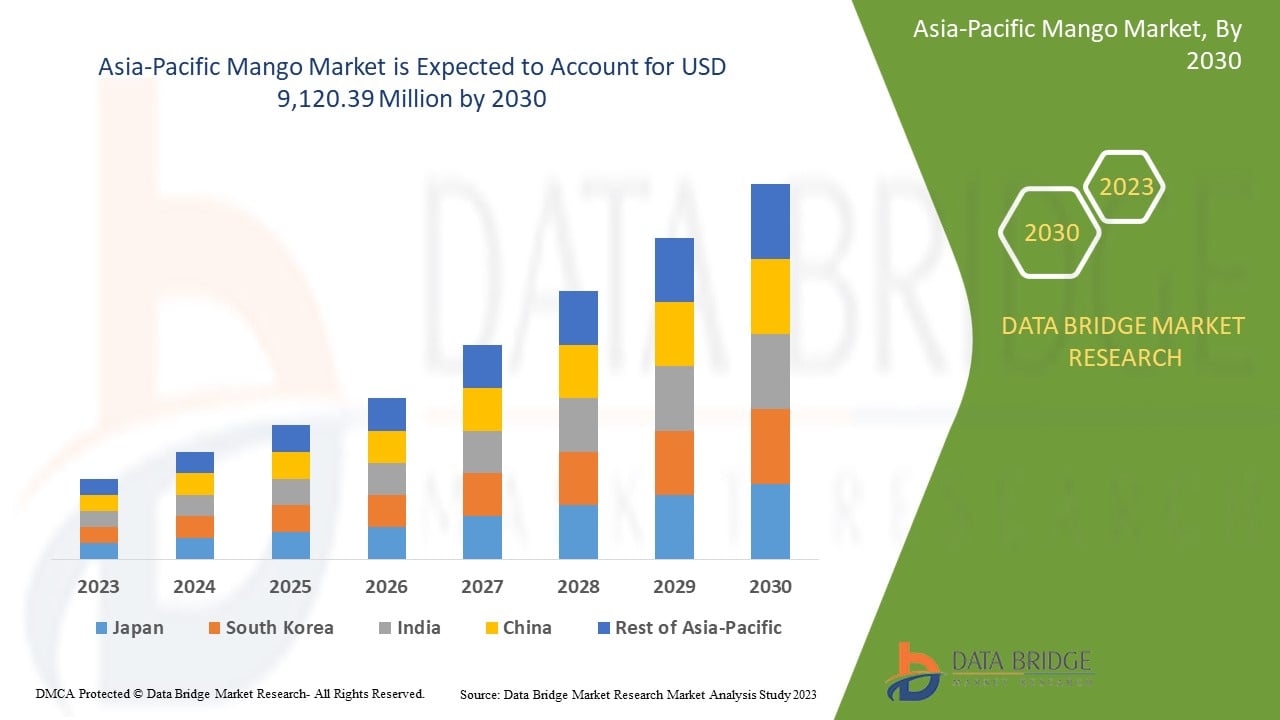
Asia-Pacific Mango Market Analysis and Size
The situation in the worldwide mango market is now pretty tranquil. Although supply is low, demand Mango is a tropical fruit that originated from the Southern Asia region. The fruit is high in vitamins and nutrients and a rich source of vitamins A and C. The fruit is consumed all over the world in fresh, frozen as well as processed forms. Manufacturers will use it to make confectionary and processed food items.
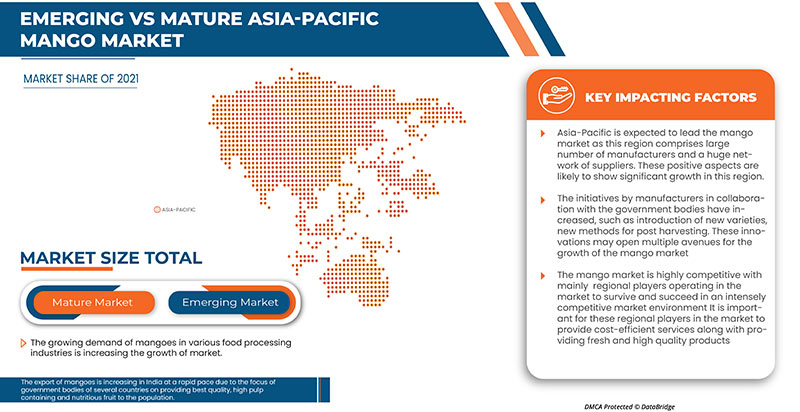
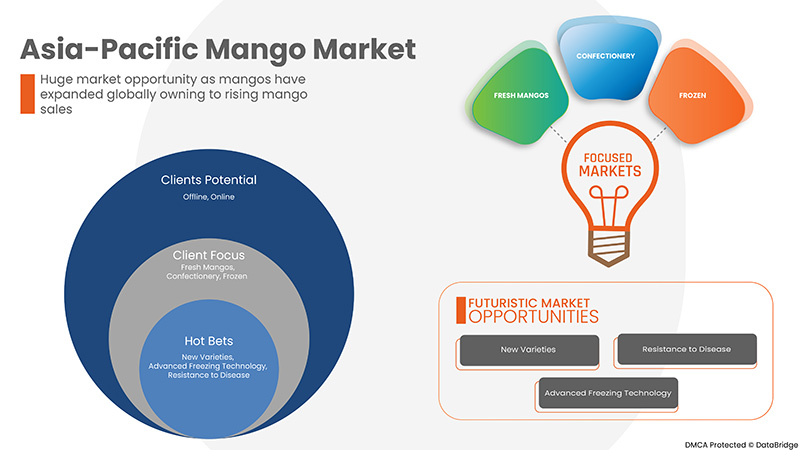
Different varieties of mango are present in the market. The fruit is a rich source of nutrients and vitamins and is widely consumed in fresh, frozen and canned forms. The increasing applications of mango in the beverage industry and processing and confectionery items are expected to drive the demand for the Asia-Pacific mango market. However, seasonal availability and high pest and disease attack may hamper the market growth.
Data Bridge Market Research analyses that the mango market is expected to reach a value of USD 9,120.39 million by 2030, at a CAGR of 5.0% during the forecast period. The unique taste of Alphonso makes it popular among consumers.
|
Report Metric |
Details |
|
Forecast Period |
2023 to 2030 |
|
Base Year |
2022 |
|
Historic Year |
2021 (Customizable to 2020 - 2016) |
|
Quantitative Units |
Revenue in USD Million |
|
Segments Covered |
By Variety (Alphonso, Kesar, Dashehari, Chausa, Langra, Banganapali (BADAMI), Neelum, Totapuri and Others), Packaging Size (Less Than 4 Kg, 4kg to 8 Kg and More than 8kg), Distribution Channel (Offline and Online), Application (B2B and B2C) |
|
Countries Covered |
China, Australia, Japan, South Korea, Singapore, Malaysia, Indonesia, Thailand, Philippines, India and rest of Asia-Pacific |
|
Market Players Covered |
Devgadmango, Ratnagiri Alphonso Mango, Tropical Green Company, Dole Plc, Jayanthagrofarms, Mithuna Foods, Verde Fruits Company LLC, Muthalamada Mangoes, Freshmax Group, Delina Inc, All Seasons Fresh Produce, New Limeco, LLC, Coast Citrus, Premier Fresh Australia and Piñata Farms Operations Pty Ltd. |
Market Definition
Mango (Mangifera Indica), a member of the Anacardiaceae family, is one of the most significant and commonly produced tropical fruits. The mango tree is native to southern Asia, particularly Myanmar and India's Assam state and various cultivars have been developed. Mangos are high in vitamins A, C and D.
Asia-Pacific Mango Market Dynamics
This section deals with understanding the market drivers, advantages, opportunities, restraints and challenges. All of this is discussed in detail below:
Drivers
- Growth in the beverage industry
The major factor likely to support the growth of the Asia-Pacific mango market is the increased product demand from the beverage industry in the upcoming years. Various large-scale food and beverage producers have introduced products based on mango into the market, such as Starbucks, McDonald's and PepsiCo, among others. These brands largely use fruit extracts and purees in their smoothies and drinks. These drinks are in great demand among consumers, likely to leverage the mango market in the future positively.
Moreover, mango-based drinks are back with compelling commercials on television, peddling the belief that they are all you need to quench your thirst in a day. Much like the fruit itself, Mango-based drinks are expected to be in high demand. In addition, there are several mango-flavored drinks in the market like maaza, frooti and slice, which have a large market share in various countries.
The popularity of mango-based drinks can be attributed to many factors such as 'the great Indian mango fetish' which is largely driving it, the joy, passion and excitement of mango, celebrating or enjoying the first set of mangoes for the season and availability of mango fruit for a limited period or is seasonal, which makes it even more desirable among many others.
Furthermore, big companies in the non-alcoholic beverages market, such as Coca-Cola and PepsiCo, have capitalized on the craze for mangoes and the product's steady supply over the years.
- High demand for mango puree owing to growing awareness regarding the use of organic products
Mango puree, often called mango pulp, is a smooth and thick product processed so that the insoluble fibrous parts of the ripe mangoes are broken up. It retains all fruit juice and a huge portion of the fibrous matter naturally, which is found naturally in raw fruit. Organic mango puree is in higher demand by consumers due to growing awareness regarding the usage of organic products. Mango puree is prepared from selected varieties of fresh mango fruit. The preparation process includes cutting, de-stoning, refining and packing. In the case of aseptic products, the pulp is sterilized and packed in aseptic bags. The refined pulp is packed in cans, hermetically sealed and retorted. The frozen pulp is pasteurized and deep-frozen in plate freezers. This process ensures that the natural flavor and aroma of the fruit are retained in the final products. Various large-scale food producers have introduced products based on mango puree into the market.
Due to a lack of time, people in developed and developing regions prefer mango puree instead of raw mangoes for different recipes and desserts. Mango puree is mostly used to make juices, nectars, drinks, jams, fruit, cheese and other beverages. It is also used in puddings, bakery fillings, fruit meals for children, flavors for the food industry and ice creams, yogurt and confectionery items. With the rapid urbanization and increasing disposable income in developing countries, the consumer is inclined towards convenient food products such as ready-to-eat food and ready-to-drink beverages. Food manufacturers are shifting their focus to ready-to-eat products to serve the increasing demand for convenient food products. Therefore, most manufacturers use puree instead of flavouring agents.
Opportunity
- Increase in government initiatives to create awareness regarding healthy eating habits
Mangoes offer plenty of health benefits as they contain vitamin C, an immune-boosting antioxidant that helps fight cancer and other diseases and complications. Mangoes help keep eyes and skin looking healthy as they contain vitamin A and keep the digestive system in good health by providing plenty of fiber. Moreover, mangoes contain potassium, which helps to regulate blood pressure. After looking after these benefits, various governments have taken many initiatives to create awareness among consumers for healthy eating habits, which is expected to create a host of opportunities for the Asia-Pacific mango market.
Restraint/Challenge
- Seasonal cultivation of mangoes
Seasonal mango farming or cultivation is expected to be a major stumbling block to the mango industry's growth. Mangoes grow best in tropical climates, such as Asia and the Pacific. Mango planting is usually done in July-August in rained areas and during February-March in irrigated areas. Mango can be grown in tropical and sub-tropical climates from sea level to 1400 m altitude, provided there is no high humidity, rain, or frost during the flowering period. Places with good rainfall and dry summer are ideal for mango cultivation. It is better to avoid areas with winds and cyclones, which may cause flower and fruit shedding and breaking of branches.
Due to different climate zones and short harvest periods, no single country or mango variety can offer a long supply season. That is why different varieties and production sources are needed to assure continuity. The production campaigns in these tropical countries are not always stable. Temporary shortfalls and oversupply due to overlapping seasons sometimes result in an erratic supply market. This volatility and the need for multiple suppliers make it difficult for traders to fill supply programs with major buyers.
In addition, the lack of a programmed market supply makes mango an interesting export crop for smaller growers. However, while even large producers struggle with quality issues, it is often difficult to comply with expectations for small producers. Therefore, it remains a challenge for buyers to find high-quality mangos year-round. The market needs stability in quality and supply, which becomes difficult to achieve.
Post-COVID-19 Impact on Asia-Pacific Mango Market
COVID-19 has affected the market to some extent. Due to the lockdown, the trade of mangoes worldwide was severely affected due to quarantine measures, influencing the market. Due to the change in many mandates and regulations, manufacturers can design and launch new products, which will help the market's growth.
Recent Development
- Parle company provides two different candies with mango flavors. The Kaccha Mango Bite and Bigger Kaccha Mango Bite both have a delicious raw mango flavor
Asia-Pacific Mango Market Scope
The Asia-Pacific mango market is segmented into notable segments based on variety, packaging size, application and distribution channel. The growth amongst these segments will help you analyze major growth segments in the industries and provide the users with a valuable market overview and market insights to make strategic decisions to identify core market applications.
Variety
- Alphonso
- Kesar
- Dashehari
- Chausa
- Langra
- Banganapali (badami)
- Neelum
- Totapuri
- Others
The variety segment is further segmented into alphonso, kesar, dashehari, chausa, langra, banganapali (badami), neelum, totapuri and others.
Packaging Size
- Less than 4 kg
- 4kg to 8 kg
- More than 8kg
The packaging size segment is segmented into less than 4 kg, 4kg to 8 kg and more than 8kg.
Application
- B2B
- B2C
The application segment is further segmented into B2B and B2C.
Distribution Channel
- Online
- Offline
The distribution channel segment is further segmented into online and offline.
Asia-Pacific Mango Market Regional Analysis/Insights
The Asia-Pacific mango market is analyzed and market size insights and trends are provided based on as referenced above.
The countries covered in the Asia-Pacific mango market report are China, Australia, Japan, South Korea, Singapore, Malaysia, Indonesia, Thailand, Philippines, India and rest of Asia-Pacific.
China is the highest growing country in this region because of the massive growth in the Asia-Pacific fruit trade market in Asia-Pacific. Increased demand for totapuri, Kesar, Alphonso, and banganpali mangoes in India, China, and Thailand is anticipated to drive the overall market growth across the region.
The country section of the report also provides individual market-impacting factors and market regulation changes that impact the market's current and future trends. Data points like downstream and upstream value chain analysis, technical trends, porter's five forces analysis, and case studies are some of the pointers used to forecast the market scenario for individual countries. Also, the presence and availability of Asia-Pacific brands and their challenges are faced due to large or scarce competition from local and domestic brands. The impact of domestic tariffs and trade routes is considered while providing forecast analysis of the country data.
Competitive Landscape and Mango Market Share Analysis
The mango market competitive landscape provides details of a competitor. Details include company overview, company financials, revenue generated, market potential, investment in research and development, new market initiatives, Asia-Pacific presence, production sites and facilities, production capacities, company strengths and weaknesses, product launch, product width and breadth, and application dominance. The above data points are only related to the companies focus on the mango market.
Some major players operating in the mango market are Devgadmango, Ratnagiri Alphonso Mango, Tropical Green Company, Dole Plc, Jayanthagrofarms, Mithuna Foods, Verde Fruits Company LLC, Muthalamada Mangoes, Freshmax Group, Delina Inc., All Seasons Fresh Produce, New Limeco, LLC, Coast Citrus, Premier Fresh Australia and Piñata Farms Operations Pty Ltd among others.
Research Methodology: Asia-Pacific Mango Market
Data collection and base year analysis are done using data collection modules with large sample sizes. The stage includes obtaining market information or related data through various sources and strategies. It includes examining and planning all the data acquired from the past advance. It likewise envelops the examination of information inconsistencies seen across different information sources. The market data is analyzed and estimated using market statistical and coherent models. Also, market share analysis and key trend analysis are the major success factors in the market report. Please request an analyst call or drop down your inquiry to know more.
The key research methodology used by the DBMR research team is data triangulation which involves data mining, analysis of the Impact of data variables on the market, and primary (industry expert) validation. Data models include Vendor Positioning Grid, Market Time Line Analysis, Market Overview and Guide, Company Positioning Grid, Patent Analysis, Pricing Analysis, Company Market Share Analysis, Standards of Measurement, Asia-Pacific versus Regional, and Vendor Share Analysis. To know more about the research methodology, drop in an inquiry to speak to our industry experts.
Customization Available
Data Bridge Market Research is a leader in advanced formative research. We take pride in servicing our existing and new customers with data and analysis matching and matching their goals. The report can be customized to include price trend analysis of target brands understanding the market for additional countries (ask for the list of countries), clinical trial results data, literature review, refurbished market, and product base analysis. Market analysis of target competitors can be analyzed from technology-based analysis to market portfolio strategies. We can add as many competitors as you require data in the format and style you are looking for. Our team of analysts can also provide you with data in crude raw excel files pivot tables (Fact book) or can assist you in creating presentations from the data sets available in the report.
SKU-
세계 최초의 시장 정보 클라우드 보고서에 온라인으로 접속하세요

- 대화형 데이터 분석 대시보드
- 높은 성장 잠재력 기회를 위한 회사 분석 대시보드
- 사용자 정의 및 질의를 위한 리서치 분석가 액세스
- 대화형 대시보드를 통한 경쟁자 분석
- 최신 뉴스, 업데이트 및 추세 분석
- 포괄적인 경쟁자 추적을 위한 벤치마크 분석의 힘 활용
목차
1 서론
1.1 연구 목적
1.2 시장 정의
1.3 아시아 태평양 망고 시장 개요
1.4 제한 사항
1.5 대상 시장
2 시장 세분화
2.1 대상 시장
2.2 지리적 범위
연구에 2.3년이 고려됨
2.4 통화 및 가격
2.5 DBMR TRIPOD 데이터 검증 모델
2.6 다변량 모델링
2.7 치료 수명선 곡선
2.8 주요 여론 선도자와의 1차 인터뷰
2.9 DBMR 시장 위치 그리드
2.1 애플리케이션 적용 범위 그리드
2.11 2차 소스
2.12 가정
3 요약
4가지 프리미엄 인사이트
4.1 소비자 구매 행동
4.2 포터의 5가지 힘 분석
4.2.1 고객의 협상력
4.2.2 공급업체의 협상력
4.2.3 신규 진입자의 위협
4.2.4 대체품 위협
4.2.5 기존 경쟁자 간의 경쟁
4.3 기술적 발전
4.4 무역 분석
4.4.1 유럽
4.4.2 아시아 태평양
4.4.3 북미 및 남미
4.4.4 중동 및 아프리카
5 시장 개요
5.1 드라이버
5.1.1 음료 산업의 성장
5.1.2 유기농 제품 사용에 대한 인식이 높아짐에 따라 망고 퓨레에 대한 수요가 높아짐
5.1.3 다양한 지역에서 제과류에 망고를 사용하는 사례 증가
5.1.4 비식품 응용 분야에서 망고 추출물 사용 증가
5.2 제약
5.2.1 망고의 계절별 재배
5.2.2 과일 생산량 감소로 인한 유기농 망고 부족
5.2.3 높은 해충 및 질병 발생률은 궁극적으로 생산성에 영향을 미칩니다.
5.3 기회
5.3.1 건강한 식습관에 대한 인식을 제고하기 위한 정부 이니셔티브 증가
5.3.2 아이스크림 및 영유아식품 등 다양한 세그먼트에서 증가하는 제품 응용 분야
5.3.3 고품질 망고 생산을 위한 연구 및 개발 프로그램 확대
5.4 과제
5.4.1 다양한 종류의 망고에서의 다양성과 불일치성
5.4.2 오렌지 주스 및 퓨레와 같은 다른 과일 및 대체 제품의 존재
5.4.3 망고 수입-수출에 대한 엄격한 규칙 및 규정
6 아시아 태평양 망고 시장, 품종별
6.1 개요
6.2 알폰소
6.3 케사르
6.4 토타푸리
6.5 랑그라
6.6 다셰하리
6.7 방간팔리
6.8 니룸
6.9 차우사
6.1 기타
7 아시아 태평양 망고 시장, 포장 크기별
7.1 개요
7.2 8kg 이상
7.3 4kg ~ 8kg
7.4 4kg 미만
8 아시아 태평양 망고 시장, 유통 채널별
8.1 개요
8.2 오프라인
8.3 온라인
9 아시아 태평양 망고 시장, 응용 분야별
9.1 개요
9.2 B2B
9.3 B2C
10 아시아 태평양 망고 시장, 지역별
10.1 아시아 태평양
10.1.1 인도
10.1.2 중국
10.1.3 태국
10.1.4 일본
10.1.5 필리핀
10.1.6 인도네시아
10.1.7 대한민국
10.1.8 말레이시아
10.1.9 호주 및 뉴질랜드
10.1.10 싱가포르
10.1.11 아시아 태평양의 나머지 지역
11 회사 전경
11.1 회사 점유율 분석: 아시아 태평양
12 SWOT 분석
13 회사 프로필
13.1 데브가드망고
13.1.1 회사 스냅샷
13.1.2 회사 점유율 분석
13.1.3 제품 포트폴리오
13.1.4 최근 개발
13.2 라트나기리 알폰소 망고
13.2.1 회사 스냅샷
13.2.2 회사 점유율 분석
13.2.3 제품 포트폴리오
13.2.4 최근 개발 사항
13.3 돌 PLC
13.3.1 회사 스냅샷
13.3.2 수익 분석
13.3.3 회사 점유율 분석
13.3.4 제품 포트폴리오
13.3.5 최근 개발
13.4 코스트 시트러스
13.4.1 회사 스냅샷
13.4.2 회사 점유율 분석
13.4.3 제품 포트폴리오
13.4.4 최근 개발
13.5 피냐타 팜스 오퍼레이션 주식회사
13.5.1 회사 스냅샷
13.5.2 회사 점유율 분석
13.5.3 제품 포트폴리오
13.5.4 최근 개발
13.6 올시즌 망고
13.6.1 회사 스냅샷
13.6.2 제품 포트폴리오
13.6.3 최근 개발
13.7 델리나 주식회사
13.7.1 회사 스냅샷
13.7.2 제품 포트폴리오
13.7.3 최근 개발
13.8 프레쉬맥스 그룹
13.8.1 회사 스냅샷
13.8.2 제품 포트폴리오
13.8.3 최근 개발
13.9 자얀타그로팜스
13.9.1 회사 스냅샷
13.9.2 제품 포트폴리오
13.9.3 최근 개발 사항
13.1 미투나푸드
13.10.1 회사 스냅샷
13.10.2 제품 포트폴리오
13.10.3 최근 개발 사항
13.11 무탈라마다 망고
13.11.1 회사 스냅샷
13.11.2 제품 포트폴리오
13.11.3 최근 개발
13.12 뉴라임코 유한회사
13.12.1 회사 스냅샷
13.12.2 제품 포트폴리오
13.12.3 최근 개발
13.13 프리미어 프레시 오스트레일리아
13.13.1 회사 스냅샷
13.13.2 제품 포트폴리오
13.13.3 최근 개발
13.14 트로피컬그린 주식회사
13.14.1 회사 스냅샷
13.14.2 제품 포트폴리오
13.14.3 최근 개발
13.15 베르데 과일 회사 유한회사.
13.15.1 회사 스냅샷
13.15.2 제품 포트폴리오
13.15.3 최근 개발 사항
14 설문지
15 관련 보고서
표 목록
표 1 스페인의 망고 거래량 추정치(톤)
표 2 지난 5년간 망고 수출량
표 3 인도의 망고 수출 국가별 데이터(2019-20)
표 4 인도에서 상위 10개국으로의 신선 망고 수출량(2021-22)
표 5 아시아 태평양 망고 시장, 품종별, 2021-2030 (백만 달러)
표 6 아시아 태평양 알폰소 망고의 망고 시장, 지역별, 2021-2030 (백만 달러)
표 7 아시아 태평양 케사르 망고의 망고 시장, 지역별, 2021-2030 (백만 달러)
표 8 아시아 태평양 토타푸리 망고의 망고 시장, 지역별, 2021-2030 (백만 달러)
표 9 아시아 태평양 랑그라 망고의 망고 시장, 지역별, 2021-2030 (백만 달러)
표 10 아시아 태평양 다셰하리 망고, 망고 시장, 지역별, 2021-2030 (백만 달러)
표 11 아시아 태평양 BANGANPALI MANGO in MANGO 시장, 지역별, 2021-2030 (USD 백만)
표 12 아시아 태평양 망고 시장에서의 NEELUM 망고, 지역별, 2021-2030 (백만 달러)
표 13 아시아 태평양 차우사 망고 시장, 지역별 망고 시장, 2021-2030 (백만 달러)
표 14 아시아 태평양 기타 지역별 망고 시장의 망고, 2021-2030년 (백만 달러)
표 15 아시아 태평양 망고 시장, 포장 크기별, 2021-2030 (백만 달러)
표 16 아시아 태평양 지역별 망고 시장 8kg 이상, 2021-2030년(백만 달러)
표 17 아시아 태평양 지역별 4kg~5kg 망고 시장, 2021~2030년 (백만 달러)
표 18 아시아 태평양 지역별 4kg 미만 망고 시장, 2021-2030년 (백만 달러)
표 19 아시아 태평양 망고 시장, 유통 채널별, 2021-2030 (백만 달러)
표 20 아시아 태평양 지역 오프라인 망고 시장, 지역별, 2021-2030 (백만 달러)
표 21 아시아 태평양 온라인 망고 시장, 지역별, 2021-2030 (백만 달러)
표 22 아시아 태평양 망고 시장, 응용 분야별, 2021-2030 (백만 달러)
표 23 아시아 태평양 B2B 망고 시장, 지역별, 2021-2030 (백만 달러)
표 24 아시아 태평양 B2C 망고 시장, 지역별, 2021-2030 (백만 달러)
표 25 아시아 태평양 망고 시장, 국가별, 2021-2030 (백만 달러)
표 26 아시아 태평양 망고 시장, 품종별, 2021-2030 (백만 달러)
표 27 아시아 태평양 망고 시장, 포장 크기별, 2022-2030 (백만 달러)
표 28 아시아 태평양 망고 시장, 유통 채널별, 2022-2030 (백만 달러)
표 29 아시아 태평양 망고 시장, 응용 분야별, 2022-2030 (백만 달러)
표 30 인도 망고 시장, 품종별, 2021-2030 (백만 달러)
표 31 인도 망고 시장, 포장 크기별, 2022-2030 (백만 달러)
표 32 인도 망고 시장, 유통 채널별, 2022-2030년(백만 달러)
표 33 인도 망고 시장, 응용 분야별, 2022-2030 (백만 달러)
표 34 중국 망고 시장, 품종별, 2021-2030 (백만 달러)
표 35 중국 망고 시장, 포장 크기별, 2022-2030 (백만 달러)
표 36 중국 망고 시장, 유통 채널별, 2022-2030 (백만 달러)
표 37 중국 망고 시장, 응용 분야별, 2022-2030 (백만 달러)
표 38 태국 망고 시장, 품종별, 2021-2030 (백만 달러)
표 39 태국 망고 시장, 포장 크기별, 2022-2030 (백만 달러)
표 40 태국 망고 시장, 유통 채널별, 2022-2030 (백만 달러)
표 41 태국 망고 시장, 응용 분야별, 2022-2030 (백만 달러)
표 42 일본 망고 시장, 품종별, 2021-2030 (백만 달러)
표 43 일본 망고 시장, 포장 크기별, 2022-2030 (백만 달러)
표 44 유통 채널별 일본 망고 시장, 2022-2030년(백만 달러)
표 45 일본 망고 시장, 응용 분야별, 2022-2030 (백만 달러)
표 46 필리핀 망고 시장, 품종별, 2021-2030 (백만 달러)
표 47 필리핀 망고 시장, 포장 크기별, 2022-2030 (백만 달러)
표 48 필리핀 망고 시장, 유통 채널별, 2022-2030년(백만 달러)
표 49 필리핀 망고 시장, 응용 분야별, 2022-2030 (백만 달러)
표 50 인도네시아 망고 시장, 품종별, 2021-2030 (백만 달러)
표 51 인도네시아 망고 시장, 포장 크기별, 2022-2030년(백만 달러)
표 52 인도네시아 망고 시장, 유통 채널별, 2022-2030년(백만 달러)
표 53 인도네시아 망고 시장, 응용 분야별, 2022-2030 (백만 달러)
표 54 한국 망고 시장, 품종별, 2021-2030 (백만 달러)
표 55 한국 망고 시장, 포장 크기별, 2022-2030 (백만 달러)
표 56 유통 채널별 한국 망고 시장, 2022-2030년(백만 달러)
표 57 한국 망고 시장, 응용 분야별, 2022-2030 (백만 달러)
표 58 말레이시아 망고 시장, 품종별, 2021-2030 (백만 달러)
표 59 말레이시아 망고 시장, 포장 크기별, 2022-2030년(백만 달러)
표 60 말레이시아 망고 시장, 유통 채널별, 2022-2030년(백만 달러)
표 61 말레이시아 망고 시장, 응용 분야별, 2022-2030 (백만 달러)
표 62 호주 및 뉴질랜드 망고 시장, 품종별, 2021-2030 (백만 달러)
표 63 호주 및 뉴질랜드 망고 시장, 포장 크기별, 2022-2030 (백만 달러)
표 64 호주 및 뉴질랜드 망고 시장, 유통 채널별, 2022-2030년(백만 달러)
표 65 호주 및 뉴질랜드 망고 시장, 응용 분야별, 2022-2030 (백만 달러)
표 66 싱가포르 망고 시장, 품종별, 2021-2030 (백만 달러)
표 67 싱가포르 망고 시장, 포장 크기별, 2022-2030년(백만 달러)
표 68 싱가포르 망고 시장, 유통 채널별, 2022-2030년(백만 달러)
표 69 싱가포르 망고 시장, 응용 분야별, 2022-2030 (백만 달러)
표 70 아시아 태평양 망고 시장의 나머지 지역, 품종별, 2021-2030년(백만 달러)
그림 목록
그림 1 아시아 태평양 망고 시장: 세분화
그림 2 아시아 태평양 망고 시장: 데이터 삼각 측량
그림 3 아시아 태평양 망고 시장: DROC 분석
그림 4 아시아 태평양 망고 시장: 아시아 태평양 대 지역 시장 분석
그림 5 아시아 태평양 망고 시장: 회사 연구 분석
그림 6 아시아 태평양 망고 시장: 인터뷰 인구 통계
그림 7 아시아 태평양 망고 시장: DBMR 시장 위치 그리드
그림 8 아시아 태평양 망고 시장: 응용 프로그램 적용 범위 그리드
그림 9 아시아 태평양 망고 시장: 세분화
그림 10 비식품 응용 분야에서 망고 추출물 사용에 대한 수요 증가는 2023년에서 2030년까지의 예측 기간 동안 아시아 태평양 망고 시장 성장을 견인하고 있습니다.
그림 11 품종 세그먼트는 2023년 및 2030년에 아시아 태평양 망고 시장에서 가장 큰 점유율을 차지할 것으로 예상됩니다.
그림 12 포터의 5가지 힘 분석
그림 13 유럽의 망고 수입량(2016-2020)
그림 14 원산지 및 2020년 유럽의 망고 거래량에서의 점유율
그림 15 2020년 국가별 망고 수입 및 수출
그림 16 중국의 망고 수입량(톤) 2011-2020
그림 17 아시아 태평양 망고 시장의 동인, 제약, 기회 및 과제
그림 18 아시아 태평양 망고 시장: 품종별, 2022
그림 19 아시아 태평양 망고 시장, 포장 크기별, 2022년
그림 20 그림 3 아시아 태평양 망고 시장, 유통 채널별, 2022
그림 21 아시아 태평양 망고 시장, 응용 분야별, 2022
그림 22 아시아 태평양 망고 시장: 스냅샷(2022)
그림 23 아시아 태평양 망고 시장: 국가별(2022년)
그림 24 아시아 태평양 망고 시장: 국가별(2023년 및 2030년)
그림 25 아시아 태평양 망고 시장: 국가별(2022년 및 2030년)
그림 26 아시아 태평양 망고 시장: 품종별(2023년 및 2030년)
그림 27 아시아 태평양 망고 시장: 회사 점유율 2022(%)

연구 방법론
데이터 수집 및 기준 연도 분석은 대규모 샘플 크기의 데이터 수집 모듈을 사용하여 수행됩니다. 이 단계에는 다양한 소스와 전략을 통해 시장 정보 또는 관련 데이터를 얻는 것이 포함됩니다. 여기에는 과거에 수집한 모든 데이터를 미리 검토하고 계획하는 것이 포함됩니다. 또한 다양한 정보 소스에서 발견되는 정보 불일치를 검토하는 것도 포함됩니다. 시장 데이터는 시장 통계 및 일관된 모델을 사용하여 분석하고 추정합니다. 또한 시장 점유율 분석 및 주요 추세 분석은 시장 보고서의 주요 성공 요인입니다. 자세한 내용은 분석가에게 전화를 요청하거나 문의 사항을 드롭하세요.
DBMR 연구팀에서 사용하는 주요 연구 방법론은 데이터 마이닝, 시장에 대한 데이터 변수의 영향 분석 및 주요(산업 전문가) 검증을 포함하는 데이터 삼각 측량입니다. 데이터 모델에는 공급업체 포지셔닝 그리드, 시장 타임라인 분석, 시장 개요 및 가이드, 회사 포지셔닝 그리드, 특허 분석, 가격 분석, 회사 시장 점유율 분석, 측정 기준, 글로벌 대 지역 및 공급업체 점유율 분석이 포함됩니다. 연구 방법론에 대해 자세히 알아보려면 문의를 통해 업계 전문가에게 문의하세요.
사용자 정의 가능
Data Bridge Market Research는 고급 형성 연구 분야의 선두 주자입니다. 저희는 기존 및 신규 고객에게 목표에 맞는 데이터와 분석을 제공하는 데 자부심을 느낍니다. 보고서는 추가 국가에 대한 시장 이해(국가 목록 요청), 임상 시험 결과 데이터, 문헌 검토, 재생 시장 및 제품 기반 분석을 포함하도록 사용자 정의할 수 있습니다. 기술 기반 분석에서 시장 포트폴리오 전략에 이르기까지 타겟 경쟁업체의 시장 분석을 분석할 수 있습니다. 귀하가 원하는 형식과 데이터 스타일로 필요한 만큼 많은 경쟁자를 추가할 수 있습니다. 저희 분석가 팀은 또한 원시 엑셀 파일 피벗 테이블(팩트북)로 데이터를 제공하거나 보고서에서 사용 가능한 데이터 세트에서 프레젠테이션을 만드는 데 도움을 줄 수 있습니다.











