


Europe Industrial IoT Market, By Technology (Sensors, Industrial Robotics, Cameras, Distributed Control System, GPS/GNSS, Networking Technology, RFID, Interface Board, Condition Monitoring, Yield Monitoring, Smart Meters, Smart Beacon, Flow & Application Control Device, Guidance & Steering, and Electronic Shelf Label), Application (SCADA, MES, PLM, Distribution Management System, Transit Management System, Outage Management System, Visualization Software, Remote Patient Monitoring, Retail Management Software, Farm Management System And Others), Connectivity (Wired, Wireless And Hybrid), End Use (Manufacturing, Transportation & Logistics, Energy, Oil & Gas, Metal & Mining, Healthcare, Retail, Agriculture, and Others) Industry Trends and Forecast to 2029
Europe Industrial IoT Market Analysis and Size
Increased use of the industrial IoT market due to the adoption of Artificial Intelligence (AI) and Machine Learning (ML) in the end user industry is also driving the market's growth. The higher probability of device theft and data breaches is expected to restrain the industrial IoT market. Growing internet penetration and digitalization across the globe are an opportunity for the industrial IoT market. High installation costs and difficulties in integrating IoT devices challenge the Europe industrial IoT market.
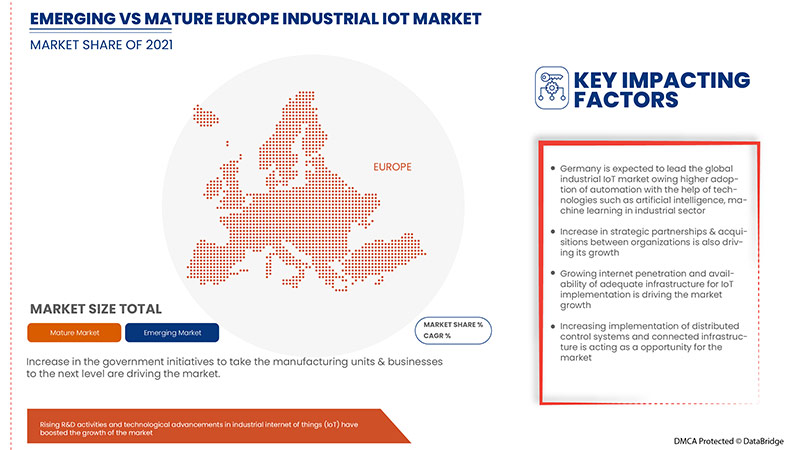
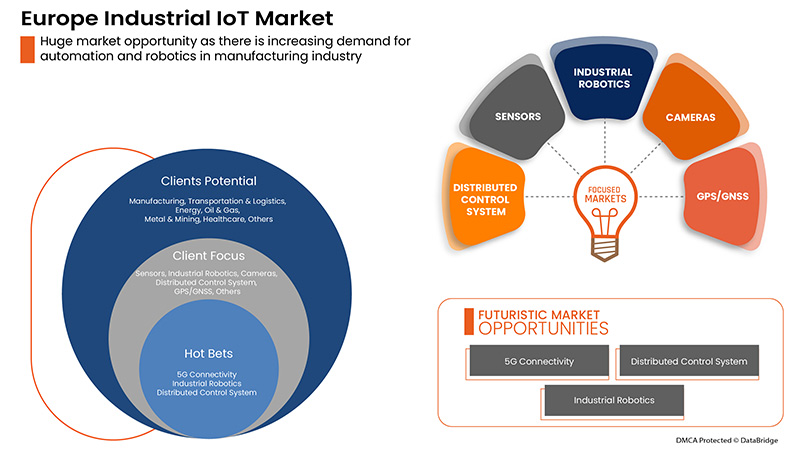
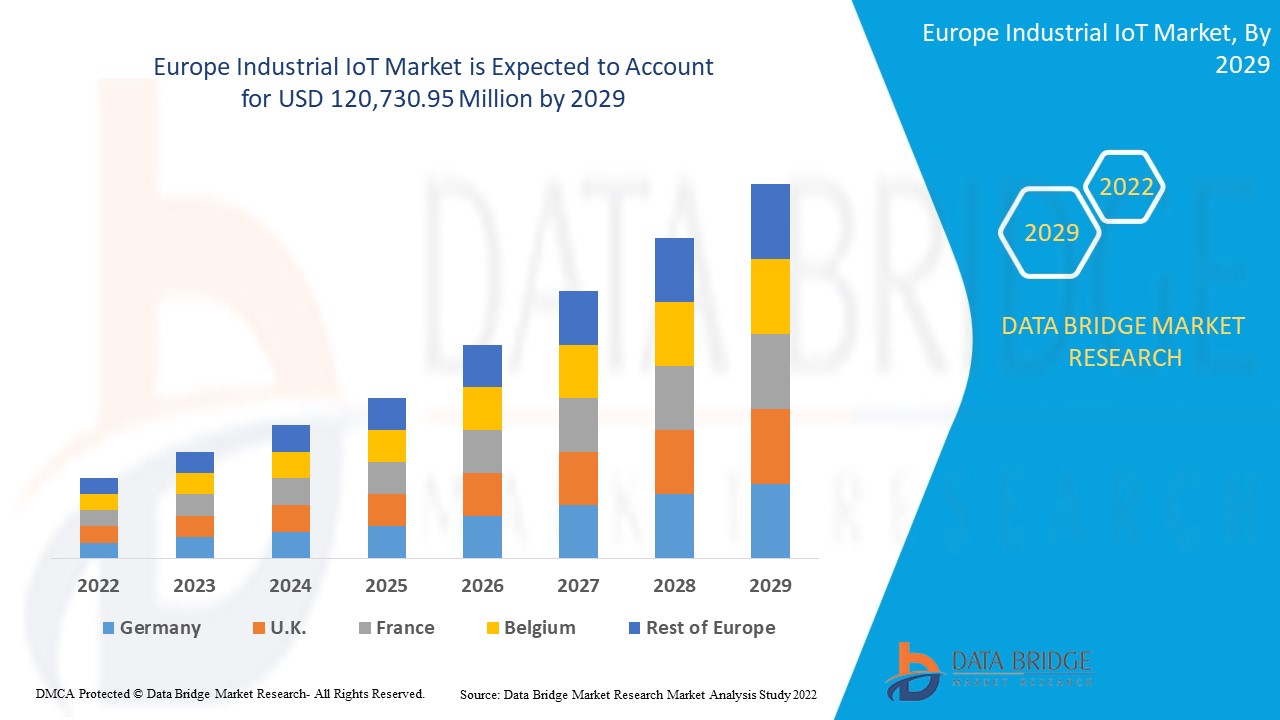
Data Bridge Market Research analyses that the Europe industrial IoT market is expected to reach USD 120,730.95 million by 2029, at a CAGR of 9.6% during the forecast period. "Sensors" accounts for the most prominent technology segment as this type of technology is in demand and is the best option to extract information from industrial components. The industrial IoT market report also comprehensively covers pricing, patent, and technological advancements.
|
Report Metric |
Details |
|
Forecast Period |
2022 to 2029 |
|
Base Year |
2021 |
|
Historic Years |
2020 (Customizable to 2019-2014) |
|
Quantitative Units |
Revenue in USD Million, Volumes in Units, Pricing in USD |
|
Segments Covered |
By Technology (Sensors, Industrial Robotics, Cameras, Distributed Control System, GPS/GNSS, Networking Technology, RFID, Interface Board, Condition Monitoring, Yield Monitoring, Smart Meters, Smart Beacon, Flow & Application Control Device, Guidance & Steering, and Electronic Shelf Label), Application (SCADA, MES, PLM, Distribution Management System, Transit Management System, Outage Management System, Visualization Software, Remote Patient Monitoring, Retail Management Software, Farm Management System, and Others), Connectivity (Wired, Wireless, and Hybrid), End Use (Manufacturing, Transportation & Logistics, Energy, Oil & Gas, Metal & Mining, Healthcare, Retail, Agriculture, and Others)– Industry Trends and Forecast to 2029 |
|
Countries Covered |
Germany, France, Italy, U.K., Turkey, Switzerland, Spain, Russia, Netherlands, Belgium, and the Rest of Europe |
|
Market Players Covered |
Cisco Systems, Inc., Siemens. General Electric, IBM Corporation, Intel Corporation, PTC, Honeywell International Inc., NEC Corporation, Rockwell Automation, ABB, SAP SE, Texas Instruments Incorporated, Robert Bosch GmbH, Emerson Electric Co., Microsoft, KUKA AG, Sigfox Network Limited (a subsidiary of UnaBiz), Wipro, Arm Limited (a subsidiary of Softbank Group Corp.) and Huawei Technologies Co., Ltd., among others |
Market Definition
The extension and application of the internet of things (IoT) in industrial sectors and applications are referred to as the industrial internet of things (IoT). The Machine-to-Machine (M2M) Internet of Things (IIoT) enables businesses and industries to operate more efficiently and reliably because of its strong emphasis on M2M connectivity, big data, and machine learning. Industrial applications such as robotics, medical technology, and software-defined production processes are all included in the IIoT.
Industrial IoT Market Dynamics
This section deals with understanding the market drivers, advantages, opportunities, restraints, and challenges. All of this is discussed in detail below:
Drivers
- Increase in adoption of artificial intelligence (AI) and machine learning (ML) in end user industry
The popularity of AI and ML is increasing year over year in various industries such as manufacturing, healthcare, energy, oil & gas, and many others. Most of these industries adopt the technology to increase working efficiency, automate the service delivery process and modernize the offerings, which has gained an important role in competing with competitors in the market. Thus, the rising trend of AI & ML adoption is a major driver of the growth of the Europe industrial IoT market.
- Surge in implementation of sensors and distributed control systems in business operations
The adoption of sensors and distributed control system will help control and manage the work process and automate the management process for all industrial processes. Thus, the demand for implementing sensors and DCS in various business operations will increase yearly. Thus, globally, the need for sensors and DCS is increasing due to multiple advantages associated with the implementation. It promotes the growth of the Europe Industrial IoT market and acts as a driver for the development of the market.
- Increase in the need for real-time data solutions and services
The real-time data solutions require a wide range of electronic devices, and the demand for IoT devices is expected to increase to support real-time data analysis in business operations to keep a quick understanding of data and guide the decisions to deliver products or services to customers. Thus, there is high demand for the adoption of real-time solutions that directly involve the usage of IoT devices for industries. Therefore it is expected to be a major driver of market growth.
Restraints/ Challenges
- Lack of skilled labor and training sessions
Adopting IoT solutions for industries is not quick and easy; it involves complete visualization and an adequate method of automating the sector. Therefore, end users need more time and labor to adopt the solutions and train the employees to understand the process and maintenance.
- Higher probability of device theft and data breaches
The dependability of the IT climate suggests getting the plant's resources, organization, and information created by these associated gadgets. The reliability responsibility is higher in adopting digitalization in business operations; however, there is a high probability of a safety disadvantage.
- Rise in the technical complexities due to day-by-day technological advancement
Flexible security is one thought for giving medical care, instruction, and lodging help, whether somebody is officially utilized. Furthermore, action records can back deep-rooted training and laborer retraining. Regardless of how individuals decide to invest energy, there should be ways for individuals to live satisfying lives irrespective of whether society needs fewer specialists. Thus, continuous technological advancement will lead to constant employee training and hinder the market growth.
Post COVID-19 Impact on Industrial IoT Market
COVID-19 significantly impacted the industrial IoT market as almost every country has opted for the shutdown for every production facility except those dealing in producing essential goods. The government has taken strict actions, such as shutting down production and sale of non-essential goods, blocking international trade, and many more, to prevent the spread of COVID-19. The only business dealing in this pandemic situation is the essential services allowed to open and run the processes.
The growth of the industrial IoT market is rising due to the digitalization in the production process and supply chains across agriculture, electrical utilities, mining, oil and gas, and transportation. Moreover, the IoT adoption in industries had huge progress from 2020 to 2021 as the pandemic demonstrated the importance of IoT in all types of businesses. The surge in demand for automation to avoid the involvement of a maximum workforce has driven the adoption of IoT in industries. This replicates the positive impact of COVID-19 on the IIoT market, which has further catalyzed the business through adopting industry 4.0 technologies.
Manufacturers are making various strategic decisions to bounce back post-COVID-19. The players are conducting multiple research and development activities to improve the technology involved in the industrial IoT market. The companies will bring advanced and accurate solutions to the market.
Recent Development
- In March 2022, Cisco Systems, Inc. developed an advanced IoT Control Center platform to help improve service reliability and reduce operational costs. This development will help the company diversify its solution portfolio and offers better quality solutions
- In April 2022, Arm Limited introduced two new solutions, Arm Cortex-M85 and Cortex-A. These new products and solutions will help the company offer better solutions to customers, attracting new customers and accelerating revenue growth
Europe Industrial IoT Market Scope
The industrial IoT market is segmented based on technology, application, connectivity, and end use. The growth amongst these segments will help you analyze meager growth segments in the industries and provide the users with a valuable market overview and market insights to help them make strategic decisions for identifying core market applications.
By Technology
- Sensors
- Industrial Robotics
- Cameras
- Distributed Control System
- GPS/GNSS
- Networking Technology
- RFID
- Interface Board
- Condition Monitoring
- Yield Monitoring
- Smart Meters
- Smart Beacon
- Flow & Application Control Device
- Guidance & Steering
- Electronic Shelf Label
On the basis of technology, the Europe industrial IoT market is segmented into sensors, industrial robotics, cameras, distributed control system, GPS/GNSS, networking technology, RFID, interface board, condition monitoring, yield monitoring, smart meters, smart beacon, flow & application control device, guidance & steering, and electronic shelf label.
By Application
- SCADA
- MES
- PLM
- Distribution Management System
- Transit Management System
- Outage Management System
- Visualization Software
- Remote Patient Monitoring
- Retail Management Software
- Farm Management System
- Others
On the basis of application, the Europe industrial IoT market has been segmented into SCADA, MES, PLM, distribution management system, transit management system, outage management system, visualization software, remote patient monitoring, retail management software, farm management system, and others.
By Connectivity
- Wired
- Wireless
- Hybrid
On the basis of connectivity, the Europe industrial IoT market has been segmented into wired, wireless, and hybrid.
By End-Use
- Manufacturing
- Transportation & Logistics
- Energy
- Oil & Gas
- Metal & Mining
- Healthcare
- Retail
- Agriculture
- Others
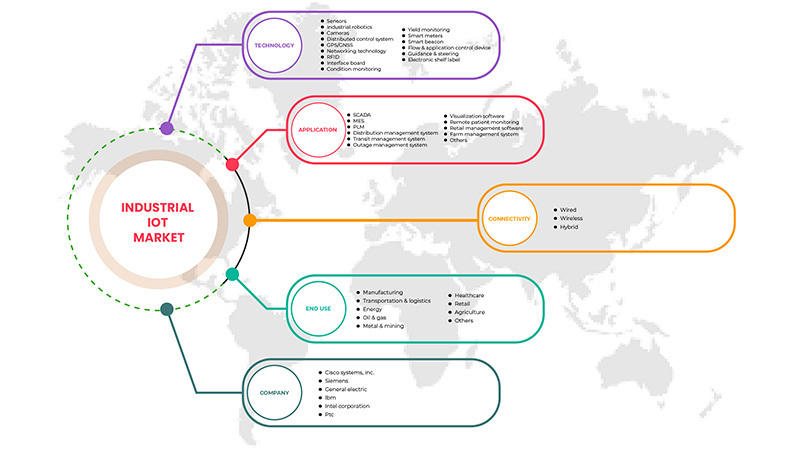
On the basis of End-Use, the Europe industrial IoT market has been segmented into manufacturing, transportation & logistics, energy, oil & gas, metal & mining, healthcare, retail, agriculture, and others.
Industrial IoT Market Regional Analysis/Insights
The industrial IoT market is analyzed, and market size insights and trends are provided by technology, application, connectivity, and end-use, as referenced above.
The countries covered in the industrial IoT market report are Germany, France, Italy, U.K., Turkey, Switzerland, Spain, Russia, Netherlands, Belgium, and the rest of Europe.
Germany dominates the Europe industrial IoT market. Germany is likely to be the fastest-growing industrial IoT market. Germany develops cloud-based solutions and services to improve security and contribute new levels of operational intelligence for governments, enterprises, transport, and communities. This will boost the demand for industrial IoT products in the Europe region.
The country section of the report also provides individual market-impacting factors and market regulation changes that impact the market's current and future trends. Data points like downstream and upstream value chain analysis, technical trends, porter's five forces analysis, and case studies are some of the pointers used to forecast the market scenario for individual countries. Also, the presence and availability of Europe brands and their challenges faced due to large or scarce competition from local and domestic brands, the impact of domestic tariffs, and trade routes are considered while providing a forecast analysis of the country data.
Competitive Landscape and Industrial IoT Market Share Analysis
The industrial IoT market competitive landscape provides details about the competitor. Components included are company overview, company financials, revenue generated, market potential, investment in research and development, new market initiatives, Europe presence, production sites and facilities, production capacities, company strengths and weaknesses, product launch, product width and breadth, and application dominance. The above data points provided are only related to the companies' focus related Inter to the industrial IoT market.
Some of the major players operating in the industrial IoT market are:
- Cisco Systems, Inc.
- Siemens
- General Electric
- IBM Corporation
- Intel Corporation
- PTC
- Honeywell International Inc.
- NEC Corporation
- Rockwell Automation, Inc.
- ABB
- SAP SE
- Texas Instruments Incorporated
- Robert Bosch GmbH
- Emerson Electric Co.
- Microsoft
- KUKA AG
- Sigfox Partner Network (a subsidiary of UnaBiz)
- Wipro
- Arm Limited (a subsidiary of Softbank Group Corp.)
- Huawei Technologies Co., Ltd.
SKU-
세계 최초의 시장 정보 클라우드 보고서에 온라인으로 접속하세요

- 대화형 데이터 분석 대시보드
- 높은 성장 잠재력 기회를 위한 회사 분석 대시보드
- 사용자 정의 및 질의를 위한 리서치 분석가 액세스
- 대화형 대시보드를 통한 경쟁자 분석
- 최신 뉴스, 업데이트 및 추세 분석
- 포괄적인 경쟁자 추적을 위한 벤치마크 분석의 힘 활용
목차
1 서론
1.1 연구 목적
1.2 시장 정의
1.3 유럽 산업용 IoT 시장 개요
1.4 통화 및 가격
1.5 제한 사항
1.6 대상 시장
2 시장 세분화
2.1 대상 시장
2.2 지리적 범위
연구에 2.3년이 고려됨
2.4 DBMR TRIPOD 데이터 검증 모델
2.5 주요 여론 리더와의 1차 인터뷰
2.6 DBMR 시장 위치 그리드
2.7 공급업체 점유율 분석
2.8 다변량 모델링
2.9 기술 타임라인 곡선
2.1 시장 최종 사용 범위 그리드
2.11 2차 소스
2.12 가정
3 요약
4가지 프리미엄 인사이트
4.1 사용 사례 분석
4.1.1 개요
4.1.2 예측 유지 관리
4.1.3 위치 추적
4.1.4 직장 분석
4.1.5 원격 품질 모니터링
4.1.6 에너지 최적화
5 시장 개요
5.1 드라이버
5.1.1 최종 사용자 산업에서 인공 지능(AI) 및 머신 러닝(ML) 도입 증가
5.1.2 비즈니스 운영에서 센서 및 분산 제어 시스템 구현의 급증
5.1.3 실시간 데이터 솔루션 및 서비스에 대한 필요성 증가
5.1.4 자동차 및 제조 산업에서 Industry 4.0의 침투 증가
5.2 제약
5.2.1 숙련 노동력 및 교육 세션 부족
5.2.2 장치 도난 및 데이터 침해의 더 높은 확률
5.2.3 날로 발전하는 기술로 인한 기술적 복잡성의 증가
5.3 기회
5.3.1 전 세계 인터넷 보급률 증가
5.3.2 디지털화 추세의 증가
5.3.3 스마트 기술의 발전
5.3.4 클라우드 기반 배포 모델의 높은 채택률
5.4 과제
5.4.1 높은 설치 비용
5.4.2 IoT 기기 통합의 어려움
6 유럽 산업용 IoT 시장, 기술별
6.1 개요
6.2 센서
6.3 산업용 로봇공학
6.4 카메라
6.5 분산 제어 시스템
6.6 GPS/GNSS
6.7 네트워킹 기술
6.8 무선주파수(RFID)
6.9 인터페이스 보드
6.1 상태 모니터링
6.11 수확량 모니터링
6.12 스마트 미터
6.13 스마트 비콘
6.14 흐름 및 응용 프로그램 제어 장치
6.15 안내 및 조종
6.16 전자 선반 라벨
7 유럽 산업용 IoT 시장, 응용 분야별
7.1 개요
7.2 스카다
7.3 MES
7.4 PLM
7.5 분산 제어 시스템
7.6 교통 관리 시스템
7.7 정전 관리 시스템
7.8 시각화 소프트웨어
7.9 원격 환자 모니터링
7.1 소매 관리 소프트웨어
7.11 농장 관리 시스템
7.12 기타
8 유럽 산업용 IoT 시장, 연결성별
8.1 개요
8.2 유선
8.3 무선
8.4 하이브리드
9 유럽 산업용 IoT 시장, 최종 사용별
9.1 개요
9.2 제조
9.3 운송 및 물류
9.4 에너지
9.5 석유 및 가스
9.6 금속 및 광업
9.7 건강관리
9.8 소매
9.9 농업
9.1 기타
10 유럽 산업용 IoT 시장, 지역별
10.1 유럽
10.1.1 독일
10.1.2 영국
10.1.3 프랑스
10.1.4 이탈리아
10.1.5 스페인
10.1.6 스위스
10.1.7 네덜란드
10.1.8 터키
10.1.9 러시아
10.1.10 벨기에
10.1.11 유럽의 나머지 지역
11 유럽 산업용 IoT 시장, 회사 환경
11.1 회사 점유율 분석: 유럽
12 SWOT 분석
13 회사 프로필
13.1 시스코 시스템즈 주식회사
13.1.1 회사 스냅샷
13.1.2 수익 분석
13.1.3 회사 점유율 분석
13.1.4 제품 포트폴리오
13.1.5 최근 개발 사항
13.2 지멘스
13.2.1 회사 스냅샷
13.2.2 수익 분석
13.2.3 회사 점유율 분석
13.2.4 제품 포트폴리오
13.2.5 최근 개발 사항
13.3 일반 전기
13.3.1 회사 스냅샷
13.3.2 수익 분석
13.3.3 회사 점유율 분석
13.3.4 제품 포트폴리오
13.3.5 최근 개발 사항
13.4 IBM 주식회사
13.4.1 회사 스냅샷
13.4.2 수익 분석
13.4.3 회사 점유율 분석
13.4.4 제품 포트폴리오
13.4.5 최근 개발 사항
13.5 인텔 코퍼레이션
13.5.1 회사 스냅샷
13.5.2 수익 분석
13.5.3 회사 점유율 분석
13.5.4 제품 포트폴리오
13.5.5 최근 개발 사항
13.6 표준
13.6.1 회사 스냅샷
13.6.2 수익 분석
13.6.3 제품 포트폴리오
13.6.4 최근 개발
13.7 ARM LIMITED (소프트뱅크 그룹의 자회사)
13.7.1 회사 스냅샷
13.7.2 수익 분석
13.7.3 제품 포트폴리오
13.7.4 최근 개발 사항
13.8 에머슨 일렉트릭(주)
13.8.1 회사 스냅샷
13.8.2 수익 분석
13.8.3 제품 포트폴리오
13.8.4 최근 개발 사항
13.9 허니웰 인터내셔널 주식회사
13.9.1 회사 스냅샷
13.9.2 수익 분석
13.9.3 제품 포트폴리오
13.9.4 최근 개발 사항
13.1 화웨이 테크놀로지 주식회사
13.10.1 회사 스냅샷
13.10.2 제품 포트폴리오
13.10.3 최근 개발 사항
13.11 쿠카 AG
13.11.1 회사 스냅샷
13.11.2 수익 분석
13.11.3 제품 포트폴리오
13.11.4 최근 개발 사항
13.12 마이크로소프트
13.12.1 회사 스냅샷
13.12.2 수익 분석
13.12.3 제품 포트폴리오
13.12.4 최근 개발 사항
13.13 NEC 주식회사
13.13.1 회사 스냅샷
13.13.2 수익 분석
13.13.3 제품 포트폴리오
13.13.4 최근 개발 사항
13.14 피티씨
13.14.1 회사 스냅샷
13.14.2 수익 분석
13.14.3 제품 포트폴리오
13.14.4 최근 개발 사항
13.15 로버트 보쉬 GMBH
13.15.1 회사 스냅샷
13.15.2 수익 분석
13.15.3 제품 포트폴리오
13.15.4 최근 개발 사항
13.16 로크웰 오토메이션 주식회사
13.16.1 회사 스냅샷
13.16.2 수익 분석
13.16.3 제품 포트폴리오
13.16.4 최근 개발 사항
13.17 SAP SE
13.17.1 회사 스냅샷
13.17.2 수익 분석
13.17.3 제품 포트폴리오
13.17.4 최근 개발 사항
13.18 SIGFOX 파트너 네트워크
13.18.1 회사 스냅샷
13.18.2 제품 포트폴리오
13.18.3 최근 개발 사항
13.19 텍사스 인스트루먼트 주식회사
13.19.1 회사 스냅샷
13.19.2 수익 분석
13.19.3 제품 포트폴리오
13.19.4 최근 개발 사항
13.2 위프로
13.20.1 회사 스냅샷
13.20.2 수익 분석
13.20.3 제품 포트폴리오
13.20.4 최근 개발 사항
14 설문지
15 관련 보고서
표 목록
표 1 기술별 유럽 산업용 IoT 시장, 2020-2029년(백만 달러)
표 2 지역별 산업용 IoT 시장의 유럽 센서, 2020-2029년(백만 달러)
표 3 지역별 산업용 IoT 시장에서의 유럽 산업용 로봇, 2020-2029년(백만 달러)
표 4 지역별 산업용 IoT 시장의 유럽 카메라, 2020-2029년(백만 달러)
표 5 지역별 산업용 IoT 시장의 유럽 분산 제어 시스템, 2020-2029년(백만 달러)
표 6 지역별 산업용 IoT 시장에서의 유럽 GPS/GNSS, 2020-2029년(백만 달러)
표 7 지역별 산업용 IoT 시장에서의 유럽 네트워킹 기술, 2020-2029년(백만 달러)
표 8 지역별 산업용 IoT 시장에서의 유럽 RFID, 2020-2029년(백만 달러)
표 9 지역별 산업용 IoT 시장의 유럽 인터페이스 보드, 2020-2029년(백만 달러)
표 10 지역별 산업용 IoT 시장의 유럽 상황 모니터링, 2020-2029년(백만 달러)
표 11 지역별 산업용 IoT 시장의 유럽 수익 모니터링, 2020-2029년(백만 달러)
표 12 지역별 산업용 IoT 시장에서의 유럽 스마트 미터, 2020-2029년(백만 달러)
표 13 지역별 산업용 IoT 시장에서의 유럽 스마트 비콘, 2020-2029년(백만 달러)
표 14 유럽 지역별 산업용 IoT 시장의 흐름 및 응용 제어 장치, 2020-2029년(백만 달러)
표 15 지역별 산업용 IoT 시장의 유럽 지침 및 방향, 2020-2029 (백만 달러)
표 16 지역별 산업용 IoT 시장에서의 유럽 전자 선반 라벨, 2020-2029년(백만 달러)
표 17 유럽 산업용 IoT 시장, 응용 분야별, 2020-2029년(백만 달러)
표 18 지역별 산업용 IoT 시장에서의 유럽 SCADA, 2020-2029년(백만 달러)
표 19 2020-2029년 지역별 산업용 IoT 시장에서의 유럽 MES(백만 달러)
표 20 지역별 산업용 IoT 시장에서의 유럽 PLM, 2020-2029년(백만 달러)
표 21 지역별 산업용 IoT 시장의 유럽 분산 제어 시스템, 2020-2029년(백만 달러)
표 22 지역별 산업용 IoT 시장에서의 유럽 교통 관리 시스템, 2020-2029년(백만 달러)
표 23 지역별 산업용 IoT 시장의 유럽 정전 관리 시스템, 2020-2029년(백만 달러)
표 24 지역별 산업용 IoT 시장에서의 유럽 시각화 소프트웨어, 2020-2029년(백만 달러)
표 25 유럽 원격 환자 모니터링 산업 IoT 시장, 지역별, 2020-2029 (백만 달러)
표 26 지역별 산업용 IoT 시장의 유럽 소매 관리 소프트웨어, 2020-2029년(백만 달러)
표 27 지역별 산업용 IoT 시장에서의 유럽 농장 관리 시스템, 2020-2029년(백만 달러)
표 28 유럽 및 기타 지역별 산업용 IoT 시장, 2020-2029년(백만 달러)
표 29 유럽 산업용 IoT 시장, 연결성 기준, 2020-2029 (백만 달러)
표 30 지역별 산업용 IoT 시장에 연결된 유럽, 2020-2029년(백만 달러)
표 31 2020-2029년 지역별 산업용 IoT 시장에서의 유럽 무선 시장(백만 달러)
표 32 지역별 산업용 IoT 시장에서의 유럽 하이브리드, 2020-2029년(백만 달러)
표 33 최종 사용별 유럽 산업용 IoT 시장, 2020-2029년(백만 달러)
표 34 지역별 산업용 IoT 시장의 유럽 제조업, 2020-2029년(백만 달러)
표 35 지역별 산업용 IoT 시장의 유럽 운송 및 물류, 2020-2029년(백만 달러)
표 36 지역별 산업용 IoT 시장의 유럽 에너지, 2020-2029년(백만 달러)
표 37 지역별 산업용 IoT 시장에서의 유럽 석유 및 가스, 2020-2029년(백만 달러)
표 38 지역별 산업용 IoT 시장에서의 유럽 금속 및 광업, 2020-2029년(백만 달러)
표 39 지역별 산업용 IoT 시장에서의 유럽 헬스케어, 2020-2029년(백만 달러)
표 40 지역별 산업용 IoT 시장의 유럽 소매업, 2020-2029년(백만 달러)
표 41 지역별 산업용 IoT 시장에서의 유럽 농업, 2020-2029년(백만 달러)
표 42 지역별 산업용 IoT 시장의 유럽 기타 국가, 2020-2029년(백만 달러)
표 43 국가별 유럽 산업용 IoT 시장, 2020-2029년(백만 달러)
표 44 기술별 유럽 산업용 IoT 시장, 2020-2029년(백만 달러)
표 45 유럽 산업용 IoT 시장, 응용 분야별, 2020-2029년(백만 달러)
표 46 유럽 산업용 IoT 시장, 연결성 기준, 2020-2029년(백만 달러)
표 47 최종 사용별 유럽 산업용 IoT 시장, 2020-2029년(백만 달러)
표 48 기술별 독일 산업용 IoT 시장, 2020-2029년(백만 달러)
표 49 독일 산업용 IoT 시장, 응용 분야별, 2020-2029년(백만 달러)
표 50 독일 산업용 IoT 시장, 연결성 기준, 2020-2029 (백만 달러)
표 51 독일 산업용 IoT 시장, 최종 사용 기준, 2020-2029년(백만 달러)
표 52 영국 산업용 IoT 시장, 기술별, 2020-2029년(백만 달러)
표 53 영국 산업용 IoT 시장, 응용 분야별, 2020-2029년(백만 달러)
표 54 영국 산업용 IoT 시장, 연결성 기준, 2020-2029년(백만 달러)
표 55 영국 산업용 IoT 시장, 최종 사용 기준, 2020-2029년(백만 달러)
표 56 기술별 프랑스 산업용 IoT 시장, 2020-2029년(백만 달러)
표 57 프랑스 산업용 IoT 시장, 응용 분야별, 2020-2029년(백만 달러)
표 58 프랑스 산업용 IoT 시장, 연결성 기준, 2020-2029 (백만 달러)
표 59 최종 사용별 프랑스 산업용 IoT 시장, 2020-2029년(백만 달러)
표 60 기술별 이탈리아 산업용 IoT 시장, 2020-2029년(백만 달러)
표 61 이탈리아 산업용 IoT 시장, 응용 분야별, 2020-2029년(백만 달러)
표 62 이탈리아 산업용 IoT 시장, 연결성 기준, 2020-2029년(백만 달러)
표 63 이탈리아 산업용 IoT 시장, 최종 사용 기준, 2020-2029년(백만 달러)
표 64 스페인 산업용 IoT 시장, 기술별, 2020-2029년(백만 달러)
표 65 스페인 산업용 IoT 시장, 응용 분야별, 2020-2029년(백만 달러)
표 66 스페인 산업용 IoT 시장, 연결성 기준, 2020-2029년(백만 달러)
표 67 스페인 산업용 IoT 시장, 최종 사용 기준, 2020-2029년(백만 달러)
표 68 스위스 산업용 IoT 시장, 기술별, 2020-2029년(백만 달러)
표 69 스위스 산업용 IoT 시장, 응용 분야별, 2020-2029년(백만 달러)
표 70 스위스 산업용 IoT 시장, 연결성 기준, 2020-2029년(백만 달러)
표 71 스위스 산업용 IoT 시장, 최종 사용 기준, 2020-2029년(백만 달러)
표 72 네덜란드 산업용 IoT 시장, 기술별, 2020-2029년(백만 달러)
표 73 네덜란드 산업용 IoT 시장, 응용 분야별, 2020-2029년(백만 달러)
표 74 네덜란드 산업용 IoT 시장, 연결성 기준, 2020-2029년(백만 달러)
표 75 네덜란드 산업용 IoT 시장, 최종 사용 기준, 2020-2029년(백만 달러)
표 76 터키 산업용 IoT 시장, 기술별, 2020-2029년(백만 달러)
표 77 터키 산업용 IoT 시장, 응용 분야별, 2020-2029년(백만 달러)
표 78 터키 산업용 IoT 시장, 연결성 기준, 2020-2029년(백만 달러)
표 79 터키 산업용 IoT 시장, 최종 사용 기준, 2020-2029년(백만 달러)
표 80 러시아 산업용 IoT 시장, 기술별, 2020-2029 (백만 달러)
표 81 러시아 산업용 IoT 시장, 응용 분야별, 2020-2029년(백만 달러)
표 82 러시아 산업용 IoT 시장, 연결성 기준, 2020-2029 (백만 달러)
표 83 러시아 산업용 IoT 시장, 최종 사용 기준, 2020-2029년(백만 달러)
표 84 벨기에 산업용 IoT 시장, 기술별, 2020-2029년(백만 달러)
표 85 벨기에 산업용 IoT 시장, 응용 분야별, 2020-2029년(백만 달러)
표 86 벨기에 산업용 IoT 시장, 연결성 기준, 2020-2029년(백만 달러)
표 87 벨기에 산업용 IoT 시장, 최종 사용 기준, 2020-2029년(백만 달러)
표 88 기술별 유럽 기타 지역 산업용 IoT 시장, 2020-2029년(백만 달러)
그림 목록
그림 1 유럽 산업용 IoT 시장: 세분화
그림 2 유럽 산업용 IoT 시장: 데이터 삼각 측량
그림 3 유럽 산업용 IoT 시장: DROC 분석
그림 4 유럽 산업용 IoT 시장: 유럽 대 지역 시장 분석
그림 5 유럽 산업용 IoT 시장: 회사 연구 분석
그림 6 유럽 산업용 IoT 시장: 인터뷰 인구 통계
그림 7 유럽 산업용 IoT 시장: DBMR 시장 위치 그리드
그림 8 유럽 산업용 IoT 시장: 공급업체 점유율 분석
그림 9 유럽 산업용 IoT 시장: 시장 최종 사용 범위 그리드
그림 10 유럽 산업용 IoT 시장: 세분화
그림 11 최종 사용자 산업에서 인공 지능(AI) 및 머신 러닝(ML) 도입 증가가 2022년~2029년 예측 기간 동안 유럽 산업용 IoT 시장을 주도할 것으로 예상됨
그림 12 SCADA 세그먼트는 2022년과 2029년에 유럽 산업용 IoT 시장에서 가장 큰 점유율을 차지할 것으로 예상됩니다.
그림 13 유럽 산업용 IoT 시장의 동인, 제약, 기회 및 과제
그림 14 전 세계 AI 도입률
그림 15 분석 솔루션으로부터 혜택을 얻는 회사
그림 16 전 세계 인터넷 사용자 증가
그림 17 중동 및 북아프리카 지역의 실업률
그림 18 연구 및 개발 지출(GDP의 %)
그림 19 전 세계 클라우드 투자, 2019년~2025년
그림 20 유럽 산업용 IoT 시장, 기술별, 2021
그림 21 유럽 산업용 IoT 시장, 응용 분야별, 2021
그림 22 유럽 산업용 IoT 시장, 연결성 기준, 2021
그림 23 최종 사용별 유럽 산업용 IoT 시장, 2021년
그림 24 유럽 산업용 IoT 시장: 스냅샷(2021)
그림 25 유럽 산업용 IoT 시장: 국가별(2021년)
그림 26 유럽 산업용 IoT 시장: 국가별(2022년 및 2029년)
그림 27 유럽 산업용 IoT 시장: 국가별(2021년 및 2029년)
그림 28 유럽 산업용 IoT 시장: 기술별(2022년 및 2029년)
그림 29 유럽 산업용 IoT 시장: 회사 점유율 2021(%)

연구 방법론
데이터 수집 및 기준 연도 분석은 대규모 샘플 크기의 데이터 수집 모듈을 사용하여 수행됩니다. 이 단계에는 다양한 소스와 전략을 통해 시장 정보 또는 관련 데이터를 얻는 것이 포함됩니다. 여기에는 과거에 수집한 모든 데이터를 미리 검토하고 계획하는 것이 포함됩니다. 또한 다양한 정보 소스에서 발견되는 정보 불일치를 검토하는 것도 포함됩니다. 시장 데이터는 시장 통계 및 일관된 모델을 사용하여 분석하고 추정합니다. 또한 시장 점유율 분석 및 주요 추세 분석은 시장 보고서의 주요 성공 요인입니다. 자세한 내용은 분석가에게 전화를 요청하거나 문의 사항을 드롭하세요.
DBMR 연구팀에서 사용하는 주요 연구 방법론은 데이터 마이닝, 시장에 대한 데이터 변수의 영향 분석 및 주요(산업 전문가) 검증을 포함하는 데이터 삼각 측량입니다. 데이터 모델에는 공급업체 포지셔닝 그리드, 시장 타임라인 분석, 시장 개요 및 가이드, 회사 포지셔닝 그리드, 특허 분석, 가격 분석, 회사 시장 점유율 분석, 측정 기준, 글로벌 대 지역 및 공급업체 점유율 분석이 포함됩니다. 연구 방법론에 대해 자세히 알아보려면 문의를 통해 업계 전문가에게 문의하세요.
사용자 정의 가능
Data Bridge Market Research는 고급 형성 연구 분야의 선두 주자입니다. 저희는 기존 및 신규 고객에게 목표에 맞는 데이터와 분석을 제공하는 데 자부심을 느낍니다. 보고서는 추가 국가에 대한 시장 이해(국가 목록 요청), 임상 시험 결과 데이터, 문헌 검토, 재생 시장 및 제품 기반 분석을 포함하도록 사용자 정의할 수 있습니다. 기술 기반 분석에서 시장 포트폴리오 전략에 이르기까지 타겟 경쟁업체의 시장 분석을 분석할 수 있습니다. 귀하가 원하는 형식과 데이터 스타일로 필요한 만큼 많은 경쟁자를 추가할 수 있습니다. 저희 분석가 팀은 또한 원시 엑셀 파일 피벗 테이블(팩트북)로 데이터를 제공하거나 보고서에서 사용 가능한 데이터 세트에서 프레젠테이션을 만드는 데 도움을 줄 수 있습니다.











