



Europe Tomatoes Market, By Type (Cherry Tomatoes, Grape Tomatoes, Roma Tomatoes, Tomatoes On The Vine, Beefsteak Tomatoes, Heirloom Tomatoes, Green Tomatoes, and Others), Product Type (Fresh, Frozen, and Dried), Category (Conventional and Organic), End User (Food Service Industry and Household/ Retail Industry), Distribution Channel (Direct and Indirect) - Industry Trends and Forecast to 2030.
Europe Tomatoes Market Analysis and Size
The Europe tomatoes market is being driven by the numerous benefits it offers to both companies and employees. The market for tomatoes is also being driven by an increase in demand for tomatoes in the food processing industry. The B2B market needs tomatoes since they are utilized as a raw material to make other processed tomato products. Tomatoes are used in various forms, including juice, paste, puree, diced/peeled tomatoes, Tomato ketchup, pickles, sauces, and ready-to-eat curries, which ultimately act as a driver for market growth. The growing number of working groups and the millennial population’s demand for tomatoes and their various forms has increased massively. Rising technological advancements in tomato production are an opportunity to enter this expanding market. However, fluctuations in the prices of tomatoes are one of the main restraining factors limiting market growth.
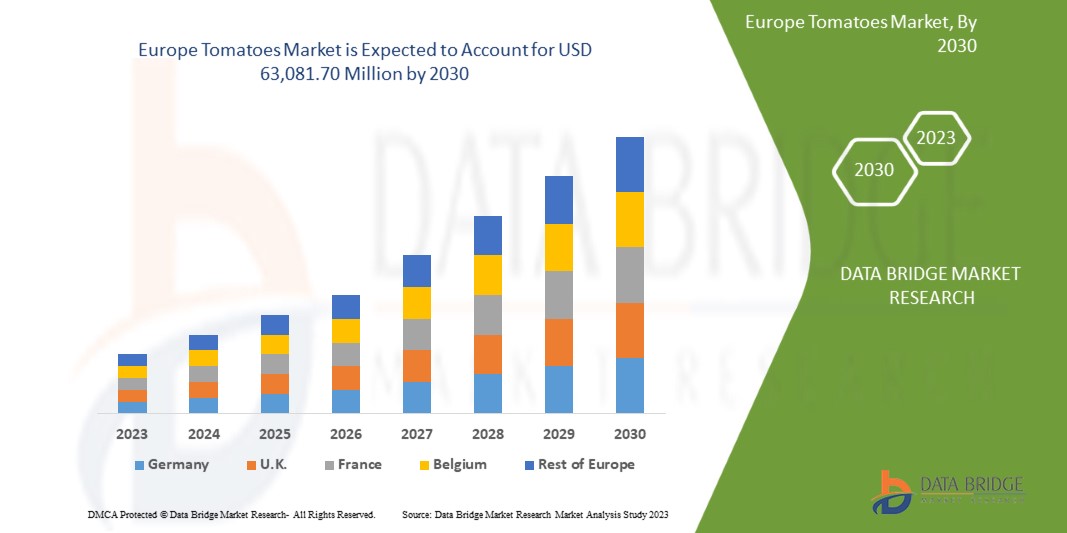
Data Bridge Market Research analyzes that the Europe tomatoes market is expected to reach the value of USD 63,081.70 million by 2030, at a CAGR of 3.4% during the forecast period of 2023 to 2030.
|
Report Metric |
Details |
|
Forecast Period |
2023 to 2030 |
|
Base Year |
2022 |
|
Historic Year |
2021 (Customizable to 2015-2020) |
|
Quantitative Units |
Revenue in Million, Pricing in USD, Volume in Units |
|
Segments Covered |
Type (Cherry Tomatoes, Grape Tomatoes, Roma Tomatoes, Tomatoes On The Vine, Beefsteak Tomatoes, Heirloom Tomatoes, Green Tomatoes, and Others), Product Type (Fresh, Frozen, and Dried), Category (Conventional and Organic), End User (Food Service Industry and Household/ Retail Industry), Distribution Channel (Direct and Indirect) |
|
Countries Covered |
Turkey, Russia, Spain, Italy, France, Germany, Poland, U.K., Belgium, Netherlands, Sweden, Switzerland, Finland, Denmark, Norway, and the rest of Europe |
|
Market Players Covered |
CASALASCO - SOCIETÀ AGRICOLA S.p.A (Cremona, Italy), Duijvestijn Tomatoes (Pijnacker, Netherlands), R&L Holt Ltd. (Evesham, Europe), REDSTAR Sales BV (De Lier, Netherlands), and MASTRONARDI PRODUCE LTD (Ontario, Canada) among others |
Market Definition
Tomatoes are basically round-shaped vegetables that can be eaten cooked or uncooked. They are edible, pulpy berries of the herb Solanum lycoperscium. They are of many colors such as red, yellow, orange, and many more. They are of many varieties having different tastes and applications.
Tomatoes have a wide application in the food and beverages industry. They are used in the production of soups, sauces, purees, juices, and ketchup among others. They are also used as raw vegetables in burgers, sandwiches, salads, pizza, and many more.
Tomatoes are an essential source in food processing industries having wide applications, and also contain essential components useful for the human body. They help in maintaining blood pressure and healthy skin and also have anti-inflammatory action.
Europe Tomatoes Market Dynamics
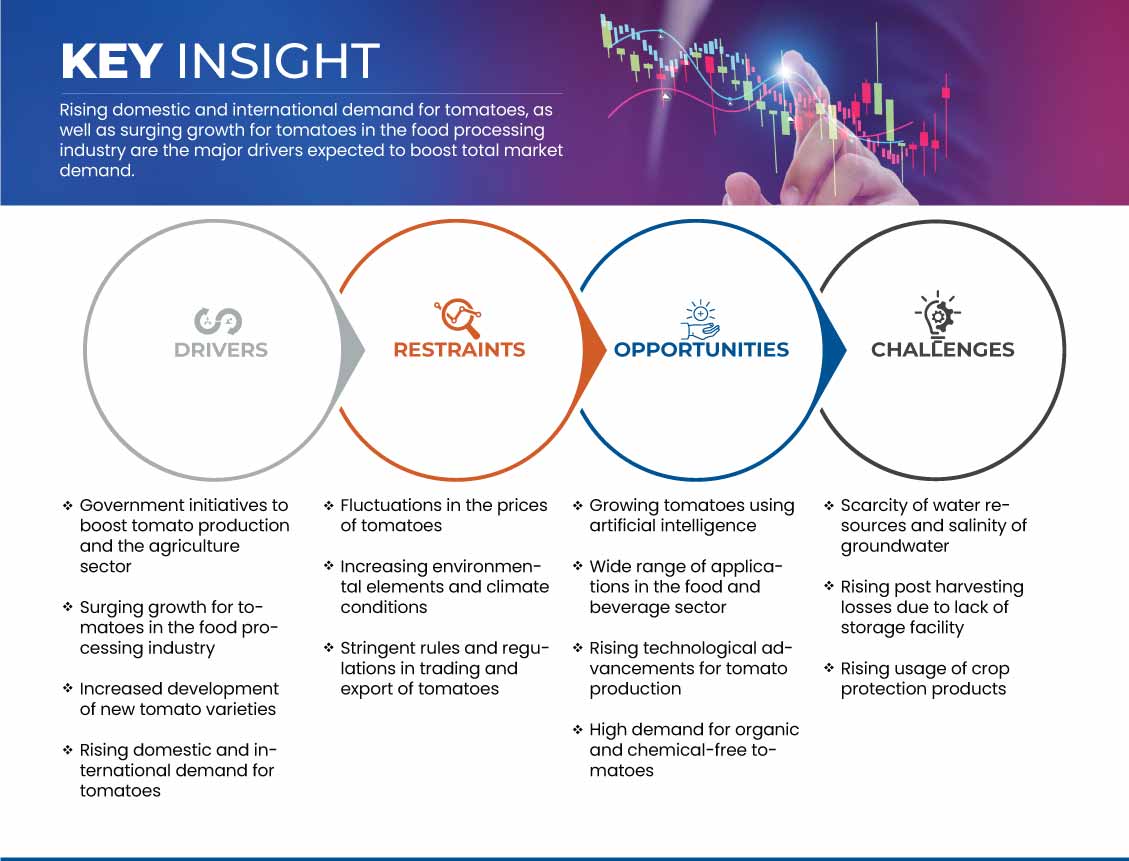
This section deals with understanding the market drivers, advantages, opportunities, restraints, and challenges. All of this is discussed in detail below:
Drivers
- Government Initiatives to Boost Tomato Production and the Agricultural Sector
With the increasing population and higher demand for fruits and fresh vegetables, the government has put several efforts into increasing the production and processing of the crops. Through much R&D in science and technology, the government has come up with many initiatives to increase tomato production to fulfill the demand for tomatoes and other agricultural products. The government funds research institutions such as the California Tomato Research Institute, Agriculture Research Service (ARS), and ICAR-IIHR in India to develop new varieties such as Pusa Ruby, Pusa Gaurav, and Chhuhara. These high-yielding varieties give more yield and are also more disease and pest-resistant, which is very important for higher production and makes them less prone to natural disasters.
The government also frames export and import policies that focus on the import and export of agricultural products, which will help the farmers and the supplier to catch up with the international demand for tomatoes and other products expected to drive the market growth. Thus, various initiatives taken by government bodies to promote the production and processing of tomatoes will accelerate market growth.
- Surging Growth for Tomatoes in the Food Processing Industry
The B2B market needs tomatoes since they are utilized as a raw material to make other processed tomato products. Tomatoes are used in various forms, including juice, paste, puree, diced/peeled tomatoes, ketchup, pickles, sauces, and ready-to-eat curries. There are numerous uses for processed tomato products in the food sector, such as in snacks, culinary, hotels, restaurants, and fast food retail chains. They can be eaten both cooked and uncooked and have a high demand in the Europe market. Because of rapid urbanization, consumers in emerging and developed countries are enticed to eat readymade foods and tomato-processed products. To meet the growing demand, processed food manufacturers and tomato paste processors focus on ready-to-eat products.
Additionally, the range of tomato processed foods is expanding with the introduction of various tomato products, including powder-based products. Tomato paste and tomato puree are the primary processed tomato products. Secondary processed products for tomatoes are made possible by processing primary products. The main market for tomato paste and puree is the ketchup and sauce sector. The beverage and food industry is the second largest user of tomato paste and puree.
With the growing number of working groups and millennial populations, the demand for tomatoes and their various forms has increased massively in the fast food sector, resulting and café, university dining halls, hotels, inns, catering, and food processing industries, which ultimately contribute towards the market growth.
Restraint
- Fluctuations in the Prices of Tomatoes
Volatile and unpredictable Europe marketplaces have far-reaching consequences for industrial companies. Unanticipated barriers such as rising energy costs and unexpected variations in raw material pricing are disrupting supply chains and making it harder for businesses to stay profitable. Variations in the prices of raw materials for making sauces, dressings, and condiments hot fill bottle packaging put up additional costs on the price of the finished product. A bumper crop or crop disaster in a major production region can change tomato prices quickly.
The prices of tomatoes are volatile as it depends on various factors such as seasonality in production, unseasonal rains, and prolonged drought. It also depends on location, preferences, consumers' age, and consumer buying power. Due to its seasonality, prices increase when the product is out of season and decreases when it is in season.
In India, around 70% of tomato is produced and harvested between December and June, that is, when the prices decrease and the supply increases. Between July and November, only 30% of the total production is harvested, where the prices rise due to limited supply.
Farmers, suppliers, and companies dealing in the tomato market find it difficult to correctly judge the risk of large fluctuations in tomato costs. Highly fluctuating costs and ineffective price management can seriously jeopardize the success of companies. The growers utilize many greenhouse facilities to grow tomatoes to lessen the impact of weather on tomato growing and increase the yield per acre. Tomatoes grown in greenhouses require different seeds than those grown in their natural environment. As a result, the cost of seeds used to grow tomatoes in greenhouses is higher than those used to grow tomatoes in natural conditions.
For instance,
- In July 2022, according to an article published in The Economic Times, every year from July to November, seasonal factors tend to push tomato prices up, with the pressure being highest in July. However, in March, the seasonal component exerts the most downward pressure on pricing. Given that around 70% of tomatoes are produced during the Rabi season. This seasonality in prices results from the seasonal pattern of tomato production
Moreover, increased Europe trade, urbanization, transportation needs, and energy demands put further pressure on the cost of the intermediaries required for the tomato market. Therefore, changes in the costs of tomatoes affect the demand for the product and are, thus, expected to hinder market growth.
Challenge
- Rising Post Harvesting Losses Due to Lack of Storage Facility
Despite the driving factors and the opportunities available in the market for tomato demand Europe, there is a certain challenge faced by the farmer and the supplier that would affect the supply of tomatoes. The challenge is post-harvest losses because of the perishable nature of tomatoes and the lack of storage facilities after harvesting and during transportation. Post-harvest losses are primarily caused by rotting, mechanical damage, poor handling, inappropriate temperature, relative humidity management, and hygiene issues during handling. Post-harvest losses cause the product's quality to decline, eventually lowering its price and negatively influencing market expansion.
However, post-harvest losses and other issues represent a serious market expansion challenge. In most nations, the tomato business is steadily disintegrating due to post-harvest issues, both on and off the farm. Most emerging nations cannot produce enough tomatoes on their own, as evidenced by the importation of completed tomato products. Even while there is always an oversupply on the market, this is only temporary because unprocessed tomatoes are difficult to preserve and highly perishable. Because of the inefficiencies in the post-harvest processing of tomatoes, there is a demand gap being supplied by imported processed goods. These post-harvest losses lower the market value of the product and act as a barrier to market expansion.
Post-harvest loss covers food lost along the entire food supply chain, from when a crop is harvested until it is consumed. The losses fall into several categories: weight loss from rotting, quality loss, nutritional loss, seed viability loss, and commercial loss. A shortage of storage facilities mostly causes these post-harvest losses on and off farms, which will be a key challenge to the market expansion.
Opportunities
- Growing Tomatoes Using Artificial Intelligence
Artificial intelligence (AI) is a wide-ranging branch of computer science engaged in building smart machines capable of performing tasks that typically require human intelligence. AI is a growing part of everyday life and is used in the agricultural sector. AI technology is focused on solving various problems to increase and optimize production and operation processes.
Advanced computational approaches are used in artificial intelligence to solve many real-world issues. These methods can be used in the agricultural industry to conduct original research that will enhance the kind, speed, new variety, and protection. AI can automatically check crop quality, yield, pH value, nutrient proportion, and amount of needed water, humidity, and oxygen components. Many nations use mini-bots to assess crop quality and ripeness in the agricultural industry. Mini-bots harvest ripe fruit and vegetables without damaging tomatoes' delicate skin.
AI-powered solutions help farmers to improve efficiencies, quantity, and quality and ensure faster go-to-market for crops. AI is used for crop yield prediction and price forecasting to gain maximum profits. AI sensors can help in intelligent spraying techniques by detecting weeds affected areas and spraying herbicides. Predictive insights can lighten the right time to sow the seeds for maximum productivity in different weather conditions. Agricultural robots help to harvest huge volumes of crops at a faster pace. With the help of AI/ML, crop health can be monitored, and soil deficiencies can be detected. Plant disease can be diagnosed through proper strategies to help farmers.
Thus, growing tomatoes using artificial intelligence is expected to offer opportunities for the growth of the European tomatoes market due to getting high quality and high quantity yield per unit area.
Recent Developments
- In April 2022, CASALASCO - SOCIETÀ AGRICOLA S.p.A announced its partnership with the rosella brand of Australia. This partnership has led to the development of different types of new products, like tomato roasted bell pepper soup, delicious carrot & potato soup, and creamy pumpkin soup, which will definitely help in the growth of the market and company.
- In December 2021, CASALASCO - SOCIETÀ AGRICOLA S.p.A obtained a certification named G.R.A.S.P that focuses on the agricultural activity and cultivation practice standards of the company. This helped in providing trust in the consumers for the company for providing safe and healthy products and helped in the growth of the company.
Europe Tomatoes Market Scope
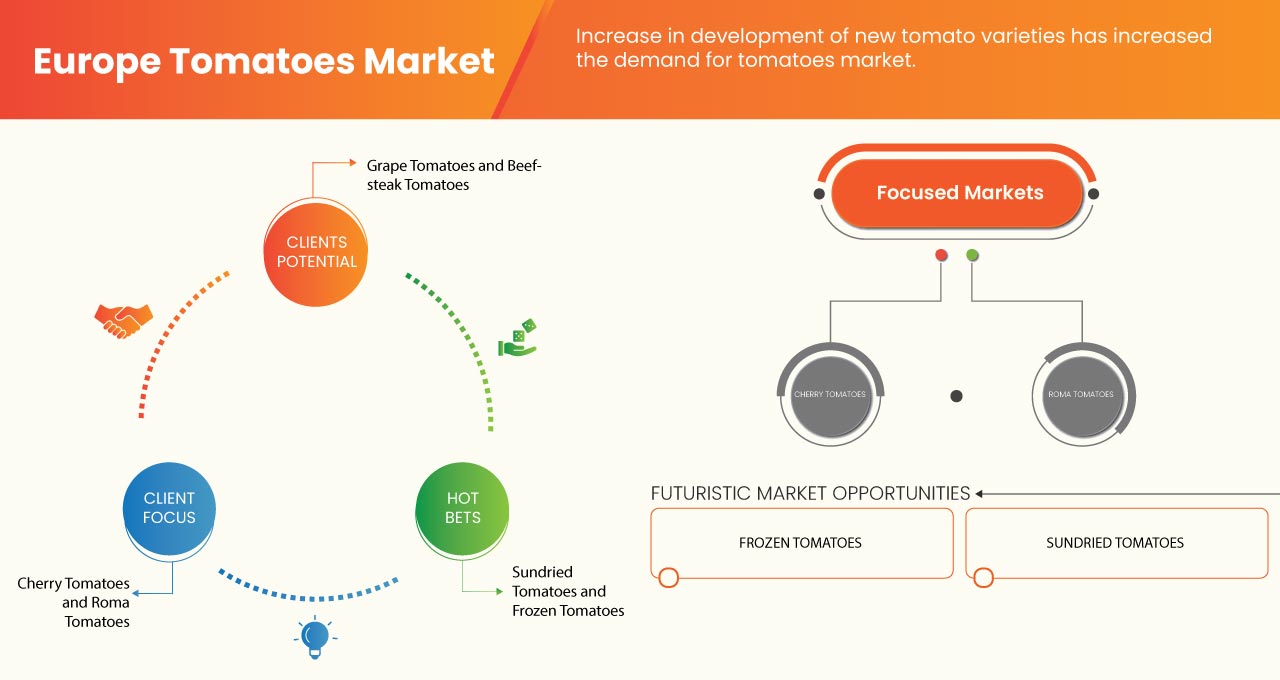
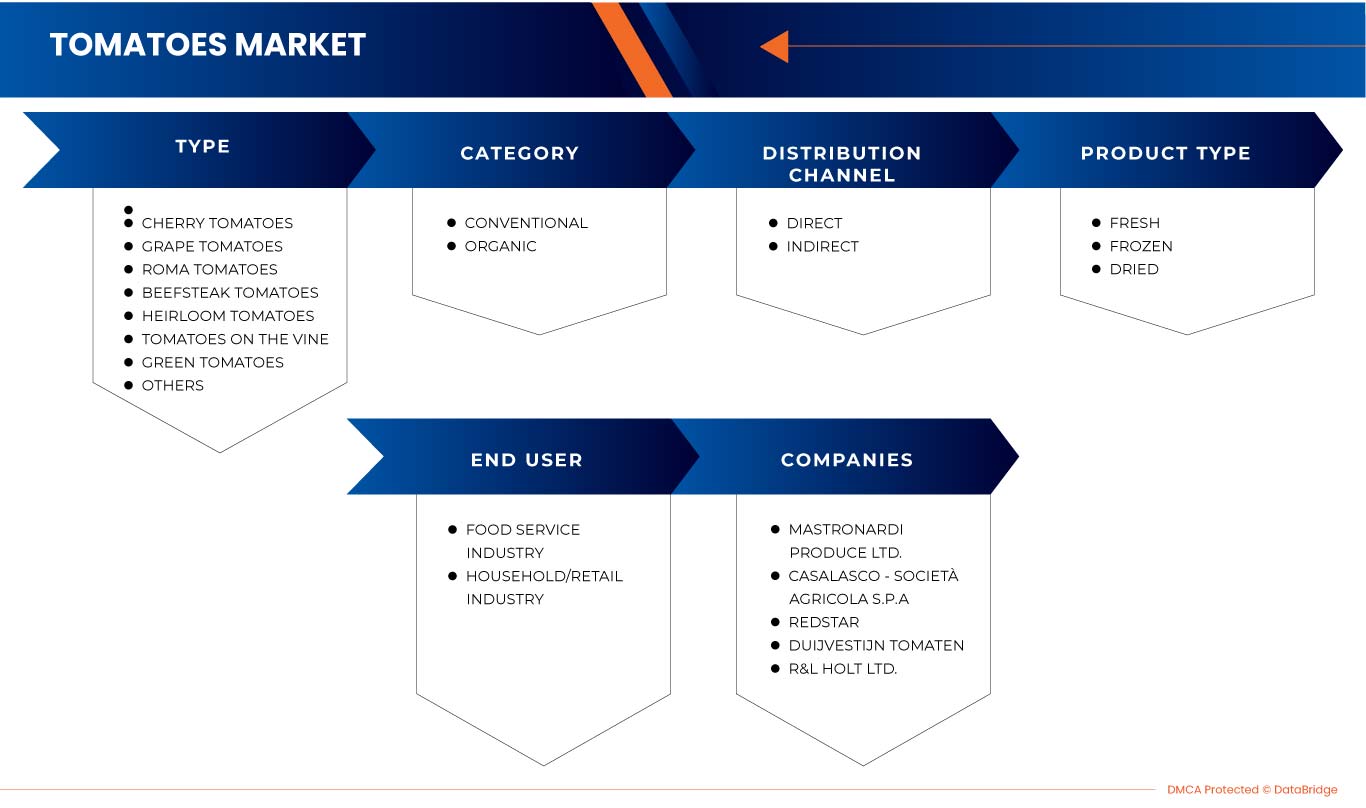
Europe tomatoes market is segmented into five notable segments based on type, product type, category, end user, and distribution channel. The growth amongst these segments will help you analyze major growth segments in the industries and provide the users with a valuable market overview and market insights to make strategic decisions to identify core market applications.
Type
- Cherry Tomatoes
- Grape Tomatoes
- Roma Tomatoes
- Tomatoes on the Vine
- Beefsteak Tomatoes
- Heirloom Tomatoes
- Green Tomatoes
- Others
Based on type, the market is segmented into cherry tomatoes, grape tomatoes, roma tomatoes, tomatoes on the vine, beefsteak tomatoes, heirloom tomatoes, green tomatoes, and others.
Product Type
- Fresh
- Frozen
- Dried
Based on product type, the market is segmented into fresh, frozen, and dried.
Category
- Conventional
- Organic
Based on category, the market is segmented into conventional and organic.
End User
- Food Service Industry
- Household/Retail Industry
Based on end user, the market is segmented into the food service industry and household/retail industry.
Distribution channel
- Direct
- Indirect
Based on distribution channel, the market is segmented into direct and indirect.
Europe Tomatoes Market Regional Analysis/Insights
The Europe tomatoes market is analyzed, and market size insights and trends are provided by country, type, product type, category, end user, and distribution channel, as referenced above.
The countries covered in this report are Turkey, Russia, Spain, Italy, France, Germany, Poland, U.K., Belgium, Netherlands, Sweden, Switzerland, Finland, Denmark, Norway, and the rest of Europe.
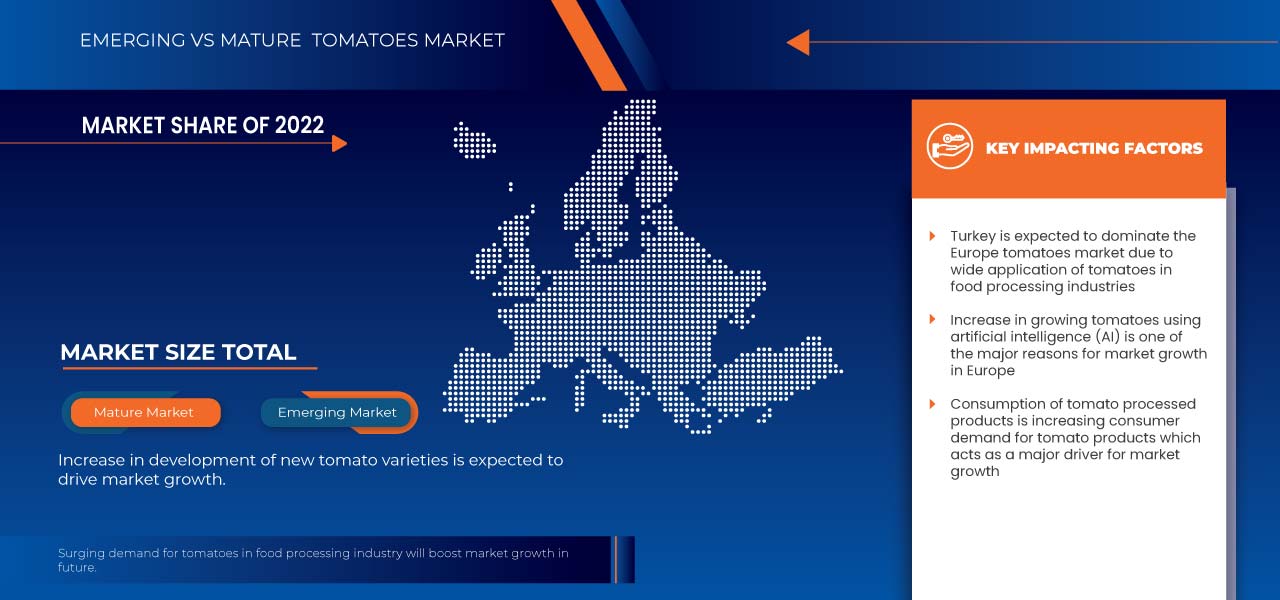
Turkey is dominating the Europe tomatoes market. The increasingly high demand from the processing industry for tomato processed products worldwide is the major reason for the market growth in Turkey. However, high cost of excellent raw materials is likely to restrict the market growth.
The country section of the report also provides individual market impacting factors and changes in market regulation that impact the current and future trends of the market. Data points such as downstream and upstream value chain analysis, technical trends, porter's five forces analysis, and case studies are some of the pointers used to forecast the market scenario for individual countries. Also, the presence and availability of Europe brands and their challenges faced due to large or scarce competition from local and domestic brands, impact of domestic tariffs, and trade routes are considered while providing forecast analysis of the country data.
Competitive Landscape and Europe Tomatoes Market Share Analysis
The Europe tomatoes market competitive landscape provides details by competitor. Details included are company overview, company financials, revenue generated, market potential, investment in R&D, new market initiatives, Europe presence, production sites and facilities, production capacities, company strengths and weaknesses, product launch, product width and breadth, and application dominance. The above data points provided are only related to the companies' focus on the market.
Some of the major players operating in the Europe tomatoes market are CASALASCO - SOCIETÀ AGRICOLA S.p.A , Duijvestijn Tomatoes, R&L Holt Ltd., REDSTAR Sales BV, and MASTRONARDI PRODUCE LTD among others.
SKU-
세계 최초의 시장 정보 클라우드 보고서에 온라인으로 접속하세요

- 대화형 데이터 분석 대시보드
- 높은 성장 잠재력 기회를 위한 회사 분석 대시보드
- 사용자 정의 및 질의를 위한 리서치 분석가 액세스
- 대화형 대시보드를 통한 경쟁자 분석
- 최신 뉴스, 업데이트 및 추세 분석
- 포괄적인 경쟁자 추적을 위한 벤치마크 분석의 힘 활용
목차
1 서론
1.1 연구 목적
1.2 시장 정의
1.3 유럽 토마토 시장 개요
1.4 제한 사항
1.5 대상 시장
2 시장 세분화
2.1 대상 시장
2.2 지리적 범위
연구에 2.3년이 고려됨
2.4 통화 및 가격
2.5 DBMR TRIPOD 데이터 검증 모델
2.6 다변량 모델링
2.7 유형 라이프라인 곡선
2.8 시장 최종 사용자 범위 그리드
2.9 주요 여론 선도자와의 1차 인터뷰
2.1 DBMR 시장 위치 그리드
2.11 2차 소스
2.12 가정
3 요약
4가지 프리미엄 인사이트
4.1 유럽 토마토 시장 상위 5대 수출국
4.2 유럽 토마토 시장 상위 5대 수입국
4.3 신제품 출시 전략
4.3.1 패키지 전략을 통한 출시 촉진
4.3.2 유기농 제품 출시
4.3.3 결론
5 규정 적용 범위
6 유럽 토마토 시장의 공급망
6.1 원자재 조달
6.2 처리
6.3 마케팅 및 유통
6.4 최종 사용자
7 시장 개요
7.1 드라이버
7.1.1 토마토 생산 및 농업 부문을 촉진하기 위한 정부 이니셔티브
7.1.2 식품 가공 산업에서 토마토의 급증
7.1.3 새로운 토마토 품종 개발 증가
7.1.4 토마토에 대한 국내 및 국제 수요 증가
7.2 제약
7.2.1 토마토 가격 변동
7.2.2 증가하는 환경 요소 및 기후 조건
7.2.3 토마토 거래 및 수출에 대한 엄격한 규칙 및 규정
7.3 기회
7.3.1 인공지능을 이용한 토마토 재배
7.3.2 식품 및 음료 부문에서의 광범위한 응용 분야
7.3.3 토마토 생산을 위한 기술적 진보의 증가
7.3.4 유기농 및 무화학 토마토에 대한 높은 수요
7.4 과제
7.4.1 수자원의 부족과 지하수의 염도
7.4.2 저장 시설 부족으로 인한 수확 후 손실 증가
7.4.3 작물 보호 제품 사용 증가
8 유럽 토마토 시장, 종류별
8.1 개요
8.2 체리토마토
8.3 포도 토마토
8.4 로마 토마토
8.5 포도나무에 심은 토마토
8.6 비프스테이크 토마토
8.7 가보 토마토
8.8 녹색 토마토
8.9 기타
9 유럽 토마토 시장, 제품 유형별
9.1 개요
9.2 신선함
9.3 동결
9.4 건조
10 유럽 토마토 시장, 카테고리별
10.1 개요
10.2 기존
10.3 유기농
11 유럽 토마토 시장, 최종 사용자별
11.1 개요
11.2 식품 서비스 산업
11.2.1 유형별 식품 서비스 산업
11.2.1.1 호텔
11.2.1.2 레스토랑
11.2.1.3 카페
11.2.1.4 기타
11.3 가정/소매 산업
12 유럽 토마토 시장, 유통 채널별
12.1 개요
12.2 직접
12.3 간접
13 유럽 토마토 시장 : 국가별
13.1 터키
13.2 러시아
13.3 스페인
13.4 이탈리아
13.5 프랑스
13.6 독일
13.7 폴란드
13.8 영국
13.9 벨기에
13.1 네덜란드
13.11 스웨덴
13.12 스위스
13.13 핀란드
13.14 덴마크
13.15 노르웨이
13.16 유럽의 나머지 지역
14 유럽 토마토 시장, 회사 환경
14.1 회사 점유율 분석: 유럽
15 SWOT 분석
16 회사 프로필
16.1 CASALASCO - SOCIETÀ AGRICOLA SPA
16.1.1 회사 스냅샷
16.1.2 제품 포트폴리오
16.1.3 최근 개발 사항
16.2 마스트로나르디 프로듀스 유한회사
16.2.1 회사 스냅샷
16.2.2 제품 포트폴리오
16.2.3 최근 개발 사항
16.3 레드스타 세일즈 BV
16.3.1 회사 스냅샷
16.3.2 제품 포트폴리오
16.3.3 최근 개발
16.4 토마토의 수확
16.4.1 회사 스냅샷
16.4.2 제품 포트폴리오
16.4.3 최근 개발
16.5 R&L 홀트 주식회사
16.5.1 회사 스냅샷
16.5.2 제품 포트폴리오
16.5.3 최근 개발
17 설문지
18 관련 보고서
표 목록
표 1 신선 및 냉장 토마토 수출국 상위 5위, HS 코드: 0702 2017-2021, 톤 단위 수량
표 2 신선 및 냉장 토마토 수입국 상위 5위, HS 코드: 0702 2017-2021, 톤 단위 수량
표 3 사이즈 코드가 적용되는 경우 다음 표의 코드 및 범위를 준수해야 합니다.
표 4 유럽 토마토 시장, 유형별, 2021-2030 (백만 달러)
표 5 유럽 토마토 시장, 제품 유형별, 2021-2030년(백만 달러)
표 6 유럽 토마토 시장, 카테고리별, 2021-2030 (백만 달러)
표 7 최종 사용자별 유럽 토마토 시장, 2021-2030년(백만 달러)
표 8 토마토 시장의 유럽 식품 서비스 산업, 유형별, 2021-2030 (백만 달러)
표 9 유럽 토마토 시장, 유통 채널별, 2021-2030년(백만 달러)
표 10 국가별 유럽 토마토 시장, 2021-2030년(백만 달러)
표 11 터키 토마토 시장, 유형별 2021-2030 (백만 달러)
표 12 제품 유형별 터키 토마토 시장, 2021-2030년(백만 달러)
표 13 터키 토마토 시장, 카테고리별, 2021-2030 (백만 달러)
표 14 최종 사용자별 터키 토마토 시장, 2021-2030년(백만 달러)
표 15 토마토 시장에서 터키 식품 서비스 산업, 유형별, 2021-2030 (백만 달러)
표 16 유통 채널별 터키 토마토 시장, 2021-2030년(백만 달러)
표 17 러시아 토마토 시장, 유형별 2021-2030 (백만 달러)
표 18 러시아 토마토 시장, 제품 유형별, 2021-2030년(백만 달러)
표 19 러시아 토마토 시장, 카테고리별, 2021-2030 (백만 달러)
표 20 최종 사용자별 러시아 토마토 시장, 2021-2030년(백만 달러)
표 21 러시아 식품 서비스 산업의 토마토 시장, 유형별, 2021-2030 (백만 달러)
표 22 러시아 토마토 시장, 유통 채널별, 2021-2030 (백만 달러)
표 23 스페인 토마토 시장, 유형별 2021-2030 (백만 달러)
표 24 스페인 토마토 시장, 제품 유형별, 2021-2030년(백만 달러)
표 25 스페인 토마토 시장, 카테고리별, 2021-2030 (백만 달러)
표 26 스페인 토마토 시장, 최종 사용자별, 2021-2030년(백만 달러)
표 27 토마토 시장의 스페인 식품 서비스 산업, 유형별, 2021-2030 (백만 달러)
표 28 스페인 토마토 시장, 유통 채널별, 2021-2030년(백만 달러)
표 29 이탈리아 토마토 시장, 유형별 2021-2030 (백만 달러)
표 30 이탈리아 토마토 시장, 제품 유형별, 2021-2030년(백만 달러)
표 31 이탈리아 토마토 시장, 카테고리별, 2021-2030 (백만 달러)
표 32 최종 사용자별 이탈리아 토마토 시장, 2021-2030년(백만 달러)
표 33 토마토 시장의 이탈리아 식품 서비스 산업, 유형별, 2021-2030 (백만 달러)
표 34 유통 채널별 이탈리아 토마토 시장, 2021-2030년(백만 달러)
표 35 프랑스 토마토 시장, 유형별 2021-2030 (백만 달러)
표 36 프랑스 토마토 시장, 제품 유형별, 2021-2030년(백만 달러)
표 37 프랑스 토마토 시장, 카테고리별, 2021-2030 (백만 달러)
표 38 최종 사용자별 프랑스 토마토 시장, 2021-2030년(백만 달러)
표 39 토마토 시장의 프랑스 식품 서비스 산업, 유형별, 2021-2030 (백만 달러)
표 40 유통 채널별 프랑스 토마토 시장, 2021-2030년(백만 달러)
표 41 독일 토마토 시장, 유형별 2021-2030 (백만 달러)
표 42 독일 토마토 시장, 제품 유형별, 2021-2030년(백만 달러)
표 43 독일 토마토 시장, 카테고리별, 2021-2030 (백만 달러)
표 44 독일 토마토 시장, 최종 사용자별, 2021-2030년(백만 달러)
표 45 독일 식품 서비스 산업의 토마토 시장, 유형별, 2021-2030 (백만 달러)
표 46 독일 토마토 시장, 유통 채널별, 2021-2030년(백만 달러)
표 47 폴란드 토마토 시장, 유형별 2021-2030 (백만 달러)
표 48 폴란드 토마토 시장, 제품 유형별, 2021-2030년(백만 달러)
표 49 폴란드 토마토 시장, 카테고리별, 2021-2030 (백만 달러)
표 50 폴란드 토마토 시장, 최종 사용자별, 2021-2030(백만 달러)
표 51 토마토 시장의 폴란드 식품 서비스 산업, 유형별, 2021-2030 (백만 달러)
표 52 폴란드 토마토 시장, 유통 채널별, 2021-2030년(백만 달러)
표 53 영국 토마토 시장, 유형별 2021-2030 (백만 달러)
표 54 영국 토마토 시장, 제품 유형별, 2021-2030년(백만 달러)
표 55 영국 토마토 시장, 카테고리별, 2021-2030 (백만 달러)
표 56 최종 사용자별 영국 토마토 시장, 2021-2030년(백만 달러)
표 57 영국 식품 서비스 산업의 토마토 시장, 유형별, 2021-2030 (백만 달러)
표 58 유통 채널별 영국 토마토 시장, 2021-2030년(백만 달러)
표 59 벨기에 토마토 시장, 유형별 2021-2030 (백만 달러)
표 60 벨기에 토마토 시장, 제품 유형별, 2021-2030년(백만 달러)
표 61 벨기에 토마토 시장, 카테고리별, 2021-2030 (백만 달러)
표 62 최종 사용자별 벨기에 토마토 시장, 2021-2030년(백만 달러)
표 63 벨기에 식품 서비스 산업의 토마토 시장 유형별, 2021-2030년(백만 달러)
표 64 벨기에 토마토 시장, 유통 채널별, 2021-2030년(백만 달러)
표 65 네덜란드 토마토 시장, 유형별 2021-2030 (백만 달러)
표 66 네덜란드 토마토 시장, 제품 유형별, 2021-2030년(백만 달러)
표 67 네덜란드 토마토 시장, 카테고리별, 2021-2030 (백만 달러)
표 68 최종 사용자별 네덜란드 토마토 시장, 2021-2030년(백만 달러)
표 69 토마토 시장의 네덜란드 식품 서비스 산업, 유형별, 2021-2030 (백만 달러)
표 70 네덜란드 토마토 시장, 유통 채널별, 2021-2030년(백만 달러)
표 71 스웨덴 토마토 시장, 유형별 2021-2030 (백만 달러)
표 72 스웨덴 토마토 시장, 제품 유형별, 2021-2030년(백만 달러)
표 73 스웨덴 토마토 시장, 카테고리별, 2021-2030 (백만 달러)
표 74 최종 사용자별 스웨덴 토마토 시장, 2021-2030년(백만 달러)
표 75 스웨덴 식품 서비스 산업의 토마토 시장, 유형별, 2021-2030 (백만 달러)
표 76 유통 채널별 스웨덴 토마토 시장, 2021-2030년(백만 달러)
표 77 스위스 토마토 시장, 유형별 2021-2030 (백만 달러)
표 78 스위스 토마토 시장, 제품 유형별, 2021-2030년(백만 달러)
표 79 스위스 토마토 시장, 카테고리별, 2021-2030 (백만 달러)
표 80 최종 사용자별 스위스 토마토 시장, 2021-2030년(백만 달러)
표 81 토마토 시장의 스위스 식품 서비스 산업, 유형별, 2021-2030 (백만 달러)
표 82 스위스 토마토 시장, 유통 채널별, 2021-2030년(백만 달러)
표 83 2021-2030년 유형별 핀란드 토마토 시장(백만 달러)
표 84 핀란드 토마토 시장, 제품 유형별, 2021-2030년(백만 달러)
표 85 핀란드 토마토 시장, 카테고리별, 2021-2030 (백만 달러)
표 86 최종 사용자별 핀란드 토마토 시장, 2021-2030년(백만 달러)
표 87 토마토 시장의 핀란드 식품 서비스 산업, 유형별, 2021-2030 (백만 달러)
표 88 유통 채널별 핀란드 토마토 시장, 2021-2030년(백만 달러)
표 89 덴마크 토마토 시장, 유형별 2021-2030 (백만 달러)
표 90 덴마크 토마토 시장, 제품 유형별, 2021-2030년(백만 달러)
표 91 덴마크 토마토 시장, 카테고리별, 2021-2030 (백만 달러)
표 92 덴마크 토마토 시장, 최종 사용자별, 2021-2030년(백만 달러)
표 93 덴마크 식품 서비스 산업의 토마토 시장, 유형별, 2021-2030 (백만 달러)
표 94 덴마크 토마토 시장, 유통 채널별, 2021-2030년(백만 달러)
표 95 노르웨이 토마토 시장, 유형별 2021-2030 (백만 달러)
표 96 제품 유형별 노르웨이 토마토 시장, 2021-2030년(백만 달러)
표 97 노르웨이 토마토 시장, 카테고리별, 2021-2030 (백만 달러)
표 98 최종 사용자별 노르웨이 토마토 시장, 2021-2030년(백만 달러)
표 99 토마토 시장의 노르웨이 식품 서비스 산업, 유형별, 2021-2030 (백만 달러)
표 100 유통 채널별 노르웨이 토마토 시장, 2021-2030년(백만 달러)
표 101 유럽 기타 지역 토마토 시장, 유형별 2021-2030 (백만 달러)
그림 목록
그림 1 유럽 토마토 시장: 세분화
그림 2 유럽 토마토 시장: 데이터 삼각 측량
그림 3 유럽 토마토 시장: DROC 분석
그림 4 유럽 토마토 시장: 글로벌 대 지역 분석
그림 5 유럽 토마토 시장: 회사 연구 분석
그림 6 유럽 토마토 시장: 시장 최종 사용자 적용 범위 그리드
그림 7 유럽 토마토 시장: 인터뷰 인구 통계
그림 8 유럽 토마토 시장: DBMR 위치 그리드
그림 9 유럽 토마토 시장: 세분화
그림 10 식품 가공 산업에서 토마토의 급증하는 성장은 2023년에서 2030년까지의 예측 기간 동안 유럽 토마토 시장을 주도할 것으로 예상됩니다.
그림 11 체리 토마토 세그먼트는 2023년에서 2030년 예측 기간 동안 유럽 토마토 시장에서 가장 큰 점유율을 차지할 것으로 예상됩니다.
그림 12 유럽 토마토 시장의 공급망
그림 13 유럽 토마토 시장의 동인, 제약, 기회 및 과제
그림 14 유럽 토마토 시장: 유형별, 2022
그림 15 유럽 토마토 시장: 제품 유형별, 2022
그림 16 유럽 토마토 시장: 카테고리별, 2022
그림 17 유럽 토마토 시장: 최종 사용자별, 2022
그림 18 유럽 토마토 시장: 유통 채널별, 2022
그림 19 유럽 토마토 시장: 스냅샷(2022)
그림 20 유럽 토마토 시장: 국가별(2022년)
그림 21 유럽 토마토 시장: 국가별(2023년 및 2030년)
그림 22 유럽 토마토 시장: 국가별(2022년 및 2030년)
그림 23 유럽 토마토 시장: 유형별(2023-2030)
그림 24 유럽 토마토 시장: 회사 점유율 2022(%)

연구 방법론
데이터 수집 및 기준 연도 분석은 대규모 샘플 크기의 데이터 수집 모듈을 사용하여 수행됩니다. 이 단계에는 다양한 소스와 전략을 통해 시장 정보 또는 관련 데이터를 얻는 것이 포함됩니다. 여기에는 과거에 수집한 모든 데이터를 미리 검토하고 계획하는 것이 포함됩니다. 또한 다양한 정보 소스에서 발견되는 정보 불일치를 검토하는 것도 포함됩니다. 시장 데이터는 시장 통계 및 일관된 모델을 사용하여 분석하고 추정합니다. 또한 시장 점유율 분석 및 주요 추세 분석은 시장 보고서의 주요 성공 요인입니다. 자세한 내용은 분석가에게 전화를 요청하거나 문의 사항을 드롭하세요.
DBMR 연구팀에서 사용하는 주요 연구 방법론은 데이터 마이닝, 시장에 대한 데이터 변수의 영향 분석 및 주요(산업 전문가) 검증을 포함하는 데이터 삼각 측량입니다. 데이터 모델에는 공급업체 포지셔닝 그리드, 시장 타임라인 분석, 시장 개요 및 가이드, 회사 포지셔닝 그리드, 특허 분석, 가격 분석, 회사 시장 점유율 분석, 측정 기준, 글로벌 대 지역 및 공급업체 점유율 분석이 포함됩니다. 연구 방법론에 대해 자세히 알아보려면 문의를 통해 업계 전문가에게 문의하세요.
사용자 정의 가능
Data Bridge Market Research는 고급 형성 연구 분야의 선두 주자입니다. 저희는 기존 및 신규 고객에게 목표에 맞는 데이터와 분석을 제공하는 데 자부심을 느낍니다. 보고서는 추가 국가에 대한 시장 이해(국가 목록 요청), 임상 시험 결과 데이터, 문헌 검토, 재생 시장 및 제품 기반 분석을 포함하도록 사용자 정의할 수 있습니다. 기술 기반 분석에서 시장 포트폴리오 전략에 이르기까지 타겟 경쟁업체의 시장 분석을 분석할 수 있습니다. 귀하가 원하는 형식과 데이터 스타일로 필요한 만큼 많은 경쟁자를 추가할 수 있습니다. 저희 분석가 팀은 또한 원시 엑셀 파일 피벗 테이블(팩트북)로 데이터를 제공하거나 보고서에서 사용 가능한 데이터 세트에서 프레젠테이션을 만드는 데 도움을 줄 수 있습니다.











