


What is the Tomato Ketchup Market Size and Growth Rate?
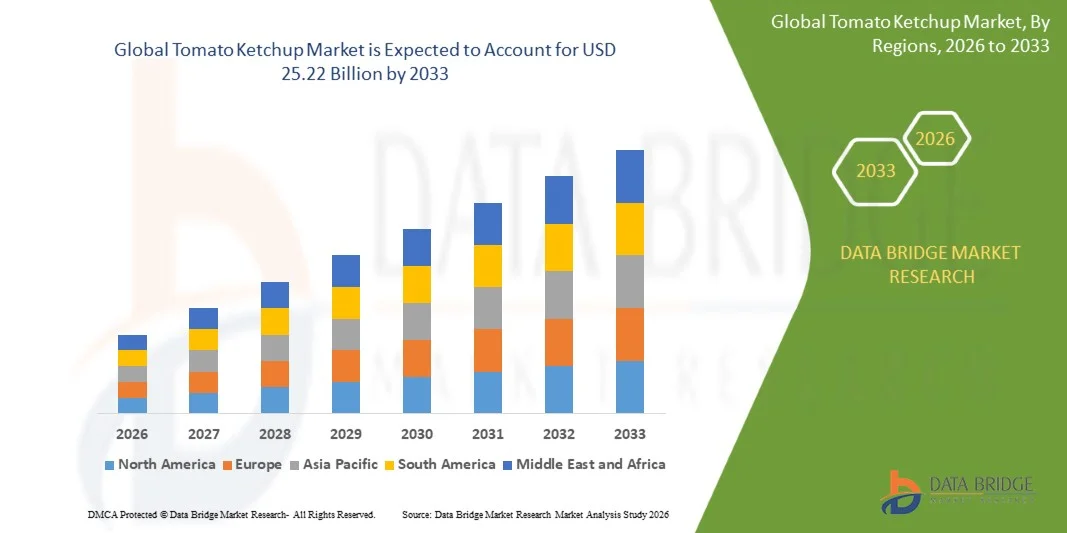
- As per Data Bridge Market Research analysis, the tomato ketchup market was valued at USD 15.24 billion in 2025 and is projected to reach USD 25.22 billion by 2033, growing at a CAGR of 6.50% from 2026 to 2033.
- The market is experiencing consistent growth driven by rising demand for convenience foods, expanding quick-service restaurant networks, and increasing availability of organic, low-sugar, and flavored ketchup across retail and online channels.
- The increasing shift toward ready-to-eat meals, fast food, and home cooking with table sauces, combined with growing demand for clean-labelling, lower-sugar, and premium variants, is supporting market adoption. Tomato ketchup is being positioned across households, restaurants, schools, and institutional kitchens, offering consumers greater convenience in flavoring meals using tomato-based sauces, condiments, and table sauces.
Market Size & Forecast
- Global Market Value (2025): USD 15.24 Billion
- Expected Market Value (2033): USD 25.22 Billion
- Forecast CAGR (2026–2033): 6.50%
- Leading Region in 2025: North America
- Fastest Growing Region: Asia Pacific
What are the Major Takeaways of the Tomato Ketchup Market?
- North America dominated the tomato ketchup market with the largest revenue share of 35.40% in 2025, supported by high per-capita condiment consumption, strong fast-food culture, and well-established retail and foodservice distribution networks.
- Asia-Pacific is expected to be the fastest-growing region at a CAGR of 8.20% from 2026 to 2033, fueled by urbanization, expanding quick-service restaurants, and rising demand for Western-style sauces.
- The regular ketchup segment led the market with a 62.40% share in 2025, driven by affordability, familiar taste, and mass adoption across households and restaurants.
- Organic ketchup is the fastest-growing type, projected to register a CAGR of 8.70%, reflecting rising demand for clean-label, lower-sugar, and naturally produced condiments among health-conscious households.
- The plastic bottles segment dominated the packaging category with a 46.30% revenue share in 2025, led by squeezability, light weight, and low cost.
- Household use accounted for 58.60% of the market share in 2025, preferred for everyday meals, snacks, family dining, and regular grocery replenishment.
- The commercial segment is the fastest-growing application, with a CAGR of 7.40%, driven by restaurant chains, catering services, and single-serve sachet demand.
Report Scope and Tomato Ketchup Market Segmentation
|
Attributes |
Tomato Ketchup Key Market Insights |
|
Segments Covered |
|
|
Countries Covered |
North America
Europe
Asia-Pacific
Middle East and Africa
South America
|
|
Key Market Players |
|
|
Market Opportunities |
|
|
Value Added Data Infosets |
In addition to the insights on market scenarios such as market value, growth rate, segmentation, geographical coverage, and major players, the market reports curated by the Data Bridge Market Research also include in-depth expert analysis, pricing analysis, brand share analysis, consumer survey, demography analysis, supply chain analysis, value chain analysis, raw material/consumables overview, vendor selection criteria, PESTLE Analysis, Porter Analysis, and regulatory framework. |
What is the Key Trend in the Tomato Ketchup Market?
- Tomato ketchup is increasingly evolving from a basic table condiment into a premium and functional product, combining reduced sugar and salt, organic ingredients, bold flavors, and convenient packaging formats for different eating occasions.
- For instance, in July 2026, The Kraft Heinz Company introduced Heinz Penalty Packets, a limited-edition range of oversized ketchup and mustard packets sold through a dedicated microsite and Walmart.com, extending portion formats beyond restaurants and into mainstream digital retail, and highlighting the growing role of single-serve and promotional packaging
- Reformulation is accelerating, as brands replace added sugar and salt with higher tomato content and natural ingredients, responding to consumer interest in healthier condiments without sacrificing taste.
- Manufacturers are expanding spicy, smoky, and fusion flavors, as consumers compare products on taste, ingredient simplicity, price, and brand trust while shopping across supermarkets, convenience stores, and online platforms.
- For instance, in November 2023, Heinz announced the launch of Pickle Ketchup, a new condiment combining the tangy flavor of pickles with classic Heinz ketchup, as part of its Taste Elevation portfolio and its push for category expansion through flavor innovation, with a U.S. shelf rollout planned for early 2024
- As health awareness, flavor innovation, sustainable packaging, and e-commerce reach continue to advance, tomato ketchup is expected to expand beyond traditional table use into dipping, cooking, marinades, and premium specialty occasions.
What are the Key Drivers of the Tomato Ketchup Market?
- The rapid growth of fast food, packaged meals, and home cooking has significantly increased demand for versatile, ready-to-use condiments that improve flavor across a wide range of dishes.
- For instance, in February 2025, according to the National Library of Medicine (NLM), a systematic review and dose-response meta-analysis of prospective cohort studies concluded that dietary intake and blood levels of lycopene are associated with a lower risk of cancer and death due to cancer, supporting positive perceptions of tomato-based foods.
- Households, restaurants, caterers, and institutional kitchens are adopting ketchup in larger volumes and in single-serve formats to improve taste, speed service, and meet changing flavor preferences, particularly among younger consumers.
- For instance, in June 2026, according to Kraft Heinz’s Form 10-Q for the quarter ended June 27, 2026, organic net sales in Emerging Markets rose 8.5%, with pricing contributing 4.5 percentage points and volume and mix 4.0 percentage points, illustrating growing branded food demand in developing economies.
- With retailers expanding condiment shelves and brands strengthening online and foodservice distribution, tomato ketchup can gain wider visibility, trial, and repeat purchases across supermarkets, convenience stores, and e-commerce platforms.
What Factors Are Challenging the Growth of the Tomato Ketchup Market?
- Tomato ketchup depends on processing tomatoes and tomato paste, exposing manufacturers to crop variability, weather risks, and fluctuations in agricultural input costs.
- For instance, in March 2026, according to Ag Alert, California tomato processors planned to contract 9.8 million tons from 185,000 acres, the lowest acreage in 50 years, as high inventories, water limits, shifting consumer habits, and rising input costs squeezed growers.
- These supply and cost pressures can raise ingredient prices and reduce margins for manufacturers, while competition from private labels and other sauces may restrict pricing power in price-sensitive markets and for smaller regional brands.
- High sugar and sodium content remains under consumer and regulatory scrutiny, requiring manufacturers to invest in reformulation, natural sweeteners, and clear labeling, which may increase research, ingredient, packaging, and marketing costs over time.
- For instance, in April 2026, The Kraft Heinz Company launched Heinz Tomato Ketchup Zero Added Sugar and Salt, developed at its Global Innovation Centre in the Netherlands and made with 35% more tomatoes than the classic recipe, highlighting the extent of reformulation that brands are undertaking to respond to health concerns and taste expectations.
- The combination of tomato supply swings, input cost inflation, nutrition concerns, and competition from alternative sauces and private labels can constrain growth among cost-sensitive consumers and smaller brands, particularly where basic condiment needs are already met by lower-priced products.
How is the Tomato Ketchup Market Segmented?
The tomato ketchup market is segmented on the basis of type, packaging type, application, and distribution channel.
- By Type
On the basis of type, the tomato ketchup market is segmented into regular ketchup, organic ketchup, and flavored ketchup. The regular ketchup segment dominated the market with 62.40% share in 2025, supported by affordability, familiar taste, and strong brand loyalty. Regular ketchup is the default condiment for burgers, fries, hot dogs, sandwiches, and breakfast dishes. The segment benefits from established manufacturing capacity, wide retail availability, and long shelf life. Private-label offerings and promotional pricing further reinforce volume sales. Gradual interest in lower-sugar alternatives is encouraging brands to improve recipes while keeping the classic taste. Large bottle sizes and multipacks also encourage stocking up.
The organic ketchup segment is projected to register the fastest growth at a CAGR of 8.70% from 2026 to 2033, driven by rising demand for clean-label, natural, and sustainably grown foods. Organic products avoid synthetic pesticides and often use simpler ingredient lists, appealing to health-conscious families. Premiumization in the condiment aisle is encouraging manufacturers to introduce organic and unsweetened variants. Growth of natural food stores and online marketplaces is improving access. Brands also highlight non-GMO, no high fructose corn syrup, and traceable tomato sourcing to justify higher prices. Rising disposable incomes further support adoption, particularly among younger parents and urban shoppers.
- By Packaging Type
On the basis of packaging type, the tomato ketchup market is segmented into plastic bottles, glass bottles, and pouches. The plastic bottles segment dominated the market with 46.30% share in 2025, supported by squeezability, light weight, durability, and low production cost. Squeeze bottles allow easy dispensing and are widely used in households and restaurants. Inverted caps and flexible designs reduce waste and improve convenience. Their compatibility with high-speed filling lines helps manufacturers keep costs low. Strong consumer familiarity and wide retail presence continue to strengthen the segment’s leadership, while recyclable resin options are addressing sustainability concerns.
The pouches & sachets segment is projected to register the fastest growth at a CAGR of 7.90% from 2026 to 2033, driven by demand for single-serve, portable, and low-cost packaging. Sachets are widely used by quick-service restaurants, food delivery platforms, airlines, and catering firms. In emerging markets, small packs make ketchup affordable for low-income consumers. Lightweight materials reduce shipping costs and storage space. Growth of food delivery and takeaway is creating additional opportunities. Advances in recyclable and mono-material films are also supporting sustainability goals. Tear-open designs and spill-proof seals are improving user experience and reducing waste.
- By Application
On the basis of application, the tomato ketchup market is segmented into household, commercial, and others. The household segment dominated the market with 58.60% share in 2025, driven by everyday use with meals, snacks, and children’s food. Ketchup is a pantry staple in most homes and is purchased regularly through grocery trips. Wide availability through supermarkets, convenience stores, and online platforms improves access. Family-size bottles, multipacks, and promotions support repeat purchases. Continuous product innovation in flavors, reduced-sugar recipes, and organic variants is further strengthening demand among residential consumers, while growing home cooking and air-fryer use increase dipping occasions.
The commercial segment is projected to register the fastest growth at a CAGR of 7.40% from 2026 to 2033, supported by expansion of quick-service restaurants, cafés, catering companies, and institutional kitchens. Operators purchase ketchup in bulk dispensers, large pouches, and single-serve sachets to control cost and portions. Growth of food delivery and takeaway is increasing demand for packet formats. Standardized recipes and menu consistency encourage chains to sign long-term supply agreements. Cost control and brand partnerships with restaurant groups are driving purchases of larger formats. Hotels, schools, and hospitals are also standardizing condiment supply, supporting steady commercial demand.
- By Distribution Channel
On the basis of distribution channel, the tomato ketchup market is segmented into supermarkets & hypermarkets, convenience stores, online stores, and others. The supermarkets & hypermarkets segment dominated the market with 49.80% share in 2025, supported by wide product assortment, multipack availability, and strong in-store visibility. Retail channels provide high traffic and let consumers compare brands, sizes, and flavors. Promotional programs, private-label offerings, and dedicated condiment aisles further support sales. Established relationships between manufacturers and large retail chains continue to reinforce this channel's leadership. Weekly shopping habits and bulk purchasing also keep physical stores the preferred purchase point for ketchup.
The online stores segment is projected to register the fastest growth at a CAGR of 9.40% from 2026 to 2033, driven by growing e-commerce use, online grocery shopping, and subscription purchasing. Digital platforms provide access to organic, specialty, and imported ketchup that may not be stocked in local stores. Multipacks, bundles, and doorstep delivery appeal to busy households. Expansion of quick-commerce apps is shortening delivery times. Customer reviews and recipe content also influence purchases. Direct-to-consumer brands use social media and subscription discounts to build loyalty. Rising smartphone use and digital payments are widening the online customer base.
Which Region Holds the Largest Share of the Tomato Ketchup Market?
- North America dominated the tomato ketchup market with the largest revenue share of 35.40% in 2025, supported by high per-capita condiment consumption, strong fast-food culture, and well-established retail and foodservice distribution networks.
- The region also benefits from strong demand for packaged foods, a large quick-service restaurant industry, and the presence of leading ketchup brands and retail chains. Increasing interest in organic, low-sugar, and flavored variants, along with wide availability of tomato processing capacity, continues to strengthen North America’s position in the global market.
U.S. Tomato Ketchup Market Insight
The U.S. tomato ketchup market is witnessing steady growth due to high condiment consumption, a large quick-service restaurant sector, and strong demand for convenient meal accompaniments. The country’s mature grocery retail sector, along with widespread availability of branded and private-label ketchup in supermarkets, club stores, and online platforms, is driving demand. In addition, growing interest in organic, low-sugar, and spicy variants, along with strong domestic tomato processing and frequent product launches by leading brands, is accelerating adoption across households and foodservice kitchens.
Canada Tomato Ketchup Market Insight
The Canada tomato ketchup market is expanding steadily due to the country’s strong snack and street-food culture, high retail density, and rising interest in premium and organic foods. Households, restaurants, and snack outlets are increasingly utilizing ketchup, including curry-style variants, for popular dishes. Continuous innovation in flavors, growth of discount and organic retail formats, and country’s focus on quality, ingredient transparency, and sustainable packaging are further driving market growth in the country.
Asia-Pacific Tomato Ketchup Market Insight
The Asia-Pacific tomato ketchup market is expected to witness rapid growth, driven by urbanization, expanding quick-service restaurants and fast food, and rising demand for Western-style sauces across countries such as China, India, and Japan. Growing middle-class incomes, changing eating habits, and increasing availability of packaged foods are supporting regional market expansion. In addition, wider adoption of online grocery platforms, strong local brands, growing modern retail networks, and affordable small-pack formats are accelerating availability and demand for ketchup.
Japan Tomato Ketchup Market Insight
The Japan tomato ketchup market is witnessing consistent growth due to deep use of ketchup in home cooking, fast food, and popular dishes such as omelet rice. Households, restaurants, and food manufacturers are increasingly adopting high-quality, natural tomato-based products. Moreover, strong demand for premium ingredients, convenient squeeze packaging, innovative flavors, and trusted domestic brands, together with a focus on food quality, is further contributing to market growth in Japan.
China Tomato Ketchup Market Insight
The China tomato ketchup market is growing rapidly, driven by expanding Western-style fast-food chains, rising urban incomes, and increasing use of tomato-based sauces in cooking. Growing online grocery shopping among younger consumers is significantly boosting market demand. In addition, strong domestic tomato processing, e-commerce platforms, livestreaming, expanding restaurant chains, and rising interest in imported and premium brands are positioning China as a key growth market for ketchup across Asia-Pacific.
Which are the Top Companies in Tomato Ketchup Market?
The tomato ketchup industry is primarily led by well-established companies, including:
- The Kraft Heinz Company (U.S.)
- Conagra Brands, Inc. (U.S.)
- Nestlé S.A. (Switzerland)
- Kagome Co., Ltd. (Japan)
- Del Monte Foods, Inc. (U.S.)
- Unilever PLC (U.K.)
- The Campbell’s Company (U.S.)
- McCormick & Company, Incorporated (U.S.)
- Tata Consumer Products Limited (India)
- Mutti S.p.A. (Italy)
- Premier Foods plc (U.K.)
- Samworth Brothers (U.K.)
- General Mills, Inc. (U.S.)
- McCain Foods Limited (Canada)
- Associated British Foods plc (U.K.)
- Ajinomoto Co., Inc. (Japan)
- The Hain Celestial Group, Inc. (U.S.)
- Masan Group (Vietnam)
- Orkla ASA (Norway)
- Primal Kitchen (U.S.)
What are Latest Developments in Tomato Ketchup Market?
- In July 2026, The Kraft Heinz Company introduced Heinz Penalty Packets, a limited-edition range of oversized ketchup and mustard packets styled after sports penalty cards and sold through a dedicated microsite and Walmart.com. The launch brings single-serve and away-from-home consumption cues into mainstream digital retail and extends the role of portion formats beyond traditional restaurant channels, supporting brand engagement.
- In April 2026, The Kraft Heinz Company launched Heinz Tomato Ketchup Zero Added Sugar and Salt, developed at its Global Innovation Centre in the Netherlands. The recipe uses 35% more tomatoes than the classic formulation, supporting the brand’s response to consumer demand for lower-sugar and lower-salt condiments and strengthening its better-for-you portfolio.
- In November 2023, Heinz announced the nationwide launch of Pickle Ketchup, with a rollout on U.S. shelves in early 2024, as the first Heinz innovation to launch globally after the brand’s unification under one creative platform. The product reinforced the company’s focus on unique flavor experiences within its Taste Elevation portfolio and supported category expansion through bolder, more nuanced flavors, using social media campaigns aimed at younger consumers to build awareness and trial.
- In April 2023, Heinz introduced Heinz Hot Varieties, including three spicy ketchup flavors, Chipotle, Jalapeño, and Habanero, and the first new Heinz 57 sauce in more than a decade. The products rolled out in major U.S. retailers and respond to growing consumer appetite for spicy condiments and trusted brands, offering heat levels ranging from medium to hotter.
- In September 2020, Primal Kitchen launched Organic Unsweetened Ketchup, made without refined sugar, honey, or high fructose corn syrup, and won Best New Condiment and Consumer Choice awards at Natural Products Expo East. The product was set to be available at over 1,000 retailers that fall, helping to establish the organic and unsweetened ketchup segment.

- Interactive Data Analysis Dashboard
- Company Analysis Dashboard for high growth potential opportunities
- Research Analyst Access for customization & queries
- Competitor Analysis with Interactive dashboard
- Latest News, Updates & Trend analysis
- Harness the Power of Benchmark Analysis for Comprehensive Competitor Tracking
Global Tomato Ketchup Market, Supply Chain Analysis and Ecosystem Framework
To support market growth and help clients navigate the impact of geopolitical shifts, DBMR has integrated in-depth supply chain analysis into its Global Tomato Ketchup Market research reports. This addition empowers clients to respond effectively to global changes affecting their industries. The supply chain analysis section includes detailed insights such as Global Tomato Ketchup Market consumption and production by country, price trend analysis, the impact of tariffs and geopolitical developments, and import and export trends by country and HSN code. It also highlights major suppliers with data on production capacity and company profiles, as well as key importers and exporters. In addition to research, DBMR offers specialized supply chain consulting services backed by over a decade of experience, providing solutions like supplier discovery, supplier risk assessment, price trend analysis, impact evaluation of inflation and trade route changes, and comprehensive market trend analysis.
Data collection and base year analysis are done using data collection modules with large sample sizes. The stage includes obtaining market information or related data through various sources and strategies. It includes examining and planning all the data acquired from the past in advance. It likewise envelops the examination of information inconsistencies seen across different information sources. The market data is analysed and estimated using market statistical and coherent models. Also, market share analysis and key trend analysis are the major success factors in the market report. To know more, please request an analyst call or drop down your inquiry.
The key research methodology used by DBMR research team is data triangulation which involves data mining, analysis of the impact of data variables on the market and primary (industry expert) validation. Data models include Vendor Positioning Grid, Market Time Line Analysis, Market Overview and Guide, Company Positioning Grid, Patent Analysis, Pricing Analysis, Company Market Share Analysis, Standards of Measurement, Global versus Regional and Vendor Share Analysis. To know more about the research methodology, drop in an inquiry to speak to our industry experts.
Data Bridge Market Research is a leader in advanced formative research. We take pride in servicing our existing and new customers with data and analysis that match and suits their goal. The report can be customized to include price trend analysis of target brands understanding the market for additional countries (ask for the list of countries), clinical trial results data, literature review, refurbished market and product base analysis. Market analysis of target competitors can be analyzed from technology-based analysis to market portfolio strategies. We can add as many competitors that you require data about in the format and data style you are looking for. Our team of analysts can also provide you data in crude raw excel files pivot tables (Fact book) or can assist you in creating presentations from the data sets available in the report.













