



기술(여과, 크로마토그래피, 침전), 제품(키트, 카세트 및 카트리지, 필터 플레이트, 스핀 컬럼, 멤브레인 필터 및 기타), 응용 분야(생물 공정 응용 분야, 제약 및 생명 공학 회사, CMOS 및 CROS, 학술 및 연구 기관, 진단 응용 분야)별 글로벌 탈염 및 완충액 교환 시장 세분화 - 2032년까지의 산업 동향 및 예측
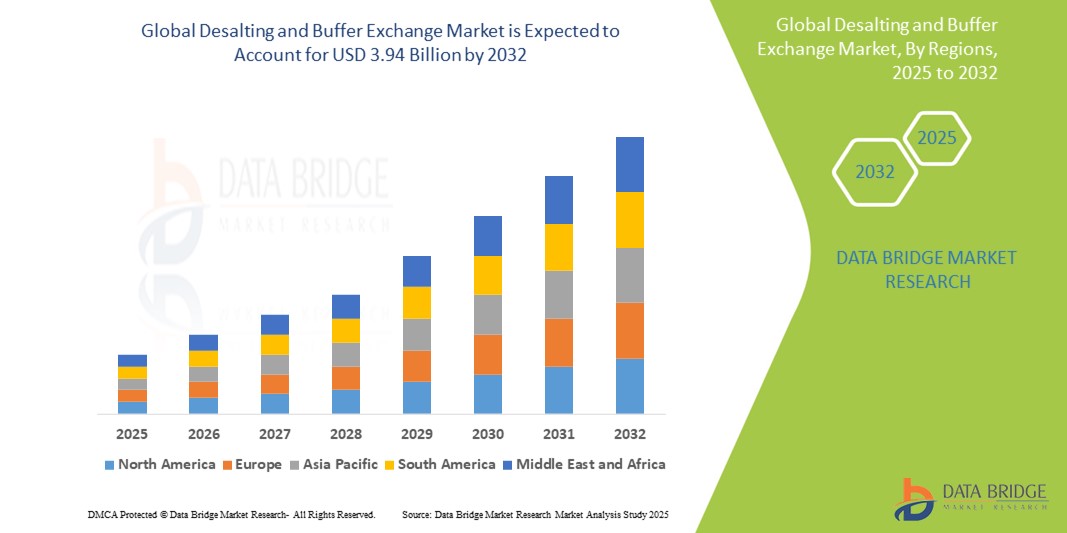
탈염 및 버퍼 교환 시장 규모
- 글로벌 탈염 및 버퍼 교환 시장 규모는 2024년에 12억 6천만 달러 로 평가되었으며 예측 기간 동안 15.25%의 CAGR 로 2032년까지 39억 4천만 달러 에 도달할 것으로 예상됩니다 .
- 시장 성장은 특히 제약 및 생명공학 산업 에서 효율적인 생물 처리 기술 에 대한 수요 증가에 의해 크게 촉진됩니다 .
- 더욱이, 생물학 및 바이오시밀러에 대한 관심 증가, 단일클론 항체 생산 증가, 그리고 효율적인 다운스트림 공정 기술에 대한 수요 증가는 탈염 및 완충액 교환을 약물 개발 및 제조의 필수 단계로 자리매김하고 있습니다. 이러한 요소들이 결합되면서 탈염 및 완충액 교환 용액의 활용이 가속화되어 업계 성장이 크게 촉진되고 있습니다.
탈염 및 버퍼 교환 시장 분석
- 탈염 및 완충액 교환은 다양한 분석 및 정제 응용 프로그램을 위한 생물학적 샘플, 특히 단백질 및 핵산을 준비하는 데 필수적인 염 및 소분자 제거 또는 완충액 교체를 포함하는 중요한 하류 생물 처리 단계입니다.
- 탈염 및 완충액 교환 솔루션에 대한 수요 증가는 주로 급성장하는 생물제약 부문, 프로테오믹스 및 유전체학 분야의 연구 개발 지출 증가, 단일클론 항체 및 백신을 포함한 생물학 제제 생산에 대한 집중 증가에 의해 촉진됩니다.
- 북미는 2024년 22.3%의 가장 큰 매출 점유율로 탈염 및 완충액 교환 시장을 장악하고 있으며, 생물제약 분야에 대한 높은 R&D 투자, 핵심 산업 참여자들의 강력한 입지, 미국과 캐나다의 고급 정제 공정에 대한 수요 증가가 특징입니다.
- 아시아 태평양 지역은 생명공학 산업의 급속한 확장, 생명 과학 연구에 대한 투자 증가, 각국의 생물 의약품 수요 증가로 인해 예측 기간 동안 CAGR 11.1%로 탈염 및 완충액 교환 시장에서 가장 빠르게 성장하는 지역이 될 것으로 예상됩니다.
- 여과 부문은 2024년 44.2%의 시장 점유율로 탈염 및 완충액 교환 시장을 장악했으며, 이는 대규모 생물공정 작업에서 염 제거 및 완충액 교환 효율성, 투석과 같은 다른 방법에 비해 빠른 속도, 동시에 샘플을 농축할 수 있는 능력에 힘입은 것입니다.
보고서 범위 및 탈염 및 버퍼 교환 시장 세분화
|
속성 |
탈염 및 버퍼 교환 주요 시장 통찰력 |
|
다루는 세그먼트 |
|
|
포함 국가 |
북아메리카
유럽
아시아 태평양
중동 및 아프리카
남아메리카
|
|
주요 시장 참여자 |
|
|
시장 기회 |
|
|
부가가치 데이터 정보 세트 |
Data Bridge Market Research에서 큐레이팅한 시장 보고서에는 시장 가치, 성장률, 세분화, 지리적 적용 범위, 주요 기업 등 시장 시나리오에 대한 통찰력 외에도 심층적인 전문가 분석, 가격 분석, 브랜드 점유율 분석, 소비자 설문 조사, 인구 통계 분석, 공급망 분석, 가치 사슬 분석, 원자재/소모품 개요, 공급업체 선택 기준, PESTLE 분석, Porter 분석 및 규제 프레임워크가 포함되어 있습니다. |
탈염 및 버퍼 교환 시장 동향
"효율성 향상을 위한 자동화 및 고처리량 솔루션"
- A significant and accelerating trend in the global desalting and buffer exchange market is the increasing adoption of automation and high-throughput solutions. This shift is driven by the growing demand for processing a large number of samples quickly and efficiently, particularly in drug discovery, biopharmaceutical development, and diagnostics
- For instance, automated liquid handling systems integrate seamlessly with desalting and buffer exchange columns and plates, enabling parallel processing of multiple samples. Companies such as Cytiva offer automated systems such as the ÄKTA go Desalting and Buffer Exchange System, designed to streamline workflows and improve reproducibility
- Automation in desalting and buffer exchange allows for reduced manual labor, minimized human error, and increased sample consistency. This is crucial in research and manufacturing settings where precision and scalability are paramount. High-throughput capabilities are also being enhanced through the development of specialized kits, spin columns, and filter plates that are compatible with robotic systems
- The seamless integration of desalting and buffer exchange with automated platforms facilitates a more efficient overall bioprocessing workflow. This allows researchers and manufacturers to rapidly prepare samples for downstream applications such as mass spectrometry, chromatography, and various analytical assays
- This trend towards more automated, high-throughput, and integrated desalting and buffer exchange systems is fundamentally reshaping laboratory practices and manufacturing processes. Consequently, companies are investing in developing user-friendly, scalable, and versatile automated platforms to meet the evolving needs of the biopharmaceutical and research sectors
- The demand for desalting and buffer exchange solutions that offer enhanced automation and high-throughput capabilities is growing rapidly across pharmaceutical companies, research laboratories, and academic institutions, as they increasingly prioritize efficiency, accuracy, and scalability in their operations
Desalting and Buffer Exchange Market Dynamics
Driver
“Growing Demand for Biopharmaceuticals and Advancements in Bioprocessing”
- The increasing prevalence of chronic diseases and the subsequent surge in demand for novel biopharmaceutical products, such as monoclonal antibodies, vaccines, and gene therapies, is a significant driver for the heightened demand for desalting and buffer exchange solutions
- For instance, the biopharmaceutical industry is continuously investing in research and development to bring new and more effective treatments to market. This includes the development of complex biologics that require meticulous purification steps. Desalting and buffer exchange are critical for removing impurities and optimizing the formulation of these sensitive biological molecules, ensuring their stability, activity, and safety
- As biopharmaceutical production scales up, there's a growing need for efficient, high-throughput, and scalable desalting and buffer exchange techniques to meet the increasing demand for therapeutic proteins and other biologics. This drives innovation in the market, leading to the development of more advanced and automated systems
- Furthermore, advancements in bioprocessing technologies, including improved chromatography and filtration techniques, are making desalting and buffer exchange more efficient and cost-effective. The trend towards continuous bioprocessing and single-use systems also necessitates robust and integrated desalting and buffer exchange solutions
- The critical role these processes play in achieving high-purity biopharmaceutical products and facilitating downstream analytical applications are key factors propelling the adoption of desalting and buffer exchange in both research and industrial settings. The ongoing pipeline of novel therapeutics and biosimilars further contributes to market growth
Restraint/Challenge
“High Initial Investment and Technical Complexities”
- The significant initial investment required for acquiring and integrating advanced desalting and buffer exchange systems poses a considerable challenge to wider market adoption, particularly for smaller research laboratories, academic institutions, and emerging biotech companies with limited financial resources
- For instance, sophisticated automated chromatography systems, tangential flow filtration (TFF) setups, and specialized membrane filtration units can involve substantial upfront costs. This capital-intensive requirement can deter potential users from investing in these essential purification technologies
- Furthermore, the technical complexities associated with operating and maintaining these advanced systems, including the need for skilled personnel, precise calibration, and optimization of parameters for different biological samples, present an additional hurdle. While automation aims to simplify workflows, the initial setup and troubleshooting can be complex
- This can lead to increased operational costs beyond the initial purchase, impacting the overall cost-effectiveness for some users. While smaller, more affordable kits and spin columns exist for lower throughput needs, the high-capacity, high-efficiency systems essential for industrial bioprocessing remain a significant investment
Desalting and Buffer Exchange Market Scope
The market is segmented on the basis of technique, product, and application
- By Technique
On the basis of technique, the desalting and buffer exchange market is segmented into filtration, chromatography, and precipitation. The filtration segment dominates the largest market revenue share of 44.2% in 2024, driven by its efficiency in removing salts and exchanging buffers in large-scale bioprocessing operations, its speed compared to other methods such as dialysis, and its ability to concentrate samples simultaneously. This technique is particularly favored in industrial applications due to its scalability and ease of integration into existing workflows.
The chromatography segment is anticipated to witness significant growth during the forecast period, fueled by its high resolution and specificity in separating biomolecules from contaminants. This technique, including gel filtration (size exclusion chromatography), is widely used for critical purification steps where precise separation and high purity are essential, especially in research and development of sensitive biologics.
- By Product
On the basis of product, the desalting and buffer exchange market is segmented into kits, cassettes and cartridges, filter plates, spin columns, membrane filters, and others. The kits segment is expected to dominate the market share in 2024, driven by their ease of use, convenience, and widespread adoption in various research and industrial applications for efficient sample preparation. Kits offer pre-packaged components and simplified protocols, making them ideal for both experienced researchers and those new to the techniques.
The spin columns segment is anticipated to witness significant growth, driven by their suitability for rapid, small-scale sample processing and high-throughput applications. Spin columns provide a convenient and efficient method for desalting and buffer exchange in laboratory settings, making them popular for researchers working with multiple samples.
- By Application
On the basis of application, the desalting and buffer exchange market is segmented into bioprocess applications, pharmaceutical and biotechnology companies, CROs and CMOs, academic and research institutes, and diagnostic applications. The pharmaceutical and biotechnology companies segment is expected to dominate the market in 2024, driven by the increasing demand for advanced purification processes in drug discovery, development, and manufacturing. These companies heavily rely on desalting and buffer exchange for various stages of biopharmaceutical production, from early-stage research to final product formulation.
The bioprocess applications segment is anticipated to witness significant growth during the forecast period, fueled by the expanding needs of large-scale biomanufacturing and downstream processing. As the production of biologics and biosimilars continues to rise, the demand for efficient and scalable desalting and buffer exchange solutions within bioprocess workflows is accelerating.
Desalting and Buffer Exchange Market Regional Analysis
- North America dominates the desalting and buffer exchange market with the largest revenue share of 22.3% in 2024, driven by high R&D investment in biopharmaceuticals, a strong presence of key industry players, and increasing demand for advanced purification processes in the U.S. and Canada
- Consumers in the region highly value advanced bioprocessing solutions that offer efficiency, purity, and scalability for drug discovery, development, and manufacturing
- This widespread adoption is further supported by favorable regulatory frameworks, increasing demand for biologics and biosimilars, and the growing focus on personalized medicine, establishing desalting and buffer exchange as crucial steps in the region's life sciences sector
U.S. Desalting and Buffer Exchange Market Insight
The U.S. desalting and buffer exchange market captured a significant revenue share within North America in 2024, fueled by the booming biopharmaceutical industry and extensive research and development activities. The increasing focus on developing novel biologics and gene therapies, coupled with substantial investments by pharmaceutical and biotechnology companies, drives the demand for efficient purification techniques. The strong presence of leading academic and research institutions, as well as a well-established infrastructure for life sciences, further propels the market in the U.S.
Europe Desalting and Buffer Exchange Market Insight
The Europe desalting and buffer exchange market is projected to expand at a substantial CAGR throughout the forecast period, primarily driven by growing pharmaceutical R&D, increasing production of biosimilars, and rising government funding for life science research. The region's robust healthcare sector and the presence of numerous biopharmaceutical companies contribute to the consistent demand for advanced desalting and buffer exchange solutions across various applications, from drug discovery to manufacturing.
U.K. Desalting and Buffer Exchange Market Insight
The U.K. desalting and buffer exchange market is anticipated to grow at a noteworthy CAGR during the forecast period, driven by a strong focus on scientific research, a thriving biotechnology sector, and increasing investment in bioprocessing technologies. The U.K.'s significant contributions to drug discovery and development, along with a growing number of contract research and manufacturing organizations (CROs and CMOs), are propelling the adoption of advanced purification solutions.
Germany Desalting and Buffer Exchange Market Insight
독일의 탈염 및 완충액 교환 시장은 예측 기간 동안 상당한 연평균 성장률(CAGR)로 성장할 것으로 예상되며, 이는 제약 산업의 선도적 입지와 생명공학 혁신에 대한 강력한 집중에 힘입은 것입니다. 독일의 잘 발달된 연구 인프라와 고순도 바이오 의약품에 대한 높은 수요는 학계와 산업계 모두에서 효율적인 탈염 및 완충액 교환 기술의 도입을 촉진하고 있습니다.
아시아 태평양 탈염 및 버퍼 교환 시장 통찰력
아시아 태평양 지역의 탈염 및 완충액 교환 시장은 예측 기간 동안 가장 빠른 연평균 성장률(CAGR) 11.1%로 성장할 것으로 예상됩니다. 이는 바이오 제약 산업의 급속한 성장, 생명 과학 연구 투자 증가, 그리고 중국, 일본, 인도 등지의 가처분 소득 증가에 힘입은 것입니다. 이 지역의 의료 인프라 확충과 생명공학 및 제약 산업 육성을 위한 정부의 적극적인 지원 정책은 탈염 및 완충액 교환 기술 도입을 가속화하고 있습니다.
일본 탈염 및 버퍼 교환 시장 통찰력
일본의 탈염 및 완충액 교환 시장은 일본의 첨단 생명공학 분야, 의료 혁신에 대한 정부의 강력한 지원, 그리고 고품질 바이오 의약품에 대한 수요 증가로 인해 성장세가 가속화되고 있습니다. 일본은 정밀성과 첨단 연구 방법을 중시하고, 임상 시험 및 신약 개발 활동도 활발하게 진행하면서 정교한 탈염 및 완충액 교환 솔루션 도입이 확대되고 있습니다.
인도 탈염 및 버퍼 교환 시장 통찰력
인도의 탈염 및 완충액 교환 시장은 아시아 태평양 지역에서 상당한 시장 매출 점유율을 차지했는데, 이는 인도의 급속한 제약 및 생명공학 산업 성장, 연구개발 투자 증가, 그리고 저렴한 치료제에 대한 수요를 견인하는 풍부한 환자층에 기인합니다. 국내 제약 제조업체의 성장과 바이오시밀러 생산에 대한 집중 증가는 인도 시장 성장을 촉진하는 주요 요인입니다.
탈염 및 버퍼 교환 시장 점유율
탈염 및 완충액 교환 산업은 주로 다음을 포함한 잘 확립된 회사들이 주도하고 있습니다.
- Cytiva (미국)
- Merck KGaA (독일)
- Bio-Rad Laboratories, Inc. (미국)
- Thermo Fisher Scientific Inc. (미국)
- Sartorius AG (독일)
- Repligen Corporation(미국)
- 폴 코퍼레이션(미국)
- 론자(스위스)
- 아반터 주식회사(미국)
- 토소 주식회사(일본)
- 바이오웍스(스웨덴)
- 애질런트 테크놀로지스(미국)
- 워터스 코퍼레이션(미국)
- 시마즈 주식회사(일본)
- 히타치 하이테크 주식회사(일본)
- Cole-Parmer Instrument Company, LLC(미국)
- 스펙트럼 연구소(미국)
- GE 헬스케어(미국)
- Sepax Technologies, Inc. (미국)
글로벌 탈염 및 버퍼 교환 시장의 최신 동향
- 2024년 5월, 바이오프로세스 기업인 아사히 카세이 메디컬은 플라노바(Planova) 바이러스 제거 필터 조립 공장을 신설했습니다. 플라노바 신규 조립 공장은 2024년에 완공되었습니다. 이는 바이오의약품 안전에 필수적인 여과 기술의 지속적인 혁신을 보여줍니다.
- 2024년 12월, 질량 분석 기반 프로테오믹스를 위한 펩타이드 정제 기술의 발전이 보고되었으며, 여기에는 고회수 탈염 팁 컬럼 개발도 포함됩니다. 이러한 혁신은 탈염 단계에서 펩타이드 손실을 최소화하도록 설계되었으며, 이는 프로테오믹스 연구의 감도와 커버리지 향상에 매우 중요합니다.
- 2023년 11월, Cytiva는 새로운 ÄKTA go 탈염 및 완충액 교환 시스템을 출시했습니다. 이 시스템은 탈염 및 완충액 교환 워크플로우를 자동화하여 더 빠르고, 효율적이며, 재현성이 뛰어나 바이오프로세싱 분야의 자동화 요구가 증가하는 상황에 대응하도록 설계되었습니다.
- 2023년 10월, Danaher의 일부인 Cytiva는 푸네에 생물학 제조 허브를 개설하면서 인도에서의 입지를 확장했습니다. 이 33,000제곱피트 규모의 시설은 접선 흐름, 바이러스 여과 및 불활성화 시스템을 포함한 생물 처리 장비를 제조하여 이 지역의 성장하는 생물 제약 생산을 지원할 것입니다.
- 2022년 2월, Sartorius의 하위 그룹인 Sartorius Stedim Biotech는 Novasep의 크로마토그래피 부문 인수를 완료했습니다. 이 전략적 움직임은 Sartorius의 크로마토그래피 제공을 확장하고 생물 처리 산업에서의 입지를 강화하여 주요 참여자의 통합 및 강화를 나타냅니다.
SKU-
세계 최초의 시장 정보 클라우드 보고서에 온라인으로 접속하세요

- 대화형 데이터 분석 대시보드
- 높은 성장 잠재력 기회를 위한 회사 분석 대시보드
- 사용자 정의 및 질의를 위한 리서치 분석가 액세스
- 대화형 대시보드를 통한 경쟁자 분석
- 최신 뉴스, 업데이트 및 추세 분석
- 포괄적인 경쟁자 추적을 위한 벤치마크 분석의 힘 활용
연구 방법론
데이터 수집 및 기준 연도 분석은 대규모 샘플 크기의 데이터 수집 모듈을 사용하여 수행됩니다. 이 단계에는 다양한 소스와 전략을 통해 시장 정보 또는 관련 데이터를 얻는 것이 포함됩니다. 여기에는 과거에 수집한 모든 데이터를 미리 검토하고 계획하는 것이 포함됩니다. 또한 다양한 정보 소스에서 발견되는 정보 불일치를 검토하는 것도 포함됩니다. 시장 데이터는 시장 통계 및 일관된 모델을 사용하여 분석하고 추정합니다. 또한 시장 점유율 분석 및 주요 추세 분석은 시장 보고서의 주요 성공 요인입니다. 자세한 내용은 분석가에게 전화를 요청하거나 문의 사항을 드롭하세요.
DBMR 연구팀에서 사용하는 주요 연구 방법론은 데이터 마이닝, 시장에 대한 데이터 변수의 영향 분석 및 주요(산업 전문가) 검증을 포함하는 데이터 삼각 측량입니다. 데이터 모델에는 공급업체 포지셔닝 그리드, 시장 타임라인 분석, 시장 개요 및 가이드, 회사 포지셔닝 그리드, 특허 분석, 가격 분석, 회사 시장 점유율 분석, 측정 기준, 글로벌 대 지역 및 공급업체 점유율 분석이 포함됩니다. 연구 방법론에 대해 자세히 알아보려면 문의를 통해 업계 전문가에게 문의하세요.
사용자 정의 가능
Data Bridge Market Research는 고급 형성 연구 분야의 선두 주자입니다. 저희는 기존 및 신규 고객에게 목표에 맞는 데이터와 분석을 제공하는 데 자부심을 느낍니다. 보고서는 추가 국가에 대한 시장 이해(국가 목록 요청), 임상 시험 결과 데이터, 문헌 검토, 재생 시장 및 제품 기반 분석을 포함하도록 사용자 정의할 수 있습니다. 기술 기반 분석에서 시장 포트폴리오 전략에 이르기까지 타겟 경쟁업체의 시장 분석을 분석할 수 있습니다. 귀하가 원하는 형식과 데이터 스타일로 필요한 만큼 많은 경쟁자를 추가할 수 있습니다. 저희 분석가 팀은 또한 원시 엑셀 파일 피벗 테이블(팩트북)로 데이터를 제공하거나 보고서에서 사용 가능한 데이터 세트에서 프레젠테이션을 만드는 데 도움을 줄 수 있습니다.











