



Global Digital Wound Care Market Segmentation, By Product Type (Devices, Software), Wound Type (Chronic Wounds, Acute Wounds), Application (Wound Assessment, Treatment Monitoring, Documentation and Analysis), End User (Hospitals, Specialty Clinics, Home Healthcare Settings, Long-Term Care Facilities) – Industry Trends and Forecast to 2032
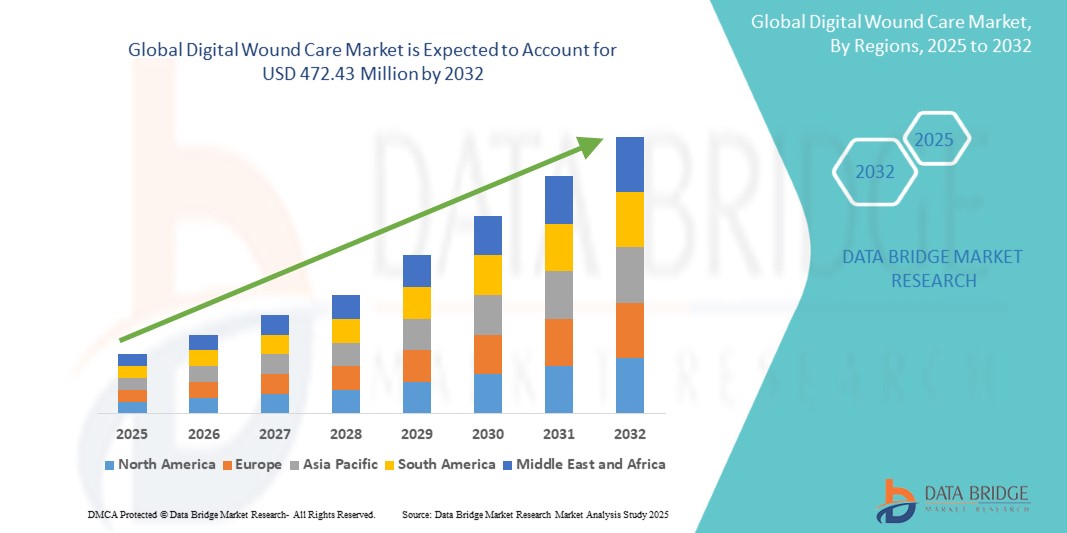
Digital Wound Care Market Analysis
The rising prevalence of chronic wounds and advancements in digital healthcare technologies drives the global digital wound care market growth. According to the World Health Organization (WHO), over 422 million people worldwide have diabetes, a leading cause of diabetic foot ulcers, with approximately 15-25% of diabetic patients experiencing foot ulcers during their lifetime. Additionally, pressure ulcers affect an estimated 2.5 million patients annually in the United States alone, leading to increased demand for advanced wound care solutions. The growing elderly population, who are more prone to chronic and acute wounds, further amplifies the need for innovative wound monitoring technologies. Digital wound care systems enable precise wound assessment, improve healing outcomes, and reduce hospital readmissions, making them an essential tool in modern healthcare settings.
Digital Wound Care Market Size
Global digital wound care market size was valued at USD 235.22 million in 2024 and is projected to reach USD 472.43 million by 2032, with a CAGR of 9.10% during the forecast period of 2025 to 2032. In addition to the insights on market scenarios such as market value, growth rate, segmentation, geographical coverage, and major players, the market reports curated by the Data Bridge Market Research also include depth expert analysis, patient epidemiology, pipeline analysis, pricing analysis, and regulatory framework.
Global Digital Wound Care Market Trends
“Shift Toward Personalized Wound Care”
Personalized wound care is emerging as a significant trend, focusing on tailoring treatment plans to the unique needs of each patient. This approach utilizes advanced data analytics, wearable sensors, and digital monitoring tools to gather real-time information on wound characteristics, healing progression, and patient-specific factors such as age, comorbidities, and lifestyle. By integrating this data, healthcare providers can optimize treatment regimens, select appropriate therapies, and predict healing outcomes with greater accuracy. This trend is helping to improve clinical outcomes, minimize complications, and enhance patient satisfaction by aligning care strategies more closely with individual healing processes.
Report Scope and Global Digital Wound Care Market Segmentation
|
Attributes |
Global Digital Wound Care Key Market Insights |
|
Segments Covered |
|
|
Countries Covered |
U.S., Canada, Mexico, Germany, France, U.K., Netherlands, Switzerland, Belgium, Russia, Italy, Spain, Turkey, Rest of Europe, China, Japan, India, South Korea, Singapore, Malaysia, Australia, Thailand, Indonesia, Philippines, Rest of Asia-Pacific, Saudi Arabia, U.A.E., South Africa, Egypt, Israel, Rest of Middle East and Africa, Brazil, Argentina, Rest of South America |
|
Key Market Players |
3M (U.S.), Smith+Nephew (U.K.), Integra LifeSciences Holdings Corporation (U.S.), Mölnlycke Health Care AB (Sweden), ConvaTec Group plc (U.K.), Coloplast A/S (Denmark), Medtronic (Ireland), Johnson & Johnson Services, Inc. (U.S.), WoundZoom Inc. (U.S.), WoundMatrix, Inc. (U.S.), Healthy.io Ltd (Israel), Swift Medical Inc. (Canada), eKare, Inc. (U.S.), Net Health Systems, Inc. (U.S.), Entec Health Ltd. (U.K.), MolecuLight Inc. (Canada), and ARANZ Medical Limited (New Zealand) among others. |
|
Market Opportunities |
|
|
Value Added Data Infosets |
In addition to the insights on market scenarios such as market value, growth rate, segmentation, geographical coverage, and major players, the market reports curated by the Data Bridge Market Research also include depth expert analysis, patient epidemiology, pipeline analysis, pricing analysis, and regulatory framework. |
Digital Wound Care Market Definition
Digital wound care refers to the use of advanced digital technologies, such as imaging devices, software platforms, and data analytics, to assess, monitor, and manage wounds. It involves capturing detailed wound images, measuring wound dimensions, tracking healing progress, and integrating patient data for personalized treatment plans. This approach enhances clinical decision-making, improves patient outcomes, and reduces the risk of complications by providing real-time insights and accurate documentation for healthcare providers.
Digital Wound Care Market Dynamics
Drivers
- Rising Prevalence of Chronic Wounds
The rising prevalence of chronic wounds is a key driver for the global digital wound care market. Chronic conditions like diabetes, pressure ulcers, and venous leg ulcers are increasingly common due to aging populations and lifestyle-related risk factors. Diabetes, in particular, is a major concern, with over 537 million adults worldwide affected, as per the International Diabetes Federation. Up to 25% of these individuals are likely to develop diabetic foot ulcers during their lifetime, which require ongoing monitoring and precise treatment to prevent complications such as infections or amputations. Similarly, pressure ulcers affect millions annually, particularly among bedridden or elderly individuals. Advanced digital wound care solutions, including imaging and measurement tools, provide accurate monitoring, enabling timely interventions and reducing the burden on healthcare systems. As the prevalence of chronic wounds continues to rise, the adoption of innovative digital technologies will be crucial for improving patient outcomes and care efficiency.
- Technological Advancements in Wound Care Solutions
Technological advancements in wound care solutions are significantly driving the growth of the global digital wound care market. Innovations such as AI-powered wound assessment tools enable precise measurement of wound size and depth, automate healing progress analysis, and support clinical decision-making with predictive insights. Similarly, 3D imaging systems provide enhanced visualization and accurate wound mapping, helping healthcare professionals tailor treatment strategies. The integration of electronic medical records (EMR) further streamlines data management by allowing seamless sharing of wound data across healthcare teams, ensuring coordinated and efficient patient care. These technologies also improve documentation, facilitating compliance with healthcare regulations and enhancing accountability. By reducing the margin for human error, they improve outcomes and patient satisfaction while optimizing resource allocation in healthcare settings. As the demand for evidence-based, efficient, and patient-centric wound management grows, these advancements will remain pivotal in shaping the future of wound care.
Opportunities
- Integration of Wearable and IoT-Enabled Devices
The integration of wearable and IoT-enabled devices into wound care presents a significant opportunity for advancing patient management and treatment outcomes. These devices allow for continuous, real-time monitoring of wounds, providing healthcare professionals with up-to-date data on wound healing, moisture levels, temperature, and other critical factors. Early detection of complications, such as infections or delayed healing, is made possible through the constant data collection, enabling timely intervention and preventing severe outcomes. Additionally, wearable devices align with the growing trend of telemedicine and home-based healthcare, reducing the need for frequent hospital visits and improving patient convenience. Remote monitoring also allows healthcare providers to deliver personalized care plans and adjust treatments as needed without patients needing to travel. As digital health continues to expand, the adoption of IoT-enabled devices in wound care will enhance overall efficiency, reduce healthcare costs, and improve patient outcomes, making them a key opportunity in the market.
- Growing Aging Population
The aging global population presents a significant opportunity for the digital wound care market. As people age, they become more susceptible to chronic conditions such as diabetes, vascular diseases, and limited mobility, which increase the risk of chronic wounds like pressure ulcers, diabetic foot ulcers, and venous leg ulcers. These wounds require continuous monitoring and specialized care to avoid complications. Digital wound care solutions, such as remote monitoring tools, wearable devices, and telemedicine, offer a way to address the needs of this demographic effectively. By enabling real-time wound assessments, providing early detection of complications, and allowing for personalized care plans, these technologies help improve patient outcomes and reduce hospital visits. As the aging population continues to grow, particularly in developed regions, the demand for accessible, cost-effective, and efficient wound care solutions will increase. This presents a substantial opportunity for digital wound care technologies to meet the evolving healthcare needs of elderly patients.
Restraints/Challenges
- High Cost of Digital Wound Care Solutions
The high cost of digital wound care solutions presents a significant restraint in the global market. Advanced technologies such as AI-powered wound assessment tools, 3D imaging systems, and wearable devices require substantial initial investment in equipment, software, and infrastructure. In addition to the purchase costs, healthcare providers must also allocate funds for training staff to effectively use these solutions and for ongoing maintenance and updates. This can make digital wound care solutions less accessible, particularly for smaller healthcare facilities or providers in developing regions where budgets are limited. Although these solutions can improve patient outcomes, reduce hospital admissions, and lower long-term healthcare expenses, the initial financial barrier prevents many healthcare institutions from adopting them. As a result, the high cost remains a key challenge for the widespread implementation of digital wound care technologies, limiting their growth potential in certain markets.
- Data Privacy and Security Concerns
Data privacy and security concerns represent a significant challenge for the global digital wound care market. Since digital wound care solutions involve the collection, storage, and sharing of sensitive patient health information, ensuring the protection of this data is crucial. There is an inherent risk of data breaches, cyberattacks, or unauthorized access, especially as healthcare providers adopt more connected devices and platforms. Compliance with strict data protection regulations such as the General Data Protection Regulation (GDPR) in Europe and the Health Insurance Portability and Accountability Act (HIPAA) in the U.S. adds additional complexity for healthcare providers and technology developers. They must implement robust security measures like encryption, secure cloud storage, and user authentication protocols. Failure to safeguard patient data can result in a loss of trust, legal ramifications, and reputational damage for both healthcare institutions and technology providers. As digital wound care solutions continue to grow, addressing these security concerns will be essential for market success.
Global Digital Wound Care Market Scope
The market is segmented on the basis of product type, wound type, application, and end user. The growth amongst these segments will help you analyze meagre growth segments in the industries and provide the users with a valuable market overview and market insights to help them make strategic decisions for identifying core market applications.
Product Type
- Devices
- Software
Wound Type
- Chronic Wounds
- Acute Wounds
Application
- Wound Assessment
- Treatment Monitoring
- Documentation and Analysis
End User
- Hospitals
- Specialty Clinics
- Home Healthcare Settings
- Long-Term Care Facilities
Global Digital Wound Care Market Regional Analysis
The market is analyzed and market size insights and trends are provided by country, product type, wound type, application, and end user as referenced above.
The countries covered in the market are U.S., Canada, Mexico, Germany, France, U.K., Netherlands, Switzerland, Belgium, Russia, Italy, Spain, Turkey, rest of Europe, China, Japan, India, South Korea, Singapore, Malaysia, Australia, Thailand, Indonesia, Philippines, rest of Asia-Pacific, Saudi Arabia, U.A.E., South Africa, Egypt, Israel, rest of Middle East and Africa, Brazil, Argentina, and rest of South America.
North America is expected to dominate the market due to its advanced healthcare infrastructure, high adoption rate of digital health technologies, and increasing prevalence of chronic wounds, particularly among the aging population.
Asia-Pacific is expected to be the fastest growing due to the rising prevalence of chronic diseases, improving healthcare infrastructure, and increasing awareness and adoption of digital health technologies in emerging economies.
The country section of the report also provides individual market impacting factors and changes in regulation in the market domestically that impacts the current and future trends of the market. Data points like down-stream and upstream value chain analysis, technical trends and porter's five forces analysis, case studies are some of the pointers used to forecast the market scenario for individual countries. Also, the presence and availability of global brands and their challenges faced due to large or scarce competition from local and domestic brands, impact of domestic tariffs and trade routes are considered while providing forecast analysis of the country data.
Global Digital Wound Care Market Share
The market competitive landscape provides details by competitor. Details included are company overview, company financials, revenue generated, market potential, investment in research and development, new market initiatives, global presence, production sites and facilities, production capacities, company strengths and weaknesses, product launch, product width and breadth, application dominance. The above data points provided are only related to the companies' focus related to market.
Global Digital Wound Care Market Leaders Operating in the Market Are:
- 3M (U.S.)
- Smith+Nephew (U.K.)
- Integra LifeSciences Holdings Corporation (U.S.)
- Mölnlycke Health Care AB (Sweden)
- ConvaTec Group plc (U.K.)
- Coloplast A/S (Denmark)
- Medtronic (Ireland)
- Johnson & Johnson Services, Inc. (U.S.)
- WoundZoom Inc. (U.S.)
- WoundMatrix, Inc. (U.S.)
- Healthy.io Ltd (Israel)
- Swift Medical Inc. (Canada)
- eKare, Inc. (U.S.)
- Net Health Systems, Inc. (U.S.)
- Entec Health Ltd. (U.K.)
- MolecuLight Inc. (Canada)
- ARANZ Medical Limited (New Zealand)
Latest Developments in Global Digital Wound Care Market
- In October 2024, Mölnlycke Health Care partnered with Transdiagen (TDG), a precision medicine company, to research chronic wound healing and tissue regeneration using TDG’s novel wound gene signatures. This collaboration will help Mölnlycke enhance its wound care products by integrating advanced genetic insights for more effective treatment
- In October 2024, Swift Medical launched its "Skin & Wound 2" platform, featuring advanced interoperability standards, imaging, and documentation tools. With over 50 million patient assessments across various healthcare settings, this platform will enhance the company’s ability to provide efficient, data-driven wound care solutions and improve patient outcomes
- In October 2024, Sonoma Pharmaceuticals amended its distribution agreement with a major global healthcare distributor to market and distribute its Microcyn-based wound care products in Canada. This expansion will help the company increase its market presence and reach more customers in the Canadian healthcare sector
- In March 2024, Swift Medical secured a strategic co-investment from DIGITAL, Canada’s Global Innovation Cluster, to advance healthcare innovation in wound care. By leveraging AI, this collaboration aims to improve patient outcomes and treatment equity, helping Swift Medical lead the way in digital wound care management
SKU-
세계 최초의 시장 정보 클라우드 보고서에 온라인으로 접속하세요

- 대화형 데이터 분석 대시보드
- 높은 성장 잠재력 기회를 위한 회사 분석 대시보드
- 사용자 정의 및 질의를 위한 리서치 분석가 액세스
- 대화형 대시보드를 통한 경쟁자 분석
- 최신 뉴스, 업데이트 및 추세 분석
- 포괄적인 경쟁자 추적을 위한 벤치마크 분석의 힘 활용
연구 방법론
데이터 수집 및 기준 연도 분석은 대규모 샘플 크기의 데이터 수집 모듈을 사용하여 수행됩니다. 이 단계에는 다양한 소스와 전략을 통해 시장 정보 또는 관련 데이터를 얻는 것이 포함됩니다. 여기에는 과거에 수집한 모든 데이터를 미리 검토하고 계획하는 것이 포함됩니다. 또한 다양한 정보 소스에서 발견되는 정보 불일치를 검토하는 것도 포함됩니다. 시장 데이터는 시장 통계 및 일관된 모델을 사용하여 분석하고 추정합니다. 또한 시장 점유율 분석 및 주요 추세 분석은 시장 보고서의 주요 성공 요인입니다. 자세한 내용은 분석가에게 전화를 요청하거나 문의 사항을 드롭하세요.
DBMR 연구팀에서 사용하는 주요 연구 방법론은 데이터 마이닝, 시장에 대한 데이터 변수의 영향 분석 및 주요(산업 전문가) 검증을 포함하는 데이터 삼각 측량입니다. 데이터 모델에는 공급업체 포지셔닝 그리드, 시장 타임라인 분석, 시장 개요 및 가이드, 회사 포지셔닝 그리드, 특허 분석, 가격 분석, 회사 시장 점유율 분석, 측정 기준, 글로벌 대 지역 및 공급업체 점유율 분석이 포함됩니다. 연구 방법론에 대해 자세히 알아보려면 문의를 통해 업계 전문가에게 문의하세요.
사용자 정의 가능
Data Bridge Market Research는 고급 형성 연구 분야의 선두 주자입니다. 저희는 기존 및 신규 고객에게 목표에 맞는 데이터와 분석을 제공하는 데 자부심을 느낍니다. 보고서는 추가 국가에 대한 시장 이해(국가 목록 요청), 임상 시험 결과 데이터, 문헌 검토, 재생 시장 및 제품 기반 분석을 포함하도록 사용자 정의할 수 있습니다. 기술 기반 분석에서 시장 포트폴리오 전략에 이르기까지 타겟 경쟁업체의 시장 분석을 분석할 수 있습니다. 귀하가 원하는 형식과 데이터 스타일로 필요한 만큼 많은 경쟁자를 추가할 수 있습니다. 저희 분석가 팀은 또한 원시 엑셀 파일 피벗 테이블(팩트북)로 데이터를 제공하거나 보고서에서 사용 가능한 데이터 세트에서 프레젠테이션을 만드는 데 도움을 줄 수 있습니다.











