



Global IoMT in Orthopedics Market Segmentation, By Product Type (Wearable Devices, Implants, Monitoring Systems, Diagnostic Equipment, Others), Technology (Sensors, Data Storage & Cloud Computing, Connectivity Technologies, AI and Machine Learning Integration), Application (Fracture Management, Joint Replacement Surgery, Spinal Surgery, Orthopedic Rehabilitation, Pain Management, Osteoporosis Monitoring), End User (Hospitals, Orthopedic Clinics, Home Healthcare, Research Institutes, Ambulatory Surgical Centers) – Industry Trends and Forecast to 2032
IoMT in Orthopedics Market Analysis
The global Internet of Medical Things (IoMT) in orthopedics market is witnessing significant growth, driven by the increasing prevalence of orthopedic conditions such as fractures, joint disorders, and musculoskeletal diseases. According to the World Health Organization, musculoskeletal conditions affect over 1.7 billion people worldwide, with a particularly high incidence of osteoarthritis, which impacts around 10% of men and 18% of women over 60 years old. As the aging global population grows, the demand for orthopedic interventions and monitoring solutions is rising. Additionally, advancements in IoMT technologies, such as wearable devices and real-time patient monitoring systems, are enhancing treatment outcomes and improving patient care by offering personalized and remote management solutions. These innovations help address the rising burden of orthopedic conditions, reduce hospital readmissions, and promote rehabilitation, making IoMT increasingly integral to the orthopedic healthcare environment.
IoMT in Orthopedics Market Size
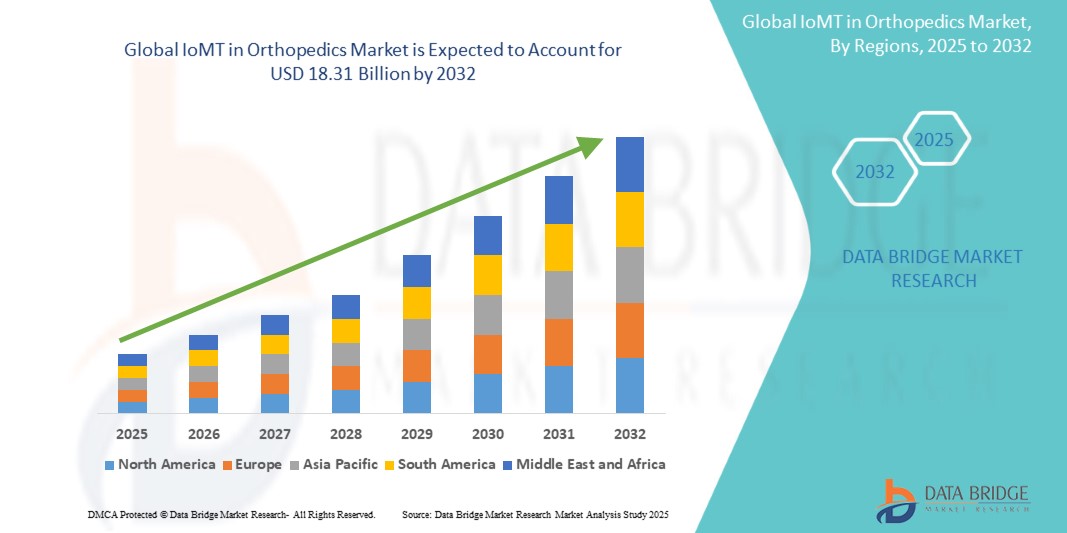
Global IoMT in orthopedics market size was valued at USD 4.90 billion in 2024 and is projected to reach USD 18.31 billion by 2032, with a CAGR of 17.90% during the forecast period of 2025 to 2032. In addition to the insights on market scenarios such as market value, growth rate, segmentation, geographical coverage, and major players, the market reports curated by the Data Bridge Market Research also include depth expert analysis, patient epidemiology, pipeline analysis, pricing analysis, and regulatory framework.
Global IoMT in Orthopedics Market Trends
“Growth in Smart Implants”
The growth in smart implants is becoming a prominent trend in the orthopedic sector. These implants, embedded with advanced sensors, continuously monitor the health of joints, bones, and soft tissues. They can detect issues such as infection, inflammation, or mechanical failure in real time, allowing for immediate intervention. This technology is particularly beneficial for patients recovering from joint replacement surgeries, as it provides valuable data that can be used to adjust treatment plans and improve rehabilitation. By enabling proactive care and enhancing long-term outcomes, smart implants are transforming the way orthopedic conditions are managed and treated.
Report Scope and Global IoMT in Orthopedics Market Segmentation
|
Attributes |
Global IoMT in Orthopedics Key Market Insights |
|
Segments Covered |
|
|
Countries Covered |
U.S., Canada, Mexico, Germany, France, U.K., Netherlands, Switzerland, Belgium, Russia, Italy, Spain, Turkey, Rest of Europe, China, Japan, India, South Korea, Singapore, Malaysia, Australia, Thailand, Indonesia, Philippines, Rest of Asia-Pacific, Saudi Arabia, U.A.E., South Africa, Egypt, Israel, Rest of Middle East and Africa, Brazil, Argentina, Rest of South America |
|
Key Market Players |
Medtronic (Ireland), Stryker (U.S.), Zimmer Biomet (U.S.), • Johnson & Johnson Services, Inc. (U.S.), Smith+Nephew (U.K.), Boston Scientific (U.S.), B.Braun SE (Germany), CureMetrix (U.S.), Bioventus (U.S.), EchoPixel (U.S.), Intuitive Surgical (U.S.), 3D Systems (U.S.), Carestream Health (U.S.), Mazor Robotics (Israel), MedTech Surgical (France), Sentio Solutions (U.S.), Spinal Elements (U.S.), Arthrex, Inc. (U.S.) among others. |
|
Market Opportunities |
|
|
Value Added Data Infosets |
In addition to the insights on market scenarios such as market value, growth rate, segmentation, geographical coverage, and major players, the market reports curated by the Data Bridge Market Research also include depth expert analysis, patient epidemiology, pipeline analysis, pricing analysis, and regulatory framework. |
IoMT in Orthopedics Market Definition
The Internet of Medical Things (IoMT) in orthopedics refers to the network of interconnected devices, sensors, and technologies used to monitor, diagnose, and manage orthopedic conditions in real-time. These devices, which can include wearable sensors, smart implants, and diagnostic tools, collect and transmit data to healthcare providers, enabling continuous monitoring of patients' orthopedic health. IoMT in orthopedics enhances the accuracy of diagnoses, facilitates remote patient monitoring, and supports personalized treatment plans, ultimately improving patient outcomes and optimizing the management of musculoskeletal disorders.
IoMT in Orthopedics Market Dynamics
Drivers
- Rising Prevalence of Orthopedic Disorders
The rising prevalence of orthopedic disorders, including osteoarthritis, fractures, and musculoskeletal conditions, is a significant driver for the adoption of IoMT technologies in orthopedic care. As the global population ages, the incidence of conditions such as joint degeneration and bone fractures is increasing, creating a heightened demand for efficient and innovative treatment solutions. IoMT devices, such as wearable sensors, smart implants, and connected diagnostic tools, offer continuous monitoring of patients' orthopedic health, enabling early detection of issues like joint instability, inflammation, or mechanical failure. These technologies help in managing chronic conditions more effectively by providing real-time data, allowing healthcare providers to intervene promptly and tailor treatment plans based on individual patient needs. As the number of patients requiring orthopedic care continues to grow, IoMT technologies present a solution to improve long-term management, recovery, and outcomes. In conclusion, the growing prevalence of orthopedic conditions is accelerating the need for IoMT solutions in this field.
- Advancements in Wearable Devices and Smart Implants
Advancements in wearable devices and smart implants are significantly driving the growth of the Internet of Medical Things (IoMT) market in orthopedics. These innovative technologies, equipped with sensors, allow for continuous monitoring of orthopedic conditions such as joint health, bone healing, and soft tissue recovery. Wearable devices, such as smart braces and patches, collect real-time data that can be transmitted to healthcare providers, enabling remote monitoring and early detection of any complications. Similarly, smart implants, which are embedded with sensors, can track the status of implants and provide feedback on their function, ensuring timely interventions when necessary. This continuous data flow allows for more personalized treatment plans, which can be adjusted based on the patient's recovery progress. By enhancing monitoring accuracy and improving the overall management of orthopedic conditions, these devices contribute to better patient outcomes and faster recovery times. In conclusion, technological advancements in wearable devices and smart implants are key factors driving IoMT adoption in orthopedics.
Opportunities
- Expanding Telemedicine and Remote Patient Monitoring
Expanding telemedicine and remote patient monitoring presents a significant opportunity for the Internet of Medical Things (IoMT) in orthopedics. With the increasing demand for remote care, IoMT devices can provide continuous, real-time monitoring of orthopedic patients, particularly those recovering from surgery or managing chronic conditions like osteoarthritis or fractures. By integrating IoMT devices with telemedicine platforms, healthcare providers can track patients' progress remotely, offering timely interventions without requiring frequent in-person visits. This model improves patient convenience by allowing them to manage their conditions from the comfort of their homes while reducing the burden on healthcare facilities. Additionally, remote monitoring ensures that healthcare providers can efficiently manage a larger number of patients, even in underserved regions. This shift toward remote care not only enhances accessibility but also lowers healthcare costs associated with hospitalization and clinic visits.
In conclusion, the expansion of telemedicine and remote monitoring is a valuable opportunity for the growth of IoMT in orthopedics.
- Integration with Artificial Intelligence for Predictive Analysis
The integration of artificial intelligence (AI) with Internet of Medical Things (IoMT) devices offers a valuable opportunity to enhance predictive analysis and decision-making in orthopedic care. By combining data from wearable devices, smart implants, and sensors, AI can assist healthcare providers in predicting complications, monitoring patient recovery, and creating personalized treatment plans tailored to individual needs. This integration allows for continuous, data-driven insights that help identify early warning signs of potential issues, improving the timeliness and effectiveness of interventions. AI-powered predictive analysis can also optimize recovery paths by adjusting treatment based on real-time data, reducing the risk of complications, and ensuring better outcomes post-surgery. This proactive approach improves patient care, accelerates healing, and enhances decision-making capabilities for orthopedic providers.
AI integration in IoMT devices has the potential to revolutionize orthopedic care by offering precise, personalized, and data-driven solutions for improved patient management.
Restraints/Challenges
- High Cost of Implementing IoMT Technologies
The high cost of implementing Internet of Medical Things (IoMT) technologies is a significant restraint in the orthopedic market. Integrating advanced devices, sensors, and AI-driven analytics into orthopedic care requires substantial investments in infrastructure, equipment, software, and ongoing training for healthcare professionals. Small to medium-sized healthcare providers, particularly in developing regions, may struggle to afford these technologies, limiting their ability to adopt IoMT solutions. Furthermore, the continuous maintenance, system updates, and technical support add to the financial burden, further exacerbating accessibility challenges. While IoMT technologies offer considerable benefits, such as enhanced patient outcomes, improved efficiency, and better recovery monitoring, the initial and recurring costs can prevent widespread adoption. This financial barrier can particularly affect hospitals or clinics with limited budgets, restricting their access to cutting-edge orthopedic care. Therefore, the high costs associated with IoMT implementation pose a challenge for market growth and the global expansion of these technologies in orthopedics.
- Data Privacy and Security Concerns
A key challenge in the market is ensuring the privacy and security of patient data. IoMT devices, which continuously collect and transmit sensitive health information, face increasing risks of cyberattacks, data breaches, and unauthorized access. As healthcare providers integrate more advanced devices and systems, they must comply with stringent regulations such as GDPR and HIPAA to protect patient data. Failure to meet these standards could result in significant legal ramifications, loss of patient trust, and reputational damage. Additionally, the diverse range of devices and platforms used in IoMT may create vulnerabilities, complicating data security efforts further. Healthcare providers must invest in robust cybersecurity measures, including encryption, secure cloud storage, and secure data transmission protocols, to protect sensitive health data. Continuous advancements in cybersecurity are necessary to address these challenges and ensure the safe and effective use of IoMT technologies in orthopedic care.
IoMT in Orthopedics Market Scope
The market is segmented on the basis of product type, technology, application, and end user. The growth amongst these segments will help you analyze meagre growth segments in the industries and provide the users with a valuable market overview and market insights to help them make strategic decisions for identifying core market applications.
Product Type
- Wearable Devices
- Implants
- Monitoring Systems
- Diagnostic Equipment, Others
Technology
- Sensors
- Data Storage & Cloud Computing
- Connectivity Technologies
- AI and Machine Learning Integration
Application
- Fracture Management
- Joint Replacement Surgery
- Spinal Surgery
- Orthopedic Rehabilitation
- Pain Management
- Osteoporosis Monitoring
End User
- Hospitals
- Orthopedic Clinics
- Home Healthcare
- Research Institutes
- Ambulatory Surgical Centers
IoMT in Orthopedics Market Regional Analysis
The market is analyzed and market size insights and trends are provided by country, product type, technology, application, and end user as referenced above.
The countries covered in the market are U.S., Canada, Mexico, Germany, France, U.K., Netherlands, Switzerland, Belgium, Russia, Italy, Spain, Turkey, rest of Europe, China, Japan, India, South Korea, Singapore, Malaysia, Australia, Thailand, Indonesia, Philippines, rest of Asia-Pacific, Saudi Arabia, U.A.E., South Africa, Egypt, Israel, rest of Middle East and Africa, Brazil, Argentina, and rest of South America.
North America is expected to dominate the market due to its well-established healthcare infrastructure, which supports the widespread adoption of advanced technologies. The region benefits from strong investments in research and development, fostering innovation in IoMT solutions such as smart implants and wearable devices.
Asia-Pacific is expected to be the fastest growing due to the increasing adoption of digital health technologies, driven by improving healthcare infrastructure and rising demand for advanced orthopedic care solutions. Additionally, the region’s large aging population, growing prevalence of orthopedic conditions, and expanding telemedicine and remote monitoring capabilities further contribute to the rapid growth of IoMT technologies in this market.
The country section of the report also provides individual market impacting factors and changes in regulation in the market domestically that impacts the current and future trends of the market. Data points like down-stream and upstream value chain analysis, technical trends and porter's five forces analysis, case studies are some of the pointers used to forecast the market scenario for individual countries. Also, the presence and availability of global brands and their challenges faced due to large or scarce competition from local and domestic brands, impact of domestic tariffs and trade routes are considered while providing forecast analysis of the country data.
IoMT in Orthopedics Market Share
The market competitive landscape provides details by competitor. Details included are company overview, company financials, revenue generated, market potential, investment in research and development, new market initiatives, global presence, production sites and facilities, production capacities, company strengths and weaknesses, product launch, product width and breadth, application dominance. The above data points provided are only related to the companies' focus related to market.
IoMT in Orthopedics Market Leaders Operating in the Market Are:
- Medtronic (Ireland)
- Stryker (U.S.)
- Zimmer Biomet (U.S.)
- Johnson & Johnson Services, Inc. (U.S.)
- Smith+Nephew (U.K.)
- Boston Scientific (U.S.)
- B.Braun SE (Germany)
- CureMetrix (U.S.)
- Bioventus (U.S.)
- EchoPixel (U.S.)
- Intuitive Surgical (U.S.)
- 3D Systems (U.S.)
- Carestream Health (U.S.)
- Mazor Robotics (Israel)
- MedTech Surgical (France)
- Sentio Solutions (U.S.)
- Spinal Elements (U.S.)
- Arthrex, Inc. (U.S.)
Latest Developments in Global IoMT in Orthopedics Market
- In November 2024, Auxein, announced the success of its participation in MEDICA 2024, held from November 11-14 in Düsseldorf, Germany. With over 5,800 exhibitors and 80,000 visitors from 165 countries, MEDICA solidified its status as a premier medical technology event, and Auxein's presence was a standout moment. This exposure strengthens Auxein’s brand visibility and fosters valuable industry connections, further advancing its global presence in the orthopedic market
SKU-
세계 최초의 시장 정보 클라우드 보고서에 온라인으로 접속하세요

- 대화형 데이터 분석 대시보드
- 높은 성장 잠재력 기회를 위한 회사 분석 대시보드
- 사용자 정의 및 질의를 위한 리서치 분석가 액세스
- 대화형 대시보드를 통한 경쟁자 분석
- 최신 뉴스, 업데이트 및 추세 분석
- 포괄적인 경쟁자 추적을 위한 벤치마크 분석의 힘 활용
연구 방법론
데이터 수집 및 기준 연도 분석은 대규모 샘플 크기의 데이터 수집 모듈을 사용하여 수행됩니다. 이 단계에는 다양한 소스와 전략을 통해 시장 정보 또는 관련 데이터를 얻는 것이 포함됩니다. 여기에는 과거에 수집한 모든 데이터를 미리 검토하고 계획하는 것이 포함됩니다. 또한 다양한 정보 소스에서 발견되는 정보 불일치를 검토하는 것도 포함됩니다. 시장 데이터는 시장 통계 및 일관된 모델을 사용하여 분석하고 추정합니다. 또한 시장 점유율 분석 및 주요 추세 분석은 시장 보고서의 주요 성공 요인입니다. 자세한 내용은 분석가에게 전화를 요청하거나 문의 사항을 드롭하세요.
DBMR 연구팀에서 사용하는 주요 연구 방법론은 데이터 마이닝, 시장에 대한 데이터 변수의 영향 분석 및 주요(산업 전문가) 검증을 포함하는 데이터 삼각 측량입니다. 데이터 모델에는 공급업체 포지셔닝 그리드, 시장 타임라인 분석, 시장 개요 및 가이드, 회사 포지셔닝 그리드, 특허 분석, 가격 분석, 회사 시장 점유율 분석, 측정 기준, 글로벌 대 지역 및 공급업체 점유율 분석이 포함됩니다. 연구 방법론에 대해 자세히 알아보려면 문의를 통해 업계 전문가에게 문의하세요.
사용자 정의 가능
Data Bridge Market Research는 고급 형성 연구 분야의 선두 주자입니다. 저희는 기존 및 신규 고객에게 목표에 맞는 데이터와 분석을 제공하는 데 자부심을 느낍니다. 보고서는 추가 국가에 대한 시장 이해(국가 목록 요청), 임상 시험 결과 데이터, 문헌 검토, 재생 시장 및 제품 기반 분석을 포함하도록 사용자 정의할 수 있습니다. 기술 기반 분석에서 시장 포트폴리오 전략에 이르기까지 타겟 경쟁업체의 시장 분석을 분석할 수 있습니다. 귀하가 원하는 형식과 데이터 스타일로 필요한 만큼 많은 경쟁자를 추가할 수 있습니다. 저희 분석가 팀은 또한 원시 엑셀 파일 피벗 테이블(팩트북)로 데이터를 제공하거나 보고서에서 사용 가능한 데이터 세트에서 프레젠테이션을 만드는 데 도움을 줄 수 있습니다.











