



Global Medical Device Engineering Market Segmentation, By Service Type (Product Innovation & Design/Industrial Design Services, Prototyping Services, Electronics Engineering Services, Software Development & Testing Services, Connectivity And Mobility Services, Cybersecurity Services, Product Testing Services, Regulatory Consulting Services, Product Support & Maintenance Services), Device Type (Diagnostic Imaging Equipment, Surgical Equipment, Patient Monitoring Devices & Life Support Devices, Medical Lasers, IVD Devices, Other Medical Devices) – Industry Trends and Forecast to 2032
Medical Device Engineering Market Analysis
The medical device engineering market is experiencing robust growth, driven by advancements in healthcare technology, increased investment in R&D, and rising demand for innovative medical solutions. With a market size projected to grow at a CAGR of over 5.8%, the industry benefits from the development of minimally invasive devices, wearable health technologies, and diagnostic tools powered by AI and IoT. Key factors influencing this growth include the aging global population and the rising prevalence of chronic diseases, which necessitate advanced medical devices for effective management. Regulatory changes, such as the EU's MDR (Medical Device Regulation) and stringent FDA requirements, are driving companies to invest in high-quality engineering solutions to ensure compliance and safety. Technological advancements, including 3D printing, robotics, and smart materials, are reshaping medical device engineering. These innovations enable faster prototyping, cost efficiency, and enhanced device functionality. The Asia-Pacific region is emerging as a significant contributor, driven by lower manufacturing costs and a growing healthcare infrastructure. Challenges like high R&D costs and regulatory hurdles remain, but the demand for cutting-edge medical devices in diagnostics, treatment, and monitoring systems ensures a positive trajectory for the industry. The integration of digital health solutions will further propel this market.
Medical Device Engineering Market Size
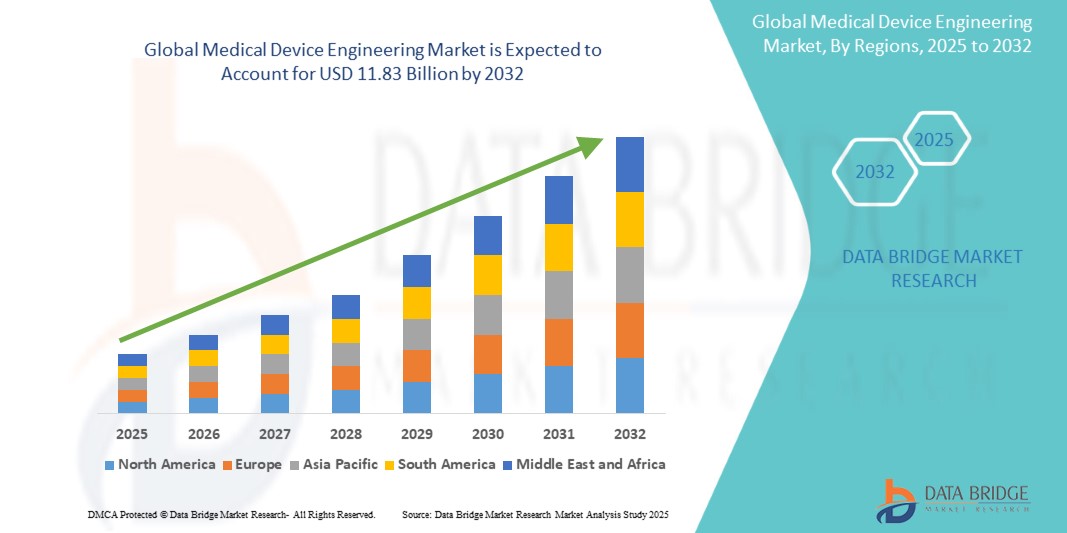
Global medical device engineering market size was valued at USD 7.66 billion in 2024 and is projected to reach USD 11.83 billion by 2032, with a CAGR of 5.8% during the forecast period of 2025 to 2032. In addition to the insights on market scenarios such as market value, growth rate, segmentation, geographical coverage, and major players, the market reports curated by the Data Bridge Market Research also include depth expert analysis, patient epidemiology, pipeline analysis, pricing analysis, and regulatory framework.
Medical Device Engineering Market Trends
“Artificial Intelligence (AI) and Machine Learning (ML) Integration in Medical Devices”
One of the most transformative trends in medical device engineering market is the integration of Artificial Intelligence (AI) and Machine Learning (ML) capabilities. AI and ML are enabling medical devices to perform more advanced functions such as diagnostics, data analysis, and personalized treatment recommendations, which are paving the way for a new generation of “smart” medical devices
AI-driven medical devices can analyze complex datasets and identify patterns that may not be apparent to human operators. For instance, AI algorithms embedded in imaging devices such as MRI and CT scanners help radiologists detect abnormalities such as tumors, fractures, or blood clots more accurately and at an earlier stage. This is helping healthcare providers make quicker and more accurate diagnoses, leading to better patient outcomes. AI-enabled devices can create individualized treatment plans by analyzing a patient’s unique physiological data, medical history, and genetic information. This is particularly valuable in fields like oncology, where treatments can be tailored to the specific genetic profile of a patient’s tumor, improving the effectiveness of therapies.
Report Scope and Medical Device Engineering Market Segmentation
|
Attributes |
Agriculture Rollers Key Market Insights |
|
Segments Covered |
|
|
Countries Covered |
U.S., Canada, Mexico, Germany, France, U.K., Netherlands, Switzerland, Belgium, Russia, Italy, Spain, Turkey, Rest of Europe, China, Japan, India, South Korea, Singapore, Malaysia, Australia, Thailand, Indonesia, Philippines, Rest of Asia-Pacific, Saudi Arabia, U.A.E., South Africa, Egypt, Israel, Rest of Middle East and Africa, Brazil, Argentina, Rest of South America |
|
Key Market Players |
L&T Technology Services Limited (India), Infosys Limited (India), HCL Technologies Limited (India), Cyient (India), Wipro (India), Tech Mahindra Limited (India), TATA Consultancy Services Limited (India), FLEX LTD (U.S.), Capgemini (France), Embien Technologies India Pvt Ltd. (India), Alten Group (France), Accenture (Ireland), Consonance (Poland), Althea Group (U.S.), MED INSTITUTE (U.S.), Saraca Solutions Private Limited (India), Nemedio Inc. (U.S.), Sternum (Israel), Medcrypt (U.S.), MCRA, LLC (U.S.), North American Science Associates, LLC (U.S.), MedQtech (Sweden), Veranex (U.S.), Ontogen Medtech LLC (U.S.), Seisa Media (U.S.), and Simplexity Product Development (U.S.). |
|
Market Opportunities |
|
|
Value Added Data Infosets |
In addition to the insights on market scenarios such as market value, growth rate, segmentation, geographical coverage, and major players, the market reports curated by the Data Bridge Market Research also include depth expert analysis, patient epidemiology, pipeline analysis, pricing analysis, and regulatory framework. |
Medical Device Engineering Market Definition
Medical device engineering is a multidisciplinary field focused on the design, development, and manufacturing of devices used for medical purposes, such as diagnosis, treatment, monitoring, or prevention of diseases. It integrates principles of mechanical, electrical, software, and biomedical engineering to create innovative and reliable devices, ranging from wearable health monitors and imaging systems to minimally invasive surgical tools and prosthetics. This field emphasizes compliance with stringent regulatory standards, safety, and user-centered design to ensure efficacy and patient comfort. Advances in materials science, robotics, and digital health technologies, like AI and IoT, are reshaping medical device engineering for improved healthcare outcomes.
Medical Device Engineering Market Dynamics
Drivers
- Increasing Prevalence of Chronic Diseases
The rising prevalence of chronic diseases such as cardiovascular disease, diabetes, cancer, and respiratory disorders is a major driver for the medical device engineering market. Chronic diseases are long-term, often lifestyle-related conditions that require ongoing monitoring, management, and treatment. As these diseases become more common due to factors such as aging populations, urbanization, and sedentary lifestyles, there is a growing need for medical devices that can aid in diagnostics, monitoring, and treatment. Conditions such as diabetes and cardiovascular diseases necessitate constant monitoring. Devices such as glucose monitors, heart rate monitors, and even wearable ECGs have become essential for patients, allowing for real-time health tracking and quick response to adverse events.
For instance, according to 2021 International Diabetes Federation (IDF) report, 10.5% of the adult population (20-79 years) has diabetes, with almost half unaware that they are living with the condition. By 2045, IDF projections show that 1 in 8 adults, approximately 783 million, will be living with diabetes, an increase of 46%.
The demand for medical devices used in managing chronic diseases has led to innovations in portable, user-friendly, and cost-effective devices, making healthcare more accessible. For instance, the development of connected devices that transmit data to healthcare providers in real time is helping to address chronic disease management at both the patient and system levels. This trend is expected to increase, contributing significantly to the growth of the medical device engineering market.
- Technological Advancements in Medical Devices
Rapid technological innovation is a powerful driver in the medical device engineering market, reshaping devices and enhancing their capabilities. Advances in fields such as artificial intelligence, robotics, 3D printing, and biocompatible materials are enabling the development of sophisticated medical devices that offer greater precision, automation, and adaptability to individual patient needs. The adoption of these advanced technologies is enabling the medical device market to meet growing demands for more effective, efficient, and patient-centered solutions. Companies investing in these technologies are poised to capture market share by offering innovative devices that are easier for clinicians to use and provide enhanced clinical benefits. For instance, Philips leverages AI in its diagnostic imaging devices, such as the IntelliSpace AI Workflow Suite. This platform uses AI to enhance imaging quality, speed up diagnostic workflows, and assist in earlier, more accurate diagnosis. It's designed for radiologists to streamline imaging operations and provide improved patient outcomes. As healthcare systems worldwide increasingly adopt these advanced solutions, the medical device engineering market is expected to experience robust growth driven by technological progress.
Opportunities
- Expansion in Wearable and Remote Monitoring Devices
With the rise in telemedicine and demand for proactive health management, wearable and remote monitoring devices present a substantial opportunity in the medical device engineering market. These devices, including smartwatches, continuous glucose monitors, and cardiac monitors, allow for real-time health monitoring outside of traditional clinical settings. The ability to track vital signs such as heart rate, oxygen levels, and glucose provides continuous patient data and empowers individuals to manage their health more effectively. Wearable devices offer immense value for patients managing chronic conditions like diabetes, hypertension, and heart disease. With increasing awareness of preventive healthcare and growing investment in wearable technologies, this segment is anticipated to see significant growth. According to market research, the wearable medical device segment is expected to grow at a high CAGR over the next decade, contributing heavily to the overall medical device market’s expansion.
For instance, in August 2024, Dexcom announced its new over-the-counter continuous glucose monitor Stelo is officially available for purchase in the U.S. The Stelo Glucose Biosensor System is an over-the-counter (OTC) integrated Continuous Glucose Monitor (iCGM) intended to continuously measure, record, analyze, and display glucose values in people 18 years and older not on insulin. The Stelo Glucose Biosensor System helps to detect normal (euglycemic) and low or high (dysglycemic) glucose levels. The Stelo Glucose Biosensor System may also help the user better understand how lifestyle and behavior modification, including diet and exercise, impact glucose excursion. Thus, the increase in availability of wearable and remote monitoring devices is expected to drives the growth of the market during the forecast period.
- Growing Demand for Minimally Invasive Surgical Devices
The shift toward minimally invasive procedures presents another substantial opportunity for medical device engineering. Minimally invasive surgical (MIS) devices, including laparoscopic instruments, robotic-assisted surgery tools, and endoscopic devices, reduce recovery time, cause less trauma, and minimize postoperative complications. The market for MIS devices is expanding as patients and healthcare providers seek options that shorten hospital stays and improve patient outcomes. MIS techniques involve smaller incisions, which reduce the risk of infection, pain, and scarring. Robotic-assisted surgery, for instance, enables greater precision in complex procedures such as cardiac and orthopedic surgeries, improving outcomes and recovery times.
This trend is being bolstered by technological advancements in robotics, imaging, and surgical tools. The MIS devices market is expected to see robust growth, with projections indicating high demand, particularly in orthopedic, cardiovascular, and gastrointestinal applications. The opportunity is also enhanced by an aging population that often requires surgical interventions for chronic conditions, which MIS techniques can address with fewer complications and faster recoveries. For instance, Stryker’s Mako System is a robotic-assisted platform that enables orthopedic surgeons to perform precise, minimally invasive knee and hip replacement surgeries. The Mako System integrates 3D imaging and robotic arms, allowing for improved precision and patient-specific surgical planning. The introduction of this type of devices boost the growth of market during the forecast period.
Restraints/Challenges
- Regulatory Compliance and Approval Delays
One of the most significant challenges facing the medical device engineering industry is navigating complex and stringent regulatory requirements. To obtain regulatory approval, medical devices must undergo rigorous testing and clinical trials to demonstrate safety and efficacy. This process can be time-consuming and expensive, often leading to delays in product launches and market entry. Moreover, the regulatory landscape is constantly evolving, with new regulations and standards being introduced. This can create additional challenges for manufacturers, who must stay updated on the latest requirements and adapt their products accordingly.
Furthermore, the regulatory landscape can vary significantly across different countries. Obtaining approvals in multiple markets can be a complex and costly process. This can hinder the global distribution of medical devices and limit market access.
- High Initial Costs of Medical Device
The high cost of medical devices is a significant barrier to the growth of the medical device engineering market. Expensive materials, complex manufacturing processes, and stringent regulatory requirements contribute to the overall cost of these devices. As a result, healthcare providers, especially in developing countries, may struggle to afford advanced medical technologies, limiting market adoption. Additionally, high prices can deter innovation from smaller companies that lack the financial resources to invest in R&D and comply with regulatory standards. This restricts the accessibility and scalability of new technologies.
For instance, according to the American Council on Science and Health, the cost of medical devices are rarely mentioned. It represents about 5% of healthcare spending, or roughly USD120 billion in 2017. Therefore, the high cost of medical devices restraints to the growth of the medical device engineering market.
Medical Device Engineering Market Scope
The market is segmented on the basis of service type and device type. The growth amongst these segments will help you analyze meagre growth segments in the industries and provide the users with a valuable market overview and market insights to help them make strategic decisions for identifying core market applications.
Service Type
- Product Innovation & Design/Industrial Design Services
- Prototyping Services
- Electronics Engineering Services
- Software Development & Testing Services
- Connectivity And Mobility Services
- Cybersecurity Services
- Product Testing Services
- Regulatory Consulting Services
- Product Support & Maintenance Service
Device Type
- Diagnostic Imaging Equipment
- Surgical Equipment
- Patient Monitoring Devices & Life Support Devices
- Medical Lasers
- IVD Devices
- Other Medical Devices
Medical Device Engineering Market Regional Analysis
The market is analyzed and market size insights and trends are provided by country, device type, service type as referenced above.
The countries covered in the market are U.S., Canada, Mexico, Germany, France, U.K., Netherlands, Switzerland, Belgium, Russia, Italy, Spain, Turkey, rest of Europe, China, Japan, India, South Korea, Singapore, Malaysia, Australia, Thailand, Indonesia, Philippines, rest of Asia-Pacific, Saudi Arabia, U.A.E., South Africa, Egypt, Israel, rest of Middle East and Africa, Brazil, Argentina, and rest of South America.
North America is expected to dominate the market due to advancements in medical device technology and high healthcare expenditure, presence of key players. Additionally, the high cost of medical device and high adoption rate of medical device are expected to further fuel the market's growth.
Asia-Pacific is expected to be the fastest growing due to the region's rapidly increasing population. Government initiatives and investments aimed at modernizing healthcare sector, along with increasing awareness among people about the benefits of advanced medical devices, surge in start-up activity in medical devices are contributing to the market's expansion.
The country section of the report also provides individual market impacting factors and changes in regulation in the market domestically that impacts the current and future trends of the market. Data points like down-stream and upstream value chain analysis, technical trends and porter's five forces analysis, case studies are some of the pointers used to forecast the market scenario for individual countries. Also, the presence and availability of global brands and their challenges faced due to large or scarce competition from local and domestic brands, impact of domestic tariffs and trade routes are considered while providing forecast analysis of the country data.
Medical Device Engineering Market Share
The market competitive landscape provides details by competitor. Details included are company overview, company financials, revenue generated, market potential, investment in research and development, new market initiatives, global presence, production sites and facilities, production capacities, company strengths and weaknesses, product launch, product width and breadth, application dominance. The above data points provided are only related to the companies' focus related to market.
Medical Device Engineering Market Leaders Operating in the Market Are:
- L&T Technology Services Limited (India)
- Infosys Limited (India)
- HCL Technologies Limited (India)
- Cyient (India)
- Wipro (India)
- Tech Mahindra Limited (India)
- TATA Consultancy Services Limited (India)
- FLEX LTD (U.S.)
- Capgemini (France)
- Embien Technologies India Pvt Ltd. (India)
- Alten Group (France)
- Accenture (Ireland)
- Consonance (Poland)
- Althea Group (U.S.)
- MED INSTITUTE (U.S.)
- Saraca Solutions Private Limited (India)
- Nemedio Inc. (U.S.)
- Sternum (Israel)
- Medcrypt (U.S.)
- MCRA, LLC (U.S.)
- North American Science Associates, LLC (U.S.)
- MedQtech (Sweden)
- Veranex (U.S.)
- Ontogen Medtech LLC (U.S.)
- Seisa Media (U.S.)
- Simplexity Product Development (U.S.)
Latest Developments in Medical Device Engineering Market
- In November 2023, L&T Technology Services Limited (LTTS) (India) partnered with NVIDIA Corporation (U.S.) to develop software-defined architectures for medical devices, specifically for endoscopy, aimed at improving image quality and product scalability
- In October 2023, Alten Group (France) acquired East Japan Institute of Technology Co., Ltd. (Japan). This acquisition supports Alten’s strategy to strengthen its engineering capabilities in Japan and reach a significant market presence, establishing itself as a leading engineering services provider in the region
- In January 2022, HCL Technologies Limited (India) acquired Starschema (U.S.), a move that enhances HCL's digital engineering capabilities, especially in dassssta engineering, and broadens its footprint in Central and Eastern Europe
- In September 2024, Vision Engineering, a U.K. designer, manufacturer, and exporter of ergonomic microscopes and measuring systems, launched OPTA, a cost-effective entry-level product for its patented optical stereo microscope technology. Available for less than $1,200, with a choice of three stands and two lenses, OPTA redefines the entry point for users to benefit from Vision Engineering’s image quality, ergonomic design, and ease of use. This product aims to enhance image quality and ergonomics, making advanced microscopy more accessible. The launch of this type of devices boosts the growth of medical device engineering market
- In June 2022, Siemens Healthineers introduces Symbia Pro.specta, a single photon emission computed tomography/computed tomography (SPECT/CT) system with CE mark and Food and Drug Administration (FDA) clearance that has advanced SPECT and CT imaging technologies. Capabilities include a low-dose CT of up to 64 slices for impressive detail, automatic SPECT motion correction for additional image clarity, and an intuitive and automated workflow to guide the user through the entire decision-making process of the examination
SKU-
세계 최초의 시장 정보 클라우드 보고서에 온라인으로 접속하세요

- 대화형 데이터 분석 대시보드
- 높은 성장 잠재력 기회를 위한 회사 분석 대시보드
- 사용자 정의 및 질의를 위한 리서치 분석가 액세스
- 대화형 대시보드를 통한 경쟁자 분석
- 최신 뉴스, 업데이트 및 추세 분석
- 포괄적인 경쟁자 추적을 위한 벤치마크 분석의 힘 활용
연구 방법론
데이터 수집 및 기준 연도 분석은 대규모 샘플 크기의 데이터 수집 모듈을 사용하여 수행됩니다. 이 단계에는 다양한 소스와 전략을 통해 시장 정보 또는 관련 데이터를 얻는 것이 포함됩니다. 여기에는 과거에 수집한 모든 데이터를 미리 검토하고 계획하는 것이 포함됩니다. 또한 다양한 정보 소스에서 발견되는 정보 불일치를 검토하는 것도 포함됩니다. 시장 데이터는 시장 통계 및 일관된 모델을 사용하여 분석하고 추정합니다. 또한 시장 점유율 분석 및 주요 추세 분석은 시장 보고서의 주요 성공 요인입니다. 자세한 내용은 분석가에게 전화를 요청하거나 문의 사항을 드롭하세요.
DBMR 연구팀에서 사용하는 주요 연구 방법론은 데이터 마이닝, 시장에 대한 데이터 변수의 영향 분석 및 주요(산업 전문가) 검증을 포함하는 데이터 삼각 측량입니다. 데이터 모델에는 공급업체 포지셔닝 그리드, 시장 타임라인 분석, 시장 개요 및 가이드, 회사 포지셔닝 그리드, 특허 분석, 가격 분석, 회사 시장 점유율 분석, 측정 기준, 글로벌 대 지역 및 공급업체 점유율 분석이 포함됩니다. 연구 방법론에 대해 자세히 알아보려면 문의를 통해 업계 전문가에게 문의하세요.
사용자 정의 가능
Data Bridge Market Research는 고급 형성 연구 분야의 선두 주자입니다. 저희는 기존 및 신규 고객에게 목표에 맞는 데이터와 분석을 제공하는 데 자부심을 느낍니다. 보고서는 추가 국가에 대한 시장 이해(국가 목록 요청), 임상 시험 결과 데이터, 문헌 검토, 재생 시장 및 제품 기반 분석을 포함하도록 사용자 정의할 수 있습니다. 기술 기반 분석에서 시장 포트폴리오 전략에 이르기까지 타겟 경쟁업체의 시장 분석을 분석할 수 있습니다. 귀하가 원하는 형식과 데이터 스타일로 필요한 만큼 많은 경쟁자를 추가할 수 있습니다. 저희 분석가 팀은 또한 원시 엑셀 파일 피벗 테이블(팩트북)로 데이터를 제공하거나 보고서에서 사용 가능한 데이터 세트에서 프레젠테이션을 만드는 데 도움을 줄 수 있습니다.











