



Global Medical Equipment Calibration Services Market Segmentation, By Service (In-house, Third-party Services, and Original Equipment Manufacturer (OEM)), End User (Hospitals, and Clinical Laboratories), Equipment Type (Diagnostic equipment, Laboratory equipment, Therapeutic equipment, and Other), Calibration Type (Pressure, Temperature, Flow, and Other Calibration Types) - Industry Trends and Forecast to 2032
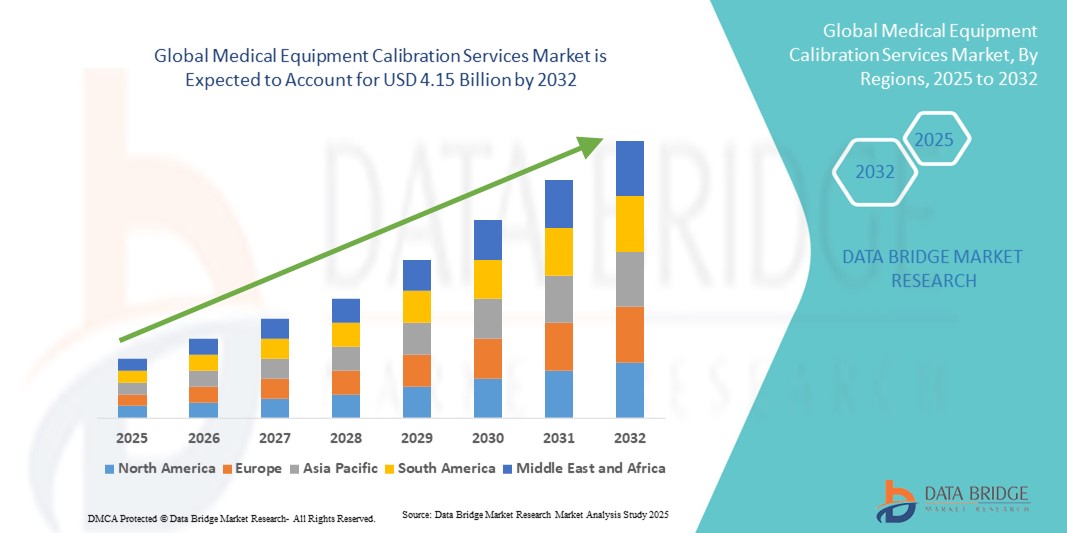
Medical Equipment Calibration Services Market Size
- The global medical equipment calibration services market size was valued at USD 1.88 billion in 2024 and is expected to reach USD 4.15 billion by 2032, at a CAGR of10.40% during the forecast period
- The market growth is largely fueled by the growing adoption and technological advancements in healthcare facilities, driving the need for accurate, reliable, and compliant medical equipment. The increasing complexity of medical devices and the emphasis on patient safety are encouraging healthcare providers to invest in calibration services to ensure optimal performance
- Furthermore, stringent regulatory requirements, including ISO and FDA standards, are compelling hospitals, diagnostic centers, and laboratories to routinely calibrate and maintain their equipment. These converging factors are accelerating the demand for Medical Equipment Calibration Services solutions, thereby significantly boosting the industry's growth
Medical Equipment Calibration Services Market Analysis
- The Medical Equipment Calibration Services market, encompassing calibration, maintenance, and performance verification of medical devices, is increasingly critical in ensuring patient safety, regulatory compliance, and accurate clinical diagnostics across hospitals, clinics, and diagnostic centers. These services help healthcare providers maintain device accuracy, extend equipment lifespan, and reduce operational risks associated with faulty or miscalibrated instruments.
- The growing demand for medical equipment calibration services is primarily driven by the rising adoption of advanced medical technologies, stringent regulatory requirements for device accuracy, and increasing awareness among healthcare facilities about the importance of routine calibration. In addition, the surge in healthcare infrastructure investments, coupled with technological advancements in diagnostic and therapeutic equipment, is further fueling market growth
- North America dominated the medical equipment calibration services market with the largest revenue share of 44.05% in 2024, supported by high healthcare expenditure, robust adoption of advanced medical technologies, and a well-established network of calibration service providers. The region benefits from stringent regulatory standards, frequent audits, and a high number of healthcare facilities, all of which emphasize the need for accurate and reliable equipment calibration
- Asia-Pacific is expected to be the fastest-growing region in the medical equipment calibration services market during the forecast period, with a high CAGR, owing to increasing urbanization, rising healthcare investments, and growing demand for high-precision diagnostic and therapeutic solutions. Rapid modernization of healthcare infrastructure in countries such as China, India, and Southeast Asia is further accelerating the adoption of calibration services
- The Diagnostic Equipment segment dominated the medical equipment calibration services market with a market revenue share of 41.8% in 2024, driven by hospitals and clinical laboratories heavily relying on precise calibration for imaging systems, monitoring devices, and neurodiagnostic instruments
Report Scope and Medical Equipment Calibration Services Market Segmentation
|
Attributes |
Medical Equipment Calibration Services Key Market Insights |
|
Segments Covered |
|
|
Countries Covered |
North America
Europe
Asia-Pacific
Middle East and Africa
South America
|
|
Key Market Players |
|
|
Market Opportunities |
|
|
Value Added Data Infosets |
In addition to the insights on market scenarios such as market value, growth rate, segmentation, geographical coverage, and major players, the market reports curated by the Data Bridge Market Research also include in-depth expert analysis, pricing analysis, brand share analysis, consumer survey, demography analysis, supply chain analysis, value chain analysis, raw material/consumables overview, vendor selection criteria, PESTLE Analysis, Porter Analysis, and regulatory framework. |
Medical Equipment Calibration Services Market Trends
Growing Importance of Advanced Calibration Solutions
- A significant and accelerating trend in the global medical equipment calibration services market is the increasing adoption of advanced calibration technologies and automated verification systems. These innovations are significantly enhancing the accuracy, efficiency, and reliability of medical equipment performance across hospitals, clinics, and diagnostic centers
- For instance, modern calibration platforms now integrate precision sensors and automated measurement tools that allow real-time monitoring and performance evaluation of critical medical devices such as diagnostic imaging systems, infusion pumps, and patient monitoring equipment. Similarly, laboratory calibration solutions provide high-throughput testing and validation of analytical instruments, ensuring compliance with international standards
- Integration of software-driven calibration management systems enables healthcare facilities to track calibration schedules, maintain detailed logs, and generate compliance reports, thereby improving operational efficiency and reducing human error. Predictive analytics in these systems can identify devices likely to require recalibration, allowing preventive maintenance and minimizing downtime
- The seamless integration of calibration services with hospital management and laboratory information systems facilitates centralized oversight of equipment performance. Through a unified interface, biomedical engineers can manage multiple devices across departments, schedule automated calibrations, and ensure adherence to regulatory requirements, creating a more streamlined and efficient operational workflow
- This trend towards intelligent, automated, and interconnected calibration solutions is fundamentally transforming the way healthcare providers manage medical equipment. Consequently, leading service providers are developing cloud-based and AI-assisted calibration platforms that enhance accuracy, reduce manual intervention, and ensure continuous compliance with evolving standards
- The demand for comprehensive, technologically advanced calibration services is growing rapidly across hospitals, diagnostic centers, and specialty clinics, as healthcare organizations increasingly prioritize patient safety, regulatory compliance, and operational efficiency
Medical Equipment Calibration Services Market Dynamics
Driver
Growing Need Due to Rising Accuracy and Compliance Requirements
- The increasing emphasis on precise and reliable performance of medical equipment across hospitals, clinical laboratories, and diagnostic centers is a significant factor driving the heightened demand for medical equipment calibration services
- For instance, In April 2024, the Indian Institute of Technology Madras (IIT-M) introduced India's first mobile unit designed for the calibration of medical diagnostic devices. This innovative facility is capable of calibrating 45 different types of life-saving medical equipment, including blood pressure monitors, ventilators, fetal simulators, incubator analyzers, defibrillators, and ECG machines
- As healthcare providers become more aware of the critical importance of calibration for patient safety and regulatory compliance, advanced calibration services provide comprehensive solutions such as performance validation, error detection, and preventive maintenance, ensuring medical equipment meets stringent quality standards
- Furthermore, the growing adoption of sophisticated medical technologies, including imaging systems, diagnostic devices, and therapeutic equipment, is increasing the complexity and frequency of calibration needs. Calibration services are therefore becoming an integral part of hospital and laboratory operational protocols
- The convenience of scheduled calibration, on-site or off-site services, and real-time performance reporting are key factors boosting the adoption of medical equipment calibration services in both hospitals and clinical laboratories. The trend towards outsourcing calibration and the increasing availability of certified, user-friendly service providers further reinforces market expansion
Restraint/Challenge
Concerns Regarding High Costs and Technical Complexity
- The relatively high cost of advanced calibration services, particularly for specialized medical equipment, poses a significant challenge to broader market adoption, especially in developing regions or budget-conscious healthcare facilities
- In addition, certain calibration procedures may require specialized expertise and training, making integration into routine clinical practice more complex for some institutions
- Addressing these challenges through cost-effective service models, simplified procedures, and enhanced training for biomedical engineers and healthcare professionals is crucial for expanding market penetration. Companies are increasingly focusing on providing reliable, easy-to-use, and clinically validated calibration services to reassure buyers
- While costs are gradually decreasing with technological advancements, the perceived premium for high-quality calibration services can still hinder widespread adoption, particularly in smaller clinics and laboratories
- Overcoming these challenges through continuous innovation, affordable service offerings, and educational initiatives on proper calibration practices will be vital for sustained market growth
Medical Equipment Calibration Services Market Scope
The market is segmented on the basis of service and end user.
- By Service
On the basis of service, the medical equipment calibration services market is segmented into in-house, third-party services, and original equipment manufacturer (OEM). The In-house segment dominated the largest market revenue share of 39.4% in 2024, driven by hospitals and clinical laboratories preferring internal calibration teams for critical medical devices. In-house calibration ensures immediate response times, tighter quality control, and compliance with internal operational protocols, reducing downtime and enhancing device reliability. Growing demand for rapid and accurate calibration across diagnostic, therapeutic, and monitoring equipment further supports sustained market leadership.
The third-party services segment is expected to witness the fastest growth at a CAGR of 12.5% from 2025 to 2032, fueled by increasing outsourcing of calibration activities to specialized service providers. Third-party calibration offers cost efficiency, access to advanced tools, and adherence to globally recognized standards, reducing the need for in-house investment in expensive calibration instruments. Hospitals and laboratories are leveraging these services to maintain regulatory compliance, ensure high device accuracy, and streamline operational efficiency. The expansion of healthcare infrastructure in emerging regions, combined with increasing adoption of advanced medical technologies, further drives demand. Enhanced service offerings, such as mobile calibration units and on-site calibration support, are also contributing to rapid growth in this segment globally.
- By End User
On the basis of end user, the medical equipment calibration services market is segmented into hospitals and clinical laboratories. The hospitals segment dominated the largest market revenue share of 41.7% in 2024, owing to high patient volumes, critical care requirements, and stringent regulatory oversight. Hospitals invest in comprehensive calibration services to ensure that medical devices, including imaging equipment, patient monitoring systems, and therapeutic devices, maintain optimal accuracy and safety standards. Integration of calibration data with hospital asset management systems facilitates predictive maintenance, reduces downtime, and improves patient care. Hospitals also benefit from bulk calibration agreements with service providers, advanced tracking systems, and highly trained technical staff, reinforcing market dominance. The emphasis on patient safety, equipment reliability, and operational efficiency continues to drive sustained demand for calibration services.
The clinical laboratories segment is expected to witness the fastest growth at a CAGR of 13.1% from 2025 to 2032, driven by increasing demand for precise diagnostic testing and high-throughput analytical processes. Laboratories require frequent calibration of analytical instruments, diagnostic devices, and laboratory equipment to ensure accurate test results and regulatory compliance. Outsourcing to specialized calibration providers, adoption of automated calibration systems, and integration with laboratory information management systems (LIMS) further accelerate growth. The rising number of diagnostic centers, research labs, and biotech facilities globally contributes to rapid expansion in this end-user segment, highlighting its growing importance in maintaining the reliability and accuracy of critical laboratory operations.
- By Equipment Type
On the basis of equipment type, the medical equipment calibration services market is segmented into diagnostic equipment, laboratory equipment, therapeutic equipment, and other equipment types. The diagnostic equipment segment dominated the largest market revenue share of 41.8% in 2024, driven by hospitals and clinical laboratories heavily relying on precise calibration for imaging systems, monitoring devices, and neurodiagnostic instruments. Accurate calibration ensures reliable diagnostics, reduces errors, and improves patient safety, which is critical for high-stakes clinical decision-making. Continuous technological advancements in diagnostic tools, including AI-enabled and portable devices, further support the adoption of calibration services. Hospitals prefer regular calibration of diagnostic equipment to comply with regulatory standards and maintain operational efficiency. The segment benefits from strong institutional investment, ongoing maintenance contracts, and growing awareness of equipment reliability. Rising adoption of preventive maintenance programs and increasing procurement of advanced diagnostic systems also contribute to market dominance.
The laboratory equipment segment is expected to witness the fastest CAGR of 13.2% from 2025 to 2032, fueled by the growing emphasis on research, biomarker analysis, and pharmaceutical testing. Academic and pharmaceutical laboratories require precise calibration of centrifuges, analyzers, and automated systems to maintain reproducibility and accuracy in testing. Outsourcing calibration or leveraging in-house specialists ensures consistent adherence to regulatory standards and improves efficiency. Technological innovations in laboratory equipment, such as IoT-enabled monitoring systems, are increasing calibration needs. Emerging regions investing in healthcare research infrastructure also contribute to rapid growth. Enhanced service offerings like mobile calibration units, automated reporting, and real-time monitoring support the expanding demand for laboratory equipment calibration. Continuous expansion in R&D activities across mental health and pharmacology further reinforces the growth of this segment.
- By Calibration Type
On the basis of calibration type, the medical equipment calibration services market is segmented into pressure, temperature, flow, and other calibration types. The pressure calibration segment dominated the largest market revenue share of 38.7% in 2024, owing to its critical application in diagnostic, therapeutic, and monitoring equipment. Accurate pressure calibration ensures the reliability of blood pressure monitors, ventilators, infusion pumps, and other vital medical devices. Hospitals and clinical laboratories prioritize pressure calibration to minimize errors, maintain patient safety, and comply with regulatory requirements. The segment benefits from standardized protocols, frequent testing requirements, and integration with automated calibration solutions. Increasing use of pressure-sensitive instruments across intensive care units and surgical settings further drives adoption. The segment is reinforced by ongoing institutional maintenance programs, growing awareness of quality assurance, and investments in preventive healthcare.
The Temperature calibration segment is projected to witness the fastest CAGR of 14.0% from 2025 to 2032, driven by rising demand for precise thermal monitoring across medical devices such as incubators, autoclaves, cryogenic storage units, and laboratory instruments. Maintaining accurate temperature settings is critical for patient safety, sample integrity, and compliance with clinical standards. Hospitals, research laboratories, and pharmaceutical companies increasingly rely on calibration services to ensure continuous operational reliability. The integration of IoT-enabled sensors, automated alerts, and digital record-keeping systems improves efficiency and traceability, further boosting adoption. Expansion of healthcare facilities in emerging markets, growing clinical research, and increasing adoption of advanced laboratory technologies contribute to strong growth in this segment.
Medical Equipment Calibration Services Market Regional Analysis
- North America dominated the medical equipment calibration services market with the largest revenue share of 44.05% in 2024, supported by high healthcare expenditure, robust adoption of advanced medical technologies, and a well-established network of calibration service providers
- The region benefits from stringent regulatory standards, frequent audits, and a high number of healthcare facilities, all of which emphasize the need for accurate and reliable equipment calibration
- Hospitals and clinical laboratories in the U.S. and Canada prioritize regular calibration of imaging systems, diagnostic devices, and therapeutic equipment to maintain patient safety, ensure compliance with quality standards, and optimize operational efficiency.The presence of leading service providers and ongoing investments in advanced calibration technologies further reinforce North America’s dominant position
U.S. Medical Equipment Calibration Services Market Insight
The U.S. medical equipment calibration services market captured the largest revenue share of 66% in 2024 within North America, fueled by the extensive adoption of high-precision diagnostic and therapeutic devices in hospitals and clinical laboratories. Increasing demand for accurate and timely calibration, coupled with regulatory mandates such as ISO 13485 and FDA requirements, drives frequent calibration activities. Hospitals are investing in advanced calibration instruments, automated tracking systems, and skilled biomedical engineering personnel to ensure optimal equipment performance. The growing complexity of medical devices, including imaging systems, patient monitors, and lab instruments, is further supporting the expansion of calibration services.
Europe Medical Equipment Calibration Services Market Insight
The Europe medical equipment calibration services market is projected to expand at a substantial CAGR throughout the forecast period, primarily driven by stringent regulatory compliance requirements and the increasing need for high-precision medical equipment. Countries across Western Europe, including Germany, France, and Italy, are emphasizing quality assurance and calibration of hospital and laboratory equipment to meet EU medical device regulations. The region’s increasing healthcare investments, coupled with rising numbers of hospitals and diagnostic centers, are fostering the adoption of both in-house and outsourced calibration services. Enhanced focus on patient safety, equipment accuracy, and preventive maintenance supports sustained market growth.
U.K. Medical Equipment Calibration Services Market Insight
The U.K. medical equipment calibration services market is anticipated to grow at a noteworthy CAGR during the forecast period, driven by growing hospital infrastructure, expansion of diagnostic centers, and the rising adoption of advanced therapeutic devices. Calibration services are increasingly crucial to maintain regulatory compliance, optimize device performance, and minimize operational risks. Continuous technological upgrades in hospital equipment, along with increasing demand for precision in laboratory diagnostics, are further propelling market expansion in the U.K.
Germany Medical Equipment Calibration Services Market Insight
The Germany medical equipment calibration services market is expected to expand at a considerable CAGR during the forecast period, fueled by high healthcare standards, advanced hospital infrastructure, and a strong focus on technological precision. Hospitals and clinical laboratories emphasize regular calibration to ensure accurate measurements, reliable diagnostics, and compliance with international quality standards. Germany’s emphasis on innovation, coupled with widespread adoption of complex diagnostic and therapeutic equipment, encourages the use of specialized calibration services. The market growth is further supported by investments in advanced biomedical engineering and preventive maintenance programs.
Asia-Pacific Medical Equipment Calibration Services Market Insight
The Asia-Pacific medical equipment calibration services market is poised to grow at the fastest CAGR during the forecast period of 2025 to 2032, driven by increasing healthcare investments, rapid modernization of medical infrastructure, and rising demand for high-precision diagnostic and therapeutic equipment. Countries such as China, India, and Japan are expanding hospital networks and clinical laboratories, fueling the need for reliable calibration services. The adoption of advanced imaging devices, patient monitoring systems, and lab automation solutions is accelerating the requirement for regular equipment calibration. Government initiatives promoting healthcare modernization and quality standards further support market expansion in the region.
Japan Medical Equipment Calibration Services Market Insight
The Japan medical equipment calibration services market is gaining momentum due to the country’s highly developed healthcare infrastructure, technological adoption, and focus on patient safety. Hospitals and clinical laboratories regularly perform equipment calibration to ensure precise diagnostics and maintain high-quality care standards. The aging population and increasing reliance on advanced diagnostic and therapeutic devices are contributing to consistent demand. Adoption of automated calibration systems and continuous training of technical staff further supports market growth.
China Medical Equipment Calibration Services Market Insight
The China medical equipment calibration services market accounted for the largest market revenue share in Asia-Pacific in 2024, attributed to rapid expansion of hospital networks, increasing investments in healthcare infrastructure, and rising demand for advanced diagnostic and therapeutic devices. Frequent calibration of medical equipment is essential to maintain accuracy, ensure regulatory compliance, and improve patient outcomes. The government’s push for high-quality healthcare services, along with the presence of domestic calibration service providers and modern biomedical technology adoption, is propelling market growth in China.
Medical Equipment Calibration Services Market Share
The medical equipment calibration services industry is primarily led by well-established companies, including:
- TEKTRONIX, INC. (U.S.)
- Fluke Biomedical (U.S.)
- Biomedical Technologies, Inc. (U.S.)
- NS Medical Systems (U.K.)
- Transcat, Inc. (U.S.)
- JM Test Systems (U.S.)
- Agilent Technologies, Inc. (U.S.)
- Thermo Fisher Scientific Inc. (U.S.)
- JPen Medical (U.K.)
- TAG Medical (U.K.)
- BD (U.S.)
- Bio-Rad Laboratories Inc. (U.S.)
- Everlife Asia Pte. Ltd. (Singapore)
- Industrial Calibration and Service Company (Sri Lanka)
Latest Developments in Global Medical Equipment Calibration Services Market
- In July 2025, Techmaster Electronics Inc., a California-based firm with a global network of laboratories, announced the acquisition of Rothe San Antonio Calibration LLC. This acquisition strengthens Techmaster's operations and expands its services, adding surge capacity to its ten labs across the U.S., Mexico, Vietnam, and Thailand. The calibration and testing lab on Sinclair Road, formerly part of longtime NASA contractor Rothe Development Inc., provides precision calibration, repair, and measurement services for testing equipment for government and civilian customers. The deal instantly widens Techmaster's accredited scope, enhancing its capabilities in electronic, pneumatic, mechanical, temperature, and hydraulic systems calibration
- In July 2021, Everlife announced that it had expands service offering to calibration services with acquisition of Biofrontier Technology in Singapore
- In July 2021, The National Accreditation Board for Testing and Calibration Laboratories (NABL) has released NABL 126: Specific criteria for calibration of medical device
SKU-
세계 최초의 시장 정보 클라우드 보고서에 온라인으로 접속하세요

- 대화형 데이터 분석 대시보드
- 높은 성장 잠재력 기회를 위한 회사 분석 대시보드
- 사용자 정의 및 질의를 위한 리서치 분석가 액세스
- 대화형 대시보드를 통한 경쟁자 분석
- 최신 뉴스, 업데이트 및 추세 분석
- 포괄적인 경쟁자 추적을 위한 벤치마크 분석의 힘 활용
연구 방법론
데이터 수집 및 기준 연도 분석은 대규모 샘플 크기의 데이터 수집 모듈을 사용하여 수행됩니다. 이 단계에는 다양한 소스와 전략을 통해 시장 정보 또는 관련 데이터를 얻는 것이 포함됩니다. 여기에는 과거에 수집한 모든 데이터를 미리 검토하고 계획하는 것이 포함됩니다. 또한 다양한 정보 소스에서 발견되는 정보 불일치를 검토하는 것도 포함됩니다. 시장 데이터는 시장 통계 및 일관된 모델을 사용하여 분석하고 추정합니다. 또한 시장 점유율 분석 및 주요 추세 분석은 시장 보고서의 주요 성공 요인입니다. 자세한 내용은 분석가에게 전화를 요청하거나 문의 사항을 드롭하세요.
DBMR 연구팀에서 사용하는 주요 연구 방법론은 데이터 마이닝, 시장에 대한 데이터 변수의 영향 분석 및 주요(산업 전문가) 검증을 포함하는 데이터 삼각 측량입니다. 데이터 모델에는 공급업체 포지셔닝 그리드, 시장 타임라인 분석, 시장 개요 및 가이드, 회사 포지셔닝 그리드, 특허 분석, 가격 분석, 회사 시장 점유율 분석, 측정 기준, 글로벌 대 지역 및 공급업체 점유율 분석이 포함됩니다. 연구 방법론에 대해 자세히 알아보려면 문의를 통해 업계 전문가에게 문의하세요.
사용자 정의 가능
Data Bridge Market Research는 고급 형성 연구 분야의 선두 주자입니다. 저희는 기존 및 신규 고객에게 목표에 맞는 데이터와 분석을 제공하는 데 자부심을 느낍니다. 보고서는 추가 국가에 대한 시장 이해(국가 목록 요청), 임상 시험 결과 데이터, 문헌 검토, 재생 시장 및 제품 기반 분석을 포함하도록 사용자 정의할 수 있습니다. 기술 기반 분석에서 시장 포트폴리오 전략에 이르기까지 타겟 경쟁업체의 시장 분석을 분석할 수 있습니다. 귀하가 원하는 형식과 데이터 스타일로 필요한 만큼 많은 경쟁자를 추가할 수 있습니다. 저희 분석가 팀은 또한 원시 엑셀 파일 피벗 테이블(팩트북)로 데이터를 제공하거나 보고서에서 사용 가능한 데이터 세트에서 프레젠테이션을 만드는 데 도움을 줄 수 있습니다.











