


글로벌 마이크로 배터리 시장 세분화, 유형별(1차 마이크로 배터리, 2차 마이크로 배터리), 배터리 화학(리튬 이온 마이크로 배터리, 고체 마이크로 배터리, 박막 마이크로 배터리, 아연-공기 마이크로 배터리), 응용 분야(가전, 의료 기기, 산업 및 IoT 기기, 스마트 패키징, 자동차), 용량(10mAh 미만, 10~100mAh, 100mAh 초과) - 2032년까지 산업 동향 및 전망
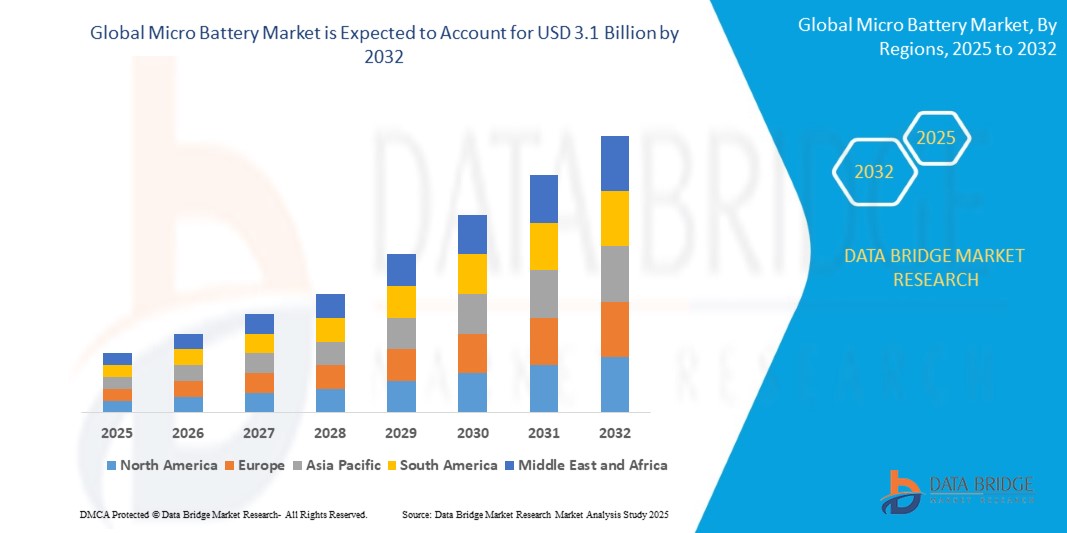
글로벌 마이크로 배터리 시장 규모
- 글로벌 마이크로 배터리 시장 규모는 2024년에 7억 2천만 달러 로 평가되었으며 예측 기간 동안 23.2%의 CAGR 로 2032년까지 31억 달러 에 도달할 것으로 예상됩니다 .
- 글로벌 마이크로 배터리 시장의 성장은 기술 발전과 다양한 최종 사용 산업 전반에 걸친 수요 증가를 포함한 몇 가지 핵심 요인에 의해 촉진됩니다.
글로벌 마이크로 배터리 시장 분석
- 글로벌 마이크로 배터리 시장은 다양한 응용 분야에서 소형, 고효율, 장수명 전원에 대한 수요 증가에 힘입어 견고한 성장을 경험하고 있습니다. 특히 웨어러블 전자기기, 이식형 의료기기, IoT 지원 센서, 그리고 소비자 가전제품의 급속한 성장에 힘입어 이러한 시장은 소형 에너지 저장 솔루션을 필요로 합니다.
- 박막, 고체, 플렉시블 배터리 화학 분야의 기술 발전은 에너지 밀도, 안전성, 그리고 폼팩터의 적응성을 크게 향상시켜, 마이크로 배터리가 현대 전자 기기의 엄격한 요구 사항을 충족할 수 있도록 했습니다. 또한, 사물 인터넷(IoT) 네트워크의 확산은 산업 자동화, 스마트 홈, 농업, 환경 모니터링 분야에서 무선 배터리 구동 센서의 도입을 급증시켰습니다.
- 의료 분야에서는 특히 고령층을 중심으로 실시간 환자 모니터링을 위한 웨어러블 및 이식형 의료 기기 사용이 증가함에 따라 신뢰성과 생체 적합성이 뛰어난 마이크로 배터리에 대한 수요가 지속적으로 증가하고 있습니다. 또한, 스마트 패키징, AR/VR 기기, 소형 가전제품의 등장은 시장 확대에 기여하고 있습니다.
- 기존 배터리에 비해 높은 생산 비용과 제한된 에너지 용량 등의 어려움에도 불구하고, 마이크로 배터리 시장은 강력한 혁신 파이프라인, 투자 증가, 그리고 최종 사용자 인식 제고로 인해 크게 성장할 것으로 예상됩니다. 마이크로 배터리 시장은 2032년까지 급속한 성장을 보일 것으로 예상되며, 북미, 유럽, 아시아 태평양 지역이 기술 개발 및 도입을 주도할 것으로 예상됩니다.
보고서 범위 및 글로벌 마이크로 배터리 시장 세분화
|
속성 |
글로벌 마이크로 배터리 시장 통찰력 |
|
다루는 세그먼트 |
|
|
포함 국가 |
북아메리카
유럽
아시아 태평양
중동 및 아프리카
남아메리카
|
|
주요 시장 참여자 |
|
|
시장 기회 |
|
|
부가가치 데이터 정보 세트 |
Data Bridge Market Research에서 큐레이팅한 시장 보고서에는 시장 가치, 성장률, 세분화, 지리적 적용 범위, 주요 기업 등 시장 시나리오에 대한 통찰력 외에도 심층적인 전문가 분석, 가격 분석, 브랜드 점유율 분석, 소비자 설문 조사, 인구 통계 분석, 공급망 분석, 가치 사슬 분석, 원자재/소모품 개요, 공급업체 선택 기준, PESTLE 분석, Porter 분석 및 규제 프레임워크가 포함되어 있습니다. |
글로벌 마이크로 배터리 시장 동향
“혁신과 연결성: 마이크로 배터리의 미래를 형성하다 ”
- 글로벌 마이크로 배터리 시장에서 중요하고 빠르게 성장하는 추세는 첨단 배터리 화학 기술과 소형 전자 장치의 통합입니다. 이를 통해 배터리 수명 연장, 안전성 향상, 그리고 웨어러블 기기, 의료용 임플란트, IoT 센서 등 다양한 분야에 활용될 수 있습니다. 이러한 기술 발전은 마이크로 배터리의 설계, 제조, 그리고 차세대 전자 시스템에의 통합 방식을 혁신하고 있습니다.
- 예를 들어, 심벳(Cymbet Corporation), 파나소닉(Panasonic Corporation), 무라타(Murata Manufacturing)와 같은 주요 시장 참여자들은 향상된 에너지 밀도와 안전 기능을 갖춘 고체, 플렉시블, 인쇄형 마이크로 배터리를 개발하고 있습니다. 이러한 혁신은 건강 모니터링 웨어러블, 스마트 패키징, 무선 센서 네트워크 등의 애플리케이션을 지원하여 기기의 자율성과 사용자 편의성을 향상시킵니다.
- 제품 개발 과정에서 유연 박막 배터리, 에너지 하베스팅 통합, AI 지원 배터리 관리 시스템과 같은 혁신 기술을 통해 공급업체는 신뢰성이 높고 수명이 길며 유지 보수가 간편한 전원을 제공할 수 있습니다. 이러한 기술은 다양한 작동 조건에서 배터리 성능을 향상시키고, 유연 전자 기기 및 의료 기기에 완벽하게 통합될 수 있도록 지원합니다.
- Furthermore, AI and machine learning are being used to optimize battery charging cycles, predict battery lifespan, and enhance safety mechanisms, resulting in smarter and more efficient micro battery solutions that meet precise application needs.
- The digital transformation extends to battery diagnostics and remote monitoring, with companies offering smart tools and apps for real-time health status, usage analytics, and maintenance alerts. These services improve customer experience and expand micro battery adoption beyond traditional markets.
- The rising demand for micro batteries combining safety, flexibility, and intelligent analytics is driving rapid growth across consumer electronics, healthcare, and industrial IoT sectors. As wearable health tech and connected devices proliferate, micro battery manufacturers are investing in smart, customizable solutions to remain competitive and address evolving market requirements.
Global Micro Battery Market Dynamics
Driver
“Rising Demand Driven by Miniaturization, Healthcare Advances, and IoT Expansion”
- The increasing global emphasis on device miniaturization and portability driven by consumer preference for lightweight, compact, and wearable electronics is a key driver of growth in the Micro Battery market. Micro batteries provide essential power solutions for these devices, enabling prolonged operation with minimal size.
- For instance, manufacturers like Murata and Samsung SDI have expanded their micro battery portfolios in 2024 with solid-state and flexible batteries tailored for wearable health devices, smart cards, and implantables. This reflects growing interest from OEMs and end-users in high-performance micro energy storage solutions.
- The rapid expansion of the Internet of Things (IoT) ecosystem, which relies heavily on distributed, wireless sensor networks, is significantly increasing demand for reliable micro batteries that power smart sensors in industrial automation, smart homes, and environmental monitoring.
- Furthermore, the growing healthcare sector especially the rise of wearable and implantable medical devices such as pacemakers, glucose monitors, and fitness trackers is creating sustained demand for biocompatible, safe, and long-lasting micro batteries.
- Increasing investments in research and development for advanced battery chemistries, including solid-state and thin-film batteries, are enabling better energy density, safety, and form factor customization, which further fuels market growth.
- Additionally, the rising consumer and regulatory focus on sustainability encourages the development of eco-friendly and rechargeable micro battery technologies that align with global environmental goals.
Restraint/Challenge
“Challenges Restricting Market Growth Due to High Costs, Technical Complexities, and Limited Awarenes”
- The relatively high cost of advanced micro battery technologies especially solid-state and flexible batteries remains a significant barrier to widespread adoption, particularly in price-sensitive segments and emerging markets.
- Smaller manufacturers and device makers often face difficulties integrating cost-effective micro batteries without compromising on energy density or safety, limiting penetration in budget wearables and low-cost IoT devices.
- The technical complexity of micro battery manufacturing, packaging, and integration can also deter some OEMs. Issues related to battery life, charging infrastructure, and compatibility with flexible or implantable devices can increase development time and costs.
- Furthermore, the micro battery market is still fragmented, with a lack of standardization across battery types and applications, complicating supplier selection and device compatibility for manufacturers.
- Limited consumer awareness and understanding of micro battery benefits, especially in developing regions, slow adoption rates. Some end-users may prioritize upfront costs or conventional battery types over innovative micro battery solutions.
- Lastly, competition from alternative low-power energy sources, such as supercapacitors and energy harvesting devices, may restrict the growth potential of certain micro battery segments, especially in niche applications requiring ultra-low power consumption.
Global Micro Battery Market Scope
The market is segmented on the basis of Type, Battery Chemistry, Application and Capacity.
- By Type
By type, the market is divided into primary micro batteries and secondary micro batteries. Primary micro batteries are non-rechargeable and commonly used in single-use applications such as medical implants and hearing aids. In contrast, secondary micro batteries are rechargeable and are widely used in devices that require regular energy replenishment, such as wearables and wireless IoT sensors.
- By Battery Chemistry
Based on battery chemistry, the market includes lithium-ion micro batteries, solid-state micro batteries, thin-film micro batteries, and zinc-air micro batteries. Lithium-ion micro batteries are preferred for their high energy density and rechargeability, making them suitable for consumer electronics and portable devices. Solid-state micro batteries offer enhanced safety, durability, and compactness, making them ideal for medical implants and miniaturized applications. Thin-film micro batteries are ultra-thin and are often used in smart cards, RFID tags, and flexible electronics. Zinc-air micro batteries are known for their high energy-to-weight ratio and are mainly used in hearing aids and certain medical devices.
- By Application
In terms of application, the micro battery market serves diverse sectors including consumer electronics, medical devices, industrial and IoT devices, smart packaging, and automotive. Consumer electronics include devices like smartwatches, earbuds, and fitness trackers. Medical applications range from pacemakers to glucose monitors and drug delivery systems. In industrial and IoT environments, micro batteries are used in smart meters, wireless sensors, and remote monitoring tools. Smart packaging utilizes micro batteries for active RFID tags and intelligent labeling, especially in pharmaceuticals and perishables. The automotive sector employs micro batteries in systems like tire pressure monitoring, keyless entry, and infotainment modules.
- By Capacity
Based on capacity, the market is segmented into below 10 mAh, 10–100 mAh, and above 100 mAh. Batteries with less than 10 mAh capacity are used in ultra-compact applications such as hearing aids and smart labels. The 10–100 mAh range is most common in wearables, wireless sensors, and portable medical devices, while batteries with more than 100 mAh capacity are used in higher-drain devices in industrial, automotive, and advanced medical settings.
Global Micro Battery Market Regional Analysis
- North America holds a significant share of the market due to its robust ecosystem of consumer electronics, advanced healthcare infrastructure, and early adoption of emerging technologies. The presence of leading technology companies, coupled with increased investment in miniaturized and implantable medical devices, continues to fuel demand for micro batteries across the U.S. and Canada. Furthermore, the region’s growing focus on smart packaging and industrial IoT applications supports the market's expansion.
- Europe is another prominent region in the micro battery landscape, driven by stringent regulations supporting medical innovations, energy efficiency, and environmental sustainability. Countries like Germany, France, and the UK are witnessing increasing integration of micro batteries in automotive electronics, smart wearables, and medical sensors. In addition, growing R&D efforts focused on solid-state and thin-film battery technologies are boosting the region’s innovation capabilities.
- Asia-Pacific is expected to register the fastest growth during the forecast period, fueled by the massive manufacturing base of consumer electronics and increasing urbanization. China, Japan, South Korea, and India are key contributors, with strong domestic demand for compact, low-power batteries in smartphones, fitness trackers, hearing aids, and industrial IoT devices. Favorable government policies to promote electric mobility and technological innovations in solid-state batteries are further strengthening the regional market.
- 라틴 아메리카는 브라질과 멕시코 등지의 모바일 및 의료 기술 보급 확대에 힘입어 점진적인 성장을 보이고 있습니다. 무선 의료 모니터링 및 스마트 웨어러블 기기에 대한 수요가 증가함에 따라 효율적인 마이크로 전원에 대한 수요도 증가하고 있습니다.
- 중동 및 아프리카(MEA)는 마이크로 배터리 시장에서 떠오르는 지역입니다. 의료 인프라 투자 증가, 휴대용 진단 기기 도입, 그리고 커넥티드 기술 솔루션에 대한 관심 증가가 이러한 성장을 뒷받침하고 있습니다. 그러나 중동 및 아프리카의 시장 발전은 다른 지역에 비해 아직 초기 단계에 있으며, 디지털 전환이 진행됨에 따라 성장 가능성이 있습니다.
북미 마이크로 배터리 시장 통찰력
북미 마이크로 배터리 시장은 가전제품, 의료기기, 산업용 IoT 애플리케이션 전반에 걸친 강력한 수요에 힘입어 견고한 성장을 경험하고 있습니다. 미국은 첨단 의료 인프라, 웨어러블 기술의 높은 도입률, 그리고 선도적인 배터리 및 전자 제품 제조업체들의 탄탄한 입지를 바탕으로 이 지역 시장을 선도하고 있습니다. 마이크로 배터리는 소형 크기와 높은 신뢰성 덕분에 피트니스 트래커, 보청기, 연속 혈당 측정기, 이식형 기기 등의 분야에서 점점 더 많이 사용되고 있습니다.
유럽 마이크로 배터리 시장 통찰력
유럽 마이크로 배터리 시장은 의료, 가전, 자동차, 스마트 패키징 분야의 수요 증가에 힘입어 상당한 성장을 보이고 있습니다. 독일, 영국, 프랑스, 네덜란드와 같은 국가들은 전자 및 의료기기 산업이 잘 구축되어 있고 에너지 효율 및 환경 규제가 엄격하여 첨단 마이크로 배터리 기술 도입을 선도하고 있습니다.
보청기, 웨어러블 건강 모니터, 이식형 센서 등 소형 의료기기의 사용이 증가하는 것은 이 지역의 주요 성장 요인입니다. 또한, 유럽은 특히 소매 및 제약 분야에서 지속 가능하고 스마트한 패키징 솔루션에 집중하고 있어 RFID 태그 및 전자 라벨에 마이크로 배터리가 도입되는 추세입니다.
아시아 태평양 마이크로 배터리 시장 통찰력
아시아 태평양 마이크로 배터리 시장은 전 세계에서 가장 크고 빠르게 성장하는 지역으로, 활발한 가전 산업, 급속한 도시화, 그리고 사물인터넷(IoT) 및 웨어러블 기술의 광범위한 도입에 힘입어 성장하고 있습니다. 중국, 일본, 한국, 인도 등 주요 경제국들은 탄탄한 제조 역량, 증가하는 R&D 투자, 그리고 전자 제품 생산 및 에너지 혁신을 장려하는 정부의 적극적인 정책 덕분에 이러한 시장 성장을 선도하고 있습니다.
라틴 아메리카 마이크로 배터리 시장 통찰력
라틴 아메리카 마이크로 배터리 시장은 가전제품, 의료기기, 스마트 패키징 솔루션의 보급률 증가에 힘입어 점차 성장세를 보이고 있습니다. 브라질, 멕시코, 아르헨티나와 같은 국가들은 도시화 증가, 중산층 인구 증가, 그리고 디지털 헬스케어 및 모바일 기술 접근성 확대에 힘입어 이러한 성장에 크게 기여하고 있습니다.
이 지역에서는 웨어러블 기기, 피트니스 트래커, 보청기, 휴대용 진단 기기에 대한 수요가 꾸준히 증가하고 있으며, 이러한 기기는 모두 마이크로 배터리와 같은 작고 효율적인 전원에 의존합니다. 의료 분야에서는 원격 환자 모니터링 및 현장 검사의 필요성이 박막 및 리튬 기반 마이크로 배터리에 대한 새로운 기회를 창출하고 있습니다.
중동 및 아프리카 마이크로 배터리 시장 통찰력
중동 및 아프리카(MEA) 마이크로 배터리 시장은 헬스케어, 스마트 인프라, 가전제품, 산업 자동화에 대한 투자 증가에 힘입어 틈새시장이면서도 유망한 분야로 부상하고 있습니다. 아랍에미리트, 사우디아라비아, 남아프리카공화국, 나이지리아와 같은 국가들은 디지털 기술 도입 증가와 헬스케어 및 통신 부문의 확장으로 지역 수요를 주도하고 있습니다.
글로벌 마이크로 배터리 시장 점유율
글로벌 자동차 휠 산업은 주로 다음을 포함한 잘 확립된 회사들이 주도하고 있습니다.
- 심벳 코퍼레이션
- 블루 스파크 테크놀로지스
- 엔퓨셀 오이
- 파나소닉 주식회사
- 무라타 제작소 주식회사
- 삼성SDI(주)
- TDK 주식회사
- 프로로지움테크놀로지 주식회사
- 울트라라이프 코퍼레이션
- 맥셀 홀딩스 주식회사
글로벌 마이크로 배터리 시장의 최신 동향
- 2025년, TDK는 고체 마이크로 배터리 기술 분야에서 괄목할 만한 진전을 이루며 향상된 에너지 밀도와 향상된 안전 기능을 제공하는 초박형 배터리를 선보였습니다. 이 배터리는 유연하고 가벼운 전원을 필요로 하는 차세대 웨어러블 전자 기기 및 IoT 기기를 위해 특별히 설계되었습니다. 향상된 사이클 수명 덕분에 잦은 교체 없이 더 오래 기기를 사용할 수 있어 의료용 임플란트 및 유연한 가전제품에 이상적입니다.
- 2025년, ST마이크로일렉트로닉스는 유럽 의료 기술 스타트업과 전략적 파트너십을 체결하여 이식형 심장 모니터에 자사의 마이크로 배터리 솔루션을 내장했습니다. 이 협력은 엄격한 신뢰성 및 안전 요건을 충족하는 생명 유지 장치에 전원을 공급하는 데 있어 마이크로 배터리의 중요한 역할을 강조하며, 의료 분야에서 소형의 안정적인 전원에 대한 수요가 증가하고 있음을 보여줍니다.
- 2024년, Enfucell Oy는 스마트 패키징 및 바이오센서 애플리케이션에 통합 가능한 인쇄 가능한 플렉시블 마이크로 배터리인 SoftBattery 기술의 업그레이드 버전을 출시했습니다. 이 혁신은 공급망 모니터링, 제약, 스마트 물류 등 소형 경량 전력 솔루션이 필수적인 분야에서 사용되는 일회용 박막 전원에 대한 수요 증가에 기여할 것입니다.
- In 2024, Panasonic Corporation introduced a new line of high-capacity rechargeable micro batteries designed for hearing aids and wireless earbuds. The batteries feature faster charging capabilities and enhanced thermal stability, addressing the high power demands of modern, compact consumer electronics and improving user convenience through reduced downtime and improved safety.
SKU-
세계 최초의 시장 정보 클라우드 보고서에 온라인으로 접속하세요

- 대화형 데이터 분석 대시보드
- 높은 성장 잠재력 기회를 위한 회사 분석 대시보드
- 사용자 정의 및 질의를 위한 리서치 분석가 액세스
- 대화형 대시보드를 통한 경쟁자 분석
- 최신 뉴스, 업데이트 및 추세 분석
- 포괄적인 경쟁자 추적을 위한 벤치마크 분석의 힘 활용
연구 방법론
데이터 수집 및 기준 연도 분석은 대규모 샘플 크기의 데이터 수집 모듈을 사용하여 수행됩니다. 이 단계에는 다양한 소스와 전략을 통해 시장 정보 또는 관련 데이터를 얻는 것이 포함됩니다. 여기에는 과거에 수집한 모든 데이터를 미리 검토하고 계획하는 것이 포함됩니다. 또한 다양한 정보 소스에서 발견되는 정보 불일치를 검토하는 것도 포함됩니다. 시장 데이터는 시장 통계 및 일관된 모델을 사용하여 분석하고 추정합니다. 또한 시장 점유율 분석 및 주요 추세 분석은 시장 보고서의 주요 성공 요인입니다. 자세한 내용은 분석가에게 전화를 요청하거나 문의 사항을 드롭하세요.
DBMR 연구팀에서 사용하는 주요 연구 방법론은 데이터 마이닝, 시장에 대한 데이터 변수의 영향 분석 및 주요(산업 전문가) 검증을 포함하는 데이터 삼각 측량입니다. 데이터 모델에는 공급업체 포지셔닝 그리드, 시장 타임라인 분석, 시장 개요 및 가이드, 회사 포지셔닝 그리드, 특허 분석, 가격 분석, 회사 시장 점유율 분석, 측정 기준, 글로벌 대 지역 및 공급업체 점유율 분석이 포함됩니다. 연구 방법론에 대해 자세히 알아보려면 문의를 통해 업계 전문가에게 문의하세요.
사용자 정의 가능
Data Bridge Market Research는 고급 형성 연구 분야의 선두 주자입니다. 저희는 기존 및 신규 고객에게 목표에 맞는 데이터와 분석을 제공하는 데 자부심을 느낍니다. 보고서는 추가 국가에 대한 시장 이해(국가 목록 요청), 임상 시험 결과 데이터, 문헌 검토, 재생 시장 및 제품 기반 분석을 포함하도록 사용자 정의할 수 있습니다. 기술 기반 분석에서 시장 포트폴리오 전략에 이르기까지 타겟 경쟁업체의 시장 분석을 분석할 수 있습니다. 귀하가 원하는 형식과 데이터 스타일로 필요한 만큼 많은 경쟁자를 추가할 수 있습니다. 저희 분석가 팀은 또한 원시 엑셀 파일 피벗 테이블(팩트북)로 데이터를 제공하거나 보고서에서 사용 가능한 데이터 세트에서 프레젠테이션을 만드는 데 도움을 줄 수 있습니다.











