


Global Micro Battery Market Size
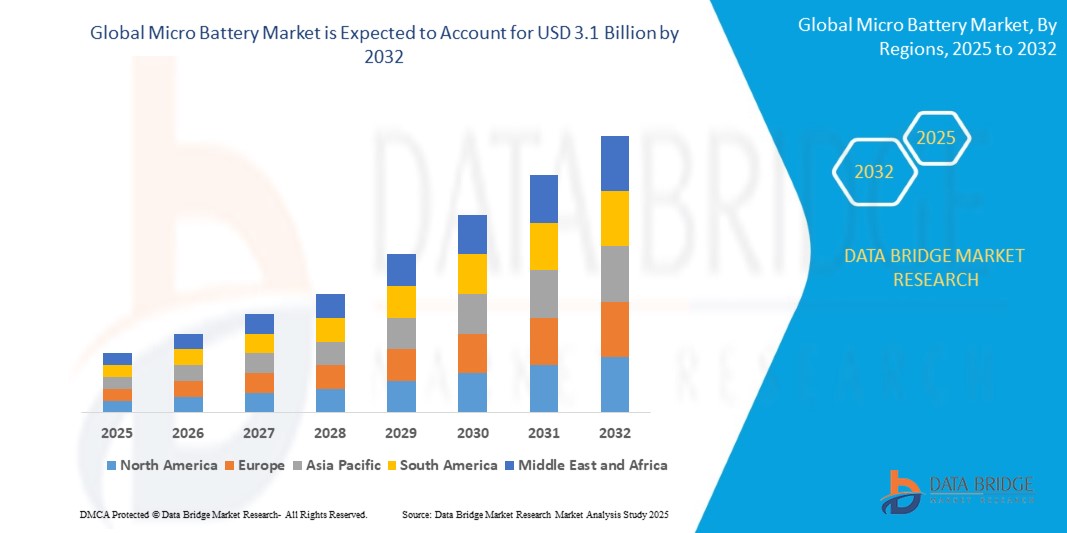
- The Global Micro Battery Market Size was valued at USD 0.72 billion in 2024 and is expected to reach USD 3.1 billion by 2032, at a CAGR of 23.2 % during the forecast period
- The growth of the Global Micro Battery Market is fueled by several key factors, including technological advancements and increasing demand across various end-use industries
Global Micro Battery Market Analysis
- The Global Micro Battery Market is experiencing robust growth, driven by the increasing demand for compact, efficient, and long-lasting power sources across a wide range of applications. The market is particularly buoyed by the rapid expansion of wearable electronics, implantable medical devices, IoT-enabled sensors, and consumer gadgets, all of which require miniaturized energy storage solutions.
- Technological advancements in thin-film, solid-state, and flexible battery chemistries have significantly enhanced energy density, safety, and form factor adaptability, enabling micro batteries to meet the rigorous demands of modern electronics. Additionally, the proliferation of Internet of Things (IoT) networks has led to a surge in wireless, battery-powered sensor deployments in industrial automation, smart homes, agriculture, and environmental monitoring.
- In the healthcare sector, the growing use of wearable and implantable medical devices for real-time patient monitoring, especially among aging populations, is creating sustained demand for highly reliable and biocompatible micro batteries. Furthermore, the rise of smart packaging, AR/VR devices, and miniaturized consumer electronics contributes to market expansion.
- Despite challenges such as higher production costs and limited energy capacity compared to traditional batteries, the micro battery market is projected to grow significantly due to strong innovation pipelines, rising investments, and growing end-user awareness. The market is poised for accelerated growth through 2032, with North America, Europe, and Asia-Pacific leading in technology development and adoption.
Report Scope and Global Micro Battery Market Segmentation
|
Attributes |
Global Micro Battery Market Insights |
|
Segments Covered |
|
|
Countries Covered |
North America
Europe
Asia-Pacific
Middle East and Africa
South America
|
|
Key Market Players |
|
|
Market Opportunities |
|
|
Value Added Data Infosets |
In addition to the insights on market scenarios such as market value, growth rate, segmentation, geographical coverage, and major players, the market reports curated by the Data Bridge Market Research also include in-depth expert analysis, pricing analysis, brand share analysis, consumer survey, demography analysis, supply chain analysis, value chain analysis, raw material/consumables overview, vendor selection criteria, PESTLE Analysis, Porter Analysis, and regulatory framework. |
Global Micro Battery Market Trends
“Innovation and Connectivity: Shaping the Future of Micro Battery”
- A significant and accelerating trend in the global Micro Battery Market is the integration of advanced battery chemistries with miniaturized electronics, enabling longer battery life, enhanced safety, and versatile applications across wearable devices, medical implants, and IoT sensors. This technological evolution is transforming how micro batteries are designed, manufactured, and integrated into next-generation electronic systems.
- For example, key market players like Cymbet Corporation, Panasonic Corporation, and Murata Manufacturing are developing solid-state, flexible, and printed micro batteries with improved energy density and safety features. These innovations support applications in health monitoring wearables, smart packaging, and wireless sensor networks, enhancing device autonomy and user convenience.
- In product development, innovations such as flexible thin-film batteries, energy harvesting integration, and AI-assisted battery management systems are enabling suppliers to deliver highly reliable, long-lasting, and low-maintenance power sources. These technologies improve battery performance under diverse operating conditions and allow seamless integration into flexible electronics and medical devices.
- Furthermore, AI and machine learning are being used to optimize battery charging cycles, predict battery lifespan, and enhance safety mechanisms, resulting in smarter and more efficient micro battery solutions that meet precise application needs.
- The digital transformation extends to battery diagnostics and remote monitoring, with companies offering smart tools and apps for real-time health status, usage analytics, and maintenance alerts. These services improve customer experience and expand micro battery adoption beyond traditional markets.
- The rising demand for micro batteries combining safety, flexibility, and intelligent analytics is driving rapid growth across consumer electronics, healthcare, and industrial IoT sectors. As wearable health tech and connected devices proliferate, micro battery manufacturers are investing in smart, customizable solutions to remain competitive and address evolving market requirements.
Global Micro Battery Market Dynamics
Driver
“Rising Demand Driven by Miniaturization, Healthcare Advances, and IoT Expansion”
- The increasing global emphasis on device miniaturization and portability driven by consumer preference for lightweight, compact, and wearable electronics is a key driver of growth in the Micro Battery market. Micro batteries provide essential power solutions for these devices, enabling prolonged operation with minimal size.
- For instance, manufacturers like Murata and Samsung SDI have expanded their micro battery portfolios in 2024 with solid-state and flexible batteries tailored for wearable health devices, smart cards, and implantables. This reflects growing interest from OEMs and end-users in high-performance micro energy storage solutions.
- The rapid expansion of the Internet of Things (IoT) ecosystem, which relies heavily on distributed, wireless sensor networks, is significantly increasing demand for reliable micro batteries that power smart sensors in industrial automation, smart homes, and environmental monitoring.
- Furthermore, the growing healthcare sector especially the rise of wearable and implantable medical devices such as pacemakers, glucose monitors, and fitness trackers is creating sustained demand for biocompatible, safe, and long-lasting micro batteries.
- Increasing investments in research and development for advanced battery chemistries, including solid-state and thin-film batteries, are enabling better energy density, safety, and form factor customization, which further fuels market growth.
- Additionally, the rising consumer and regulatory focus on sustainability encourages the development of eco-friendly and rechargeable micro battery technologies that align with global environmental goals.
Restraint/Challenge
“Challenges Restricting Market Growth Due to High Costs, Technical Complexities, and Limited Awarenes”
- The relatively high cost of advanced micro battery technologies especially solid-state and flexible batteries remains a significant barrier to widespread adoption, particularly in price-sensitive segments and emerging markets.
- Smaller manufacturers and device makers often face difficulties integrating cost-effective micro batteries without compromising on energy density or safety, limiting penetration in budget wearables and low-cost IoT devices.
- The technical complexity of micro battery manufacturing, packaging, and integration can also deter some OEMs. Issues related to battery life, charging infrastructure, and compatibility with flexible or implantable devices can increase development time and costs.
- Furthermore, the micro battery market is still fragmented, with a lack of standardization across battery types and applications, complicating supplier selection and device compatibility for manufacturers.
- Limited consumer awareness and understanding of micro battery benefits, especially in developing regions, slow adoption rates. Some end-users may prioritize upfront costs or conventional battery types over innovative micro battery solutions.
- Lastly, competition from alternative low-power energy sources, such as supercapacitors and energy harvesting devices, may restrict the growth potential of certain micro battery segments, especially in niche applications requiring ultra-low power consumption.
Global Micro Battery Market Scope
The market is segmented on the basis of Type, Battery Chemistry, Application and Capacity.
- By Type
By type, the market is divided into primary micro batteries and secondary micro batteries. Primary micro batteries are non-rechargeable and commonly used in single-use applications such as medical implants and hearing aids. In contrast, secondary micro batteries are rechargeable and are widely used in devices that require regular energy replenishment, such as wearables and wireless IoT sensors.
- By Battery Chemistry
Based on battery chemistry, the market includes lithium-ion micro batteries, solid-state micro batteries, thin-film micro batteries, and zinc-air micro batteries. Lithium-ion micro batteries are preferred for their high energy density and rechargeability, making them suitable for consumer electronics and portable devices. Solid-state micro batteries offer enhanced safety, durability, and compactness, making them ideal for medical implants and miniaturized applications. Thin-film micro batteries are ultra-thin and are often used in smart cards, RFID tags, and flexible electronics. Zinc-air micro batteries are known for their high energy-to-weight ratio and are mainly used in hearing aids and certain medical devices.
- By Application
In terms of application, the micro battery market serves diverse sectors including consumer electronics, medical devices, industrial and IoT devices, smart packaging, and automotive. Consumer electronics include devices like smartwatches, earbuds, and fitness trackers. Medical applications range from pacemakers to glucose monitors and drug delivery systems. In industrial and IoT environments, micro batteries are used in smart meters, wireless sensors, and remote monitoring tools. Smart packaging utilizes micro batteries for active RFID tags and intelligent labeling, especially in pharmaceuticals and perishables. The automotive sector employs micro batteries in systems like tire pressure monitoring, keyless entry, and infotainment modules.
- By Capacity
Based on capacity, the market is segmented into below 10 mAh, 10–100 mAh, and above 100 mAh. Batteries with less than 10 mAh capacity are used in ultra-compact applications such as hearing aids and smart labels. The 10–100 mAh range is most common in wearables, wireless sensors, and portable medical devices, while batteries with more than 100 mAh capacity are used in higher-drain devices in industrial, automotive, and advanced medical settings.
Global Micro Battery Market Regional Analysis
- North America holds a significant share of the market due to its robust ecosystem of consumer electronics, advanced healthcare infrastructure, and early adoption of emerging technologies. The presence of leading technology companies, coupled with increased investment in miniaturized and implantable medical devices, continues to fuel demand for micro batteries across the U.S. and Canada. Furthermore, the region’s growing focus on smart packaging and industrial IoT applications supports the market's expansion.
- Europe is another prominent region in the micro battery landscape, driven by stringent regulations supporting medical innovations, energy efficiency, and environmental sustainability. Countries like Germany, France, and the UK are witnessing increasing integration of micro batteries in automotive electronics, smart wearables, and medical sensors. In addition, growing R&D efforts focused on solid-state and thin-film battery technologies are boosting the region’s innovation capabilities.
- Asia-Pacific is expected to register the fastest growth during the forecast period, fueled by the massive manufacturing base of consumer electronics and increasing urbanization. China, Japan, South Korea, and India are key contributors, with strong domestic demand for compact, low-power batteries in smartphones, fitness trackers, hearing aids, and industrial IoT devices. Favorable government policies to promote electric mobility and technological innovations in solid-state batteries are further strengthening the regional market.
- Latin America is witnessing gradual growth, mainly driven by increased penetration of mobile and healthcare technologies in countries such as Brazil and Mexico. As demand for wireless medical monitoring and smart wearable devices rises, so does the need for efficient micro power sources.
- Middle East and Africa (MEA) is an emerging region in the micro battery market. Growth is being supported by increasing investments in healthcare infrastructure, adoption of portable diagnostic devices, and rising interest in connected technology solutions. However, market development in MEA is still at a nascent stage compared to other regions, with room for growth as digital transformation progresses.
North America Micro Battery Market Insight
The North America Micro Battery Market is experiencing robust growth, fueled by strong demand across consumer electronics, medical devices, and industrial IoT applications. The U.S. leads the regional market, driven by its advanced healthcare infrastructure, high adoption of wearable technology, and a strong presence of leading battery and electronics manufacturers. Micro batteries are increasingly being used in applications such as fitness trackers, hearing aids, continuous glucose monitors, and implantable devices due to their compact size and reliability.
Europe Micro Battery Market Insight
The Europe Micro Battery Market is witnessing significant growth, driven by rising demand across healthcare, consumer electronics, automotive, and smart packaging sectors. Countries such as Germany, the UK, France, and the Netherlands are leading in the adoption of advanced micro battery technologies due to their well-established electronics and medical device industries, as well as stringent energy efficiency and environmental regulations.
The increasing use of miniaturized medical devices like hearing aids, wearable health monitors, and implantable sensors is a major growth factor in the region. Additionally, Europe's focus on sustainable and smart packaging solutions particularly in retail and pharmaceuticals is encouraging the adoption of micro batteries in RFID tags and electronic labels.
Asia Pacific Micro Battery Market Insight
The Asia Pacific Micro Battery Market is the largest and fastest-growing region globally, driven by a thriving consumer electronics industry, rapid urbanization, and the widespread adoption of IoT and wearable technologies. Major economies such as China, Japan, South Korea, and India are at the forefront, thanks to their robust manufacturing capabilities, increasing R&D investments, and favorable government initiatives promoting electronics production and energy innovation.
Latin America Micro Battery Market Insight
The Latin America Micro Battery Market is gradually gaining momentum, driven by the increasing penetration of consumer electronics, medical devices, and smart packaging solutions across the region. Countries like Brazil, Mexico, and Argentina are key contributors, supported by growing urbanization, a rising middle-class population, and expanding access to digital health and mobile technologies.
The region is seeing a steady rise in demand for wearables, fitness trackers, hearing aids, and portable diagnostic devices, all of which rely on compact and efficient power sources like micro batteries. In the medical sector, the need for remote patient monitoring and point-of-care testing is creating new opportunities for thin-film and lithium-based micro batteries.
Middle East and Africa Micro Battery Market Insight
The Middle East and Africa (MEA) Micro Battery Market is emerging as a niche yet promising segment, fueled by growing investments in healthcare, smart infrastructure, consumer electronics, and industrial automation. Countries such as the United Arab Emirates, Saudi Arabia, South Africa, and Nigeria are leading regional demand due to rising adoption of digital technologies and expanding healthcare and telecom sectors.
Global Micro Battery Market Share
The Global Automotive Wheels industry is primarily led by well-established companies, including:
- Cymbet Corporation
- Blue Spark Technologies
- Enfucell Oy
- Panasonic Corporation
- Murata Manufacturing Co., Ltd.
- Samsung SDI Co., Ltd.
- TDK Corporation
- ProLogium Technology Co., Ltd.
- Ultralife Corporation
- Maxell Holdings, Ltd.
Latest Developments in Global Micro Battery Market
- In 2025, TDK Corporation made significant strides in solid-state micro battery technology, unveiling ultra-thin batteries that deliver enhanced energy density and improved safety features. These batteries are specifically designed for next-generation wearable electronics and IoT devices that demand flexible, lightweight power sources. The improved cycle life supports longer device usage without frequent replacements, making them ideal for medical implants and flexible consumer gadgets.
- In 2025, STMicroelectronics entered into a strategic partnership with a European medical technology startup to embed their micro battery solutions into implantable cardiac monitors. This collaboration emphasizes the crucial role of micro batteries in powering life-saving devices with strict reliability and safety requirements, highlighting the growing demand for miniature, reliable power sources in healthcare.
- In 2024, Enfucell Oy launched an upgraded version of its SoftBattery technology, a printable, flexible micro battery that can be integrated into smart packaging and biosensor applications. This innovation supports growing demand for disposable, thin-film power sources used in supply chain monitoring, pharmaceuticals, and smart logistics, where compact and lightweight power solutions are crucial.
- In 2024, Panasonic Corporation introduced a new line of high-capacity rechargeable micro batteries designed for hearing aids and wireless earbuds. The batteries feature faster charging capabilities and enhanced thermal stability, addressing the high power demands of modern, compact consumer electronics and improving user convenience through reduced downtime and improved safety.

- Interactive Data Analysis Dashboard
- Company Analysis Dashboard for high growth potential opportunities
- Research Analyst Access for customization & queries
- Competitor Analysis with Interactive dashboard
- Latest News, Updates & Trend analysis
- Harness the Power of Benchmark Analysis for Comprehensive Competitor Tracking
Global Micro Battery Market, Supply Chain Analysis and Ecosystem Framework
To support market growth and help clients navigate the impact of geopolitical shifts, DBMR has integrated in-depth supply chain analysis into its Global Micro Battery Market research reports. This addition empowers clients to respond effectively to global changes affecting their industries. The supply chain analysis section includes detailed insights such as Global Micro Battery Market consumption and production by country, price trend analysis, the impact of tariffs and geopolitical developments, and import and export trends by country and HSN code. It also highlights major suppliers with data on production capacity and company profiles, as well as key importers and exporters. In addition to research, DBMR offers specialized supply chain consulting services backed by over a decade of experience, providing solutions like supplier discovery, supplier risk assessment, price trend analysis, impact evaluation of inflation and trade route changes, and comprehensive market trend analysis.
Data collection and base year analysis are done using data collection modules with large sample sizes. The stage includes obtaining market information or related data through various sources and strategies. It includes examining and planning all the data acquired from the past in advance. It likewise envelops the examination of information inconsistencies seen across different information sources. The market data is analysed and estimated using market statistical and coherent models. Also, market share analysis and key trend analysis are the major success factors in the market report. To know more, please request an analyst call or drop down your inquiry.
The key research methodology used by DBMR research team is data triangulation which involves data mining, analysis of the impact of data variables on the market and primary (industry expert) validation. Data models include Vendor Positioning Grid, Market Time Line Analysis, Market Overview and Guide, Company Positioning Grid, Patent Analysis, Pricing Analysis, Company Market Share Analysis, Standards of Measurement, Global versus Regional and Vendor Share Analysis. To know more about the research methodology, drop in an inquiry to speak to our industry experts.
Data Bridge Market Research is a leader in advanced formative research. We take pride in servicing our existing and new customers with data and analysis that match and suits their goal. The report can be customized to include price trend analysis of target brands understanding the market for additional countries (ask for the list of countries), clinical trial results data, literature review, refurbished market and product base analysis. Market analysis of target competitors can be analyzed from technology-based analysis to market portfolio strategies. We can add as many competitors that you require data about in the format and data style you are looking for. Our team of analysts can also provide you data in crude raw excel files pivot tables (Fact book) or can assist you in creating presentations from the data sets available in the report.













