



Global Nuclear Imaging Devices Market Segmentation, By Product (Single Photon-Emission Computed Tomography (SPECT), Hybrid Pet, and Planar Scintigraphy), Application (Oncology, Cardiology, Neurology, and Others), End User (Hospitals, Imaging Centers, Academic and Research Centers, and Others) - Industry Trends and Forecast to 2032
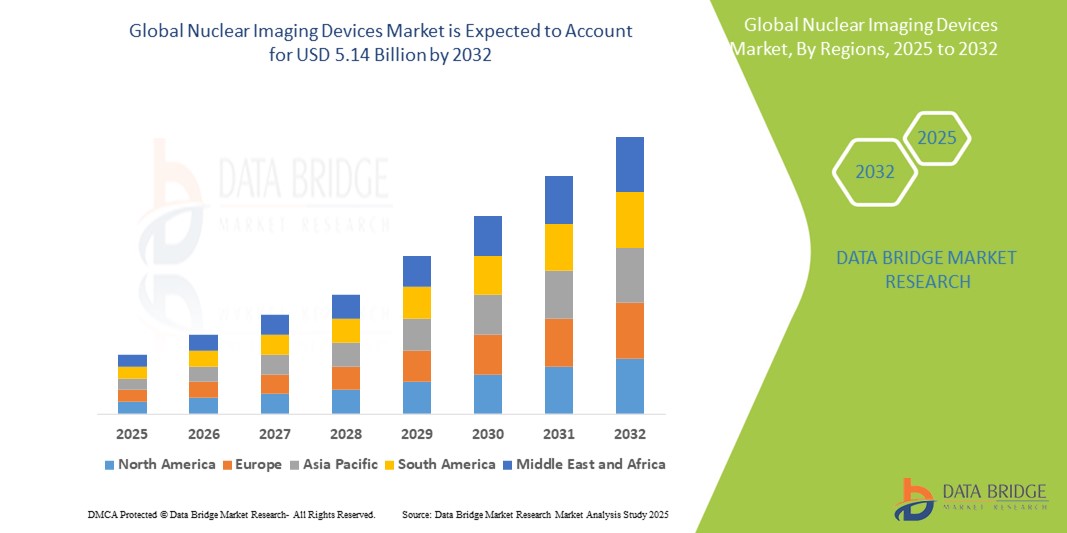
Nuclear Imaging Devices Market Size
- The global nuclear imaging devices market size was valued atUSD 3.25 billion in 2024and is expected to reachUSD 5.14 billion by 2032, at aCAGR of 5.90%during the forecast period
- This growth is driven by factors such as rising chronic disease cases, technological advancements in imaging, growing elderly population, expanding applications in healthcare, and increased government support and healthcare spending
Nuclear Imaging Devices Market Analysis
- Nuclear imaging devices are criticaldiagnostic toolsused to visualize the structure and function of organs, tissues, and bones by detecting radiation from administered radiotracers. They play a vital role in improving disease detection, treatment planning, and monitoring across healthcare sectors
- The market is witnessing steady growth, fueled by the rising prevalence of chronic diseases, technological advancements in imaging modalities, growing demand for early diagnosis, and the expansion of healthcare infrastructure worldwide
- North America is expected to dominate the nuclear imaging devices market with a share of 43.32%, due to the presence of major market players, advanced healthcare infrastructure, and high healthcare spending
- Asia-Pacific is expected to be the fastest growing region in the nuclear imaging devices market during the forecast period due to rapid urbanization, increasing healthcare investments, and a growing aging population
- Single Photon-Emission Computed Tomography (SPECT) segment is expected to dominate the market with a market share of 58.38% due to its lower cost compared to PET (Positron Emission Tomography), broader availability, ability to perform a wide range of diagnostic applications (especially in cardiology and neurology), and continuous advancements in SPECT technology, such as hybrid SPECT/CT systems that improve image quality and diagnostic accuracy
Report Scope and Nuclear Imaging Devices Market Segmentation
|
Attributes |
Nuclear Imaging Devices Key Market Insights |
|
Segments Covered |
|
|
Countries Covered |
North America
Europe
Asia-Pacific
Middle East and Africa
South America
|
|
Key Market Players |
|
|
Market Opportunities |
|
|
Value Added Data Infosets |
In addition to the insights on market scenarios such as market value, growth rate, segmentation, geographical coverage, and major players, the market reports curated by the Data Bridge Market Research also include depth expert analysis, patient epidemiology, pipeline analysis, pricing analysis, and regulatory framework. |
Nuclear Imaging Devices Market Trends
“Increasing Adoption of Hybrid Imaging Technologies”
- One prominent trend in the global nuclear imaging devices market is the increasing adoption of hybrid imaging technologies
- This trend is driven by the demand for higher diagnostic accuracy, improved imaging efficiency, and the growing need for comprehensive anatomical and functional insights in a single scan
- For instance, companies such as GE Healthcare and Siemens Healthineers are advancing hybrid imaging systems to deliver faster scans, enhanced image resolution, and better disease localization for clinical decision-making
- The integration of hybrid imaging is also fostering innovation in software solutions that enable more precise quantification and image fusion capabilities
- As healthcare providers prioritize early and accurate diagnosis along with workflow optimization, the adoption of hybrid imaging technologies is expected to significantly drive market growth
Nuclear Imaging Devices Market Dynamics
Driver
“Increasing Prevalence of Breast Cancer”
- The increasing prevalence of breast cancer is a significant driver for growth in the nuclear imaging devices market, as early detection and accurate diagnosis become critical for improving patient survival rates
- This shift is particularly prominent in healthcare sectors focused on oncology, where advanced imaging solutions are essential for precise tumor localization and treatment planning
- With the growing number of breast cancer cases worldwide, there is a rising demand for nuclear imaging modalities such as PET, SPECT, and hybrid systems that deliver high-resolution, functional imaging
- Manufacturers are advancing imaging technologies to offer enhanced sensitivity, better imaging of dense breast tissues, and faster diagnostic workflows to meet the evolving clinical needs
- The push for improved breast cancer screening and personalized treatment approaches is intensifying the demand for specialized nuclear imaging devices across hospitals and diagnostic centers
For instance,
- GE Healthcare has introduced advanced breast-specific gamma imaging (BSGI) technologies that offer better lesion detection, especially in women with dense breast tissue
- Siemens Healthineers has developed PET/CT solutions with dedicated breast imaging protocols to enhance staging accuracy and therapy monitoring
- The nuclear imaging devices market is set for strong growth, fueled by the increasing burden of breast cancer, continuous innovation in imaging technologies, and the global emphasis on early and precise cancer diagnosis
Opportunity
“Growing Prevalence of Chronic Diseases”
- The growing prevalence of chronic diseases presents a significant opportunity for the nuclear imaging devices market, driven by the increasing need for early and accurate diagnosis of conditions such as cancer, cardiovascular diseases, and neurological disorders
- Healthcare sectors are focusing on advanced imaging solutions that provide more precise and efficient diagnostics, creating a demand for innovative nuclear imaging technologies in detecting and monitoring chronic diseases
- This opportunity aligns with the broader trend toward personalized medicine, where functional imaging helps tailor treatment plans for better patient outcomes
For instance,
- Philips is developing next-generation SPECT/CT technologies to improve diagnosis and monitoring of chronic neurological and cardiovascular conditions
- Canon Medical Systems has developed advanced PET/CT scanners designed to offer more precise imaging for cardiovascular disease and oncology patients, improving diagnostic accuracy and treatment planning
- As the prevalence of chronic diseases continues to rise globally, the demand for advanced nuclear imaging devices will drive significant market growth and innovation
Restraint/Challenge
“Strict Regulations for Nuclear Imaging Devices”
- Strict regulations for nuclear imaging devices present a significant challenge for the market, particularly with the increasing demand for advanced and highly accurate diagnostic technologies
- Compliance with stringent safety standards and regulatory requirements for radiation usage and device approval increases the overall development and operational costs, limiting accessibility for healthcare providers seeking cost-effective solutions
- This challenge is especially prominent in regions with highly regulated healthcare systems, where manufacturers must navigate complex approval processes and ensure adherence to both local and international standards
For instance,
- Manufacturers of nuclear imaging devices face delays and increased costs due to the need for extensive testing and certifications to meet regulations set by agencies such as U.S. FDA and European Medicines Agency (EMA)
- The complexity of regulatory compliance and the evolving standards may impede the pace of innovation and limit market entry for smaller companies, potentially slowing overall market growth
Nuclear Imaging Devices Market Scope
The market is segmented on the basis of product, application, and end user.
|
Segmentation |
Sub-Segmentation |
|
By Product |
|
|
By Application |
|
|
By End User |
|
In 2025, the Single Photon-Emission Computed Tomography (SPECT) is projected to dominate the market with a largest share in product segment
The Single Photon-Emission Computed Tomography (SPECT) segment is expected to dominate the nuclear imaging devices market with the largest share of 58.38% in 2025 due to its lower cost compared to PET (Positron Emission Tomography), broader availability, ability to perform a wide range of diagnostic applications (especially in cardiology and neurology), and continuous advancements in SPECT technology, such as hybrid SPECT/CT systems that improve image quality and diagnostic accuracy.
The oncology is expected to account for the largest share during the forecast period in application market
In 2025, the oncology segment is expected to dominate the market with the largest market share of 49.49% due to the rising global incidence of cancer, increasing demand for early and accurate tumor detection, advancements in radiotracers and imaging technologies, and greater adoption of nuclear imaging for personalized cancer treatment planning and monitoring.
Nuclear Imaging Devices Market Regional Analysis
“North America Holds the Largest Share in the Nuclear imaging devices Market”
- North America dominates the nuclear imaging devicesmarket with a share of 43.32%, driven by the presence of major market players, advanced healthcare infrastructure, and high healthcare spending
- U.S.holds a significant share due to its strong medical device industry, extensive healthcare network, and the growing prevalence of chronic diseases, particularly cancer and cardiovascular disorders
- The region's robust healthcare system, combined with advancements in nuclear imaging technologies, positions it as a leading player in the market. Furthermore, the continuous development of hybrid imaging systems and radiotracers enhances diagnostic precision and treatment planning, contributing to market growth in North America
- As the demand for early diagnosis, precise tumor localization, and non-invasive imaging rises, North America is expected to maintain its dominant position through 2032, bolstered by technological leadership, regulatory support, and healthcare expenditure
“Asia-Pacific is Projected to Register the Highest CAGR in the Nuclear imaging devices Market”
- Asia-Pacific is expected to witness the highest growth rate in the nuclear imaging devicesmarket, driven by rapid urbanization, increasing healthcare investments, and a growing aging population
- India holds a significant share due to its expanding healthcare infrastructure, rising awareness about early disease detection, and increasing investments in medical technology. The country’s rapidly growing healthcare sector is projected to lead the region's growth, driven by both public and private sector investments in nuclear imaging solutions
- As the prevalence of chronic diseases rises in these countries, along with the growing demand for advanced imaging systems, there is a surge in the adoption of nuclear imaging devices for accurate diagnosis and treatment monitoring. Local manufacturers are also contributing to market growth by offering cost-effective solutions tailored to regional needs
- With continued investments in medical infrastructure, stronger public-private partnerships, and greater access to funding, Asia-Pacific is set to emerge as the fastest-growing region in the nuclear imaging devices market through 2032
Nuclear Imaging Devices Market Share
The market competitive landscape provides details by competitor. Details included are company overview, company financials, revenue generated, market potential, investment in research and development, new market initiatives, global presence, production sites and facilities, production capacities, company strengths and weaknesses, product launch, product width and breadth, application dominance. The above data points provided are only related to the companies' focus related to market.
The Major Market Leaders Operating in the Market Are:
- DIGIRAD CORPORATION(U.S.)
- Neusoft Corporation(China)
- CANON MEDICAL SYSTEMS CORPORATION(Japan)
- SurgicEye GmbH (Germany)
- Absolute Imaging Inc. (Canada)
- Bartec Technologies Ltd. (U.K.)
- BCL X-Ray Canada Inc. (Canada)
- CMR Naviscan. (U.S.)
- TTG Imaging Solutions, LLC (U.S.)
- Ashby Gorman Baker Ltd. (Belgium)
- Lucerno Dynamics, LLC. (U.S.)
- Berthold Technologies GmbH & Co.KG (Germany)
- Incom, Inc. (U.S.), Siemens (U.S.)
- Koninklijke Philips N.V.(Netherlands)
- Spectrum Dynamics Medical (Switzerland)
Latest Developments in Global Nuclear Imaging Devices Market
- In June 2024, GE Healthcare enhanced its nuclear imaging devices market presence with the MINItrace Magni, a compact cyclotron for in-house production of PET tracers and radiometals. In addition, the Omni Legend 21 cm PET/CT system addresses growing healthcare demands, while Clarify DL, a deep learning technology, promises clearer and more accurate imaging, improving diagnostic efficiency
- In February 2024, GE Healthcare partnered with MedQuest Associates to optimize multi-site outpatient imaging networks. This collaboration combines GE’s advanced technologies with MedQuest’s infrastructure, expanding access to high-quality nuclear imaging and enhancing patient care
- In May 2023, Philips, Elekta, and Mercurius Health entered a 3-year agreement to install diagnostic and therapeutic oncology equipment at Robert Janker Klinik in Germany. This partnership strengthens the market for advanced oncology-focused nuclear imaging solutions in Europe
- In November 2022, Canon, Inc. established Canon Healthcare USA, Inc., enhancing its position in the U.S. medical market. This move aims to expand Canon's market share in nuclear imaging devices by better serving the region's growing healthcare needs
- In June 2022, Siemens Healthineers launched the Symbia Pro.specta SPECT/CT system, receiving CE and FDA approval. Its advanced capabilities, including low-dose CT with up to 64 slices, improve diagnostic accuracy, promoting the adoption of hybrid imaging solutions in clinical settings
SKU-
세계 최초의 시장 정보 클라우드 보고서에 온라인으로 접속하세요

- 대화형 데이터 분석 대시보드
- 높은 성장 잠재력 기회를 위한 회사 분석 대시보드
- 사용자 정의 및 질의를 위한 리서치 분석가 액세스
- 대화형 대시보드를 통한 경쟁자 분석
- 최신 뉴스, 업데이트 및 추세 분석
- 포괄적인 경쟁자 추적을 위한 벤치마크 분석의 힘 활용
연구 방법론
데이터 수집 및 기준 연도 분석은 대규모 샘플 크기의 데이터 수집 모듈을 사용하여 수행됩니다. 이 단계에는 다양한 소스와 전략을 통해 시장 정보 또는 관련 데이터를 얻는 것이 포함됩니다. 여기에는 과거에 수집한 모든 데이터를 미리 검토하고 계획하는 것이 포함됩니다. 또한 다양한 정보 소스에서 발견되는 정보 불일치를 검토하는 것도 포함됩니다. 시장 데이터는 시장 통계 및 일관된 모델을 사용하여 분석하고 추정합니다. 또한 시장 점유율 분석 및 주요 추세 분석은 시장 보고서의 주요 성공 요인입니다. 자세한 내용은 분석가에게 전화를 요청하거나 문의 사항을 드롭하세요.
DBMR 연구팀에서 사용하는 주요 연구 방법론은 데이터 마이닝, 시장에 대한 데이터 변수의 영향 분석 및 주요(산업 전문가) 검증을 포함하는 데이터 삼각 측량입니다. 데이터 모델에는 공급업체 포지셔닝 그리드, 시장 타임라인 분석, 시장 개요 및 가이드, 회사 포지셔닝 그리드, 특허 분석, 가격 분석, 회사 시장 점유율 분석, 측정 기준, 글로벌 대 지역 및 공급업체 점유율 분석이 포함됩니다. 연구 방법론에 대해 자세히 알아보려면 문의를 통해 업계 전문가에게 문의하세요.
사용자 정의 가능
Data Bridge Market Research는 고급 형성 연구 분야의 선두 주자입니다. 저희는 기존 및 신규 고객에게 목표에 맞는 데이터와 분석을 제공하는 데 자부심을 느낍니다. 보고서는 추가 국가에 대한 시장 이해(국가 목록 요청), 임상 시험 결과 데이터, 문헌 검토, 재생 시장 및 제품 기반 분석을 포함하도록 사용자 정의할 수 있습니다. 기술 기반 분석에서 시장 포트폴리오 전략에 이르기까지 타겟 경쟁업체의 시장 분석을 분석할 수 있습니다. 귀하가 원하는 형식과 데이터 스타일로 필요한 만큼 많은 경쟁자를 추가할 수 있습니다. 저희 분석가 팀은 또한 원시 엑셀 파일 피벗 테이블(팩트북)로 데이터를 제공하거나 보고서에서 사용 가능한 데이터 세트에서 프레젠테이션을 만드는 데 도움을 줄 수 있습니다.











