



Global Radiology Information Systems (RIS) Market Segmentation, By Type (Integrated, and Standalone), Component (Services, Software, and Hardware), Deployment Mode (Web Based, On-Premise, and Cloud-Based), End User (Hospitals and Clinics, Outpatient Department, Office Based Physicians, Emergency Healthcare Service Providers, and Research and Academic Institute) - Industry Trends and Forecast to 2032
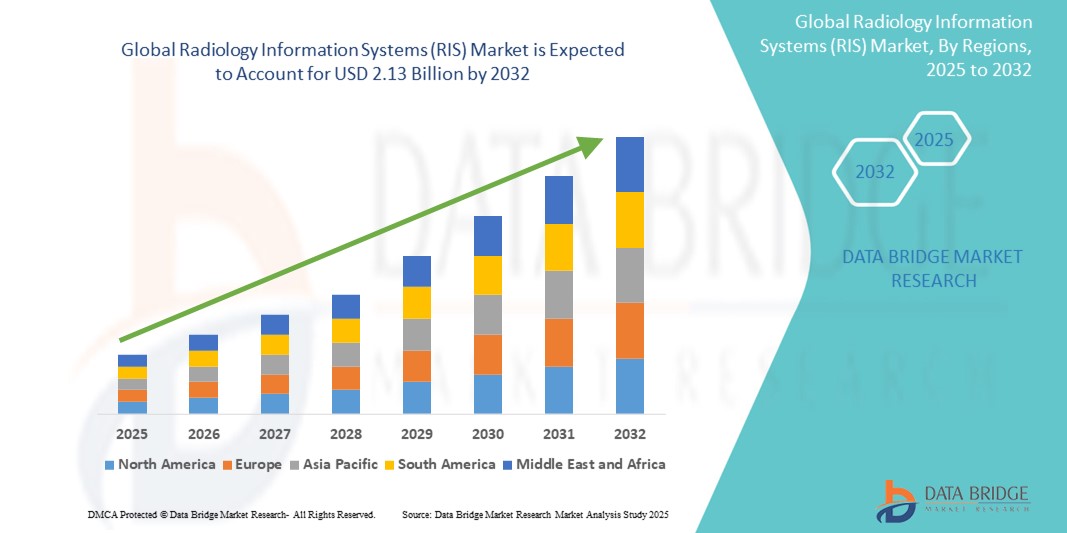
Radiology Information Systems (RIS) Market Size
- The global radiology information systems (RIS) market size was valued atUSD 1.13 billion in 2024and is expected to reachUSD 2.13 billion by 2032, at aCAGR of 8.15%during the forecast period
- This growth is driven by factors such as the increasing demand for streamlined workflow in radiology departments, rising adoption of electronic health records (EHRs), growing imaging procedures, and the need for efficient data management and reporting tools
Radiology Information Systems (RIS) Market Analysis
- The global radiology information systems market is showing steady expansion, with healthcare facilities increasingly relying on digital tools to manage imaging data more efficiently
- A key focus remains on improving the accuracy and accessibility of radiological records, which enhances workflow and supports faster clinical decision-making
- North America is expected to dominate the Radiology Information Systems (RIS)s market with 49.05% share due to its advanced healthcare infrastructure and high technology adoption rates
- Asia-Pacific is expected to be the fastest growing region in the Radiology Information Systems (RIS) market during the forecast period with 8.05% share due to increasingly adopting digital solutions in healthcare, contributing to rapid market expansion
- The Web Based segment is expected to dominate the Radiology Information Systems (RIS) market with the largest share of 77.05% in 2025 due to its ease of deployment, scalability, and remote accessibility. These systems enable healthcare professionals to access imaging data and reports from any location, which significantly improves workflow efficiency and patient care
Report Scope and Radiology Information Systems (RIS) Market Segmentation
|
Attributes |
Radiology Information Systems (RIS) KeyMarket Insights |
|
Segments Covered |
|
|
Countries Covered |
North America
Europe
Asia-Pacific
Middle East and Africa
South America
|
|
Key Market Players |
|
|
Market Opportunities |
|
|
Value Added Data Infosets |
In addition to the insights on market scenarios such as market value, growth rate, segmentation, geographical coverage, and major players, the market reports curated by the Data Bridge Market Research also include in-depth expert analysis, patient epidemiology, pipeline analysis, pricing analysis, and regulatory framework. |
Radiology Information Systems (RIS) Market Trends
“Advancements in Operating Microscopes & 3D Visualization for Intraocular Surgery”
- One major trend shaping the radiology information systems market is the shift toward cloud-based solutions for better accessibility and data security
- Cloud platforms are helping healthcare providers manage imaging data more efficiently while minimizing the need for complex in-house infrastructure
- Many facilities are adopting these solutions to support remote access, enabling radiologists to review and interpret images from different locations
- The ability to scale storage and services as needed also makes cloud-based systems a flexible option for growing imaging demands
- Healthcare organizations are increasingly recognizing the value of cloud integration in reducing operational costs and enhancing collaboration across departments
- For instance, some hospitals now use cloud-enabled radiology systems to allow off-site radiologists to access and report on imaging cases in real time
- In conclusion, this growing preference for cloud-based systems is transforming how radiology data is managed and accessed across healthcare settings
Radiology Information Systems (RIS) Market Dynamics
Driver
“RISing Demand for Streamlined Workflow in Radiology Departments”
- RISing demand for streamlined workflows is driving growth in the radiology information systems market due to increasing imaging procedure volumes
- Hospitals and diagnostic centers face pressure to manage imaging records, appointment scheduling, reporting, and billing efficiently
- Radiology information systems centralize and automate these processes, reducing administrative burdens for radiologists and technicians
- Integration with hospital systems ensures accurate data entry, faster report turnaround, and smoother coordination between departments
- For instance, using RIS, a hospital can reduce waiting times and improve clinical decision-making by ensuring real-time access to patient imaging history
- In conclusion, the trend toward efficient workflow solutions will continue as healthcare providers aim to optimize operations, reduce costs, and improve patient satisfaction
Opportunity
“Integration of Artificial Intelligence for Enhanced Image Analysis”
- A key opportunity in the radiology information systems market is the integration of artificial intelligence for advanced image analysis
- AI helps radiologists manage growing workloads and complex imaging data, providing support for faster and more accurate diagnoses
- By embedding AI into RIS, tasks such as lesion detection, measurement calculations, and anomaly flagging can be automated
- For instance, AI can detect subtle abnormalities that might be overlooked in high-volume settings, leading to earlier diagnosis and improved outcomes
- AI systems can continuously learn from large datasets, improving diagnostic accuracy and offering consistent results over time
- In conclusion, the integration of AI into radiology information systems enhances clinical efficiency, providing smarter, more personalized care without requiring an overhaul of IT infrastructure
Restraint/Challenge
“High Cost of System Implementation and Maintenance”
- A major challenge in adopting radiology information systems is the high cost of implementation and ongoing maintenance
- The initial investment required for software, hardware upgrades, integration with existing systems, and user training can be significant
- Ongoing expenses such as licensing fees, technical support, and regular updates add to the financial burden for healthcare providers
- For instance, small clinics with limited budgets may hesitate to adopt or upgrade systems due to the high upfront costs
- Transitioning from legacy systems to advanced platforms may disrupt operations temporarily, requiring staff retraining and further investment
- In conclusion, to overcome these challenges, flexible pricing models or government-supported initiatives could help improve access to radiology information systems and accelerate market growth
Radiology Information Systems (RIS) Market Scope
The market is segmented on the basis of type, component, deployment type, and end user.
|
Segmentation |
Sub-Segmentation |
|
By Type |
|
|
By Component |
|
|
By Deployment Mode |
|
|
By End User |
|
In 2025, the Web Based segment is projected to dominate the market with a largest share in deployment type segment
The web based segment is expected to dominate the Radiology Information Systems (RIS) market with the largest share of 77.05% in 2025 due to its ease of deployment, scalability, and remote accessibility. These systems enable healthcare professionals to access imaging data and reports from any location, which significantly improves workflow efficiency and patient care. Web based solutions require less complex IT infrastructure, reducing upfront investment costs for hospitals and clinics. They also support real-time data sharing, allowing seamless collaboration among radiologists, physicians, and specialists.
The Integrated segment is expected to account for the largest share during the forecast period in type segment
In 2025, the integrated segment is expected to dominate the market with the largest market share of 67.05% due to its ability to streamline radiology workflows by connecting various functions such as scheduling, reporting, billing, and image management within a single platform. This integration reduces the need for multiple standalone systems, minimizing data entry errors and improving communication across departments. Healthcare providers benefit from a unified system that enhances operational efficiency and supports quicker clinical decision-making. Integrated radiology information systems also enable real-time access to patient data and imaging results, helping improve diagnostic accuracy and patient outcomes.
Radiology Information Systems (RIS) Market Regional Analysis
“North America Holds the Largest Share in the Radiology Information Systems (RIS) Market”
- North America holds the largest share of the global radiology information systems market with 49.05% share
- The U.S. is the primary contributor due to its advanced healthcare infrastructure and high technology adoption rates
- A strong regulatory framework and well-established healthcare organizations drive the dominance of this region
- The demand for integrated systems and advanced solutions in radiology is high in this market
- North America is expected to maintain its leadership position in the coming years due to continuous technological advancements in radiology systems
“Asia-Pacific is Projected to Register the HighestCAGR in the Radiology Information Systems (RIS) Market”
- The Asia Pacific region is witnessing the fastest growth in the radiology information systems market with 8.05% share
- Countries such as China, India, and Japan are increasingly adopting digital solutions in healthcare, contributing to rapid market expansion
- Significant investments in healthcare infrastructure and growing healthcare awareness are key growth drivers
- The rising prevalence of chronic diseases and the need for efficient diagnostic solutions are further accelerating the demand for radiology information systems
- As healthcare modernization efforts continue, this region is expected to see robust growth over the next few years
Radiology Information Systems (RIS) Market Share
The market competitive landscape provides details by competitor. Details included are company overview, company financials, revenue generated, market potential, investment in research and development, new market initiatives, global presence, production sites and facilities, production capacities, company strengths and weaknesses, product launch, product width and breadth, application dominance. The above data points providesd are only related to the companies' focus related to market.
The Major Market Leaders Operating in the Market Are:
- Koninklijke Philips N.V. (Netherlands)
- Siemens Healthcare GmbH (Germany)
- Oracle (U.S.)
- McKesson Corporation (U.S.)
- GE HealthCare (U.S.)
- Canon Medical Systems Corporation (Japan)
- Fujifilm Holdings Corporation (Japan)
- Esaote SPA (Italy)
- Hitachi Ltd. (Japan)
- Veradigm LLC (U.S.)
- MedInformatix, Inc. (U.S.)
- Epic Systems Corporation (U.S.)
- Carestream Health (U.S.)
- Shimadzu Corporation (Japan)
- Hologic, Inc. (U.S.)
- EIZO Corporation (Japan)
- Sectra AB (Sweden)
- Fischer Medical (U.S.)
Latest Developments in Global Radiology Information Systems (RIS) Market
- In November 2022, a strategic partnership between Epic and Google Cloud was formed, enabling hospitals utilizing Epic electronic health records (EHR) technology to store records in the cloud. This collaboration broadens healthcare organizations' choices for managing records in a cloud environment, offering enhanced flexibility and access to specialized tools
- In March 2022, Intelerad Medical Systems introduced the EnterpRISe Imaging and Informatics Suite during the HIMSS Global Health Conference. This innovative solution offers radiologists an emerging option for medical image management, potentially enhancing efficiency and capabilities in the dynamic landscape of healthcare information and management systems
- In February 2022, Carestream Health India introduced the DRX Compass, a precise, convenient, and customizable digital radiology solution. Engineered to enhance radiologists' efficiency, it offers a new level of accuracy in diagnostic imaging, reflecting advancements in technology and addressing the evolving needs of the healthcare industry
SKU-
세계 최초의 시장 정보 클라우드 보고서에 온라인으로 접속하세요

- 대화형 데이터 분석 대시보드
- 높은 성장 잠재력 기회를 위한 회사 분석 대시보드
- 사용자 정의 및 질의를 위한 리서치 분석가 액세스
- 대화형 대시보드를 통한 경쟁자 분석
- 최신 뉴스, 업데이트 및 추세 분석
- 포괄적인 경쟁자 추적을 위한 벤치마크 분석의 힘 활용
연구 방법론
데이터 수집 및 기준 연도 분석은 대규모 샘플 크기의 데이터 수집 모듈을 사용하여 수행됩니다. 이 단계에는 다양한 소스와 전략을 통해 시장 정보 또는 관련 데이터를 얻는 것이 포함됩니다. 여기에는 과거에 수집한 모든 데이터를 미리 검토하고 계획하는 것이 포함됩니다. 또한 다양한 정보 소스에서 발견되는 정보 불일치를 검토하는 것도 포함됩니다. 시장 데이터는 시장 통계 및 일관된 모델을 사용하여 분석하고 추정합니다. 또한 시장 점유율 분석 및 주요 추세 분석은 시장 보고서의 주요 성공 요인입니다. 자세한 내용은 분석가에게 전화를 요청하거나 문의 사항을 드롭하세요.
DBMR 연구팀에서 사용하는 주요 연구 방법론은 데이터 마이닝, 시장에 대한 데이터 변수의 영향 분석 및 주요(산업 전문가) 검증을 포함하는 데이터 삼각 측량입니다. 데이터 모델에는 공급업체 포지셔닝 그리드, 시장 타임라인 분석, 시장 개요 및 가이드, 회사 포지셔닝 그리드, 특허 분석, 가격 분석, 회사 시장 점유율 분석, 측정 기준, 글로벌 대 지역 및 공급업체 점유율 분석이 포함됩니다. 연구 방법론에 대해 자세히 알아보려면 문의를 통해 업계 전문가에게 문의하세요.
사용자 정의 가능
Data Bridge Market Research는 고급 형성 연구 분야의 선두 주자입니다. 저희는 기존 및 신규 고객에게 목표에 맞는 데이터와 분석을 제공하는 데 자부심을 느낍니다. 보고서는 추가 국가에 대한 시장 이해(국가 목록 요청), 임상 시험 결과 데이터, 문헌 검토, 재생 시장 및 제품 기반 분석을 포함하도록 사용자 정의할 수 있습니다. 기술 기반 분석에서 시장 포트폴리오 전략에 이르기까지 타겟 경쟁업체의 시장 분석을 분석할 수 있습니다. 귀하가 원하는 형식과 데이터 스타일로 필요한 만큼 많은 경쟁자를 추가할 수 있습니다. 저희 분석가 팀은 또한 원시 엑셀 파일 피벗 테이블(팩트북)로 데이터를 제공하거나 보고서에서 사용 가능한 데이터 세트에서 프레젠테이션을 만드는 데 도움을 줄 수 있습니다.











