



Global Smart Refrigerators Market, By Type (Top Freezer Refrigerator, Bottom Freezer Refrigerator, French Door Refrigerator, Side-By-Side Refrigerator, Others), Distribution Channel (Offline Channel, Online Channel), End User (Residential, Commercial), Price Range (Premium, Economy, Low) - Industry Trends and Forecast to 2030.
Smart Refrigerators Market Analysis and Size
Growing urbanization and busy lifestyles are fueling the market growth rate. In addition, increasing awareness of environmental issues and sustainability is driving demand for eco-friendly and green dry-cleaning alternatives that use less harmful chemicals and processes. However, environmental regulations and labor costs are projected to hamper market growth.
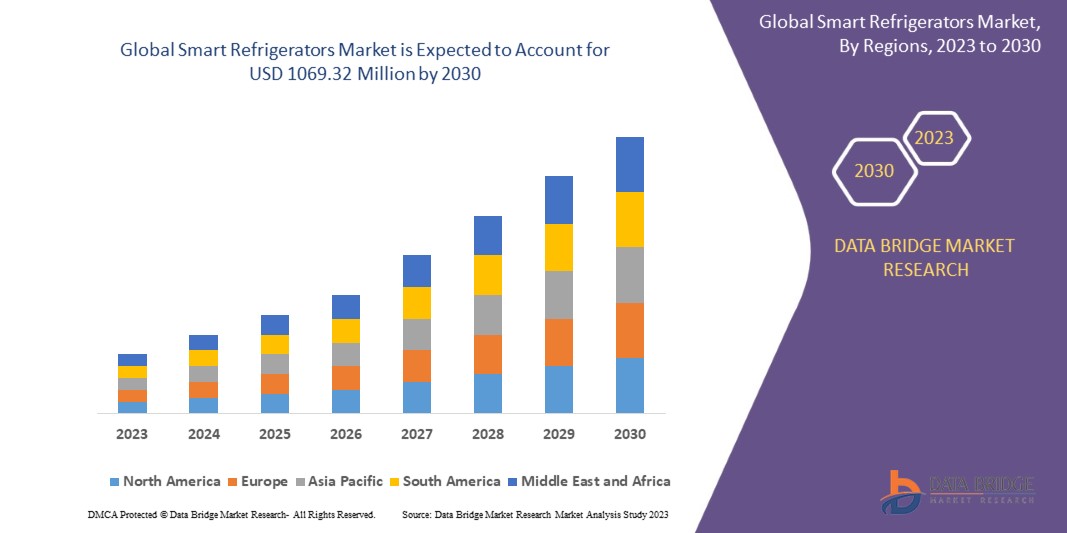
Data Bridge Market Research analyzes that the global smart refrigerators market which was USD 650.23 million in 2022, would rocket up to USD 1069.32 million by 2030 and is expected to undergo a CAGR of 12.0% during the forecast period. The “French Door Refrigerator” segment of the type segment is expected to dominate the market as it allows proper segregation of food items and provides convenience to the users by avoiding food spoilage. These refrigerators are a bit larger than the regular ones, including the single-door and side-by-side door refrigerators.
In addition to the market insights such as market value, growth rate, market segments, geographical coverage, market players, and market scenario, the market report curated by the Data Bridge Market Research team includes in-depth expert analysis, import/export analysis, pricing analysis, production consumption analysis, and consumer behavior.
Report Scope and Market Segmentation
|
Report Metric |
Details |
|
Forecast Period |
2023 to 2030 |
|
Base Year |
2022 |
|
Historic Years |
2021 (Customizable to 2015-2020) |
|
Quantitative Units |
Revenue in USD Million, Volumes in Units, Pricing in USD |
|
Segments Covered |
Type (Top Freezer Refrigerator, Bottom Freezer Refrigerator, French Door Refrigerator, Side-By-Side Refrigerator, Others), Distribution Channel (Offline Channel, Online Channel), End User (Residential, Commercial), Price Range (Premium, Economy, Low) |
|
Countries Covered |
U.S., Canada, Mexico, Germany, France, U.K., Netherlands, Switzerland, Belgium, Russia, Italy, Spain, Turkey, Rest of Europe, China, Japan, India, South Korea, Singapore, Malaysia, Australia, Thailand, Indonesia, Philippines, Rest of Asia-Pacific, Saudi Arabia, U.A.E., South Africa, Egypt, Israel, Rest of Middle East and Africa, Brazil, Argentina, Rest of South America |
|
Market Players Covered |
AB Electrolux (Sweden), Haier Group (China), LG Electronics (South Korea), SAMSUNG (South Korea), Whirlpool Corporation (U.S.), Siemens (Germany), Hisense (China), Midea Group (China), Panasonic Corporation (Japan), Aucma (Germany), Danby (Ontario), Frigidaire Appliance Company (U.S.), LIEBHERR (Switzerland), Xiaomi Global Community (China), BSH Home (Germany), Hitachi, Ltd.(Japan), TCL Electronics Holdings Limited. (Hongkong), and Transform SR Brands LLC (U.S.) |
|
Market Opportunities |
|
Market Definition
A smart refrigerator is a technologically advanced household appliance designed to store and preserve food items at optimal temperatures while offering additional features and connectivity through digital and Internet of Things (IoT) capabilities. It is also referred to as internet refrigerator. It is a technologically developed refrigerator which is programmed to sense what kind of products is being stored inside it and therefore it keeps the record through barcode or RIFD scanning. This form of refrigerator is frequently equipped to determine whenever a food item requires to be refilled.
Global Smart Refrigerators Market Dynamics
Drivers
- Changing Lifestyles and Rising Disposable Income
Consumer preferences have shifted towards connected and convenient home appliances. Smart refrigerators offer features such as food inventory management, temperature control through mobile apps, and recipe suggestions, which appeal to modern consumers. Smart refrigerators are often designed with energy-efficient features, which can lead to cost savings for consumers. These appliances can optimize cooling based on usage patterns and provide alerts about energy consumption.
- Integration with Smart Homes
Smart refrigerators are designed to collaborate within comprehensive smart home ecosystems. They can communicate with other connected devices such as smart thermostats to optimize energy efficiency and maintain ideal temperatures. In addition, integration with lighting systems enables users to adjust kitchen lighting based on fridge contents. Voice-activated assistants, such as Amazon Alexa or Google Assistant, can facilitate seamless control and interaction, allowing users to check inventory, set reminders, or even find recipes through voice commands. This convergence of devices enhances convenience and creates a cohesive, automated home environment where various appliances work in tandem, catering to the modern demand for streamlined, efficient living.
Opportunities
- Technological Advancements
The advancements in technology, particularly in the Internet of Things (IoT) and smart home technology, have enabled the development of smart refrigerators with features such as touchscreens, voice control, and remote monitoring. Smart refrigerators now employ artificial intelligence and machine learning algorithms to optimize temperature settings, predict food freshness, and offer personalized recommendations for recipes and grocery shopping based on user habits. Enhanced Wi-Fi capabilities and IoT integration have made it easier to connect smart refrigerators to other smart devices, allowing for remote control, real-time monitoring, and data sharing
Restraint
- Higher Cost Associated with Smart Refrigerators
The higher cost of smart refrigerators compared to traditional models is primarily attributed to the incorporation of advanced technology and features. These appliances have sophisticated components such as touchscreens, cameras, sensors, and connectivity hardware, all of which contribute to the elevated price tag. Price-sensitive consumers, who prioritize affordability, may find this cost prohibitive. The initial investment in a smart refrigerator can deter them from upgrading, especially when traditional refrigerators offer basic functionality at a lower price point. Manufacturers and the market may need to find ways to make smart refrigerators more accessible to a wider range of consumers through cost reductions or incentives to encourage adoption.
Challenges
- Complexity and Compatibility
Some consumers may find the technology in smart refrigerators complex. Setup and troubleshooting can be challenging, and not all users are tech-savvy. Smart refrigerators may require a compatible smartphone or home automation system for full functionality. Users who do not own such devices or systems may find the appliance less useful.
Impact and Current Market Scenario of Raw Material Shortage and Shipping Delays
Data Bridge Market Research offers a high-level analysis of the market and delivers information by keeping in account the impact and current market environment of raw material shortage and shipping delays. This translates into assessing strategic possibilities, creating effective action plans, and assisting businesses in making important decisions. Apart from the standard report, we also offer in-depth analysis of the procurement level from forecasted shipping delays, distributor mapping by region, commodity analysis, production analysis, price mapping trends, sourcing, category performance analysis, supply chain risk management solutions, advanced benchmarking, and other services for procurement and strategic support.
Expected Impact of Economic Slowdown on the Pricing and Availability of Products
When economic activity slows, industries begin to suffer. The forecast effects of the economic downturn on the pricing and accessibility of the products are taken into account in the market insight reports and intelligence services provided by DBMR. With this, our clients can typically keep one step ahead of their competitors, project their sales and revenue, and estimate their profit and loss expenditures.
Global Smart Refrigerators Market Scope
The global smart refrigerators market is segmented on the basis of type, distribution channel, end user, and price range. The growth amongst these segments will help you analyze meagre growth segments in the industries and provide the users with a valuable market overview and market insights to help them make strategic decisions for identifying core market applications.
Type
- Top Freezer Refrigerator
- Bottom Freezer Refrigerator
- French Door Refrigerator
- Side-By-Side Refrigerator
- Others
Distribution Channel
- Offline Channel
- Online Channel
End User
- Residential
- Commercial
Price Range
- Premium
- Economy
- Low
Global Smart Refrigerators Market Regional Analysis/Insights
The global smart refrigerators market is analyzed and market size, volume information are provided by country, type, distribution channel, end user, and price range as referenced above.
The countries covered in this market report are U.S., Canada, Mexico, Germany, France, U.K., Netherlands, Switzerland, Belgium, Russia, Italy, Spain, Turkey, rest of Europe, China, Japan, India, South Korea, Singapore, Malaysia, Australia, Thailand, Indonesia, Philippines, rest of Asia-Pacific, Saudi Arabia, U.A.E., South Africa, Egypt, Israel, rest of Middle East and Africa, Brazil, Argentina, rest of South America.
North America dominates the global smart refrigerators market due to the large number of urban population and the rise in the number of nuclear families. Furthermore, the increase in the expenditure capacity and rapid technological developments and its implementation towards advancing smart homes and appliances will further boost the market growth in the region.
Asia-Pacific is projected to be the fastest growing region in the market due to the rapid adoption of technology and growing disposable income. Moreover, the increasing expense capacity of people is further anticipated to propel the growth of the smart refrigerators market in the region in the coming years.
The country section of this market report also provides individual market impacting factors and changes in regulation in the market domestically that impacts the current and future trends of the market. Data points such as downstream and upstream value chain analysis, technical trends, Porter's five forces analysis, and case studies are some of the pointers used to forecast the market scenario for individual countries. Also, the presence and availability of global brands and their challenges faced due to large or scarce competition from local and domestic brands, impact of domestic tariffs and trade routes are considered while providing forecast analysis of the country data.
Competitive Landscape and Global Smart Refrigerators Market analysis
The global smart refrigerators market competitive landscape provides details by competitor. Details included are company overview, company financials, revenue generated, market potential, investment in research and development, new market initiatives, global presence, production sites and facilities, production capacities, company strengths and weaknesses, product launch, product width and breadth, application dominance. The above data points provided are only related to the companies' focus related to the market.
Some of the major market players operating in the global smart refrigerators market are:
- AB Electrolux (Sweden)
- Haier Group (China)
- LG Electronics (South Korea)
- SAMSUNG (South Korea)
- Whirlpool Corporation (U.S.)
- Siemens (Germany)
- Hisense (China)
- Midea Group (China)
- Panasonic Corporation (Japan)
- Aucma (Germany)
- Danby (Ontario)
- Frigidaire Appliance Company (U.S.)
- LIEBHERR (Switzerland)
- Xiaomi Global Community (China)
- BSH Home (Germany)
- Hitachi, Ltd. (Japan)
- TCL Electronics Holdings Limited. (Hongkong)
- Transform SR Brands LLC (U.S.) among others
SKU-
세계 최초의 시장 정보 클라우드 보고서에 온라인으로 접속하세요

- 대화형 데이터 분석 대시보드
- 높은 성장 잠재력 기회를 위한 회사 분석 대시보드
- 사용자 정의 및 질의를 위한 리서치 분석가 액세스
- 대화형 대시보드를 통한 경쟁자 분석
- 최신 뉴스, 업데이트 및 추세 분석
- 포괄적인 경쟁자 추적을 위한 벤치마크 분석의 힘 활용
연구 방법론
데이터 수집 및 기준 연도 분석은 대규모 샘플 크기의 데이터 수집 모듈을 사용하여 수행됩니다. 이 단계에는 다양한 소스와 전략을 통해 시장 정보 또는 관련 데이터를 얻는 것이 포함됩니다. 여기에는 과거에 수집한 모든 데이터를 미리 검토하고 계획하는 것이 포함됩니다. 또한 다양한 정보 소스에서 발견되는 정보 불일치를 검토하는 것도 포함됩니다. 시장 데이터는 시장 통계 및 일관된 모델을 사용하여 분석하고 추정합니다. 또한 시장 점유율 분석 및 주요 추세 분석은 시장 보고서의 주요 성공 요인입니다. 자세한 내용은 분석가에게 전화를 요청하거나 문의 사항을 드롭하세요.
DBMR 연구팀에서 사용하는 주요 연구 방법론은 데이터 마이닝, 시장에 대한 데이터 변수의 영향 분석 및 주요(산업 전문가) 검증을 포함하는 데이터 삼각 측량입니다. 데이터 모델에는 공급업체 포지셔닝 그리드, 시장 타임라인 분석, 시장 개요 및 가이드, 회사 포지셔닝 그리드, 특허 분석, 가격 분석, 회사 시장 점유율 분석, 측정 기준, 글로벌 대 지역 및 공급업체 점유율 분석이 포함됩니다. 연구 방법론에 대해 자세히 알아보려면 문의를 통해 업계 전문가에게 문의하세요.
사용자 정의 가능
Data Bridge Market Research는 고급 형성 연구 분야의 선두 주자입니다. 저희는 기존 및 신규 고객에게 목표에 맞는 데이터와 분석을 제공하는 데 자부심을 느낍니다. 보고서는 추가 국가에 대한 시장 이해(국가 목록 요청), 임상 시험 결과 데이터, 문헌 검토, 재생 시장 및 제품 기반 분석을 포함하도록 사용자 정의할 수 있습니다. 기술 기반 분석에서 시장 포트폴리오 전략에 이르기까지 타겟 경쟁업체의 시장 분석을 분석할 수 있습니다. 귀하가 원하는 형식과 데이터 스타일로 필요한 만큼 많은 경쟁자를 추가할 수 있습니다. 저희 분석가 팀은 또한 원시 엑셀 파일 피벗 테이블(팩트북)로 데이터를 제공하거나 보고서에서 사용 가능한 데이터 세트에서 프레젠테이션을 만드는 데 도움을 줄 수 있습니다.











