


Japan Tax IT Software Market Segmentation, By Offering (Software and Services), Tax Type (Income Tax, Corporate Tax, Property Tax, and Others), Deployment Mode (New Cloud and On-Premises), Organization Size (Small And Medium-Sized Enterprises and Large Enterprises), Revenue Model (One-Time Purchase and Subscription Based) Industry (Banking, Financial Services, And Insurance (BFSI), IT And Telecommunications, Manufacturing, Retail And Consumer Goods, Healthcare, Energy And Utilities, Media and Entertainment, and Others) - Industry Trends and Forecast to 2032
Japan Tax IT Software Market Analysis and Size
The Japan IT tax software market is experiencing growth driven by increasing demand for compliance with evolving tax regulations and government digitization initiatives like e-Tax. Businesses are adopting automated solutions to reduce errors and enhance operational efficiency in tax filing. Integration of AI and real-time analytics is a significant trend, enabling dynamic updates and personalized insights. Key players are focusing on user-friendly interfaces and robust cybersecurity to cater to diverse business needs. Challenges include high implementation costs for small businesses and resistance to digital transformation. Opportunities lie in expanding cloud-based solutions and catering to the growing SME sector. Competition is intensifying with both domestic and international providers targeting the market.
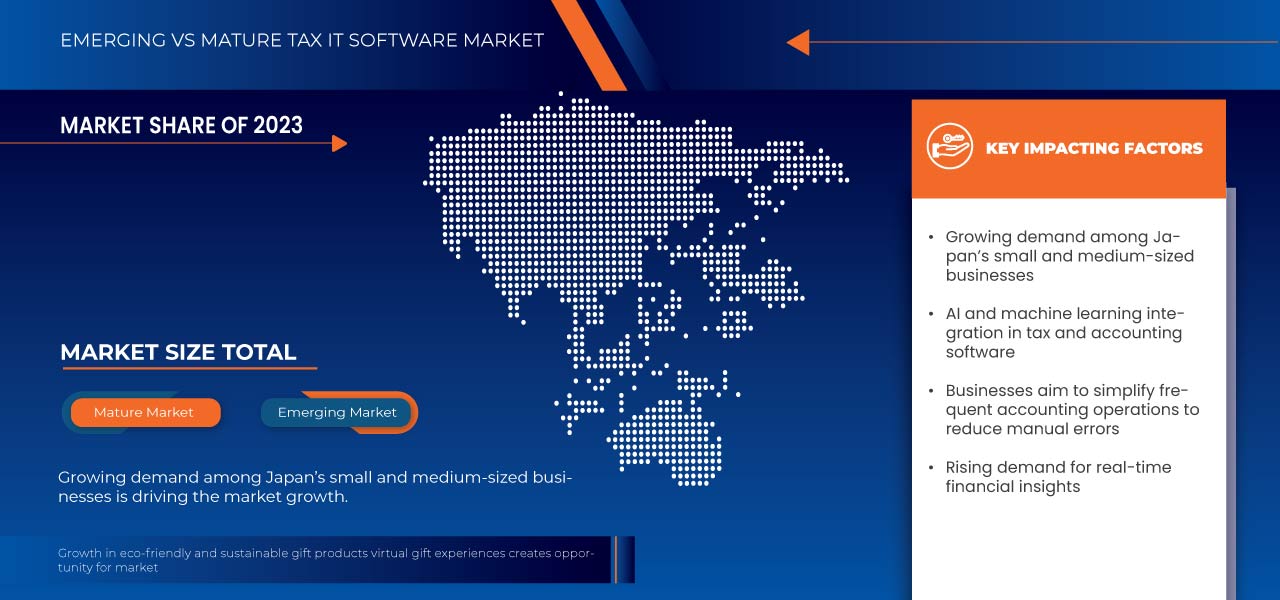
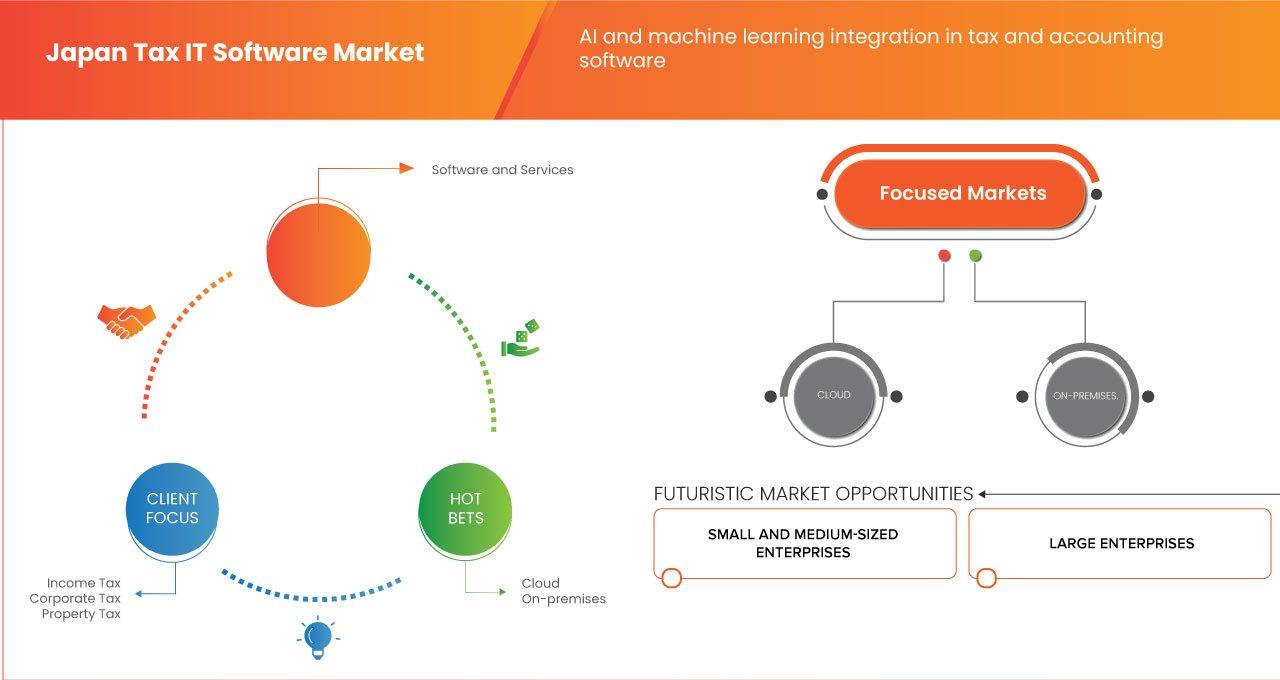
Data Bridge Market Research analyses that the Japan tax IT software market is expected to reach a value of USD 4.66 billion by 2032, from USD 2.58 billion in 2024, growing at a CAGR of 7.7% during the forecast period of 2025 to 2032.
Report Scope and Tax IT software Market Segmentation
|
Attributes |
Sensor Cleaning System Key Market Insights |
|
Segments Covered |
|
|
Key Market Players |
SAP (Germany), ADP, Inc. (U.S.), freee K.K. (Japan), Money Forward, Inc. (Japan), PCA Corporation (U.S.), QUICKBOOKS (INTUIT INC.) (U.S.), SAGE GROUP PLC (U.K.), TKC Corporation (Japan), and Wolters Kluwer N.V. (Netherlands) |
|
Market Opportunities |
|
|
Value Added Data Infosets |
In addition to the insights on market scenarios such as market value, growth rate, segmentation, geographical coverage, and major players, the market reports curated by the Data Bridge Market Research also include depth expert analysis, patient epidemiology, pipeline analysis, pricing analysis, and regulatory framework. |
Market Definition
The Japan tax IT software market encompasses a range of software solutions designed to streamline and automate tax-related processes for individuals, businesses, and tax professionals. This market includes software applications that support tax preparation, filing, compliance, and reporting in accordance with Japan's specific tax regulations. Key functionalities typically involve real-time data analytics, e-filing capabilities, tax planning, and regulatory updates, which help users adhere to both local and international tax requirements. As demand for digital transformation rises, these solutions increasingly integrate technologies such as cloud computing, artificial intelligence, and data security, allowing for greater efficiency and accuracy in tax management.
Japan Tax IT Software Market Dynamics
Drivers
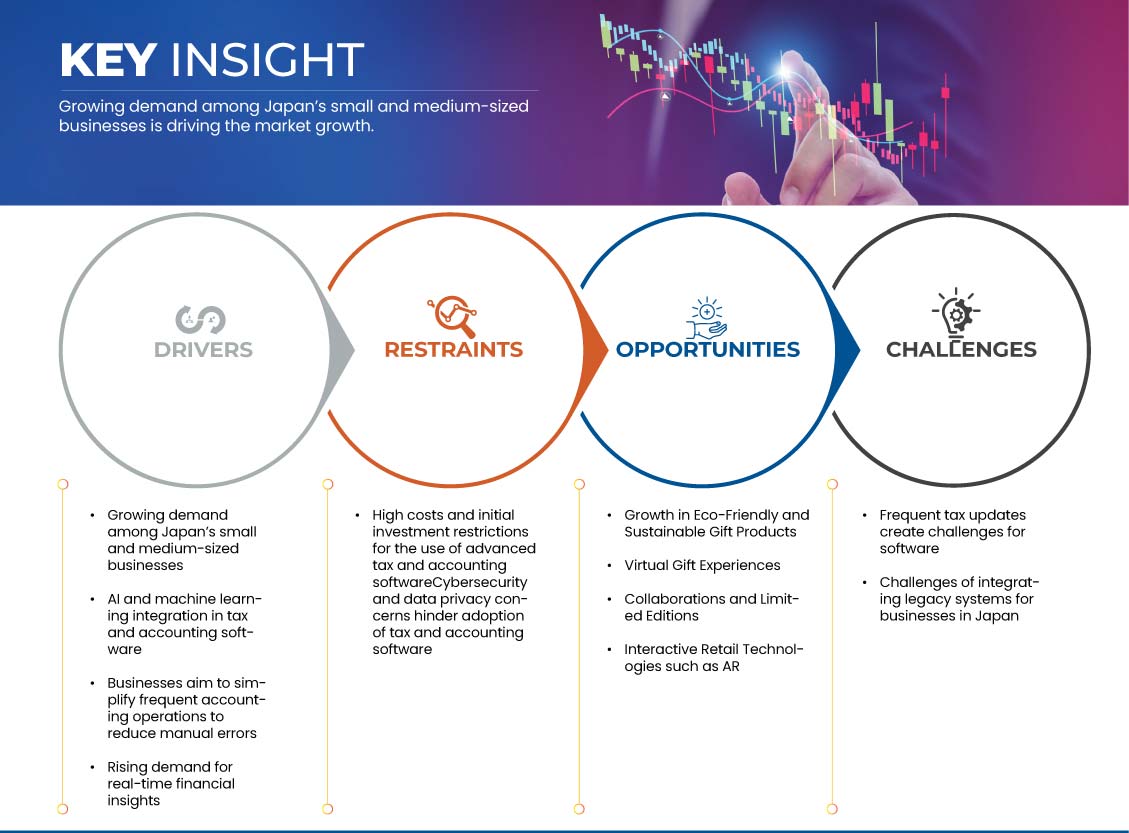
- Growing Demand Among Japan's Small and Medium-Sized Businesses
The small and medium-sized business (SMB) sector in Japan has been rapidly expanding, resulting in an increased demand for efficient and cost-effective solutions, especially in tax and accounting. As firms grow, the need to streamline financial operations and guarantee compliance with changing legislation becomes more critical. In this context, cloud-based tax and accounting software offers a perfect alternative for SMEs looking to improve financial management while keeping costs under control.
- The AI and Machine Learning Integration in Tax and Accounting Software
The integration of Artificial Intelligence (AI) and Machine Learning (ML) technology into tax and accounting software is transforming the financial management landscape for businesses. As businesses face increasingly complicated financial situations, using AI for predictive analytics, tax optimization, and fraud detection provides a significant competitive advantage. These technologies allow firms to automate time-consuming operations and provide improved accuracy, resulting in increased operational efficiency.
Opportunities
- Expansion of Cloud Services for Business
The rapid expansion of cloud services has created new opportunities for small and medium-sized companies (SMBs) in Japan. As the country moves toward digital transformation, cloud-based tax and accounting software is gaining appeal. These solutions provide a cost-effective, scalable, and user-friendly manner for organizations to manage their financial operations without the need for significant infrastructure investments.
- Government Initiatives to Promote Digital compliance Software
Governments throughout the globe, including Japan, are actively supporting the use of digital compliance software in enterprises to improve productivity, eliminate mistakes, and assure regulatory compliance. With the advent of digital transformation activities, governments are creating programs and laws that encourage businesses to use modern technology, such as tax and accounting software, to simplify their operations and fulfil the rising needs of regulatory compliance.
Restraints/Challenges
- High Costs and Initial Investment Restrictions
Although modern tax and accounting software has many advantages, the high costs of obtaining, deploying, and maintaining these systems can be a substantial obstacle, especially for small and medium-sized businesses (SMEs). As organizations seek to streamline their financial operations and remain competitive, the initial investment necessary for such software might dissuade many, particularly when extra customization and integration fees are included.
- Cybersecurity and Data Privacy Concerns
As firms digitize their financial operations, cybersecurity concerns have become a major impediment to the use of modern tax and accounting software. Businesses face increased risks of data breaches, cyberattacks, and privacy violations as they rely more heavily on digital platforms to manage sensitive financial data. These issues frequently prevent businesses from completely adopting digital financial management systems.
Recent Developments
- In October 2024, ADP has acquired Workforce Software, a leading provider of workforce management solutions for global enterprises. This acquisition expands ADP's offerings, enhancing global workforce management capabilities and driving future innovation to meet evolving business needs
- In October 2024, TKC Co., Ltd. launched the TKC-Phone SE3, a secure smartphone designed for tax accountant offices. This device helps firms comply with the Tax Accountant Act’s confidentiality and supervision requirements. It features app restrictions, data protection, and device management, ensuring privacy for staff and secure communication. The nationwide rollout is scheduled for December 2024
Japan Tax IT Software Market Scope
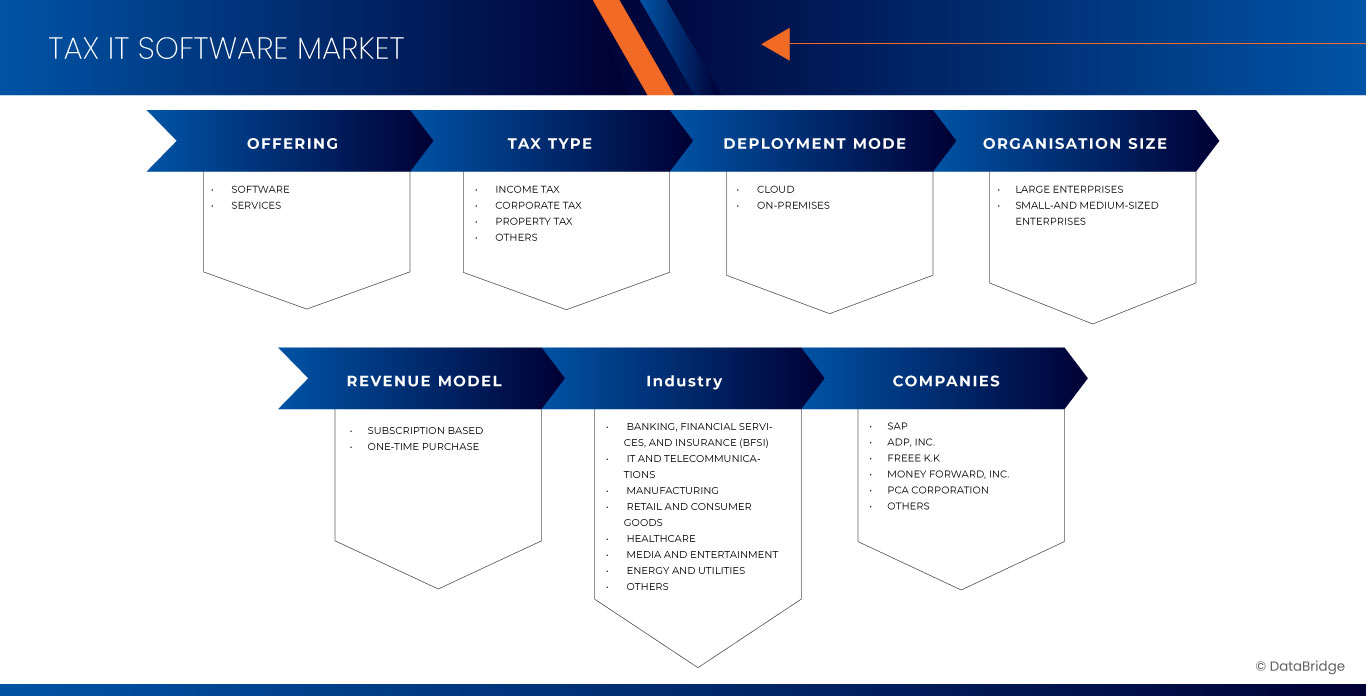
The Japan tax IT software market is segmented into six notable segments based on the offering, tax type, deployment mode, organization size, revenue model, and industry. The growth amongst these segments will help you analyse meagre growth segments in the industries and provide the users with a valuable market overview and market insights to help them make strategic decisions for identifying core market applications.
Offering
- Software
- Services
Tax Type
- Income Tax
- Corporate Tax
- Property Tax
- Others
Deployment Mode
- New Cloud
- On-Premises
Organization Size
- Small and Medium-Sized Enterprises
- Large Enterprises
Revenue Model
- One-Time Purchase
- Subscription Based
Industry
- Banking
- Financial Services and Insurance BFSI
- IT and Telecommunications
- Manufacturing
- Retail And Consumer Goods
- Healthcare
- Energy And Utilities
- Media and Entertainment
- Others
Competitive Landscape and Japan Tax IT Software Market Share Analysis
Japan tax IT software market competitive landscape provides details of the competitor. Details included are company overview, company financials, revenue generated, market potential, investment in research and development, new market initiatives, production sites and facilities, production capacities, company strengths and weaknesses, product launch, product width and breadth, application dominance. The above data points provided are only related to the companies' focus related to Japan tax IT software market.
- SAP (Germany)
- ADP, Inc. (U.S.)
- freee K.K. (Japan)
- Money Forward, Inc. (Japan)
- PCA Corporation (U.S.)
- QUICKBOOKS (INTUIT INC.) (U.S.)
- SAGE GROUP PLC (U.K.)
- TKC Corporation (Japan)
- Wolters Kluwer N.V. (Netherlands)
- Yayoi Co., Ltd. (Japan)
SKU-
세계 최초의 시장 정보 클라우드 보고서에 온라인으로 접속하세요

- 대화형 데이터 분석 대시보드
- 높은 성장 잠재력 기회를 위한 회사 분석 대시보드
- 사용자 정의 및 질의를 위한 리서치 분석가 액세스
- 대화형 대시보드를 통한 경쟁자 분석
- 최신 뉴스, 업데이트 및 추세 분석
- 포괄적인 경쟁자 추적을 위한 벤치마크 분석의 힘 활용
목차
1 서론
1.1 연구 목적
1.2 시장 정의
1.3 일본 세무 IT 소프트웨어 시장 개요
1.4 통화 및 가격
1.5 제한 사항
1.6 대상 시장
2 시장 세분화
2.1 대상 시장
2.2 지리적 범위
연구에 2.3년이 고려됨
2.4 DBMR TRIPOD 데이터 검증 모델
2.5 주요 여론 리더와의 1차 인터뷰
2.6 DBMR 시장 위치 그리드
2.7 다변량 모델링
2.8 제공 타임라인 곡선
2.9 2차 소스
2.1 가정
3 요약
4가지 프리미엄 인사이트
4.1 산업 분석 및 미래 시나리오
4.1.1 산업 분석
4.1.2 현재 시장 상황
4.1.3 미래 시나리오
4.1.3.1 기술 동향
4.1.4 경쟁 환경
4.1.5 미래 전망
4.2 침투 및 성장 전망 매핑
4.3 시장 기회
4.4 기술 분석
4.5 회사 비교 분석
5 규제 기준
6 시장 개요
6.1 드라이버
6.1.1 일본 중소기업의 수요 증가
6.1.2 세무 및 회계 소프트웨어의 AI 및 머신 러닝 통합
6.1.3 기업은 수동 오류를 줄이기 위해 빈번한 회계 작업을 단순화하는 것을 목표로 합니다.
6.1.4 실시간 재무 통찰력에 대한 수요 증가
6.2 제약
6.2.1 고급 세무 및 회계 소프트웨어 사용에 대한 높은 비용 및 초기 투자 제한
6.2.2 사이버 보안 및 데이터 개인 정보 보호 문제로 인해 세무 및 회계 소프트웨어 도입이 방해받음
6.3 기회
6.3.1 비즈니스를 위한 클라우드 서비스 확장
6.3.2 기업 전체에서 디지털 규정 준수 소프트웨어 도입을 촉진하기 위한 정부 이니셔티브
6.4 과제
6.4.1 빈번한 세무 업데이트로 인해 소프트웨어에 문제가 발생합니다.
6.4.2 일본 기업을 위한 레거시 시스템 통합의 과제
7 일본 세금 IT 소프트웨어 시장, 제공을 통해
7.1 개요
7.2 소프트웨어
7.3 서비스
7.3.1 서비스 유형별
7.4 교육 및 컨설팅
7.5 지원
8 일본 세금 IT 소프트웨어 시장, 세금 유형별
8.1 개요
8.2 소득세
8.3 법인세
8.4 재산세
8.5 기타
9 일본 세금 IT 소프트웨어 시장, 배포 모드별
9.1 개요
9.2 클라우드
9.3 온프레미스
10 일본 세금 IT 소프트웨어 시장, 조직 규모별
10.1 개요
10.2 대기업
10.3 중소기업
11 일본 세금 IT 소프트웨어 시장, 수익 모델별
11.1 개요
11.2 구독 기반
11.3 일회 구매
12 일본 세금 IT 소프트웨어 시장, 산업별
12.1 개요
12.2 은행, 금융 서비스 및 보험(BFSI)
12.3 IT 및 통신
12.4 제조
12.5 소매 및 소비재
12.6 건강관리
12.7 미디어 및 엔터테인먼트
12.8 에너지 및 유틸리티
12.9 기타
13 일본 세금 IT 소프트웨어 시장
13.1 회사 점유율 분석: 일본
14 SWOT 분석
15개 회사 프로필
15.1 에이디피 주식회사
15.1.1 회사 스냅샷
15.1.2 수익 분석
15.1.3 제품 포트폴리오
15.1.4 최근 개발
15.2 야요이 주식회사
15.2.1 회사 스냅샷
15.2.2 제품 포트폴리오
15.2.3 최근 개발
15.3 티케이씨 주식회사
15.3.1 회사 스냅샷
15.3.2 수익 분석
15.3.3 제품 포트폴리오
15.3.4 최근 개발
15.4 세이지그룹 PLC
15.4.1 회사 스냅샷
15.4.2 수익 분석
15.4.3 제품 포트폴리오
15.4.4 최근 개발
15.5 머니포워드 주식회사
15.5.1 회사 스냅샷
15.5.2 수익 분석
15.5.3 제품 포트폴리오
15.5.4 최근 개발
15.6 프리이 KK
15.6.1 회사 스냅샷
15.6.2 수익 분석
15.6.3 제품 포트폴리오
15.6.4 최근 개발
15.7 인튜이트 주식회사
15.7.1 회사 스냅샷
15.7.2 수익 분석
15.7.3 제품 포트폴리오
15.7.4 최근 개발
15.8 PCA 주식회사
15.8.1 회사 스냅샷
15.8.2 수익 분석
15.8.3 제품 포트폴리오
15.8.4 최근 개발
15.9 SAP SE
15.9.1 회사 스냅샷
15.9.2 수익 분석
15.9.3 제품 포트폴리오
15.9.4 최근 개발
15.1 볼터스 클루워 NV
15.10.1 회사 스냅샷
15.10.2 수익 분석
15.10.3 제품 포트폴리오
15.10.4 최근 개발
16 설문지
17 관련 보고서
표 목록
표 1 AWI TAX CONSULTING TAX 소프트웨어 가격(USD)
표 2 기술 매트릭스
표 3 비교 분석
표 4 일본 세무 및 회계 소프트웨어 시장에 대한 규정 및 표준
표 5 일본 세금 IT 소프트웨어 시장, 제공 품목별 2018-2032 (USD 천 달러)
표 6 2018-2032년 유형별 세금 IT 소프트웨어 시장의 일본 서비스 (USD 천)
표 7 세금 유형별 일본 세금 IT 소프트웨어 시장, 2018-2032 (USD 천 달러)
표 8 배포 모드별 일본 세금 IT 소프트웨어 시장, 2018-2032 (USD 천 달러)
표 9 일본 세금 IT 소프트웨어 시장, 조직 규모별, 2022-2032 (USD 천 달러)
표 10 일본 세금 IT 소프트웨어 시장, 수익 모델별, 2018-2032 (USD 천 달러)
표 11 일본 세금 IT 소프트웨어 시장, 산업별, 2018-2032 (USD 천)
그림 목록
그림 1 일본 세금 IT 소프트웨어 시장: 세분화
그림 2 일본 세금 IT 소프트웨어 시장: 데이터 삼각 측량
그림 3 일본 세금 IT 소프트웨어 시장: DROC 분석
그림 4 일본 세금 IT 소프트웨어 시장: 글로벌 대 지역 시장 분석
그림 5 일본 세금 IT 소프트웨어 시장: 회사 연구 분석
그림 6 일본 세금 IT 소프트웨어 시장: 인터뷰 인구 통계
그림 7 일본 세금 IT 소프트웨어 시장: DBMR 시장 위치 그리드
그림 8 일본 세금 IT 소프트웨어 시장: 다변량 모델링
그림 9 일본 세금 IT 소프트웨어 시장: 제품 타임라인 곡선
그림 10 일본 세금 IT 소프트웨어 시장: 세분화
그림 11 두 세그먼트는 제품별 일본 세금 IT 소프트웨어 시장을 구성합니다(2024년)
그림 12 일본 세금 IT 소프트웨어 시장, 시장 수익, 제품 및 공급업체 침투 매트릭스별
그림 13 전략적 결정
그림 14 일본의 중소기업의 증가하는 수요는 2025년에서 2032년까지의 예측 기간 동안 일본의 세금 IT 소프트웨어 시장을 견인할 것으로 예상됩니다.
그림 15 소프트웨어 세그먼트는 2025년 및 2032년에 일본 세금 IT 소프트웨어 시장에서 가장 큰 점유율을 차지할 것으로 예상됩니다.
그림 16 일본의 세금 준비 방법
그림 17 제조업 총 매출 추이 (10억 달러)
그림 18 일본 세금 IT 소프트웨어 시장의 동인, 제약, 기회 및 과제
그림 19 일본 세금 IT 소프트웨어 시장: 제공 기준, 2024
그림 20 일본 세금 IT 소프트웨어 시장: 세금 유형별, 2024
그림 21 일본 세금 IT 소프트웨어 시장: 배포 모드별, 2024
그림 22 일본 세금 IT 소프트웨어 시장: 조직 규모별, 2024
그림 23 일본 세금 IT 소프트웨어 시장: 조직 규모별, 2024
그림 24 일본 세금 IT 소프트웨어 시장: 산업별, 2024
그림 25 일본 세금 IT 소프트웨어 시장: 회사 점유율 2024(%)

연구 방법론
데이터 수집 및 기준 연도 분석은 대규모 샘플 크기의 데이터 수집 모듈을 사용하여 수행됩니다. 이 단계에는 다양한 소스와 전략을 통해 시장 정보 또는 관련 데이터를 얻는 것이 포함됩니다. 여기에는 과거에 수집한 모든 데이터를 미리 검토하고 계획하는 것이 포함됩니다. 또한 다양한 정보 소스에서 발견되는 정보 불일치를 검토하는 것도 포함됩니다. 시장 데이터는 시장 통계 및 일관된 모델을 사용하여 분석하고 추정합니다. 또한 시장 점유율 분석 및 주요 추세 분석은 시장 보고서의 주요 성공 요인입니다. 자세한 내용은 분석가에게 전화를 요청하거나 문의 사항을 드롭하세요.
DBMR 연구팀에서 사용하는 주요 연구 방법론은 데이터 마이닝, 시장에 대한 데이터 변수의 영향 분석 및 주요(산업 전문가) 검증을 포함하는 데이터 삼각 측량입니다. 데이터 모델에는 공급업체 포지셔닝 그리드, 시장 타임라인 분석, 시장 개요 및 가이드, 회사 포지셔닝 그리드, 특허 분석, 가격 분석, 회사 시장 점유율 분석, 측정 기준, 글로벌 대 지역 및 공급업체 점유율 분석이 포함됩니다. 연구 방법론에 대해 자세히 알아보려면 문의를 통해 업계 전문가에게 문의하세요.
사용자 정의 가능
Data Bridge Market Research는 고급 형성 연구 분야의 선두 주자입니다. 저희는 기존 및 신규 고객에게 목표에 맞는 데이터와 분석을 제공하는 데 자부심을 느낍니다. 보고서는 추가 국가에 대한 시장 이해(국가 목록 요청), 임상 시험 결과 데이터, 문헌 검토, 재생 시장 및 제품 기반 분석을 포함하도록 사용자 정의할 수 있습니다. 기술 기반 분석에서 시장 포트폴리오 전략에 이르기까지 타겟 경쟁업체의 시장 분석을 분석할 수 있습니다. 귀하가 원하는 형식과 데이터 스타일로 필요한 만큼 많은 경쟁자를 추가할 수 있습니다. 저희 분석가 팀은 또한 원시 엑셀 파일 피벗 테이블(팩트북)로 데이터를 제공하거나 보고서에서 사용 가능한 데이터 세트에서 프레젠테이션을 만드는 데 도움을 줄 수 있습니다.











