Middle East and Africa Lysosomal Storage Disorder Drugs Market Segmentation, By Type of Disorder Gaucher DiseaseFabry DiseasePompe Disease, Mucopolysaccharidosis (MPS), Niemann-Pick DiseaseKrabbe Disease, and Others), Type (Enzyme Replacement Therapy (ERT), Substrate Reduction Therapy (SRT), Chaperone Therapy, and Others), Drugs (Imiglucerase, Agalsidase Beta, Idursulfase, Alglucosidase Alpha, Velaglucerase, Taliglucerase Alfa, Laronidase, Agalsidase Alpha, Galsulfase, Avalglucosidase Alfa, and Others), Route of Administration (Intravenous (IV), Subcutaneous (SC), Oral, and Others), Age Group (Pediatric, Adults, and Geriatric), Gender (Male and Female), Distribution Channel (Hospital Pharmacies, Drugs Stores and Retail Pharmacies, and Online Pharmacies) - Industry Trends and Forecast to 2032
Middle East and Africa Lysosomal Storage Disorder Drugs Market Analysis
The Middle East and Africa lysosomal storage disorder drugs market encompasses the commercial sector for pharmaceuticals developed to diagnose, treat, and manage various lysosomal storage disorders, which are rare genetic conditions typically characterized by the accumulation of undigested substances within lysosomes due to enzyme deficiencies. This market includes a range of therapeutic products, such as enzyme replacement therapies, substrate reduction therapies, and gene therapies, aimed at addressing the diverse clinical manifestations of LSDs, such as Gaucher disease, Fabry disease, and Pompe disease. With increasing awareness, advancements in research and technology, and a growing number of pipeline therapies, this market is poised for significant expansion. In addition, rising healthcare expenditure and initiatives to improve access to rare disease treatments further drive market growth, presenting both opportunities and challenges for pharmaceutical companies and healthcare providers.
Lysosomal Storage Disorder Drugs Market Size
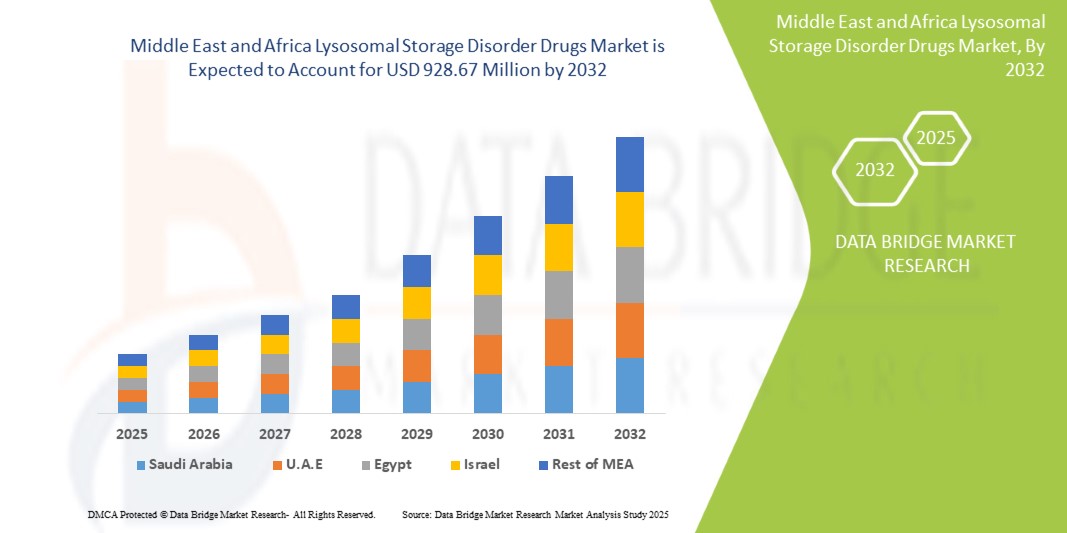
Middle East and Africa lysosomal storage disorder drugs market size was valued at USD 510.05 million in 2024 and is projected to reach USD 928.67 million by 2032, growing with a CAGR of 7.8% during the forecast period of 2025 to 2032. In addition to the insights on market scenarios such as market value, growth rate, segmentation, geographical coverage, and major players, the market reports curated by the Data Bridge Market Research also include import export analysis, production capacity overview, production consumption analysis, price trend analysis, climate change scenario, supply chain analysis, value chain analysis, raw material/consumables overview, vendor selection criteria, PESTLE Analysis, Porter Analysis, and regulatory framework.
Lysosomal Storage Disorder Drugs Market Trends
“Biotechnology Advancements for Lysosomal Storage Disorders Treatments”
Advancements in biotechnology have played a pivotal role in transforming the treatment landscape for Lysosomal Storage Disorders (LSDs), providing patients with more effective and tailored treatment options. Enzyme Replacement Therapy (ERT) has revolutionized the treatment of Lysosomal Storage Disorders (LSDs) by directly addressing the enzyme deficiencies that cause these conditions. In LSD patients, the lack of specific enzymes leads to the accumulation of toxic substances in cells, damaging organs and tissues. ERT works by administering synthetic enzymes to compensate for the missing ones, improving metabolic functions and alleviating symptoms. Over the years, ERT has advanced significantly, with new, more effective formulations and delivery methods that improve enzyme absorption and reduce side effects. These innovations have resulted in better clinical outcomes, this trend slowed disease progression, reduced organ damage, and enhanced patient quality of life.
Report Scope and Lysosomal Storage Disorder Drugs Market Segmentation
|
Attributes |
Lysosomal Storage Disorder Drugs Key Market Insights |
|
Segments Covered |
|
|
Countries Covered |
South Africa, Egypt, Bahrain, United Arab Emirates, Kuwait, Oman, Qatar, Saudi Arabia, and rest of Middle East and Africa |
|
Key Market Players |
Sanofi (France), BioMarin (U.S.), Pfizer Inc. (U.S.), Amicus Therapeutics, Inc. (U.S.), Takeda Pharmaceutical Company Limited (Japan), Protalix BioTherapeutics Inc. (Israel), and REGENXBIO INC. (U.S.) among others |
|
Market Opportunities |
|
|
Value Added Data Infosets |
In addition to the insights on market scenarios such as market value, growth rate, segmentation, geographical coverage, and major players, the market reports curated by the Data Bridge Market Research also include import export analysis, production capacity overview, production consumption analysis, price trend analysis, climate change scenario, supply chain analysis, value chain analysis, raw material/consumables overview, vendor selection criteria, PESTLE Analysis, Porter Analysis, and regulatory framework. |
Lysosomal Storage Disorder Drugs Market Definition
Lysosomal storage disorder drugs refer to a category of pharmaceuticals specifically developed to treat Lysosomal Storage Disorders (LSDs), which are a group of rare genetic conditions caused by deficiencies in specific enzymes responsible for breaking down complex molecules within lysosomes. These drugs aim to address the underlying metabolic abnormalities associated with LSDs by either replacing the missing enzymes (enzyme replacement therapy), by enhancing the body's ability to produce the enzymes, or by modifying the substrates that accumulate due to enzyme deficiency (substrate reduction therapy). By improving enzymatic function or reducing the toxic build-up of substrates, these treatments can alleviate symptoms, slow disease progression, and ultimately improve the quality of life for individuals affected by these challenging conditions.
Lysosomal Storage Disorder Drugs Market Dynamics
Drivers
- Emerging Personalized Medicine for Lysosomal Storage Disorders
Emerging personalized medicine is transforming the landscape of treatment for Lysosomal Storage Disorders (LSDs) by offering therapies specifically tailored to the individual genetic profiles of patients. LSDs are caused by genetic mutations that affect enzyme function, and these mutations can vary widely between patients. Personalized treatments involve analyzing a patient’s unique genetic makeup to develop a more targeted approach, optimizing the efficacy of therapies such as enzyme replacement or gene therapy. This precision allows for better matching of treatments with the patient's specific needs, minimizing side effects and enhancing therapeutic outcomes. As advancements in genetic testing and technology progress, healthcare providers are able to identify the most suitable interventions, potentially improving response rates and overall treatment success. The shift toward personalized medicine is accelerating the development of customized LSD treatments, which promise to revolutionize disease management. With these innovations, the global lysosomal storage disorders drug market is witnessing increased demand for more effective, individualized treatment options. Personalized medicine is thus a key driver of market growth, as it boosts treatment effectiveness and enhances patient outcomes, fostering greater confidence in therapeutic options.
For instance,
In February 2023, according to the article published by NCBI, Emerging personalized medicine uses an individual’s genetic profile to guide decisions related to the prevention, diagnosis, and treatment of diseases. This approach enables more precise and effective therapies for Lysosomal Storage Disorders (LSDs), tailoring treatments to specific genetic mutations. As personalized medicine becomes more prevalent, it drives the demand for targeted LSD therapies, fueling growth in the global lysosomal storage disorders drug market.
- Increased Government Funding for Research into Rare Disease Treatments
Government funding and grants for research into rare disease treatments are crucial for advancing the development of therapies for conditions such as Lysosomal Storage Disorders (LSDs). Rare diseases, often lacking commercial viability due to small patient populations, pose significant challenges in drug development. To address this, governments worldwide are increasingly allocating funds to incentivize research in these underserved areas. Financial support in the form of grants, subsidies, and tax credits helps pharmaceutical companies and research institutions overcome the high costs and risks associated with developing treatments for rare diseases. Furthermore, governments often fast-track regulatory processes for these treatments, recognizing the urgent need for solutions. By reducing the financial burden on researchers and companies, these funding mechanisms enable the exploration of innovative therapies, such as enzyme replacement and gene therapies that would otherwise face significant barriers to development.
For instance,
In August 2023, according to the article published by National Organization for Rare Diseases, The National Organization for Rare Disorders announced over USD 100,000 in grant funding for rare disease research, highlighting increased government support for advancing treatments. These funds enable researchers to explore innovative therapies for rare diseases like Lysosomal Storage Disorders (LSDs). Such financial backing accelerates drug development, driving growth in the global LSD drug market by fostering new treatment options.
Opportunities
- Increasing Number of Pipeline Drugs
The increasing number of drugs in the pipeline for Lysosomal Storage Disorders (LSDs) represents a significant opportunity for the global lysosomal storage disorders drugs market, potentially leading to improved treatment options and enhanced patient outcomes. As researchers and pharmaceutical companies enhance their understanding of these disorders, they are developing a diverse array of novel therapies, including gene therapies, substrate reduction therapies, and small molecule drugs. This expanded pipeline reflects a growing recognition of the unmet medical needs within the LSD community and promises to offer patients a wider variety of treatment modalities tailored to their specific conditions. The introduction of innovative therapies can enhance patient adherence to treatment, reduce disease burden, and ultimately improve the quality of life for individuals living with these disorders.
For instance,
In June 2024, Ultragenyx announced the Planning to file for accelerated approval of UX111 for the treatment of Sanfilippo Syndrome Type A (MPS IIIA). UX111 is a novel in vivo gene therapy in Phase 1/2/3 development for Sanfilippo syndrome type A (MPS IIIA), a rare fatal lysosomal storage disease with no approved treatment that primarily affects the central nervous system.
- Growing Emphasis on Early Diagnosis
The growing emphasis on early diagnosis of Lysosomal Storage Disorders (LSDs) presents a significant opportunity for the global lysosomal storage disorders drugs market by facilitating timely interventions that can greatly enhance patient outcomes. As healthcare systems place greater emphasis on early detection through improved screening programs, genetic testing, and advancements in diagnostic technologies, more patients are likely to be diagnosed at an earlier stage of their diseases. This early intervention allows for better management of symptoms but increases the potential efficacy of existing and emerging therapies. The result of this shift is a broader patient base that requires and can benefit from treatment options, ultimately driving demand within the lysosomal storage disorders drug market.
For instance,
In February 2023, according to an article, ‘Lysosomal storage disorders: from biology to the clinic with reference to India’, early diagnosis is the most critical part of the management of LSDs as it provides the opportunity for therapeutic intervention, precise genetic counselling, prenatal diagnosis and a better outcome for the patient.
Restraints/Challenges
- Lack of Awareness Among Healthcare Professionals and Patients
The lack of awareness among healthcare professionals and patients about Lysosomal Storage Disorders (LSDs) presents a significant barrier to early diagnosis, treatment, and effective management. Many healthcare providers, especially in regions with limited exposure to rare diseases, often fail to recognize the symptoms of LSDs, which are diverse and overlap with other more common conditions. This lack of knowledge leads to delayed diagnoses, misdiagnosis, and ineffective treatment, exacerbating the severity of the disease. For patients, especially those in resource-poor or underserved areas, the lack of awareness prevents early intervention, leaving them unaware of potential therapies. The complexity and rarity of LSDs further complicate the situation, as patients and healthcare professionals may not fully understand the importance of early treatment or the availability of specialized care options. Fewer patients are diagnosed and treated in time, leading to suboptimal clinical outcomes. This lack of awareness limits the demand for LSD-specific treatments and hinders the overall growth of the global lysosomal storage disorders drugs market.
For instance,
In January 2024, according to the article published by Wiley, there’s a significant diagnostic delay of around 15 years from symptom onset to diagnosis is common in adult LSD cases due to overlapping clinical phenotypes and varying severity. This delay highlights the lack of awareness among healthcare professionals, particularly those treating adult patients. Such restraints hinder early detection and timely treatment, restricting the growth of the global lysosomal storage disorders drugs market.
- Prolonged Drug Approval Procedures
Lengthy drug approval processes present a significant restraint for the lysosomal storage disorder drugs market, slowing the introduction of much-needed therapies. The process for obtaining regulatory approval for new drugs, particularly for rare diseases like LSDs, involves numerous clinical trials, extensive documentation, and rigorous assessments by regulatory bodies such as the FDA and EMA. These approval timelines are often extended due to the need for a thorough evaluation of safety, efficacy, and potential long-term effects. In the case of LSDs, the rarity and complexity of these diseases add another layer of challenge, as there is a limited patient population for clinical trials, making it difficult to generate robust data. The need for specialized treatments and the lack of established standards for these rare diseases complicates the approval process. Consequently, drug developers face prolonged waiting periods, delays in bringing new treatments to market, and additional costs, which can be discouraging for pharmaceutical companies. As a result, the lengthy approval processes slow the availability of innovative therapies for patients, reducing market growth and hindering the accessibility of effective treatments for LSDs. This regulatory delay ultimately acts as a major restraint for the global lysosomal storage disorders drugs market.
For instance,
In August 2024, according to the article published by Drugs.com, The research, development, and approval process for drugs typically takes 12 to 15 years. This extended timeline delays the introduction of new therapies and increases costs for pharmaceutical companies. As a result, the lengthy drug approval process restrains the growth of the global LSD drug market by limiting the speed of treatment availability.
This market report provides details of new recent developments, trade regulations, import-export analysis, production analysis, value chain optimization, market share, impact of domestic and localized market players, analyses opportunities in terms of emerging revenue pockets, changes in market regulations, strategic market growth analysis, market size, category market growths, application niches and dominance, product approvals, product launches, geographic expansions, technological innovations in the market. To gain more info on the market contact Data Bridge Market Research for an Analyst Brief, our team will help you take an informed market decision to achieve market growth.
Lysosomal Storage Disorder Drugs Market Scope
The market is segmented on the basis of by type of disorder, type, drugs, route of administration, age group, gender, and distribution channel. The growth amongst these segments will help you analyze meagre growth segments in the industries and provide the users with a valuable market overview and market insights to help them make strategic decisions for identifying core market applications.
Type of Disorder
- Gaucher Disease
- Type 1
- Type 3
- Type 2
- Fabry Disease
- Pompe Disease
- Infantile-Onset Pompe
- Late-Onset Pompe
- Mucopolysaccharidosis (MPS)
- MPS I
- MPS II
- MPS IV
- MPS VI
- MPS III
- Niemann-Pick Disease
- Type C
- Type B
- Type A
- Krabbe Disease
- Others
Type
- Enzyme Replacement Therapy (ERT)
- Substrate Reduction Therapy (SRT)
- Chaperone Therapy
- Others
Drugs
- Imiglucerase
- Agalsidase Beta
- Idursulfase
- Alglucosidase Alpha
- Velaglucerase
- Taliglucerase Alfa
- Laronidase
- Agalsidase Alpha
- Galsulfase
- Avalglucosidase Alfa
- Others
Route of Administration
- Intravenous (IV)
- Subcutaneous (SC)
- Oral
- Others
Age Group
- Pediatric
- Adults
- Geriatric
Gender
- Male
- Female
Distribution Channel
- Hospital Pharmacies
- Drugs Stores and Retail Pharmacies
- Online Pharmacies
Lysosomal Storage Disorder Drugs Market Regional Analysis
The market is analyzed and market size insights and trends are provided by type of disorder, type, drugs, route of administration, age group, gender, and distribution channel as referenced above.
The countries covered in the market are South Africa, Egypt, Bahrain, United Arab Emirates, Kuwait, Oman, Qatar, Saudi Arabia, and rest of Middle East and Africa.
Saudi Arabia is expected to dominate and the highest growing country in Middle East and Africa lysosomal storage disorder drugs market due to its advanced healthcare infrastructure, high adoption of drugs, significant research and development investments, and a large patient population.
The country section of the report also provides individual market impacting factors and changes in regulation in the market domestically that impacts the current and future trends of the market. Data points like down-stream and upstream value chain analysis, technical trends and porter's five forces analysis, case studies are some of the pointers used to forecast the market scenario for individual countries. Also, the presence and availability of Middle East and Africa brands and their challenges faced due to large or scarce competition from local and domestic brands, impact of domestic tariffs and trade routes are considered while providing forecast analysis of the country data.
Lysosomal Storage Disorder Drugs Market Share
The market competitive landscape provides details by competitor. Details included are company overview, company financials, revenue generated, market potential, investment in research and development, new market initiatives, Middle East and Africa presence, production sites and facilities, production capacities, company strengths and weaknesses, product launch, product width and breadth, application dominance. The above data points provided are only related to the companies' focus related to market.
Lysosomal Storage Disorder Drugs Market Leaders Operating in the Market Are:
- Sanofi (France)
- BioMarin (U.S.)
- Pfizer Inc. (U.S.)
- Amicus Therapeutics, Inc. (U.S.)
- Takeda Pharmaceutical Company Limited (Japan)
- Protalix BioTherapeutics Inc. (Israel)
- REGENXBIO INC. (U.S.)
Latest Developments in Lysosomal Storage Disorder Drugs Market
- In October 2024, Amicus Therapeutics announced a settlement regarding its drug Galafold (migalastat), which treats Fabry disease. The settlement resolves ongoing patent disputes and confirms the continuation of the drug’s marketing without litigation interference. This agreement with multiple parties aims to provide stability for Galafold’s availability and development while protecting intellectual property rights
- In June 2024, Amicus Therapeutics was honored with the Prix Galien UK Award for its innovative treatment, Pombiliti (miglustat), for the management of Fabry disease. The award recognizes excellence in pharmaceutical innovation and emphasizes the impact of Pombiliti in improving the lives of patients with rare genetic conditions. This accolade highlights Amicus’ leadership in rare disease therapies
- In April 2024, Forge Biologics announced it would present nine times at the ASGCT 27th Annual Meeting in May 2024, including a late-breaking oral presentation and three technical sessions. Presentations will cover process development, molecular advancements, and clinical updates, including a significant clinical result for FBX-101 in Krabbe disease
- In November 2023, Chiesi Group has been reaccredited as a Great Place to Work-Certified organization across multiple regions, including Italy, Australia, the US, and others. With an 85% response rate from employees, Chiesi achieved an 83% overall satisfaction rate, reflecting its commitment to fostering a positive, inclusive, and collaborative work environment focused on employee well-being and growth
- In January 2024, Denali Therapeutics Inc., a biopharmaceutical company developing therapies to cross the blood-brain barrier for treating neurodegenerative and lysosomal storage diseases, announced progress and milestones for 2024. CEO Ryan Watts, Ph.D., highlighted these developments during a corporate presentation at the 42nd Annual J.P. Morgan Healthcare Conference on January 9th
SKU-
세계 최초의 시장 정보 클라우드 보고서에 온라인으로 접속하세요
- 대화형 데이터 분석 대시보드
- 높은 성장 잠재력 기회를 위한 회사 분석 대시보드
- 사용자 정의 및 질의를 위한 리서치 분석가 액세스
- 대화형 대시보드를 통한 경쟁자 분석
- 최신 뉴스, 업데이트 및 추세 분석
- 포괄적인 경쟁자 추적을 위한 벤치마크 분석의 힘 활용
목차
1 서론
1.1 연구 목적
1.2 시장 정의
1.3 중동 및 아프리카 리소좀 저장 장애 약물 시장 개요
1.4 대상 시장
2 시장 세분화
2.1 대상 시장
2.2 지리적 범위
연구에 2.3년이 고려됨
2.4 통화 및 가격
2.5 DBMR TRIPOD 데이터 검증 모델
2.6 다변량 모델링
2.7 주요 여론 선도자와의 1차 인터뷰
2.8 DBMR 시장 위치 그리드
2.9 2차 소스
2.1 가정
3 요약
4 프리미엄 인사이트
4.1 포터의 5가지 힘
4.2 파이프라인 분석
5 중동 및 아프리카 리소좀 저장 장애 약물 시장: 규정
5.1 중동 및 아프리카의 규제 기관.
6 시장 개요
6.1 드라이버
6.1.1 리소좀 저장 장애 치료를 위한 생명공학 발전
6.1.2 리소좀 저장 장애에 대한 새로운 개인화 의학
6.1.3 희귀 질환 치료 연구를 위한 정부 자금 지원 증가
6.1.4 제약 회사와 연구 기관 간의 협력 및 파트너십
6.2 제약
6.2.1 의료 전문가와 환자의 인식 부족
6.2.2 장기 약물 승인 절차
6.3 기회
6.3.1 파이프라인 약물의 증가
6.3.2 조기 진단에 대한 강조 증가
6.3.3 리소좀 저장 장애 치료를 위한 유전자 치료의 발전
6.4 과제
6.4.1 질병 치료와 관련된 상당한 비용
6.4.2 리소좀 저장 장애로 고통받는 좁은 환자 기반
7 중동 및 아프리카 리소좀 저장 장애 약물 시장, 장애 유형별
7.1 개요
7.2 고셰병
7.2.1 유형 1
7.2.2 유형 3
7.2.3 유형 2
7.3 파브리병
7.4 폼페병
7.4.1 유아기 발병 폼페
7.4.2 후기 발병 폼페
7.5 점액다당증(MPS)
7.5.1 MPS 1
7.5.2 MPS II
7.5.3 MPS 4
7.5.4 MPS 6
7.5.5 MPS III
7.6 니만-픽병
7.6.1 C형
7.6.2 유형 B
7.6.3 A형
7.7 크라베병
7.8 기타
8 중동 및 아프리카 리소좀 저장 장애 약물 시장, 약물별
8.1 개요
8.2 이미글루세라제
8.3 아갈시다제 베타
8.4 이두르설파제
8.5 알글루코시다제 알파
8.6 벨라글루세라제
8.7 탈리글루세라제 알파
8.8 라로니다제
8.9 아갈시다제 알파
8.1 갈설파아제
8.11 아발글루코시다제 알파
8.12 기타
9 중동 및 아프리카 리소좀 저장 장애 약물 시장, 유형별
9.1 개요
9.2 효소 대체 요법(ERT)
9.3 기질 감소 요법(SRT)
9.4 샤페론 치료
9.5 기타
10 중동 및 아프리카 리소좀 저장 장애 약물 시장, 성별별
10.1 개요
10.2 남자
10.3 여성
11 중동 및 아프리카 리소좀 저장 장애 약물 시장, 연령대별
11.1 개요
11.2 소아과
11.3 성인
11.4 노인병
12 중동 및 아프리카 리소좀 저장 장애 약물 시장, 유통 채널별
12.1 개요
12.2 병원 약국
12.3 약국 및 소매 약국
12.4 온라인 약국
13 중동 및 아프리카 리소좀 저장 장애 약물 시장, 투여 경로별
13.1 개요
13.2 정맥 주사(IV)
13.3 피하(SC)
13.4 구두
13.5 기타
14 중동 및 아프리카 리소좀 저장 장애 약물 시장, 지역별
14.1 중동 및 아프리카
14.1.1 사우디 아라비아
14.1.2 아랍에미리트(UAE)
14.1.3 남아프리카 공화국
14.1.4 이집트
14.1.5 카타르
14.1.6 쿠웨이트
14.1.7 오만
14.1.8 바레인
14.1.9 중동 및 아프리카의 나머지 지역
15 중동 및 아프리카 리소좀 저장 장애 약물 시장: 회사 환경
15.1 회사 점유율 분석: 중동 및 아프리카
16 SWOT 분석
17 회사 프로필
17.1 사노피
17.1.1 회사 스냅샷
17.1.2 수익 분석
17.1.3 회사 점유율 분석
17.1.4 제품 포트폴리오
17.1.5 최근 개발
17.2 바이오마린
17.2.1 회사 스냅샷
17.2.2 수익 분석
17.2.3 회사 점유율 분석
17.2.4 제품 포트폴리오
17.2.5 최근 개발
17.3 파이저 주식회사
17.3.1 회사 스냅샷
17.3.2 수익 분석
17.3.3 회사 점유율 분석
17.3.4 제품 포트폴리오
17.3.5 최근 개발
17.4 다케다제약 주식회사
17.4.1 회사 스냅샷
17.4.2 수익 분석
17.4.3 회사 점유율 분석
17.4.4 제품 포트폴리오
17.4.5 최근 개발
17.5 아미커스 테라퓨틱 주식회사
17.5.1 회사 스냅샷
17.5.2 수익 분석
17.5.3 회사 점유율 분석
17.5.4 제품 포트폴리오
17.5.5 최근 개발
17.6 키에시 파마슈티치 스파
17.6.1 회사 스냅샷
17.6.2 제품 포트폴리오
17.6.3 최근 개발
17.7 데날리 테라퓨틱스
17.7.1 회사 스냅샷
17.7.2 수익 분석
17.7.3 파이프라인 제품 포트폴리오
17.7.4 최근 개발
17.8 FORGE BIOLOGICS
17.8.1 회사 스냅샷
17.8.2 파이프라인 제품 포트폴리오
17.8.3 최근 개발
17.9 제이씨알제약(주)
17.9.1 회사 스냅샷
17.9.2 수익 분석
17.9.3 PINELINE 제품 포트폴리오
17.9.4 제품 포트폴리오
17.9.5 최근 개발
17.1 오차드 테라퓨틱스 PLC
17.10.1 회사 스냅샷
17.10.2 수익 분석
17.10.3 제품 포트폴리오
17.10.4 최근 개발
17.11 프로탈릭스 바이오테라퓨틱스
17.11.1 회사 스냅샷
17.11.2 수익 분석
17.11.3 파이프라인 제품 포트폴리오
17.11.4 최근 개발
17.12 리젠엑스바이오 주식회사
17.12.1 회사 스냅샷
17.12.2 수익 분석
17.12.3 PINELINE 제품 포트폴리오
17.12.4 최근 개발
17.13 산가모 테라퓨틱스
17.13.1 회사 스냅샷
17.13.2 수익 분석
17.13.3 제품 포트폴리오
17.13.4 최근 개발
17.14 스퍼 치료제
17.14.1 회사 스냅샷
17.14.2 제품 포트폴리오
17.14.3 최근 개발
17.15 울트라제닉스제약 주식회사
17.15.1 회사 스냅샷
17.15.2 수익 분석
17.15.3 제품 포트폴리오
17.15.4 최근 개발
18 설문지
19 관련 보고서
표 목록
표 1 중동 및 아프리카 리소좀 저장 장애 약물 시장, 장애 유형별, 2018-2032년(백만 달러)
표 2 중동 및 아프리카 고셔병 리소좀 저장 장애 약물 시장, 지역별, 2018-2032(백만 달러)
표 3 중동 및 아프리카 고셔병 리소좀 저장 장애 약물 시장, 유형별, 2018-2032(백만 달러)
표 4 중동 및 아프리카 리소좀 저장 장애 약물 시장의 파브리병, 지역별, 2018-2032 (백만 달러)
표 5 중동 및 아프리카 리소좀 저장 장애 약물 시장의 폼페병, 지역별, 2018-2032 (백만 달러)
표 6 중동 및 아프리카 폼페병 리소좀 저장 장애 약물 시장, 유형별, 2018-2032(백만 달러)
표 7 중동 및 아프리카 리소좀 저장 장애 약물 시장에서의 점액다당증(MPS), 지역별, 2018-2032년(백만 달러)
표 8 중동 및 아프리카 리소좀 저장 장애 약물 시장의 점액다당증(MPS), 유형별, 2018-2032년(백만 달러)
표 9 중동 및 아프리카 니만-픽 질환 리소좀 저장 장애 약물 시장, 지역별, 2018-2032 (백만 달러)
표 10 중동 및 아프리카 니만-픽 질환 리소좀 저장 장애 약물 시장, 유형별, 2018-2032(백만 달러)
표 11 중동 및 아프리카 지역별 리소좀 저장 장애 약물 시장의 크라베병, 2018-2032년(백만 달러)
표 12 중동 및 아프리카 기타 리소좀 저장 장애 약물 시장, 지역별, 2018-2032 (백만 달러)
표 13 중동 및 아프리카 리소좀 저장 장애 약물 시장, 약물별, 2018-2032 (백만 달러)
표 14 중동 및 아프리카 리소좀 저장 장애 약물 시장에서의 이미글루세라제, 지역별, 2018-2032(백만 달러)
표 15 중동 및 아프리카 리소좀 저장 장애 약물 시장에서의 아갈시다제 베타, 지역별, 2018-2032 (백만 달러)
표 16 중동 및 아프리카 리소좀 저장 장애 약물 시장의 이두르설파제, 지역별, 2018-2032 (백만 달러)
표 17 중동 및 아프리카 리소좀 저장 장애 약물 시장의 알글루코시다제 알파, 지역별, 2018-2032 (백만 달러)
표 18 중동 및 아프리카 리소좀 저장 장애 약물 시장의 벨라글루세라제, 지역별, 2018-2032 (백만 달러)
표 19 중동 및 아프리카 리소좀 저장 장애 약물 시장에서의 탈리글루세라제 알파, 지역별, 2018-2032 (백만 달러)
표 20 중동 및 아프리카 지역별 리소좀 저장 장애 약물 시장의 라로니다제, 2018-2032년(백만 달러)
표 21 중동 및 아프리카 리소좀 저장 장애 약물 시장에서의 아갈시다제 알파, 지역별, 2018-2032 (백만 달러)
표 22 중동 및 아프리카 리소좀 저장 장애 약물 시장의 갈설파제, 지역별, 2018-2032 (백만 달러)
표 23 중동 및 아프리카 리소좀 저장 장애 약물 시장에서의 아발글루코시다제 알파, 지역별, 2018-2032 (백만 달러)
표 24 중동 및 아프리카 기타 리소좀 저장 장애 약물 시장, 지역별, 2018-2032 (백만 달러)
표 25 중동 및 아프리카 리소좀 저장 장애 약물 시장, 유형별, 2018-2032(백만 달러)
표 26 중동 및 아프리카 리소좀 저장 장애 약물 시장에서 효소 대체 요법(ERT) 시장, 지역별, 2018-2032(백만 달러)
표 27 중동 및 아프리카 리소좀 저장 장애 약물 시장에서의 기질 감소 요법(SRT), 지역별, 2018-2032(백만 달러)
표 28 중동 및 아프리카 리소좀 저장 장애 약물 시장에서의 샤페론 요법, 지역별, 2018-2032 (백만 달러)
표 29 중동 및 아프리카 기타 리소좀 저장 장애 약물 시장, 지역별, 2018-2032 (백만 달러)
표 30 중동 및 아프리카 리소좀 저장 장애 약물 시장, 성별별, 2018-2032 (백만 달러)
표 31 중동 및 아프리카 남성 리소좀 저장 장애 약물 시장, 지역별, 2018-2032 (백만 달러)
표 32 중동 및 아프리카 여성의 리소좀 저장 장애 약물 시장, 지역별, 2018-2032 (백만 달러)
표 33 중동 및 아프리카 리소좀 저장 장애 약물 시장, 연령대별, 2018-2032 (백만 달러)
표 34 중동 및 아프리카 소아용 리소좀 저장 장애 약물 시장, 지역별, 2018-2032(백만 달러)
표 35 중동 및 아프리카 성인 리소좀 저장 장애 약물 시장, 지역별, 2018-2032 (백만 달러)
표 36 중동 및 아프리카 노인성 리소좀 저장 장애 약물 시장, 지역별, 2018-2032 (백만 달러)
표 37 중동 및 아프리카 리소좀 저장 장애 약물 시장, 유통 채널별, 2018-2032년(백만 달러)
표 38 중동 및 아프리카 병원 약국의 리소좀 저장 장애 약물 시장, 지역별, 2018-2032(백만 달러)
표 39 중동 및 아프리카 약물 매장 및 리소좀 저장 장애 약물 시장의 소매 약국, 지역별, 2018-2032 (백만 달러)
표 40 중동 및 아프리카 리소좀 저장 장애 약물 시장의 온라인 약국, 지역별, 2018-2032 (백만 달러)
표 41 중동 및 아프리카 리소좀 저장 장애 약물 시장, 투여 경로별, 2018-2032년(백만 달러)
표 42 중동 및 아프리카 리소좀 저장 장애 약물 시장(IV) 지역별, 2018-2032(백만 달러)
표 43 중동 및 아프리카 리소좀 저장 장애 약물 시장(SC) 지역별, 2018-2032(백만 달러)
표 44 중동 및 아프리카 지역별 리소좀 저장 장애 약물 시장 경구 시장, 2018-2032년(백만 달러)
표 45 중동 및 아프리카 기타 리소좀 저장 장애 약물 시장, 지역별, 2018-2032 (백만 달러)
표 46 중동 및 아프리카 리소좀 저장 장애 약물 시장, 국가별, 2018-2032년(백만 달러)
표 47 중동 및 아프리카 리소좀 저장 장애 약물 시장, 장애 유형별, 2018-2032년(백만 달러)
표 48 중동 및 아프리카 고셔병 리소좀 저장 장애 약물 시장, 유형별, 2018-2032(백만 달러)
표 49 중동 및 아프리카 폼페병 리소좀 저장 장애 약물 시장, 유형별, 2018-2032(백만 달러)
표 50 중동 및 아프리카 리소좀 저장 장애 약물 시장의 점액다당증(MPS), 유형별, 2018-2032(백만 달러)
표 51 중동 및 아프리카 니만-픽 질환 리소좀 저장 장애 약물 시장, 유형별, 2018-2032(백만 달러)
표 52 중동 및 아프리카 리소좀 저장 장애 약물 시장, 유형별, 2018-2032(백만 달러)
표 53 중동 및 아프리카 리소좀 저장 장애 약물 시장, 약물별, 2018-2032 (백만 달러)
표 54 중동 및 아프리카 리소좀 저장 장애 약물 시장, 투여 경로별, 2018-2032년(백만 달러)
표 55 중동 및 아프리카 리소좀 저장 장애 약물 시장, 연령대별, 2018-2032 (백만 달러)
표 56 중동 및 아프리카 리소좀 저장 장애 약물 시장, 성별별, 2018-2032 (백만 달러)
표 57 중동 및 아프리카 리소좀 저장 장애 약물 시장, 유통 채널별, 2018-2032년(백만 달러)
표 58 사우디 아라비아 리소좀 저장 장애 약물 시장, 장애 유형별, 2018-2032년(백만 달러)
표 59 사우디 아라비아 고셔병 리소좀 저장 장애 약물 시장, 유형별, 2018-2032 (백만 달러)
표 60 사우디 아라비아 폼페병 리소좀 저장 장애 약물 시장, 유형별, 2018-2032 (백만 달러)
표 61 사우디 아라비아의 리소좀 저장 장애 약물 시장에서의 점액다당증(MPS), 유형별, 2018-2032년(백만 달러)
표 62 사우디 아라비아 니만-픽 질환 리소좀 저장 장애 약물 시장, 유형별, 2018-2032(백만 달러)
표 63 사우디 아라비아 리소좀 저장 장애 약물 시장, 유형별, 2018-2032년(백만 달러)
표 64 사우디 아라비아 리소좀 저장 장애 약물 시장, 약물별, 2018-2032 (백만 달러)
표 65 사우디 아라비아 리소좀 저장 장애 약물 시장, 투여 경로별, 2018-2032 (백만 달러)
표 66 사우디 아라비아 리소좀 저장 장애 약물 시장, 연령대별, 2018-2032 (백만 달러)
표 67 사우디 아라비아 리소좀 저장 장애 약물 시장, 성별별, 2018-2032 (백만 달러)
표 68 사우디 아라비아 리소좀 저장 장애 약물 시장, 유통 채널별, 2018-2032년(백만 달러)
표 69 아랍에미리트(UAE) 리소좀 저장 장애 약물 시장, 장애 유형별, 2018-2032년(백만 달러)
표 70 아랍에미리트(UAE)의 리소좀 저장 장애 약물 시장에서의 고셔병, 유형별, 2018-2032년(백만 달러)
표 71 아랍에미리트(UAE) 리소좀 저장 장애 약물 시장의 폼페병 유형별, 2018-2032년(백만 달러)
표 72 아랍에미리트(UAE) 리소좀 저장 장애 약물 시장에서의 점액다당증(MPS), 유형별, 2018-2032년(백만 달러)
표 73 아랍에미리트(UAE) 리소좀 저장 장애 약물 시장의 NIEMANN-PICK 질환, 유형별, 2018-2032(백만 달러)
표 74 아랍에미리트(UAE) 리소좀 저장 장애 약물 시장, 유형별, 2018-2032년(백만 달러)
표 75 아랍에미리트(UAE) 리소좀 저장 장애 약물 시장, 약물별, 2018-2032년(백만 달러)
표 76 아랍에미리트(UAE) 리소좀 저장 장애 약물 시장, 투여 경로별, 2018-2032년(백만 달러)
표 77 아랍에미리트(UAE) 리소좀 저장 장애 약물 시장, 연령대별, 2018-2032년(백만 달러)
표 78 아랍에미리트(UAE) 리소좀 저장 장애 약물 시장, 성별별, 2018-2032년(백만 달러)
표 79 아랍에미리트(UAE) 리소좀 저장 장애 약물 시장, 유통 채널별, 2018-2032년(백만 달러)
표 80 남아프리카 공화국 리소좀 저장 장애 약물 시장, 장애 유형별, 2018-2032년(백만 달러)
표 81 남아프리카 공화국 고셔병 리소좀 저장 장애 약물 시장, 유형별, 2018-2032(백만 달러)
표 82 남아프리카 공화국 폼페병 리소좀 저장 장애 약물 시장, 유형별, 2018-2032(백만 달러)
표 83 남아프리카 공화국 리소좀 저장 장애 약물 시장에서의 점액다당증(MPS), 유형별, 2018-2032년(백만 달러)
표 84 남아프리카 공화국 니만-픽 질환 리소좀 저장 장애 약물 시장, 유형별, 2018-2032(백만 달러)
표 85 남아프리카 공화국 리소좀 저장 장애 약물 시장, 유형별, 2018-2032년(백만 달러)
표 86 남아프리카 공화국 리소좀 저장 장애 약물 시장, 약물별, 2018-2032 (백만 달러)
표 87 남아프리카 공화국 리소좀 저장 장애 약물 시장, 투여 경로별, 2018-2032년(백만 달러)
표 88 남아프리카 공화국 리소좀 저장 장애 약물 시장, 연령대별, 2018-2032년(백만 달러)
표 89 남아프리카 공화국 리소좀 저장 장애 약물 시장, 성별별, 2018-2032년(백만 달러)
표 90 남아프리카 공화국 리소좀 저장 장애 약물 시장, 유통 채널별, 2018-2032년(백만 달러)
표 91 이집트 리소좀 저장 장애 약물 시장, 장애 유형별, 2018-2032년(백만 달러)
표 92 이집트 고셔병 리소좀 저장 장애 약물 시장, 유형별, 2018-2032(백만 달러)
표 93 이집트 폼페병 리소좀 저장 장애 약물 시장, 유형별, 2018-2032 (백만 달러)
표 94 이집트 뮤코폴리사카리도시스(MPS) 리소좀 저장 장애 약물 시장, 유형별, 2018-2032(백만 달러)
표 95 이집트 니만-픽 질환 리소좀 저장 장애 약물 시장, 유형별, 2018-2032(백만 달러)
표 96 이집트 리소좀 저장 장애 약물 시장, 유형별, 2018-2032 (백만 달러)
표 97 이집트 리소좀 저장 장애 약물 시장, 약물별, 2018-2032 (백만 달러)
표 98 이집트 리소좀 저장 장애 약물 시장, 투여 경로별, 2018-2032년(백만 달러)
표 99 이집트 리소좀 저장 장애 약물 시장, 연령대별, 2018-2032 (백만 달러)
표 100 이집트 리소좀 저장 장애 약물 시장, 성별별, 2018-2032 (백만 달러)
표 101 이집트 리소좀 저장 장애 약물 시장, 유통 채널별, 2018-2032년(백만 달러)
표 102 카타르 리소좀 저장 장애 약물 시장, 장애 유형별, 2018-2032 (백만 달러)
표 103 카타르 고셔병 리소좀 저장 장애 약물 시장, 유형별, 2018-2032 (백만 달러)
표 104 카타르 폼페병 리소좀 저장 장애 약물 시장, 유형별, 2018-2032(백만 달러)
표 105 카타르 리소좀 저장 장애 약물 시장에서의 점액다당증(MPS), 유형별, 2018-2032년(백만 달러)
표 106 카타르 니만-픽 질환 리소좀 저장 장애 약물 시장, 유형별, 2018-2032(백만 달러)
표 107 카타르 리소좀 저장 장애 약물 시장, 유형별, 2018-2032 (백만 달러)
표 108 카타르 리소좀 저장 장애 약물 시장, 약물별, 2018-2032 (백만 달러)
표 109 카타르 리소좀 저장 장애 약물 시장, 투여 경로별, 2018-2032년(백만 달러)
표 110 카타르 리소좀 저장 장애 약물 시장, 연령대별, 2018-2032 (백만 달러)
표 111 카타르 리소좀 저장 장애 약물 시장, 성별별, 2018-2032 (백만 달러)
표 112 카타르 리소좀 저장 장애 약물 시장, 유통 채널별, 2018-2032년(백만 달러)
표 113 쿠웨이트 리소좀 저장 장애 약물 시장, 장애 유형별, 2018-2032 (백만 달러)
표 114 리소좀 저장 장애 약물 시장의 쿠웨이트 고셔병, 유형별, 2018-2032(백만 달러)
표 115 리소좀 저장 장애 약물 시장의 쿠웨이트 폼페병, 유형별, 2018-2032(백만 달러)
표 116 리소좀 저장 장애 약물 시장에서 쿠웨이트 점액다당증(MPS) 유형별, 2018-2032년(백만 달러)
표 117 리소좀 저장 장애 약물 시장의 쿠웨이트 니만-픽 질환, 유형별, 2018-2032(백만 달러)
표 118 쿠웨이트 리소좀 저장 장애 약물 시장, 유형별, 2018-2032 (백만 달러)
표 119 쿠웨이트 리소좀 저장 장애 약물 시장, 약물별, 2018-2032 (백만 달러)
표 120 쿠웨이트 리소좀 저장 장애 약물 시장, 투여 경로별, 2018-2032 (백만 달러)
표 121 쿠웨이트 리소좀 저장 장애 약물 시장, 연령대별, 2018-2032 (백만 달러)
표 122 쿠웨이트 리소좀 저장 장애 약물 시장, 성별별, 2018-2032 (백만 달러)
표 123 쿠웨이트 리소좀 저장 장애 약물 시장, 유통 채널별, 2018-2032 (백만 달러)
표 124 오만 리소좀 저장 장애 약물 시장, 장애 유형별, 2018-2032 (백만 달러)
표 125 오만 고셔병 리소좀 저장 장애 약물 시장, 유형별, 2018-2032 (백만 달러)
표 126 오만 폼페병 리소좀 저장 장애 약물 시장, 유형별, 2018-2032 (백만 달러)
표 127 오만 뮤코폴리사카리도시스(MPS) 리소좀 저장 장애 약물 시장, 유형별, 2018-2032(백만 달러)
표 128 오만 니만-픽 질환 리소좀 저장 장애 약물 시장, 유형별, 2018-2032(백만 달러)
표 129 오만 리소좀 저장 장애 약물 시장, 유형별, 2018-2032 (백만 달러)
표 130 오만 리소좀 저장 장애 약물 시장, 약물별, 2018-2032 (백만 달러)
표 131 오만 리소좀 저장 장애 약물 시장, 투여 경로별, 2018-2032 (백만 달러)
표 132 오만 리소좀 저장 장애 약물 시장, 연령대별, 2018-2032 (백만 달러)
표 133 오만 리소좀 저장 장애 약물 시장, 성별별, 2018-2032 (백만 달러)
표 134 오만 리소좀 저장 장애 약물 시장, 유통 채널별, 2018-2032 (백만 달러)
표 135 바레인 리소좀 저장 장애 약물 시장, 장애 유형별, 2018-2032년(백만 달러)
표 136 바레인 고셔병 리소좀 저장 장애 약물 시장, 유형별, 2018-2032 (백만 달러)
표 137 바레인 폼페병 리소좀 저장 장애 약물 시장, 유형별, 2018-2032 (백만 달러)
표 138 바레인 리소좀 저장 장애 약물 시장에서의 점액다당증(MPS), 유형별, 2018-2032년(백만 달러)
표 139 바레인 니만-픽 질환 리소좀 저장 장애 약물 시장, 유형별, 2018-2032(백만 달러)
표 140 바레인 리소좀 저장 장애 약물 시장, 유형별, 2018-2032년(백만 달러)
표 141 바레인 리소좀 저장 장애 약물 시장, 약물별, 2018-2032 (백만 달러)
표 142 바레인 리소좀 저장 장애 약물 시장, 투여 경로별, 2018-2032년(백만 달러)
표 143 바레인 리소좀 저장 장애 약물 시장, 연령대별, 2018-2032 (백만 달러)
표 144 바레인 리소좀 저장 장애 약물 시장, 성별별, 2018-2032 (백만 달러)
표 145 바레인 리소좀 저장 장애 약물 시장, 유통 채널별, 2018-2032년(백만 달러)
표 146 중동 및 아프리카 나머지 지역의 리소좀 저장 장애 약물 시장, 장애 유형별, 2018-2032년(백만 달러)
그림 목록
그림 1 중동 및 아프리카 리소좀 저장 장애 약물 시장: 세분화
그림 2 중동 및 아프리카 리소좀 저장 장애 약물 시장: 데이터 삼각 측량
그림 3 중동 및 아프리카 리소좀 저장 장애 약물 시장: DROC 분석
그림 4 중동 및 아프리카 리소좀 저장 장애 약물 시장: 중동 및 아프리카 대 지역 시장 분석
그림 5 중동 및 아프리카 리소좀 저장 장애 약물 시장: 회사 연구 분석
그림 6 중동 및 아프리카 리소좀 저장 장애 약물 시장: 다변량 모델링
그림 7 중동 및 아프리카 리소좀 저장 장애 약물 시장: 인터뷰 인구 통계
그림 8 중동 및 아프리카 리소좀 저장 장애 약물 시장: DBMR 시장 위치 그리드
그림 9 중동 및 아프리카 리소좀 저장 장애 약물 시장: 세분화
그림 10 요약
그림 11 중동 및 아프리카 리소좀 저장 장애 약물 시장은 장애 유형별로 7개 세그먼트로 구성됩니다.
그림 12 전략적 결정
그림 13 리소좀 저장 장애 치료를 위한 생명공학 발전이 예측 기간 동안 중동 및 아프리카 리소좀 저장 장애 약물 시장을 주도할 것으로 예상됨
그림 14 고셔병 부문은 2025년 및 2032년 중동 및 아프리카 리소좀 저장 장애 약물 시장에서 가장 큰 점유율을 차지할 것으로 예상됩니다.
그림 15 PESTEL 분석
그림 16 중동 및 아프리카 리소좀 저장 장애 약물 시장의 동인, 제약, 기회 및 과제
그림 17 중동 및 아프리카 리소좀 저장 장애 약물 시장: 장애 유형별, 2024
그림 18 중동 및 아프리카 리소좀 저장 장애 약물 시장: 장애 유형별, 2025-2032년(백만 달러)
그림 19 중동 및 아프리카 리소좀 저장 장애 약물 시장: 장애 유형별, CAGR(2025-2032)
그림 20 중동 및 아프리카 리소좀 저장 장애 약물 시장: 장애 유형별, 수명선 곡선
그림 21 중동 및 아프리카 리소좀 저장 장애 약물 시장: 약물별, 2024
그림 22 중동 및 아프리카 리소좀 저장 장애 약물 시장: 약물별, 2025-2032(백만 달러)
그림 23 중동 및 아프리카 리소좀 저장 장애 약물 시장: 약물별, CAGR(2025-2032)
그림 24 중동 및 아프리카 리소좀 저장 장애 약물 시장: 약물별, 수명선 곡선
그림 25 중동 및 아프리카 리소좀 저장 장애 약물 시장: 유형별, 2024
그림 26 중동 및 아프리카 리소좀 저장 장애 약물 시장: 유형별, 2025-2032년(백만 달러)
그림 27 중동 및 아프리카 리소좀 저장 장애 약물 시장: 유형별, CAGR(2025-2032)
그림 28 중동 및 아프리카 리소좀 저장 장애 약물 시장: 유형별, 수명선 곡선
그림 29 중동 및 아프리카 리소좀 저장 장애 약물 시장: 성별별, 2024년
그림 30 중동 및 아프리카 리소좀 저장 장애 약물 시장: 성별별, 2025-2032년(백만 달러)
그림 31 중동 및 아프리카 리소좀 저장 장애 약물 시장: 성별, CAGR별(2025-2032)
그림 32 중동 및 아프리카 리소좀 저장 장애 약물 시장: 성별, 수명선 곡선별
그림 33 중동 및 아프리카 리소좀 저장 장애 약물 시장: 연령대별, 2024년
그림 34 중동 및 아프리카 리소좀 저장 장애 약물 시장: 연령대별, 2025-2032년(백만 달러)
그림 35 중동 및 아프리카 리소좀 저장 장애 약물 시장: 연령대별, CAGR(2025-2032)
그림 36 중동 및 아프리카 리소좀 저장 장애 약물 시장: 연령대별, 수명선 곡선
그림 37 중동 및 아프리카 리소좀 저장 장애 약물 시장: 유통 채널별, 2024년
그림 38 중동 및 아프리카 리소좀 저장 장애 약물 시장: 유통 채널별, 2025-2032년(백만 달러)
그림 39 중동 및 아프리카 리소좀 저장 장애 약물 시장: 유통 채널별, CAGR(2025-2032)
그림 40 중동 및 아프리카 리소좀 저장 장애 약물 시장: 유통 채널별, 수명선 곡선
그림 41 중동 및 아프리카 리소좀 저장 장애 약물 시장: 투여 경로별, 2024년
그림 42 중동 및 아프리카 리소좀 저장 장애 약물 시장: 투여 경로별, 2025-2032년(백만 달러)
그림 43 중동 및 아프리카 리소좀 저장 장애 약물 시장: 투여 경로별, CAGR(2025-2032)
그림 44 중동 및 아프리카 리소좀 저장 장애 약물 시장: 투여 경로별, 수명선 곡선
그림 45 중동 및 아프리카 리소좀 저장 장애 약물 시장: 스냅샷 2024
그림 46 중동 및 아프리카 리소좀 저장 장애 약물 시장: 회사 점유율 2024(%)

연구 방법론
데이터 수집 및 기준 연도 분석은 대규모 샘플 크기의 데이터 수집 모듈을 사용하여 수행됩니다. 이 단계에는 다양한 소스와 전략을 통해 시장 정보 또는 관련 데이터를 얻는 것이 포함됩니다. 여기에는 과거에 수집한 모든 데이터를 미리 검토하고 계획하는 것이 포함됩니다. 또한 다양한 정보 소스에서 발견되는 정보 불일치를 검토하는 것도 포함됩니다. 시장 데이터는 시장 통계 및 일관된 모델을 사용하여 분석하고 추정합니다. 또한 시장 점유율 분석 및 주요 추세 분석은 시장 보고서의 주요 성공 요인입니다. 자세한 내용은 분석가에게 전화를 요청하거나 문의 사항을 드롭하세요.
DBMR 연구팀에서 사용하는 주요 연구 방법론은 데이터 마이닝, 시장에 대한 데이터 변수의 영향 분석 및 주요(산업 전문가) 검증을 포함하는 데이터 삼각 측량입니다. 데이터 모델에는 공급업체 포지셔닝 그리드, 시장 타임라인 분석, 시장 개요 및 가이드, 회사 포지셔닝 그리드, 특허 분석, 가격 분석, 회사 시장 점유율 분석, 측정 기준, 글로벌 대 지역 및 공급업체 점유율 분석이 포함됩니다. 연구 방법론에 대해 자세히 알아보려면 문의를 통해 업계 전문가에게 문의하세요.
사용자 정의 가능
Data Bridge Market Research는 고급 형성 연구 분야의 선두 주자입니다. 저희는 기존 및 신규 고객에게 목표에 맞는 데이터와 분석을 제공하는 데 자부심을 느낍니다. 보고서는 추가 국가에 대한 시장 이해(국가 목록 요청), 임상 시험 결과 데이터, 문헌 검토, 재생 시장 및 제품 기반 분석을 포함하도록 사용자 정의할 수 있습니다. 기술 기반 분석에서 시장 포트폴리오 전략에 이르기까지 타겟 경쟁업체의 시장 분석을 분석할 수 있습니다. 귀하가 원하는 형식과 데이터 스타일로 필요한 만큼 많은 경쟁자를 추가할 수 있습니다. 저희 분석가 팀은 또한 원시 엑셀 파일 피벗 테이블(팩트북)로 데이터를 제공하거나 보고서에서 사용 가능한 데이터 세트에서 프레젠테이션을 만드는 데 도움을 줄 수 있습니다.