


Asia-Pacific Deep Brain Stimulation Systems Market Segmentation, By Product Type (Single-Channel Deep Brain Stimulator, Dual-Channel Deep Brain Stimulator), By Applications (Parkinson's disease, Epilepsy, Essential Tremor, Dystonia, Obsessive Compulsive Disorder and Other Applications), Type (Rechargeable, Non-Rechargeable), By End User (Neurological Clinics, Ambulatory Surgical Centers, Hospital and Others) – Industry Trends and Forecast to 2032
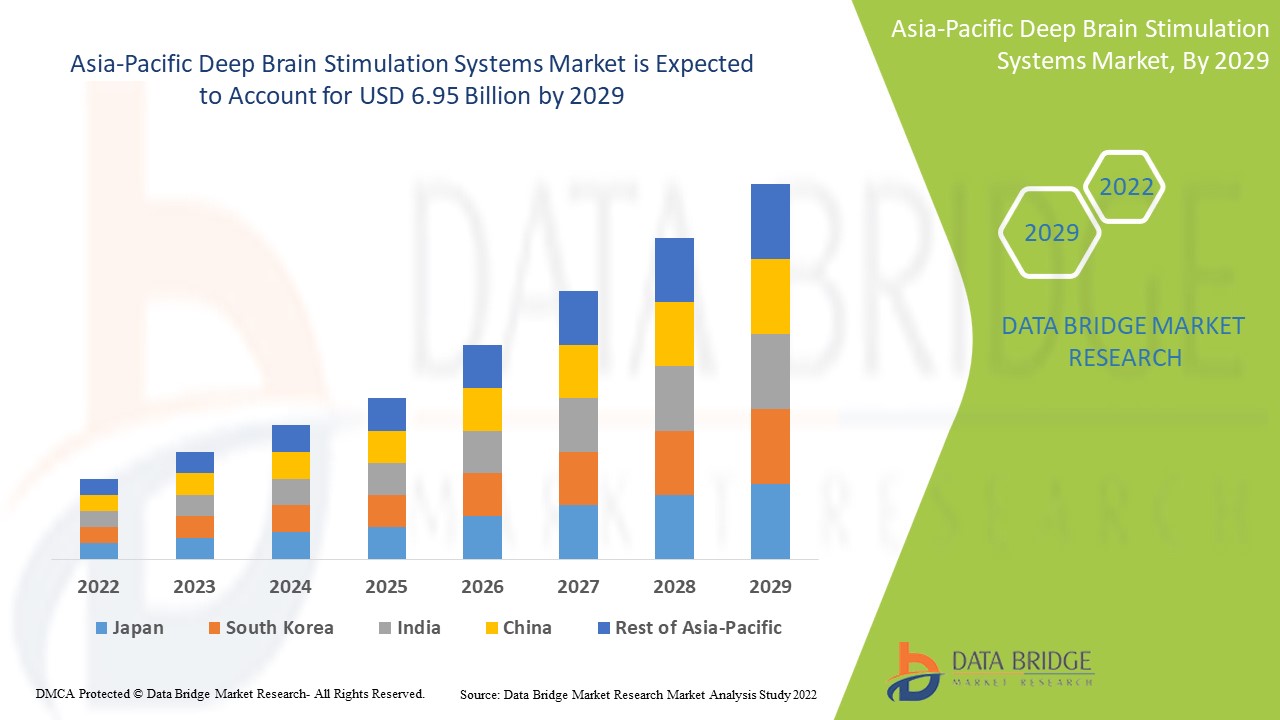
Deep Brain Stimulation Systems Market Analysis
According to the World Health Organization, neurological diseases account for 6.3 percent of the Asia-Pacific disease burden and are one of the top causes of mortality, accounting for 13.2 percent of deaths in high-income countries and 16.8 percent in low- and middle-income countries. The high mortality and sickness load increase clinical urgency for long-term treatments such as deep brain stimulators. Furthermore, as the public becomes increasingly aware of the enormous burden of neurological disease, there is a greater demand for deep brain stimulators as an alternative therapy. This is projected to propel market expansion throughout the forecast period. Deep brain stimulators are being driven by the increasing occurrence of neurological disorders such as Parkinson's disease, essential tremors, dystonia, and epilepsy.
Deep Brain Stimulation Systems Market Size
Asia-Pacific deep brain stimulation systems market size was valued at USD 2.34 billion in 2024 and is projected to reach USD 13.35 billion by 2032, with a CAGR of 24.30% during the forecast period of 2025 to 2032.
Report Scope and Market Segmentation
|
Attributes |
Deep Brain Stimulation Systems Key Market Insights |
|
Segmentation |
|
|
Countries Covered |
China, Japan, India, South Korea, Singapore, Malaysia, Australia, Thailand, Indonesia, Philippines, Rest of Asia-Pacific (APAC) in the Asia-Pacific (APAC) |
|
Key Market Players |
Boston Scientific Corporation (US), Fisher Wallace (US), SceneRay Corporation, Limited (China), Beijing PINS Medical Co., Ltd (China), ALEVA NEUROTHERAPEUTICS SA (Switzerland), MEDTRONIC (Ireland), and Abbott (US), Deep Brain Innovations, LLC (US), St. Jude Children's Research Hospital (US), Stanford Health Care (US), NeuroPace Inc. (US), Renishaw plc. (US), Functional Neuromodulation Ltd. (Canada) |
|
Market Opportunities |
|
Deep Brain Stimulation Systems Market Definition
Deep brain stimulation is a surgical procedure in which an electrical device is implanted in the brain. Electrical signals are sent from the gadget to the areas of the brain that govern movement. These devices are used to treat a variety of neurological diseases, including epilepsy, dystonia, Parkinson's disease, essential tremor, and obsessive-compulsive disorder.
Deep Brain Stimulation Systems Market Dynamics
Drivers
- Potential advantages of deep brain stimulation tools
Deep brain stimulation systems are projected to expand in popularity due to their long-term efficacy and better postoperative outcome control. Furthermore, these developments aid clinical researchers in using deep brain stimulation devices in experimental efficacy trials for the treatment of certain neurological diseases. Over the projected period, demand for deep brain stimulation devices is expected to rise due to these key causes.
- Prevalence of lifestyle diseases
One of the initial factors driving the growth of the deep brain stimulation systems market is the rise in the incidence of lifestyle disorders such as depression and chronic pain around the world.
- Rise in demand for minimal invasive surgery
The rising popularity of minimally invasive surgery among the general public, owing to benefits such as less pain and faster recovery, is propelling the industry forward.
- Occurrences of neurological disorders
The rise in neurological illnesses such as epilepsy, Parkinson's disease, Alzheimer's disease, and chronic pain is also having an impact on the market. Furthermore, severe adverse effects and medication interactions due to drug absorption by non-targeted locations are expected to drive demand for DBS devices. These medications can enhance motor function significantly, but they can also have side effects, especially as the disease advances. Constant treatment of the drug levodopa, for example, can lead to long-term problems such hallucinations, dyskinesia, neurotoxic consequences, and severe metabolic abnormalities. As a result of side effects like this, clinicians are increasingly turning to specialized therapy options, such as deep brain stimulators. As a result, market growth will be boosted during the forecast period.
Opportunities
Technical improvements in deep brain stimulation technologies are expected to propel this market forward. Robot-assisted insertion, improved microelectrode designs, multi-target stimulation, rechargeable implantable pulse generators, and tailored directed programming are among the technological advancements. As a result of these developments, DBS devices are demonstrating less side effects, increased efficacy, and symptomatic alleviation in Parkinson's patients compared to previous techniques. The Infinity Deep Brain Stimulation (DBS) System from Abbott, for example, is a highly advanced new DBS that can aid patients with their symptoms. It's the world's first wireless iOS software DBS mobile platform, allowing for more efficient and tailored therapy administration with fewer side effects.
Further advancements in fundamental neuroscience and other disciplines of research and technology are anticipated to broaden DBS' therapeutic application. DBS demonstrates an extremely obvious link between basic science, clinical research, and therapeutic practice, making it highly fascinating from both a humanitarian and a scientific standpoint. As with any new field of research, there are possible problems ahead, but DBS holds a lot of promise, and there's reason to expect that the next 50 years of progress will provide even more benefits than the prior 50.
Restraints/Challenges
Concerns about side effects such as allergic response and tingling or prickling of the skin, on the other hand, are predicted to stymie market expansion. In the forecast period of 2025-2032, other treatment options, such as medication therapy and surgeries, are expected to pose a challenge to the deep brain stimulation systems market. Financial constraints also hamper DBS research and wider clinical usage. Because the hardware and the surgery and follow-up consultations are costly, large-scale trials can be difficult to fund. Due to a lack of large-scale trial data, funding authorities are hesitant to pay for DBS, resulting in fewer patients to examine.
This cost issue is especially troublesome in underdeveloped countries, where few people can afford the hardware and treatment costs despite a high frequency of movement disorders and other illnesses that may be treated with DBS. Although the absence of surgical facilities and experience may still be a limiting factor, further development of low-cost IPGs might help alleviate this difficulty.
This deep brain stimulation systems market report provides details of new recent developments, trade regulations, import-export analysis, production analysis, value chain optimization, market share, impact of domestic and localized market players, analyses opportunities in terms of emerging revenue pockets, changes in market regulations, strategic market growth analysis, market size, category market growths, application niches and dominance, product approvals, product launches, geographic expansions, technological innovations in the market. To gain more info on the deep brain stimulation systems market contact Data Bridge Market Research for an Analyst Brief, our team will help you take an informed market decision to achieve market growth.
Deep Brain Stimulation Systems Market Scope
The deep brain stimulation systems market is segmented on the basis of product, type, application and end-user. The growth amongst these segments will help you analyze meagre growth segments in the industries and provide the users with a valuable market overview and market insights to help them make strategic decisions for identifying core market applications.
Product Type
- Single-Channel Deep Brain Stimulator
- Dual-Channel Deep Brain Stimulator
Type
- Rechargeable
- Non-Rechargeable
Applications
- Parkinson's disease
- Epilepsy
- Essential Tremor
- Dystonia
- Obsessive Compulsive Disorder
- Other Applications
End-User
- Neurological Clinics
- Ambulatory Surgical Centers
- Hospital
- Others
Deep Brain Stimulation Systems Market Regional Analysis
The deep brain stimulation systems market is analyzed and market size insights and trends are provided by country, product, type, application and end-user as referenced above.
The countries covered in the deep brain stimulation systems market report are China, Japan, India, South Korea, Singapore, Malaysia, Australia, Thailand, Indonesia, Philippines, Rest of Asia-Pacific (APAC) in the Asia-Pacific (APAC).
North America dominates the deep brain stimulation systems market because of the rise in the number of PD patients coupled with increasing government funding and initiatives within the region.
Asia-Pacific (APAC) is expected to witness substantial growth during the forecast period of 2025 to 2032 due to the increase in occurrence of neuro degenerative disorders in the region.
The country section of the report also provides individual market impacting factors and changes in regulation in the market domestically that impacts the current and future trends of the market. Data points like down-stream and upstream value chain analysis, technical trends and porter's five forces analysis, case studies are some of the pointers used to forecast the market scenario for individual countries. Also, the presence and availability of Asia-Pacific brands and their challenges faced due to large or scarce competition from local and domestic brands, impact of domestic tariffs and trade routes are considered while providing forecast analysis of the country data.
Deep Brain Stimulation Systems Market Share
The deep brain stimulation systems market competitive landscape provides details by competitor. Details included are company overview, company financials, revenue generated, market potential, investment in research and development, new market initiatives, Asia-Pacific presence, production sites and facilities, production capacities, company strengths and weaknesses, product launch, product width and breadth, application dominance. The above data points provided are only related to the companies' focus related to deep brain stimulation systems market.
Deep Brain Stimulation Systems Market Leaders Operating in the Market Are:
- Boston Scientific Corporation (US)
- Fisher Wallace (US)
- SceneRay Corporation, Limited (China)
- Beijing PINS Medical Co., Ltd (China)
- ALEVA NEUROTHERAPEUTICS SA (Switzerland)
- MEDTRONIC (Ireland)
- Abbott (US)
- Deep Brain Innovations, LLC (US)
- St. Jude Children's Research Hospital (US)
- Stanford Health Care (US)
- NeuroPace Inc. (US)
- Renishaw plc. (US)
- Functional Neuromodulation Ltd. (Canada)
Latest Developments in Deep Brain Stimulation Systems Market
- Jan-2020: The Percept PC neurostimulator from Medtronic has received the CE mark. BrainSense technology is used in this Deep Brain Stimulation (DBS) device. Patients with neurologic illnesses such as Parkinson's disease can benefit from the system's ability to detect and record brain signals while receiving treatment.
- Jan-2020: The US Food and Drug Administration (FDA) has approved Abbott Laboratories' Infinity Deep Brain Stimulation (DBS) device. This system would be employed in Parkinson's disease treatment. The technology would allow for the improvement of Parkinson's disease symptoms that are not controlled by medication by targeting a specific area of the brain known as the internal globus pallidus (GPi).
SKU-
Obtenha acesso online ao relatório sobre a primeira nuvem de inteligência de mercado do mundo

- Painel interativo de análise de dados
- Painel de análise da empresa para oportunidades de elevado potencial de crescimento
- Acesso de analista de pesquisa para personalização e customização. consultas
- Análise da concorrência com painel interativo
- Últimas notícias, atualizações e atualizações Análise de tendências
- Aproveite o poder da análise de benchmark para um rastreio abrangente da concorrência
Metodologia de Investigação
A recolha de dados e a análise do ano base são feitas através de módulos de recolha de dados com amostras grandes. A etapa inclui a obtenção de informações de mercado ou dados relacionados através de diversas fontes e estratégias. Inclui examinar e planear antecipadamente todos os dados adquiridos no passado. Da mesma forma, envolve o exame de inconsistências de informação observadas em diferentes fontes de informação. Os dados de mercado são analisados e estimados utilizando modelos estatísticos e coerentes de mercado. Além disso, a análise da quota de mercado e a análise das principais tendências são os principais fatores de sucesso no relatório de mercado. Para saber mais, solicite uma chamada de analista ou abra a sua consulta.
A principal metodologia de investigação utilizada pela equipa de investigação do DBMR é a triangulação de dados que envolve a mineração de dados, a análise do impacto das variáveis de dados no mercado e a validação primária (especialista do setor). Os modelos de dados incluem grelha de posicionamento de fornecedores, análise da linha de tempo do mercado, visão geral e guia de mercado, grelha de posicionamento da empresa, análise de patentes, análise de preços, análise da quota de mercado da empresa, normas de medição, análise global versus regional e de participação dos fornecedores. Para saber mais sobre a metodologia de investigação, faça uma consulta para falar com os nossos especialistas do setor.
Personalização disponível
A Data Bridge Market Research é líder em investigação formativa avançada. Orgulhamo-nos de servir os nossos clientes novos e existentes com dados e análises que correspondem e atendem aos seus objetivos. O relatório pode ser personalizado para incluir análise de tendências de preços de marcas-alvo, compreensão do mercado para países adicionais (solicite a lista de países), dados de resultados de ensaios clínicos, revisão de literatura, mercado remodelado e análise de base de produtos . A análise de mercado dos concorrentes-alvo pode ser analisada desde análises baseadas em tecnologia até estratégias de carteira de mercado. Podemos adicionar quantos concorrentes necessitar de dados no formato e estilo de dados que procura. A nossa equipa de analistas também pode fornecer dados em tabelas dinâmicas de ficheiros Excel em bruto (livro de factos) ou pode ajudá-lo a criar apresentações a partir dos conjuntos de dados disponíveis no relatório.











