



Asia-Pacific Food Authenticity Testing Market Segmentation, By Test Type (Mass Spectrometry, PCR (Polymerase Chain Reaction)-Based, DNA Sequencing/Barcoding, NMR Technique/Molecular Spectrometry, Immunoassay-Based/Elisa (Enzyme-Linked Immunosorbent Assay), Isotope Methods, and Next-Generation Sequencing), Category (Adulteration Tests, Organic, Allergen Testing, Meat Speciation, GMP Testing, Halal Verification, Kosher Verification, Protected Geographical Indication (PGI), Protected Denomination of Origin (PDO), False Labeling, and Others), Application (Food and Beverages) – Industry Trends and Forecast to 2032
Food Authenticity Testing Market Analysis
The Asia Pacific food authenticity testing market is experiencing significant growth due to increasing consumer demand for food safety, quality, and transparency. Key drivers include rising concerns over food fraud, contamination, and the growing trend of plant-based and organic food consumption. Testing methods like DNA barcoding, spectroscopy, and chromatography are widely used to verify food origin, ingredients, and production processes. The market is further fueled by stringent regulatory standards and the adoption of advanced technologies for more accurate and rapid testing. North America and Europe dominate the market, but the Asia-Pacific region is expected to grow significantly due to rising awareness and food safety concerns. Leading market players are focusing on innovations to enhance testing accuracy and reliability.
Food Authenticity Testing Market Size
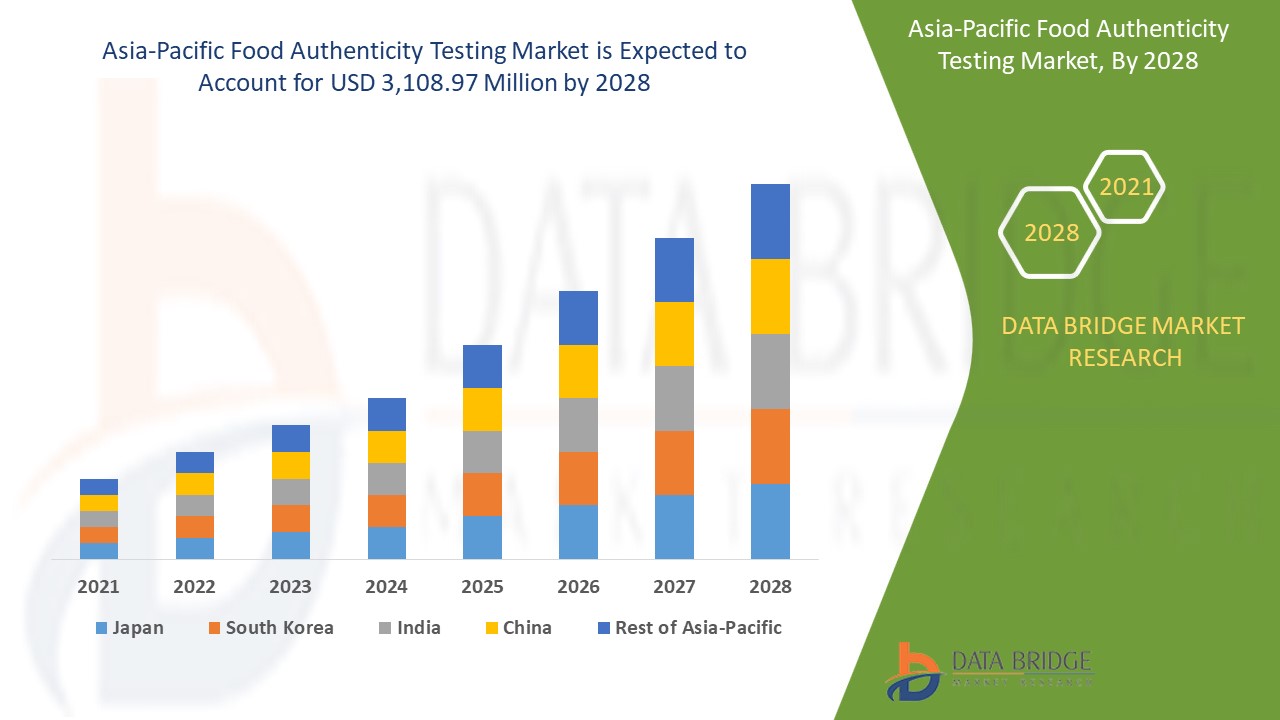
The Asia Pacific food authenticity testing market is expected to reach USD 13.45 billion by 2032 from USD 8.49 billion in 2024, growing with a substantial CAGR of 6.1% in the forecast period of 2025 to 2032. In addition to the insights on market scenarios such as market value, growth rate, segmentation, geographical coverage, and major players, the market reports curated by the Data Bridge Market Research also include import export analysis, production capacity overview, production consumption analysis, price trend analysis, climate change scenario, supply chain analysis, value chain analysis, raw material/consumables overview, vendor selection criteria, PESTLE Analysis, Porter Analysis, and regulatory framework.
Food Authenticity Testing Market Trend
“Rising Food Safety Concerns and Regulatory Pressure”
The Asia Pacific food authenticity testing market is witnessing key trends driven by rising food safety concerns and regulatory pressure. Advancements in technologies like DNA barcoding, infrared spectroscopy, and mass spectrometry are enhancing testing accuracy and speed. There is a growing demand for testing to verify organic, halal, and non-GMO claims, as consumers increasingly seek transparency. The rise of e-commerce platforms also pushes for greater authenticity verification to avoid fraud. Additionally, food fraud concerns in the meat, dairy, and olive oil sectors are spurring growth. Geographic expansion in emerging markets like Asia-Pacific is notable, as consumer awareness of food safety increases. Companies are focusing on integrated solutions and partnerships to strengthen their market positions, while regulatory bodies are tightening standards for food traceability.
Report Scope and Market Segmentation
|
Attributes |
Food authenticity testing Ingredients Key Market Insights |
|
Segments Covered |
|
|
Countries Covered |
U.S., Canada, and Mexico, Germany, U.K., France, Italy, Spain, Russia, Switzerland, Turkey, Belgium, Netherlands and Rest of Europe, China, India, Japan, South Korea, Indonesia, Thailand, Malaysia, Philippines, Singapore, Australia & New Zealand and Rest of Asia-Pacific, Brazil, Argentina, Rest of South America South Africa, Saudi Arabia, U.A.E., Egypt, Israel, and Rest of Middle East and Africa |
|
Key Market Players |
Eurofins Scientific (Luxembourg), SGS Société Générale de Surveillance SA. (Switzerland), Intertek Group plc (U.K.), Thermo Fisher Scientific Inc. (U.S.), ALS (Australia), TÜV SÜD (GERMANY), SCIEX (U.S.), Cotecna (Switzerland), Analytik Jena GmbH+Co. KG (Germany), FoodChain ID (U.S.) |
|
Market Opportunities |
|
|
Value Added Data Infosets |
In addition to the insights on market scenarios such as market value, growth rate, segmentation, geographical coverage, and major players, the market reports curated by the Data Bridge Market Research also include import export analysis, production capacity overview, production consumption analysis, price trend analysis, climate change scenario, supply chain analysis, value chain analysis, raw material/consumables overview, vendor selection criteria, PESTLE Analysis, Porter Analysis, and regulatory framework. |
Food Authenticity Testing Market Definition
The food authenticity testing ensures the authenticity, quality, and safety of food products by detecting fraud, adulteration, and mislabeling. Food authenticity testing involves methods to identify practices such as adulteration (adding unauthorized substances), substitution (replacing high-value ingredients with cheaper alternatives), and mislabeling (making false claims about origin, organic certification, or species). Key technologies employed include DNA analysis, spectroscopy, chromatography, and mass spectrometry, which are used by food manufacturers, regulatory bodies, retailers, and testing laboratories.
Food Authenticity Testing Market Dynamics
Drivers
- Increasing Instances of Food Adulteration, Counterfeiting and False Labeling
As consumers become increasingly conscious of the quality, safety, and authenticity of the food they consume, the demand for stringent testing methods has surged. Food adulteration, involving the deliberate addition of substandard or harmful substances to food products, poses significant health risks. Counterfeiting and mislabeling, on the other hand, deceive consumers regarding the origin, composition, or nutritional value of products, undermining trust in food supply chains. The Asia Pacificization of the food trade has introduced complex supply chains, making it easier for adulteration and counterfeiting to go undetected. Simultaneously, rising consumer awareness and regulatory stringency compel manufacturers to verify the authenticity of their products. For instance, rising cases of counterfeit olive oil, diluted honey, and mislabeled seafood have led to public outcry, encouraging governments and organizations to implement stricter policies and testing standards.
For instance,
In April 2021, according to an article by ResearchGate GmbH, an example of food fraud is the addition of melamine to Chinese milk products, falsely increasing their nitrogen content to mimic higher protein levels. This fraudulent act caused widespread health crises, including fatalities, underscoring the critical need for robust food authenticity systems to protect public health and ensure supply chain integrity
In December 2023, according to an article by DOAJ, the pervasive issue of food fraud Asia Pacificly was driven by increasing food demand and weak enforcement of regulations. Commonly targeted products include organic foods, seafood, supplements, and olive oil. Complex supply chains and inadequate technological tools exacerbate detection challenges. Collaborative Asia Pacific standards and interventions are recommended to combat these fraudulent activities effectively
- Growing Consumer Demand for Transparency and Clean-Label Products
Today’s consumers are more aware of what goes into their food, preferring products with simple, natural ingredients and minimal processing. Clean-label products, which exclude artificial additives, preservatives, and colors, are especially popular among health-conscious consumers who seek foods that align with their values of sustainability and authenticity. This demand for transparency is largely driven by concerns over food safety and integrity, particularly in the wake of food fraud scandals. Food fraud, where products are misrepresented, adulterated, or falsely labeled, has led to growing mistrust among consumers. For instance, various incidents such as the mislabeling of meat products, honey adulteration, and olive oil fraud have highlighted the need for reliable verification methods. As a result, food authenticity testing has become a crucial tool in ensuring that what is promised on the label matches what is inside the product. These testing methods, which include DNA testing, isotope analysis, and chemical profiling, help verify the authenticity of ingredients and confirm the legitimacy of product claims, such as "organic," "non-GMO," or "free-range."
For instance,
In October 2024, according to an article by Food Safety Works, the clean label movement in the food and beverage industry focuses on transparency and natural ingredients, with consumers favoring products free from artificial additives. This shift is prompting companies to reformulate items, often highlighting certifications such as organic or non-GMO, particularly in baby food and plant-based categories
Opportunities
- Rising Demand for Ethical Sources and Environment Friendly Products
As consumers become more conscious of the environmental and social impact of their purchasing decisions, they increasingly seek products that align with their values. This shift in consumer behavior is not limited to organic food but extends to a broader range of sustainable, ethical, and responsibly sourced goods. In the food industry, ethically sourced products are those that are produced using methods that prioritize environmental sustainability, fair labor practices, and animal welfare. As a result, consumers are demanding transparency about the origins and production processes of their food, leading to an increased emphasis on food authenticity testing. This testing ensures that food products labeled as organic, fair-trade, or environmentally friendly are genuinely produced using sustainable practices and that their claims are accurate and verifiable.
- Technological Advancements and Introduction of Portable and Real-Time Testing Devices
Technological advancements are transforming the market, with the introduction of portable and real-time testing devices offering significant opportunities. These innovations enable on-site testing, making food authenticity verification more accessible and efficient. Portable devices such as handheld spectrometers and portable DNA analyzers allow food producers, retailers, and regulators to conduct quick and reliable tests, ensuring compliance with safety standards and authenticity claims. These devices improve efficiency by reducing the need for costly laboratory tests and lengthy waiting periods. They also allow for real-time analysis, enabling quicker decision-making and reducing the risk of food fraud. As the demand for fast, accurate testing grows, these technological advancements cater to both small and large-scale operations. Moreover, these tools are becoming more affordable, enabling widespread adoption across various sectors, from food production to supply chain management.
Restraints/Challenges
- High Testing Costs
Food authenticity tests are essential for ensuring food safety, quality, and regulatory compliance, particularly in detecting fraud. However, various effective testing methods, such as DNA-based tests, isotope ratio mass spectrometry (IRMS), and chromatography, require expensive equipment and skilled technicians, making them cost-prohibitive for smaller companies or developing nations. This increases the financial burden on food manufacturers, who must balance the need for stringent testing with the high operational costs. Additionally, the complexity of food supply chains, coupled with the need for extensive testing to authenticate various products, compounds these costs. Multiple tests may be necessary for a single product to confirm its authenticity across different parameters, such as origin, composition, and processing methods. Furthermore, frequent testing, required to ensure consistent compliance with quality standards, can add up, particularly for companies managing large volumes of goods.
For instance,
In May 2023, according to an article published by Elsevier B.V., high testing costs for meat authenticity methods, such as DNA-based techniques (PCR, next-gen sequencing) and mass spectrometry, limit their widespread use. These methods often require expensive equipment, specialized expertise, and lengthy processing times, making them impractical for regular or large-scale testing. As a result, their adoption is hindered despite their effectiveness.
- Evolving Food Fraud Trends and Techniques
As food fraud becomes more sophisticated, traditional testing methods often struggle to keep up. Fraudsters employ increasingly advanced tactics to adulterate or misrepresent food products, from adding cheaper ingredients to counterfeiting premium items such as organic or specialty foods. The rise of fake organic or fair-trade claims is another example, as manufacturers seek to capitalize on consumer demand for ethical, environmentally friendly products. This undermines consumer trust and also harms legitimate businesses that adhere to regulatory standards. To combat these evolving threats, the food industry is increasingly turning to advanced testing technologies such as DNA barcoding, mass spectrometry, and blockchain-based traceability solutions. These technologies enable more accurate identification of food ingredients and sourcing, even within complex and fragmented supply chains.
Impact and Current Market Scenario of Raw Material Shortage and Shipping Delays
Data Bridge Market Research offers a high-level analysis of the market and delivers information by keeping in account the impact and current market environment of raw material shortage and shipping delays. This translates into assessing strategic possibilities, creating effective action plans, and assisting businesses in making important decisions.
Apart from the standard report, we also offer in-depth analysis of the procurement level from forecasted shipping delays, distributor mapping by region, commodity analysis, production analysis, price mapping trends, sourcing, category performance analysis, supply chain risk management solutions, advanced benchmarking, and other services for procurement and strategic support.
Expected Impact of Economic Slowdown on the Pricing and Availability of Products
When economic activity slows, industries begin to suffer. The forecasted effects of the economic downturn on the pricing and accessibility of the products are taken into account in the market insight reports and intelligence services provided by DBMR. With this, our clients can typically keep one step ahead of their competitors, project their sales and revenue, and estimate their profit and loss expenditures.
Asia Pacific Food Authenticity Testing Market Scope
The market is segmented on the basis of test type, category, and application. The growth amongst these segments will help you analyze meagre growth segments in the industries and provide the users with a valuable market overview and market insights to help them make strategic decisions for identifying core market applications.
Test Type
- Mass Spectrometry
- PCR (Polymerase Chain Reaction) Based
- DNA Sequencing/Barcoding
- NMR Technique/Molecular Spectrometry
- Immunoassay-Based/Elisa (Enzyme-Linked Immunosorbent Assay)
- Isotope Methods
- Next-Generation Sequencing
Category
- Adulteration Tests
- Organic
- Allergen Testing
- Meat Speciation
- GMP Testing
- Halal Verification
- Kosher Verification
- Protected Geographical Indication (PGI)
- Protected Denomination of Origin (PDO)
- False Labeling
- Others
Application
- Food
- Beverages
Asia Pacific Food Authenticity Testing Market Regional Analysis
The market is analyzed and market size insights and trends are provided by country, test type, category, and application as referenced above.
The countries covered in the market are U.S., Canada, and Mexico, Germany, U.K., France, Italy, Spain, Russia, Switzerland, Turkey, Belgium, Netherlands and Rest of Europe, China, India, Japan, South Korea, Indonesia, Thailand, Malaysia, Philippines, Singapore, Australia & New Zealand and Rest of Asia-Pacific, Brazil, Argentina, Rest of South America South Africa, Saudi Arabia, U.A.E., Egypt, Israel and Rest of Middle East and Africa
China is dominating and the fastest growing in the Asia-Pacific food authenticity testing market due to its strong manufacturing sector, large food production scale, and government initiatives focused on food safety. This growth is further fueled by increasing consumer demand for verified, safe, and high-quality food products.
The country section of the report also provides individual market impacting factors and changes in regulation in the market domestically that impacts the current and future trends of the market. Data points like down-stream and upstream value chain analysis, technical trends and porter's five forces analysis, case studies are some of the pointers used to forecast the market scenario for individual countries. Also, the presence and availability of Asia Pacific brands and their challenges faced due to large or scarce competition from local and domestic brands, impact of domestic tariffs and trade routes are considered while providing forecast analysis of the country data.
Asia Pacific Food Authenticity Testing Market Share
The market competitive landscape provides details by competitors. Details included are company overview, company financials, revenue generated, market potential, investment in research and development, new market initiatives, Asia Pacific presence, production sites and facilities, production capacities, company strengths and weaknesses, product launch, product width and breadth, application dominance. The above data points provided are only related to the companies' focus related to market.
Asia Pacific Food Authenticity Testing Market Leaders Operating in the Market Are:
- Eurofins Scientific (Luxembourg)
- SGS Société Générale de Surveillance SA. (Switzerland)
- Intertek Group plc (U.K.)
- Thermo Fisher Scientific Inc. (U.S.)
- ALS (Australia)
- TÜV SÜD (GERMANY)
- SCIEX (U.S.)
- Cotecna (Switzerland)
- Analytik Jena GmbH+Co. KG (Germany)
- FoodChain ID (U.S.)
Latest Developments in Asia Pacific Food Authenticity Testing Market
- In October 2024, Intertek Caleb Brett has opened a new state-of-the-art laboratory in Algeciras, Spain, enhancing services for the maritime and energy sectors. The facility specializes in fuel testing, compliance with ISO 8217, and environmental monitoring, strengthening support for international trade and regulatory compliance
- In May 2021, Thermo Fisher Scientific Inc. announced that Marc N. Casper, chairman, president, and chief executive officer, will present virtually at the BofA Securities 2021 Health Care Conference. This will help the company interact among various bioscience and healthcare professionals and conclude better resolutions and efforts towards the healthcare industry
- In April 2021, Thermo Fisher Scientific Inc. announced a definitive agreement with PPD, Inc. a leading Asia Pacific provider of clinical research services to the pharma and biotech industry. This will help the company TOprovide customers with important clinical research services and help them in new ways as they move a scientific idea to an approved medicine quickly
SKU-
Obtenha acesso online ao relatório sobre a primeira nuvem de inteligência de mercado do mundo

- Painel interativo de análise de dados
- Painel de análise da empresa para oportunidades de elevado potencial de crescimento
- Acesso de analista de pesquisa para personalização e customização. consultas
- Análise da concorrência com painel interativo
- Últimas notícias, atualizações e atualizações Análise de tendências
- Aproveite o poder da análise de benchmark para um rastreio abrangente da concorrência
Metodologia de Investigação
A recolha de dados e a análise do ano base são feitas através de módulos de recolha de dados com amostras grandes. A etapa inclui a obtenção de informações de mercado ou dados relacionados através de diversas fontes e estratégias. Inclui examinar e planear antecipadamente todos os dados adquiridos no passado. Da mesma forma, envolve o exame de inconsistências de informação observadas em diferentes fontes de informação. Os dados de mercado são analisados e estimados utilizando modelos estatísticos e coerentes de mercado. Além disso, a análise da quota de mercado e a análise das principais tendências são os principais fatores de sucesso no relatório de mercado. Para saber mais, solicite uma chamada de analista ou abra a sua consulta.
A principal metodologia de investigação utilizada pela equipa de investigação do DBMR é a triangulação de dados que envolve a mineração de dados, a análise do impacto das variáveis de dados no mercado e a validação primária (especialista do setor). Os modelos de dados incluem grelha de posicionamento de fornecedores, análise da linha de tempo do mercado, visão geral e guia de mercado, grelha de posicionamento da empresa, análise de patentes, análise de preços, análise da quota de mercado da empresa, normas de medição, análise global versus regional e de participação dos fornecedores. Para saber mais sobre a metodologia de investigação, faça uma consulta para falar com os nossos especialistas do setor.
Personalização disponível
A Data Bridge Market Research é líder em investigação formativa avançada. Orgulhamo-nos de servir os nossos clientes novos e existentes com dados e análises que correspondem e atendem aos seus objetivos. O relatório pode ser personalizado para incluir análise de tendências de preços de marcas-alvo, compreensão do mercado para países adicionais (solicite a lista de países), dados de resultados de ensaios clínicos, revisão de literatura, mercado remodelado e análise de base de produtos . A análise de mercado dos concorrentes-alvo pode ser analisada desde análises baseadas em tecnologia até estratégias de carteira de mercado. Podemos adicionar quantos concorrentes necessitar de dados no formato e estilo de dados que procura. A nossa equipa de analistas também pode fornecer dados em tabelas dinâmicas de ficheiros Excel em bruto (livro de factos) ou pode ajudá-lo a criar apresentações a partir dos conjuntos de dados disponíveis no relatório.











