


Asia-Pacific Lithium-Ion Battery Recycling Market, By Component (Active Material, Non-Active Material), Chemistry (Lithium-Nickel Manganese Cobalt (Li-NMC), Lithium Cobalt Oxide (LCO), Lithium-Manganese Oxide (LMO), Lithium-Iron Phosphate (LFP), Lithium-Nickel Cobalt Aluminium Oxide (NCA), Lithium-Titanate Oxide (LTO)), Recycling Process (Hydrometallurgical Process, Pyrometallurgy Process, Physical/ Mechanical Process) – Industry Trends and Forecast to 2029.
Market Analysis and Size
Lithium ion battery comprises of lithium ions which moves from negative electrode to the positive electrode through the electrolyte during charging and moves backwards at the time of charging. These batteries are rechargeable and commonly used in consumer electronics and automobiles. It consists of four components cathode, anode, separator and electrolyte. Anode helps in storing and releasing of lithium ions from cathode, enabling the pass of current through an external circuit. Cathode acts as a source of lithium ions which determines the capacity and average voltage of the battery. Electrolytic is basically the medium which helps in the movement of the ions. Separator basically helps in preventing the contact between the cathode and anode. Aluminium foils are used as a current collector for cathodes and copper foils are used as a current collector for anodes. The combination of all four components makes up a cell which is used to power various applications. With cluster of cells module is formed and with cluster of modules a pack is formed. Lithium ion batteries offer high energy density, voltage capacity and lower self-discharge rate than other rechargeable batteries. This makes them highly suitable for wide range of applications.
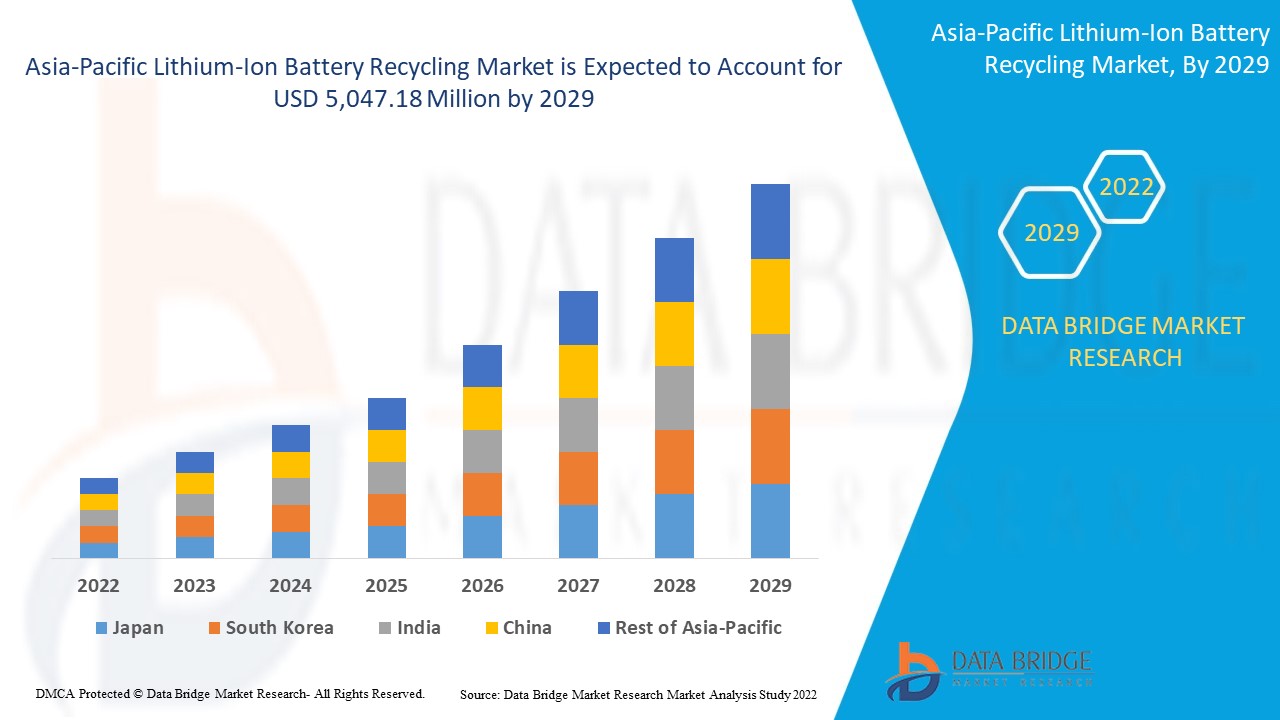
Data Bridge Market Research analyses that the Asia-Pacific lithium-ion battery recycling market is expected to reach the value of USD 5,047.18 million by 2029, at a CAGR of 22.3% during the forecast period. The lithium-ion battery recycling market report also covers pricing analysis, patent analysis, and technological advancements in depth.
|
Report Metric |
Details |
|
Forecast Period |
2022 to 2029 |
|
Base Year |
2021 |
|
Historic Years |
2020 |
|
Quantitative Units |
Revenue in USD Million, Pricing in USD |
|
Segments Covered |
By Component (Active Material, Non-Active Material), Chemistry (Lithium-Nickel Manganese Cobalt (Li-NMC), Lithium Cobalt Oxide (LCO), Lithium-Manganese Oxide (LMO), Lithium-Iron Phosphate (LFP), Lithium-Nickel Cobalt Aluminium Oxide (NCA), Lithium-Titanate Oxide (LTO)), Recycling Process (Hydrometallurgical Process, Pyrometallurgy Process, Physical/ Mechanical Process) |
|
Countries Covered |
China, Japan, India, South Korea, Singapore, Malaysia, Australia, Thailand, Indonesia, Philippines, and Rest of Asia-Pacific (APAC) |
|
Market Players Covered |
Glencore, Retriev Technologies, Umicore, TES, Fortum , Contemporary Amperex Technology Co., Limited, GEM Co., Ltd., Ganfeng Lithium Co.,Ltd., Attero, Tata Chemicals Ltd., Veolia Environnement SA, Batrec Industrie, Neometals Ltd, & Envirostream Australia Pty Ltd. |
Drivers
- Rising demand for smart phones & consumer electronics
The demands and requirements of consumer electronics have continued to increase at an exponential rate. Lithium-ion batteries are common in consumer electronics. They are one of the most popular types of rechargeable battery for portable electronics, with proper energy-to-weight ratios, high open circuit voltage and low self-discharge rate. The advancement in technologies has compacted the size of electronic devices making it slimmer and lightweight which is increasing the requirement of lithium ion battery. The lithium ion battery last longer, charge faster and have a higher power density for more battery life in a lighter package.
- Penetration of low carbon generation transportation fleet
Road transport emissions account for almost 75% of all transport GHG (greenhouse gas) emissions and 11% of global GHG emissions. Electrification is the key decarburization lever for road transport. In contrast, Electric vehicle currently emits 30-60% fewer emissions than combustion engines depending on the power mix. Without action, global road transport emissions would continue to grow as a result of increased transport needs supplied by fossil fuels. However, electrification helps to reduce CO2 emissions and improve air quality by avoiding mixing of toxic gases. To mitigate climate change and create a fossil fuel-free economy, the global community has agreed that GHG emissions must be reduced rapidly and significantly. Li-ion batteries are thus considered as the promising clean technology to replace the conventional fossil-fuel powered device. Compared to the other high-quality rechargeable battery technologies, Li-ion batteries have highest energy densities of any battery technology today (100-265 Wh/kg or 250-670 Wh/L). Li-ion batteries are also used to power electrical systems for some aerospace applications, being environmental friendly & lightweight is the major factor among others.
Opportunities
- Growing number of R&D initiatives and government facilities for recycling
Lithium ion batteries have wide range of application and with more efforts put in through research and development, more advance characteristics are being developed. Companies are building new manufacturing facilities for fulfilling the surging demands of lithium ion batteries in application for electrical vehicles, medical devices and data communication. The new facilities and growing research and development is creating new opportunity for growth of global lithium ion battery market.
Restraints/Challenges
- Safety issues related to the storage and transportation of spent batteries
Lithium ions are widely used in various applications such as consumer electronics, industrial applications, medical devices and in automobiles. Lithium ion batteries are light weight and are now designed to be flexible in nature with variable shapes. However, lithium ion batteries can be extremely dangerous if defective or overcharged, packaged incorrectly, misused or mishandled. Lithium is highly reactive and flammable and can therefore cause severe damage to life and property. These characteristics can cause harm during storage, usage and transportation of lithium ion.
- Issues related to overheating of lithium-ion battery
Despite their technological promise, Li-ion batteries still have a number of shortcomings, particularly with regards to safety. Li-ion batteries have a tendency to overheat, and can be damaged at high voltages. In some cases, this can lead to thermal runaway and combustion. These batteries require safety mechanisms to limit voltage and internal pressures, which can increase weight and limit performance in some cases. Li-ion batteries are also subject to aging, meaning that they can lose capacity and frequently fail after a number of years. Another factor limiting their widespread adoption is their cost, which is around 40% higher than Ni-Cd.
Post COVID-19 Impact on Lithium-Ion Battery Recycling Market
COVID-19 created a major impact on the lithium-ion battery recycling market as almost every country has opted for the shutdown for every production facility except the ones dealing in producing the essential goods.
Post pandemic, the growth of the lithium-ion battery recycling market is attributed to the increasing adoption of electrification of automotive industry across all regions and countries. Although automotive industry faced major issues during pandemic, the electric vehicle sales jumped to higher levels in post pandemic scenario. Also demand for consumer battery operated electronics has increased over the period of time which is acting as a driver for this market’s growth.
Manufacturers are making various strategic decisions to bounce back post-COVID-19. The players are conducting multiple research and development activities to improve the technology involved in the lithium-ion battery recycling. With this, the companies will bring advanced technologies to the market. In addition, government initiatives for usage of electric vehicle has led to the market's growth
Recent Development
- In May 2020, Neometals Ltd. collaborated with Indian power trading company Manikaran Power Limited (MPL) for a jointly financed AACE Class 3 Feasibility Study to evaluate lithium refinery located in India. Neometals is planning to invest in 50:50 joint venture with MPL to develop the lithium refinery after assessment results. This will help the company to expand their footprint in Indian market.
- In December 2021, Envirostream Australia Pty Ltd received approval from the city council for the establishment of their second and larger recycling plant setup for used or waste batteries in Melbourne, Victoria. This will help the company to fulfill its goal of keeping batteries out of landfills and recycling them across Australia.
Asia-Pacific Lithium-Ion Battery Recycling Market Scope
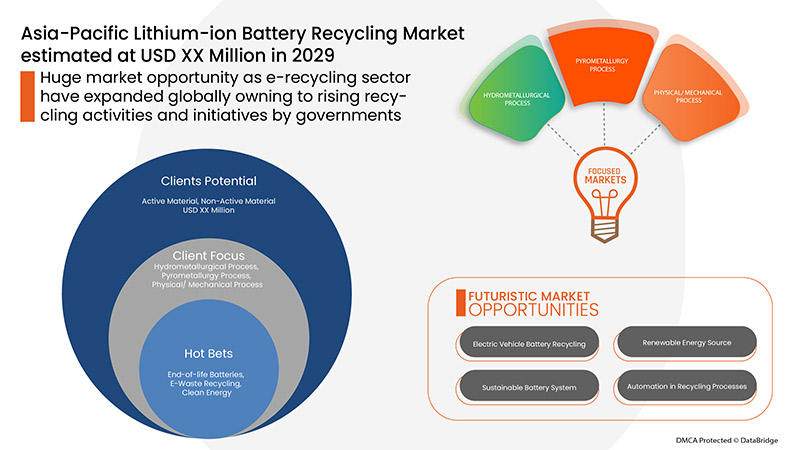
The lithium-ion battery recycling market is segmented on the basis of component, chemistry, and recycling process. The growth amongst these segments will help you analyze meagre growth segments in the industries and provide the users with a valuable market overview and market insights to help them make strategic decisions for identifying core market applications.
Component
- Active Material
- Non-Active Material
On the basis of component, the lithium-ion battery recycling market is segmented into active material and non-active material.
Chemistry
- Lithium-Nickel Manganese Cobalt (Li-NMC)
- Lithium Cobalt Oxide (LCO)
- Lithium-Manganese Oxide (LMO)
- Lithium-Iron Phosphate (LFP)
- Lithium-Nickel Cobalt Aluminium Oxide (NCA)
- Lithium-Titanate Oxide (LTO)
On the basis of chemistry, the lithium-ion battery recycling market has been segmented into below lithium-nickel manganese cobalt (Li-NMC), lithium cobalt oxide (LCO), lithium-manganese oxide (LMO), lithium-iron phosphate (LFP), lithium-nickel cobalt aluminium oxide (NCA), lithium-titanate oxide (LTO).
Recycling process
- Hydrometallurgical Process
- Pyrometallurgy Process
- Physical/ Mechanical Process
On the basis of recycling process, the lithium-ion battery recycling market has been segmented into hydrometallurgical process, pyrometallurgy process, physical/ mechanical process.
Lithium-Ion Battery Recycling Market Regional Analysis/Insights
The lithium-ion battery recycling market is analysed and market size insights and trends are provided by country, component, recycling process and chemistry as referenced above.
The countries covered in the lithium-ion battery recycling market report are China, Japan, India, South Korea, Singapore, Malaysia, Australia, Thailand, Indonesia, Philippines, and Rest of Asia-Pacific (APAC).
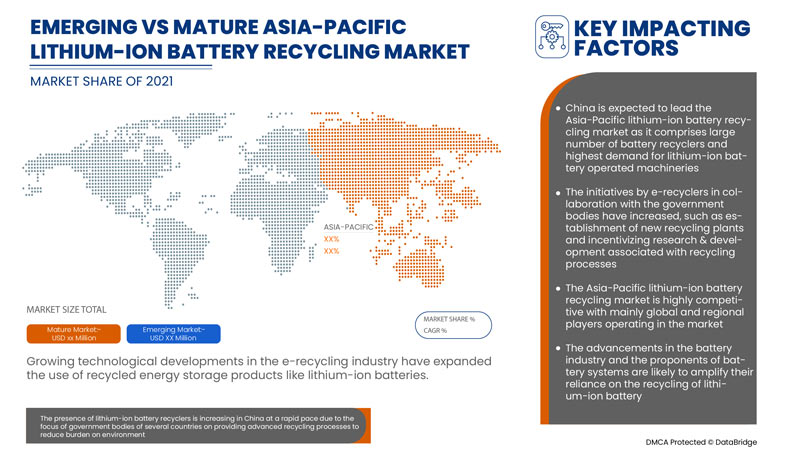
China dominates the Asia-Pacific lithium-ion battery recycling market. China is likely to be the fastest-growing Asia-Pacific lithium-ion battery recycling market. The major reason behind this is increasing adoption of battery recycling and clean energy initiatives from China government.
The country section of the report also provides individual market impacting factors and changes in market regulation that impact the current and future trends of the market. Data points like down-stream and upstream value chain analysis, technical trends and porter's five forces analysis, case studies are some of the pointers used to forecast the market scenario for individual countries. Also, the presence and availability of Asia-Pacific brands and their challenges faced due to large or scarce competition from local and domestic brands, impact of domestic tariffs and trade routes are considered while providing forecast analysis of the country data.
Competitive Landscape and Lithium-Ion Battery Recycling Market Share Analysis
The lithium-ion battery recycling market competitive landscape provides details by competitor. Details included are company overview, company financials, revenue generated, market potential, investment in research and development, new market initiatives, Asia-Pacific presence, production sites and facilities, production capacities, company strengths and weaknesses, product launch, product width and breadth, application dominance. The above data points provided are only related to the companies' focus related to lithium-ion battery recycling market.
Some of the major players operating in the lithium-ion battery recycling market are Glencore, Retriev Technologies, Umicore, TES, Fortum , Contemporary Amperex Technology Co., Limited, GEM Co., Ltd., Ganfeng Lithium Co.,Ltd., Attero, Tata Chemicals Ltd., Veolia Environnement SA, Batrec Industrie, Neometals Ltd, & Envirostream Australia Pty Ltd.
SKU-
Obtenha acesso online ao relatório sobre a primeira nuvem de inteligência de mercado do mundo

- Painel interativo de análise de dados
- Painel de análise da empresa para oportunidades de elevado potencial de crescimento
- Acesso de analista de pesquisa para personalização e customização. consultas
- Análise da concorrência com painel interativo
- Últimas notícias, atualizações e atualizações Análise de tendências
- Aproveite o poder da análise de benchmark para um rastreio abrangente da concorrência
Índice
1 INTRODUÇÃO
1.1 OBJETIVOS DO ESTUDO
1.2 DEFINIÇÃO DE MERCADO
1.3 VISÃO GERAL DO MERCADO DE RECICLAGEM DE BATERIAS DE ÍON-LÍTIO DA ÁSIA-PACÍFICO
1.4 MOEDA E PREÇOS
1.5 LIMITAÇÕES
1.6 MERCADOS COBERTOS
2 SEGMENTAÇÃO DE MERCADO
2.1 MERCADOS COBERTOS
2.2 ÂMBITO GEOGRÁFICO
2,3 ANOS CONSIDERADOS PARA O ESTUDO
2.4 MODELO DE VALIDAÇÃO DE DADOS TRIPÉ DBMR
2.5 ENTREVISTAS PRINCIPAIS COM PRINCIPAIS LÍDERES DE OPINIÃO
2.6 GRADE DE POSIÇÃO DE MERCADO DBMR
2.7 ANÁLISE DA PARTICIPAÇÃO DO FORNECEDOR
2.8 MODELAGEM MULTIVARIADA
2.9 CURVA DE LINHA DO TEMPO DOS COMPONENTES
2.1 MATRIZ DE DESAFIOS DE MERCADO
2.11 FONTES SECUNDÁRIAS
2.12 PREMISSAS
3 RESUMO EXECUTIVO
4 INSIGHTS PREMIUM
4.1 PERSPECTIVAS DE FABRICAÇÃO
4.2 AVANÇO TECNOLÓGICO DOS FABRICANTES
4.3 AS CINCO FORÇAS DE PORTER
4.4 CRITÉRIOS DE SELEÇÃO DE FORNECEDORES
4.5 ANÁLISE PESTEL
4.6 ANÁLISE DA CADEIA DE SUPRIMENTOS
4.6.1 VISÃO GERAL
4.6.2 CENÁRIO DE CUSTOS LOGÍSTICOS
4.6.3 IMPORTÂNCIA DOS PRESTADORES DE SERVIÇOS LOGÍSTICOS
4.7 CENÁRIO DE MUDANÇAS CLIMÁTICAS
4.7.1 PREOCUPAÇÕES AMBIENTAIS
4.7.2 RESPOSTA DA INDÚSTRIA
4.7.3 PAPEL DO GOVERNO
4.7.4 RECOMENDAÇÃO DO ANALISTA
5 COBERTURA REGULAMENTAR
6 VISÃO GERAL DO MERCADO
6.1 MOTORISTAS
6.1.1 CRESCENTE DEMANDA POR SMARTPHONES E ELETRÔNICOS DE CONSUMO
6.1.2 PENETRAÇÃO DA FROTA DE TRANSPORTE DE BAIXA GERAÇÃO DE CARBONO
6.1.3 AUMENTO DA DEMANDA POR BATERIAS DE ÍON-LÍTIO PARA DIVERSAS APLICAÇÕES INDUSTRIAIS
6.1.4 AUMENTO DO NÚMERO DE VEÍCULOS ELÉTRICOS NA REGIÃO
6.1.5 AUMENTO DA ADOÇÃO DE BATERIAS DE ÍON-LÍTIO NO SETOR DE DEFESA
6.2 RESTRIÇÕES
6.2.1 QUESTÕES DE SEGURANÇA RELACIONADAS AO ARMAZENAMENTO E TRANSPORTE DE PILHAS USADAS
6.2.2 REGULAMENTOS E POLÍTICAS GOVERNAMENTAIS RIGOROSAS PARA RECICLAGEM DE BATERIA DE ÍON-LÍTIO
6.3 OPORTUNIDADES
6.3.1 NÚMERO CRESCENTE DE INICIATIVAS DE P&D E INSTALAÇÕES GOVERNAMENTAIS PARA RECICLAGEM
6.3.2 AUMENTO NAS AQUISIÇÕES E PARCERIAS ENTRE DIVERSAS ORGANIZAÇÕES
6.3.3 AUMENTO DO CRESCIMENTO DAS ENERGIAS RENOVÁVEIS NA REGIÃO
6.3.4 MAIOR ADOÇÃO DE FERRAMENTAS ELÉTRICAS SEM FIO
6.4 DESAFIOS
6.4.1 PROBLEMAS RELACIONADOS AO SUPERAQUECIMENTO DA BATERIA DE ÍONS DE LÍTIO
6.4.2 MAIOR TAXA DE DEGRADAÇÃO DA BATERIA DE ÍON-LÍTIO
7 MERCADO DE RECICLAGEM DE BATERIAS DE ÍON-LÍTIO DA ÁSIA-PACÍFICO, POR COMPONENTE
7.1 VISÃO GERAL
7.2 MATERIAL ATIVO
7.3 MATERIAL NÃO ATIVO
8 MERCADO DE RECICLAGEM DE BATERIAS DE ÍON-LÍTIO DA ÁSIA-PACÍFICO, POR QUÍMICA
8.1 VISÃO GERAL
8.2 LÍTIO-NÍQUEL MANGANÊS COBALTO (LI-NMC)
8.3 ÓXIDO DE LÍTIO E COBALTO (LCO)
8.4 ÓXIDO DE LÍTIO-MANGANÊS (LMO)
8.5 FOSFATO DE LÍTIO-FERRO (LFP)
8.6 ÓXIDO DE ALUMÍNIO E LÍTIO-NÍQUEL-COBALTO (NCA)
8.7 ÓXIDO DE TITANATO DE LÍTIO (LTO)
9 MERCADO DE RECICLAGEM DE BATERIAS DE ÍON-LÍTIO DA ÁSIA-PACÍFICO, POR PROCESSO DE RECICLAGEM
9.1 VISÃO GERAL
9.2 PROCESSO HIDROMETALURGICO
9.3 PROCESSO DE PIROMETALURGIA
9.4 PROCESSO FÍSICO/MECÂNICO
10 MERCADO DE RECICLAGEM DE BATERIAS DE ÍON-LÍTIO DA ÁSIA-PACÍFICO, POR REGIÃO
10.1 ÁSIA-PACÍFICO
10.1.1 CHINA
10.1.2 JAPÃO
10.1.3 COREIA DO SUL
10.1.4 ÍNDIA
10.1.5 AUSTRÁLIA
10.1.6 SINGAPURA
10.1.7 TAILÂNDIA
10.1.8 MALÁSIA
10.1.9 INDONÉSIA
10.1.10 FILIPINAS
10.1.11 RESTANTE DA ÁSIA-PACÍFICO
11 MERCADO DE RECICLAGEM DE BATERIAS DE ÍON-LÍTIO DA ÁSIA-PACÍFICO: CENÁRIO DA EMPRESA
11.1 ANÁLISE DE AÇÕES DA EMPRESA: ÁSIA-PACÍFICO
12 ANÁLISE SWOT
13 PERFIL DA EMPRESA
13.1 GLENCORE
13.1.1 RESUMO DA EMPRESA
13.1.2 ANÁLISE DE RECEITA
13.1.3 ANÁLISE DAS AÇÕES DA EMPRESA
13.1.4 PORTFÓLIO DE PRODUTOS
13.1.5 DESENVOLVIMENTO RECENTE
13.2 CONTEMPORÂNEA AMPEREX TECHNOLOGY CO., LIMITADA
13.2.1 RESUMO DA EMPRESA
13.2.2 ANÁLISE DE RECEITA
13.2.3 ANÁLISE DAS AÇÕES DA EMPRESA
13.2.4 CATEGORIAS DE SOLUÇÃO
13.2.5 DESENVOLVIMENTO RECENTE
13.3 UMICORE
13.3.1 RESUMO DA EMPRESA
13.3.2 ANÁLISE DE RECEITA
13.3.3 ANÁLISE DE AÇÕES DA EMPRESA
13.3.4 PACOTE DE PRODUTOS
13.3.5 DESENVOLVIMENTO RECENTE
13.4 GEM CO., LTD.
13.4.1 RESUMO DA EMPRESA
13.4.2 ANÁLISE DE RECEITA
13.4.3 ANÁLISE DAS AÇÕES DA EMPRESA
13.4.4 PORTFÓLIO DE PRODUTOS
13.4.5 DESENVOLVIMENTO RECENTE
13,5 VEOLIA
13.5.1 RESUMO DA EMPRESA
13.5.2 ANÁLISE DE RECEITA
13.5.3 ANÁLISE DAS AÇÕES DA EMPRESA
13.5.4 PORTFÓLIO DE PRODUTOS
13.5.5 DESENVOLVIMENTOS RECENTES
13.6 ACCUREC-RECICLAGEM GMBH
13.6.1 RESUMO DA EMPRESA
13.6.2 PORTFÓLIO DE PRODUTOS
13.6.3 DESENVOLVIMENTO RECENTE
13.7 AKKUSER OY
13.7.1 RESUMO DA EMPRESA
13.7.2 PORTFÓLIO DE SERVIÇOS
13.7.3 DESENVOLVIMENTO RECENTE
13.8 AMERICAN MANGANESE INC.
13.8.1 RESUMO DA EMPRESA
13.8.2 PORTFÓLIO DE PRODUTOS
13.8.3 DESENVOLVIMENTO RECENTE
13.9 ATTERO RECICLAGEM PVT. LTD.
13.9.1 RESUMO DA EMPRESA
13.9.2 PORTFÓLIO DE PRODUTOS
13.9.3 DESENVOLVIMENTO RECENTE
13.1 INDÚSTRIA BATREC
13.10.1 RESUMO DA EMPRESA
13.10.2 PORTFÓLIO DE PRODUTOS
13.10.3 DESENVOLVIMENTO RECENTE
13.11 CAWLEYS
13.11.1 RESUMO DA EMPRESA
13.11.2 PORTFÓLIO DE SERVIÇOS
13.11.3 DESENVOLVIMENTOS RECENTES
13.12 DUESENFELD GMBH
13.12.1 RESUMO DA EMPRESA
13.12.2 PORTFÓLIO DE PRODUTOS
13.12.3 DESENVOLVIMENTO RECENTE
13.13 ECOBAT
13.13.1 RESUMO DA EMPRESA
13.13.2 PORTFÓLIO DE PRODUTOS
13.13.3 DESENVOLVIMENTO RECENTE
13.14 ENVIROSTREAM AUSTRÁLIA PTY LTD
13.14.1 RESUMO DA EMPRESA
13.14.2 PORTFÓLIO DE SERVIÇOS
13.14.3 DESENVOLVIMENTOS RECENTES
13.15 FORTUM
13.15.1 RESUMO DA EMPRESA
13.15.2 ANÁLISE DE RECEITA
13.15.3 PORTFÓLIO DE PRODUTOS
13.15.4 DESENVOLVIMENTO RECENTE
13.16 GANFENG LÍTIO CO., LTD
13.16.1 RESUMO DA EMPRESA
13.16.2 ANÁLISE DE RECEITA
13.16.3 PORTFÓLIO DE PRODUTOS
13.16.4 DESENVOLVIMENTO RECENTE
13.17 LI-CYCLE CORP
13.17.1 RESUMO DA EMPRESA
13.17.2 ANÁLISE DE RECEITA
13.17.3 PORTFÓLIO DE SERVIÇOS
13.17.4 DESENVOLVIMENTO RECENTE
13.18 RECICLAGEM DE LÍTIOS
13.18.1 RESUMO DA EMPRESA
13.18.2 PORTFÓLIO DE PRODUTOS
13.18.3 DESENVOLVIMENTOS RECENTES
13.19 NEOMETALS LTD
13.19.1 RESUMO DA EMPRESA
13.19.2 ANÁLISE DE RECEITA
13.19.3 PORTFÓLIO DE PRODUTOS
13.19.4 DESENVOLVIMENTO RECENTE
13.2 NICKELHÜTTE AUE GMBH
13.20.1 RESUMO DA EMPRESA
13.20.2 PORTFÓLIO DE PRODUTOS
13.20.3 DESENVOLVIMENTOS RECENTES
13.21 ONTO TECHNOLOGY LLC
13.21.1 RESUMO DA EMPRESA
13.21.2 PORTFÓLIO DE SERVIÇOS
13.21.3 DESENVOLVIMENTOS RECENTES
13.22 REDWOOD MATERIALS, INC.,
13.22.1 RESUMO DA EMPRESA
13.22.2 PORTFÓLIO DE SERVIÇOS
13.22.3 DESENVOLVIMENTO RECENTE
13.23 TECNOLOGIAS DE RECUPERAÇÃO
13.23.1 RESUMO DA EMPRESA
13.23.2 PORTFÓLIO DE PRODUTOS
13.23.3 DESENVOLVIMENTOS RECENTES
13.24 SAUBERMACHER DIENSTLEISTUNGS AG
13.24.1 RESUMO DA EMPRESA
13.24.2 PORTFÓLIO DE PRODUTOS
13.24.3 DESENVOLVIMENTO RECENTE
13.25 TATA CHEMICALS LTD.
13.25.1 RESUMO DA EMPRESA
13.25.2 ANÁLISE DE RECEITA
13.25.3 PORTFÓLIO DE PRODUTOS
13.25.4 DESENVOLVIMENTO RECENTE
13,26 TES
13.26.1 RESUMO DA EMPRESA
13.26.2 PORTFÓLIO DE PRODUTOS
13.26.3 DESENVOLVIMENTO RECENTE
14 QUESTIONÁRIO
15 RELATÓRIOS RELACIONADOS
Lista de Tabela
TABELA 1 LISTA DAS EMPRESAS COM SEU PROCESSO DE RECICLAGEM E CAPACIDADE APROXIMADA
TABELA 2 NORMAS RELACIONADAS ÀS BATERIAS DE ÍON-LÍTIO
TABELA 3 POLÍTICAS RELEVANTES PARA A RECICLAGEM LIB PUBLICADAS NA CHINA
TABELA 4 MERCADO DE RECICLAGEM DE BATERIAS DE ÍON-LÍTIO DA ÁSIA-PACÍFICO, POR COMPONENTE, 2020-2029 (US$ MILHÕES)
TABELA 5 MATERIAL ATIVO DA ÁSIA-PACÍFICO NO MERCADO DE RECICLAGEM DE BATERIAS DE ÍON-LÍTIO, POR REGIÃO, 2020-2029 (US$ MILHÕES)
TABELA 6 MATERIAL NÃO ATIVO NO MERCADO DE RECICLAGEM DE BATERIAS DE ÍON-LÍTIO DA ÁSIA-PACÍFICO, POR REGIÃO, 2020-2029 (US$ MILHÕES)
TABELA 7 MERCADO DE RECICLAGEM DE BATERIAS DE ÍON-LÍTIO DA ÁSIA-PACÍFICO, POR PRODUTO QUÍMICO, 2020-2029 (US$ MILHÕES)
TABELA 8 LÍTIO-NÍQUEL MANGANÊS COBALTO (LI-NMC) DA ÁSIA-PACÍFICO NO MERCADO DE RECICLAGEM DE BATERIAS DE ÍON-LÍTIO, POR REGIÃO, 2020-2029 (US$ MILHÕES)
TABELA 9 ÓXIDO DE LÍTIO E COBALTO (LCO) NA ÁSIA-PACÍFICO NO MERCADO DE RECICLAGEM DE BATERIAS DE ÍON-LÍTIO, POR REGIÃO, 2020-2029 (US$ MILHÕES)
TABELA 10 ÓXIDO DE LÍTIO-MANGANÊS (LMO) NA ÁSIA-PACÍFICO NO MERCADO DE RECICLAGEM DE BATERIAS DE ÍON-LÍTIO, POR REGIÃO, 2020-2029 (US$ MILHÕES)
TABELA 11 FOSFATO DE LÍTIO-FERRO (LFP) DA ÁSIA-PACÍFICO NO MERCADO DE RECICLAGEM DE BATERIAS DE ÍON-LÍTIO, POR REGIÃO, 2020-2029 (US$ MILHÕES)
TABELA 12 ÓXIDO DE ALUMÍNIO-LÍTIO-NÍQUEL-COBALTO (NCA) DA ÁSIA-PACÍFICO NO MERCADO DE RECICLAGEM DE BATERIAS DE ÍON-LÍTIO, POR REGIÃO, 2020-2029 (US$ MILHÕES)
TABELA 13 ÓXIDO DE TITANATO DE LÍTIO (LTO) NA ÁSIA-PACÍFICO NO MERCADO DE RECICLAGEM DE BATERIAS DE ÍON-LÍTIO, POR REGIÃO, 2020-2029 (US$ MILHÕES)
TABELA 14 MERCADO DE RECICLAGEM DE BATERIAS DE ÍON-LÍTIO DA ÁSIA-PACÍFICO, POR PROCESSO DE RECICLAGEM, 2020-2029 (US$ MILHÕES)
TABELA 15 PROCESSO HIDROMETALURGICO DA ÁSIA-PACÍFICO NO MERCADO DE RECICLAGEM DE BATERIAS DE ÍON-LÍTIO, POR REGIÃO, 2020-2029 (US$ MILHÕES)
TABELA 16 PROCESSO DE PIROMETALURGIA DA ÁSIA-PACÍFICO NO MERCADO DE RECICLAGEM DE BATERIAS DE ÍON-LÍTIO, POR REGIÃO, 2020-2029 (US$ MILHÕES)
TABELA 17 PROCESSO FÍSICO/MECÂNICO DA ÁSIA-PACÍFICO NO MERCADO DE RECICLAGEM DE BATERIAS DE ÍON-LÍTIO, POR REGIÃO, 2020-2029 (US$ MILHÕES)
TABELA 18 MERCADO DE RECICLAGEM DE BATERIAS DE ÍON-LÍTIO DA ÁSIA-PACÍFICO, POR PAÍS, 2020-2029 (US$ MILHÕES)
TABELA 19 MERCADO DE RECICLAGEM DE BATERIAS DE ÍON-LÍTIO DA ÁSIA-PACÍFICO, POR COMPONENTE, 2020-2029 (US$ MILHÕES)
TABELA 20 MERCADO DE RECICLAGEM DE BATERIAS DE ÍON-LÍTIO NA ÁSIA-PACÍFICO, POR PRODUTO QUÍMICO, 2020-2029 (US$ MILHÕES)
TABELA 21 MERCADO DE RECICLAGEM DE BATERIAS DE ÍON-LÍTIO DA ÁSIA-PACÍFICO, POR PROCESSO DE RECICLAGEM, 2020-2029 (US$ MILHÕES)
TABELA 22 MERCADO DE RECICLAGEM DE BATERIAS DE ÍON-LÍTIO DA CHINA, POR COMPONENTE, 2020-2029 (US$ MILHÕES)
TABELA 23 MERCADO DE RECICLAGEM DE BATERIAS DE ÍON-LÍTIO DA CHINA, POR QUÍMICA, 2020-2029 (US$ MILHÕES)
TABELA 24 MERCADO DE RECICLAGEM DE BATERIAS DE ÍON-LÍTIO DA CHINA, POR PROCESSO DE RECICLAGEM, 2020-2029 (US$ MILHÕES)
TABELA 25 MERCADO DE RECICLAGEM DE BATERIAS DE ÍON-LÍTIO DO JAPÃO, POR COMPONENTE, 2020-2029 (US$ MILHÕES)
TABELA 26 MERCADO DE RECICLAGEM DE BATERIAS DE ÍON-LÍTIO DO JAPÃO, POR QUÍMICA, 2020-2029 (US$ MILHÕES)
TABELA 27 MERCADO DE RECICLAGEM DE BATERIAS DE ÍON-LÍTIO NO JAPÃO, POR PROCESSO DE RECICLAGEM, 2020-2029 (US$ MILHÕES)
TABELA 28 MERCADO DE RECICLAGEM DE BATERIAS DE ÍON-LÍTIO DA COREIA DO SUL, POR COMPONENTE, 2020-2029 (US$ MILHÕES)
TABELA 29 MERCADO DE RECICLAGEM DE BATERIAS DE ÍON-LÍTIO DA COREIA DO SUL, POR PRODUTO QUÍMICO, 2020-2029 (US$ MILHÕES)
TABELA 30 MERCADO DE RECICLAGEM DE BATERIAS DE ÍON-LÍTIO DA COREIA DO SUL, POR PROCESSO DE RECICLAGEM, 2020-2029 (US$ MILHÕES)
TABELA 31 MERCADO DE RECICLAGEM DE BATERIAS DE ÍON-LÍTIO DA ÍNDIA, POR COMPONENTE, 2020-2029 (US$ MILHÕES)
TABELA 32 MERCADO DE RECICLAGEM DE BATERIAS DE ÍON-LÍTIO DA ÍNDIA, POR PRODUTO QUÍMICO, 2020-2029 (US$ MILHÕES)
TABELA 33 MERCADO DE RECICLAGEM DE BATERIAS DE ÍON-LÍTIO DA ÍNDIA, POR PROCESSO DE RECICLAGEM, 2020-2029 (US$ MILHÕES)
TABELA 34 MERCADO DE RECICLAGEM DE BATERIAS DE ÍON-LÍTIO DA AUSTRÁLIA, POR COMPONENTE, 2020-2029 (US$ MILHÕES)
TABELA 35 MERCADO DE RECICLAGEM DE BATERIAS DE ÍON-LÍTIO DA AUSTRÁLIA, POR PRODUTO QUÍMICO, 2020-2029 (US$ MILHÕES)
TABELA 36 MERCADO AUSTRÁLIA DE RECICLAGEM DE BATERIAS DE ÍON-LÍTIO, POR PROCESSO DE RECICLAGEM, 2020-2029 (US$ MILHÕES)
TABELA 37 MERCADO DE RECICLAGEM DE BATERIAS DE ÍON-LÍTIO DE SINGAPURA, POR COMPONENTE, 2020-2029 (US$ MILHÕES)
TABELA 38 MERCADO DE RECICLAGEM DE BATERIAS DE ÍON-LÍTIO DE SINGAPURA, POR QUÍMICA, 2020-2029 (US$ MILHÕES)
TABELA 39 MERCADO DE RECICLAGEM DE BATERIAS DE ÍON-LÍTIO DE SINGAPURA, POR PROCESSO DE RECICLAGEM, 2020-2029 (US$ MILHÕES)
TABELA 40 MERCADO DE RECICLAGEM DE BATERIAS DE ÍON-LÍTIO DA TAILÂNDIA, POR COMPONENTE, 2020-2029 (US$ MILHÕES)
TABELA 41 MERCADO DE RECICLAGEM DE BATERIAS DE ÍON-LÍTIO DA TAILÂNDIA, POR QUÍMICA, 2020-2029 (US$ MILHÕES)
TABELA 42 MERCADO DE RECICLAGEM DE BATERIAS DE ÍON-LÍTIO DA TAILÂNDIA, POR PROCESSO DE RECICLAGEM, 2020-2029 (US$ MILHÕES)
TABELA 43 MERCADO DE RECICLAGEM DE BATERIAS DE ÍON-LÍTIO DA MALÁSIA, POR COMPONENTE, 2020-2029 (US$ MILHÕES)
TABELA 44 MERCADO DE RECICLAGEM DE BATERIAS DE ÍON-LÍTIO DA MALÁSIA, POR QUÍMICA, 2020-2029 (US$ MILHÕES)
TABELA 45 MERCADO DE RECICLAGEM DE BATERIAS DE ÍON-LÍTIO DA MALÁSIA, POR PROCESSO DE RECICLAGEM, 2020-2029 (US$ MILHÕES)
TABELA 46 MERCADO DE RECICLAGEM DE BATERIAS DE ÍON-LÍTIO DA INDONÉSIA, POR COMPONENTE, 2020-2029 (US$ MILHÕES)
TABELA 47 MERCADO DE RECICLAGEM DE BATERIAS DE ÍON-LÍTIO DA INDONÉSIA, POR QUÍMICA, 2020-2029 (US$ MILHÕES)
TABELA 48 MERCADO DE RECICLAGEM DE BATERIAS DE ÍON-LÍTIO DA INDONÉSIA, POR PROCESSO DE RECICLAGEM, 2020-2029 (US$ MILHÕES)
TABELA 49 MERCADO DE RECICLAGEM DE BATERIAS DE ÍON-LÍTIO NAS FILIPINAS, POR COMPONENTE, 2020-2029 (US$ MILHÕES)
TABELA 50 MERCADO DE RECICLAGEM DE BATERIAS DE ÍON-LÍTIO NAS FILIPINAS, POR PRODUTO QUÍMICO, 2020-2029 (US$ MILHÕES)
TABELA 51 MERCADO DE RECICLAGEM DE BATERIAS DE ÍON-LÍTIO NAS FILIPINAS, POR PROCESSO DE RECICLAGEM, 2020-2029 (US$ MILHÕES)
TABELA 52 RESTANTE DO MERCADO DE RECICLAGEM DE BATERIAS DE ÍON-LÍTIO DA ÁSIA-PACÍFICO, POR COMPONENTE, 2020-2029 (US$ MILHÕES)
Lista de Figura
FIGURA 1 MERCADO DE RECICLAGEM DE BATERIAS DE ÍON-LÍTIO DA ÁSIA-PACÍFICO: SEGMENTAÇÃO
FIGURA 2 MERCADO DE RECICLAGEM DE BATERIAS DE ÍON-LÍTIO DA ÁSIA-PACÍFICO: TRIANGULAÇÃO DE DADOS
FIGURA 3 MERCADO DE RECICLAGEM DE BATERIAS DE ÍON-LÍTIO DA ÁSIA-PACÍFICO: ANÁLISE DROC
FIGURA 4 MERCADO DE RECICLAGEM DE BATERIAS DE ÍON-LÍTIO DA ÁSIA-PACÍFICO: ANÁLISE DE MERCADO DA ÁSIA-PACÍFICO VS. MERCADO REGIONAL
FIGURA 5 MERCADO DE RECICLAGEM DE BATERIAS DE ÍON-LÍTIO DA ÁSIA-PACÍFICO: ANÁLISE DE PESQUISA DA EMPRESA
FIGURA 6 MERCADO DE RECICLAGEM DE BATERIAS DE ÍON-LÍTIO DA ÁSIA-PACÍFICO: DEMOGRAFIA DA ENTREVISTA
FIGURA 7 MERCADO DE RECICLAGEM DE BATERIAS DE ÍON-LÍTIO DA ÁSIA-PACÍFICO: GRADE DE POSIÇÃO DO MERCADO DBMR
FIGURA 8 MERCADO DE RECICLAGEM DE BATERIAS DE ÍON-LÍTIO DA ÁSIA-PACÍFICO: ANÁLISE DA PARTICIPAÇÃO DE FORNECEDORES
FIGURA 9 MERCADO DE RECICLAGEM DE BATERIAS DE ÍON-LÍTIO DA ÁSIA-PACÍFICO: SEGMENTAÇÃO
FIGURA 10 A CRESCENTE DEMANDA POR SMARTPHONES E ELETRÔNICOS DE CONSUMO DEVE IMPULSIONAR O MERCADO DE RECICLAGEM DE BATERIAS DE ÍON-LÍTIO DA ÁSIA-PACÍFICO NO PERÍODO PREVISTO DE 2022 A 2029
FIGURA 11 O SEGMENTO DE TIPOS DEVE SER REPRESENTANTE DA MAIOR PARCIALIDADE DO MERCADO DE RECICLAGEM DE BATERIAS DE ÍON-LÍTIO DA ÁSIA-PACÍFICO EM 2022 E 2029
FIGURA 12 ESPERA-SE QUE A ÁSIA-PACÍFICO DOMINE E SEJA A REGIÃO DE CRESCIMENTO MAIS RÁPIDO NO MERCADO DE RECICLAGEM DE BATERIAS DE ÍON-LÍTIO DA ÁSIA-PACÍFICO NO PERÍODO PREVISTO DE 2020 A 2029
FIGURA 13 DADOS HISTÓRICOS DA IMPLANTAÇÃO ANUAL DE BATERIAS DE ÍON-LÍTIO NA ÁSIA-PACÍFICO PARA TODOS OS MERCADOS
FIGURA 14 REGIÃO COM CAPACIDADE DE RECICLAGEM DE BATERIA DE ÍON DE LÍTIO PARA TODAS AS APLICAÇÕES
FIGURA 15 MOTIVADORES, RESTRIÇÕES, OPORTUNIDADES E DESAFIOS DO MERCADO DE RECICLAGEM DE BATERIAS DE ÍON-LÍTIO DA ÁSIA-PACÍFICO
FIGURA 16 PROJEÇÃO DE CRESCIMENTO ESTÁVEL DA DEMANDA POR ELETRÔNICOS DE CONSUMO (2015-2025)
FIGURA 17 NÚMERO DE VENDAS DE CARROS ELÉTRICOS DE PASSAGEIROS PLUG-IN EM 2020 EM UNIDADES
FIGURA 18 MERCADO DE RECICLAGEM DE BATERIAS DE ÍON-LÍTIO DA ÁSIA-PACÍFICO: POR COMPONENTE, 2021
FIGURA 19 MERCADO DE RECICLAGEM DE BATERIAS DE ÍON-LÍTIO DA ÁSIA-PACÍFICO: POR QUÍMICA, 2021
FIGURA 20 MERCADO DE RECICLAGEM DE BATERIAS DE ÍON-LÍTIO DA ÁSIA-PACÍFICO: POR PROCESSO DE RECICLAGEM, 2021
FIGURA 21 MERCADO DE RECICLAGEM DE BATERIAS DE ÍON-LÍTIO DA ÁSIA-PACÍFICO: RESUMO (2021)
FIGURA 22 MERCADO DE RECICLAGEM DE BATERIAS DE ÍON-LÍTIO DA ÁSIA-PACÍFICO: POR PAÍS (2021)
FIGURA 23 MERCADO DE RECICLAGEM DE BATERIAS DE ÍON-LÍTIO DA ÁSIA-PACÍFICO: POR PAÍS (2022 E 2029)
FIGURA 24 MERCADO DE RECICLAGEM DE BATERIAS DE ÍON-LÍTIO DA ÁSIA-PACÍFICO: POR PAÍS (2021 E 2029)
FIGURA 25 MERCADO DE RECICLAGEM DE BATERIAS DE ÍON-LÍTIO DA ÁSIA-PACÍFICO: POR COMPONENTE (2022-2029)
FIGURA 26 MERCADO DE RECICLAGEM DE BATERIAS DE ÍON-LÍTIO DA ÁSIA-PACÍFICO: PARTICIPAÇÃO DA EMPRESA EM 2021 (%)

Metodologia de Investigação
A recolha de dados e a análise do ano base são feitas através de módulos de recolha de dados com amostras grandes. A etapa inclui a obtenção de informações de mercado ou dados relacionados através de diversas fontes e estratégias. Inclui examinar e planear antecipadamente todos os dados adquiridos no passado. Da mesma forma, envolve o exame de inconsistências de informação observadas em diferentes fontes de informação. Os dados de mercado são analisados e estimados utilizando modelos estatísticos e coerentes de mercado. Além disso, a análise da quota de mercado e a análise das principais tendências são os principais fatores de sucesso no relatório de mercado. Para saber mais, solicite uma chamada de analista ou abra a sua consulta.
A principal metodologia de investigação utilizada pela equipa de investigação do DBMR é a triangulação de dados que envolve a mineração de dados, a análise do impacto das variáveis de dados no mercado e a validação primária (especialista do setor). Os modelos de dados incluem grelha de posicionamento de fornecedores, análise da linha de tempo do mercado, visão geral e guia de mercado, grelha de posicionamento da empresa, análise de patentes, análise de preços, análise da quota de mercado da empresa, normas de medição, análise global versus regional e de participação dos fornecedores. Para saber mais sobre a metodologia de investigação, faça uma consulta para falar com os nossos especialistas do setor.
Personalização disponível
A Data Bridge Market Research é líder em investigação formativa avançada. Orgulhamo-nos de servir os nossos clientes novos e existentes com dados e análises que correspondem e atendem aos seus objetivos. O relatório pode ser personalizado para incluir análise de tendências de preços de marcas-alvo, compreensão do mercado para países adicionais (solicite a lista de países), dados de resultados de ensaios clínicos, revisão de literatura, mercado remodelado e análise de base de produtos . A análise de mercado dos concorrentes-alvo pode ser analisada desde análises baseadas em tecnologia até estratégias de carteira de mercado. Podemos adicionar quantos concorrentes necessitar de dados no formato e estilo de dados que procura. A nossa equipa de analistas também pode fornecer dados em tabelas dinâmicas de ficheiros Excel em bruto (livro de factos) ou pode ajudá-lo a criar apresentações a partir dos conjuntos de dados disponíveis no relatório.











