Asia-Pacific Medication-Assisted Treatment (MAT) Market, By Type (Medication and Therapy), Products (Buprenorphine and Naloxone, Naltrexone, Buprenorphine, Methadone, Naloxone, Disulfiram and Acamprosate), Drug Type (Generics and Branded), Dosage Form (Immediate Release and Extended Release), Route of Administration (Oral, Parenteral and Others), Population Type (Adults and Teenage), End User (Rehabilitation Clinics, Hospitals, Specialty Centres, Homecare and Others) Distribution Channel (Hospital Pharmacy, Direct Tender, Retail Pharmacy, Online Pharmacy and Others), Industry Trends and Forecast to 2029
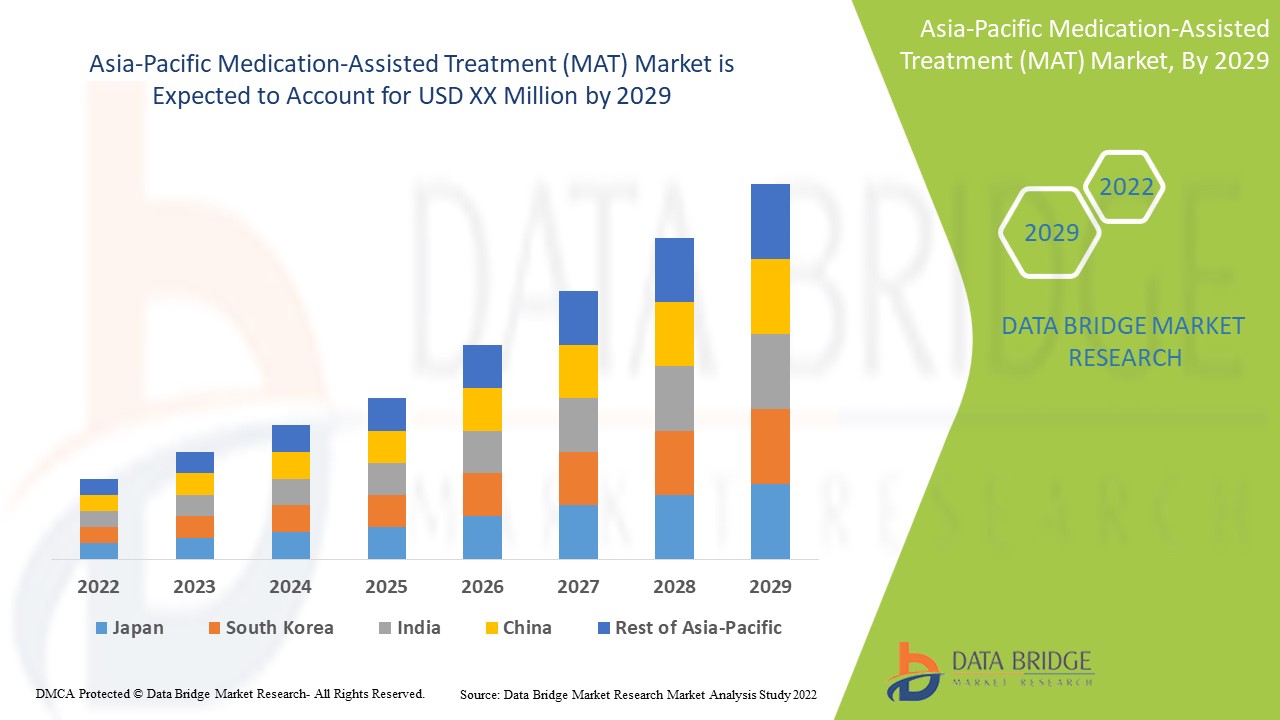
Análise e Perspectivas de Mercado
A Food and Drug Administration (FDA) aprovou três medicamentos clínicos: buprenorfina, metadona e naltrexona. O tratamento assistido por medicação (MAT) é aplicado para curar o transtorno do uso de álcool, medicação de dependência de opioides e medicação de prevenção de overdose de opioides. O transtorno do uso de álcool (AUD) é uma condição médica caracterizada por uma deficiência na capacidade de parar o uso de álcool, apesar de consequências sociais, ocupacionais ou de saúde adversas. Acamprosate, dissulfiram, e naltrexona são os medicamentos mais comuns usados para tratar o transtorno do uso de álcool (AUD). A medicação para dependência de opioides, aumento da dependência de opioides entre os pacientes. Buprenorfina, metadona e naltrexona são usados para tratar distúrbios do uso de opioides de curta duração, como heroína, morfina e codeína, bem como opioides semi-sintéticos como oxicodona e hidrocodona. Estes medicamentos MAT são seguros durante meses, anos, ou até uma vida inteira.
Definição do mercado
Tratamento assistido por medicação (MAT) envolve o uso de medicamentos, combinado com aconselhamento e terapias comportamentais, para fornecer uma abordagem completa do paciente para o tratamento de distúrbios do uso de substâncias. O MAT é utilizado principalmente no tratamento da dependência de opióides, tais como heroína e analgésicos prescritos. O objetivo da TAM é a recuperação adequada, que inclui melhora da sobrevida da paciente, aumento da retenção do tratamento, redução da resposta ilícita e aumento dos desfechos da gravidez entre as mulheres. Para a medicação de prevenção da sobredosagem de opiáceos, a naloxona é utilizada para prevenir a sobredosagem de opióides invertendo os efeitos tóxicos da sobredosagem. Segundo a Organização Mundial da Saúde (OMS) e a Administração de Serviços de Saúde Mental e Abuso de Substâncias (SAMSHA) a naloxona é um dos muitos medicamentos considerados essenciais para um sistema de saúde funcional.
O tratamento assistido por medicamentos Asia-Pacific é de apoio e visa reduzir a gravidade dos sintomas. Data Bridge Market Research analisa que o mercado de tratamento assistido por medicação (MAT) crescerá em um CAGR de 10,5% de 2022 a 2029.
|
Metric de Relatório |
Detalhes |
|
Período de previsão |
2022 a 2029 |
|
Ano de base |
2021 |
|
Anos Históricos |
2020 (Alfândega até 2019 - 2014) |
|
Unidades quantitativas |
Receitas em USD Million, Preços em USD |
|
Segmentos Cobertos |
Por tipo (Medicação e Terapia), Produtos (Buprenorfina e Naloxona, Naltrexona, Buprenorfina, Metadona, Naloxona, Dissulfiram e Acamprosate), Tipo de Droga (Genérica e Marca), Forma de Dosagem (Libertação Imediata e Libertação Alargada), Via de Administração (Oral, Parentérica e Outros), Tipo de População (Adultos e Adolescentes), Usuário Final (Clínicas de Reabilitação, Hospitais, Centros de Especialidade, Homecare e Outros) Canal de Distribuição ( Farmácia Hospitalar, Tender Directo, Farmácia Varejista, Farmácia Online e Outros) |
|
Países abrangidos |
China, Japão, Coreia do Sul, Índia, Austrália, Singapura, Tailândia, Malásia, Indonésia, Filipinas, Vietnã e Resto da Ásia-Pacífico. |
|
Jogadores de mercado cobertos |
Indivior PLC, Sun Pharmaceutical Industries Ltd., Taj Pharmaceuticals Limited, Hikma Pharmaceuticals PLC, Pfizer Inc., Glenmark Pharmaceutical Inc., Viatris Inc., Alvogen, Accord Healthcare, Teva Pharmaceutical Industries Ltd., Dr. Reddy's Laboratories Ltd.Amneal Pharmaceuticals LLC. entre outros |
Mercado de tratamento assistido por medicamentos da Ásia-Pacífico (MAT)Dinâmica
Controladores
- O aumento na incidência de distúrbios do uso opióide (Opioide Dependência Medicação)
Tratamento assistido por medicação (MAT) está usando medicamentos em combinação com aconselhamento e terapias comportamentais para fornecer uma abordagem "todo-paciente" para o tratamento de transtornos de uso de substâncias. Os medicamentos utilizados na MAT são aprovados pela Food and Drug Administration (FDA), e os programas de MAT são orientados e adaptados clinicamente para atender às necessidades de cada paciente.
Por exemplo,
- A prevalência do consumo de opiáceos de alto risco (por injecção ou por utilização regular/de longa duração) entre adultos (15-64 anos) na Ásia-Pacífico tem sido relativamente estável desde há muitos anos, com estimativas de utilizadores de cerca de 0,35 % da população da UE
Como as empresas estão constantemente envolvidas em atividades de pesquisa e desenvolvimento, o conhecimento sobre a incidência de transtornos do uso de álcool e transtornos do uso de opioides ajudaria a encontrar novas soluções e auxiliar em mais colaborações. Isso significa o aumento dos investimentos em pesquisa e desenvolvimento relacionados ao início de medicamentos genéricos em tratamento assistido por medicamentos (MAT), que é esperado para impulsionar o crescimento do mercado.
- O financiamento pelo governo para o tratamento assistido pela medicação (MAT)
Apesar da efetividade estabelecida das farmacoterapias para o tratamento do uso de opioides e distúrbios do álcool, limitações na implementação de medicamentos para tratamento da dependência (MAT) por programas de tratamento especializado têm sido observadas. É necessário prestar especial atenção às fontes específicas de financiamento, estrutura organizacional e recursos da mão-de-obra, fazendo um investimento a longo prazo que alinha o pagamento com os potenciais futuros beneficiários.
Por exemplo,
- Em fevereiro de 2021, o Programa Integrado de Treinamento de Distúrbios do Uso de Substâncias (ISTP) foi financiado para planejar, desenvolver e operar um programa de treinamento de 12 meses em tempo integral ou 24 meses para enfermeiros e médicos auxiliares de tratamento assistido por medicação (MAT). O financiamento amplia a força de trabalho treinada para cuidar de indivíduos que necessitam de saúde mental e prevenção de transtornos do uso de opioides
O financiamento do governo resultaria na segurança do paciente e economia de custos. Além disso, hospitais e agências de saúde administrariam esse tratamento a um preço mais baixo através da colaboração com organizações governamentais. Assim, espera-se que os avanços nas atividades de pesquisa e desenvolvimento e no financiamento pelo governo estimulem o crescimento do mercado.
Oportunidades
- Aumento nas despesas de saúde
Além disso, o aumento das actividades de investigação e desenvolvimento e o aumento dos investimentos por parte das organizações governamentais e privadas impulsionarão novas oportunidades para a taxa de crescimento do mercado.
Por exemplo,
- Em março de 2020, os dados do Instituto Nacional de Saúde (NIH) afirmam que a Medicare gastou cerca de US$ 829.500 milhões em 2020, ou seja, 20% do total da NHE
O aumento das despesas com os cuidados de saúde é igualmente benéfico para o desenvolvimento económico e o crescimento do sector da saúde. Além disso, o aumento da renda disponível da população é um fator favorável. Espera-se que estas oportunidades criem oportunidades lucrativas de tratamento assistido por medicação (MAT).
- Iniciativa Estratégica por Jogadores de Mercado
A demanda por tratamento assistido por medicação (MAT) tem aumentado nos EUA e Ásia-Pacífico devido ao tratamento oportuno das condições crônicas. Esses fatores favoráveis potencializam a necessidade de medicamentos e, para atingir a demanda do mercado, pequenos e grandes atores do mercado estão utilizando várias estratégias.
Os principais atores também estão tentando desenvolver estratégias específicas, como lançamentos de produtos, aquisições, aprovações, expansões e parcerias, para garantir o bom funcionamento do negócio, evitar riscos e aumentar o crescimento a longo prazo nas vendas do mercado.
Por exemplo,
- Em abril de 2021, a Adamis Pharmaceuticals Corporation com a USWM anunciou o lançamento e a disponibilidade de um produto de naloxona injetável ZIMHI de alta dose para ajudar a combater mortes por overdose de opioides. Espera-se que o lançamento aumente a receita do segmento de produtos, o que impulsionará o crescimento do mercado, e que o ZIMHI seja disponibilizado com desconto para os primeiros respondedores e organizações comunitárias de saúde
Essas iniciativas estratégicas dos agentes do mercado, incluindo aquisição, conferências e lançamentos de produtos de segmento focados, estão ajudando as empresas a crescer e melhorar os portfólios de produtos da empresa, levando a uma maior geração de receita. Assim, essas iniciativas estratégicas dos agentes do mercado oferecem uma oportunidade que os está ajudando a impulsionar o crescimento do mercado.
Restrição/Desafio
- Efeitos colaterais de drogas usadas no tratamento assistido por medicação (MAT)
O tratamento assistido por medicação (MAT) envolve o uso de medicamentos, em conjunto com terapias de aconselhamento e comportamento, para fornecer uma abordagem "todo-paciente" como parte da estratégia de tratamento abrangente. Por conseguinte, espera-se que o custo actual elevado mostre uma tendência descendente no futuro. O MAT tem se mostrado mais eficaz no tratamento de distúrbios do uso de álcool e opioides. No entanto, foram notificados certos efeitos secundários
Por exemplo,
- Metadona e buprenorfina, os medicamentos genéricos são quimicamente semelhantes aos opioides, então seus efeitos colaterais também podem ser semelhantes. Estes podem incluir obstipação, sonolência e tonturas. Algumas pessoas podem ter efeitos secundários mais graves
As complicações adversas relatadas levariam ao declínio das vendas dos medicamentos medicamentosos de dependência de opioides, o que limitaria as vendas dos medicamentos. Além disso, afectaria a fiabilidade dos fabricantes envolvidos neste mercado e, consequentemente, iria limitar o crescimento do mercado.
COVID-19 Impacto sobreo mercado de tratamento assistido por medicação (MAT)
Durante a pandemia, o tratamento assistido por medicação (MAT) reduz notavelmente a mortalidade e morbidade de pacientes com COVID-19. Mais estudos em larga escala são necessários para aprovar esses resultados. Um protocolo para o tratamento assistido por medicação (MAT) na infecção por COVID-19 deve ser definido para alcançar os melhores resultados clínicos possíveis. Ensaios clínicos foram conduzidos durante os serviços de medicação COVID-19 para transtorno do uso de opioides (MUD) são vitais para lidar com a crise de opioides, e COVID-19 tem impactado significativamente o parto de MOUD.
Desenvolvimento recente
- Em abril de 2021, a Adamis Pharmaceuticals Corporation com a USWM anunciou o lançamento e a disponibilidade de um produto de naloxona injetável ZIMHI de alta dose para ajudar a combater mortes por overdose de opioides. Espera-se que o lançamento aumente a receita do segmento de produtos, o que impulsionará o crescimento do mercado, e que o ZIMHI seja disponibilizado com desconto para os primeiros respondedores e organizações comunitárias de saúde
Âmbito de mercado do tratamento assistido por medicamentos da Ásia-Pacífico (MAT)
O mercado de tratamento assistido por medicamentos (MAT) é segmentado com base em oito segmentos: tipo, produtos, tipo de medicamento, forma de dosagem, via de administração, tipo de população, usuário final e canal de distribuição. O crescimento entre estes segmentos irá ajudá-lo a analisar segmentos de crescimento escassos nas indústrias e fornecer aos usuários uma visão geral de mercado valiosa e insights de mercado para ajudá-los a tomar decisões estratégicas para identificar aplicações de mercado principais.
Tipo
- Medicação
- Terapia
Com base no tipo de mercado de tratamento assistido por medicamentos da Ásia-Pacífico (MAT) é segmentado emmedicamentose terapia.
Produtos
- Buprenorfina e Naloxona
- Naltrexona
- Buprenorfina
- Metadona
- Naloxona
- Dissulfiram
- Acamprosato
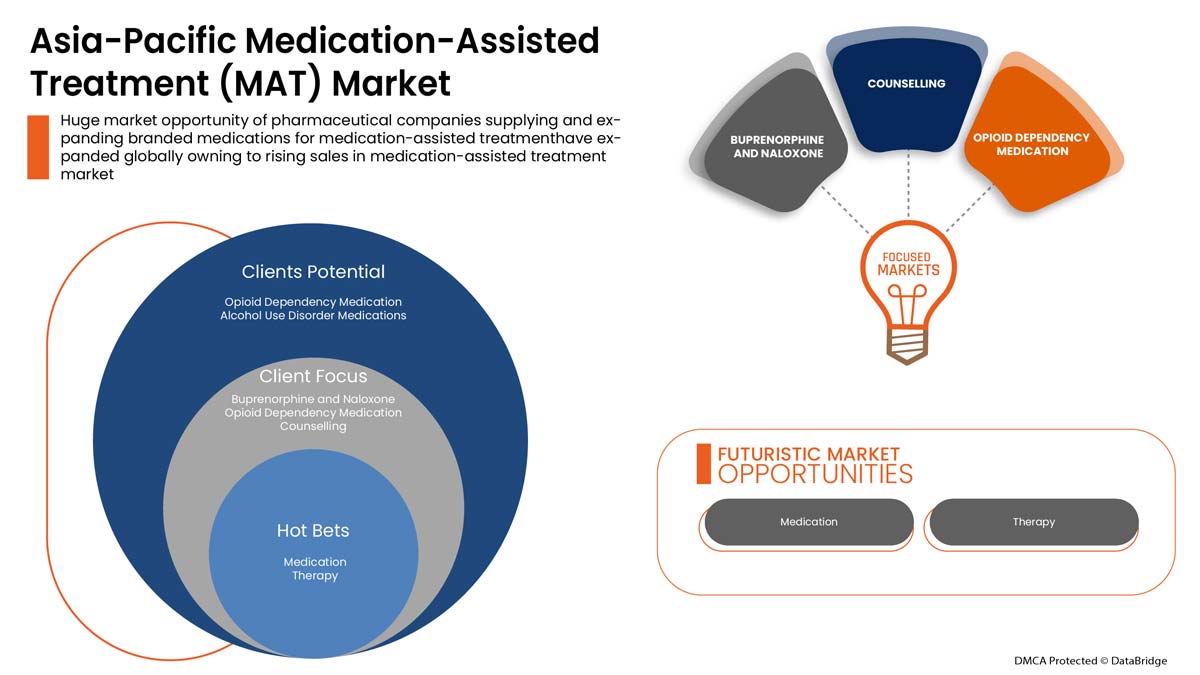
Com base nos produtos, o mercado de tratamento assistido por medicamentos da Ásia-Pacífico (MAT) é segmentado em buprenorfina e naloxona, naltrexona, buprenorfina, metadona, naloxona, dissulfiram e acamprosato.
Tipo de Droga
- Genéricos
- Marcado
Com base no tipo de droga, o mercado de tratamento assistido por medicamentos da Ásia-Pacífico (MAT) é segmentado em genéricos e marcado.
Forma de dosagem
- Liberação imediata
- Liberação Extendida
Com base na forma de dosagem, o mercado de tratamento assistido por medicamentos da Ásia-Pacífico (MAT) é segmentado em liberação imediata e liberação prolongada.
Via de administração
- Oral
- Parenteral
- Outros
Com base na via de administração, o mercado de tratamento assistido por medicamentos da Ásia-Pacífico (MAT) é segmentado paraoral, parenteral e outros.
Tipo de População
- Adultos
- Adolescentes
Com base no tipo de população, o mercado de tratamento assistido por medicamentos da Ásia-Pacífico (MAT) é segmentado em adultos e adolescentes.
Utilizador Final
- Clínicas de Reabilitação
- Serviços hospitalares
- Centros Especiais
- Homecare
- Outros
Com base no usuário final, o mercado de tratamento assistido por medicamentos da Ásia-Pacífico (MAT) é segmentado em clínicas de reabilitação, hospitais, centros de especialidade, homecare e outros.
Canal de Distribuição
- Farmácia Hospitalar
- Concurso Directo
- Farmácia de retalho
- Farmácia Online
- Outros
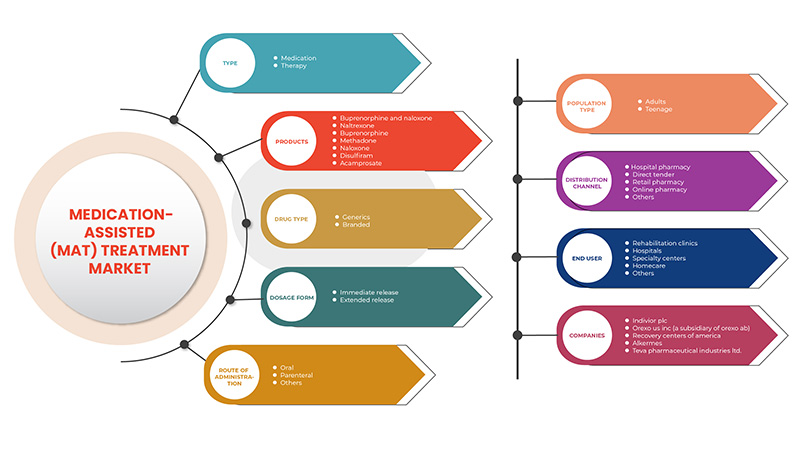
Com base no canal de distribuição, o mercado de tratamento assistido por medicamentos da Ásia-Pacífico (MAT) é segmentado em farmácia hospitalar, concurso direto, farmácia de varejo, farmácia on-line e outros.
Mercado de tratamento assistido por medicação (MAT)Análise/Insights regionais
O mercado de tratamento assistido por medicamentos da Ásia-Pacífico (MAT) é analisado e os insights e tendências de tamanho do mercado são fornecidos por regiões, tipo de produto, tipo, aplicação, fluxo de trabalho, usuário final e canal de distribuição acima referenciados.
Os países abrangidos pelo relatório do mercado de tratamento assistido por medicamentos (MAT) são a China, Japão, Coreia do Sul, Índia, Austrália, Singapura, Tailândia, Malásia, Indonésia, Filipinas, Vietname e o resto da Ásia-Pacífico.
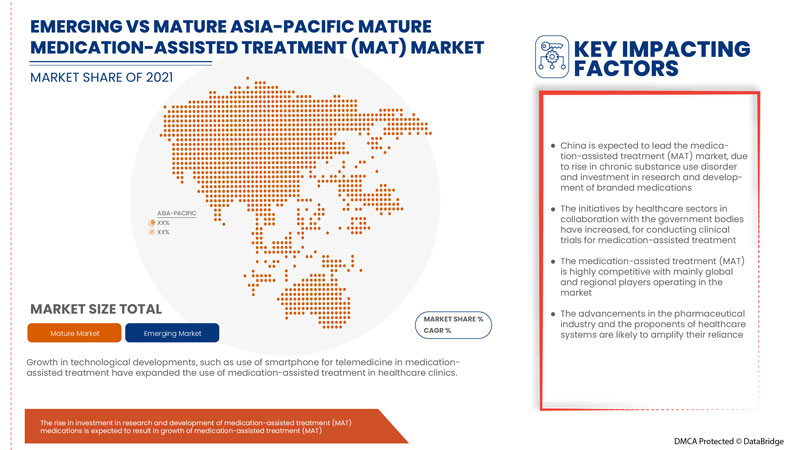
Espera-se que a China domine o mercado devido ao aumento dos casos de distúrbios do álcool e ao aumento da população que recebe tratamento assistido por medicação (MAT) e programas de conscientização assistido por medicação (MAT) na região Ásia-Pacífico.
A secção «país» do relatório também fornece factores de impacto individuais no mercado e alterações na regulamentação interna que afectam as tendências actuais e futuras do mercado. Pontos de dados como novas vendas, vendas de reposição, dados demográficos dos países, epidemiologia da doença e tarifas de importação-exportação são alguns dos indicadores significativos usados para prever o cenário de mercado para cada país. Além disso, presença e disponibilidade de marcas globais e seus desafios enfrentados devido à grande ou escassa concorrência de marcas locais e nacionais, o impacto dos canais de vendas são considerados ao fornecer a análise de previsão dos dados do país.
Paisagem competitiva eMercado de tratamento assistido por medicação (MAT)Análise da Partilha
O cenário competitivo do mercado de tratamento assistido por medicamentos da Ásia-Pacífico (MAT) fornece detalhes pelo concorrente. Detalhes incluídos são visão geral da empresa, finanças da empresa, receita gerada, potencial de mercado, investimento em pesquisa e desenvolvimento, novas iniciativas de mercado, presença Ásia-Pacífico, locais de produção e instalações, capacidades de produção, pontos fortes e fracos da empresa, lançamento do produto, largura e amplitude do produto, dominância de aplicação. Os dados acima apresentados estão relacionados apenas ao foco das empresas no mercado de tratamento assistido por medicamentos.
Alguns dos principais atores que operam no mercado de tratamento assistido por medicamentos (MAT) são Indivior PLC, Sun Pharmaceutical Industries Ltd., Taj Pharmaceuticals Limited, Hikma Pharmaceuticals PLC, Pfizer Inc., Glenmark Pharmaceutical Inc., Viatris Inc., Alvogen, Accord Healthcare, Teva Pharmaceutical Industries Ltd., Amneal Pharmaceuticals LLC. entre outros.
SKU-
Obtenha acesso online ao relatório sobre a primeira nuvem de inteligência de mercado do mundo
- Painel interativo de análise de dados
- Painel de análise da empresa para oportunidades de elevado potencial de crescimento
- Acesso de analista de pesquisa para personalização e customização. consultas
- Análise da concorrência com painel interativo
- Últimas notícias, atualizações e atualizações Análise de tendências
- Aproveite o poder da análise de benchmark para um rastreio abrangente da concorrência
Índice
1 INTRODUÇÃO
1.1 OBJECTIVOS DO ESTUDO
1.2 DEFINIÇÃO DE MERCADO
1.3 VISÃO GERAL DO MERCADO DE TRATAMENTO (MAT) AOS PACIFICADORES DE MEDICAÇÃO
1.4 MOEDA E PREÇOS
1.5 LIMITAÇÕES
1.6 MERCADOS COBERTOS
2 MERCADO DA ÁSIA DE TRATAMENTO ASSISTIDO PELA MEDICAÇÃO PACIFICA (MAT): SEGMENTAÇÃO
2.1 MERCADOS COBERTOS
2.2 ÂMBITO GEOGRÁFICO
2.3 ANOS CONSIDERADOS PARA O ESTUDO
2.4 MODELO DE VALIDAÇÃO DE DADOS TRIPOD DBRR
2.5 INTERVENÇÕES PRIMÁRIAS COM OPINIÕES-CHAVE
2.6 MODELIZAÇÃO MULTIVARIADA
2.7 Curva da linha de vida do SEGMENTO DO PRODUTO
2.8 GRIDE DE POSIÇÃO DO MERCADO DA DBRR
2.9 ANÁLISE DA PARTICIPAÇÃO DOS VENDANTES
2.1 GRÁFICO DE COBERTURA DO UTILIZADOR FINAL DE MERCADO
2.11 FONTES SEGUNDÁRIAS
3 RESUMO
4 INSIGHTS PRÉMIO
4.1 EPIDEMIOLOGIA
4.2 PESTEL
4.3 MODELO DE CINCO FORÇAS DO PORTRO
4.4 INCIDÊNCIA ANUAL DE OBJECTOS QUE ENTRAM TRATAMENTO ASSISTIDO À MEDICAÇÃO EM ÁLCOOL, DISORDE DE UTILIZAÇÃO OPIOIDA E PREVENÇÃO DE OPERAÇÕES OPIOIDAS (2021)
4. 5 NÚMERO ANUAL DE TRATAMENTOS COM CLONIDINA E COM LOFEXIDINA NA PREVENÇÃO DE DISORDÊNCIA DE UTILIZAÇÃO OPIÓIDA E DE PREVENÇÃO DE OPERAÇÕES OPIÓIDAS (2021)
4.6 INCIDÊNCIA ANUAL DE TRATAMENTO ASSISTIDO À MEDICAÇÃO REENTERAÇÃO DE PESSOAS.
4.7 UTILIZAÇÃO ANUAL DA INJECÇÃO DE NALTREXONA NO ÂMBITO DO TRATAMENTO PARA A RETIRADA INICIAL DE OPIÓIDES E TERAPIA DE MANUTENÇÃO ANUAL UTILIZANDO A INJECÇÃO DE NALTREXONA (2021)
4. 8 ANÁLISE DA PIPELINA NO MERCADO DO TRATAMENTO (MAT) MEDICAÇÃO
5 MERCADO DE TRATAMENTO ASSISTIDO PELA MEDICAÇÃO PACIFICA DA ÁSIA: REGULAMENTOS
6 VISÃO GERAL DO MERCADO
6. 1 CONDUTORES
6.1.1 O AUMENTO DA INCIDÊNCIA DO UTILIZAÇÃO DE ÁLCOOL DESIGNADOR E DIVULGANTES DE UTILIZAÇÃO OPIOIDA
6.1.2 O FINANCIAMENTO PELO GOVERNO DO TRATAMENTO APLICÁVEL À MEDICAÇÃO (MAT)
6.1.3 O AUMENTO DO TRATAMENTO ASSISTIDO À MEDICAÇÃO (MAT) E DO PROGRAMA DE CONSCIÊNCIA ASSISTIDO À MEDICAÇÃO (MAT)
6.1.4 UTILIZAÇÃO DE REEMBOLSO PARA TRATAMENTO MEDICADO (MAT)
6.2 RESTRUÇÕES
6.2.1 EFEITOS SECUNDÁRIOS DE DROGAS UTILIZADOS NO TRATAMENTO MEDICADO (MAT)
6.2.2 QUESTÕES ÉTICAS RELACIONADAS COM A UTILIZAÇÃO DE TRATAMENTO ASSISTIDO À MEDICAÇÃO (MAT)
6.2.3 AUMENTO DAS RECORDAÇÕES DOS PRODUTOS
6.3 OPORTUNIDADES
6.3.1 INICIATIVA ESTRATÉGICA DOS JOGOS DE MERCADO
6.3.2 DESPESAS DE CARE DE SAÚDE
6.4 DESAFIOS
6.4.1 A FALTA DE PROFISSIONAIS HABITADOS, EXIGIDOS PARA TRATAMENTO A MEDICAÇÃO
6.4.2 REGULAMENTOS RETINGENTES
6.4.3 DISTINUAÇÃO DO TRATAMENTO ASSISTIDO À MEDICAÇÃO (MAT)
7 MERCADO DE TRATAMENTO (MAT) MEDICAÇÃO DA ÁSIA PACIFICA, POR TIPO
7.1 VISÃO GERAL
7.2 MEDICAÇÃO
7.2.1 MEDICAÇÃO DE DEPENDÊNCIA OPIOIDA
7.2.1.1 Buprenorfina e naloxona
72.1.2 Buprenorfina
7.2.1.3 METADONA
7.2.1.4 NALTREXONA
7.2.2 ÁLCOOL UTILIZAR MEDICAÇÕES DESORDADAS
7.2.2.1 NALTREXONA
7.2.2.2 DISULFIRAM
7.2.2.3 ACEMPROSATO
7.2.3 MEDICAÇÃO DE PREVENÇÃO OPIOIDA
7.2.3.1 NALOXONA
7.3 TERAPIA
7.3.1 TERAPIA COMERCIAL
7.3.2 TERAPIA EDUCCIONAL
7.3.3 CONVENÇÕES
7.3.4 TERAPIA PROFISSIONAL
7.3.5 OUTROS
8 MERCADO DE TRATAMENTO (MAT) AOS PRODUTOS
8.1 VISÃO GERAL
8,2 Buprenorfina e NALOXONA
8. 3 NALTREXONA
8,4 Buprenorfina
8.5 METADONA
8, 6 NALOXONA
8, 7 DISULFIRAM
8.8 ACEMPROSATO
9 MERCADO DE TRATAMENTO (MAT) MEDICAÇÃO DA ÁSIA PACIFICA, POR TIPO DE DROGA
9.1 VISÃO GERAL
9.2 GENERICS
9.3 BRANDE
9.3.1 SUBOXONA
9.3.2 VIVITROL
9.3.3 BURROS
9.3.4 ZUBSOLV
9.3.5 PROBUFINA
9.3.6 OUTRAS
10 MERCADO DE TRATAMENTO (MAT) MEDICAÇÃO DA ÁSIA PACIFICA, POR FORMULÁRIO DE DOSAGEM
10.1 VISÃO GERAL
10.2 LIBERTAÇÃO PRIMÁRIA
10.3 LIBERTAÇÃO EXTERNA
11 MERCADO DE TRATAMENTO (MAT) MEDICAÇÃO DA ÁSIA PACIFICA, POR VIA DE ADMINISTRAÇÃO
11.1 VISÃO GERAL
11.2 ORAL
11.2.1 COMPRIMIDOS
11.2.2 FILM SUBLINGUAL
11.2.3 OUTRAS
11.3 PARENTERAL
11.1 SOLUÇÃO
11.3.2 SUSPENSÃO
11,4 OUTRAS
12 MERCADO DE TRATAMENTO (MAT) MEDICAÇÃO DA ÁSIA PACIFICA, POR TIPO DE POPULAÇÃO
12.1 VISÃO GERAL
12.2 ADULTOS
12.3 TEENAGEM
13 MERCADO DE TRATAMENTO ASSISTIDO POR MEDICAÇÃO DA ÁSIA PACÍFICA (MAT), POR UTILIZADOR FINAL
13.1 VISÃO GERAL
13.2 CLÍNICAS DE REABILITAÇÃO
13.3 HOSPITAIS
13.4 CENTROS ESPECIAIS
13.5 HOMEM
13.6 OUTRAS
14 MERCADO DE TRATAMENTO (MAT) MEDICAÇÃO DA ÁSIA PACIFICA, POR CANAL DE DISTRIBUIÇÃO
14.1 VISÃO GERAL
FARMÁCIA HOSPITAL
14.3 ENTRADA DIRECTA
14.4 FARMACIA DE RETALHO
14.5 FARMÁCIA ONLINE
14,6 OUTRAS
15 MERCADO DA ÁSIA DE TRATAMENTO ASSISTIDO PELA REGIONAÇÃO
15.1 PACÍFICO ÁSIA
15.1.1 CHINA
15.1.2 JAPÃO
15.1.3 ÍNDIA
15.1.4 AUSTRÁLIA
15.1.5 COREIA DO SUL
15.1.6 SINGAPURA
15.1.7 MALAÍSIA
15.1.8 Tailândia
15.1.9 INDONESIA
15.1.10 FILIPINAS
15.1.11 VIETNAME
15.1.12 RESTO DO PACÍFICO ÁSIA
16 MERCADO DA ÁSIA DE TRATAMENTO ASSISTIDO PELA MEDICAÇÃO PACIFICATIVA (MAT): PAISCAPE DA EMPRESA
16.1 ANÁLISE PARTILHAR DA EMPRESA: ÁSIA PACIFICA
17 ANÁLISE DE SWOT
18 PERFIL DA EMPRESA
18.1 INDÚSTRIAS FARMACÊUTICAS TEVA LTD. (2021)
18.1.1 EMPRESA SNAPSHOT
18.1.2 ANÁLISE DAS RECEITAS
18.1.3 ANÁLISE PARTICIPAL
18.1.4 PRODUTO PORTFÓLIO
18.1.5 EVOLUÇÃO RECENTE
18.2 CLP INDIVADOR (2021)
18.2.1 EMPRESA SNAPSHOT
ANÁLISE DAS RECEITAS
18.2.3 ANÁLISE PARTICIPAL
18.2.4 PRODUTO PORTFÓLIO
18.2.5 EVOLUÇÃO RECENTE
18.3 VIATRIS INC (2021)
18.3.1 EMPRESA SNAPSHOT
ANÁLISE DAS RECEITAS
18.3.3 ANÁLISE PARTICIPAL
18.3.4 PORTFOLIO DO PRODUTO
18.3.5 EVOLUÇÃO RECENTE
18.4 INDÚSTRIAS FARMACÊUTICAS DO SUN LTD (2021)
18.4.1 EMPRESA SNAPSHOT
ANÁLISE DE RECEITAS
18.4.3 ANÁLISE PARTICIPAL
18.4.4 PRODUTO PORTFOLIO
18.4.5 EVOLUÇÃO RECENTE
18.5 ALKERMES (2021)
18.5.1 EMPRESA SNAPSHOT
ANÁLISE DAS RECEITAS
18.5.3 ANÁLISE PARTICIPAL
18.5.4 PRODUTO PORTFÓLIO
18.5.5 EVOLUÇÃO RECENTE
18,6 PURDUE PHARMA L.P. (2021)
18.6.1 EMPRESA SNAPSHOT
18.6.2 PRODUTO PORTFOLIO
18.6.3 EVOLUÇÃO RECENTE
18.7 PFIZER (2021)
18.7.1 EMPRESA SNAPSHOT
ANÁLISE DAS RECEITAS
18.7.3 PRODUTO PORTFÓLIO
18.7.4 EVOLUÇÃO RECENTE
18.8 GLINAMARK CIN FARMACÊUTICA (2021)
18.8.1 EMPRESA SNAPSHOT
18.8.2 ANÁLISE DAS RECEITAS
18.8.3 PRODUTO PORTFÓLIO
18.8.4 EVOLUÇÃO RECENTE
18.9 LABORATÓRIOS DE DR. REDDY LTD (2021)
18.9.1 EMPRESA SNAPSHOT
ANÁLISE DAS RECEITAS
18.9.3 PRODUTO PORTFÓLIO
18.9.4 EVOLUÇÃO RECENTE
18.1 ALVOGEN (2021)
18.10.1 EMPRESA SNAPSHOT
18.10.2 PRODUTO PORTFOLIO
18.10.3 EVOLUÇÃO RECENTE
18.11 CORPORAÇÃO DA ADAMIS FARMACÊUTICA (2021)
18.11.1 EMPRESA SNAPSHOT
ANÁLISE DAS RECEITAS
18.11.3 PRODUTO PORTFOLIO
EVOLUÇÃO RECENTE
18.12 ACORDO SAÚDE (A SUBSIDIÁRIO DE INTAS FARMACÊUTICAS)
18.12.1 EMPRESA SNAPSHOT
18.12.2 PRODUTO PORTFÓLIO
18.12.3 EVOLUÇÃO RECENTE
18.13 FARMACÊUTICAS AMNEAIS LLC (2021)
18.13.1 EMPRESA SNAPSHOT
ANÁLISE DAS RECEITAS
18.13.3 PRODUTO PORTFOLIO
18.13.4 EVOLUÇÃO RECENTE
18.14 CENTROS DE ADICÇÃO AMÉRICA (2021)
18.14.1 EMPRESA SNAPSHOT
18.14.2 PRODUTO PORTFÓLIO
18.14.3 EVOLUÇÃO RECENTE
18.15 HIKMA FARMACÊUTICAS PLC (2021)
18.15.1 EMPRESA SNAPSHOT
ANÁLISE DAS RECEITAS
18.15.3 PRODUTO PORTFOLIO
18.15.4 EVOLUÇÃO RECENTE
18.16 LANNETT (2021)
18.16.1 EMPRESA SNAPSHOT
18.16.2 ANÁLISE DAS RECEITAS
18.16.3 PRODUTO PORTFOLIO
18.16.4 DESENVOLVIMENTO RECENTE
18.17 MALLINCKRODT (2021)
18.17.1 EMPRESA SNAPSHOT
ANÁLISE DAS RECEITAS
18.17.3 PRODUTO PORTFÓLIO
18.17.4 DESENVOLVIMENTO RECENTE
18.18 OREXO US INC (A SUBSIDIÁRIO DE OREXO, INC) (2021)
18.18.1 EMPRESA SNAPSHOT
ANÁLISE DAS RECEITAS
18.18.3 PRODUTO PORTFÓLIO
18.18.4 DESENVOLVIMENTO RECENTE
18.19 CENTROS DE TRATAMENTO DE PINACLOS
18.19.1 EMPRESA SNAPSHOT
18.19.2 PRODUTO PORTFÓLIO
18.19.3 DESENVOLVIMENTO RECENTE
18.2 CENTROS DE RECUPERAÇÃO DA AMÉRICA
18.20.1 EMPRESA SNAPSHOT
18.20.2 PRODUTO PORTFÓLIO
18.20.3 DESENVOLVIMENTOS RECENTES
18.21 LIMITED TAJ FARMACÊUTICAS
18.21.1 EMPRESA SNAPSHOT
18.21.2 PRODUTO PORTFÓLIO
18.21.3 EVOLUÇÃO RECENTE
18.22 PRODUTOS TITANOS (2021)
18.22.1 EMPRESA SNAPSHOT
18.22.2 ANÁLISE DAS RECEITAS
18.22.3 PRODUTO PORTFÓLIO
18.22.4 EVOLUÇÃO RECENTE
18.23 VISTAPHAM, INC (A SUBSIDIÁRIO DE VERTICE PHARMA, LLC. (2021)
18.23.1 EMPRESA SNAPSHOT
18.23.2 PRODUTO PORTFÓLIO
18.23.3 EVOLUÇÃO RECENTE
19 QUESTIONÁRIO
20 RELATÓRIOS RELACIONADOS
Lista de Tabela
QUADRO 1 MERCADO DE TRATAMENTO ASSISTIDO POR MEDICAÇÃO DA ÁSIA (MAT), POR TIPO 2020-2029 (USD MILHÃO)
QUADRO 2 MEDICAÇÃO PACIFICA DA ÁSIA NO MERCADO DO TRATAMENTO (MAT) ASSISTIDO PELA REGIÃO 2020-2029 (USD MILHÃO)
QUADRO 3 MEDICAÇÃO PACIFICA DA ÁSIA NO MERCADO DE TRATAMENTO (MAT) MEDICAÇÃO ASSISTIDA POR TIPO 2020-2029 (USD MILHÃO)
QUADRO 4 MEDICAÇÃO DA DEPENDÊNCIA OPIÓIDA DA ÁSIA NO MERCADO DE TRATAMENTO (MAT) MEDICAÇÃO ASSISTIDA POR TIPO 2020-2029 (USD MILHÃO)
QUADRO 5 ÁLCOOLO DA ÁSIA PACÍFICO UTILIZAR MEDICAÇÕES DESORDADAS NO MERCADO DE TRATAMENTO (MAT) MEDICAÇÃO, POR TIPO 2020-2029 (USD MILHÃO)
QUADRO 6 MEDICAÇÃO DE PREVENÇÃO DE OPIOIDES DA ÁSIA PACIFICA NO MERCADO DE TRATAMENTO (MAT) MEDICAÇÃO EM MÉDIA, POR TIPO 2020-2029 (USD MILHÃO)
QUADRO 7 TERAPIA PACÍFICA DA ÁSIA NO MERCADO DO TRATAMENTO (MAT) MEDICAÇÃO, POR REGIÃO, 2020-2029 (USD MILHÃO)
QUADRO 8 TERAPIA PACÍFICA DA ÁSIA NO MERCADO DE TRATAMENTO (MAT) MEDICAÇÃO, POR TIPO 2020-2029 (USD MILHÃO)
QUADRO 9 MERCADO DE TRATAMENTO ASSISTIDO POR MEDICAÇÃO DA ÁSIA (MAT) POR PRODUTOS, 2020-2029 (USD MILHÃO)
QUADRO 10 BUPRENORPHINA PACIFICA DA ÁSIA E NALOXONA NO MERCADO DE TRATAMENTO (MAT) MEDICAÇÃO, POR REGIÃO, 2020-2029 (USD MILHÃO)
QUADRO 11 ÁSIA PACIFIC NALTREXONA NO MERCADO DE TRATAMENTO (MAT) MEDICAÇÃO, POR REGIÃO, 2020-2029 (USD MILHÃO)
QUADRO 12 BUPRENORFINA DA ÁSIA PACIFICA NO MERCADO DE TRATAMENTO (MAT) MEDICAÇÃO, POR REGIÃO, 2020-2029 (USD MILHÃO)
QUADRO 13 METADONA DA ÁSIA PACÍFICA NO MERCADO DE TRATAMENTO (MAT) MEDICAÇÃO, POR REGIÃO, 2020-2029 (USD MILHÃO)
QUADRO 14 ÁSIA PACIFIC NALOXONA NO MERCADO DE TRATAMENTO (MAT) MEDICAÇÃO, POR REGIÃO, 2020-2029 (USD MILHÃO)
QUADRO 15 DISULFIRAMA DA ÁSIA PACÍFICA NO MERCADO DO TRATAMENTO (MAT) MEDICAÇÃO, POR REGIÃO, 2020-2029 (USD MILHÃO)
QUADRO 16 AMOSTRAGEM DA ÁSIA PACIFICA NO MERCADO DE TRATAMENTO (MAT) MEDICAÇÃO, POR REGIÃO, 2020-2029 (USD MILHÃO)
QUADRO 17 MERCADO DE TRATAMENTO ASSISTIDO PELA MEDICAÇÃO DA ÁSIA PACIFICA, POR TIPO DE DROGA, 2020-2029 (USD MILHÃO)
QUADRO 18 GÉNERA DA ÁSIA PACIFICA NO MERCADO DO TRATAMENTO (MAT) MEDICAÇÃO, POR REGIÃO, 2020-2029 (USD MILHÃO)
QUADRO 19 ÁSIA PACIFICADO NO MERCADO DE TRATAMENTO (MAT) MEDICAÇÃO, POR REGIÃO, 2020-2029 (USD MILHÃO)
QUADRO 20 ÁSIA PACIFICA NO MERCADO DE TRATAMENTO (MAT) MEDICAÇÃO, POR TIPO DE DROGA, 2020-2029 (USD MILHÃO)
QUADRO 21 MERCADO DE TRATAMENTO ASSISTIDO POR FORMULÁRIO DE DOSAGEM 2020-2029 (USD MILHÃO)
QUADRO 22: LIBERTAÇÃO IMPEDIÁRIA DA ÁSIA NO MERCADO DE TRATAMENTO (MAT) MEDICAÇÃO, POR REGIÃO, 2020-2029 (USD MILHÃO)
QUADRO 23 ASIA PACIFIC LIBERTAÇÃO EXTENDIDA NO MERCADO DO TRATAMENTO (MAT) MEDICAÇÃO, POR REGIÃO, 2020-2029 (USD MILHÃO)
QUADRO 24 MERCADO DE TRATAMENTO ASSISTIDO POR MEDICAÇÃO DA ÁSIA (MAT), POR VIA DE ADMINISTRAÇÃO, 2020-2029 (USD MILHÃO)
QUADRO 25 ÁSIA ORAL PACÍFICO NO MERCADO DO TRATAMENTO (MAT) MEDICAÇÃO, POR REGIÃO, 2020-2029 (USD MILHÃO)
QUADRO 26 ÁSIA ORAL PACÍFICO NO MERCADO DE TRATAMENTO (MAT) MEDICAÇÃO, POR VIA DE ADMINISTRAÇÃO, 2020-2029 (USD MILHÃO)
QUADRO 27 ÁSIA PADRÃO PACÍFICO NO MERCADO DO TRATAMENTO (MAT) MEDICAÇÃO, POR REGIÃO, 2020-2029 (USD MILHÃO)
QUADRO 28 ÁSIA PADRÃO PACÍFICO NO MERCADO DE TRATAMENTO (MAT) MEDICAÇÃO, POR VIA DE ADMINISTRAÇÃO, 2020-2029 (USD MILHÃO)
QUADRO 29 OUTROS OUTROS PACIFICADOS DA ÁSIA NO MERCADO DE TRATAMENTO (MAT) MEDICAÇÃO, POR REGIÃO, 2020-2029 (USD MILHÃO)
QUADRO 30 MERCADO DE TRATAMENTO ASSISTIDO POR MEDICAÇÃO DA ÁSIA PACIFIC (MAT), POR TIPO DE POPULAÇÃO, 2020-2029 (USD MILHÃO)
QUADRO 31 ADULTOS DA ÁSIA PACÍFICOS NO MERCADO DO TRATAMENTO (MAT) MEDICAÇÃO, POR REGIÃO, 2020-2029 (USD MILHÃO)
QUADRO 32 TEENAGEM DA ÁSIA PACIFICA NO MERCADO DE TRATAMENTO (MAT) MEDICAÇÃO, POR REGIÃO, 2020-2029 (USD MILHÃO)
QUADRO 33 MERCADO DE TRATAMENTO ASSISTIDO POR MEDICAÇÃO DA ÁSIA (MAT), POR FIM DO UTILIZADOR, 2020-2029 (USD MILHÃO)
QUADRO 34 CLÍNICAS DE REABILITAÇÃO PACIFICA DA ÁSIA NO MERCADO DE TRATAMENTO (MAT) MEDICAÇÃO, POR REGIÃO, 2020-2029 (USD MILHÃO)
QUADRO 35 HOSPITAIS DA ÁSIA PACIFIC NO MERCADO DE TRATAMENTO (MAT) MEDICAÇÃO, POR REGIÃO, 2020-2029 (USD MILHÃO)
QUADRO 36 CENTROS DE ESPECIARIA PACIFICA DA ÁSIA NO MERCADO DO TRATAMENTO (MAT) MEDICAÇÃO, POR REGIÃO, 2020-2029 (USD MILHÃO)
QUADRO 37 HOMECARE DA ÁSIA PACÍFICO NO MERCADO DO TRATAMENTO (MAT) MEDICAÇÃO, POR REGIÃO, 2020-2029 (USD MILHÃO)
QUADRO 38 OUTROS PACIFICOS DA ÁSIA NO MERCADO DO TRATAMENTO (MAT) MEDICAÇÃO, POR REGIÃO, 2020-2029 (USD MILHÃO)
QUADRO 39 DO MERCADO DE TRATAMENTO DE MEDICAÇÃO ASSISTIDA À ÁSIA (MAT), POR CANAL DE DISTRIBUIÇÃO, 2020-2029 (USD MILHÃO)
QUADRO 40 FARMÁCIA HOSPITAL DA ÁSIA PACIFICA NO MERCADO DE TRATAMENTO (MAT) MEDICAÇÃO, POR REGIÃO, 2020-2029 (USD MILHÃO)
QUADRO 41 ASIA PACIFIC DIRECT TENDDER NO MERCADO DO TRATAMENTO (MAT) MEDICAÇÃO, POR REGIÃO, 2020-2029 (USD MILHÃO)
QUADRO 42 FARMACY DO RETALHO DA ÁSIA PACIFICA NO MERCADO DE TRATAMENTO (MAT) MEDICAÇÃO, POR REGIÃO, 2020-2029 (USD MILHÃO)
QUADRO 43 FARMACY ONLINE DA ÁSIA NO MERCADO DE TRATAMENTO (MAT) MEDICAÇÃO, POR REGIÃO, 2020-2029 (USD MILHÃO)
QUADRO 44 OUTROS PACIFICOS DA ÁSIA NO MERCADO DE TRATAMENTO (MAT) MEDICAÇÃO, POR REGIÃO, 2020-2029 (USD MILHÃO)
QUADRO 45 MERCADO DO TRATAMENTO ASSISTIDO PELA MEDICAÇÃO AOS PAÍSES 2020-2029 (USD MILHÃO)
QUADRO 46 MERCADO DE TRATAMENTO ASSISTIDO POR MEDICAÇÃO PACÍFICA DA ÁSIA (MAT), POR TIPO 2020-2029 (USD MILHÃO)
QUADRO 47 MEDICAÇÃO PACÍFICA DA ÁSIA NO MERCADO DE TRATAMENTO (MAT) MEDICAÇÃO ASSISTIDA À MEDICAÇÃO, POR TIPO 2020-2029 (USD MILHÃO)
QUADRO 48 MEDICAÇÃO DA DEPENDÊNCIA OPIÓDIA ÁSIA-PACÍFICA NO MERCADO DE TRATAMENTO (MAT) MEDICAÇÃO ASSISTIDA POR TIPO 2020-2029 (USD MILHÃO)
QUADRO 49 ÁLCOOL ÁSIA-PACÍFICO UTILIZAÇÃO DAS MEDICAÇÕES DE DESIGNAÇÃO NO MERCADO DE TRATAMENTO (MAT) MEDICAÇÃO, POR TIPO 2020-2029 (USD MILHÃO)
QUADRO 50 MEDICAÇÃO DE PREVENÇÃO OPÍODE ÁSIA-PACÍFICA NO MERCADO DE TRATAMENTO (MAT) MEDICAÇÃO DE MEDICAÇÃO, POR TIPO 2020-2029 (USD MILHÃO)
QUADRO 51 TERAPIA PACÍFICA DA ÁSIA NO MERCADO DO TRATAMENTO (MAT) MEDICAÇÃO, POR TIPO 2020-2029 (USD MILHÃO)
QUADRO 52 MERCADO DO TRATAMENTO (MAT) ASSISTIDO À MEDICAÇÃO AOS PAÍSES DA ÁSIA, POR PRODUTOS, 2020-2029 (USD MILHÃO)
QUADRO 53 MERCADO DE TRATAMENTO ASSISTIDO POR MEDICAÇÃO A ÁSIA (MAT), POR TIPO DE DROGA, 2020-2029 (USD MILHÃO)
QUADRO 54 ASSIA-PACÍFICO NO MERCADO DE TRATAMENTO (MAT) MEDICAÇÃO, POR TIPO DE DROGA, 2020-2029 (USD MILHÃO)
QUADRO 55 MERCADO DOS TRATAMENTOS ASSISTIDOS POR FORMULÁRIO DOSAGEM 2020-2029 (USD MILHÃO)
QUADRO 56 MERCADO DE TRATAMENTO ASSISTIDO EM MEDICAÇÃO (MAT), POR VIA DE ADMINISTRAÇÃO, 2020-2029 (USD MILHÃO)
QUADRO 57 ORAL ÁSIA-PACÍFICO NO MERCADO DE TRATAMENTO (MAT) MEDICAÇÃO, POR VIA DE ADMINISTRAÇÃO, 2020-2029 (USD MILHÃO)
QUADRO 58 PARTENTERAL ÁSIA-PACÍFICO NO MERCADO DE TRATAMENTO (MAT) MEDICAÇÃO, POR VIA DE ADMINISTRAÇÃO, 2020-2029 (USD MILHÃO)
QUADRO 59 MERCADO DO TRATAMENTO ASSISTIDO EM MEDICAÇÃO (MAT), POR TIPO DE POPULAÇÃO, 2020-2029 (USD MILHÃO)
QUADRO 60 MERCADO DOS TRATAMENTOS ASSISTIDOS PELA MEDICAÇÃO AOS PAÍSES DA ÁSIA (MAT), POR FIM DO UTILIZADOR, 2020-2029 (USD MILHÃO)
QUADRO 61 MERCADO DE TRATAMENTO ASSISTIDO POR MEDICAÇÃO PACÍFICA DA ÁSIA (MAT), POR CANAL DE DISTRIBUIÇÃO, 2020-2029 (USD MILHÃO)
QUADRO 62 MERCADO DO TRATAMENTO COM A MEDICAÇÃO DA CHINA (MAT), POR TIPO 2020-2029 (USD MILHÃO)
QUADRO 63 MEDICAÇÃO DA CHINA NO MERCADO DO TRATAMENTO (MAT) MEDICAÇÃO, POR TIPO 2020-2029 (USD MILHÃO)
QUADRO 64 MEDICAÇÃO DA DEPENDÊNCIA OPIOIDA DA CHINA NO MERCADO DE TRATAMENTO (MAT) MEDICAÇÃO ASSISTIDA À MEDICAÇÃO, POR TIPO 2020-2029 (USD MILHÃO)
QUADRO 65
QUADRO 66 MEDICAÇÃO DE PREVENÇÃO OPIOIDA DA CHINA NO MERCADO DE TRATAMENTO (MAT) MEDICAÇÃO ASSISTIDA À MEDICAÇÃO, POR TIPO 2020-2029 (MILION USD)
QUADRO 67 TERAPIA DA CHINA NO MERCADO DO TRATAMENTO (MAT) MEDICAÇÃO, POR TIPO 2020-2029 (USD MILHÃO)
QUADRO 68 MERCADO DE TRATAMENTO ASSISTIDO À MEDICAÇÃO DA CHINA, POR PRODUTOS, 2020-2029 (USD MILHÃO)
QUADRO 69 MERCADO DO TRATAMENTO COM A MEDICAÇÃO DA CHINA (MAT), POR TIPO DE DROGA, 2020-2029 (USD MILHÃO)
QUADRO 70 CHINA BRANDADO NO MERCADO DE TRATAMENTO (MAT) MEDICAÇÃO, POR TIPO DE DROGA, 2020-2029 (USD MILHÃO)
QUADRO 71 MERCADO DE TRATAMENTO ASSISTIDO À MEDICAÇÃO DA CHINA, POR FORMULÁRIO DE DOSAGEM, 2020-2029 (USD MILHÃO)
QUADRO 72 MERCADO DE TRATAMENTO ASSISTIDO À MEDICAÇÃO DA CHINA, POR VIA DE ADMINISTRAÇÃO, 2020-2029 (USD MILHÃO)
QUADRO 73 ORAL CHINA NO MERCADO DE TRATAMENTO (MAT) MEDICAÇÃO, POR VIA DE ADMINISTRAÇÃO, 2020-2029 (USD MILHÃO)
QUADRO 74 PARENTERAL DA CHINA NO MERCADO DE TRATAMENTO (MAT) MEDICAÇÃO, POR VIA DE ADMINISTRAÇÃO, 2020-2029 (USD MILHÃO)
QUADRO 75 MERCADO DO TRATAMENTO COM A MEDICAÇÃO DA CHINA, POR TIPO DE POPULAÇÃO, 2020-2029 (USD MILHÃO)
QUADRO 76 MERCADO DO TRATAMENTO ASSISTIDO À MEDICAÇÃO DA CHINA (MAT), POR UTILIZADOR FINAL, 2020-2029 (USD MILHÃO)
QUADRO 77 MERCADO DO TRATAMENTO COM A MEDICAÇÃO DA CHINA (MAT), POR CANAL DE DISTRIBUIÇÃO, 2020-2029 (USD MILHÃO)
QUADRO 78 MERCADO DO TRATAMENTO COM A MEDICAÇÃO JAPÃO (MAT), POR TIPO 2020-2029 (USD MILHÃO)
QUADRO 79 MEDICAÇÃO JAPÃO NO MERCADO DE TRATAMENTO (MAT) MEDICAÇÃO ASSISTIDA À MEDICAÇÃO, POR TIPO 2020-2029 (USD MILHÃO)
QUADRO 80 MEDICAÇÃO DA DEPENDÊNCIA OPIOIDA JAPÃO NO MERCADO DE TRATAMENTO (MAT) MEDICAÇÃO ASSISTIDA À MEDICAÇÃO, POR TIPO 2020-2029 (USD MILHÃO)
QUADRO 81 ÁLCOOL JAPÃO UTILIZAR MEDICAÇÕES DE DESORDAMENTO NO MERCADO DE TRATAMENTO (MAT) MEDICAÇÃO, POR TIPO 2020-2029 (USD MILHÃO)
QUADRO 82 MEDICAÇÃO DE PREVENÇÃO OPIOIDA JAPÃO NO MERCADO DE TRATAMENTO (MAT) MEDICAÇÃO ASSISTIDA A MEDICAÇÃO, POR TIPO 2020-2029 (USD MILHÃO)
QUADRO 83 TERAPIA JAPÃO NO MERCADO DE TRATAMENTO (MAT) MEDICAÇÃO, POR TIPO 2020-2029 (USD MILHÃO)
QUADRO 84 MERCADO DE TRATAMENTO ASSISTIDO À MEDICAÇÃO JAPÃO, POR PRODUTOS, 2020-2029 (USD MILHÃO)
QUADRO 85 MERCADO DE TRATAMENTO COM A MEDICAÇÃO JAPÃO, POR TIPO DE DROGA, 2020-2029 (USD MILHÃO)
QUADRO 86 MERCADO DO TRATAMENTO COM A MEDICAÇÃO JAPÃO (MAT), POR FORMULÁRIO DOSAGEM, 2020-2029 (USD MILHÃO)
QUADRO 87 MERCADO DE TRATAMENTO COM A MEDICAÇÃO JAPÃO (MAT), POR VIA DE ADMINISTRAÇÃO, 2020-2029 (USD MILHÃO)
QUADRO 88 ORAL JAPÃO NO MERCADO DE TRATAMENTO (MAT) MEDICAÇÃO, POR VIA DE ADMINISTRAÇÃO, 2020-2029 (USD MILHÃO)
QUADRO 89 PARENTERAL JAPÃO NO MERCADO DE TRATAMENTO (MAT) MEDICAÇÃO, POR VIA DE ADMINISTRAÇÃO, 2020-2029 (USD MILHÃO)
QUADRO 90 MERCADO DE TRATAMENTO ASSISTIDO À MEDICAÇÃO JAPÃO, POR TIPO DE POPULAÇÃO, 2020-2029 (USD MILHÃO)
QUADRO 91 MERCADO DE TRATAMENTO ASSISTIDO À MEDICAÇÃO JAPÃO (MAT), POR UTILIZADOR FINAL, 2020-2029 (USD MILHÃO)
QUADRO 92 MERCADO DE TRATAMENTO ASSISTIDO À MEDICAÇÃO JAPÃO, POR CANAL DE DISTRIBUIÇÃO, 2020-2029 (USD MILHÃO)
QUADRO 93 MERCADO DO TRATAMENTO COM A MEDICAÇÃO DA INDIA (MAT), POR TIPO 2020-2029 (USD MILHÃO)
QUADRO 94 MEDICAÇÃO DA ÍNDIA NO MERCADO DO TRATAMENTO (MAT) MEDICAÇÃO, POR TIPO 2020-2029 (USD MILHÃO)
QUADRO 95 MEDICAÇÃO DA DEPENDÊNCIA OPIOIDA DA ÍNDIA NO MERCADO DE TRATAMENTO (MAT) MEDICAÇÃO ASSISTIDA À MEDICAÇÃO, POR TIPO 2020-2029 (USD MILHÃO)
QUADRO 96
QUADRO 97 MEDICAÇÃO DE PREVENÇÃO OPIOIDA DA INDIA NO MERCADO DE TRATAMENTO (MAT) MEDICAÇÃO ASSISTIDA À MEDICAÇÃO, POR TIPO 2020-2029 (USD MILHÃO)
QUADRO 98 TERAPIA DA ÍNDIA NO MERCADO DE TRATAMENTO (MAT) MEDICAÇÃO, POR TIPO 2020-2029 (USD MILHÃO)
QUADRO 99 MERCADO DE TRATAMENTO ASSISTIDO À MEDICAÇÃO DA INDIA (MAT) POR PRODUTOS, 2020-2029 (USD MILHÃO)
QUADRO 100 MERCADO DO TRATAMENTO COM A MEDICAÇÃO DA INDIA (MAT), POR TIPO DE DROGA, 2020-2029 (USD MILHÃO)
QUADRO 101 MERCADO DO TRATAMENTO ASSISTIDO À MEDICAÇÃO DA INDIA (MAT), POR FORMA DOSAGEM, 2020-2029 (USD MILHÃO)
QUADRO 102 MERCADO DO TRATAMENTO (MAT) MEDICAÇÃO DA INDIA, POR VIA DE ADMINISTRAÇÃO, 2020-2029 (USD MILHÃO)
QUADRO 103 ORAL DA ÍNDIA NO MERCADO DE TRATAMENTO (MAT) MEDICAÇÃO, POR VIA DE ADMINISTRAÇÃO, 2020-2029 (USD MILHÃO)
QUADRO 104 PARTENTERAL INDIA NO MERCADO DE TRATAMENTO (MAT) MEDICAÇÃO, POR VIA DE ADMINISTRAÇÃO, 2020-2029 (USD MILHÃO)
QUADRO 105 MERCADO DE TRATAMENTO (MAT) MEDICAÇÃO DA INDIA, POR TIPO DE POPULAÇÃO, 2020-2029 (USD MILHÃO)
QUADRO 106 MERCADO DO TRATAMENTO ASSISTIDO À MEDICAÇÃO DA INDIA (MAT), POR UTILIZADOR FINAL, 2020-2029 (USD MILHÃO)
QUADRO 107 MERCADO DO TRATAMENTO ASSISTIDO À MEDICAÇÃO DA INDIA (MAT), POR CANAL DE DISTRIBUIÇÃO, 2020-2029 (USD MILHÃO)
QUADRO 108 MERCADO DO TRATAMENTO AUSTRÁLIA (MAT), POR TIPO 2020-2029 (USD MILHÃO)
QUADRO 109 MEDICAÇÃO DA AUSTRÁLIA NO MERCADO DO TRATAMENTO (MAT) ASSISTIDO À MEDICAÇÃO, POR TIPO 2020-2029 (USD MILHÃO)
QUADRO 110 MEDICAÇÃO DA DEPENDÊNCIA OPIOIDA DA AUSTRÁLIA NO MERCADO DE TRATAMENTO (MAT) MEDICAÇÃO ASSISTIDA À MEDICAÇÃO, POR TIPO 2020-2029 (USD MILHÃO)
QUADRO 111
QUADRO 112 MEDICAÇÃO DE PREVENÇÃO OPIOIDA DA AUSTRÁLIA NO MERCADO DE TRATAMENTO (MAT) MEDICAÇÃO ASSISTIDA À MEDICAÇÃO, POR TIPO 2020-2029 (USD MILHÃO)
QUADRO 113 TERAPIA DA AUSTRÁLIA NO MERCADO DO TRATAMENTO (MAT) MEDICAÇÃO, POR TIPO 2020-2029 (USD MILHÃO)
QUADRO 114 MERCADO DE TRATAMENTO ASSISTIDO À MEDICAÇÃO DA AUSTRÁLIA (MAT), POR PRODUTOS, 2020-2029 (USD MILHÃO)
QUADRO 115 MERCADO DE TRATAMENTO AUSTRÁLIA-MEDICAÇÃO (MAT), POR TIPO DE DROGA, 2020-2029 (USD MILHÃO)
QUADRO 116 AUSTRÁLIA NO MERCADO DE TRATAMENTO (MAT) MEDICAÇÃO, POR TIPO DE DROGA, 2020-2029 (USD MILHÃO)
QUADRO 117 MERCADO DE TRATAMENTO ASSISTIDO À MEDICAÇÃO DA AUSTRÁLIA (MAT), POR FORMA DOSAGEM, 2020-2029 (USD MILHÃO)
QUADRO 118 MERCADO DE TRATAMENTO ASSISTIDO PELA MEDICAÇÃO DA AUSTRÁLIA (MAT), POR VIA DE ADMINISTRAÇÃO, 2020-2029 (USD MILHÃO)
QUADRO 119 ORAL DA AUSTRÁLIA NO MERCADO DE TRATAMENTO (MAT) MEDICAÇÃO, POR VIA DE ADMINISTRAÇÃO, 2020-2029 (USD MILHÃO)
QUADRO 120 AUSTRÁLIA PARENTERAL NO MERCADO DE TRATAMENTO (MAT) MEDICAÇÃO, POR VIA DE ADMINISTRAÇÃO, 2020-2029 (USD MILHÃO)
QUADRO 121 MERCADO DO TRATAMENTO ASSISTIDO À MEDICAÇÃO DA AUSTRÁLIA (MAT), POR TIPO DE POPULAÇÃO, 2020-2029 (USD MILHÃO)
QUADRO 122 MERCADO DO TRATAMENTO ASSISTIDO À MEDICAÇÃO DA AUSTRÁLIA (MAT), POR FIM DO UTILIZADOR, 2020-2029 (USD MILHÃO)
QUADRO 123 MERCADO DO TRATAMENTO ASSISTIDO À MEDICAÇÃO DA AUSTRÁLIA (MAT), POR CANAL DE DISTRIBUIÇÃO, 2020-2029 (USD MILHÃO)
QUADRO 124 MERCADO DO TRATAMENTO ASSISTIDO À MEDICAÇÃO DO SUL (MAT), POR TIPO 2020-2029 (USD MILHÃO)
QUADRO 125 MEDICAÇÃO DA COREA DO SUL NO MERCADO DO TRATAMENTO (MAT) ASSISTIDO À MEDICAÇÃO, POR TIPO 2020-2029 (USD MILHÃO)
QUADRO 126 MEDICAÇÃO DA DEPENDÊNCIA OPIOIDA DA COREIA DO SUL NO MERCADO DE TRATAMENTO (MAT) MEDICAÇÃO ASSISTIDA À MEDICAÇÃO, POR TIPO 2020-2029 (USD MILHÃO)
QUADRO 127 ÁLCOOL DA COREA DO SUL UTILIZAR MEDICAÇÕES DE DESIGNAÇÃO NO MERCADO DE TRATAMENTO (MAT) MEDICAÇÃO, POR TIPO 2020-2029 (USD MILHÃO)
QUADRO 128 MEDICAÇÃO DE PREVENÇÃO OPIOIDA DA COREA DO SUL NO MERCADO DE TRATAMENTO (MAT) MEDICAÇÃO ASSISTIDA À MEDICAÇÃO, POR TIPO 2020-2029 (USD MILHÃO)
QUADRO 129 TERAPIA DA COREIA DO SUL NO MERCADO DO TRATAMENTO (MAT) MEDICAÇÃO, POR TIPO 2020-2029 (USD MILHÃO)
QUADRO 130 MERCADO DO TRATAMENTO ASSISTIDO À MEDICAÇÃO DO SUL (MAT) POR PRODUTOS, 2020-2029 (USD MILHÃO)
QUADRO 131 MERCADO DO TRATAMENTO ASSISTIDO À MEDICAÇÃO DO SUL (MAT), POR TIPO DE DROGA, 2020-2029 (USD MILHÃO)
QUADRO 132 MERCADO DO TRATAMENTO ASSISTIDO À MEDICAÇÃO DO SUL (MAT), POR FORMULÁRIO DOSAGEM, 2020-2029 (USD MILHÃO)
QUADRO 133 MERCADO DO TRATAMENTO ASSISTIDO À MEDICAÇÃO DO SUL (MAT), POR VIA DE ADMINISTRAÇÃO, 2020-2029 (USD MILHÃO)
QUADRO 134 ORAL DA COREIA DO SUL NO MERCADO DE TRATAMENTO (MAT) MEDICAÇÃO, POR VIA DE ADMINISTRAÇÃO, 2020-2029 (USD MILHÃO)
QUADRO 135 PADRÃO DA COREIA DO SUL NO MERCADO DE TRATAMENTO (MAT) MEDICAÇÃO, POR VIA DE ADMINISTRAÇÃO, 2020-2029 (USD MILHÃO)
QUADRO 136 MERCADO DO TRATAMENTO ASSISTIDO À MEDICAÇÃO DO SUL, POR TIPO DE POPULAÇÃO, 2020-2029 (USD MILHÃO)
QUADRO 137 MERCADO DO TRATAMENTO ASSISTIDO À MEDICAÇÃO DO SUL (MAT), POR FIM DO UTILIZADOR, 2020-2029 (USD MILHÃO)
QUADRO 138 MERCADO DO TRATAMENTO ASSISTIDO À MEDICAÇÃO DO SUL (MAT), POR CANAL DE DISTRIBUIÇÃO, 2020-2029 (USD MILHÃO)
QUADRO 139 MERCADO DO TRATAMENTO COM MEDICAÇÃO DE SINGAPURA (MAT), POR TIPO 2020-2029 (USD MILHÃO)
QUADRO 140 MEDICAÇÃO DE SINGAPURA NO MERCADO DE TRATAMENTO (MAT) MEDICAÇÃO A MEDICAÇÃO, POR TIPO 2020-2029 (USD MILHÃO)
QUADRO 141 MEDICAÇÃO DA DEPENDÊNCIA OPIOIDA DE SINGAPURA NO MERCADO DE TRATAMENTO (MAT) MEDICAÇÃO ASSISTIDA À MEDICAÇÃO, POR TIPO 2020-2029 (USD MILHÃO)
QUADRO 142 ÁLCOOL DE SINGAPURA UTILIZAÇÃO DE MEDICAÇÕES DE DESORDAMENTO NO MERCADO DE TRATAMENTO (MAT) MEDICAÇÃO, POR TIPO 2020-2029 (USD MILHÃO)
QUADRO 143 MEDICAÇÃO DE PREVENÇÃO OPIÓDIA DE SINGAPURA NO MERCADO DE TRATAMENTO (MAT) MEDICAÇÃO ASSISTIDA A MEDICAÇÃO, POR TIPO 2020-2029 (USD MILHÃO)
QUADRO 144 TERAPIA SINGAPURA NO MERCADO DO TRATAMENTO (MAT) MEDICAÇÃO, POR TIPO 2020-2029 (USD MILHÃO)
QUADRO 145 MERCADO DO TRATAMENTO COM A MEDICAÇÃO DE SINGAPURA (MAT) POR PRODUTOS, 2020-2029 (USD MILHÃO)
QUADRO 146 MERCADO DO TRATAMENTO COM A MEDICAÇÃO DE SINGAPURA (MAT), POR TIPO DE DROGA, 2020-2029 (USD MILHÃO)
QUADRO 147 MERCADO DE TRATAMENTO (MAT) MEDICAÇÃO DE SINGAPURA, POR FORMULÁRIO DE DOSAGEM, 2020-2029 (USD MILHÃO)
QUADRO 148 MERCADO DE TRATAMENTO COM A MEDICAÇÃO DE SINGAPURA (MAT), POR VIA DE ADMINISTRAÇÃO, 2020-2029 (USD MILHÃO)
QUADRO 149 ORAL DE SINGAPURA NO MERCADO DE TRATAMENTO (MAT) MEDICAÇÃO, POR VIA DE ADMINISTRAÇÃO, 2020-2029 (USD MILHÃO)
QUADRO 150 PARTÉRIAS DE SINGAPURA NO MERCADO DE TRATAMENTO (MAT) MEDICAÇÃO, POR VIA DE ADMINISTRAÇÃO, 2020-2029 (USD MILHÃO)
QUADRO 151 MERCADO DE TRATAMENTO ASSISTIDO À MEDICAÇÃO DE SINGAPURA (MAT), POR TIPO DE POPULAÇÃO, 2020-2029 (USD MILHÃO)
QUADRO 152 MERCADO DE TRATAMENTO ASSISTIDO À MEDICAÇÃO DE SINGAPURA (MAT), POR FIM DO UTILIZADOR, 2020-2029 (USD MILHÃO)
QUADRO 153 MERCADO DO TRATAMENTO ASSISTIDO À MEDICAÇÃO DE SINGAPURA (MAT), POR CANAL DE DISTRIBUIÇÃO, 2020-2029 (USD MILHÃO)
QUADRO 154 MERCADO DO TRATAMENTO ASSISTIDO À MEDICAÇÃO (MAT), POR TIPO 2020-2029 (MILION USD)
QUADRO 155 MEDICAÇÃO DE MALAYSIA NO MERCADO DE TRATAMENTO (MAT) MEDICAÇÃO A MEDICAÇÃO, POR TIPO 2020-2029 (USD MILHÃO)
QUADRO 156 MEDICAÇÃO DA DEPENDÊNCIA OPIOIDA DE MALAYSIA NO MERCADO DE TRATAMENTO (MAT) MEDICAÇÃO ASSISTIDA À MEDICAÇÃO, POR TIPO 2020-2029 (USD MILHÃO)
QUADRO 157 ALCOOL DE MALAYSIA UTILIZAR MEDICAÇÕES DE DESORDAMENTO NO MERCADO DE TRATAMENTO (MAT) MEDICAÇÃO, POR TIPO 2020-2029 (USD MILHÃO)
QUADRO 158 MEDICAÇÃO DE PREVENÇÃO OPÍODA DE MALAYSIA NO MERCADO DE TRATAMENTO (MAT) MEDICAÇÃO ASSISTIDA À MEDICAÇÃO, POR TIPO 2020-2029 (USD MILHÃO)
QUADRO 159 TERAPIA DE MALAÍSIA NO MERCADO DE TRATAMENTO (MAT) MEDICAÇÃO, POR TIPO 2020-2029 (USD MILHÃO)
QUADRO 160 MERCADO DE TRATAMENTO (MAT) MEDICAÇÃO DE MALAYSIA POR PRODUTOS 2020-2029 (USD MILHÃO)
QUADRO 161 MERCADO DE TRATAMENTO COM A MEDICAÇÃO DE MALAYSIA (MAT), POR TIPO DE DROGA, 2020-2029 (USD MILHÃO)
QUADRO 162 MALAYSIA BRANDADO NO MERCADO DE TRATAMENTO (MAT) MEDICAÇÃO, POR TIPO DE DROGA, 2020-2029 (USD MILHÃO)
QUADRO 163 MERCADO DE TRATAMENTO ASSISTIDO À MEDICAÇÃO DE MALAYSIA (MAT), POR FORMA DOSAGEM, 2020-2029 (USD MILHÃO)
QUADRO 164 MERCADO DO TRATAMENTO ASSISTIDO À MEDICAÇÃO (MAT), POR VIA DE ADMINISTRAÇÃO, 2020-2029 (USD MILHÃO)
QUADRO 165 ORAL DE MALAYSIA NO MERCADO DE TRATAMENTO (MAT) MEDICAÇÃO, POR VIA DE ADMINISTRAÇÃO, 2020-2029 (USD MILHÃO)
QUADRO 166 MALAYSIA PARENTERAL NO MERCADO DE TRATAMENTO (MAT) MEDICAÇÃO, POR VIA DE ADMINISTRAÇÃO, 2020-2029 (USD MILHÃO)
QUADRO 167 MERCADO DE TRATAMENTO ASSISTIDO À MEDICAÇÃO DE MALAYSIA (MAT), POR TIPO DE POPULAÇÃO, 2020-2029 (USD MILHÃO)
QUADRO 168 MERCADO DO TRATAMENTO ASSISTIDO À MEDICAÇÃO DE MALAYSIA (MAT), POR FIM DO UTILIZADOR, 2020-2029 (USD MILHÃO)
QUADRO 169 MERCADO DO TRATAMENTO ASSISTIDO À MEDICAÇÃO DE MALAYSIA (MAT), POR CANAL DE DISTRIBUIÇÃO, 2020-2029 (USD MILHÃO)
QUADRO 170 MERCADO DE TRATAMENTO COM A MEDICAÇÃO DA Tailândia, POR TIPO 2020-2029 (USD MILHÃO)
QUADRO 171 MEDICAÇÃO DA THAILAND NO MERCADO DO TRATAMENTO (MAT) MEDICAÇÃO A MEDICAÇÃO, POR TIPO 2020-2029 (USD MILHÃO)
QUADRO 172 MEDICAÇÃO DA DEPENDÊNCIA OPIOIDA DA Tailândia NO MERCADO DE TRATAMENTO (MAT) MEDICAÇÃO ASSISTIDA À MEDICAÇÃO, POR TIPO 2020-2029 (MILlion USD)
QUADRO 173 ÁLCOOL-TAILÂNDIA UTILIZAR MEDICAÇÕES DESORDERADAS NO MERCADO DE TRATAMENTO (MAT) MEDICAÇÃO, POR TIPO 2020-2029 (USD MILHÃO)
QUADRO 174 MEDICAÇÃO DE PREVENÇÃO OPIOIDA DA THAILAND NO MERCADO DE TRATAMENTO (MAT) MEDICAÇÃO MEDIDA, POR TIPO 2020-2029 (USD MILHÃO)
QUADRO 175 TERAPIA DA Tailândia NO MERCADO DO TRATAMENTO (MAT) MEDICAÇÃO, POR TIPO 2020-2029 (USD MILHÃO)
QUADRO 176 MERCADO DOS TRATAMENTOS ASSISTIDOS À MEDICAÇÃO DA Tailândia (MAT) POR PRODUTOS, 2020-2029 (USD MILHÃO)
QUADRO 177 MERCADO DE TRATAMENTO ASSISTIDO À MEDICAÇÃO DA Tailândia (MAT), POR TIPO DE DROGA, 2020-2029 (USD MILHÃO)
QUADRO 178 MERCADO DE TRATAMENTO ASSISTIDO À MEDICAÇÃO DA Tailândia (MAT), POR FORMA DOSAGEM, 2020-2029 (USD MILHÃO)
QUADRO 179 MERCADO DO TRATAMENTO ASSISTIDO À MEDICAÇÃO DA Tailândia (MAT), POR VIA DE ADMINISTRAÇÃO, 2020-2029 (USD MILHÃO)
QUADRO 180 ORAL Thailand NO MERCADO DE TRATAMENTO (MAT) MEDICAÇÃO, POR VIA DE ADMINISTRAÇÃO, 2020-2029 (USD MILHÃO)
QUADRO 181 PADRÃO DA THAILAND NO MERCADO DE TRATAMENTO (MAT) MEDICAÇÃO, POR VIA DE ADMINISTRAÇÃO, 2020-2029 (USD MILHÃO)
QUADRO 182 MERCADO DE TRATAMENTO ASSISTIDO À MEDICAÇÃO DA Tailândia (MAT), POR TIPO DE POPULAÇÃO, 2020-2029 (USD MILHÃO)
QUADRO 183 MERCADO DE TRATAMENTO ASSISTIDO À MEDICAÇÃO DA Tailândia (MAT), POR FIM DO UTILIZADOR, 2020-2029 (USD MILHÃO)
QUADRO 184 MERCADO DO TRATAMENTO ASSISTIDO À MEDICAÇÃO DA Tailândia (MAT), POR CANAL DE DISTRIBUIÇÃO, 2020-2029 (USD MILHÃO)
QUADRO 185 MERCADO DE TRATAMENTO ASSISTIDO À MEDICAÇÃO DE INDONÉSIA (MAT), POR TIPO 2020-2029 (USD MILHÃO)
QUADRO 186 MEDICAÇÃO DA INDONÉSIA NO MERCADO DE TRATAMENTO (MAT) MEDICAÇÃO A MEDICAÇÃO, POR TIPO 2020-2029 (USD MILHÃO)
QUADRO 187 MEDICAÇÃO DA DEPENDÊNCIA OPIOIDA DA INDONÉSIA NO MERCADO DE TRATAMENTO (MAT) MEDICAÇÃO ASSISTIDA À MEDICAÇÃO, POR TIPO 2020-2029 (MILION USD)
QUADRO 188 ALCOOL INDONÉSIA UTILIZAR MEDICAÇÕES DESORDADAS NO MERCADO DE TRATAMENTO (MAT) MEDICAÇÃO, POR TIPO 2020-2029 (USD MILHÃO)
QUADRO 189 MEDICAÇÃO DE PREVENÇÃO OPIOIDA DA INDONÉSIA NO MERCADO DE TRATAMENTO (MAT) MEDICAÇÃO ASSISTIDA À MEDICAÇÃO, POR TIPO 2020-2029 (USD MILHÃO)
QUADRO 190 TERAPIA DA INDONÉSIA NO MERCADO DE TRATAMENTO (MAT) MEDICAÇÃO, POR TIPO 2020-2029 (USD MILHÃO)
QUADRO 191 MERCADO DO TRATAMENTO ASSISTIDO À MEDICAÇÃO DA INDONÉSIA (MAT), POR PRODUTOS, 2020-2029 (USD MILHÃO)
QUADRO 192 MERCADO DO TRATAMENTO ASSISTIDO À MEDICAÇÃO DE INDONÉSIA (MAT), POR TIPO DE DROGA, 2020-2029 (USD MILHÃO)
QUADRO 193 INDONÉSIA CONSTRUIDA NO MERCADO DE TRATAMENTO (MAT) MEDICAÇÃO, POR TIPO DE DROGA, 2020-2029 (USD MILHÃO)
QUADRO 194 MERCADO DO TRATAMENTO ASSISTIDO À MEDICAÇÃO DA INDONÉSIA (MAT), POR FORMA DOSAGEM, 2020-2029 (USD MILHÃO)
QUADRO 195 MERCADO DE TRATAMENTO ASSISTIDO À MEDICAÇÃO DE INDONÉSIA (MAT), POR VIA DE ADMINISTRAÇÃO, 2020-2029 (USD MILHÃO)
QUADRO 196 INDONESIA ORAL NO MERCADO DE TRATAMENTO (MAT) MEDICAÇÃO, POR VIA DE ADMINISTRAÇÃO, 2020-2029 (USD MILHÃO)
QUADRO 197 INDONÉSIA PARENTERAL NO MERCADO DE TRATAMENTO (MAT) MEDICAÇÃO, POR VIA DE ADMINISTRAÇÃO, 2020-2029 (USD MILHÃO)
QUADRO 198 MERCADO DE TRATAMENTO ASSISTIDO À MEDICAÇÃO DA INDONÉSIA (MAT), POR TIPO DE POPULAÇÃO, 2020-2029 (USD MILHÃO)
QUADRO 199 MERCADO DE TRATAMENTO ASSISTIDO À MEDICAÇÃO DE INDONÉSIA (MAT), POR FIM DO UTILIZADOR, 2020-2029 (USD MILHÃO)
QUADRO 200 MERCADO DO TRATAMENTO ASSISTIDO À MEDICAÇÃO DA INDONÉSIA (MAT), POR CANAL DE DISTRIBUIÇÃO, 2020-2029 (USD MILHÃO)
QUADRO 201 MERCADO DO TRATAMENTO ASSISTIDO À MEDICAÇÃO (MAT), POR TIPO 2020-2029 (USD MILHÃO)
QUADRO 202 MEDICAÇÃO DAS FILIPINAS NO MERCADO DO TRATAMENTO (MAT) MEDICAÇÃO ASSISTIDA À MEDICAÇÃO, POR TIPO 2020-2029 (USD MILHÃO)
QUADRO 203 MEDICAÇÃO DA DEPENDÊNCIA OPIÓIDA NO MERCADO DE TRATAMENTO (MAT) MEDICAÇÃO ASSISTIDA À MEDICAÇÃO, POR TIPO 2020-2029 (USD MILHÃO)
QUADRO 204 FILIPPINAS ÁLCOOL UTILIZAR MEDICAÇÕES DE DESORDECIMENTO NO MERCADO DE TRATAMENTO (MAT) MEDICAÇÃO, POR TIPO 2020-2029 (USD MILHÃO)
QUADRO 205 PHILIPPINAS MEDICAÇÃO DE PREVENÇÃO OPÍODA EM MATERIA DE TRATAMENTO (MAT)
QUADRO 206 TERAPIA DAS FILIPINAS NO MERCADO DO TRATAMENTO (MAT) MEDICAÇÃO, POR TIPO 2020-2029 (USD MILHÃO)
QUADRO 207 MERCADO DO TRATAMENTO ASSISTIDO À MEDICAÇÃO (MAT) POR PRODUTOS, 2020-2029 (USD MILHÃO)
QUADRO 208 MERCADO DE TRATAMENTO ASSISTIDO À MEDICAÇÃO DE FILIPINAS (MAT), POR TIPO DE DROGA, 2020-2029 (USD MILHÃO)
QUADRO 209 MERCADO DE TRATAMENTO ASSISTIDO À MEDICAÇÃO DE FILIPINAS (MAT), POR FORMULÁRIO DE DOSAGEM, 2020-2029 (USD MILHÃO)
QUADRO 210 MERCADO DE TRATAMENTO ASSISTIDO À MEDICAÇÃO (MAT), POR VIA DE ADMINISTRAÇÃO, 2020-2029 (USD MILHÃO)
QUADRO 211 FILIPPINAS ORAL NO MERCADO DE TRATAMENTO (MAT) MEDICAÇÃO, POR VIA DE ADMINISTRAÇÃO, 2020-2029 (USD MILHÃO)
QUADRO 212 FILIPINAS PARTÉRIAS NO MERCADO DE TRATAMENTO (MAT) MEDICAÇÃO, POR VIA DE ADMINISTRAÇÃO, 2020-2029 (USD MILHÃO)
QUADRO 213 MERCADO DE TRATAMENTO ASSISTIDO À MEDICAÇÃO DE FILIPINAS (MAT), POR TIPO DE POPULAÇÃO, 2020-2029 (USD MILHÃO)
QUADRO 214 MERCADO DO TRATAMENTO ASSISTIDO À MEDICAÇÃO DE FILIPINAS (MAT), POR FIM DO UTILIZADOR, 2020-2029 (USD MILHÃO)
QUADRO 215 MERCADO DE TRATAMENTO ASSISTIDO À MEDICAÇÃO DE FILIPINAS (MAT), POR CANAL DE DISTRIBUIÇÃO, 2020-2029 (USD MILHÃO)
QUADRO 216 MERCADO DO TRATAMENTO ASSISTIDO À MEDICAÇÃO DO VIETNAME, POR TIPO 2020-2029 (USD MILHÃO)
QUADRO 217 MEDICAÇÃO DO VIETNAME NO MERCADO DO TRATAMENTO (MAT) MEDICAÇÃO MEDICADA, POR TIPO 2020-2029 (USD MILHÃO)
QUADRO 218 MEDICAÇÃO DA DEPENDÊNCIA OPIOIDA DE VIETNAM NO MERCADO DE TRATAMENTO (MAT) MEDICAÇÃO ASSISTIDA À MEDICAÇÃO, POR TIPO 2020-2029 (USD MILHÃO)
QUADRO 219 ÁLCOOL DO VIETNAME UTILIZAR MEDICAÇÕES DE DESORDAMENTO NO MERCADO DE TRATAMENTO (MAT) MEDICAÇÃO, POR TIPO 2020-2029 (USD MILHÃO)
QUADRO 220 MEDICAÇÃO DE PREVENÇÃO OPIOIDA DE VIETNÃO NO MERCADO DE TRATAMENTO (MAT) MEDICAÇÃO A MEDICAÇÃO, POR TIPO 2020-2029 (USD MILHÃO)
QUADRO 221 TERAPIA DO VIETNAME NO MERCADO DE TRATAMENTO (MAT) MEDICAÇÃO, POR TIPO 2020-2029 (USD MILHÃO)
QUADRO 222 MERCADO DO TRATAMENTO ASSISTIDO À MEDICAÇÃO DE VIETNAM (MAT), POR PRODUTOS, 2020-2029 (USD MILHÃO)
QUADRO 223 MERCADO DO TRATAMENTO ASSISTIDO À MEDICAÇÃO DO VIETNAME (MAT), POR TIPO DE DROGA, 2020-2029 (USD MILHÃO)
QUADRO 224 MERCADO DE TRATAMENTO ASSISTIDO À MEDICAÇÃO DO VIETNAME, POR FORMULÁRIO DE DOSAGEM, 2020-2029 (USD MILHÃO)
QUADRO 225 MERCADO DO TRATAMENTO ASSISTIDO À MEDICAÇÃO DO VIETNAME (MAT), POR VIA DE ADMINISTRAÇÃO, 2020-2029 (USD MILHÃO)
QUADRO 226 VIETNAME ORAL NO MERCADO DE TRATAMENTO (MAT) MEDICAÇÃO, POR VIA DE ADMINISTRAÇÃO, 2020-2029 (USD MILHÃO)
QUADRO 227 VIETNAME PARENTERAL NO MERCADO DE TRATAMENTO (MAT) MEDICAÇÃO, POR VIA DE ADMINISTRAÇÃO, 2020-2029 (USD MILHÃO)
QUADRO 228 MERCADO DE TRATAMENTO ASSISTIDO À MEDICAÇÃO DE VIETNAM (MAT), POR TIPO DE POPULAÇÃO, 2020-2029 (USD MILHÃO)
QUADRO 229 MERCADO DO TRATAMENTO ASSISTIDO À MEDICAÇÃO DO VIETNAME (MAT), POR FIM DO UTILIZADOR, 2020-2029 (USD MILHÃO)
QUADRO 230 MERCADO DE TRATAMENTO ASSISTIDO À MEDICAÇÃO DE VIETNAM (MAT), POR CANAL DE DISTRIBUIÇÃO, 2020-2029 (USD MILHÃO)
QUADRO 231 RESTADO DO MERCADO DE TRATAMENTO ASSISTIDO POR MEDICAÇÃO PACÍFICA DA ÁSIA (MAT), POR TIPO 2020-2029 (USD MILHÃO)
Lista de Figura
FIGURA 1 MERCADO DA ÁSIA DE TRATAMENTO COM A MEDICAÇÃO PACIFICA (MAT): SEGMENTAÇÃO
FIGURA 2 MERCADO DE TRATAMENTO ASSISTIDO POR MEDICAÇÃO PACIFICA DA ÁSIA (MAT): TRIANGULAÇÃO DE DADOS
FIGURA 3 MERCADO DA ÁSIA DE TRATAMENTO ASSISTIDO À MEDICAÇÃO PACIFICA (MAT): ANÁLISE DE DROCOS
FIGURA 4 MERCADO DA ÁSIA DE TRATAMENTO ASSISTIDO PELA MEDICAÇÃO PACIFICA: ANÁLISE DO MERCADO REGIONAL
FIGURA 5 MERCADO DA ÁSIA DE TRATAMENTO ASSISTIDO PELA MEDICAÇÃO PACIFICA (MAT): ANÁLISE DA EMPRESA DE INVESTIGAÇÃO
FIGURA 6 MERCADO DE TRATAMENTO (MAT) MEDICAÇÃO PÁCIFICA DA ÁSIA
FIGURA 7 MERCADO DE TRATAMENTO ASSISTIDO PELA MEDICAÇÃO DA ÁSIA
FIGURA 8 MERCADO DE TRATAMENTO (MAT): ANÁLISE DE PARTICIPAÇÃO DOS VENDANTES
FIGURA 9 MERCADO DE TRATAMENTO ASSISTIDO POR MEDICAÇÃO PACIFICA DA ÁSIA (MAT): ENCERRAMENTO DE COBERTURA DO UTILIZADOR
FIGURA 10 MERCADO DA ÁSIA DE TRATAMENTO ASSISTIDO PELA MEDICAÇÃO PACIFICA (MAT): SEGMENTAÇÃO
FIGURA 11 A AMÉRICA DO NORTE É ANTICIPADA PARA DOMINAR O MERCADO DE TRATAMENTO DE MEDICAÇÃO (MAT) ASIA PACIFICADO E O PACÍFICO ASIA ESTÁ ESTIFICADO PARA CRESCER COM O CAGRE MAIS ALTO NO PERÍODO ANTES DE 2022 A 2029
FIGURA 12 AUMENTO DA INCIDÊNCIA DA UTILIZAÇÃO DE ALCOOL DESORDEDORES E AUMENTO DAS HOMOLOGAÇÕES DO PRODUTO ESPERA-SE CONDUTAR MERCADO DE 2022 a 2029 DE TRATAMENTO DE MEDICAÇÃO PACÍFICA AOS ASSISTENTES À ÁSIA (MAT)
FIGURA 13 ESPERA-SE QUE O MERCADO DE TRATAMENTO (MAT) A partir de 2022 e 2029 tenha a maior parte do mercado de tratamento assistido por medicamentos da Ásia.
FIGURA 14 DIRECTORES, RESTRUMENTOS, OPORTUNIDADES E DESAFIOS DO MERCADO DE TRATAMENTO (MAT) MEDICAÇÃO ASSISTIDA À ÁSIA
FIGURA 15 INCIDÊNCIA DO CONSUMO DE ALCOOL EM 2019
FIGURA 16 MERCADO DE TRATAMENTO ASSISTIDO POR MEDICAÇÃO DA ÁSIA (MAT): POR TIPO, 2021
FIGURA 17 MERCADO DE TRATAMENTO ASSISTIDO POR MEDICAÇÃO DA ÁSIA (MAT): POR TIPO, 2022-2029 (USD MILHÃO)
FIGURA 18 MERCADO DE TRATAMENTO ASSISTIDO POR MEDICAÇÃO DA ÁSIA (MAT): POR TIPO, CAGR (2022-2029)
FIGURA 19 MERCADO DE TRATAMENTO ASSISTIDO POR MEDICAÇÃO DA ÁSIA PACIFICA (MAT): POR TIPO, CURVA LIVRE
FIGURA 20 MERCADO DE TRATAMENTO ASSISTIDO POR MEDICAÇÃO PACIFICA DA ÁSIA (MAT): POR PRODUTOS, 2021
FIGURA 21 MERCADO DE TRATAMENTO ASSISTIDO POR MEDICAÇÃO PACIFICA DA ÁSIA (MAT): POR PRODUTOS, 2022-2029 (USD MILHÃO)
FIGURA 22 MERCADO DE TRATAMENTO ASSISTIDO POR MEDICAÇÃO PACIFICA DA ÁSIA (MAT): PELOS PRODUTOS, CAGR (2022-2029)
FIGURA 23 MERCADO DE TRATAMENTO ASSISTIDO POR MEDICAÇÃO PACIFICA DA ÁSIA (MAT): PELOS PRODUTOS
FIGURA 24 MERCADO DA ÁSIA DE TRATAMENTO COM A MEDICAÇÃO PACÍFICA (MAT): POR TIPO DE DROGA, 2021
FIGURA 25 MERCADO DE TRATAMENTO ASSISTIDO POR MEDICAÇÃO DA ÁSIA (MAT): POR TIPO DE DROGA, 2022-2029 (USD MILHÃO)
FIGURA 26 MERCADO DE TRATAMENTO COM A MEDICAÇÃO DA ÁSIA PACIFICA: POR TIPO DE DROGA, CAGR (2022-2029)
FIGURA 27 MERCADO DE TRATAMENTO ASSISTIDO POR MEDICAÇÃO PACIFICA DA ÁSIA (MAT): POR TIPO DE DROGA, CURVA DE LINHA DE VIDA
FIGURA 28 MERCADO DE TRATAMENTO ASSISTIDO POR MEDICAÇÃO PACIFICA: POR FORMULÁRIO DE DOSAGEM, 2021
FIGURA 29 MERCADO DE TRATAMENTO ASSISTIDO POR MEDICAÇÃO DA ÁSIA (MAT): POR FORMULÁRIO DE DOSAGEM, 2022-2029 (USD MILHÃO)
FIGURA 30 MERCADO DE TRATAMENTO ASSISTIDO POR MEDICAÇÃO DA ÁSIA (MAT): POR FORMULÁRIO DE DOSAGEM, CAGR (2022-2029)
FIGURA 31 MERCADO DE TRATAMENTO ASSISTIDO POR MEDICAÇÃO PACIFICA (MAT): POR FORMULÁRIO DE DOSAGEM, CURVA LIVRE
FIGURA 32 MERCADO DE TRATAMENTO ASSISTIDO POR MEDICAÇÃO PACIFICA: POR VIA DE ADMINISTRAÇÃO, 2021
FIGURA 33 MERCADO DE TRATAMENTO ASSISTIDO POR MEDICAÇÃO DA ÁSIA (MAT): POR VIA DE ADMINISTRAÇÃO, 2022-2029 (USD MILHÃO)
FIGURA 34 MERCADO DE TRATAMENTO ASSISTIDO POR MEDICAÇÃO DA ÁSIA (MAT): POR VIA DE ADMINISTRAÇÃO, CAGR (2022-2029)
FIGURA 35 MERCADO DE TRATAMENTO ASSISTIDO POR MEDICAÇÃO DA ÁSIA PACIFICA: POR VIA DE ADMINISTRAÇÃO, CURVA DE VIDA
FIGURA 36 MERCADO DE TRATAMENTO ASSISTIDO POR MEDICAÇÃO DA ÁSIA (MAT): POR TIPO DE POPULAÇÃO, 2021
FIGURA 37 MERCADO DE TRATAMENTO ASSISTIDO À MEDICAÇÃO DA ÁSIA (MAT): POR TIPO DE POPULAÇÃO, 2022-2029 (USD MILHÃO)
FIGURA 38 MERCADO DE TRATAMENTO ASSISTIDO POR MEDICAÇÃO DA ÁSIA (MAT): POR TIPO DE POPULAÇÃO, CAGR (2022-2029)
FIGURA 39 MERCADO DE TRATAMENTO ASSISTIDO POR MEDICAÇÃO PACIFICA DA ÁSIA (MAT): POR TIPO DE POPULAÇÃO, CURVA LIVRE
FIGURA 40 MERCADO DE TRATAMENTO ASSISTIDO POR MEDICAÇÃO DA ÁSIA (MAT): POR UTILIZADOR FINAL, 2021
FIGURA 41 MERCADO DE TRATAMENTO ASSISTIDO POR MEDICAÇÃO PACIFICA DA ÁSIA (MAT): POR FIM DO UTILIZADOR, 2022-2029 (USD MILHÃO)
FIGURA 42 MERCADO DE TRATAMENTO ASSISTIDO POR MEDICAÇÃO DA ÁSIA (MAT): PELO UTILIZADOR FINAL, CAGR (2022-2029)
FIGURA 43 MERCADO DE TRATAMENTO ASSISTIDO POR MEDICAÇÃO PACIFICA DA ÁSIA (MAT): PELO UTILIZADOR FINAL, CURVA LIVRE
FIGURA 44 MERCADO DE TRATAMENTO ASSISTIDO POR MEDICAÇÃO DA ÁSIA (MAT): POR CANAL DE DISTRIBUIÇÃO, 2021
FIGURA 45 ASIA PACIFIC MEDICAÇÃO-ASSISTIDO (MAT) MERCADO: POR CANAL DE DISTRIBUIÇÃO, 2022-2029 (USD MILHÃO)
FIGURA 46 MERCADO DE TRATAMENTO ASSISTIDO PELA MEDICAÇÃO DA ÁSIA (MAT): POR CANAL DE DISTRIBUIÇÃO, CAGR (2022-2029)
FIGURA 47 MERCADO DE TRATAMENTO ASSISTIDO POR MEDICAÇÃO PACIFICA DA ÁSIA (MAT): POR CANAL DE DISTRIBUIÇÃO, CURVA LIFELINE
FIGURA 48 MERCADO DE TRATAMENTO ASSISTIDO POR MEDICAÇÃO PACÍFICA DA ÁSIA (MAT): SNAPSHOT (2021)
FIGURA 49 MERCADO DE TRATAMENTO ASSISTIDO POR MEDICAÇÃO AOS PAÍSES (2021)
FIGURA 50 MERCADO DO TRATAMENTO ASSISTIDO POR MEDICAÇÃO AOS PAÍSES (2022 e 2029)
FIGURA 51 MERCADO DE TRATAMENTO ASSISTIDO POR MEDICAÇÃO AOS PAÍSES (2021 e 2029)
FIGURA 52 MERCADO DE TRATAMENTO ASSISTIDO POR MEDICAÇÃO PACÍFICA DA ÁSIA (MAT): POR TIPO (2022-2029)
FIGURA 53 MERCADO DE TRATAMENTO ASSISTIDO POR MEDICAÇÃO DA ÁSIA (MAT): COMPANHIA COMPARTILHE 2021 (%)

Metodologia de Investigação
A recolha de dados e a análise do ano base são feitas através de módulos de recolha de dados com amostras grandes. A etapa inclui a obtenção de informações de mercado ou dados relacionados através de diversas fontes e estratégias. Inclui examinar e planear antecipadamente todos os dados adquiridos no passado. Da mesma forma, envolve o exame de inconsistências de informação observadas em diferentes fontes de informação. Os dados de mercado são analisados e estimados utilizando modelos estatísticos e coerentes de mercado. Além disso, a análise da quota de mercado e a análise das principais tendências são os principais fatores de sucesso no relatório de mercado. Para saber mais, solicite uma chamada de analista ou abra a sua consulta.
A principal metodologia de investigação utilizada pela equipa de investigação do DBMR é a triangulação de dados que envolve a mineração de dados, a análise do impacto das variáveis de dados no mercado e a validação primária (especialista do setor). Os modelos de dados incluem grelha de posicionamento de fornecedores, análise da linha de tempo do mercado, visão geral e guia de mercado, grelha de posicionamento da empresa, análise de patentes, análise de preços, análise da quota de mercado da empresa, normas de medição, análise global versus regional e de participação dos fornecedores. Para saber mais sobre a metodologia de investigação, faça uma consulta para falar com os nossos especialistas do setor.
Personalização disponível
A Data Bridge Market Research é líder em investigação formativa avançada. Orgulhamo-nos de servir os nossos clientes novos e existentes com dados e análises que correspondem e atendem aos seus objetivos. O relatório pode ser personalizado para incluir análise de tendências de preços de marcas-alvo, compreensão do mercado para países adicionais (solicite a lista de países), dados de resultados de ensaios clínicos, revisão de literatura, mercado remodelado e análise de base de produtos . A análise de mercado dos concorrentes-alvo pode ser analisada desde análises baseadas em tecnologia até estratégias de carteira de mercado. Podemos adicionar quantos concorrentes necessitar de dados no formato e estilo de dados que procura. A nossa equipa de analistas também pode fornecer dados em tabelas dinâmicas de ficheiros Excel em bruto (livro de factos) ou pode ajudá-lo a criar apresentações a partir dos conjuntos de dados disponíveis no relatório.