


Europe and U.S. Rehabilitation Equipment Market, By Product (Mobility Equipment, Exercise Equipment, Daily Living Aids, Body Support Devices, Electromedical Therapy Products, Game Based Therapy Devices and Others), Therapy (Physical Therapy, Occupational Therapy, Speech and Language Therapy, Cognitive Therapy and Others), Application (Orthopedic Rehabilitation, Neurological Rehabilitation, Oncology Rehabilitation and Others), Method (Conventional, and Tele-Rehabilitation), End User (Hospitals, Rehabilitation Centers, Skilled Nursing and Long Term Care Facilities, Sports and Fitness Centers, Home Health, and Others), Distribution Channel (Offline, and Online) - Industry Trends and Forecast to 2031.
Europe and U.S. Rehabilitation Equipment Market Analysis and Insights
In January 2023, according to the National Library of Medicine, the total population aged 50 years or older associated with at least one chronic disease is estimated to increase by 99.5% from 71.522 million in 2020 to 142.66 million by 2050.
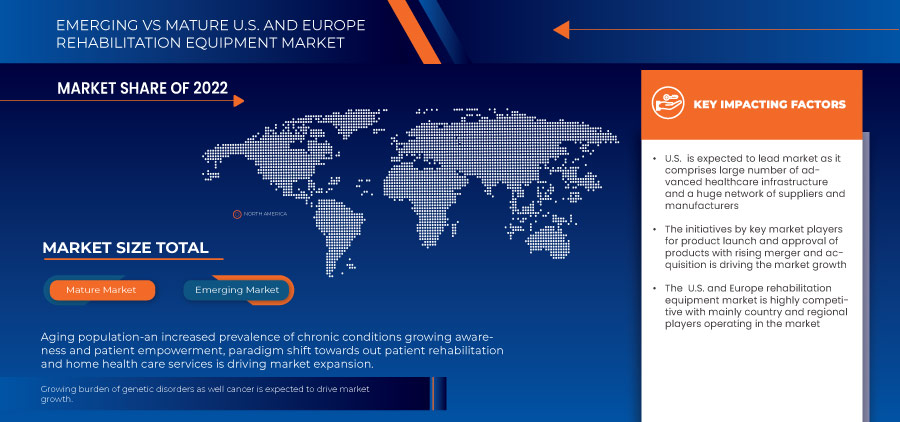
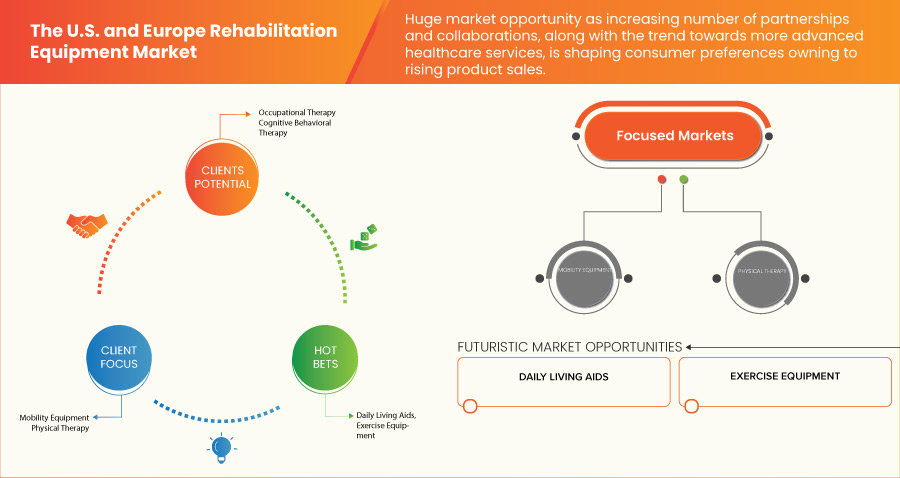
Data Bridge Market Research analyzes that the U.S. rehabiilitation equipment market is expected to grow at a CAGR of 6.7% in the forecast period of 2024 to 2031 and is expected to reach USD 9.34 billion by 2031 from USD 5.64 billion in 2023.
Europe rehabiilitation equipment market is expected to grow at a CAGR of 7.2% in the forecast period of 2024 to 2031 and is expected to reach USD 7.45 billion by 2031 from USD 4.34 billion in 2023. The enterprise customer solutions segment is projected to propel the market growth due to the rising adoption rehabiilitation equipment.
|
Report Metric |
Details |
|
Forecast Period |
2024 to 2031 |
|
Base Year |
2023 |
|
Historic Years |
2022 (Customizable to 2016–2021) |
|
Quantitative Units |
Revenue in USD Billion |
|
Segments Covered |
By Product (Mobility Equipment, Exercise Equipment, Daily Living Aids, Body Support Devices, Electromedical Therapy Products, Game Based Therapy Devices and Others), Therapy (Physical Therapy, Occupational Therapy, Speech and Language Therapy, Cognitive Therapy and Others), Application (Orthopedic Rehabilitation, Neurological Rehabilitation, Oncology Rehabilitation and Others), Method (Conventional, and Tele-Rehabilitation), End User (Hospitals, Rehabilitation Centers, Skilled Nursing and Long Term Care Facilities, Sports and Fitness Centers, Home Health, and Others), Distribution Channel (Offline, and Online) |
|
Countries Covered |
U.S., Germany, U.K., France, Italy, Netherlands, Spain, Russia, Switzerland, Turkey, and Rest of Europe |
|
Market Players Covered |
Drive Devilbiss Healthcare, Dynatronics Corporation, Baxter International Inc. (Hill- rom Services Inc.), Enovis (DJO Global, Inc.), ETAC AB, Joerns Healthcare, Prism Medical, EZ Way Inc., Technobody, Handicare, Sunrise Medical, Enraf- nonius, Antano Group, Proxomed, Spine Care Technologies Inc., among others |
Market Definition
The market for rehabilitation equipment in Europe and the U.S. refers to the industry that produces, distributes, and sells medical devices, equipment, and technology designed to aid in the recovery, treatment, and management of patients with physical impairments, disabilities, or those undergoing rehabilitation processes. This market encompasses a wide range of products, including orthotic and prosthetic devices, physical therapy equipment, wheelchairs, and assistive technology.
Europe and U.S. Rehabilitation Equipment Market Dynamics
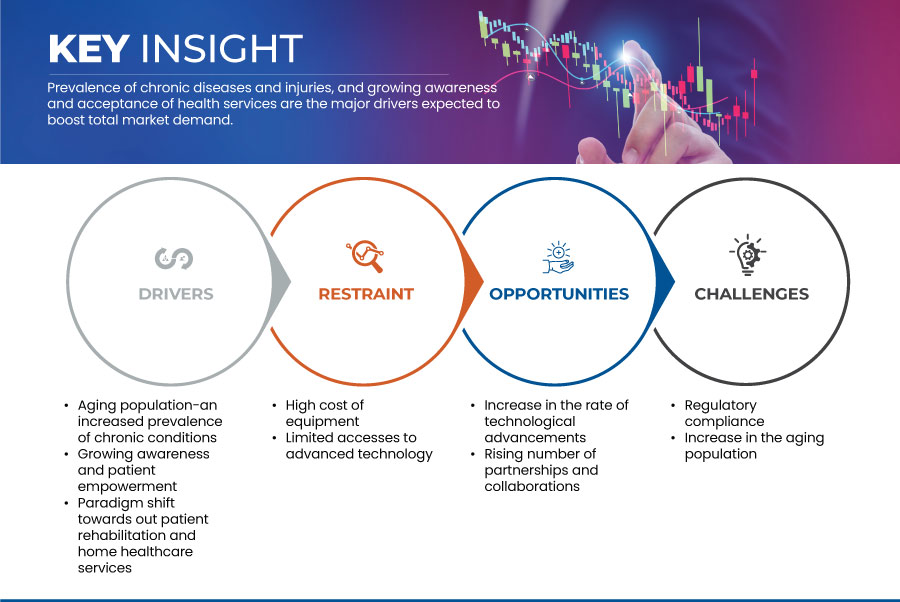
This section deals with understanding the market drivers, opportunities, restraints, and challenges. All of this is discussed in detail below:
Driver
- Growing Awareness and Patient Empowerment
There is a growing awareness among patients, caregivers, and healthcare professionals about the importance of rehabilitation in improving functional outcomes and overall well-being, leading to increased demand for rehabilitation equipment and services.
The market for rehabilitation equipment is being driven by factors such as growing patient empowerment and growing awareness of the critical role that rehabilitation plays in enhancing overall well-being and functional outcomes for patients, caregivers, and healthcare professionals. As people become more aware, there is a larger need for cutting-edge rehabilitation technology that speeds up healing and promotes independence. Innovative solutions to support their rehabilitation process are actively looked after by empowered patients, which has increased the use of state-of-the-art technologies and individualized rehabilitation plans. This trend encourages patients and healthcare professionals to work together to develop customized rehabilitation plans and a more comprehensive approach to patient care, which drives market expansion in the rehabilitation equipment industry.
Restraint
- High Cost of Equipment
The cost of advanced rehabilitation equipment can be prohibitive for some healthcare facilities and patients, limiting adoption, especially in regions with constrained healthcare budgets.
The market for rehabilitation equipment has been severely limited by the high cost of the equipment, which prevents both patients and healthcare facilities from using it. High-tech rehabilitation technologies are frequently expensive, thus several healthcare providers with tight resources cannot afford them. Furthermore, patients might not have enough money to buy or obtain pricey rehabilitation equipment, particularly if insurance coverage or reimbursement guidelines are insufficient. Due to their high cost, innovative rehabilitation solutions may not be widely adopted, which might hinder market growth and possibly reduce people of necessary rehabilitation services.
For instances,
- In September 2022, an article titled as “Purchasing high-cost medical devices and equipment in hospitals: a systematic review”: The importance of medical equipment and technology for preserving the functionality of the health system has been emphasized by the World Health Organization (WHO). Poor technology distribution and selection can lead to waste and inefficiencies, as well as jeopardize the standard of healthcare services, as the current COVID-19 epidemic shown. Medical device safety is ensured by design principles and regulatory criteria, which work together to prevent these hazards and guarantee that devices are safe enough to be put on the market.
Opportunity
- Increase in the demand of Home- based rehabilitation
With advancements in technology, more people are opting for home-based rehabilitation due to its convenience, comfort, and cost-effectiveness. This shift has created a need for portable and easy-to-use rehabilitation equipment that can be used in the comfort of one's home. The growing demand for home-based rehabilitation is driven by several factors, including convenience, comfort, cost-effectiveness, and advancements in technology. By understanding these factors, manufacturers and healthcare providers can develop and offer rehabilitation equipment and services that cater to this growing market.
Home-based rehabilitation allows patients to undergo treatment without the need to travel to a hospital or clinic. This saves time and effort, especially for individuals with mobility issues or those living in remote areas. The convenience factor has made home-based rehabilitation an attractive option for patients seeking a more flexible and accessible treatment experience. Receiving rehabilitation treatment in the comfort of one's home can help patients feel more relaxed and at ease. This can lead to better mental well-being, which is crucial for the overall recovery process. Additionally, patients can create a personalized environment tailored to their specific needs, making the rehabilitation experience more comfortable and enjoyable.
For instance,
In October 2020, according to a news article published, a new portable arm rehabilitation device was launched to help patients perform robot-aided therapy at home. This launch helped the patients to perform intensive exercises that, in turn, protect the patients from getting in contact with infectious diseases.
Challenge
- Regulatory Compliance
The rehabilitation equipment market is heavily regulated to ensure patient safety and effectiveness of the devices. Navigating and adhering to these regulatory requirements can be a significant challenge for manufacturers, as it may involve lengthy approval processes and high compliance costs. Regulatory compliance in the rehabilitation equipment market refers to the adherence to a set of rules, standards, and guidelines established by governmental agencies, regulatory bodies, and industry associations to ensure the safety, efficacy, and quality of rehabilitation devices and equipment. These regulatory frameworks aim to protect patients, healthcare professionals, and the general public while promoting innovation and fair competition within the industry.
Regulatory bodies establish specific requirements for the design, manufacturing, and testing of rehabilitation equipment to ensure that they meet safety standards and perform as intended. This includes evaluating the durability, reliability, and effectiveness of the devices in achieving their intended therapeutic goals. Manufacturers must implement and maintain quality management systems that cover all aspects of their operations, from product development to post-market surveillance. These systems help ensure consistent quality, traceability, and continuous improvement in the production of rehabilitation equipment. Regulatory compliance also includes providing accurate and clear information about the intended use, indications, contraindications, warnings, and precautions related to rehabilitation equipment. This information is crucial for healthcare professionals and patients to make informed decisions and use the devices appropriately.
For instance,
In June 2020, according to an article published on National Library of Medicine, the article stated that the laws on data protection including regulations regarding the protection of privacy and confidentiality of health information regarding the rehabilitation equipment’s is a crucial case.
Europe and U.S. Rehabilitation Equipment Market Scope
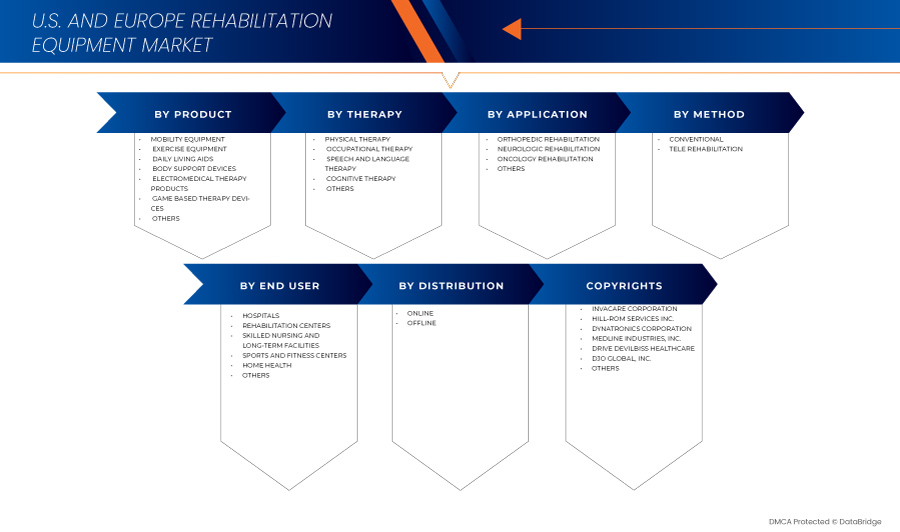
The Europe and U.S. rehabilitation equipment market is segmented into six notable segments based on product, therapy, application, method, end user, and distribution channel. The growth among segments helps you analyze niche pockets of growth and strategies to approach the market and determine your core application areas and the differences in your target markets.
Product
- Mobility Equipment
- Exercise Equipment
- Daily Living Aids
- Body Support Devices
- Electromedical Therapy Products
- Game Based Therapy Devices
- Others
On the basis of product, the market is segmented into mobility equipment, exercise equipment, daily living aids, body support devices, electromedical therapy products, game based therapy devices and others.
Therapy
- Physical Therapy
- Occupational Therapy
- Speech and Language Therapy
- Cognitive Therapy
- Others
On the basis of therapy, the market is segmented into physical therapy, occupational therapy, speech and language therapy, cognitive therapy and others.
Application
- Orthopedic Rehabilitation
- Neurological Rehabilitation
- Oncology Rehabilitation
- Others
On the basis of application, the market is segmented into orthopedic rehabilitation, neurological rehabilitation, oncology rehabilitation and others.
Method
- Conventional
- Tele- Rehabilitation
On the basis of method, the market is segmented into conventional and tele- rehabilitation.
End User
- Hospitals
- Rehabilitation Centers
- Skilled Nursing and Long Term Care Facilities
- Sports And Fitness Centers
- Home Health
- Others
On the basis of end user, the market is segmented into hospitals, rehabilitation centers, skilled nursing and long term care facilities, sports and fitness centers, home health and others.
Distribution Channel
- Offline Channel
- Online Channel
On the basis of service channel, the market is segmented into offline channel, and online channel.
Europe and U.S. Rehabilitation Equipment Market Regional Analysis/Insights
The Europe and U.S. rehabilitation equipment market is segmented into six notable segments based on product, therapy, application, method, end user, and distribution channel.
The countries covered in this market report are U.S., Germany, U.K., France, Italy, Netherlands, Spain, Russia, Switzerland, Turkey, and rest of Europe.
U.S. is expected to dominate in Europe and U.S. rehabilitation equipment market, owing to high number of people taking rehabilation treatments.
The country section of the report also provides individual market-impacting factors and changes in regulation in the market domestically that impact the current and future trends of the market. Data points such as new sales, replacement sales, country demographics, regulatory acts, and import-export tariffs are some of the major pointers used to forecast the market scenario for individual countries. Also, the presence and availability of large services company and their challenges faced due to large or scarce competition from local and domestic players and the impact of sales channels are considered while providing forecast analysis of the country data.
Competitive Landscape and Europe and U.S. Rehabilitation Equipment Market Share Analysis
The Europe and U.S. rehabilitation equipment market competitive landscape provides details of competitors. Details included are company overview, company financials, revenue generated, market potential, investment in R&D, new market initiatives, production sites and facilities, company strengths and weaknesses, product launch, product approvals, product width and breadth, application dominance, and product type lifeline curve. The above data points provided are only related to the company’s focus on the market.
Some of the major market players operating in the market are ETAC AB., Vitrex Medical A/S, Joerns Healthcare , Sunrise Medical, Handicare, Proxomed, Prism Medical, Invacare Corporation, Medline Industries, Inc., Drive deVilbiss Healthcare, Antano Group, GF Health Products, Inc., Technomex, Spine Care Technologies, Enraf Nonius, Roma Medical, Dynatronics Corporation, Carex ,Tecnobody , Ez Way, Inc., Hill- rom Services, Inc., and Djo Ltd., among others.
SKU-
Obtenha acesso online ao relatório sobre a primeira nuvem de inteligência de mercado do mundo

- Painel interativo de análise de dados
- Painel de análise da empresa para oportunidades de elevado potencial de crescimento
- Acesso de analista de pesquisa para personalização e customização. consultas
- Análise da concorrência com painel interativo
- Últimas notícias, atualizações e atualizações Análise de tendências
- Aproveite o poder da análise de benchmark para um rastreio abrangente da concorrência
Metodologia de Investigação
A recolha de dados e a análise do ano base são feitas através de módulos de recolha de dados com amostras grandes. A etapa inclui a obtenção de informações de mercado ou dados relacionados através de diversas fontes e estratégias. Inclui examinar e planear antecipadamente todos os dados adquiridos no passado. Da mesma forma, envolve o exame de inconsistências de informação observadas em diferentes fontes de informação. Os dados de mercado são analisados e estimados utilizando modelos estatísticos e coerentes de mercado. Além disso, a análise da quota de mercado e a análise das principais tendências são os principais fatores de sucesso no relatório de mercado. Para saber mais, solicite uma chamada de analista ou abra a sua consulta.
A principal metodologia de investigação utilizada pela equipa de investigação do DBMR é a triangulação de dados que envolve a mineração de dados, a análise do impacto das variáveis de dados no mercado e a validação primária (especialista do setor). Os modelos de dados incluem grelha de posicionamento de fornecedores, análise da linha de tempo do mercado, visão geral e guia de mercado, grelha de posicionamento da empresa, análise de patentes, análise de preços, análise da quota de mercado da empresa, normas de medição, análise global versus regional e de participação dos fornecedores. Para saber mais sobre a metodologia de investigação, faça uma consulta para falar com os nossos especialistas do setor.
Personalização disponível
A Data Bridge Market Research é líder em investigação formativa avançada. Orgulhamo-nos de servir os nossos clientes novos e existentes com dados e análises que correspondem e atendem aos seus objetivos. O relatório pode ser personalizado para incluir análise de tendências de preços de marcas-alvo, compreensão do mercado para países adicionais (solicite a lista de países), dados de resultados de ensaios clínicos, revisão de literatura, mercado remodelado e análise de base de produtos . A análise de mercado dos concorrentes-alvo pode ser analisada desde análises baseadas em tecnologia até estratégias de carteira de mercado. Podemos adicionar quantos concorrentes necessitar de dados no formato e estilo de dados que procura. A nossa equipa de analistas também pode fornecer dados em tabelas dinâmicas de ficheiros Excel em bruto (livro de factos) ou pode ajudá-lo a criar apresentações a partir dos conjuntos de dados disponíveis no relatório.











