



Europe Mass Notification Systems Market Segmentation, By Offering (Hardware, Software, and Service), Solution (In-Building Solutions, Distributed Recipient Solutions, and Wide-Area Solutions), Deployment Model (On-Premises and Cloud), Organization Size (Large Organization and Small and Medium Organization), Application (Integrated Public Alert and Warning System (IPAWS), Interoperable Emergency Communication, Business Continuity and Disaster Recovery), End User (Commercial, Industrial, Healthcare, Energy and Utilities, IT and Telecommunication, Education, Transport and Logistics, Hospitality, Government, Defense, Retail, and Others) - Industry Trends and Forecast to 2033
Qual é a dimensão e a taxa de crescimento do mercado dos sistemas europeus de notificação em massa
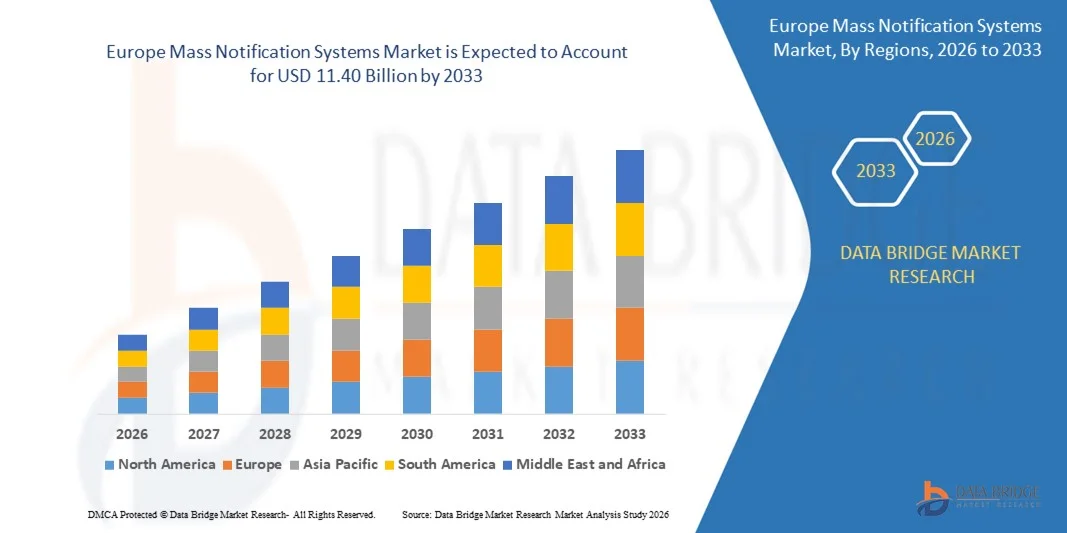
- De acordo com Data Bridge Market Research Analysis the A dimensão do mercado dos sistemas europeus de notificação em massa foi avaliada emUSD 3,05 mil milhões em 2025e espera-se alcançar11,40 mil milhões de USD até 2033, em umaCAGR de 17,9%durante o período de previsão
- O crescimento do mercado é em grande parte impulsionado pela crescente necessidade de comunicação de emergência rápida, confiável e multicanal entre organizações públicas e privadas, uma vez que os crescentes incidentes relacionados com desastres naturais, ameaças de segurança e emergências no local de trabalho estão aumentando os requisitos de preparação
- Além disso, a crescente ênfase regulatória na conformidade com a segurança pública e a crescente adoção de tecnologias de comunicação em nuvem e móveis estão incentivando as organizações a investir em sistemas avançados de notificação de massa. Estes factores combinados estão a acelerar a implantação do sistema entre empresas e organismos governamentais, apoiando assim de forma significativa a expansão global do mercado.
Tamanho e previsão do mercado
- Valor de mercado europeu (2025): USD 3,05 Bilhões
- Valor de mercado previsto (2033): 11,40 milhões de dólares
- Previsões CAGR (2026-2033): 17.9%
Análise de mercado dos sistemas de notificação em massa da Europa
- Sistemas de notificação em massa são plataformas de comunicação projetadas para divulgar rapidamente alertas críticos e instruções para grandes grupos através de canais como SMS, chamadas de voz, e-mails, aplicativos móveis e notificações de desktop, garantindo a conscientização oportuna durante emergências
- A crescente demanda por sistemas de notificação de massa é principalmente suportada pelo aumento do foco na resiliência organizacional, integração crescente com soluções de segurança e gerenciamento de incidentes, e a necessidade de conscientização situacional em tempo real para minimizar o risco e melhorar os resultados de resposta de emergência
- A Alemanha dominou o mercado dos sistemas de notificação em massa em 2025, devido à forte ênfase regulamentar na segurança no local de trabalho, preparação para emergências e sistemas públicos de alerta nos setores industrial e público
- Espera-se que o Reino Unido seja o país em crescimento mais rápido no mercado de sistemas de notificação em massa durante o período de previsão, devido ao crescente foco na segurança pública, continuidade empresarial e conformidade regulamentar entre empresas e instituições públicas
- O segmento de software dominou o mercado com uma quota de mercado de cerca de 65% em 2025, devido à demanda por plataformas de alerta centralizadas que podem integrar entre dispositivos e canais de comunicação. Organizações estão adotando cada vez mais plataformas de software robustas que oferecem alertas em tempo real, mensagens multicanais e escalabilidade para atender às necessidades de diversas operações e protocolos de emergência
Relatar Escopo e Sistemas de Notificação em Massa
|
Atributos |
Sistemas de Notificação em Massa Principais Insights do Mercado |
|
Segmentos Cobertos |
|
|
Países abrangidos |
Europa
|
|
Jogadores do mercado chave |
|
|
Oportunidades de Mercado |
|
|
Informações sobre o Valor Adicionado |
Além dos insights de mercado, como valor de mercado, taxa de crescimento, segmentos de mercado, cobertura geográfica, atores de mercado e cenário de mercado, o relatório de mercado curado pela equipe de Pesquisa do Mercado da Ponte de Dados inclui análise de especialistas em profundidade, análise de importação/exportação, análise de preços, análise de consumo de produção e análise de pilão. |
Qual é a tendência chave no mercado europeu de sistemas de notificação em massa
Integração crescente de plataformas de notificação de massa com base em nuvem e dispositivos móveis
- Uma grande tendência no mercado de sistemas de notificação de massa é a crescente integração de arquiteturas baseadas em nuvem e plataformas habilitadas para dispositivos móveis, impulsionadas pela necessidade de comunicação de emergência mais rápida, escalável e independente de localização. Esta integração está aumentando a capacidade das organizações de fornecer alertas em tempo real em vários canais, garantindo flexibilidade e confiabilidade do sistema durante eventos críticos
- Por exemplo, a Everbridge expandiu seus recursos de notificação de massa em nuvem para suportar comunicações multicanais através de aplicativos SMS, voz, e-mail e móveis, permitindo que empresas e instituições públicas melhorassem a velocidade e coordenação da resposta a crises. Tais plataformas reforçam o alcance da comunicação e apoiam a gestão centralizada de alertas entre usuários geograficamente dispersos
- A adoção de sistemas de notificação de massa habilitados para dispositivos móveis está aumentando à medida que os smartphones se tornam o principal dispositivo de comunicação para funcionários, estudantes e cidadãos. Isto está a melhorar a eficácia da transmissão de mensagens e a garantir taxas de resposta mais elevadas durante as emergências
- Organizações com força de trabalho distribuída estão cada vez mais contando com plataformas de notificação hospedadas na nuvem para manter a continuidade dos negócios e segurança dos funcionários. Esta é a implantação da nuvem de posicionamento como uma abordagem preferencial para comunicação de emergência escalável e resistente
- A integração de sistemas de notificação de massa com outras plataformas digitais de segurança e segurança está ganhando força à medida que as organizações buscam estruturas unificadas de resposta a incidentes. Esta tendência está a reforçar o papel da nuvem e das tecnologias móveis na construção de ecossistemas de segurança ligados e responsivos
- A crescente dependência da infraestrutura digital para a preparação de emergência está fortalecendo essa tendência, uma vez que as plataformas de notificação de massa baseadas em nuvem e habilitadas para dispositivos móveis suportam rápida implantação, atualizações em tempo real e disponibilidade contínua do sistema em diversos ambientes
Dinâmica do mercado dos sistemas europeus de notificação em massa
Controlador
Foco crescente na comunicação de emergência em tempo real e conformidade com a segurança pública
- A crescente ênfase na comunicação de emergência em tempo real é um fator chave para o mercado de sistemas de notificação de massa, uma vez que as organizações priorizam a disseminação de informações oportunas para minimizar o risco e proteger vidas. Uma maior sensibilização para a segurança no local de trabalho, a segurança pública e a preparação para catástrofes encoraja a adopção mais ampla destes sistemas
- Por exemplo, o Toronto Zoo selecionou o sistema de notificação em massa da Everbridge para comunicar rapidamente alertas críticos aos funcionários e visitantes, melhorando a gestão da segurança no local durante emergências. Esta adopção reflecte a forma como os locais públicos estão a reforçar o cumprimento das regras de segurança através de plataformas de notificação fiáveis
- As agências e empresas governamentais estão investindo em soluções de notificação em massa para atender aos requisitos regulamentares relacionados com a preparação de emergência e as obrigações públicas de alerta. Esses sistemas suportam protocolos de comunicação padronizados e garantem uma entrega de alerta consistente
- A crescente frequência de catástrofes naturais, incidentes de segurança e perturbações operacionais está a aumentar a necessidade de uma comunicação coordenada e imediata. Isso reforça a importância dos sistemas de notificação de massa como componentes essenciais das estratégias de resiliência organizacional
- A crescente expectativa de comunicação de emergência transparente, rápida e precisa está solidificando as capacidades de notificação em tempo real como um driver crítico que molda a expansão do mercado a longo prazo
Restrição/Desafio
Altos Custos de Implementação e Complexidade de Integração
- O mercado de sistemas de notificação em massa enfrenta desafios relacionados com elevados custos de implementação e a complexidade da integração de novas plataformas com as infraestruturas de TI e comunicação existentes. Estes factores podem retardar a adopção, especialmente entre as organizações sensíveis aos custos
- Por exemplo, implantações em larga escala por empresas que integram sistemas de notificação de massa com sistemas de telefonia, segurança e gestão de edifícios legados muitas vezes requerem investimento inicial significativo e personalização técnica. Isso aumenta os prazos de implantação e os custos globais do projeto
- A integração complexa do sistema exige recursos de TI qualificados e manutenção contínua, aumentando as despesas operacionais para as organizações. Estes requisitos podem limitar a adopção de pequenas e médias organizações
- Garantir a interoperabilidade entre vários canais de comunicação e plataformas de terceiros aumenta ainda mais a complexidade do sistema. As organizações devem investir em testes e configuração para manter a entrega de alerta confiável
- Estes desafios relacionados com a integração e os custos continuam a ser restrições fundamentais que influenciam as taxas de adoção, apesar da necessidade crescente de soluções eficazes de notificação em massa nos setores público e privado
Sistema Europeu de Notificação em Massa
O mercado é segmentado com base na oferta, solução, modelo de implantação, tamanho da organização, aplicação e usuário final.
- Oferecendo
Com base na oferta, o mercado de sistemas de notificação em massa é segmentado em hardware, software e serviço. O segmento de software dominou o mercado com a maior parcela de receita de cerca de 65% em 2025, impulsionada pela demanda por plataformas de alerta centralizadas que podem integrar entre dispositivos e canais de comunicação. As organizações estão adotando cada vez mais plataformas de software robustas que oferecem alertas em tempo real, mensagens multicanais e escalabilidade para atender às necessidades de diversas operações e protocolos de emergência.
Espera-se que o segmento de serviços testemunhe a taxa de crescimento mais rápida de 2026 a 2033, impulsionada pela crescente demanda por serviços gerenciados e profissionais. Esses serviços incluem integração, manutenção e suporte do sistema, que são fundamentais para garantir uma operação ininterrupta e o cumprimento dos requisitos de segurança específicos do setor.
- Por Solução
Com base na solução, o mercado de sistemas de notificação de massa é segmentado em soluções de construção, soluções de receptores distribuídos e soluções de ampla área. O segmento de soluções de destinatários distribuídos teve a maior participação de receita em 2025, impulsionada pela necessidade de alcançar usuários através de vários canais, como SMS, e-mail, chamadas telefônicas e aplicativos móveis. Essas soluções permitem que as organizações forneçam alertas rápidos em todas as geografias e são amplamente adotadas para comunicação interna e pública.
Espera-se que o segmento de soluções de ampla área testemunhe a taxa de crescimento mais rápida de 2026 para 2033, impulsionada pelo aumento dos investimentos em sistemas de alerta em toda a cidade e iniciativas governamentais para segurança pública e resposta a desastres. Estes sistemas são essenciais para sirenes de aviso ao ar livre e alertas baseados em geolocalização.
- Por modelo de implantação
Com base no modelo de implantação, o mercado de sistemas de notificação de massa é segmentado em locais e nuvem. O segmento de nuvem teve a maior participação de receita em 2025, atribuída à sua flexibilidade, escalabilidade e custos iniciais mais baixos. As soluções baseadas em nuvem permitem uma rápida implantação e são particularmente adequadas para organizações com operações distribuídas ou infraestrutura de TI limitada.
Espera-se que o segmento no local testemunhe a taxa de crescimento mais rápida de 2026 a 2033, devido à sua relevância para instituições com rigoroso controle de dados, conformidade de segurança ou operações offline. Organizações governamentais e de defesa geralmente preferem implantações no local para manter o controle total sobre dados sensíveis.
- Por Tamanho da Organização
Com base no tamanho da organização, o mercado de sistemas de notificação de massa é segmentado em grandes organizações e pequenas e médias organizações. O segmento de grandes organizações representou a maior participação de receita em 2025, impulsionada pela escala e complexidade das necessidades de comunicação em diversas instalações e departamentos. Essas organizações priorizam alerta rápido, conformidade e continuidade de negócios, muitas vezes investindo em infraestrutura de notificação abrangente.
Espera-se que o segmento de organização de pequeno e médio porte testemunhe a taxa de crescimento mais rápida de 2026 a 2033, alimentada pela crescente conscientização dos benefícios dos sistemas de notificação de massa na mitigação dos riscos. Soluções baseadas em nuvem e econômicas tornam a adoção viável para empresas menores com orçamentos limitados.
- Por Aplicação
Com base na aplicação, o mercado de sistemas de notificação de massa é segmentado em Sistema Integrado de Alerta Público e Aviso (IPAWS), comunicação de emergência interoperável, continuidade de negócios e recuperação de desastres. O segmento de continuidade de negócios e recuperação de desastres dominou o mercado em 2025, impulsionado pelo aumento de incidentes de ciberataques, desastres naturais e interrupções operacionais. Empresas de todas as indústrias estão adotando MNS para garantir a entrega de informações em tempo real e minimizar o tempo de inatividade.
Espera-se que o segmento Integrado do Sistema Integrado de Alerta e Aviso Público (IPAWS) testemunhe a taxa de crescimento mais rápida entre 2026 e 2033, particularmente em países com quadros avançados de resposta a emergências. O IPAWS apoia alertas nacionais, melhorando a coordenação entre agências públicas e comunidades.
- Por Usuário Final
Com base no utilizador final, o mercado dos sistemas de notificação em massa é segmentado em sistemas comerciais, industriais, de saúde, de energia e de serviços públicos, de TI e de telecomunicações, de educação,transporte e logística, hospitalidade, governo, defesa, varejo e outros. O segmento do governo detinha a maior quota de receita de mercado em 2025, impulsionada por mandatos nacionais para sistemas de emergência e alerta público. Os governos estão implementando sistemas avançados de notificação em massa para comunicação de crises, alertas de evacuação e alertas meteorológicos.
Espera-se que o segmento de saúde testemunhe a taxa de crescimento mais rápida de 2026 a 2033, impulsionada pela necessidade crítica de coordenação em tempo real em hospitais, clínicas e serviços de assistência. Plataformas de MNS ajudam a gerenciar alertas de equipe, notificações de pacientes e o cumprimento dos padrões de saúde e segurança.
Análise regional do mercado dos sistemas de notificação em massa na Europa
- A Alemanha dominou o mercado de sistemas de notificação em massa com a maior parte de receitas em 2025, impulsionada pela forte ênfase regulamentar na segurança no local de trabalho, preparação para emergências e sistemas públicos de alerta nos setores industrial e público
- A base industrial avançada do país, a adoção generalizada de infraestrutura de comunicação digital e a alta penetração de plataformas de segurança e segurança das empresas continuam a apoiar a demanda consistente por sistemas de notificação em massa em aplicações de manufatura, transporte e governo
- Aumentar os investimentos em infraestrutura inteligente, gestão crítica de eventos e plataformas de segurança integradas, apoiadas por fornecedores de tecnologia como Siemens e Bosch Building Technologies, reforçam a posição de liderança da Alemanha. Melhorias contínuas dos sistemas de alerta público e dos quadros de comunicação empresarial garantem a posição dominante da Alemanha no mercado europeu de sistemas de notificação em massa
Sistema de Notificação em Massa do Reino Unido
O Reino Unido está projetado para registrar o CAGR mais rápido no mercado europeu de sistemas de notificação de massa de 2026 a 2033, apoiado pelo crescente foco na segurança pública, continuidade de negócios e conformidade regulatória entre empresas e instituições públicas. Por exemplo, organizações em toda a educação, saúde e governo local cada vez mais implantar plataformas de provedores como Everbridge para apoiar a comunicação de emergência multicanal. A expansão da adoção de soluções de notificação baseadas na nuvem, fortes iniciativas de transformação digital e a crescente ênfase na prontidão para a resposta a crises estão acelerando a expansão do mercado. O crescente investimento em infraestruturas de comunicação resilientes posiciona o Reino Unido como o mercado de crescimento mais rápido da região.
França Mass Notification Systems Market Insight
Espera-se que a França testemunhe um crescimento constante durante 2026-2033, impulsionado pela demanda consistente de agências governamentais, autoridades de transporte e grandes empresas focadas em comunicação de emergência e resiliência operacional. O forte quadro de segurança pública do país e a ênfase na gestão coordenada de crises apoiam a adoção estável de sistemas de notificação em massa. O aumento da integração das plataformas de notificação com as infraestruturas de segurança, mobilidade e alerta público reforça a penetração no mercado. Investimentos estáveis em soluções de segurança digital, adesão às normas regulamentares e modernização contínua dos sistemas de comunicação reforçam o crescimento constante da França no mercado europeu de sistemas de notificação de massa.
Quais são as principais empresas da Europa no mercado de sistemas de notificação em massa
A indústria de sistemas de notificação em massa é liderada principalmente por empresas bem estabelecidas, incluindo:
- Controles Johnson(EUA)
- Grupo BearCom, Inc. (EUA)
- Omnilert (EUA)
- American Signal Corporation (EUA)
- Everbridge (EUA)
- Siemens (Alemanha)
- Anthology Inc.(EUA)
- 3S Incorporated (EUA)
- Singlewire Software, LLC. (EUA)
- xMatters.
- Alertus Technologies LLC. (EUA)
- Na Time Telecom, Inc. (EUA)
- Grupo Mircom de Empresas. (Canadá)
- Transputec Ltd. (U.K.)
- Alertar Cascade(U.K.)
- Alerta Media, Inc. (EUA)
- CriticalArc (Austrália)
- Aurea, Inc. (EUA)
- BlackBerry Limited. (Canadá)
- Mitel Networks Corp. (Canadá)
Os últimos desenvolvimentos na Europa Mass Notification Systems Market
- Em junho de 2024, o Toronto Zoo adotou o sistema de notificação em massa da Everbridge para reforçar as medidas de segurança para funcionários e visitantes, refletindo a crescente dependência em plataformas de comunicação de emergência multicanal em locais públicos. A implantação permite a disseminação rápida de alertas críticos através de SMS, e-mail, notificações de desktop e chamadas de voz, melhorando a coordenação de resposta durante emergências. Esta adoção destaca como a facilidade de implantação e as capacidades de comunicação escaláveis estão impulsionando uma maior penetração de sistemas de notificação de massa dentro de grandes instalações de alto nível, reforçando a demanda do mercado por soluções baseadas em nuvem e rapidamente implementáveis
- Em março de 2024, a Motorola Solutions aprimorou sua plataforma de notificação de massa Rave Alert, ampliando as capacidades de alerta em tempo real, análise e integração móvel para empresas e usuários do setor público. A atualização melhora a consciência situacional e acelera a tomada de decisões durante emergências, unificando alertas, dados incidentes e respostas do usuário em um único ecossistema. Este desenvolvimento fortalece o posicionamento competitivo da Motorola Solutions ao mesmo tempo que reforça a mudança de mercado para plataformas de notificação integradas e inteligentes que suportam respostas de emergência mais rápidas e coordenadas
- Em setembro de 2023, a Everbridge Inc. lançou o Everbridge 360 na conferência Global Security Exchange (GSX) 2023, introduzindo uma plataforma unificada de gerenciamento de eventos críticos e aviso público. Ao consolidar a inteligência de risco, comunicações, colaboração e coordenação em uma interface, a plataforma reduz o tempo de resposta e a complexidade operacional durante as crises. Este lançamento avança significativamente o mercado de sistemas de notificação em massa, abordando a demanda empresarial por soluções de resiliência de ponta a ponta que simplificam fluxos de trabalho de emergência e melhoram a preparação organizacional
- Em 2022, a Evolv Technology aprimorou seu sistema Evolv Express através da integração com o sistema de gerenciamento de vídeo Milestone e a plataforma de notificação de massa Titan HST, permitindo detecção sincronizada de ameaças e alertas em tempo real. A integração permite que as equipes de segurança ativem notificações imediatas com base em dados de detecção de armas nos pontos de entrada do local, melhorando a precisão e velocidade da resposta incidente. Esta inovação apoia a transição do mercado para ecossistemas de notificação de massa conectados e guiados pela inteligência, particularmente em ambientes de alto risco e de alta frequência
- Em 2022, a Acoustic Technology, Inc. introduziu uma nova linha de sistemas de notificação de massa que combinaram suas capacidades estabelecidas com recursos atualizados focados na eficiência de comunicação em tempo real e confiabilidade do sistema. O produto lança uma melhor entrega de alerta de emergência e desempenho operacional, apoiando uma comunicação mais confiável durante eventos críticos. Este desenvolvimento reforça a estratégia orientada para a inovação da empresa, contribuindo simultaneamente para o crescimento global do mercado, melhorando a eficácia e a fiabilidade da infra-estrutura de notificação de massa em aplicações de segurança pública
SKU-
Obtenha acesso online ao relatório sobre a primeira nuvem de inteligência de mercado do mundo

- Painel interativo de análise de dados
- Painel de análise da empresa para oportunidades de elevado potencial de crescimento
- Acesso de analista de pesquisa para personalização e customização. consultas
- Análise da concorrência com painel interativo
- Últimas notícias, atualizações e atualizações Análise de tendências
- Aproveite o poder da análise de benchmark para um rastreio abrangente da concorrência
Metodologia de Investigação
A recolha de dados e a análise do ano base são feitas através de módulos de recolha de dados com amostras grandes. A etapa inclui a obtenção de informações de mercado ou dados relacionados através de diversas fontes e estratégias. Inclui examinar e planear antecipadamente todos os dados adquiridos no passado. Da mesma forma, envolve o exame de inconsistências de informação observadas em diferentes fontes de informação. Os dados de mercado são analisados e estimados utilizando modelos estatísticos e coerentes de mercado. Além disso, a análise da quota de mercado e a análise das principais tendências são os principais fatores de sucesso no relatório de mercado. Para saber mais, solicite uma chamada de analista ou abra a sua consulta.
A principal metodologia de investigação utilizada pela equipa de investigação do DBMR é a triangulação de dados que envolve a mineração de dados, a análise do impacto das variáveis de dados no mercado e a validação primária (especialista do setor). Os modelos de dados incluem grelha de posicionamento de fornecedores, análise da linha de tempo do mercado, visão geral e guia de mercado, grelha de posicionamento da empresa, análise de patentes, análise de preços, análise da quota de mercado da empresa, normas de medição, análise global versus regional e de participação dos fornecedores. Para saber mais sobre a metodologia de investigação, faça uma consulta para falar com os nossos especialistas do setor.
Personalização disponível
A Data Bridge Market Research é líder em investigação formativa avançada. Orgulhamo-nos de servir os nossos clientes novos e existentes com dados e análises que correspondem e atendem aos seus objetivos. O relatório pode ser personalizado para incluir análise de tendências de preços de marcas-alvo, compreensão do mercado para países adicionais (solicite a lista de países), dados de resultados de ensaios clínicos, revisão de literatura, mercado remodelado e análise de base de produtos . A análise de mercado dos concorrentes-alvo pode ser analisada desde análises baseadas em tecnologia até estratégias de carteira de mercado. Podemos adicionar quantos concorrentes necessitar de dados no formato e estilo de dados que procura. A nossa equipa de analistas também pode fornecer dados em tabelas dinâmicas de ficheiros Excel em bruto (livro de factos) ou pode ajudá-lo a criar apresentações a partir dos conjuntos de dados disponíveis no relatório.











