Global Alopecia Areata Market, By Disease Type (Alopecia Areata (Patchy), Alopecia Areata Totalis, Alopecia Areata Universalis, and Others), Cause (Non-Genetic and Genetic), Type (Treatment and Diagnosis), Age Group (Below 18 Years, 18-50 Years, and Above 50 Years), Gender (Female and Male) - Industry Trends and Forecast to 2031.
Alopecia Areata Market Analysis and Size
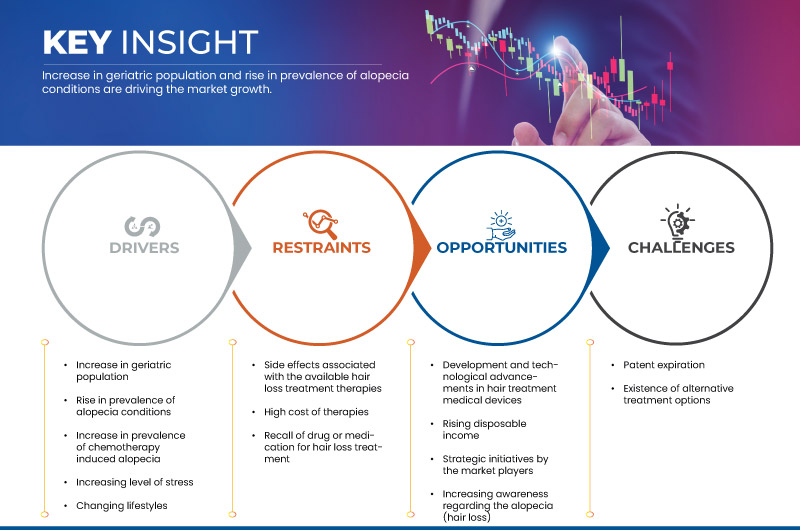
Key drivers of the global alopecia areata market include an increase in the geriatric population and rise in the prevalence of alopecia conditions. However, the market faces challenges such as patent expiration and existence of alternative treatment options. In addition, advancements in topical immunotherapy, which aims to retrain the immune system to stop attacking hair follicles, offer further avenues for treatment. The benefits of this market extend beyond just hair regrowth. Effective alopecia areata treatments can significantly improve a patient's quality of life by boosting self-esteem and reducing the psychological impact of hair loss.
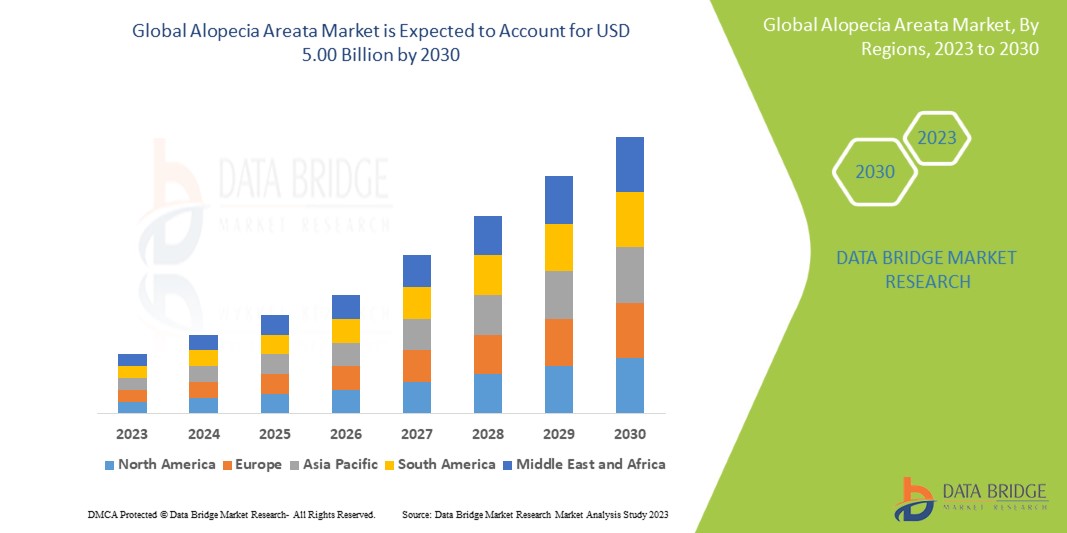
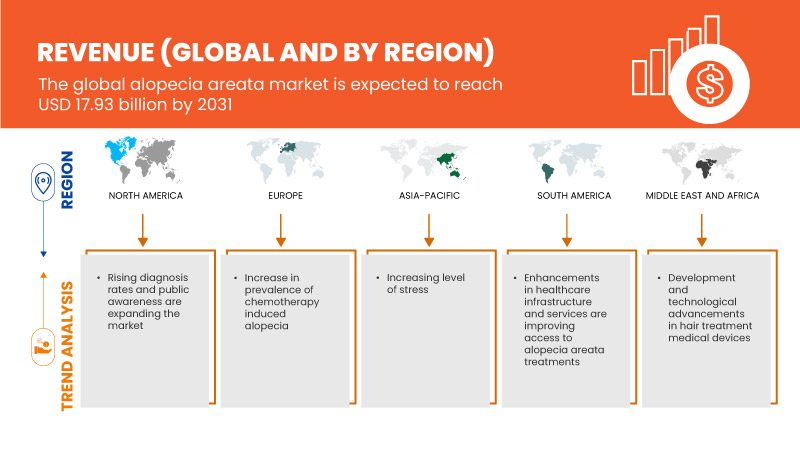
Data Bridge Market Research analyzes that the global alopecia areata market is growing with a CAGR of 8.1% in the forecast period of 2024 to 2031 and is expected to reach USD 17.93 billion by 2031 from USD 9.58 billion in 2023.
|
Report Metric |
Details |
|
Forecast Period |
2024 to 2031 |
|
Base Year |
2023 |
|
Historic Years |
2022 (Customizable 2016-2021) |
|
Quantitative Units |
Revenue in USD Billion |
|
Segments Covered |
Disease Type (Alopecia Areata (Patchy), Alopecia Areata Totalis, Alopecia Areata Universalis, and Others), Cause (Non-Genetic and Genetic), Type (Treatment and Diagnosis), Age Group (Below 18 Years, 18-50 Years, and Above 50 Years), Gender (Female and Male) |
|
Countries Covered |
U.S., Canada, Mexico, Germany, France, U.K., Italy, Spain, Netherlands, Russia, Switzerland, Turkey, Austria, Norway, Hungary, Lithuania, Ireland, Poland, Rest of Europe, Japan, China, South Korea, Australia, India, Singapore, Malaysia, Thailand, Indonesia, Philippines, Vietnam, Rest of Asia-Pacific, Brazil, Argentina, Peru, Rest of South America, Saudi Arabia, South Africa, U.A.E., Kuwait, Israel, Egypt, and Rest of Middle East and Africa |
|
Market Players Covered |
Pfizer Inc., Dr. Reddy's Laboratories Ltd., Lilly, Sun Pharmaceutical Industries Ltd., GSK plc., Johnson & Johnson Consumer Inc., Lupin, Croma-Pharma GmbH, Viviscal Limited (A Subsidiary of Church & Dwight Co.), AdvaCare Pharma, Wellona Pharma, Teva Pharmaceuticals USA, Inc., Croma-Pharma GmbH, Follicum AB, Nanogen, Vitabiotics Ltd., Reistone Biopharma, and TechnoDerma Medicines Inc., among others |
Market Definition
The global alopecia areata market encompasses the commercial landscape for treatments and therapies addressing alopecia areata, an autoimmune condition that causes hair loss by attacking hair follicles. This market includes a diverse range of products such as corticosteroids, immunosuppressant, biologics, and JAK inhibitors, as well as emerging therapies and novel drug developments aimed at restoring hair growth and managing symptoms. The market is also witnessing a growing interest in personalized medicine, where treatments are tailored to individual patient profiles, thereby increasing the efficacy and reducing potential side effects.
Global Alopecia Areata Market Dynamics
This section deals with understanding the market drivers, advantages, opportunities, restraints, and challenges. All of this is discussed in detail as below:
Drivers
- Increase in Geriatric Population
The escalating demand of alopecia treatment options has been observed across all over the globe and the reason behind is the rapid surge in hair loss among the old aged population. The older people are suffering from alopecia (hair loss) and used to rely on one or more than one type of alopecia treatment so as to achieve effective results. The older adult population is expanding, living longer but with several dermatological problems such as alopecia (hair loss) among others. The hair loss is a major concern among the older population and hence they look for an effective treatment options. The geriatric population is expanding dramatically. As the aging progress individuals suffers from the problem of hair loss. This thus signifies that increase in geriatric population acts as driver for the market growth.
- Rise in Prevalence of Alopecia Conditions
Alopecia has become a significant concern now days due to changing lifestyles and worse environmental conditions. Androgenetic alopecia is an extremely common disorder which has been reported to affect approximately 50% of men and a maximum numbers of women have also been reported to affect with alopecia. As the prevalence of alopecia is increasing worldwide the sufferers are adopting the most advanced, innovative, safe and effective treatment options in order to achieve the best treatment. Thus rising prevalence of alopecia conditions is acting as the driver for the alopecia market growth.
Opportunity
- Development and Technological Advancements in Hair Treatment Medical Devices
Technological advancement is one of the pre-requisite for achieving successful revenue growth in the market. Technological advancements in alopecia treatment (hair loss) products add on additional functions which enhances the success rate for achieving effective treatment. The commercialization of technologically advanced products leads to increased demand of it among the consumers. As the prevalence of alopecia is increasing, the demand of effective alopecia treatment (hair loss) is also increasing, this is why manufacturers involved in alopecia treatment (hair loss) market are focusing more towards launching new and advanced alopecia treatment (hair loss) products so as to attain a lucrative growth in the alopecia treatment (hair loss) market. This is why the technological advancements are propelling the alopecia treatment (hair loss) market growth.
Restraint/Challenge
- Side Effects Associated with the Available Hair Loss Treatment Therapies
The various therapies used for alopecia treatment (hair loss) involving localized therapies, topical corticosteroids, minoxidil, oral dutasteride, anthralin, finasteride, topical immunotherapy, and systemic therapies among others pose several kinds of health risks. These health risks restrict the patients suffering from various types of alopecia from using these drugs. Below are health risks associated with alopecia treatment (hair loss) therapies or treatments. Therefore, adverse effects associated with hair loss treatment therapies act as a factor hampering the growth of the alopecia market.
Recent Developments
- In January 2024, Lilly announced today that OLUMIANT (baricitinib) received regulatory approval for its severe alopecia areata indication via Notice of Compliance (NOC) from Health Canada. OLUMIANT is taken once daily, as a systemic treatment for adults with severe alopecia areata (AA), as 2 mg or 4 mg tablets orally. The recommended dose of OLUMIANT for patients living with severe alopecia areata is 2 mg/day, with an increase to 4 mg/day if treatment response is not adequate. For patients with nearly complete or complete scalp hair loss, with or without substantial eyelash or eyebrow hair loss, a starting dose 4 mg/day may be considered. Once an adequate response is achieved on 4 mg/day, dose reduction to 2 mg/day may be considered. OLUMIANT is not recommended for use in combination with other JAK inhibitors, biologic immunomodulators, azathioprine, cyclosporine or other potent immunosuppressant
- In December 2023, Pfizer Inc. announced the successful completion of its acquisition of Seagen Inc., a global biotechnology company known for discovering, developing, and commercializing transformative cancer medicines. Pfizer acquired all outstanding common stock of Seagen for USD 229 per share in cash, totalling approximately USD 43 billion in enterprise value
- In June 2023, Pfizer Inc. announced that the U.S. Food and Drug Administration (FDA) has approved LITFULO (ritlecitinib), a once-daily oral treatment for individuals aged 12 and older with severe alopecia areata. The approved recommended dose for LITFULO is 50 mg. This approval makes LITFULO the first and only FDA-approved treatment for adolescents (12+) with severe alopecia areata
- In January 2023, Sun Pharmaceutical Industries Limited (together with its subsidiaries and/or associated companies, “Sun Pharma”) and Concert Pharmaceuticals, Inc. (“Concert”) today announced that they have executed a definitive agreement under which Sun Pharma will acquire all outstanding shares of Concert through a tender offer for an upfront payment of USD 8.00 per share of common stock in cash, or USD 576 million in equity value
- In June 2022, Lilly and Incyte announced today that the U.S. Food and Drug Administration (FDA) has approved OLUMIANT (baricitinib), a once-daily pill, as a first-in-disease systemic treatment for adults with severe alopecia areata (AA), available as 4-mg, 2-mg and 1-mg tablets.1 The recommended dose is OLUMIANT 2-mg/day, with an increase to 4-mg/day if treatment response is inadequate
Global Alopecia Areata Market Scope
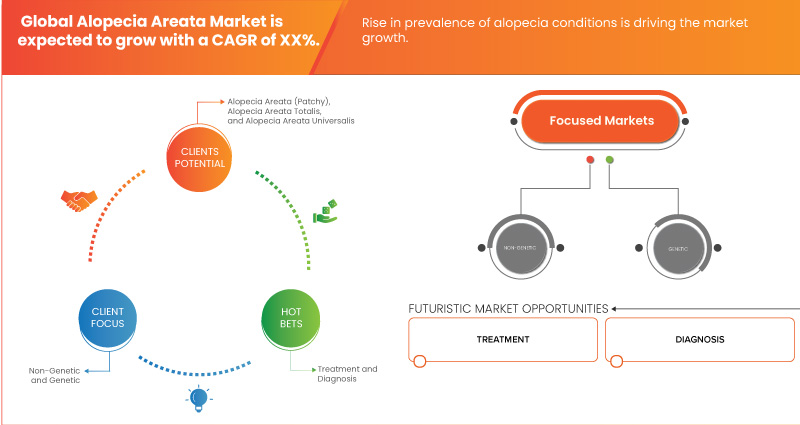
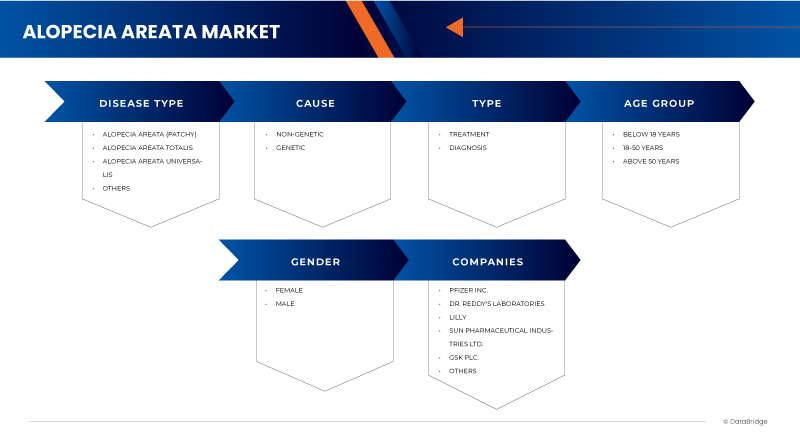
The global alopecia areata market is segmented into five notable segments based on disease type, cause, type, age group, and gender.
Disease Type
- Alopecia Areata (Patchy)
- Alopecia Areata Totalis
- Alopecia Areata Universalis
- Others
On the basis of disease type, the global alopecia areata market is segmented into alopecia areata (patchy), alopecia areata totalis, alopecia areata universalis and others.
Cause
- Non-Genetic
- Genetic
On the basis of cause, the global alopecia areata market is segmented into non-genetic and genetic.
Type
- Treatment
- Diagnosis
On the basis of type, the global alopecia areata market is segmented into treatment and diagnosis.
Age Group
- Below 18 Years
- 18-50 Years
- Above 50 Years
On the basis of age group, the global alopecia areata market is segmented into below 18 years, 18-50 years and above 50 years.
Gender
- Female
- Male
On the basis of gender, the global alopecia areata market is segmented into female and male.
Global Alopecia Areata Market Regional Analysis/Insights
The global alopecia areata market is analyzed, and market size insights and trends are provided by based on disease type, cause, type, age group, and gender as referenced above.
The countries covered in this market report are U.S., Canada, Mexico, Germany, France, U.K., Italy, Spain, Netherlands, Russia, Switzerland, Turkey, Austria, Norway, Hungary, Lithuania, Ireland, Poland, Rest of Europe, Japan, China, South Korea, Australia, India, Singapore, Malaysia, Thailand, Indonesia, Philippines, Vietnam, Rest of Asia-Pacific, Brazil, Argentina, Peru, Rest of South America, Saudi Arabia, South Africa, U.A.E., Kuwait, Israel, Egypt, and Rest of Middle East and Africa.
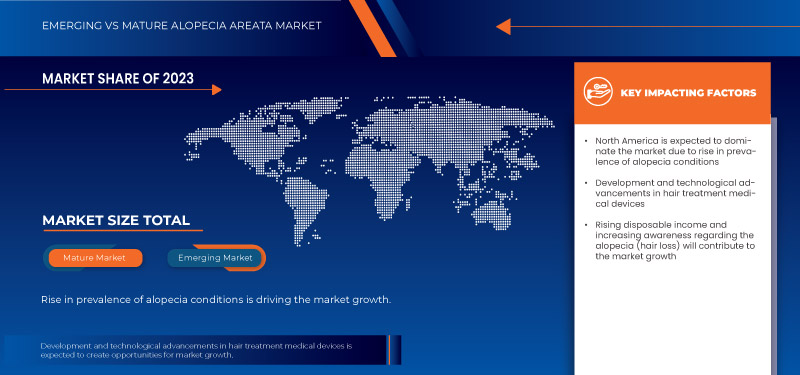
North America is expected to dominate the market due to its advanced healthcare infrastructure and high awareness levels. The U.S. is expected to dominate the market in North America region due to its strong healthcare system, robust research and development initiatives, and high prevalence of the condition. Germany is expected to dominate the market in Europe region due to its advanced healthcare infrastructure, strong pharmaceutical industry, and increasing focus on dermatological research and treatments. China is expected to dominate the market in Asia-Pacific region due to its large population base, growing awareness of dermatological conditions, and rapid advancements in healthcare infrastructure and treatment options.
The country section of the report also provides individual market impacting factors and changes in market regulation that impact the current and future trends of the market. Data points such as down-stream and upstream value chain analysis, technical trends and porter's five forces analysis, case studies are some of the pointers used to forecast the market scenario for individual countries. Also, the presence and availability of global brands and their challenges faced due to large or scarce competition from local and domestic brands, impact of domestic tariffs and trade routes are considered while providing forecast analysis of the country data.
Competitive Landscape and Global Alopecia Areata Market Share Analysis
The global alopecia areata market competitive landscape provides details by competitor. Details included are company overview, company financials, revenue generated, market potential, investment in research and development, new market initiatives, global presence, production sites and facilities, production capacities, company strengths and weaknesses, product launch, product width and breadth, and application dominance. The above data points provided are only related to the companies' focus on the global alopecia areata market.
Some of the major players operating in the global alopecia areata market are Pfizer Inc., Dr. Reddy's Laboratories Ltd., Lilly, Sun Pharmaceutical Industries Ltd., GSK plc., Johnson & Johnson Consumer Inc., Lupin, Croma-Pharma GmbH, Viviscal Limited (A Subsidiary of Church & Dwight Co.), AdvaCare Pharma, Wellona Pharma, Teva Pharmaceuticals USA, Inc., Croma-Pharma GmbH, Follicum AB, Nanogen, Vitabiotics Ltd., Reistone Biopharma, and TechnoDerma Medicines Inc., among others.
SKU-
Obtenha acesso online ao relatório sobre a primeira nuvem de inteligência de mercado do mundo
- Painel interativo de análise de dados
- Painel de análise da empresa para oportunidades de elevado potencial de crescimento
- Acesso de analista de pesquisa para personalização e customização. consultas
- Análise da concorrência com painel interativo
- Últimas notícias, atualizações e atualizações Análise de tendências
- Aproveite o poder da análise de benchmark para um rastreio abrangente da concorrência
Metodologia de Investigação
A recolha de dados e a análise do ano base são feitas através de módulos de recolha de dados com amostras grandes. A etapa inclui a obtenção de informações de mercado ou dados relacionados através de diversas fontes e estratégias. Inclui examinar e planear antecipadamente todos os dados adquiridos no passado. Da mesma forma, envolve o exame de inconsistências de informação observadas em diferentes fontes de informação. Os dados de mercado são analisados e estimados utilizando modelos estatísticos e coerentes de mercado. Além disso, a análise da quota de mercado e a análise das principais tendências são os principais fatores de sucesso no relatório de mercado. Para saber mais, solicite uma chamada de analista ou abra a sua consulta.
A principal metodologia de investigação utilizada pela equipa de investigação do DBMR é a triangulação de dados que envolve a mineração de dados, a análise do impacto das variáveis de dados no mercado e a validação primária (especialista do setor). Os modelos de dados incluem grelha de posicionamento de fornecedores, análise da linha de tempo do mercado, visão geral e guia de mercado, grelha de posicionamento da empresa, análise de patentes, análise de preços, análise da quota de mercado da empresa, normas de medição, análise global versus regional e de participação dos fornecedores. Para saber mais sobre a metodologia de investigação, faça uma consulta para falar com os nossos especialistas do setor.
Personalização disponível
A Data Bridge Market Research é líder em investigação formativa avançada. Orgulhamo-nos de servir os nossos clientes novos e existentes com dados e análises que correspondem e atendem aos seus objetivos. O relatório pode ser personalizado para incluir análise de tendências de preços de marcas-alvo, compreensão do mercado para países adicionais (solicite a lista de países), dados de resultados de ensaios clínicos, revisão de literatura, mercado remodelado e análise de base de produtos . A análise de mercado dos concorrentes-alvo pode ser analisada desde análises baseadas em tecnologia até estratégias de carteira de mercado. Podemos adicionar quantos concorrentes necessitar de dados no formato e estilo de dados que procura. A nossa equipa de analistas também pode fornecer dados em tabelas dinâmicas de ficheiros Excel em bruto (livro de factos) ou pode ajudá-lo a criar apresentações a partir dos conjuntos de dados disponíveis no relatório.