Segmentação do Mercado Global de Antifibrinolíticos por Medicamentos (Ácido Aminocaproico, Ácido Tranexâmico e Outros), Indicação (Ginecologia, Sangramento Gastrointestinal, Angioedema Hereditário, Hemorragia, Cirurgias e Outros), Via de Administração (Oral, Injetável e Outras), Usuários Finais (Hospitais, Assistência Domiciliar, Centros Especializados e Outros), Canal de Distribuição (Farmácia Hospitalar, Farmácia Online e Farmácia de Varejo) – Tendências e Previsões do Setor até 2033
O que é o tamanho do mercado antifibrinolítico e taxa de crescimento
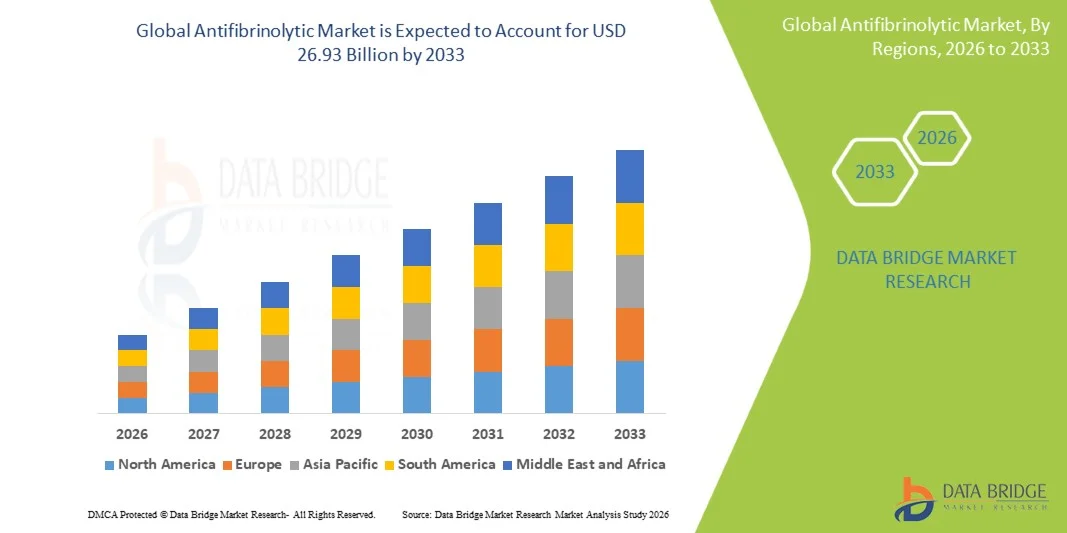
- De acordo com a Data Bridge Market Research Analysis, o tamanho global do mercado antifibrinolítico foi avaliado em18,23 mil milhões de dólares em 2025e espera-se alcançar26,93 mil milhões de USD até 2033, em umaCAGR de 5,00%durante o período de previsão
- O crescimento do mercado é em grande parte impulsionado pelo aumento da prevalência de procedimentos cirúrgicos, casos de trauma e condições crônicas, como doenças cardiovasculares e distúrbios hemorrágicos, que requerem controle eficaz da perda de sangue e controle hemostático
- Além disso, o aumento da demanda por terapias eficientes e custo-efetivas no cuidado perioperatório, juntamente com a crescente conscientização sobrecontrolo sanguíneo do doente(PBM) estratégias entre hospitais e sistemas de saúde, está posicionando agentes antifibrinolíticos como componentes essenciais na prática clínica moderna. Estes factores combinados estão a acelerar significativamente a adopção de terapias antifibrinolíticas, aumentando assim o crescimento global do mercado.
Tamanho e previsão do mercado
- Valor de mercado global (2025):18,23 mil milhões de USD
- Valor de mercado previsto (2033):26,93 mil milhões de USD
- Previsões CAGR (2026-2033):5.00%
O que são os principais takeaways do mercado antifibrinolítico
- Os agentes antifibrinolíticos, que auxiliam na prevenção do sangramento excessivo, inibindo o rompimento dos coágulos sanguíneos, são cada vez mais críticos nos serviços de saúde modernos, particularmente nos procedimentos cirúrgicos, no tratamento do trauma e no manejo de distúrbios hemorrágicos, devido à sua eficácia na redução da perda de sangue e minimização da necessidade de transfusões.
- A crescente demanda por antifibrinolíticos é impulsionada principalmente pelo crescente volume de cirurgias em todo o mundo, aumentando a incidência de lesões traumáticas e aumentando o foco nas práticas de manejo do sangue do paciente (PBM), juntamente com aplicações crescentes em obstetrícia, ortopedia e cirurgias cardíacas.
- A América do Norte dominou o mercado antifibrinolítico com a maior parcela de receita de 41,3% em 2025, apoiada por infraestrutura de saúde avançada, altos volumes de procedimentos cirúrgicos e forte adoção de protocolos de manejo de sangue baseados em evidências, com os EUA testemunhando uso significativo de antifibrinolíticos em hospitais e centros cirúrgicos ambulatoriais
- Espera-se que a Ásia-Pacífico seja a região de crescimento mais rápido do mercado antifibrinolítico durante o período de previsão, devido à melhoria das infraestruturas de saúde, ao aumento das despesas com os cuidados de saúde e ao aumento da sensibilização para uma gestão eficaz das hemorragias nas economias emergentes
- O segmento de ácido tranexâmico dominou o mercado antifibrinolítico com uma quota de mercado de 45,7% em 2025, impulsionada pelo seu amplo uso clínico, custo-efetividade e forte perfil de eficácia em uma ampla gama de aplicações cirúrgicas e relacionadas ao trauma.
Escopo do relatório e Segmentação de Mercado Antifibrinolítico
|
Atributos |
Insights do mercado chave antifibrinolítico |
|
Segmentos Cobertos |
|
|
Países abrangidos |
América do Norte
Europa
Ásia- Pacífico
Médio Oriente e África
América do Sul
|
|
Jogadores do mercado chave |
|
|
Oportunidades de Mercado |
|
|
Informações sobre o Valor Adicionado |
Além dos insights sobre cenários de mercado, como valor de mercado, taxa de crescimento, segmentação, cobertura geográfica e principais atores, os relatórios de mercado curados pela Data Bridge Market Research também incluem análise de especialistas em profundidade, epidemiologia do paciente, análise de pipelines, análise de preços e marco regulatório |
Qual é a tendência chave no mercado antifibrinolítico
“Expansão da adoção clínica impulsionada por resultados baseados em evidências”
- Uma tendência significativa e acelerada no mercado global antifibrinolítico é a crescente integração de protocolos clínicos baseados em evidências e diretrizes que apoiam o uso rotineiro de agentes antifibrinolíticos em múltiplas áreas cirúrgicas e terapêuticas. Esse alinhamento com as vias de cuidado padronizadas está melhorando significativamente os resultados dos pacientes e reduzindo os riscos perioperatórios.
- Por exemplo, o ácido tranexâmico é amplamente incorporado às diretrizes clínicas para cirurgias ortopédicas e cardíacas, onde é administrado rotineiramente para minimizar a perda sanguínea intraoperatória e pós-operatória. Da mesma forma, seu uso em protocolos de trauma tem sido endossado após ensaios clínicos em larga escala demonstrando benefícios de sobrevivência.
- A integração clínica de antifibrinolíticos possibilita características como regimes posológicos padronizados, melhora da eficiência cirúrgica e redução da dependência de transfusões sanguíneas. Por exemplo, os hospitais que adotam programas de manejo sanguíneo (PBM) utilizam antifibrinolíticos para otimizarhemostasiae complicações relacionadas com transfusões mais baixas. Além disso, esses agentes suportam tempos de recuperação mais rápidos e redução do tempo de internação, limitando o sangramento excessivo durante os procedimentos.
- A incorporação contínua de antifibrinolíticos em protocolos de tratamento hospitalar facilita o atendimento coordenado em departamentos como cirurgia, medicina de emergência e obstetrícia. Através de vias clínicas unificadas, os prestadores de cuidados de saúde podem garantir uma gestão consistente e eficaz da hemorragia, aumentando a eficiência global do tratamento e a segurança do doente
- Essa tendência para uso mais padronizado, orientado para o desfecho e baseado em protocolo está fundamentalmente reformulando as abordagens de tratamento no manejo do sangramento. Consequentemente, empresas como a Pfizer e a Sun Pharmaceutical Industries estão focadas em expandir as indicações clínicas e melhorar a acessibilidade da formulação para se alinharem com as diretrizes médicas em evolução.
- A demanda por antifibrinolíticos que ofereçam comprovada eficácia clínica e ampla aplicabilidade vem crescendo rapidamente entre hospitais e centros cirúrgicos, uma vez que os sistemas de saúde priorizam cada vez mais soluções de tratamento de custo-efetivas e baseadas em evidências.
- A adoção crescente de antifibrinolíticos em aplicações emergentes, como sangramento oncológico e procedimentos minimamente invasivos, está ampliando o escopo desses agentes para além do uso cirúrgico tradicional.
Dinâmica do Mercado Antifibrinolítico
Controlador
“Crescimento da necessidade devido à elevação do volume cirúrgico e foco na gestão do sangue”
- O aumento do volume de procedimentos cirúrgicos em todo o mundo, aliado à crescente ênfase nas estratégias de manejo do sangue do paciente (MBP) é um fator importante para o aumento da demanda por agentes antifibrinolíticos.
- Por exemplo, em março de 2025, uma rede líder de profissionais de saúde expandiu seu programa PBM em vários hospitais, incorporando terapias antifibrinolíticas como protocolo padrão para reduzir as taxas de transfusão. Tais estratégias das principais instituições de saúde devem impulsionar o crescimento do mercado antifibrinolítico no período previsto
- Como os profissionais de saúde têm o objetivo de minimizar a perda de sangue e reduzir a dependência do sangue doador, os antifibrinolíticos oferecem benefícios comprovados, como diminuição das necessidades transfusionais, menores taxas de complicações e melhores resultados cirúrgicos, tornando-os um componente essencial do cuidado perioperatório moderno.
- Além disso, o aumento da incidência de casos de trauma, hemorragia pós-parto e condições crônicas que requerem intervenção cirúrgica está impulsionando a adoção de antifibrinolíticos em diversas especialidades médicas, incluindo ortopedia, cardiologia e obstetrícia.
- A custo-efetividade das terapias antifibrinolíticas, aliada à sua capacidade de melhorar a eficiência clínica e a segurança do paciente, está incentivando a adoção generalizada em mercados de saúde desenvolvidos e emergentes. A expansão das infra-estruturas de cuidados de saúde e o acesso a medicamentos essenciais favorece ainda mais o crescimento do mercado
- Iniciativas governamentais e institucionais crescentes que promovem estratégias de conservação do sangue estão acelerando ainda mais a integração dos antifibrinolíticos em protocolos de tratamento padrão em sistemas públicos de saúde
- Aumentar a conscientização dos profissionais de saúde sobre os benefícios a longo prazo da redução da dependência transfusional está fortalecendo ainda mais a adoção de terapias antifibrinolíticas globalmente
Restrição/Desafio
“O risco de efeitos adversos e de conformidade regulamentar prejudica”
- As preocupações em torno de potenciais efeitos adversos e considerações de segurança associadas ao uso antifibrinolítico, incluindo complicações tromboembólicas, representam um desafio significativo para a adoção mais ampla do mercado. Como estes agentes influenciam a estabilidade do coágulo, é necessária uma cuidadosa selecção e monitorização dos doentes.
- Por exemplo, as autoridades reguladoras emitiram diretrizes de precaução sobre o uso antifibrinolítico em pacientes de alto risco, levando à adoção cautelosa entre os profissionais de saúde em determinados cenários clínicos
- Abordar estas preocupações de segurança através de dados clínicos sólidos, orientações de tratamento atualizadas e educação médica é crucial para garantir a utilização adequada. Empresas como F. Hoffmann-La Roche Ltd e Cipla Ltd enfatizam os perfis de segurança e a adesão às normas regulatórias em suas estratégias de desenvolvimento e comercialização de produtos. Além disso, a variabilidade das aprovações regulamentares e da rotulagem entre regiões pode criar barreiras à penetração uniforme do mercado.
- Embora os antifibrinolíticos sejam geralmente custo-efetivos, a consciência limitada em algumas regiões em desenvolvimento e o acesso inconsistente aos serviços de saúde podem dificultar sua ótima utilização, particularmente em ambientes rurais ou sub-recursos
- Superar estes desafios através de uma investigação clínica reforçada, de quadros regulamentares harmonizados e de um melhor acesso aos serviços de saúde será essencial para sustentar o crescimento do mercado a longo prazo
- Requisitos regulamentares rigorosos para aprovação de medicamentos e vigilância pós-comercialização podem atrasar o lançamento do produto e aumentar os custos de conformidade para fabricantes que operam em várias regiões
- As potenciais interações medicamentosas e contraindicações em pacientes com história médica complexa podem limitar o uso generalizado, necessitando de cuidadosa avaliação clínica e restringindo a adoção em determinadas populações de alto risco.
Como é o Mercado Antifibrinolítico Segmentado
O mercado é segmentado com base em medicamentos, indicação, via de administração, usuários finais e canal de distribuição.
- Por Drogas
Com base em fármacos, o mercado antifibrinolítico é segmentado em ácido aminocaproico, ácido tranexâmico, entre outros. O segmento de ácido tranexâmico dominou o mercado com a maior parcela de receita de mercado de 45,7% em 2025, impulsionada por sua ampla adoção clínica em uma ampla gama de indicações, incluindo trauma, cirurgias e sangramento obstétrico. Seu forte perfil de eficácia, acessibilidade e inclusão em listas de medicamentos essenciais em vários países contribuíram significativamente para seu uso generalizado. Além disso, a crescente ênfase nas práticas de manejo sanguíneo do paciente (MBP) tem reforçado ainda mais sua posição nos protocolos hospitalares. A disponibilidade de múltiplas formulações, como formas orais e injetáveis, aumenta sua acessibilidade e flexibilidade clínica. O aumento da evidência clínica que sustenta sua segurança e eficácia também está reforçando sua dominância. O papel da droga na redução da mortalidade em casos de trauma acelera ainda mais sua demanda global.
Prevê-se que o segmento de ácido aminocaproico testemunhe a taxa de crescimento mais rápida de 2026 a 2033, alimentado pelo seu uso crescente em procedimentos cirúrgicos específicos ehemorragiasquando for necessária uma inibição de fibrinólise orientada. Sua aplicação em cirurgias cardíacas e procedimentos odontológicos para pacientes de alto risco vem ganhando força entre os profissionais de saúde. O aumento da conscientização sobre opções alternativas antifibrinolíticas também está apoiando sua adoção em áreas terapêuticas de nicho. O fármaco é particularmente útil em pacientes que podem não tolerar outros antifibrinolíticos, ampliando assim sua relevância clínica. O aumento do acesso à saúde nos mercados emergentes está a contribuir para uma maior utilização. Além disso, espera-se que a investigação em curso que explore novas indicações crie novas oportunidades de crescimento para este segmento.
- Por Indicação
Com base na indicação, o mercado antifibrinolítico é segmentado em ginecologia, sangramento gastrointestinal, angioedema hereditário, hemorragia, cirurgias, entre outros. O segmento cirúrgico dominou o mercado com a maior parcela de receita em 2025, impulsionada pelo alto volume de procedimentos cirúrgicos globalmente e pela necessidade crítica de manejo intraoperatório e pós-operatório de perda sanguínea. Antifibrinolíticos são amplamente utilizados em cirurgias ortopédicas, cardíacas e de transplante para melhorar os resultados dos pacientes e reduzir as necessidades de transfusão. A adoção crescente de cirurgias minimamente invasivas também está contribuindo para o uso desses agentes na melhora da recuperação. Os hospitais dependem cada vez mais de protocolos padronizados de manejo do sangramento, aumentando ainda mais a demanda. Além disso, a economia de custos associada à redução das transfusões de sangue incentiva o uso generalizado. O aumento consistente nas cirurgias eletivas e de emergência globalmente suporta a dominância sustentada desse segmento.
Espera-se que o segmento de hemorragia testemunhe a taxa de crescimento mais rápida de 2026 a 2033, impulsionada pelo aumento dos casos de trauma e hemorragia pós-parto em todo o mundo. Os antifibrinolíticos desempenham um papel crucial em situações de emergência, controlando rapidamente o sangramento excessivo e melhorando as taxas de sobrevivência. O aumento da conscientização dos profissionais de saúde sobre a intervenção precoce em condições hemorrágicas vem apoiando a expansão do mercado. A integração dos antifibrinolíticos em protocolos de emergência está acelerando a adoção. Os investimentos crescentes em infra-estruturas de cuidados de saúde de emergência, em particular nas regiões em desenvolvimento, também contribuem para o crescimento. Além disso, iniciativas globais de saúde voltadas para a redução da mortalidade materna vêm potencializando a demanda nesse segmento.
- Por Via de Administração
Com base na via de administração, o mercado antifibrinolítico é segmentado em via oral, injetável e outros. O segmento injetável dominou o mercado com a maior participação de receita em 2025, impulsionado pelo rápido início de ação e alta efetividade em cuidados críticos e em cenários cirúrgicos. Os antifibrinolíticos injectáveis são preferidos nos hospitais para o tratamento de hemorragia aguda e durante os principais procedimentos cirúrgicos onde são necessários resultados imediatos. Sua dosagem precisa e administração controlada os tornam adequados para aplicações de emergência e cuidados intensivos. A ampla disponibilidade de formulações injetáveis em hospitais fortalece ainda mais esse segmento. Além disso, seu uso em trauma e cuidados perioperatórios continua se expandindo globalmente. O número crescente de tratamentos hospitalares reforça sua posição dominante.
O segmento oral é esperado para testemunhar a taxa de crescimento mais rápida de 2026 a 2033, alimentada por sua conveniência, facilidade de administração e adequação para tratamento ambulatorial ou de longa duração. Os antifibrinolíticos orais são cada vez mais prescritos para condições como sangramento menstrual pesado e angioedema hereditário. A crescente preferência pela atenção domiciliar e pela redução das consultas hospitalares está apoiando a adoção de formulações orais. A melhoria da conformidade dos pacientes e os menores custos de administração também são os principais fatores de crescimento. Os avanços farmacêuticos nas formulações de medicamentos orais estão aumentando a biodisponibilidade e a eficácia. Além disso, o aumento da conscientização entre pacientes e médicos está aumentando o crescimento do segmento.
- Por Usuários Finais
Com base nos utilizadores finais, o mercado antifibrinolítico é segmentado em hospitais, cuidados domiciliares, centros de especialização, entre outros. O segmento hospitalar dominou o mercado com a maior parcela de receita em 2025, impulsionada pelo alto volume de cirurgias e tratamentos de emergência realizados nesses cenários. Os hospitais servem como centros primários de administração de antifibrinolíticos, particularmente em serviços de cuidados críticos, trauma e cirurgia. A presença de profissionais de saúde qualificados e de infraestrutura avançada apoia o uso efetivo desses medicamentos. Além disso, os hospitais são os principais adotantes dos programas de manejo do sangue do paciente, impulsionando ainda mais a demanda. O crescente número de internações hospitalares globalmente contribui para o crescimento sustentado. Além disso, o suporte ao reembolso e os protocolos de tratamento padronizados aumentam a dominância do segmento.
Espera-se que o segmento de atenção domiciliar testemunhe a taxa de crescimento mais rápida de 2026 a 2033, impulsionada pela tendência crescente de atendimento descentralizado e ambulatorial. Pacientes com condições crônicas que necessitam de terapia antifibrinolítica estão cada vez mais optando por soluções de cuidados domiciliares. A conveniência e o custo-efetividade dos ambientes de cuidado domiciliar são encorajadores na adoção. Os avanços tecnológicos no fornecimento de drogas e no apoio à telessaúde estão ainda a permitir esta mudança. Aumentar a consciência e a preferência do paciente pelo atendimento personalizado também contribuem para a expansão do segmento. Além disso, os sistemas de saúde visando à redução da carga hospitalar estão promovendo serviços de atenção domiciliar.
- Por Canal de Distribuição
Com base no canal de distribuição, o mercado antifibrinolítico é segmentado em farmácia hospitalar, farmácia on-line e farmácia de varejo. O segmento de farmácia hospitalar dominou o mercado com a maior parcela de receita em 2025, impulsionada pela alta demanda por antifibrinolíticos em ambiente hospitalar e cirúrgico. As farmácias hospitalares garantem a disponibilidade de medicamentos essenciais para uso imediato em procedimentos críticos e emergências. A aquisição direta e a distribuição controlada nos hospitais aumentam a eficiência da cadeia de suprimentos. Além disso, uma forte coordenação entre os profissionais de saúde e as farmácias hospitalares apoia a administração oportuna de medicamentos. O aumento do número de procedimentos cirúrgicos aumenta ainda mais a demanda por esse canal. Além disso, os acordos de compra institucionais contribuem para a sua posição dominante.
Prevê-se que o segmento de farmácia on-line testemunhe a taxa de crescimento mais rápida de 2026 a 2033, alimentada pela rápida digitalização dos serviços de saúde e pelo aumento da preferência do consumidor pelo acesso conveniente aos medicamentos. Plataformas on-line oferecem facilidade de encomenda, entrega em domicílio e preços competitivos, atraindo uma base de pacientes crescente. A expansão da infraestrutura de comércio eletrônico na área da saúde vem apoiando essa tendência. Maior penetração na internet e uso do smartphone também estão dirigindo adoção. O apoio regulamentar às vendas de produtos farmacêuticos em linha em várias regiões está a permitir o crescimento do mercado. Além disso, a mudança para o atendimento ambulatorial vem aumentando a demanda por meio de canais online.
Qual é a região que detém a maior parte do mercado antifibrinolítico
- A América do Norte dominou o mercado antifibrinolítico com a maior parcela de receita de 41,3% em 2025, apoiada por infraestrutura de saúde avançada, altos volumes de procedimentos cirúrgicos e forte adoção de protocolos de manejo de sangue baseados em evidências
- Os profissionais de saúde da região valorizam muito a eficácia clínica, custo-efetividade e ação rápida oferecida pelos agentes antifibrinolíticos em aplicações cirúrgicas, traumáticas e obstétricas
- Essa adoção generalizada é ainda apoiada pela infraestrutura de saúde avançada, por fortes quadros de reembolso e pela presença de empresas farmacêuticas líderes, estabelecendo os antifibrinolíticos como um componente padrão nos modernos protocolos de tratamento entre hospitais e ambientes de atenção especializada.
U.S. Antifibrinolytic Market Insight
O mercado antifibrinolítico norte-americano captou a maior parcela de receita de 80% em 2025 na América do Norte, alimentada pelo alto volume de procedimentos cirúrgicos e pela expansão da adoção de programas de manejo de sangue de pacientes. Os profissionais de saúde estão cada vez mais priorizando a redução da perda de sangue e dependência transfusional por meio de intervenções farmacológicas eficazes. A crescente preferência por protocolos de tratamento baseados em evidências, combinada com forte demanda por terapias econômicas e melhores resultados clínicos, impulsiona ainda mais o mercado antifibrinolítico. Além disso, a crescente integração dos antifibrinolíticos nas diretrizes de atendimento ao trauma e nas práticas cirúrgicas vem contribuindo significativamente para a expansão do mercado. A presença de empresas farmacêuticas líderes e as contínuas atividades de pesquisa clínica reforçam ainda mais o crescimento do mercado. Além disso, políticas de reembolso favoráveis e infraestrutura hospitalar avançada apoiam a adoção generalizada em todos os serviços de saúde.
Europa Visão do mercado antifibrinolítico
Projeta-se que o mercado europeu antifibrinolítico expanda-se em um CAGR substancial ao longo do período de previsão, impulsionado principalmente por diretrizes clínicas rigorosas e pela necessidade crescente de manejo efetivo do sangramento em hospitais e centros cirúrgicos. O aumento do envelhecimento populacional, aliado ao aumento do número de cirurgias, vem fomentando a adoção de terapias antifibrinolíticas. Os prestadores de cuidados de saúde europeus são também atraídos pela eficiência clínica e pela economia de custos que estes medicamentos oferecem. A região vem experimentando um crescimento significativo em aplicações ortopédicas, cardíacas e obstétricas, sendo os antifibrinolíticos incorporados em procedimentos médicos de rotina e complexos. O apoio do governo para melhorar os resultados cirúrgicos e reduzir os custos de saúde acelera ainda mais a expansão do mercado. Além disso, o aumento da conscientização dos profissionais de saúde em relação aos protocolos de tratamento avançados vem aumentando a demanda.
U.K. Antifibrinolytic Market Insight
Prevê-se que o mercado antifibrinolítico do Reino Unido cresça em um notável CAGR durante o período de previsão, impulsionado pelo crescente foco na melhoria dos resultados cirúrgicos e redução dos custos de saúde. Além disso, as preocupações com a escassez de sangue e os riscos relacionados às transfusões estão incentivando os hospitais a adotar terapias antifibrinolíticas. Espera-se que a ênfase do Reino Unido nas vias de tratamento padronizadas, juntamente com o seu forte sistema público de saúde, continue a estimular o crescimento do mercado. O aumento dos investimentos em infraestrutura de saúde e avanços cirúrgicos também estão apoiando a adoção. Além disso, o aumento da conscientização da segurança e eficiência do paciente nos cuidados perioperatórios está impulsionando o uso de antifibrinolíticos. O número crescente de cirurgias eletivas e de emergência contribui ainda mais para o crescimento sustentado do mercado.
Alemanha Antifibrinolytic Market Insight
Espera-se que o mercado antifibrinolítico da Alemanha se expanda em um CAGR considerável durante o período de previsão, alimentado pelo aumento da conscientização de soluções avançadas de gerenciamento de sangramento e da demanda por terapias baseadas em evidências de alta qualidade. A bem desenvolvida infra-estrutura de cuidados de saúde da Alemanha, aliada à sua ênfase na investigação clínica e na inovação, promove a adopção de antifibrinolíticos, particularmente em contextos de cuidados cirúrgicos e críticos. A integração dessas terapias em protocolos hospitalares também vem se tornando cada vez mais prevalente, com forte preferência por opções de tratamento seguras e eficazes, alinhadas com os padrões regionais de saúde. O aumento das colaborações entre instituições de investigação e empresas farmacêuticas está a aumentar ainda mais o desenvolvimento de produtos. Além disso, a crescente população geriátrica e a demanda cirúrgica estão contribuindo para o crescimento do mercado.
Visão do mercado antifibrinolítico Ásia-Pacífico
O mercado antifibrinolítico Ásia-Pacífico está pronto a crescer ao mais rápido possível no CAGR de 24% durante o período de previsão de 2026 a 2033, impulsionado pelo aumento dos gastos com saúde, aumento dos volumes cirúrgicos e melhoria do acesso a tratamentos médicos em países como China, Japão e Índia. O crescente foco da região no fortalecimento dos sistemas de saúde, apoiado por iniciativas governamentais que promovem melhores resultados clínicos, está impulsionando a adoção de antifibrinolíticos. Além disso, como o APAC surge como um mercado chave para a produção de medicamentos genéricos, a acessibilidade e acessibilidade das terapias antifibrinolíticas estão se expandindo para uma população mais ampla de pacientes. A urbanização rápida e o aumento da consciência sobre tratamentos médicos avançados também estão contribuindo para o crescimento. Além disso, melhorias na infraestrutura de atendimento de emergência estão impulsionando a demanda por soluções de manejo de sangramento.
Japão Visão do mercado antifibrinolítico
O mercado antifibrinolítico japonês está ganhando ímpeto devido ao avançado sistema de saúde do país, ao envelhecimento da população e à demanda por cuidados médicos de alta qualidade. O mercado japonês coloca uma ênfase significativa na segurança do paciente, e a adoção de antifibrinolíticos é impulsionada pelo aumento do número de procedimentos cirúrgicos e casos de doenças crônicas. A integração desses fármacos em diretrizes clínicas, juntamente com seu uso em tratamentos especializados, como cirurgias cardíacas e ortopédicas, está alimentando o crescimento. Além disso, é provável que o envelhecimento demográfico do Japão estimule a procura de soluções eficazes para o manejo de sangramentos em ambientes hospitalares e ambulatoriais. Os avanços tecnológicos contínuos na prestação de cuidados de saúde também estão apoiando a expansão do mercado. Além disso, quadros regulatórios fortes garantem a disponibilidade de terapias seguras e eficazes.
Índia Visão do mercado antifibrinolítico
O mercado antifibrinolítico indiano representou a maior parte de receita de mercado na Ásia Pacífico em 2025, atribuída à expansão da infraestrutura de saúde do país, aumento da população e aumento da conscientização sobre opções de tratamento econômicas. A Índia é um dos mercados de crescimento mais rápido para medicamentos genéricos, e os antifibrinolíticos estão se tornando cada vez mais populares em hospitais e serviços de emergência. O impulso para melhorar os serviços de cuidados de saúde maternos e de trauma, juntamente com a disponibilidade de opções de medicamentos acessíveis e fabricantes domésticos fortes, são fatores fundamentais que impulsionam o mercado na Índia. As iniciativas governamentais para melhorar o acesso aos cuidados de saúde e reduzir as taxas de mortalidade apoiam ainda mais a adopção. Além disso, o crescente número de hospitais privados e centros cirúrgicos está contribuindo para o crescimento sustentado do mercado.
Quais são as Principais Empresas no Mercado Antifibrinolítico
A indústria antifibrinolítica é liderada principalmente por empresas bem estabelecidas, incluindo:
- Pfizer Inc. (EUA)
- F. Hoffmann-La Roche Ltd (Suíça)
- Sanofi (França)
- Takeda Pharmaceutical Company Limited (Japão)
- Teva Pharmaceutical Industries Ltd (Israel)
- Sun Pharmaceutical Industries Ltd. (Índia)
- Zydus Lifesciences Limited (Índia)
- Hikma Pharmaceuticals PLC (U.K.)
- Amneal Pharmaceuticals, Inc. (EUA)
- Cipla Limited (Índia)
- Dr. Reddy’s Laboratories Ltd. (Índia)
- Lupin Limited (Índia)
- Aurobindo Pharma Limited (Índia)
- Glenmark Pharmaceuticals Limited (índia)
- Intas Pharmaceuticals Ltd. (Índia)
- Alkem Laboratories Ltd. (Índia)
- Abbott (EUA)
- Baxter (EUA)
Quais são os Desenvolvimentos Recentes no Mercado Global Antifibrinolítico
- Em outubro de 2025, a Food and Drug Administration (FDA) dos EUA anunciou atualizações obrigatórias de rotulagem para injeção de ácido tranexâmico, incluindo a adição de um aviso em caixa para evitar a administração incorreta da coluna vertebral. A atualização foi emitida após a identificação de erros de medicação relacionados a vias de administração inadequadas. Esta ação regulatória reforça o crescente foco na segurança dos medicamentos e no uso adequado de terapias antifibrinolíticas em ambientes clínicos, garantindo adoção mais segura em hospitais e ambientes cirúrgicos
- Em setembro de 2025, pesquisadores publicaram um estudo clínico avaliando o uso combinado de ácido tranexâmico com anticoagulantes em cirurgias de substituição articular, demonstrando redução efetiva das complicações pós-operatórias, como trombose venosa profunda. Os achados corroboram a expansão da aplicação clínica de antifibrinolíticos em procedimentos ortopédicos e reforçam seu papel na melhoria dos resultados cirúrgicos. Este desenvolvimento destaca os esforços de pesquisa em curso para otimizar o uso antifibrinolítico através de protocolos complexos de tratamento
- Em março de 2025, a Nexus Pharmaceuticals, LLC, anunciou o lançamento de sua injeção de Ácido Tranexâmico, ampliando seu portfólio de medicamentos hospitalares salvadores de vida. O produto é projetado para apoiar o manejo de sangramento em situações cirúrgicas e de emergência, garantindo a disponibilidade de terapia antifibrinolítica crítica. Esse desenvolvimento destaca a crescente importância dos antifibrinolíticos prontos para uso em salas de cirurgia e ambientes de cuidados agudos, além de fortalecer a confiabilidade da oferta em serviços de saúde.
- Em junho de 2024, Avenacy anunciou o lançamento, nos EUA, de sua injeção de ácido tranexâmico aprovada pela FDA, USP, uma versão terapêutica genérica utilizada para prevenir ou reduzir sangramentos em pacientes, particularmente durante procedimentos odontológicos em casos de hemofilia. O lançamento enfatiza a crescente disponibilidade de terapias antifibrinolíticas custo-efetivas e apoia a adoção mais ampla em hospitais. Este desenvolvimento reflecte o crescente enfoque na penetração de medicamentos genéricos para melhorar a acessibilidade e a acessibilidade em tratamentos de gestão de hemorragias.
- Em novembro de 2023, pesquisadores da Bio-Tecnologia (publicação ASH) relataram a descoberta de um novo candidato antifibrinolítico, BT-114143, demonstrando potente inibição da fibrinólise com potencial para melhor eficácia em relação às terapias existentes. O composto apresentou resultados pré-clínicos promissores e estava sendo preparado para avaliação de ensaios clínicos. Este desenvolvimento destaca a inovação contínua em antifibrinolíticos de próxima geração, visando melhorar os resultados do tratamento e expandir as opções terapêuticas para além dos agentes tradicionais, como o ácido tranexâmico.
SKU-
Obtenha acesso online ao relatório sobre a primeira nuvem de inteligência de mercado do mundo
- Painel interativo de análise de dados
- Painel de análise da empresa para oportunidades de elevado potencial de crescimento
- Acesso de analista de pesquisa para personalização e customização. consultas
- Análise da concorrência com painel interativo
- Últimas notícias, atualizações e atualizações Análise de tendências
- Aproveite o poder da análise de benchmark para um rastreio abrangente da concorrência
Metodologia de Investigação
A recolha de dados e a análise do ano base são feitas através de módulos de recolha de dados com amostras grandes. A etapa inclui a obtenção de informações de mercado ou dados relacionados através de diversas fontes e estratégias. Inclui examinar e planear antecipadamente todos os dados adquiridos no passado. Da mesma forma, envolve o exame de inconsistências de informação observadas em diferentes fontes de informação. Os dados de mercado são analisados e estimados utilizando modelos estatísticos e coerentes de mercado. Além disso, a análise da quota de mercado e a análise das principais tendências são os principais fatores de sucesso no relatório de mercado. Para saber mais, solicite uma chamada de analista ou abra a sua consulta.
A principal metodologia de investigação utilizada pela equipa de investigação do DBMR é a triangulação de dados que envolve a mineração de dados, a análise do impacto das variáveis de dados no mercado e a validação primária (especialista do setor). Os modelos de dados incluem grelha de posicionamento de fornecedores, análise da linha de tempo do mercado, visão geral e guia de mercado, grelha de posicionamento da empresa, análise de patentes, análise de preços, análise da quota de mercado da empresa, normas de medição, análise global versus regional e de participação dos fornecedores. Para saber mais sobre a metodologia de investigação, faça uma consulta para falar com os nossos especialistas do setor.
Personalização disponível
A Data Bridge Market Research é líder em investigação formativa avançada. Orgulhamo-nos de servir os nossos clientes novos e existentes com dados e análises que correspondem e atendem aos seus objetivos. O relatório pode ser personalizado para incluir análise de tendências de preços de marcas-alvo, compreensão do mercado para países adicionais (solicite a lista de países), dados de resultados de ensaios clínicos, revisão de literatura, mercado remodelado e análise de base de produtos . A análise de mercado dos concorrentes-alvo pode ser analisada desde análises baseadas em tecnologia até estratégias de carteira de mercado. Podemos adicionar quantos concorrentes necessitar de dados no formato e estilo de dados que procura. A nossa equipa de analistas também pode fornecer dados em tabelas dinâmicas de ficheiros Excel em bruto (livro de factos) ou pode ajudá-lo a criar apresentações a partir dos conjuntos de dados disponíveis no relatório.