


Segmentação do mercado da bomba de combustível automotiva global, por tipo de veículo elétrico (BEV, FCEV, HEV e PHEV), tipo de veículo (carros de passageiros, veículos comerciais leves e veículos comerciais pesados), tecnologia (eletric e mecânico), deslocamento (deslocamento variável e deslocamento fixo), Off High-Way Vehicles (equipamento de construção e equipamentos de mineração)- Tendências e Previsão da Indústria para 2033
Mercado de bombas de combustível automotivoVisão geral
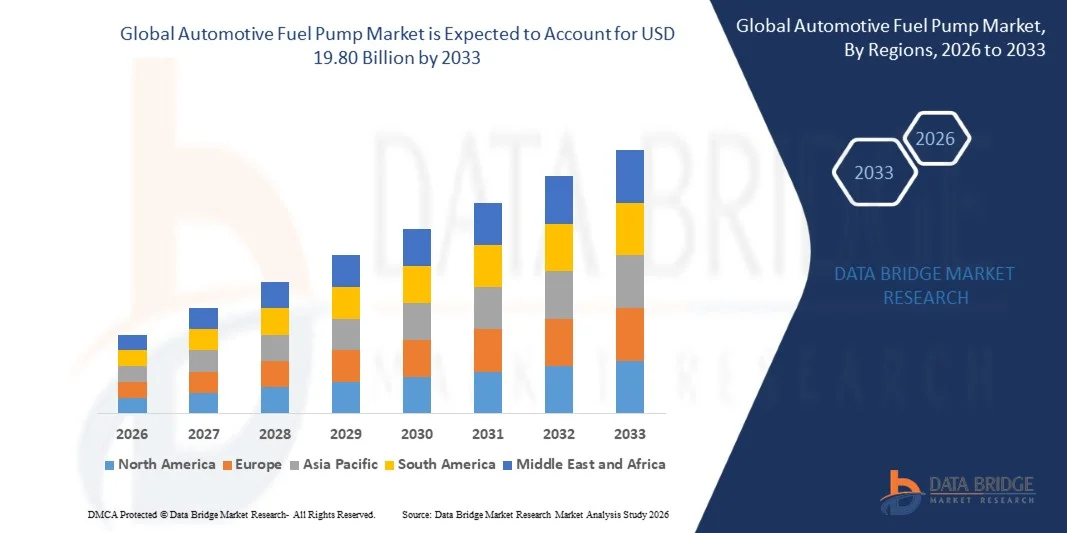
O mercado de bombas de combustível automotivo foi avaliado emUSD 13.00 mil milhões em 2025e é projetado para alcançar19,80 mil milhões de USD até 2033, crescendo emCAGR de 5,40% de 2026 a 2033O mercado está a assistir a um crescimento constante, impulsionado pelo aumento da produção global de veículos, pelo aumento da procura de sistemas automóveis eficientes em termos de combustível e pela expansão contínua das frotas de passageiros e veículos comerciais nas economias emergentes e desenvolvidas. Os avanços nas tecnologias de injeção de combustível e a adoção crescente de sistemas de fornecimento de combustível de alto desempenho estão apoiando ainda mais a expansão do mercado.
A crescente ênfase na eficiência do veículo, redução de emissões e desempenho do motor está incentivando as montadoras a integrar tecnologias avançadas de bomba de combustível capazes de fornecer fluxo de combustível preciso e pressão. Os regulamentos ambientais rigorosos e os padrões de economia de combustível nos principais mercados automotivos estão acelerando a substituição de sistemas de combustível convencionais por bombas de combustível elétrico mais eficientes. Além disso, o aftermarket em expansão para componentes automotivos e o crescente parc de veículos em todo o mundo estão criando demanda sustentada para substituição e manutenção de bombas de combustível, contribuindo para o crescimento do mercado a longo prazo.
Principais tendências do mercado e perspectivas
- A América do Norte dominou o mercado de bombas de combustível automotivas com a maior parcela de receita de 34,6% em 2025, apoiada por altas taxas de propriedade de veículos, forte presença de principais OEMs automotivos e adoção generalizada de tecnologias avançadas de injeção de combustível. A região se beneficia de uma indústria automotiva madura, alta demanda por caminhões e SUVs e atualizações tecnológicas contínuas em sistemas de fornecimento de combustível.
- O mercado de bombas de combustível automotivo Ásia-Pacífico deverá testemunhar a taxa de crescimento mais rápida de 2026 para 2033, apoiada pela urbanização rápida, aumento da produção de veículos e aumento da demanda por veículos comerciais e de passageiros em países como China, Índia, Japão e Coreia do Sul.
- O segmento HEV detinha a maior quota de receita de mercado de aproximadamente 46,2% em 2025 impulsionada pela forte adoção híbrida global como montadoras continuam a usar motores de combustão interna ao lado de acionamentos elétricos para melhorar a eficiência de combustível e reduzir as emissões. Modelos híbridos de fabricantes como Toyota e Honda continuam a confiar fortemente em bombas avançadas de combustível elétrico para a entrega de combustível otimizado durante as fases de ativação do motor.
- O segmento PHEV é projetado para registrar o crescimento mais rápido em um CAGR de 7,8% de 2026 a 2033, impulsionado pelo aumento da preferência do consumidor pela extensão da faixa de condução combinada com menor consumo de combustível. A adoção crescente do PHEV na Europa e na China, juntamente com a expansão da disponibilidade de modelos de OEMs como BMW e BYD, está acelerando a demanda por sistemas de bomba de combustível de alta pressão integrados com arquiteturas de trem de potência dupla.
- O segmento de automóveis de passageiros detinha a maior parte de receita de mercado de aproximadamente 58,5% em 2025 impulsionada por altos volumes de produção global e crescente adoção de sistemas avançados de injeção de combustível em categorias de veículos compactos, médios e premium. A forte procura na Ásia-Pacífico, particularmente na Índia e na China, continua a apoiar o domínio do segmento.
- O segmento de veículos comerciais leves é projetado para registrar o crescimento mais rápido em um CAGR de 6,6% de 2026 para 2033, impulsionado pela expansão logística, redes de entrega de e-commerce e frotas de transporte urbano que exigem sistemas de entrega de combustível eficientes e duráveis. O crescimento dos serviços de entrega de última milha está aumentando a adoção de bombas de combustível elétrico de alto desempenho para melhorar a confiabilidade do motor e a economia de combustível.
- O segmento elétrico detinha a maior parte de receita de mercado de aproximadamente 67,9% em 2025 impulsionada pela adoção generalizada de bombas de combustível elétrico em tanque em modernos sistemas de injeção de combustível, incluindo injeção direta de gasolina (GDI) e veículos híbridos. As bombas elétricas oferecem controle de combustível preciso, maior eficiência e compatibilidade com padrões avançados de emissão, como BS-VI e Euro 6.
- O segmento elétrico também é projetado para registrar o crescimento mais rápido em um CAGR de 5,9% de 2026 a 2033, impulsionado pelo aumento da eletrificação de sistemas de combustível em veículos híbridos e crescente demanda por fornecimento de combustível controlado eletronicamente em motores turboalimentados. A inovação contínua em projetos compactos de bombas de alta pressão está apoiando ainda mais a expansão do segmento.
- O segmento de deslocamento fixo detinha a maior quota de receita de mercado de aproximadamente 54,3% em 2025 impulsionada pelo seu uso extensivo em veículos convencionais de motores de combustão interna devido ao menor custo, design mais simples e desempenho confiável de entrega de combustível em todas as condições de condução padrão.
- O segmento de deslocamento variável é projetado para registrar o crescimento mais rápido em um CAGR de 6,8% de 2026 a 2033, impulsionado pelo aumento da demanda por sistemas eficientes em combustível capazes de ajustar o fluxo de combustível com base na carga do motor e condições de condução. A adoção crescente em veículos híbridos e de desempenho está apoiando ainda mais a expansão do segmento devido à melhoria da eficiência e redução da perda de energia.
- O segmento de equipamentos de construção detinha a maior quota de receita de mercado de aproximadamente 61,7% em 2025 impulsionada pelo alto uso de máquinas a combustível, como escavadoras, carregadoras e escavadoras em projetos de desenvolvimento de infraestrutura globalmente. A urbanização crescente e as actividades de construção em larga escala na Ásia-Pacífico apoiam ainda mais a procura de sistemas de bomba de combustível duradouros.
- O segmento de equipamentos de mineração é projetado para registrar o crescimento mais rápido em um CAGR de 6,4% de 2026 a 2033, impulsionado pelo aumento das atividades de exploração de mineração e crescente demanda por sistemas de combustível de alto desempenho em equipamentos pesados operando em condições extremas. A expansão de projetos de extração mineral na América Latina e África está acelerando o crescimento do segmento.
Tamanho e previsão do mercado
- Valor de Mercado Global (2025): USD 13,00 Bilhões
- Valor de mercado esperado (2033): USD 19,80 Bilhões
- Previsões CAGR (2026-2033): 5,40%
- Região líder em 2025: América do Norte
- Região de crescimento mais rápido: Ásia-Pacífico
Âmbito do relatório eSegmentação do mercado da bomba de combustível automotivo
|
Atributos |
Chave da bomba de combustível automotivoPerspectivas de mercado |
|
Segmentos Cobertos |
|
|
Países abrangidos |
América do Norte
Europa
Ásia- Pacífico
Médio Oriente e África
América do Sul
|
|
Jogadores do mercado chave |
•Continental AG(Alemanha) |
|
Oportunidades de Mercado |
• Adoção crescente de sistemas avançados de injeção de combustível • Aumento da demanda por veículos de combustível eficiente e baixa emissão |
|
Informações sobre o Valor Adicionado |
Além dos insights de mercado, como valor de mercado, taxa de crescimento, segmentos de mercado, cobertura geográfica, atores de mercado e cenário de mercado, o relatório de mercado curado pela equipe de Pesquisa do Mercado da Ponte de Dados inclui análise de especialistas em profundidade, análise de importação/exportação, análise de preços, análise de consumo de produção e análise de pilão. |
Mercado de bombas de combustível automotivoTendências
Tendência: Crescimento na Eletrificação de Sistemas de Entrega de Combustível e Tecnologias de Injeção Direta de Alta Pressão
O mercado de bombas de combustível automotivas está presenciando uma forte mudança para sistemas de fornecimento de combustível controlados eletronicamente, de alta pressão e inteligentes, impulsionados pelo aumento da demanda por eficiência de combustível e regulamentos de emissão rigorosos em todos os mercados automotivos globais. As bombas mecânicas tradicionais estão sendo rapidamente substituídas por bombas elétricas em tanque e de combustível de alta pressão que suportam arquiteturas avançadas de motores, como injeção direta de gasolina (GDI), motores turboalimentados e trens híbridos, permitindo a medição precisa de combustível e a melhoria da eficiência de combustão.
Em plataformas modernas de veículos, as montadoras estão cada vez mais integrando sistemas de bomba de combustível de alta pressão, por exemplo em motores GDI usados por grandes OEMs, como Hyundai e Ford, para alcançar uma melhor atomização de combustível e maior eficiência térmica em diferentes condições de condução. Veículos híbridos também estão adotando sistemas de bomba de combustível em modo duplo que otimizam o fornecimento de combustível durante os ciclos de arranque do motor para reduzir o desperdício e melhorar a responsividade geral do acionamento.
A expansão de tecnologias híbridas e de motores de tamanho reduzido está aumentando a demanda por bombas de combustível elétrico compactas e de velocidade variável capazes de manter pressão estável em diversas cargas operacionais. Testes industriais e benchmarking em 2025 indicam que sistemas avançados de bomba de combustível de alta pressão podem melhorar a eficiência de combustão em aproximadamente 10-15% em comparação com sistemas convencionais de injeção de combustível portuário, contribuindo para reduções mensuráveis no consumo de combustível e emissões de CO2 em ciclos de condução no mundo real
Mercado de bombas de combustível automotivoDinâmica
Motorista do mercado chave: Produção de veículos em ascensão e regulamentos rigorosos de emissão e eficiência de combustível
O mercado de bombas de combustível automotivo é impulsionado principalmente pelo aumento da produção de veículos através de economias emergentes e desenvolvidas, combinado com normas de emissão cada vez mais rigorosas e padrões de economia de combustível impostos por organismos reguladores em todo o mundo. A crescente demanda de veículos de passageiros na Ásia-Pacífico e a crescente expansão da frota comercial nos setores de logística e transporte estão reforçando ainda mais a exigência de sistemas eficientes de fornecimento de combustível que melhorem o desempenho do motor e reduzam o consumo de combustível.
Os governos dos principais mercados de automóveis estão a aplicar quadros de emissões mais rigorosos, como o Euro 6 na Europa e o BS-VI na Índia, obrigando os OEM a adoptarem tecnologias avançadas de injecção de combustível e de bomba de combustível de alta eficiência. Por exemplo, as montadoras estão integrando bombas de combustível controladas eletronicamente em veículos compatíveis com a BS-VI de nova geração para alcançar relações ar-combustível otimizadas e menores emissões de partículas. Além disso, a mudança global para os trens híbridos está aumentando a dependência em sistemas de fornecimento de combustível de precisão que suportam a operação intermitente do motor e melhoria da eficiência térmica.
Dados da indústria indicam que a produção global de veículos superou 90 milhões de unidades nos últimos anos, com uma participação significativa adotando cada vez mais sistemas de combustível controlados eletronicamente, destacando a demanda sustentada por componentes avançados da bomba de combustível nos segmentos OEM e pós-mercado
Chave de retenção/desafio: Eletrificação crescente de veículos e declínio da dependência interna do motor de combustão
O mercado da bomba de combustível automotiva enfrenta desafios significativos desde a rápida transição global para veículos elétricos, que não exigem sistemas tradicionais de fornecimento de combustível, limitando assim o crescimento da demanda a longo prazo por bombas de combustível em segmentos totalmente elétricos. Aumentar a adoção da EV em toda a China, Europa e América do Norte está gradativamente reduzindo a participação de veículos de motor de combustão interna (ICE) em volumes de produção globais, impactando diretamente o potencial de expansão do mercado futuro.
Além disso, as plataformas híbridas de veículos, enquanto ainda utilizam bombas de combustível, são projetadas para reduzir o tempo de execução do motor e menor consumo de combustível, o que pode diminuir o desgaste e a frequência de substituição dos componentes em comparação com os veículos ICE convencionais. Esta mudança está afetando gradualmente ciclos de demanda pós-mercado para serviços de substituição e manutenção de bombas de combustível.
As tendências de transição da indústria mostram que as vendas de EV representaram mais de 14 milhões de unidades globalmente em 2024, refletindo um forte aumento anual, que deverá continuar a remodelar as estruturas de demanda de componentes automotivos e limitar a dependência a longo prazo dos sistemas tradicionais de bombas de combustível
Oportunidade chave do mercado: crescimento em veículos híbridos de alto desempenho e demanda avançada de substituição pós-mercado
Apesar das tendências de eletrificação, permanecem oportunidades significativas na expansão de veículos híbridos, aplicações de ICE de alto desempenho e o crescente mercado de pós-venda automotivo global. Veículos elétricos híbridos continuam a depender de bombas de combustível para sistemas de suporte à combustão interna, criando demanda sustentada por tecnologias avançadas de bombas de combustível elétricas e de alta pressão projetadas para eficiência e durabilidade em condições operacionais variáveis.
As montadoras estão adotando cada vez mais módulos avançados de bomba de combustível, por exemplo em veículos elétricos híbridos plug-in (PHEVs) usados pela Toyota e BMW, para otimizar a eficiência de combustível durante as fases de engajamento do motor, mantendo a entrega de energia suave e a conformidade com as emissões. Além disso, os segmentos de desempenho e veículos de luxo continuam a exigir sistemas de combustível de alta pressão capazes de suportar motores turboalimentados e de injeção direta para uma dinâmica de condução melhorada.
O parque de veículos global em expansão também está impulsionando forte demanda de reposição pós-mercado, particularmente em regiões com frotas de veículos em envelhecimento, como Ásia-Pacífico e América Latina. Estimativas da indústria sugerem que os componentes do sistema de combustível, incluindo bombas de combustível, normalmente requerem substituição após 100.000-150.000 quilômetros, dependendo das condições de operação, criando oportunidades de receita recorrentes em redes de reparo e serviço independentes em todo o mundo
Âmbito de mercado da bomba de combustível automotivo
O mercado é segmentado com base no tipo de veículo elétrico, tipo de veículo, tecnologia, deslocamento e veículos fora da rodovia.
• Por tipo de veículo elétrico
Com base no tipo de veículo elétrico, o mercado da bomba de combustível automotivo é segmentado em BEV, FCEV, HEV e PHEV. O segmento HEV detinha a maior quota de receita de mercado de aproximadamente 46,2% em 2025 impulsionada pela forte adoção híbrida global como montadoras continuam a usar motores de combustão interna ao lado de acionamentos elétricos para melhorar a eficiência de combustível e reduzir as emissões. Modelos híbridos de fabricantes como Toyota e Honda continuam a confiar fortemente em bombas avançadas de combustível elétrico para a entrega de combustível otimizado durante as fases de ativação do motor.
O segmento PHEV é projetado para registrar o crescimento mais rápido em um CAGR de 7,8% de 2026 a 2033, impulsionado pelo aumento da preferência do consumidor pela extensão da faixa de condução combinada com menor consumo de combustível. A adoção crescente do PHEV na Europa e na China, juntamente com a expansão da disponibilidade de modelos de OEMs como BMW e BYD, está acelerando a demanda por sistemas de bomba de combustível de alta pressão integrados com arquiteturas de trem de potência dupla.
• Por Tipo de Veículo
Com base no modelo de veículo, o mercado é segmentado em automóveis de passageiros, veículos comerciais leves e veículos comerciais pesados. O segmento de automóveis de passageiros detinha a maior parte de receita de mercado de aproximadamente 58,5% em 2025 impulsionada por altos volumes de produção global e crescente adoção de sistemas avançados de injeção de combustível em categorias de veículos compactos, médios e premium. A forte procura na Ásia-Pacífico, particularmente na Índia e na China, continua a apoiar o domínio do segmento.
O segmento de veículos comerciais leves é projetado para registrar o crescimento mais rápido em um CAGR de 6,6% de 2026 para 2033, impulsionado pela expansão logística, redes de entrega de e-commerce e frotas de transporte urbano que exigem sistemas de entrega de combustível eficientes e duráveis. O crescimento dos serviços de entrega de última milha está aumentando a adoção de bombas de combustível elétrico de alto desempenho para melhorar a confiabilidade do motor e a economia de combustível.
• Por Tecnologia
Com base na tecnologia, o mercado é segmentado em bombas de combustível elétrico e mecânico. O segmento elétrico detinha a maior parte de receita de mercado de aproximadamente 67,9% em 2025 impulsionada pela adoção generalizada de bombas de combustível elétrico em tanque em modernos sistemas de injeção de combustível, incluindo injeção direta de gasolina (GDI) e veículos híbridos. As bombas elétricas oferecem controle de combustível preciso, maior eficiência e compatibilidade com padrões avançados de emissão, como BS-VI e Euro 6.
O segmento elétrico também é projetado para registrar o crescimento mais rápido em um CAGR de 5,9% de 2026 a 2033, impulsionado pelo aumento da eletrificação de sistemas de combustível em veículos híbridos e crescente demanda por fornecimento de combustível controlado eletronicamente em motores turboalimentados. A inovação contínua em projetos compactos de bombas de alta pressão está apoiando ainda mais a expansão do segmento.
• Por Deslocamento
Com base no deslocamento, o mercado é segmentado em deslocamento variável e deslocamento fixo. O segmento de deslocamento fixo detinha a maior quota de receita de mercado de aproximadamente 54,3% em 2025 impulsionada pelo seu uso extensivo em veículos convencionais de motores de combustão interna devido ao menor custo, design mais simples e desempenho confiável de entrega de combustível em todas as condições de condução padrão.
O segmento de deslocamento variável é projetado para registrar o crescimento mais rápido em um CAGR de 6,8% de 2026 a 2033, impulsionado pelo aumento da demanda por sistemas eficientes em combustível capazes de ajustar o fluxo de combustível com base na carga do motor e condições de condução. A adoção crescente em veículos híbridos e de desempenho está apoiando ainda mais a expansão do segmento devido à melhoria da eficiência e redução da perda de energia.
• Por fora veículos de alta via
Com base em veículos fora de estrada, o mercado é segmentado em equipamentos de construção e equipamentos de mineração. O segmento de equipamentos de construção detinha a maior quota de receita de mercado de aproximadamente 61,7% em 2025 impulsionada pelo alto uso de máquinas a combustível, como escavadoras, carregadoras e escavadoras em projetos de desenvolvimento de infraestrutura globalmente. A urbanização crescente e as actividades de construção em larga escala na Ásia-Pacífico apoiam ainda mais a procura de sistemas de bomba de combustível duradouros.
O segmento de equipamentos de mineração é projetado para registrar o crescimento mais rápido em um CAGR de 6,4% de 2026 a 2033, impulsionado pelo aumento das atividades de exploração de mineração e crescente demanda por sistemas de combustível de alto desempenho em equipamentos pesados operando em condições extremas. A expansão de projetos de extração mineral na América Latina e África está acelerando o crescimento do segmento.
Mercado de bombas de combustível automotivoAnálise regional
América do Norte Automotive Bomba de Combustível Insight Mercado
A América do Norte dominou o mercado de bombas de combustível automotivas com a maior parcela de receita de 34,6% em 2025, apoiada por altas taxas de propriedade de veículos, forte presença de principais OEMs automotivos e adoção generalizada de tecnologias avançadas de injeção de combustível. A região se beneficia de uma indústria automotiva madura, alta demanda por caminhões e SUVs e atualizações tecnológicas contínuas em sistemas de fornecimento de combustível. Os consumidores e fabricantes da região priorizam o desempenho, a eficiência de combustível e o cumprimento de normas de emissão rigorosas, impulsionando a adoção de bombas de combustível elétrico de alta pressão e módulos avançados de sistema de combustível em veículos comerciais e de passageiros.
U.S. Automotive Pump Market Insight
O mercado de bombas de combustível automotivas dos EUA captou a maior parte de receita em 2025 na América do Norte, impulsionada pela forte produção automotiva, alta demanda por caminhões leves e rápida integração de injeção direta de gasolina (GDI) e trens híbridos. As montadoras, como a Ford e a General Motors, estão implantando cada vez mais sistemas avançados de bombas de combustível elétrico para melhorar a eficiência de combustão e atender aos requisitos regulamentares de acordo com as normas de emissão EPA. A crescente adoção de veículos híbridos e a crescente demanda de substituição em todo o segmento pós-mercado reforçam ainda mais a expansão do mercado.
Europa Automotive Bomba de Combustível Mercado Insight
Espera-se que o mercado europeu de bombas de combustível automotivas testemunhe a taxa de crescimento mais rápida de 2026 a 2033, impulsionada principalmente por regulamentos rigorosos em matéria de emissões, tais como o Euro 6 e as próximas normas Euro 7, que estão empurrando as montadoras para sistemas de injeção de combustível de alta eficiência. A região está experimentando forte demanda por veículos híbridos, especialmente em países como Alemanha, França e Itália, onde iniciativas de inovação e sustentabilidade automotivas são altamente priorizadas. O aumento da adoção de bombas avançadas de combustível elétrico em motores turboalimentados de tamanho reduzido está acelerando ainda mais o crescimento do mercado em ambos os canais OEM e aftermarket.
U.K. Automotive Pump Market Insight
Espera-se que o mercado de bombas de combustível automotivas do Reino Unido testemunhe um crescimento constante de 2026 para 2033, impulsionado pelo aumento da adoção de veículos híbridos e pelo aumento do foco na redução das emissões veiculares. A crescente procura de automóveis de passageiros eficientes em termos de combustível e a expansão dos serviços de transporte baseados na frota encorajam a utilização de sistemas avançados de bomba de combustível eléctrico. Além disso, a forte demanda de reposição de peças do sistema de combustível, apoiada por uma frota de veículos em envelhecimento, está contribuindo para o crescimento sustentado do mercado em todo o país.
Alemanha Automotive Pump Market Insight
Espera-se que o mercado alemão de bombas de combustível automotivo testemunhe um forte crescimento de 2026 para 2033, alimentado pela liderança do país em engenharia automotiva, alta adoção de trens híbridos e forte presença de OEMs premium, como Volkswagen, BMW e Mercedes-Benz. O foco da Alemanha na eficiência de combustível e engenharia de precisão está impulsionando a demanda por bombas de combustível de alto desempenho usadas em injeção direta e motores turboalimentados. A integração de sistemas avançados de fornecimento de combustível em veículos de luxo e desempenho está a apoiar ainda mais a expansão do mercado.
Asia-Pacific Automotive Pump Market Insight
Espera-se que o mercado de bombas de combustível automotivo Ásia-Pacífico testemunhe a taxa de crescimento mais rápida de 2026 para 2033, apoiada pela urbanização rápida, aumento da produção de veículos e aumento da demanda por veículos de passageiros e comerciais em países como China, Índia, Japão e Coreia do Sul. A região serve como um importante centro de fabricação automotiva, com capacidade de produção de OEM em expansão e forte adoção de sistemas de bomba de combustível elétrico econômico. As iniciativas governamentais que promovem a eficiência dos combustíveis e a redução das emissões estão a acelerar ainda mais a penetração no mercado, tanto nos segmentos ICE como nos segmentos dos veículos híbridos.
Japão Automotive Bomba de Combustível Insight Mercado
Espera-se que o mercado japonês de bombas de combustível automotivas testemunhe um crescimento constante de 2026 para 2033, devido à forte base tecnológica automotiva do país, alta adoção de veículos híbridos e foco na eficiência e confiabilidade do combustível. As montadoras líderes como Toyota e Honda continuam a integrar sistemas avançados de bomba de combustível em plataformas híbridas para otimizar o consumo de combustível e o desempenho das emissões. A ênfase do Japão em componentes automotivos compactos e de alta eficiência também está impulsionando a demanda por sistemas de fornecimento de combustível de engenharia de precisão nos mercados interno e de exportação.
China Automotive Bomba de Combustível Mercado Insight
O mercado de bombas de combustível automotivas da China representou a maior parte de receita de mercado na Ásia Pacífico em 2025, atribuída a elevados volumes de produção de veículos, rápida expansão da população de classe média, e fortes capacidades de fabricação de automóveis domésticos. A China é um dos maiores mercados automotivos mundiais, com adoção significativa de carros de passageiros, veículos híbridos e frotas comerciais que exigem sistemas avançados de bomba de combustível. A presença crescente de OEMs locais, como a BYD e Geely, juntamente com o apoio do governo para tecnologias de redução de emissões, está impulsionando a demanda por soluções eficientes de bombas de combustível elétrico em todo o país.
Automotive Pump Market Share
A indústria da Bomba de Combustível Automotiva é liderada principalmente por empresas bem estabelecidas, incluindo:
• Continental AG (Alemanha)
• CORPORAÇÃO DENSO (Japão)
• Delphi Auto Parts (EUA)
• Robert Bosch Ltd (Alemanha)
• Hitachi Automotive Systems, Ltd. (Japão)
• Infineon Technologies AG (Alemanha)
• Perkins Engines Company Limited (U.K.)
• industriesdiesel.com (EUA)
• Arkansas Fuel Injection, Inc. (EUA)
• Combustível Sagar (Índia)
• Shiyan QiJing Industry & Trading Co., Ltd. (China)
• DeatschWerks, LLC. (EUA)
• Johnson Electric Holdings Limited (Hong Kong)
• Mitsubishi Electric Corporation (Japão)
• SERVIÇO DE VALEO (França)
• MAHLE GmbH (Alemanha)
• Cummins Inc. (EUA)
• Daimler AG (Alemanha)
SKU-
Obtenha acesso online ao relatório sobre a primeira nuvem de inteligência de mercado do mundo

- Painel interativo de análise de dados
- Painel de análise da empresa para oportunidades de elevado potencial de crescimento
- Acesso de analista de pesquisa para personalização e customização. consultas
- Análise da concorrência com painel interativo
- Últimas notícias, atualizações e atualizações Análise de tendências
- Aproveite o poder da análise de benchmark para um rastreio abrangente da concorrência
Metodologia de Investigação
A recolha de dados e a análise do ano base são feitas através de módulos de recolha de dados com amostras grandes. A etapa inclui a obtenção de informações de mercado ou dados relacionados através de diversas fontes e estratégias. Inclui examinar e planear antecipadamente todos os dados adquiridos no passado. Da mesma forma, envolve o exame de inconsistências de informação observadas em diferentes fontes de informação. Os dados de mercado são analisados e estimados utilizando modelos estatísticos e coerentes de mercado. Além disso, a análise da quota de mercado e a análise das principais tendências são os principais fatores de sucesso no relatório de mercado. Para saber mais, solicite uma chamada de analista ou abra a sua consulta.
A principal metodologia de investigação utilizada pela equipa de investigação do DBMR é a triangulação de dados que envolve a mineração de dados, a análise do impacto das variáveis de dados no mercado e a validação primária (especialista do setor). Os modelos de dados incluem grelha de posicionamento de fornecedores, análise da linha de tempo do mercado, visão geral e guia de mercado, grelha de posicionamento da empresa, análise de patentes, análise de preços, análise da quota de mercado da empresa, normas de medição, análise global versus regional e de participação dos fornecedores. Para saber mais sobre a metodologia de investigação, faça uma consulta para falar com os nossos especialistas do setor.
Personalização disponível
A Data Bridge Market Research é líder em investigação formativa avançada. Orgulhamo-nos de servir os nossos clientes novos e existentes com dados e análises que correspondem e atendem aos seus objetivos. O relatório pode ser personalizado para incluir análise de tendências de preços de marcas-alvo, compreensão do mercado para países adicionais (solicite a lista de países), dados de resultados de ensaios clínicos, revisão de literatura, mercado remodelado e análise de base de produtos . A análise de mercado dos concorrentes-alvo pode ser analisada desde análises baseadas em tecnologia até estratégias de carteira de mercado. Podemos adicionar quantos concorrentes necessitar de dados no formato e estilo de dados que procura. A nossa equipa de analistas também pode fornecer dados em tabelas dinâmicas de ficheiros Excel em bruto (livro de factos) ou pode ajudá-lo a criar apresentações a partir dos conjuntos de dados disponíveis no relatório.











