


Segmentação do mercado de sensores de tensão automotivo global, por tipo (sensores de temperatura, sensores de pressão, sensores de posição, sensores de oxigênio, sensores de NOx, sensores de velocidade, sensores de inércia, sensores de imagem e outros sensores), tipo de veículo (carros de passageiros, veículos comerciais leves (LCV) e veículos comerciais pesados (HCV), canal de vendas ( fabricantes de equipamentos originais (OEMs) e aftermarket), aplicação (powertrain, Chassis, escape, segurança e controle, eletrônica do corpo, telemática, e outros)- tendências e previsão da indústria para 2033
Qual é o tamanho do mercado do sensor de tensão automotivo e taxa de crescimento
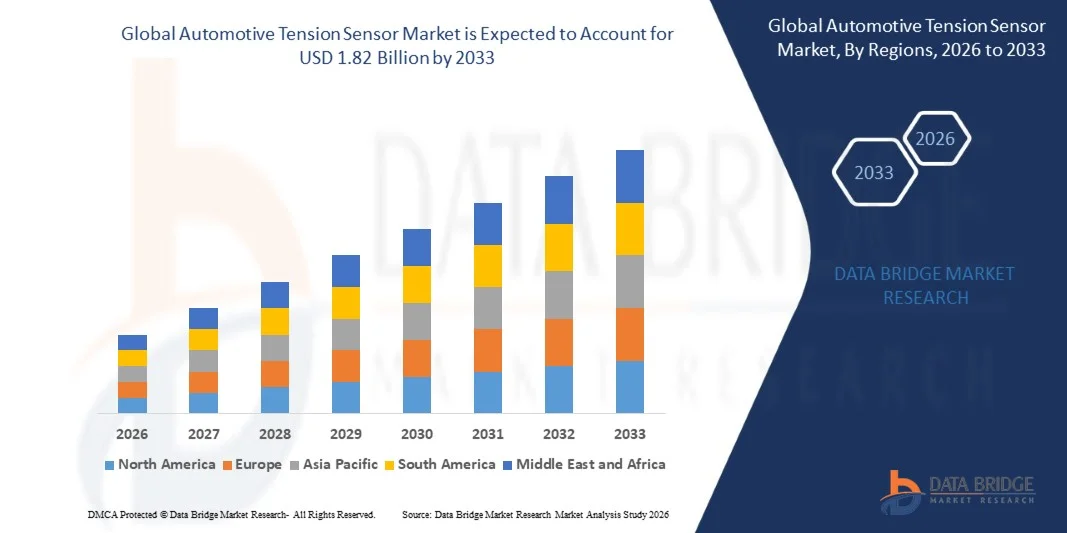
- De acordo com a análise Data Bridge Market Research, o mercado de sensores de tensão automotivos foi avaliado emUSD 1,20 mil milhões em 2025e é projetado para alcançar1,82 mil milhões de USD até 2033, crescendo emCAGR de 5,40% de 2026 a 2033.
- O mercado está experimentando crescimento consistente impulsionado pelo aumento da adoção de tecnologias automotivas avançadas e regulamentos de segurança rigorosos, enquanto avanços tecnológicos em sensores automotivos estão apoiando o desenvolvimento de sensores de tensão mais precisos, confiáveis e econômicos.
- A crescente integração da ADAS e dos veículos elétricos, aliada a crescentes exigências de segurança e desempenho dos veículos, está obrigando as montadoras a adotar tecnologias avançadas de sensorização de tensão. A integração de sensores inteligentes, miniaturização de sensores e eletrificação crescente de veículos estão criando novas oportunidades para sensores de tensão automotivos entre cinto de segurança, motor, frenagem, suspensão e outras aplicações de veículos
Tamanho e previsão do mercado
- Valor de Mercado Global (2025): USD 1,20 bilhões
- Valor de mercado esperado (2033): USD 1,82 Bilhões
- Previsões CAGR (2026-2033): 5,40%
- Região líder em 2025: América do Norte
- Região de crescimento mais rápido: Ásia Pacífico
Quais são os principais takeaways do mercado de sensores de tensão automotivo
- A América do Norte dominou o mercado de sensores de tensão automotivos com 40,2% do market share, apoiado pelo aumento da produção de veículos, regulamentos de segurança rigorosos, avanços na tecnologia automotiva e crescente demanda por veículos elétricos e híbridos.
- Espera-se que a Ásia-Pacífico seja a região de crescimento mais rápido em um CAGR de 7,2% de 2026 a 2033, alimentada pela forte produção de veículos, aumentando a adoção de tecnologias de segurança e iniciativas governamentais favoráveis que promovam a segurança e redução de emissões de veículos.
- O segmento de sensores de posição liderou o mercado com uma participação de 31,6% em 2025, impulsionado pelo seu uso extensivo para monitorar a posição dos componentes do veículo e permitir o controle preciso através do trem de potência, chassis, segurança e sistemas eletrônicos.
- Os sensores inerciais são o tipo de crescimento mais rápido, projetado para registrar um CAGR de 6,47%, refletindo o aumento na adoção de ADAS, condução autônoma, sistemas eletrônicos de estabilidade e tecnologias de monitoramento de movimento de veículos.
- O segmento de automóveis de passageiros dominou a categoria de tipo de veículo com uma quota de receita de 71,18% em 2025, liderada por maiores volumes de produção de veículos e ampla integração de sensores entre sistemas de segurança, tração elétrica, chassis e corpo-eletrônica
- A Powertrain representou 40,55% da quota de mercado em 2025, preferida pela extensa implantação de sensores para monitorar as condições de operação do motor e do drivetrain.
- O segmento telemático é a categoria de aplicação que mais cresce, com um CAGR de 8,86%, impulsionado pelo aumento da adoção de veículos conectados, análise de frotas, seguro de uso e monitoramento em tempo real de veículos.
Alcance do relatório e Segmentação do mercado do sensor de tensão automotivo
|
Atributos |
Sensor de tensão automotivo Key Market Insights |
|
Segmentos Cobertos |
|
|
Países abrangidos |
América do Norte
Europa
Ásia- Pacífico
Médio Oriente e África
América do Sul
|
|
Jogadores do mercado chave |
|
|
Oportunidades de Mercado |
|
|
Informações sobre o Valor Adicionado |
Além dos insights de mercado, como valor de mercado, taxa de crescimento, segmentos de mercado, cobertura geográfica, atores de mercado e cenário de mercado, o relatório de mercado curado pela equipe de Pesquisa do Mercado da Ponte de Dados inclui análise de especialistas em profundidade, análise de importação/exportação, análise de preços, análise de consumo de produção e análise de pilão. |
Qual é a tendência chave no mercado de sensores de tensão automotivo
- A mudança para sensores de tensão inteligentes e integrados está emergindo como uma tendência chave, pois as montadoras exigem cada vez mais sensores compactos, precisos e conectados digitalmente para monitoramento em tempo real de correias, cabos, sistemas de segurança e componentes de veículos elétricos.
- Por exemplo, em julho de 2024, a ZF LIFETEC introduziu seu ACR8. Tensionador de cinto ativo integrado ao banco S, que usa um acionamento elétrico para ajustar a tensão do cinto de segurança ativamente e pode apertar o cinto durante manobras críticas de condução, como frenagem automática de emergência. Isto demonstra a integração da tecnologia inteligente de controlo de tensão com sistemas avançados de segurança dos veículos.
- A adoção crescente de sensores automotivos habilitados para IoT está apoiando monitoramento contínuo e manutenção preditiva, permitindo que os sistemas de veículos transmitam dados relacionados à tensão e melhorem a confiabilidade, eficiência e segurança dos componentes.
- A eletrificação do veículo está reformulando os requisitos do sensor de tensão, com aplicações que se expandem de sistemas convencionais de correia de motor para cabos de atuador elétrico, sistemas de bateria, motores elétricos e sistemas de freio regenerativo.
- As montadoras estão cada vez mais integrando tecnologias de sensores leves, compactas e sem fio, pois os veículos incorporam maior conteúdo eletrônico e funções avançadas de segurança e conectividade.
- Por exemplo, em junho de 2025, a Volvo anunciou seu cinto de segurança multiadaptativo para o EX60, usando dados em tempo real dos sensores do veículo para selecionar entre 11 diferentes perfis de cinto de acordo com as características do ocupante e as condições de colisão. O sistema demonstra a mudança do tensionamento fixo convencional para o gerenciamento adaptativo de tensão orientado pelo sensor.
- Como a eletrificação, veículos conectados e tecnologias de segurança avançadas continuam a aumentar o conteúdo eletrônico por veículo, os sensores de tensão inteligentes e integrados devem se tornar cada vez mais importantes para monitoramento em tempo real, manutenção preditiva e aplicações de segurança de veículos.
Quais são os principais drivers do mercado de sensores de tensão automotivo
- A rápida adoção de sistemas avançados de assistência ao condutor (ADAS) e regulamentos rigorosos de segurança de veículos está aumentando significativamente a demanda de sensores de tensão automotivos usados para monitorar o estresse mecânico, a distribuição de carga e a integridade estrutural em sistemas de veículos críticos de segurança.
- Por exemplo, em novembro de 2024, a Continental apresentou seu Display Invisible Biometrics Sensing, que usa uma câmera integrada e projetor laser para monitorar ocupantes e fornecer mapeamento de distância 3D para implantação otimizada de airbags e detecção confiável de cintos de segurança. Isto demonstra
- ADAS, sistemas de segurança e funções de veículos controlados eletronicamente exigem um sensor exato em tempo real, incentivando as montadoras a integrar sensores de tensão avançados em aplicações de frenagem, suspensão, retenção, tração elétrica e controle.
- A crescente produção de veículos elétricos está expandindo ainda mais os requisitos dos sensores, pois os trens elétricos de potência criam aplicações no monitoramento de baterias, controle elétrico-motor, sistemas de atuadores elétricos e frenagem regenerativa.
- A integração de tecnologias de IoT e monitoramento contínuo de veículos está apoiando ainda mais a demanda por sensores de tensão de precisão capazes de transmitir dados para otimização de desempenho, monitoramento de segurança e manutenção preditiva.
- Por exemplo, em dezembro de 2024, um papel técnico SAE de Maruti Suzuki Índia examinou o desempenho dinâmico de sistemas de cinto-e-tensionador em veículos leve-híbridos, onde o cinto muda entre lados apertado e folga durante o torque-assist e modos de regeneração. O estudo destaca a crescente necessidade de monitoramento avançado da tensão, uma vez que os trens elétricos colocam maiores cargas dinâmicas nos sistemas de correia.
- Com os fabricantes de veículos priorizando cada vez mais a segurança, a eletrificação, a eficiência e o monitoramento em tempo real, os sensores de tensão automotivos devem continuar a ser uma importante tecnologia de detecção em arquiteturas de veículos de próxima geração e sistemas automotivos avançados.
Que fatores estão desafiando o crescimento do mercado de sensores de tensão automotivo
- Os requisitos de alto desenvolvimento e qualificação de sensores continuam a ser um grande desafio, especialmente para aplicações automotivas avançadas, onde os sensores devem atender a padrões rigorosos de confiabilidade, segurança funcional, meio ambiente e qualidade.
- Por exemplo, em maio de 2024, a Tower Semiconductor relatou que a fraqueza no mercado de chips automotivos e os estoques de semicondutores em excesso estavam afetando a demanda por seus chips analógicos e tecnologias de sensores relacionados com automóveis. A empresa relatou uma receita de primeiro trimestre de USD 327 milhões, de USD 356 milhões por ano antes, demonstrando como a volatilidade do mercado de semicondutores pode afetar os fornecedores de sensores automotivos.
- Os fabricantes de automóveis exigem que os fornecedores satisfaçam a conformidade com a IATF 16949, documentação PPAP, calibração de precisão e requisitos de testes ambientais, criando barreiras de entrada significativas para novos fabricantes de sensores.
- A dependência de componentes semicondutores importados, ímãs e outros materiais especializados expõe os fabricantes a rupturas na cadeia de suprimentos e volatilidade de custos, particularmente para sensores de tensão de alta precisão usados em ADAS e veículos elétricos.
- A transição para arquiteturas avançadas de sensores também aumenta a complexidade de fabricação e os custos de qualificação, enquanto a pressão de preço nos graus padrão de sensores pode restringir as margens para fornecedores que operam em aplicações automotivas sensíveis aos custos.
- Por exemplo, em maio de 2024, a General Motors celebrou um acordo de longo prazo com a GlobalFoundries para estabelecer a capacidade de semicondutores dedicada, como a GM esperava que seus requisitos semicondutores duplicassem nos próximos anos devido ao aumento do conteúdo eletrônico de veículos.
- Essas barreiras de qualificação, riscos de oferta de componentes, dependência das importações e pressões de custos podem retardar a introdução de tecnologias avançadas de sensibilidade à tensão, especialmente entre fornecedores menores e em mercados automotivos sensíveis aos preços.
Como é segmentado o mercado de sensores de tensão automotivo
O mercado de sensores de tensão automotivo é segmentado com base no tipo, tipo de veículo, canal de vendas e aplicação.
- Por Tipo
Com base no tipo, o mercado de sensores de tensão automotivos é segmentado em sensores de temperatura, sensores de pressão, sensores de posição, sensores de oxigênio, sensores de NOx, sensores de velocidade, sensores de inércia, sensores de imagem e outros sensores. O segmento de sensores de posição dominou o mercado com 31,6% de participação em 2025, apoiado pelo seu uso extensivo para monitorar a posição dos componentes do veículo e permitir o controle preciso entre o trem de potência, chassis, segurança e sistemas eletrônicos. Os sensores de posição fornecem informações em tempo real necessárias para o controle preciso do veículo e operação do sistema. Suas aplicações incluem gerenciamento de motor, transmissão, frenagem, direção e eletrônica corporal. Aumentar a eletrificação e a automação do veículo estão expandindo ainda mais a exigência de feedback preciso da posição. A ampla base de aplicação continua a suportar a posição de liderança dos sensores de posição em todos os sistemas de sensoriamento automotivo.
O segmento de sensores inerciais é projetado para registrar o crescimento mais rápido em 6,47% CAGR até 2033, impulsionado pelo aumento da adoção de ADAS, condução autônoma, sistemas eletrônicos de estabilidade e tecnologias de monitoramento de movimento de veículos. Os sensores inerciais fornecem medições de aceleração e velocidade angular necessárias para a estabilidade do veículo e funções de condução automatizadas. Sua crescente integração em sistemas de segurança avançados está criando demanda por sensoriamento de movimento de alta precisão. Esses sensores suportam navegação, detecção de capotagem, controle de estabilidade do veículo e aplicações de condução autônoma. A transição para veículos altamente automatizados e definidos por software está aumentando o número de funções de sensoriamento necessárias em veículos modernos. A adoção crescente do ADAS está aumentando a demanda por acelerômetros e giroscópios.
- Por tipo de veículo
Com base no modelo de veículo, o mercado de sensores de tensão automotivos é segmentado em automóveis de passageiros, veículos comerciais leves (LCV) e veículos comerciais pesados (HCV). O segmento de automóveis de passageiros dominou o mercado com 71,18% de participação em 2025, apoiado por maiores volumes de produção de veículos e ampla integração de sensores entre sistemas de segurança, trem elétrico, chassis e corpo-eletrônica. Os carros de passageiros incorporam cada vez mais ADAS, tecnologias conectadas e sistemas de controle eletrônico, aumentando o conteúdo dos sensores por veículo. A adoção crescente de veículos elétricos e híbridos de passageiros está expandindo ainda mais os requisitos dos sensores. A demanda do consumidor por veículos mais seguros, conectados e tecnologicamente avançados também está incentivando uma maior integração de sensores. Estes factores mantêm colectivamente os automóveis de passageiros como a categoria de veículo líder.
O segmento de veículos comerciais é projetado para registrar o crescimento mais rápido em 7,15% CAGR até 2033, apoiado pelo aumento da adoção de tecnologias de sensoriamento avançado em frotas comerciais. Os LCVs e os HCVs incorporam cada vez mais sensores para monitoramento, frenagem, segurança, controle de chassis e sistemas de gerenciamento de frota conectados. A crescente adoção do ADAS em veículos comerciais está aumentando a demanda por tecnologias de detecção em tempo real. Os operadores da frota estão colocando maior ênfase no tempo de funcionamento do veículo, manutenção preditiva, eficiência de combustível e segurança operacional. Eletrificação de veículos comerciais está criando requisitos adicionais para bateria, gerenciamento térmico e sensoriamento de controle eletrônico. Espera-se que o aumento da conectividade de veículos e a digitalização da frota fortaleçam ainda mais a demanda de sensores em aplicações comerciais.
- Por Canal de Vendas
Com base no canal de vendas, o mercado de sensores de tensão automotivos é segmentado em fabricantes de equipamentos originais (OEMs) e aftermarket. O segmento OEMs dominou o mercado com 88,2% de participação em 2025, apoiado pela ampla integração de sensores em veículos recém-fabricados e relações de fornecimento de longo prazo entre fabricantes automotivos e fornecedores de componentes. Os sensores automotivos são cada vez mais instalados como equipamentos de fábrica em sistemas de trem, chassis, exaustão, segurança, eletrônica corporal e telemática. A demanda do OEM é reforçada por requisitos rigorosos de qualidade do veículo e especificações de engenharia específicas do veículo. O aumento do conteúdo de sensores de veículos elétricos, conectados e autônomos está criando demanda adicional dos fabricantes automotivos. Consequentemente, os sensores montados em OEM continuam a representar o principal canal de vendas para fornecedores de sensores automotivos.
O segmento aftermarket é projetado para registrar o crescimento mais rápido em 12,4% CAGR até 2033, apoiado pela expansão global do parc de veículos e aumentando os requisitos de substituição para sensores automotivos. A substituição do sensor é impulsionada pela falha do componente, manutenção do veículo, desgaste e pela crescente complexidade eletrônica dos veículos modernos. Os fornecedores do Aftermarket se beneficiam da demanda de sensores de substituição usados em aplicações de veículos de tração elétrica, exaustão, chassis, segurança e outros. A expansão de redes de reparo independentes e distribuição online de peças automotivas está melhorando o acesso a componentes de substituição. Mercados emergentes com crescentes bases instaladas de veículos estão criando oportunidades adicionais para fornecedores de pós-mercado. Aumentar a idade dos veículos nos mercados automotivos desenvolvidos também está apoiando a demanda de substituição.
- Por Aplicação
Com base na aplicação, o mercado de sensores de tensão automotivos é segmentado em motor, chassis, escape, segurança e controle, eletrônica corporal, telemática, entre outros. O segmento Powertrain dominou o mercado com 40,55% de participação em 2025, devido à extensa implantação de sensores para monitorar as condições de operação do motor e do drivetrain. Os sensores Powertrain suportam o gerenciamento do motor, eficiência de combustível, controle de emissões e desempenho do veículo. Os sensores são usados para medir parâmetros, incluindo temperatura, pressão, posição e velocidade através dos sistemas de transmissão. Embora a eletrificação do veículo esteja alterando o tradicional sensor de tração elétrica, os veículos elétricos estão criando novos requisitos para o monitoramento de bateria e motor. O aumento da demanda por veículos eficientes e de baixa emissão continua a apoiar a adoção de sensores em aplicações de treinamento de potência.
O segmento de telemática é projetado para registrar o crescimento mais rápido em 8,86% CAGR até 2033, impulsionado pelo aumento da adoção de veículos conectados, análise de frota, seguro de uso e monitoramento em tempo real de veículos. Os sistemas telemáticos usam cada vez mais acelerômetros, GPS e tecnologias de conectividade para coletar e transmitir dados de veículos. A crescente implantação de tecnologias de veículos conectados está expandindo a demanda por sensores capazes de suportar a coleta contínua de dados. Os operadores de frota estão cada vez mais usando dados telemáticos para melhorar a utilização, segurança, manutenção e eficiência operacional dos veículos. Programas de seguro baseados em uso também estão criando demanda adicional para dados de condução gerados por sensores. Espera-se que a crescente transição para veículos conectados e definidos por software acelere ainda mais a adoção da telemática.
Qual região detém a maior parte do mercado de sensores de tensão automotivo
- A América do Norte dominou o mercado de sensores de tensão automotivos com 40,2% do market share, apoiado pelo aumento da produção de veículos, regulamentos de segurança rigorosos, avanços na tecnologia automotiva e crescente demanda por veículos elétricos e híbridos.
- A região também beneficia da presença de grandes fabricantes e fornecedores de sensores automotivos, cadeias de suprimentos automotivas estabelecidas e crescente adoção de tecnologias avançadas de segurança e veículos eletrônicos. Os Estados Unidos e o Canadá são os principais países da região, enquanto a presença de empresas como Honeywell, TE Connectivity e Sensata Technologies reforça ainda mais o ecossistema de sensores automotivos da América do Norte.
U.S. Automotive Sensor Market Insight
O mercado de sensores de tensão automotivos dos EUA está assistindo a um forte crescimento devido à adoção crescente de sistemas avançados de assistência ao condutor (ADAS), tecnologias de segurança de veículos, eletrificação e arquiteturas de veículos cada vez mais intensivas em sensores. O ecossistema de fabricação de automóveis maduro do país e o forte foco na segurança dos veículos estão apoiando a demanda por tecnologias avançadas de detecção em veículos comerciais e de passageiros. Pesquisa publicada pelo Instituto de Seguros para Segurança Rodoviária em fevereiro de 2025 constatou que a frenagem automática de emergência foi ativada em 93% de mais de 2.000 veículos modelo-ano 2017-2023 estudados, demonstrando a ampla integração de sistemas de segurança eletrônicos.
Asia-Pacific Automotive Tension Sensor Market Insight
Espera-se que o mercado de sensores de tensão automotivos da Ásia-Pacífico testemunhe rápido crescimento, impulsionado pela expansão da produção automotiva, aceleração da eletrificação de veículos e crescente implantação de eletrônicos automotivos avançados. A posição da região como centro global de fabricação de automóveis fornece uma base substancial instalada para tecnologias de sensores automotivos. A OICA informou que a produção de veículos Ásia-Pacíficos atingiu aproximadamente 59,2 milhões de unidades em 2025, representando mais de 61% da produção global, com produção regional aumentando 7,6% a partir de 2024. China, Índia e Japão produziram coletivamente dezenas de milhões de veículos, fortalecendo o ecossistema regional para componentes e sensores automotivos. Aumentar a eletrificação, integração ADAS e conectividade de veículos estão aumentando ainda mais o conteúdo do sensor por veículo. Esses desenvolvimentos estão fortalecendo a posição da Ásia-Pacífico como um importante centro de crescimento para tecnologias de sensor de tensão automotivas.
Japan Automotive Sensor Market Insight
O mercado japonês de sensores de tensão automotivos está testemunhando um crescimento consistente devido ao aumento dos investimentos em segurança automotiva, condução autônoma, veículos conectados e sistemas eletrônicos avançados. O Japão mantém um forte ecossistema de fabricação e tecnologia automotiva, com 7,21 milhões de automóveis de passageiros e aproximadamente 1,20 milhões de veículos comerciais produzidos em 2025, segundo a OICA. Os fabricantes de automóveis e as empresas de tecnologia estão a desenvolver cada vez mais sistemas avançados de detecção e condução automática para melhorar a segurança e mobilidade dos veículos. Em abril de 2025, Toyota e Waymo anunciaram um acordo preliminar para explorar a colaboração em tecnologia de condução autônoma, incluindo o desenvolvimento de uma nova plataforma de veículos autônomos. (Toyota) Tais desenvolvimentos estão aumentando os requisitos para sensores precisos, controle de veículos e tecnologias de segurança. O foco contínuo do Japão na mobilidade de zero acidentes e eletrônica avançada de veículos está, portanto, apoiando a demanda por sensores de tensão automotivos.
China Automotive Sensor mercado de tensão
O mercado de sensores de tensão automotivos da China está crescendo rapidamente, impulsionado pela enorme base de fabricação automotiva do país, a eletrificação rápida e a crescente integração de tecnologias avançadas de veículos. A China produziu aproximadamente 30,27 milhões de automóveis de passageiros e 4,26 milhões de veículos comerciais em 2025, tornando-se o maior país produtor de veículos do mundo. Além disso, a produção de veículos de nova energia da China atingiu 16,626 milhões de unidades em 2025, aumentando 29% ao longo do ano, demonstrando a transição rápida para arquiteturas de veículos eletrificados. O uso crescente de controles eletrônicos, ADAS, trens elétricos e tecnologias conectadas está ampliando o número de funções de sensoriamento incorporadas em veículos. Os fabricantes de automóveis chineses também estão acelerando o desenvolvimento de tecnologias inteligentes e de condução autônoma. Estes desenvolvimentos estão a criar um ambiente forte para a adopção de tecnologias avançadas de detecção e tensão automóvel.
U.K. Sensor de tensão automotivo Insight mercado
O mercado de sensores de tensão automotivos do Reino Unido está experimentando crescimento constante, apoiado pelo aumento da adoção de veículos elétricos, sistemas de segurança avançados, tecnologias conectadas e eletrônicos de veículos cada vez mais sofisticados. O setor automotivo do país está sendo influenciado pelo mandato de Zero Emission Vehicle do governo, que requer 80% de novos carros e 70% de novas vans vendidas na Grã-Bretanha para ser zero-emissão em 2030, aumentando para 100% em 2035. A transição para veículos elétricos está aumentando os requisitos para sensores usados em sistemas de controle eletrônico, bateria, gerenciamento térmico e segurança. Aumentar a funcionalidade da ADAS também está ampliando o uso de posição, pressão, velocidade e outras tecnologias de sensoriamento. As capacidades de engenharia automotiva estabelecidas pelo país e o foco na eletrificação de veículos estão apoiando a demanda por tecnologias avançadas de sensores. Esses desenvolvimentos estão criando oportunidades para sensores de tensão automotivos em novas plataformas de veículos e sistemas eletrônicos.
Alemanha Automotive Tension Sensor Market Insight
O mercado de sensores de tensão automotivos da Alemanha está se expandindo constantemente devido à forte base de fabricação automotiva do país, capacidades avançadas de engenharia e crescente integração de ADAS, veículos elétricos e tecnologias conectadas. A Alemanha produziu cerca de 4,15 milhões de automóveis de passageiros em 2025, o que representa um aumento de 2% em relação a 2024, segundo a Associação Alemã da Indústria Automotiva. Os fabricantes de automóveis alemães estão também a investir fortemente em tecnologias de condução autónoma e de segurança. O ecossistema avançado de pesquisa automotiva do país e rigorosos requisitos de segurança estão aumentando a demanda por tecnologias sofisticadas de sensoriamento e controle. A crescente eletrificação e automação estão fortalecendo ainda mais a exigência de sensores automotivos precisos. Estes desenvolvimentos continuam a apoiar a posição da Alemanha como um mercado importante para as tecnologias de detecção de tensões automotivas.
Quais são as principais empresas no mercado de sensores de tensão automotivo
A indústria de sensores de tensão automotivos é liderada principalmente por empresas bem estabelecidas, incluindo:
- Robert Bosch GmbH(Alemanha)
- CORPORAÇÃO DENSO(Japão)
- Continental AG(Alemanha)
- ZF Friedrichshafen AG(Alemanha)
- Sensata Technologies, Inc.(EUA)
- Conectividade TE (Suíça)
- A Corporação Gates (EUA)
- Littelfuse, Inc. (EUA)
- Honeywell International Inc. (EUA)
- Aptiv PLC (Irlanda)
- Valeo (França)
- Hitachi Astemo, Ltd. (Japão)
- Infineon Technologies AG (Alemanha)
- Semicondutores NXP (Países Baixos)
- TDK Corporation (Japão)
- Vishay Intertechnology, Inc. (EUA)
- INSTRUMENTOS ELETRÓNICOS DE KYOWA CO., LTD. (Japão)
- Dispositivos analógicos, Inc. (EUA)
- Texas Instruments Incorporated (EUA)
- Allegro MicroSystems, LLC (EUA)
Quais são as últimas evoluções no mercado de sensores de tensão automotivo
- Em julho de 2025, Epson iniciou o transporte de volume de seu sensor AEC-Q100 compatível com XV4311BD de alta precisão automotiva bow-rate, projetado para aplicações de condução autônoma e ADAS. Embora seja um sensor de tensão inercial e não dedicado, o lançamento demonstra o movimento mais amplo em direção às tecnologias de sensoriamento automotivas de alta precisão exigidas por sistemas de veículos cada vez mais automatizados.
- Em julho de 2024, a ZF LIFETEC lançou o tensionador ativo do cinto integrado ao assento ACR8.S, um sistema compacto de tensionamento projetado para exigir pouco espaço de instalação, proporcionando tensionamento ativo do cinto elétrico. O sistema pode minimizar a pressão do cinto durante a condução normal, puxar suavemente os ocupantes para o banco durante o canto e apertar o cinto antes de uma possível colisão. O lançamento demonstra o desenvolvimento de tecnologia de tensionamento automotivo controlada eletronicamente para aplicações avançadas de segurança.
- Em janeiro de 2024, a ZF introduziu sua nova tecnologia Smart Seat Belt com um limitador de carga comutável em vários estágios (MSLL). O sistema permite que a força de restrição seja variada em diferentes estágios de um acidente e utiliza informações baseadas em sensores para adaptar a proteção dos ocupantes. A tecnologia representa um avanço dos sistemas convencionais de retenção fixa para um gerenciamento mais adaptativo e eletronicamente controlado da correia-tensão.
- Em agosto de 2023, um pedido de patente para um "Real-Time Belt Tension Sensing System" foi publicado, descrevendo um sistema que mede continuamente a tensão do cinto enquanto o cinto está operando. O sistema utiliza um conjunto de engajamento, sensoriamento de tensão/pressão e um circuito de controle eletrônico para gerar medições contínuas de tensão sem parar o cinto. A tecnologia é projetada para permitir o monitoramento contínuo e ajudar a identificar quando são necessários ajustes de tensão da correia, demonstrando o desenvolvimento de tecnologia de sensor de tensão em tempo real.
- Em junho de 2023, a NTN Corporation anunciou o desenvolvimento de seu Twin Arm Auto Tensioner para correias de acionamento acessórios, projetado para manter a tensão adequada da correia, reduzindo a força de tensão necessária. A NTN afirmou que a tecnologia foi desenvolvida para atender aos requisitos para melhorar a eficiência do combustível e reduzir as perdas do sistema de correias. O desenvolvimento é relevante para as tecnologias automotivas de detecção de tensão e de gestão de tensão utilizadas em sistemas acessórios de motores
SKU-
Obtenha acesso online ao relatório sobre a primeira nuvem de inteligência de mercado do mundo

- Painel interativo de análise de dados
- Painel de análise da empresa para oportunidades de elevado potencial de crescimento
- Acesso de analista de pesquisa para personalização e customização. consultas
- Análise da concorrência com painel interativo
- Últimas notícias, atualizações e atualizações Análise de tendências
- Aproveite o poder da análise de benchmark para um rastreio abrangente da concorrência
Metodologia de Investigação
A recolha de dados e a análise do ano base são feitas através de módulos de recolha de dados com amostras grandes. A etapa inclui a obtenção de informações de mercado ou dados relacionados através de diversas fontes e estratégias. Inclui examinar e planear antecipadamente todos os dados adquiridos no passado. Da mesma forma, envolve o exame de inconsistências de informação observadas em diferentes fontes de informação. Os dados de mercado são analisados e estimados utilizando modelos estatísticos e coerentes de mercado. Além disso, a análise da quota de mercado e a análise das principais tendências são os principais fatores de sucesso no relatório de mercado. Para saber mais, solicite uma chamada de analista ou abra a sua consulta.
A principal metodologia de investigação utilizada pela equipa de investigação do DBMR é a triangulação de dados que envolve a mineração de dados, a análise do impacto das variáveis de dados no mercado e a validação primária (especialista do setor). Os modelos de dados incluem grelha de posicionamento de fornecedores, análise da linha de tempo do mercado, visão geral e guia de mercado, grelha de posicionamento da empresa, análise de patentes, análise de preços, análise da quota de mercado da empresa, normas de medição, análise global versus regional e de participação dos fornecedores. Para saber mais sobre a metodologia de investigação, faça uma consulta para falar com os nossos especialistas do setor.
Personalização disponível
A Data Bridge Market Research é líder em investigação formativa avançada. Orgulhamo-nos de servir os nossos clientes novos e existentes com dados e análises que correspondem e atendem aos seus objetivos. O relatório pode ser personalizado para incluir análise de tendências de preços de marcas-alvo, compreensão do mercado para países adicionais (solicite a lista de países), dados de resultados de ensaios clínicos, revisão de literatura, mercado remodelado e análise de base de produtos . A análise de mercado dos concorrentes-alvo pode ser analisada desde análises baseadas em tecnologia até estratégias de carteira de mercado. Podemos adicionar quantos concorrentes necessitar de dados no formato e estilo de dados que procura. A nossa equipa de analistas também pode fornecer dados em tabelas dinâmicas de ficheiros Excel em bruto (livro de factos) ou pode ajudá-lo a criar apresentações a partir dos conjuntos de dados disponíveis no relatório.











