


What is the Automotive Tension Sensor Market Size and Growth Rate?
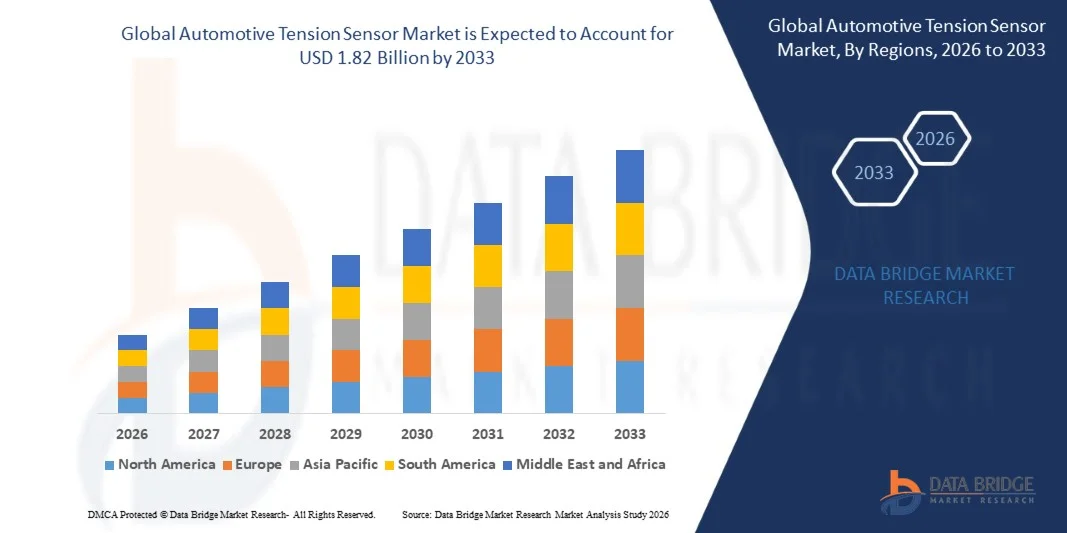
- As per Data Bridge Market Research analysis, the automotive tension sensor market was valued at USD 1.20 billion in 2025 and is projected to reach USD 1.82 billion by 2033, growing at a CAGR of 5.40% from 2026 to 2033.
- The market is experiencing consistent growth driven by increasing adoption of advanced automotive technologies and stringent safety regulations, while technological advancements in automotive sensors are supporting the development of more accurate, reliable, and cost-effective tension sensors.
- The increasing integration of ADAS and electric vehicles, combined with growing requirements for vehicle safety and performance, is compelling automakers to adopt advanced tension-sensing technologies. The integration of smart sensors, sensor miniaturization, and increasing vehicle electrification are creating further opportunities for automotive tension sensors across seatbelt, engine, braking, suspension, and other vehicle applications
Market Size & Forecast
- Global Market Value (2025): USD 1.20 Billion
- Expected Market Value (2033): USD 1.82 Billion
- Forecast CAGR (2026–2033): 5.40%
- Leading Region in 2025: North America
- Fastest Growing Region: Asia Pacific
What are the Major Takeaways of the Automotive Tension Sensor Market?
- North America dominated the automotive tension sensor market with 40.2% of the market share, supported by increasing vehicle production, stringent safety regulations, advancements in automotive technology, and growing demand for electric and hybrid vehicles.
- Asia-Pacific is expected to be the fastest-growing region at a CAGR of 7.2% from 2026 to 2033, fueled by strong vehicle production, increasing adoption of safety technologies, and favorable government initiatives promoting vehicle safety and emission reduction.
- The position sensors segment led the market with a 31.6% share in 2025, driven by their extensive use for monitoring the position of vehicle components and enabling precise control across powertrain, chassis, safety, and electronic systems.
- Inertial sensors are the fastest-growing type, projected to register a CAGR of 6.47%, reflecting the surge in adoption of ADAS, autonomous driving, electronic stability systems, and vehicle-motion monitoring technologies.
- The passenger cars segment dominated the vehicle type category with a 71.18% revenue share in 2025, led by higher vehicle production volumes and extensive integration of sensors across safety, powertrain, chassis, and body-electronics systems
- Powertrain accounted for 40.55% of the market share in 2025, preferred by the extensive sensor deployment for monitoring engine and drivetrain operating conditions.
- The telematics segment is the fastest-growing application category, with a CAGR of 8.86%, driven by increasing adoption of connected vehicles, fleet analytics, usage-based insurance, and real-time vehicle monitoring.
Report Scope and Automotive Tension Sensor Market Segmentation
|
Attributes |
Automotive Tension Sensor Key Market Insights |
|
Segments Covered |
|
|
Countries Covered |
North America
Europe
Asia-Pacific
Middle East and Africa
South America
|
|
Key Market Players |
|
|
Market Opportunities |
|
|
Value Added Data Infosets |
In addition to the market insights such as market value, growth rate, market segments, geographical coverage, market players, and market scenario, the market report curated by the Data Bridge Market Research team includes in-depth expert analysis, import/export analysis, pricing analysis, production consumption analysis, and pestle analysis. |
What is the Key Trend in the Automotive Tension Sensor Market?
- The shift toward smart and integrated tension sensors is emerging as a key trend, as automakers increasingly require compact, precise, and digitally connected sensors for real-time monitoring of belts, cables, safety systems, and electric-vehicle components.
- For instance, in July 2024, ZF LIFETEC introduced its ACR8.S seat-integrated active belt tensioner, which uses an electric drive to actively adjust seat-belt tension and can tighten the belt during critical driving maneuvers such as automatic emergency braking. This demonstrates the integration of intelligent tension-control technology with advanced vehicle safety systems.
- The increasing adoption of IoT-enabled automotive sensors is supporting continuous monitoring and predictive maintenance, allowing vehicle systems to transmit tension-related data and improve component reliability, efficiency, and safety.
- Vehicle electrification is reshaping tension-sensor requirements, with applications expanding from conventional engine belt systems toward electric actuator cables, battery-pack systems, electric motors, and regenerative-braking systems.
- Automakers are increasingly integrating lightweight, compact, and wireless sensor technologies as vehicles incorporate greater electronic content and advanced safety and connectivity functions.
- For instance, in June 2025, Volvo announced its multi-adaptive safety belt for the EX60, using real-time data from the vehicle's sensors to select among 11 different belt profiles according to occupant characteristics and crash conditions. The system demonstrates the shift from conventional fixed tensioning toward sensor-driven, adaptive tension management.
- As electrification, connected vehicles, and advanced safety technologies continue to increase the electronic content per vehicle, smart and integrated tension sensors are expected to become increasingly important for real-time monitoring, predictive maintenance, and vehicle safety applications.
What are the Key Drivers of the Automotive Tension Sensor Market?
- The rapid adoption of Advanced Driver Assistance Systems (ADAS) and stringent vehicle safety regulations is significantly increasing demand for automotive tension sensors used to monitor mechanical stress, load distribution, and structural integrity across safety-critical vehicle systems.
- For instance, in November 2024, Continental presented its Invisible Biometrics Sensing Display, which uses an integrated camera and laser projector to monitor occupants and provide 3D distance mapping for optimized airbag deployment and reliable seat-belt detection. This demonstrates
- ADAS, safety systems, and electronically controlled vehicle functions require precise real-time sensing, encouraging automakers to integrate advanced tension sensors into braking, suspension, restraint, powertrain, and control applications.
- The growing production of electric vehicles is further expanding sensor requirements, as electrified powertrains create applications in battery-pack monitoring, electric-motor control, electric actuator systems, and regenerative braking.
- The integration of IoT technologies and continuous vehicle monitoring is further supporting demand for precision tension sensors capable of transmitting data for performance optimization, safety monitoring, and predictive maintenance.
- For instance, in December 2024, a SAE technical paper from Maruti Suzuki India examined the dynamic performance of belt-and-tensioner systems in mild-hybrid vehicles, where the belt changes between tight and slack sides during torque-assist and regeneration modes. The study highlights the growing need for advanced tension monitoring as electrified powertrains place greater dynamic loads on belt systems.
- With vehicle manufacturers increasingly prioritizing safety, electrification, efficiency, and real-time monitoring, automotive tension sensors are expected to remain an important sensing technology across next-generation vehicle architectures and advanced automotive systems.
Which Factors are Challenging the Growth of the Automotive Tension Sensor Market?
- High sensor development and qualification requirements remain a major challenge, particularly for advanced automotive applications where sensors must meet stringent reliability, functional-safety, environmental, and quality standards.
- For instance, in May 2024, Tower Semiconductor reported that weakness in the automotive-chip market and excess semiconductor inventories were affecting demand for its automotive-related analog chips and sensor technologies. The company reported first-quarter revenue of USD 327 million, down from USD 356 million a year earlier, demonstrating how semiconductor-market volatility can affect automotive sensor suppliers.
- Automotive manufacturers require suppliers to satisfy IATF 16949 compliance, PPAP documentation, precision calibration, and environmental testing requirements, creating significant entry barriers for new sensor manufacturers.
- Dependence on imported semiconductor components, magnets, and other specialized materials exposes manufacturers to supply-chain disruptions and cost volatility, particularly for high-accuracy tension sensors used in ADAS and electric vehicles.
- The transition toward advanced sensor architectures also increases manufacturing complexity and qualification costs, while price pressure on standard sensor grades can restrict margins for suppliers operating in cost-sensitive automotive applications.
- For instance, in May 2024, General Motors entered into a long-term agreement with GlobalFoundries to establish dedicated semiconductor capacity, as GM expected its semiconductor requirements to double in the coming years because of increasing vehicle electronic content.
- These qualification barriers, component supply risks, import dependence, and cost pressures can slow the introduction of advanced tension-sensing technologies, particularly among smaller suppliers and in price-sensitive automotive markets.
How is the Automotive Tension Sensor Market Segmented?
The automotive tension sensor market is segmented on the basis of type, vehicle type, sales channel, and application.
- By Type
On the basis of type, the automotive tension sensor market is segmented into temperature sensors, pressure sensors, position sensors, oxygen sensors, NOx sensors, speed sensors, inertial sensors, image sensors, and other sensors. The position sensors segment dominated the market with 31.6% share in 2025, supported by their extensive use for monitoring the position of vehicle components and enabling precise control across powertrain, chassis, safety, and electronic systems. Position sensors provide real-time information required for accurate vehicle control and system operation. Their applications include engine management, transmission, braking, steering, and body electronics. Increasing vehicle electrification and automation are further expanding the requirement for accurate position feedback. The broad application base continues to support the leading position of position sensors across automotive sensing systems.
The inertial sensors segment is projected to register the fastest growth at 6.47% CAGR through 2033, driven by increasing adoption of ADAS, autonomous driving, electronic stability systems, and vehicle-motion monitoring technologies. Inertial sensors provide measurements of acceleration and angular velocity required for vehicle stability and automated driving functions. Their increasing integration into advanced safety systems is creating demand for high-precision motion sensing. These sensors support navigation, rollover detection, vehicle stability control, and autonomous-driving applications. The transition toward highly automated and software-defined vehicles is increasing the number of sensing functions required in modern vehicles. Growing adoption of ADAS is further strengthening demand for accelerometers and gyroscopes.
- By Vehicle Type
On the basis of vehicle type, the automotive tension sensor market is segmented into passenger cars, light commercial vehicles (LCV), and heavy commercial vehicles (HCV). The passenger cars segment dominated the market with 71.18% share in 2025, supported by higher vehicle production volumes and extensive integration of sensors across safety, powertrain, chassis, and body-electronics systems. Passenger cars increasingly incorporate ADAS, connected technologies, and electronic control systems, increasing sensor content per vehicle. The growing adoption of electric and hybrid passenger vehicles is further expanding sensor requirements. Consumer demand for safer, connected, and technologically advanced vehicles is also encouraging greater sensor integration. These factors collectively maintain passenger cars as the leading vehicle category.
The commercial vehicles segment is projected to register the fastest growth at 7.15% CAGR through 2033, supported by increasing adoption of advanced sensing technologies across commercial fleets. LCVs and HCVs increasingly incorporate sensors for powertrain monitoring, braking, safety, chassis control, and connected fleet-management systems. The growing adoption of ADAS in commercial vehicles is further increasing demand for real-time sensing technologies. Fleet operators are placing greater emphasis on vehicle uptime, predictive maintenance, fuel efficiency, and operational safety. Electrification of commercial vehicles is creating additional requirements for battery, thermal-management, and electronic-control sensing. Increasing vehicle connectivity and fleet digitalization are expected to further strengthen sensor demand in commercial applications.
- By Sales Channel
On the basis of sales channel, the automotive tension sensor market is segmented into original equipment manufacturers (OEMs) and aftermarket. The OEMs segment dominated the market with 88.2% share in 2025, supported by extensive integration of sensors into newly manufactured vehicles and long-term supply relationships between automotive manufacturers and component suppliers. Automotive sensors are increasingly installed as factory equipment across powertrain, chassis, exhaust, safety, body electronics, and telematics systems. OEM demand is strengthened by stringent vehicle-quality requirements and vehicle-specific engineering specifications. The increasing sensor content of electric, connected, and autonomous vehicles is creating additional demand from automotive manufacturers. Consequently, OEM-fitted sensors continue to represent the principal sales channel for automotive sensor suppliers.
The aftermarket segment is projected to register the fastest growth at 12.4% CAGR through 2033, supported by the expanding global vehicle parc and increasing replacement requirements for automotive sensors. Sensor replacement is driven by component failure, vehicle maintenance, wear, and the increasing electronic complexity of modern vehicles. Aftermarket suppliers benefit from demand for replacement sensors used in powertrain, exhaust, chassis, safety, and other vehicle applications. The expansion of independent repair networks and online automotive-parts distribution is improving access to replacement components. Emerging markets with growing installed vehicle bases are creating additional opportunities for aftermarket suppliers. Increasing vehicle age in developed automotive markets is also supporting replacement demand.
- By Application
On the basis of application, the automotive tension sensor market is segmented into powertrain, chassis, exhaust, safety & control, body electronics, telematics, and others. The powertrain segment dominated the market with 40.55% share in 2025, owing to extensive sensor deployment for monitoring engine and drivetrain operating conditions. Powertrain sensors support engine management, fuel efficiency, emissions control, and vehicle performance. Sensors are used to measure parameters including temperature, pressure, position, and speed across powertrain systems. Although vehicle electrification is changing the traditional powertrain sensor mix, electric vehicles are creating new requirements for battery and motor monitoring. Increasing demand for efficient and low-emission vehicles continues to support sensor adoption across powertrain applications.
The telematics segment is projected to register the fastest growth at 8.86% CAGR through 2033, driven by increasing adoption of connected vehicles, fleet analytics, usage-based insurance, and real-time vehicle monitoring. Telematics systems increasingly use accelerometers, GPS, and connectivity technologies to collect and transmit vehicle data. The growing deployment of connected-vehicle technologies is expanding demand for sensors capable of supporting continuous data collection. Fleet operators are increasingly using telematics data to improve vehicle utilization, safety, maintenance, and operational efficiency. Usage-based insurance programs are also creating additional demand for sensor-generated driving data. The increasing transition toward connected and software-defined vehicles is expected to further accelerate telematics adoption.
Which Region Holds the Largest Share of the Automotive Tension Sensor Market?
- North America dominated the automotive tension sensor market with 40.2% of the market share, supported by increasing vehicle production, stringent safety regulations, advancements in automotive technology, and growing demand for electric and hybrid vehicles.
- The region also benefits from the presence of major automotive manufacturers and sensor suppliers, established automotive supply chains, and increasing adoption of advanced safety and electronic vehicle technologies. The United States and Canada are the leading countries in the region, while the presence of companies such as Honeywell, TE Connectivity, and Sensata Technologies further strengthens North America's automotive sensor ecosystem.
U.S. Automotive Tension Sensor Market Insight
The U.S. automotive tension sensor market is witnessing strong growth due to rising adoption of advanced driver assistance systems (ADAS), vehicle safety technologies, electrification, and increasingly sensor-intensive vehicle architectures. The country’s mature automotive manufacturing ecosystem and strong focus on vehicle safety are supporting demand for advanced sensing technologies across passenger and commercial vehicles. Research published by the Insurance Institute for Highway Safety in February 2025 found that automatic emergency braking was enabled on 93% of more than 2,000 model-year 2017–2023 vehicles studied, demonstrating the widespread integration of electronic safety systems.
Asia-Pacific Automotive Tension Sensor Market Insight
The Asia-Pacific automotive tension sensor market is expected to witness rapid growth, driven by expanding automotive production, accelerating vehicle electrification, and increasing deployment of advanced automotive electronics. The region’s position as the global automotive manufacturing center provides a substantial installed base for automotive sensor technologies. OICA reported that Asia-Pacific vehicle production reached approximately 59.2 million units in 2025, accounting for more than 61% of global output, with regional production increasing 7.6% from 2024. China, India, and Japan collectively produced tens of millions of vehicles, strengthening the regional ecosystem for automotive components and sensors. Increasing electrification, ADAS integration, and vehicle connectivity are further increasing sensor content per vehicle. These developments are strengthening Asia-Pacific's position as a major growth center for automotive tension-sensing technologies.
Japan Automotive Tension Sensor Market Insight
The Japan automotive tension sensor market is witnessing consistent growth due to rising investments in automotive safety, autonomous driving, connected vehicles, and advanced electronic systems. Japan maintains a strong automotive manufacturing and technology ecosystem, with 7.21 million passenger cars and approximately 1.20 million commercial vehicles produced in 2025, according to OICA. Automotive manufacturers and technology companies are increasingly developing advanced sensing and automated-driving systems to improve vehicle safety and mobility. In April 2025, Toyota and Waymo announced a preliminary agreement to explore collaboration on autonomous-driving technology, including development of a new autonomous vehicle platform. (Toyota) Such developments are increasing requirements for accurate sensing, vehicle-control, and safety technologies. Japan’s continued focus on zero-accident mobility and advanced vehicle electronics is therefore supporting demand for automotive tension sensors.
China Automotive Tension Sensor Market Insight
The China automotive tension sensor market is growing rapidly, driven by the country’s enormous automotive manufacturing base, rapid electrification, and increasing integration of advanced vehicle technologies. China produced approximately 30.27 million passenger cars and 4.26 million commercial vehicles in 2025, making it the world's largest vehicle-producing country. In addition, China's new-energy vehicle production reached 16.626 million units in 2025, increasing 29% year over year, demonstrating the rapid transition toward electrified vehicle architectures. The increasing use of electronic controls, ADAS, electric powertrains, and connected technologies is expanding the number of sensing functions incorporated into vehicles. Chinese automotive manufacturers are also accelerating development of intelligent and autonomous-driving technologies. These developments are creating a strong environment for the adoption of advanced automotive tension and sensing technologies.
U.K. Automotive Tension Sensor Market Insight
The U.K. automotive tension sensor market is experiencing steady growth, supported by increasing adoption of electric vehicles, advanced safety systems, connected technologies, and increasingly sophisticated vehicle electronics. The country's automotive sector is being influenced by the government's Zero Emission Vehicle mandate, which requires 80% of new cars and 70% of new vans sold in Great Britain to be zero-emission by 2030, increasing to 100% by 2035. The transition toward electric vehicles is increasing requirements for sensors used in electronic control, battery, thermal-management, and safety systems. Increasing ADAS functionality is also expanding the use of position, pressure, speed, and other sensing technologies. The country's established automotive engineering capabilities and focus on vehicle electrification are supporting demand for advanced sensor technologies. These developments are creating opportunities for automotive tension sensors across new vehicle platforms and electronic systems.
Germany Automotive Tension Sensor Market Insight
The Germany automotive tension sensor market is expanding steadily due to the country’s strong automotive manufacturing base, advanced engineering capabilities, and increasing integration of ADAS, electric vehicles, and connected technologies. Germany produced approximately 4.15 million passenger cars in 2025, representing a 2% increase from 2024, according to the German Association of the Automotive Industry. German automotive manufacturers are also investing heavily in autonomous-driving and safety technologies. The country's advanced automotive research ecosystem and stringent safety requirements are increasing demand for sophisticated sensing and control technologies. Growing electrification and automation are further strengthening the requirement for precise automotive sensors. These developments continue to support Germany's position as an important market for automotive tension-sensing technologies.
Which are the Top Companies in Automotive Tension Sensor Market?
The automotive tension sensor industry is primarily led by well-established companies, including:
- Robert Bosch GmbH (Germany)
- DENSO CORPORATION (Japan)
- Continental AG (Germany)
- ZF Friedrichshafen AG (Germany)
- Sensata Technologies, Inc. (U.S.)
- TE Connectivity (Switzerland)
- The Gates Corporation (U.S.)
- Littelfuse, Inc. (U.S.)
- Honeywell International Inc. (U.S.)
- Aptiv PLC (Ireland)
- Valeo (France)
- Hitachi Astemo, Ltd. (Japan)
- Infineon Technologies AG (Germany)
- NXP Semiconductors (Netherlands)
- TDK Corporation (Japan)
- Vishay Intertechnology, Inc. (U.S.)
- KYOWA ELECTRONIC INSTRUMENTS CO., LTD. (Japan)
- Analog Devices, Inc. (U.S.)
- Texas Instruments Incorporated (U.S.)
- Allegro MicroSystems, LLC (U.S.)
What are Latest Developments in Automotive Tension Sensor Market?
- In July 2025, Epson began volume shipping its AEC-Q100-compliant XV4311BD high-precision automotive yaw-rate sensor, designed for autonomous-driving and ADAS applications. Although it is an inertial rather than a dedicated tension sensor, the launch demonstrates the broader movement toward automotive-grade, high-precision sensing technologies required by increasingly automated vehicle systems.
- In July 2024, ZF LIFETEC launched the ACR8.S active seat-integrated belt tensioner, a compact tensioning system designed to require little installation space while providing active electrical belt tensioning. The system can minimize belt pressure during normal driving, gently pull occupants into the seat during cornering, and tighten the belt before a potential collision. The launch demonstrates the development of electronically controlled automotive tensioning technology for advanced safety applications.
- In January 2024, ZF introduced its new Smart Seat Belt technology with a multi-stage switchable load limiter (MSLL). The system enables the restraining force to be varied at different stages of a crash and uses sensor-based information to adapt occupant protection. The technology represents an advancement from conventional fixed restraint systems toward more adaptive and electronically controlled belt-tension management.
- In August 2023, a U.S. patent application for a “Real-Time Belt Tension Sensing System” was published, describing a system that continuously measures belt tension while the belt is operating. The system uses an engagement assembly, tension/pressure sensing, and an electronic control circuit to generate continuous tension measurements without stopping the belt. The technology is designed to enable continuous monitoring and help identify when belt-tension adjustments are required, demonstrating the development of real-time tension-sensing technology.
- In June 2023, NTN Corporation announced the development of its Twin Arm Auto Tensioner for accessory drive belts, designed to maintain appropriate belt tension while reducing the tensioning force required. NTN stated that the technology was developed to address requirements for improved fuel efficiency and reduced belt-system losses. The development is relevant to automotive tension-sensing and tension-management technologies used in engine accessory systems

- Interactive Data Analysis Dashboard
- Company Analysis Dashboard for high growth potential opportunities
- Research Analyst Access for customization & queries
- Competitor Analysis with Interactive dashboard
- Latest News, Updates & Trend analysis
- Harness the Power of Benchmark Analysis for Comprehensive Competitor Tracking
Data collection and base year analysis are done using data collection modules with large sample sizes. The stage includes obtaining market information or related data through various sources and strategies. It includes examining and planning all the data acquired from the past in advance. It likewise envelops the examination of information inconsistencies seen across different information sources. The market data is analysed and estimated using market statistical and coherent models. Also, market share analysis and key trend analysis are the major success factors in the market report. To know more, please request an analyst call or drop down your inquiry.
The key research methodology used by DBMR research team is data triangulation which involves data mining, analysis of the impact of data variables on the market and primary (industry expert) validation. Data models include Vendor Positioning Grid, Market Time Line Analysis, Market Overview and Guide, Company Positioning Grid, Patent Analysis, Pricing Analysis, Company Market Share Analysis, Standards of Measurement, Global versus Regional and Vendor Share Analysis. To know more about the research methodology, drop in an inquiry to speak to our industry experts.
Data Bridge Market Research is a leader in advanced formative research. We take pride in servicing our existing and new customers with data and analysis that match and suits their goal. The report can be customized to include price trend analysis of target brands understanding the market for additional countries (ask for the list of countries), clinical trial results data, literature review, refurbished market and product base analysis. Market analysis of target competitors can be analyzed from technology-based analysis to market portfolio strategies. We can add as many competitors that you require data about in the format and data style you are looking for. Our team of analysts can also provide you data in crude raw excel files pivot tables (Fact book) or can assist you in creating presentations from the data sets available in the report.













