Global Bardet-Biedl Syndrome Market, By Diagnosis (Electroretinogram (ERG), Genetic Testing, Others), Treatment (Surgery, Kidney Transplantation, Medication, Therapy, Others), Age of Onset (Childhood, Neonatal, Infancy, Adolescent), Inheritance (Oligogenic, Autosomal Recessive), End-Users (Hospitals, Specialty Clinics, Homecare, Others), Distribution Channel (Hospital Pharmacy, Retail Pharmacy, Online Pharmacy, Others) – Industry Trends and Forecast to 2030.
Biedl-Bardet Syndrome Market Analysis and Size
Biedl-Bardet syndrome (BBS) is a hereditary disorder that affects several body systems. It is traditionally defined by six characteristics. Obesity can be an issue for patients with BBS, particularly fat deposition around the abdomen. They frequently have intellectual disabilities as well. Kidneys, eyes, and vaginal function are frequently affected. BBS patients may also have an extra digit on their hands. Even among members of the same family, the degree of BBS varies widely.
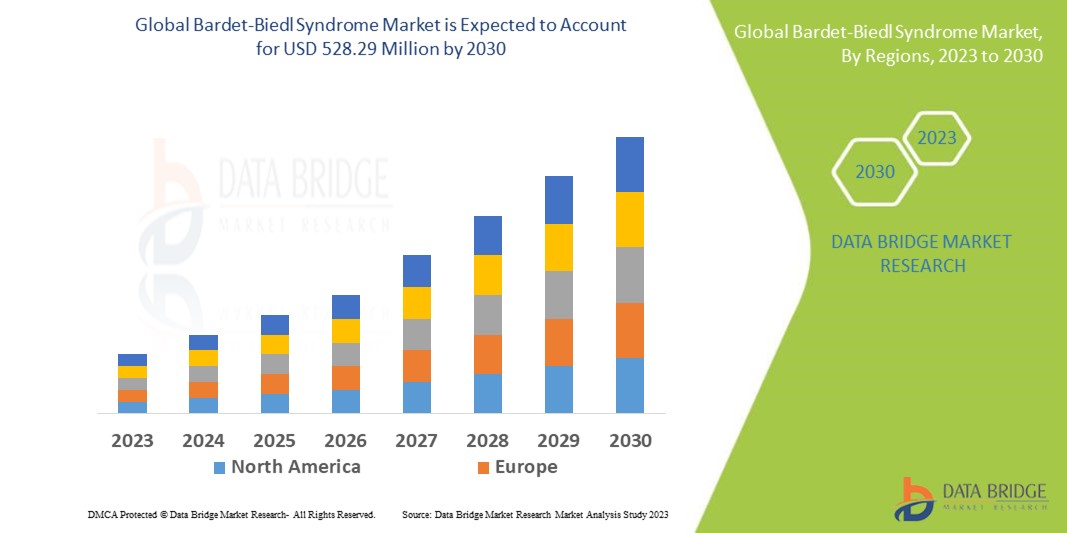
Data Bridge Market Research analyzes that the global Bardet-Biedl syndrome market, which was USD 349.22 million in 2022, is likely to reach USD 528.29 million by 2030 and is expected to undergo a CAGR of 5.9% during the forecast period 2023 to 2030. The “Genetic testing” segment is dominating the market due to the rising prevalence of chronic diseases. In addition to the market insights such as market value, growth rate, market segments, geographical coverage, market players, and market scenario, the market report curated by the Data Bridge Market Research team also includes in-depth expert analysis, patient epidemiology, pipeline analysis, pricing analysis, and regulatory framework.
Biedl-Bardet Syndrome Market Scope and Segmentation
|
Report Metric |
Details |
|
Forecast Period |
2023 to 2030 |
|
Base Year |
2022 |
|
Historic Years |
2021 (Customizable to 2015-2021) |
|
Quantitative Units |
Revenue in USD Billion, Volumes in Units, Pricing in USD |
|
Segments Covered |
Diagnosis (Electroretinogram (ERG), Genetic Testing, Others), Treatment (Surgery, Kidney Transplantation, Medication, Therapy, Others), Age of Onset (Childhood, Neonatal, Infancy, Adolescent), Inheritance (Oligogenic, Autosomal Recessive), End-Users (Hospitals, Specialty Clinics, Homecare, Others), Distribution Channel (Hospital Pharmacy, Retail Pharmacy, Online Pharmacy, Others) |
|
Countries Covered |
U.S., Canada, Mexico, Germany, France, U.K., Netherlands, Switzerland, Belgium, Russia, Italy, Spain, Turkey, Rest of Europe, China, Japan, India, South Korea, Singapore, Malaysia, Australia, Thailand, Indonesia, Philippines, Rest of Asia-Pacific, Saudi Arabia, U.A.E., South Africa, Egypt, Israel, Rest of Middle East and Africa, Brazil, Argentina, Rest of South America |
|
Market Players Covered |
F. Hoffmann-La Roche Ltd. (Switzerland), Mylan N.V. (U.S.), Teva Pharmaceutical Industries Ltd. (Ireland), Sanofi (France), Pfizer Inc. (U.S.), GlaxoSmithKline plc (U.K.), Novartis AG (Switzerland), Merck & Co., Inc. (U.S.), Allergan (Ireland), AstraZeneca (U.K.), Johnson & Johnson Private Limited (U.S.), Hikma Pharmaceuticals PLC (U.K.), Bristol-Myers Squibb Company (U.S.), Bayer AG (Germany), Boehringer Ingelheim International GmbH. (Germany), Dr. Reddy’s Laboratories Ltd. (India), Gilead Sciences, Inc. (U.S.), Amgen Inc. (U.S.), Eli Lilly and Company (U.S.), AbbVie Inc. (U.S.), Lupin (India), Allergan (Ireland) |
|
Market Opportunities |
|
Market Definition
Bardet-Biedl syndrome (BBS) is a rare hereditary multisystem condition characterized by a wide range of mild manifestations, including obesity, genitourinary, retinal dystrophy, polydactyly, and renal defects, learning difficulty, and hypogonadism. Treatment and multidisciplinary management are required. There is no targeted treatment available. The majority of manifestations are treated in the same way that the general public is (obesity, learning disability, kidney anomalies). Surgery is also recommended for the correction of genital anomalies and polydactyly.
Biedl-Bardet Syndrome Market Dynamics
Drivers
- Rising incidences of obesity
The surging incidences of obesity are a major factor driving the market's growth rate. Obesity is a prevalent component of Bardet-Biedl syndrome (BBS), thus it's especially crucial to address it. Only a few people with Bardet-Biedl syndrome (BBS) have undergone bariatric surgery with gastric banding or sleeve surgery. In those patients, surgery was linked to a 25 percent weight decrease that was maintained 12 months later. Long-term follow-up of these individuals is being done to investigate if bariatric surgery has a function in patients with Bardet-Biedl syndrome (BBS).
- Rising healthcare infrastructure
Enhanced healthcare infrastructure, including advanced medical equipment and facilities, can lead to improved diagnostic capabilities. This is crucial for rare diseases like Bardet-Biedl syndrome, which may require specialized testing and expertise for accurate diagnosis.
Opportunities
- Increasing number of research and development activities
Increasing research activities can lead to the discovery of new genetic markers and diagnostic tools for Bardet-Biedl syndrome. This can enhance the accuracy and efficiency of diagnosis. Enhanced research can facilitate the initiation of clinical trials for potential treatments or interventions. This provides patients with the opportunity to participate in experimental therapies.
- Increasing technological advancements
Technological advancements in genetic testing and sequencing have the potential to make the diagnosis of BBS faster, more accurate, and more accessible. Next-generation sequencing technologies can identify the specific genetic mutations associated with BBS. Advanced data analysis and bioinformatics tools can assist researchers and clinicians in identifying genetic variations and understanding the complex genetic underpinnings of BBS.
Restrains
- Strict regulations and guidelines
Regulations govern the conduct of clinical trials, including those related to rare diseases. Researchers and pharmaceutical companies conducting clinical trials for potential BBS treatments must adhere to ethical and safety standards set by regulatory agencies.
- High cost of treatment
Managing the complex medical needs associated with BBS can be costly, and the financial burden on patients and their families can be significant. Coping with the financial burden of high treatment costs, especially when combined with the emotional and psychological impact of living with a rare disease, can place additional stress on individuals and their families.
Challenges
- Diagnostic challenges
The diagnosis of BBS can be challenging due to its genetic complexity. Identifying the specific genetic mutations responsible for the condition may require specialized testing, and not all healthcare providers are familiar with the syndrome.
This Bardet-Biedl syndrome market report provides details of new recent developments, trade regulations, import-export analysis, production analysis, value chain optimization, market share, impact of domestic and localized market players, analyses opportunities in terms of emerging revenue pockets, changes in market regulations, strategic market growth analysis, market size, category market growths, application niches and dominance, product approvals, product launches, geographic expansions, technological innovations in the market. To gain more info on the Bardet-Biedl syndrome market contact Data Bridge Market Research for an Analyst Brief, our team will help you take an informed market decision to achieve market growth.
Recent Development
- In February 2022, Rhythm Pharmaceuticals had announced the United States Food and Drug Administration (FDA) extension of review period for IMCIVREE (setmelanotide) for patients suffering from Bardet-Biedl syndrome and Alström syndrome. In the United States, IMCIVREE is approved for the treatment of obesity in adults and children aged 6 and up who have a deficiency in proprotein convertase subtilisin/kexin type 1 (PCSK1), proopiomelanocortin (POMC), or leptin receptor (LEPR), as determined by genetic testing revealing pathogenic, likely pathogenic, or unknown significance variants in the PCSK1, POMC or LEPR genes
Global Bardet-Biedl Syndrome Market Scope
The Bardet-Biedl syndrome market is segmented on the basis of inheritance, diagnosis, treatment, age of onset, end-users and distribution channel. The growth amongst these segments will help you analyze meagre growth segments in the industries and provide the users with a valuable market overview and market insights to help them make strategic decisions for identifying core market applications.
Inheritance
- Oligogenic
- Autosomal Recessive
Diagnosis
- Electroretinogram (ERG)
- Genetic Testing
- Others
Treatment
- Surgery
- Kidney Transplantation
- Medication
- Therapy
- Suppressor Therapy
- Gene Therapy
- Stem Cell Therapy
- Others
Age of Onset
- Childhood
- Neonatal
- Infancy
- Adolescent
End-Users
- Hospitals
- Specialty Clinics
- Homecare
- Others
Distribution Channel
- Hospital Pharmacy
- Retail Pharmacy
- Online Pharmacy
- Others
Bardet-Biedl Syndrome Market Regional Analysis/Insights
The Bardet-Biedl syndrome market is analyzed and market size insights and trends are provided by country, inheritance, diagnosis, treatment, age of onset, end-users and distribution channel as referenced above.
The countries covered in the market report are U.S., Canada, Mexico, Germany, France, U.K., Netherlands, Switzerland, Belgium, Russia, Italy, Spain, Turkey, rest of Europe, China, Japan, India, South Korea, Singapore, Malaysia, Australia, Thailand, Indonesia, Philippines, rest of Asia-Pacific, Saudi Arabia, U.A.E., South Africa, Egypt, Israel, rest of Middle East and Africa, Brazil, Argentina and rest of South America.
North America is expected to dominate the market and continue to show highest growth rate in the market due to the growing prevalence of Bardet-Biedl syndrome and rising healthcare expenditure will further propel the market’s growth rate in this region. In addition, growing presence of major key players will further propel the market’s growth rate in this region. Asia-Pacific is expected to grow during the forecast period of 2023-2030 due to the development of healthcare infrastructure in this region. Also, rising government initiatives will further propel the market’s growth rate in this region.
The country section of the report also provides individual market impacting factors and changes in regulation in the market domestically that impacts the current and future trends of the market. Data points like down-stream and upstream value chain analysis, technical trends and porter's five forces analysis, case studies are some of the pointers used to forecast the market scenario for individual countries. Also, the presence and availability of global brands and their challenges faced due to large or scarce competition from local and domestic brands, impact of domestic tariffs and trade routes are considered while providing forecast analysis of the country data.
Healthcare Infrastructure growth Installed base and New Technology Penetration
The Bardet-Biedl syndrome market also provides you with detailed market analysis for every country growth in healthcare expenditure for capital equipment, installed base of different kind of products for Bardet-Biedl syndrome market, impact of technology using life line curves and changes in healthcare regulatory scenarios and their impact on the Bardet-Biedl syndrome market. The data is available for historic period 2010-2020.
Competitive Landscape and Bardet-Biedl syndrome market Share Analysis
The Bardet-Biedl syndrome market competitive landscape provides details by competitor. Details included are company overview, company financials, revenue generated, market potential, investment in research and development, new market initiatives, global presence, production sites and facilities, production capacities, company strengths and weaknesses, product launch, product width and breadth, application dominance. The above data points provided are only related to the companies' focus related to Bardet-Biedl syndrome market.
Some of the major players operating in the Bardet-Biedl syndrome market are:
- F. Hoffmann-La Roche Ltd. (Switzerland)
- Mylan N.V. (U.S.)
- Teva Pharmaceutical Industries Ltd. (Ireland)
- Sanofi (France)
- Pfizer Inc. (U.S.)
- GlaxoSmithKline plc (U.K.)
- Novartis AG (Switzerland)
- Merck & Co., Inc. (U.S.)
- Allergan (Ireland)
- AstraZeneca (U.K.)
- Johnson & Johnson Private Limited (U.S.)
- Hikma Pharmaceuticals PLC (U.K.)
- Bristol-Myers Squibb Company (U.S.)
- Bayer AG (Germany)
- Boehringer Ingelheim International GmbH. (Germany)
- Dr. Reddy’s Laboratories Ltd. (India)
- Gilead Sciences, Inc. (U.S.)
- Amgen Inc. (U.S.)
- Eli Lilly and Company (U.S.)
- AbbVie Inc. (U.S.)
- Lupin (India)
- Allergan (Ireland)
SKU-
Obtenha acesso online ao relatório sobre a primeira nuvem de inteligência de mercado do mundo
- Painel interativo de análise de dados
- Painel de análise da empresa para oportunidades de elevado potencial de crescimento
- Acesso de analista de pesquisa para personalização e customização. consultas
- Análise da concorrência com painel interativo
- Últimas notícias, atualizações e atualizações Análise de tendências
- Aproveite o poder da análise de benchmark para um rastreio abrangente da concorrência
Metodologia de Investigação
A recolha de dados e a análise do ano base são feitas através de módulos de recolha de dados com amostras grandes. A etapa inclui a obtenção de informações de mercado ou dados relacionados através de diversas fontes e estratégias. Inclui examinar e planear antecipadamente todos os dados adquiridos no passado. Da mesma forma, envolve o exame de inconsistências de informação observadas em diferentes fontes de informação. Os dados de mercado são analisados e estimados utilizando modelos estatísticos e coerentes de mercado. Além disso, a análise da quota de mercado e a análise das principais tendências são os principais fatores de sucesso no relatório de mercado. Para saber mais, solicite uma chamada de analista ou abra a sua consulta.
A principal metodologia de investigação utilizada pela equipa de investigação do DBMR é a triangulação de dados que envolve a mineração de dados, a análise do impacto das variáveis de dados no mercado e a validação primária (especialista do setor). Os modelos de dados incluem grelha de posicionamento de fornecedores, análise da linha de tempo do mercado, visão geral e guia de mercado, grelha de posicionamento da empresa, análise de patentes, análise de preços, análise da quota de mercado da empresa, normas de medição, análise global versus regional e de participação dos fornecedores. Para saber mais sobre a metodologia de investigação, faça uma consulta para falar com os nossos especialistas do setor.
Personalização disponível
A Data Bridge Market Research é líder em investigação formativa avançada. Orgulhamo-nos de servir os nossos clientes novos e existentes com dados e análises que correspondem e atendem aos seus objetivos. O relatório pode ser personalizado para incluir análise de tendências de preços de marcas-alvo, compreensão do mercado para países adicionais (solicite a lista de países), dados de resultados de ensaios clínicos, revisão de literatura, mercado remodelado e análise de base de produtos . A análise de mercado dos concorrentes-alvo pode ser analisada desde análises baseadas em tecnologia até estratégias de carteira de mercado. Podemos adicionar quantos concorrentes necessitar de dados no formato e estilo de dados que procura. A nossa equipa de analistas também pode fornecer dados em tabelas dinâmicas de ficheiros Excel em bruto (livro de factos) ou pode ajudá-lo a criar apresentações a partir dos conjuntos de dados disponíveis no relatório.