


Global Bluetooth Low Energy Market Segmentation, By Network Topology Type (Central Device, Peripheral, and Device), End-Use Type (Manufacturing, Automotive, Telecommunication, Home Appliances, and Others), Product Type (Module and Chipset), Mode (Single Mode and Dual Mode) – Industry Trends and Forecast to 2032
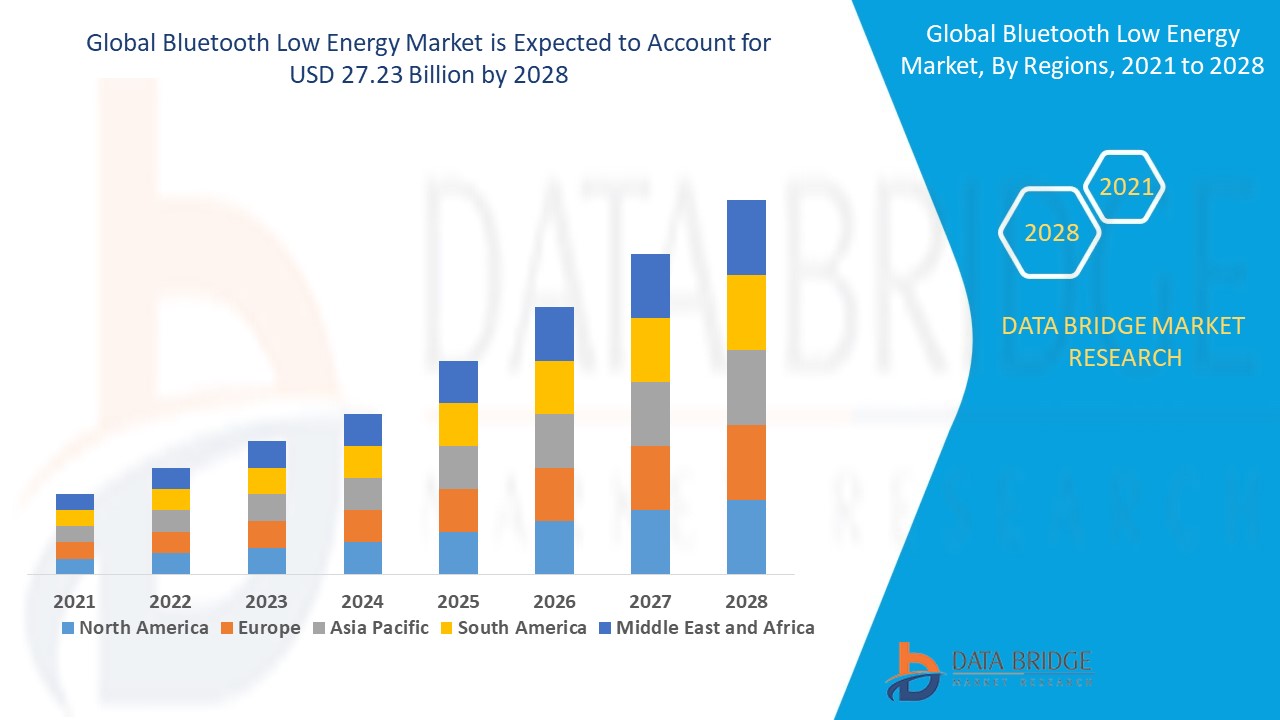
Bluetooth Low Energy Market Analysis
The bluetooth low energy market is experiencing significant growth due to its energy-efficient communication capabilities, making it ideal for applications in healthcare, automotive, consumer electronics, and industrial automation. Bluetooth low energy enables longer battery life in small devices such as wearable devices, smart home devices, and medical equipment, driving its adoption. Recent developments include advancements in bluetooth 5.0, offering improved data transfer speeds, range, and broadcast capabilities, along with innovations in bluetooth low energy mesh networks for large-scale connectivity in smart cities and IoT systems. With the increasing demand for connected devices and smart technology integration, bluetooth low energy is poised for continued growth across various industries, offering a cost-effective solution for efficient wireless communication.
Bluetooth Low Energy Market Size
The global bluetooth low energy market size was valued at USD 13.30 billion in 2024 and is projected to reach USD 55.75 billion by 2032, with a CAGR of 19.62% during the forecast period of 2025 to 2032. In addition to the insights on market scenarios such as market value, growth rate, segmentation, geographical coverage, and major players, the market reports curated by the Data Bridge Market Research also include depth expert analysis, patient epidemiology, pipeline analysis, pricing analysis, and regulatory framework.
Bluetooth Low Energy Market Trends
“Adoption of Smart Home Devices”
The bluetooth low energy market is witnessing significant innovation, driven by the increasing adoption of IoT devices and the demand for energy-efficient communication technologies. Bluetooth low energy offers lower power consumption and extended battery life, making it ideal for applications in wearables, smart home devices, and healthcare. One key trend is the rise of bluetooth low energy mesh networking, which enables scalable connectivity for smart buildings and industrial automation systems. This technology allows devices to communicate over a larger area with enhanced reliability. As bluetooth low energy continues to evolve, advancements in Bluetooth 5.0 are improving range, speed, and connectivity, contributing to the growth of this market across various sectors, including consumer electronics and healthcare.
Report Scope and Bluetooth Low Energy Market Segmentation
|
Attributes |
Bluetooth Low Energy Key Market Insights |
|
Segments Covered |
|
|
Countries Covered |
U.S., Canada and Mexico in North America, Germany, France, U.K., Netherlands, Switzerland, Belgium, Russia, Italy, Spain, Turkey, Rest of Europe in Europe, China, Japan, India, South Korea, Singapore, Malaysia, Australia, Thailand, Indonesia, Philippines, Rest of Asia-Pacific (APAC) in the Asia-Pacific (APAC), Saudi Arabia, U.A.E., South Africa, Egypt, Israel, Rest of Middle East and Africa (MEA) as a part of Middle East and Africa (MEA), Brazil, Argentina and Rest of South America as part of South America |
|
Key Market Players |
Infineon Technologies AG (Germany), Telefonaktiebolaget LM Ericsson (Sweden), Intel Corporation (U.S.), Motorola Solutions, Inc (U.S.), InsightSIP (France), Nordic Semiconductor (Norway), Silicon Laboratories (U.S.), STMicroelectronics (Switzerland), Texas Instruments Incorporated (U.S.), Telink (China), Renesas Electronics Corporation (Japan), NXP Semiconductors (Netherlands), and TOSHIBA CORPORATION (Japan) |
|
Market Opportunities |
|
|
Value Added Data Infosets |
In addition to the insights on market scenarios such as market value, growth rate, segmentation, geographical coverage, and major players, the market reports curated by the Data Bridge Market Research also include in-depth expert analysis, geographically represented company-wise production and capacity, network layouts of distributors and partners, detailed and updated price trend analysis and deficit analysis of supply chain and demand. |
Bluetooth Low Energy Market Definition
Bluetooth low energy is a wireless communication technology designed for short-range, low-power data transmission between devices. It is part of the bluetooth standard, optimized to consume minimal energy while maintaining reliable connectivity. This technology is commonly used in applications such as wearables, health monitors, smart home devices, and other Internet of Things (IoT) devices, where long battery life and efficient communication are critical. Unlike classic Bluetooth, bluetooth low energy is ideal for devices that need to send small amounts of data intermittently, offering significant energy savings for prolonged use.
Bluetooth Low Energy Market Dynamics
Drivers
- Rising Adoption of IoT Devices
The growing prevalence of Internet of Things (IoT) devices, including smart home gadgets, wearables, and health monitors, is a major driver of the bluetooth low energy market. As the number of connected devices continues to rise, the demand for efficient, low-power communication technologies has increased. Bluetooth low energy is particularly well-suited for IoT applications due to its ability to offer reliable connectivity with minimal power consumption, extending battery life and reducing maintenance needs. This makes it the preferred choice for devices that require constant or intermittent data transfer, driving widespread adoption in industries such as healthcare, fitness, and home automation.
- Wearables and Healthcare Demand
The growing demand for wearable health devices, fitness trackers, and remote patient monitoring systems is significantly driving the adoption of bluetooth low energy. These devices require continuous or frequent data transmission while maintaining long battery life, making bluetooth low energy the ideal choice due to its efficient power consumption. The ability to transmit small amounts of data over extended periods without draining the battery allows these devices to remain functional for days or even weeks on a single charge. As health and fitness tracking technology becomes more integrated into everyday life, bluetooth low energy is increasingly recognized as a crucial enabler for these innovations.
Opportunities
- Expansion in Healthcare Applications
The increasing demand for wearable health devices, remote patient monitoring, and fitness trackers is driving the adoption of bluetooth low energy due to its reliable, energy-efficient connectivity. These devices require constant data transmission while maintaining long battery life, making bluetooth low energy the ideal solution. As the focus on health and wellness continues to grow, BLE is being increasingly integrated into medical devices for applications such as real-time health monitoring, chronic disease management, and fitness tracking. This surge in health-conscious consumers and the expansion of telemedicine create a significant market opportunity for bluetooth low energy in the medical device industry.
- Advancements in Bluetooth Technology
Innovations such as bluetooth 5.0 are unlocking new opportunities for bluetooth low energy by enhancing its performance. With increased range, faster data speeds, and more efficient broadcasting capabilities, bluetooth 5.0 expands the potential applications of BLE, particularly in environments where higher performance and extended connectivity are essential. These advancements make bluetooth low energy more suitable for a broader range of industries, including smart homes, industrial automation, and large-scale IoT networks. As businesses and consumers demand more reliable, faster, and longer-range connectivity, the improved capabilities of bluetooth 5.0 present a significant market opportunity for the adoption of bluetooth low energy in various sectors.
Restraints/Challenges
- Interference and Compatibility Issues
Bluetooth low energy operates in the crowded 2.4 GHz frequency band, which is also shared by various other wireless technologies, such as Wi-Fi, Zigbee, and microwave devices. This overlapping spectrum can lead to interference, resulting in connectivity issues and reduced performance, particularly in environments with high device density. Furthermore, compatibility issues may arise when BLE devices need to interact with older Bluetooth versions or other wireless standards that are not fully compatible with the latest BLE advancements. These challenges could limit the seamless operation of BLE devices in multi-device ecosystems, posing a significant obstacle to widespread adoption.
- Limited Range
Despite advancements with bluetooth 5.0, the range of bluetooth low energy remains relatively limited compared to other wireless technologies such as Wi-Fi or Zigbee. BLE typically offers a communication range of up to 100 meters in ideal conditions, which may not be sufficient for applications that require long-range connectivity, such as large-scale industrial IoT networks or wide-area smart city systems. This limitation can hinder the widespread adoption of bluetooth low energy in scenarios where extended range is essential. As industries demand more robust and far-reaching wireless solutions, the range constraint remains a key market restraint for BLE technology.
This market report provides details of new recent developments, trade regulations, import-export analysis, production analysis, value chain optimization, market share, impact of domestic and localized market players, analyses opportunities in terms of emerging revenue pockets, changes in market regulations, strategic market growth analysis, market size, category market growths, application niches and dominance, product approvals, product launches, geographic expansions, technological innovations in the market. To gain more info on the market contact Data Bridge Market Research for an Analyst Brief, our team will help you take an informed market decision to achieve market growth.
Bluetooth Low Energy Market Scope
The market is segmented on the basis of network topology type, end-use type, product type, and mode. The growth amongst these segments will help you analyse meagre growth segments in the industries and provide the users with a valuable market overview and market insights to help them make strategic decisions for identifying core market applications.
Network Topology Type
- Central Device
- Peripheral
- Device
End-Use Type
- Manufacturing
- Automotive
- Telecommunication
- Home Appliances
- Others
Product Type
- Module
- Chipset
Mode
- Single Mode
- Dual Mode
Bluetooth Low Energy Market Regional Analysis
The market is analysed and market size insights and trends are provided by country, network topology type, end-use type, product type, and mode as referenced above.
The countries covered in the market report are U.S., Canada and Mexico in North America, Germany, France, U.K., Netherlands, Switzerland, Belgium, Russia, Italy, Spain, Turkey, Rest of Europe in Europe, China, Japan, India, South Korea, Singapore, Malaysia, Australia, Thailand, Indonesia, Philippines, Rest of Asia-Pacific (APAC) in the Asia-Pacific (APAC), Saudi Arabia, U.A.E., South Africa, Egypt, Israel, Rest of Middle East and Africa (MEA) as a part of Middle East and Africa (MEA), Brazil, Argentina and Rest of South America as part of South America.
Asia-Pacific region leads the bluetooth low energy market, driven by the growing adoption of BLE technology, increasing demand for low-maintenance, power-efficient wireless sensors, and significant advancements in the Internet of Things (IoT) sector. The region's rapid technological growth and investment in IoT infrastructure further fuel BLE adoption across various industries. With a large manufacturing base and a strong focus on smart devices, Asia-Pacific is positioned as the dominant force in the global bluetooth low energy market.
North America leads as the fastest-growing region in the Bluetooth low energy market. This growth is driven by the rapid adoption of IoT applications and advancements in smart home technologies. The strong presence of key technology companies further supports market expansion.
The country section of the report also provides individual market impacting factors and changes in regulation in the market domestically that impacts the current and future trends of the market. Data points such as down-stream and upstream value chain analysis, technical trends and porter's five forces analysis, case studies are some of the pointers used to forecast the market scenario for individual countries. Also, the presence and availability of global brands and their challenges faced due to large or scarce competition from local and domestic brands, impact of domestic tariffs and trade routes are considered while providing forecast analysis of the country data.
Bluetooth Low Energy Market Share
The market competitive landscape provides details by competitor. Details included are company overview, company financials, revenue generated, market potential, investment in research and development, new market initiatives, global presence, production sites and facilities, production capacities, company strengths and weaknesses, product launch, product width and breadth, application dominance. The above data points provided are only related to the companies' focus related to market.
Bluetooth Low Energy Market Leaders Operating in the Market Are:
- Infineon Technologies AG (U.S.)
- Telefonaktiebolaget LM Ericsson (Sweden)
- Intel Corporation (U.S.)
- Motorola Solutions, Inc (U.S.)
- InsightSIP (France)
- Nordic Semiconductor (Norway)
- Silicon Laboratories (U.S.)
- STMicroelectronics (Switzerland)
- Texas Instruments Incorporated (U.S.)
- Telink (China)
- Renesas Electronics Corporation (Japan)
- NXP Semiconductors (Netherlands)
- TOSHIBA CORPORATION (Japan)
Latest Developments in Bluetooth Low Energy Market
- In March 2021, ShotTracker secured a US$ 2 million investment from Hearst Ventures to enhance its offerings for major basketball broadcasters. This funding enabled the company to refine its technology, which includes Bluetooth low energy wearable devices that track the motion of a player's wrist and the ball’s impact on the net. The innovative solution provides real-time data, enhancing the viewing experience for basketball fans and analysts alike
- In October 2020, Samsung Electronics launched SmartThings Find, a tracking solution designed to help users easily locate their Galaxy devices. The service leverages Bluetooth low energy and ultra-wideband technologies to pinpoint and track devices such as smartphones, tablets, smartwatches, and earbuds. This innovation enhances the user experience by providing an efficient and reliable way to find lost or misplaced Galaxy products
SKU-
Obtenha acesso online ao relatório sobre a primeira nuvem de inteligência de mercado do mundo

- Painel interativo de análise de dados
- Painel de análise da empresa para oportunidades de elevado potencial de crescimento
- Acesso de analista de pesquisa para personalização e customização. consultas
- Análise da concorrência com painel interativo
- Últimas notícias, atualizações e atualizações Análise de tendências
- Aproveite o poder da análise de benchmark para um rastreio abrangente da concorrência
Metodologia de Investigação
A recolha de dados e a análise do ano base são feitas através de módulos de recolha de dados com amostras grandes. A etapa inclui a obtenção de informações de mercado ou dados relacionados através de diversas fontes e estratégias. Inclui examinar e planear antecipadamente todos os dados adquiridos no passado. Da mesma forma, envolve o exame de inconsistências de informação observadas em diferentes fontes de informação. Os dados de mercado são analisados e estimados utilizando modelos estatísticos e coerentes de mercado. Além disso, a análise da quota de mercado e a análise das principais tendências são os principais fatores de sucesso no relatório de mercado. Para saber mais, solicite uma chamada de analista ou abra a sua consulta.
A principal metodologia de investigação utilizada pela equipa de investigação do DBMR é a triangulação de dados que envolve a mineração de dados, a análise do impacto das variáveis de dados no mercado e a validação primária (especialista do setor). Os modelos de dados incluem grelha de posicionamento de fornecedores, análise da linha de tempo do mercado, visão geral e guia de mercado, grelha de posicionamento da empresa, análise de patentes, análise de preços, análise da quota de mercado da empresa, normas de medição, análise global versus regional e de participação dos fornecedores. Para saber mais sobre a metodologia de investigação, faça uma consulta para falar com os nossos especialistas do setor.
Personalização disponível
A Data Bridge Market Research é líder em investigação formativa avançada. Orgulhamo-nos de servir os nossos clientes novos e existentes com dados e análises que correspondem e atendem aos seus objetivos. O relatório pode ser personalizado para incluir análise de tendências de preços de marcas-alvo, compreensão do mercado para países adicionais (solicite a lista de países), dados de resultados de ensaios clínicos, revisão de literatura, mercado remodelado e análise de base de produtos . A análise de mercado dos concorrentes-alvo pode ser analisada desde análises baseadas em tecnologia até estratégias de carteira de mercado. Podemos adicionar quantos concorrentes necessitar de dados no formato e estilo de dados que procura. A nossa equipa de analistas também pode fornecer dados em tabelas dinâmicas de ficheiros Excel em bruto (livro de factos) ou pode ajudá-lo a criar apresentações a partir dos conjuntos de dados disponíveis no relatório.











