


Global Braze Alloys Market, By Metal (Nickel, Cobalto, Prata, Ouro, Alumínio, Cobre, Aço, Ferro, Magnésio, Titânio e Outros), Filler Material (Braze Powder, Braze Past, Braze Tape, Braze Preform, Braze Foil, e Braze Rod e Wire), Tecnologia (Brazing Toch Brazing, Fornalha de Indução, Dip Brazing, Resistência Brazing, Infrared Brazing, Brazing Exothermic Brazing, Blanket Brazing, Electron Beam/Laser Brazing, Brazing, Brazing, Ammonia Dissecia, Vacuum Brazing, Hydrogen Brazing, Fuel Brazing, e Outros), Forma (Pipe, Tubo, Chapa, Placa, Round Bar, Flat, Bar, Wire e Outros), Temperatura de Produção (Less de 900 °C, 901 °C a 1000 °C, 1001 °C a 1200 °C e acima de 1200 °C, e até 1200 °C, até 20 °C, e
O que é o Braze Alloys Market Tamanho e Visão geral
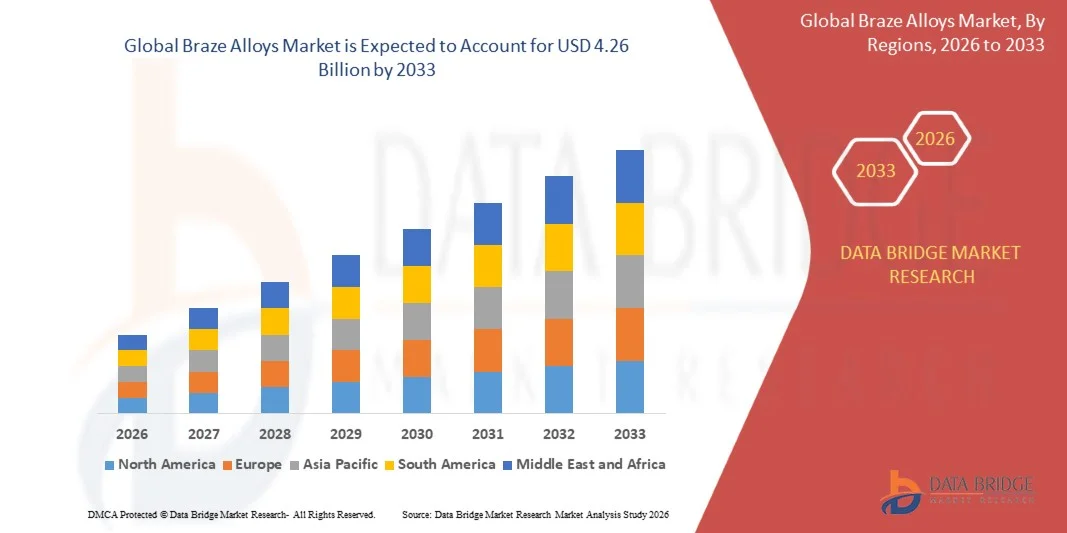
Como por Data Bridge Market Research Analysis o mercado Braze Alloys foi avaliado emUSD 2,93 Bilhões em 2025e é projetado para alcançarUSD 4.26 Bilhões até 2033, crescendo emCAGR de 4,8% de 2026 a 2033O mercado está experimentando um crescimento consistente impulsionado pela crescente demanda por materiais de alta performance que unem os setores automotivo, aeroespacial, eletrônico e industrial. O aumento da adoção de tecnologias avançadas de soldadura, a crescente necessidade de componentes leves e duráveis e a expansão da produção de veículos elétricos estão apoiando ainda mais o crescimento do mercado nas principais regiões.
A crescente ênfase na fabricação de precisão, eficiência energética e confiabilidade do material está aumentando significativamente a adoção de ligas de braze em aplicações críticas. As indústrias estão cada vez mais mudando para o vácuo de brasagem, ligas à base de níquel e metais de enchimento ambientalmente compatíveis para atender aos requisitos rigorosos de desempenho e regulamentação. Investimentos crescentes na modernização aeroespacial, fabricação de semicondutores e automação industrial estão acelerando ainda mais a demanda por soluções avançadas de soldadura em todo o mundo.
Tamanho e previsão do mercado
- Valor de Mercado Global (2025): USD 2,93 bilhões
- Valor de mercado esperado (2033): USD 4.26 Bilhões
- Previsões CAGR (2026-2033): 4,8%
- Região líder em 2025: Ásia-Pacífico
- Região de crescimento mais rápido: América do Norte
O que são as principais takeaways do mercado de ligas de Braze
- A Ásia-Pacífico dominou o Mercado de Ligas Braze com a maior parcela de receita de 46,88% em 2025, apoiada por fortes atividades de fabricação, expansão da produção automotiva e aumento da demanda por materiais avançados de junção entre os setores eletrônico, aeroespacial e industrial
- O segmento 901 °C a 1000 °C liderou o mercado com uma participação de 38,4% em 2025, impulsionada pela sua adequação para unir uma ampla gama de metais industriais, mantendo fortes propriedades mecânicas
- A América do Norte deverá ser a região de crescimento mais rápido em um CAGR de 5,1% de 2026 a 2033, alimentado pelo aumento da demanda por materiais de alto desempenho e crescentes investimentos na fabricação de veículos aeroespaciais, de defesa e elétricos
- O brazing a vácuo é o tipo de tecnologia de crescimento mais rápido, projetado para registrar um CAGR de 10,8% de 2026 a 2033, apoiado pela crescente demanda por juntas livres de contaminação e de alta resistência em aplicações aeroespaciais, eletrônicas e médicas
- O segmento de haste e arame braze dominou a categoria de materiais de enchimento com uma participação de 34,6% em 2025, liderada pelo seu uso generalizado em operações manuais e automatizadas de soldadura em indústrias automotivas, de construção e de HVAC
- Automotive representou 32,5% do mercado em 2025, preferido pelo uso extensivo de ligas de solda em radiadores, trocadores de calor, sistemas de combustível e vários componentes estruturais
- O segmento 1001 °C a 1200 °C é a categoria de temperatura de produção mais rápida, com um CAGR de 10,1% de 2026 a 2033, impulsionado pelo uso crescente de ligas de alta resistência em equipamentos industriais aeroespaciais, energéticos e pesados
Segmentação de Mercado de Ligas de Braze
|
Atributos |
Insights do mercado chave das ligas de Braze |
|
Segmentos Cobertos |
|
|
Países abrangidos |
América do Norte
Europa
Ásia- Pacífico
Médio Oriente e África
América do Sul
|
|
Jogadores do mercado chave |
|
|
Oportunidades de Mercado |
|
|
Informações sobre o Valor Adicionado |
Além dos insights sobre cenários de mercado, como valor de mercado, taxa de crescimento, segmentação, cobertura geográfica e principais atores, os relatórios de mercado curados pela Data Bridge Market Research também incluem análise de especialistas em profundidade, produção e capacidade em termos geográficos representadas pela empresa, layouts de redes de distribuidores e parceiros, análise detalhada e atualizada da tendência de preços e análise de déficit da cadeia de suprimentos e demanda. |
Qual é a tendência chave no mercado de ligas Braze
Tendência: Mudança para tecnologias de vácuo e precisão
O mercado Braze Alloys está testemunhando uma forte mudança para as tecnologias de união controladas com precisão e a vácuo impulsionadas pela necessidade de juntas sem contaminação, de alta resistência e confiáveis em aplicações críticas. A queima a vácuo é cada vez mais preferida em conjuntos de turbinas aeroespaciais, componentes semicondutores e trocadores de calor de alto desempenho devido à sua capacidade de eliminar a oxidação e melhorar a qualidade da ligação metalúrgica. Avanços em fornos de atmosfera controlada, união de feixes de elétrons e sistemas de brasagem automatizados estão melhorando ainda mais a consistência e eficiência da produção.
Empresas como a Indium Corporation estão desenvolvendo ativamente materiais de brasagem avançados sob medida para aplicações eletrônicas de semicondutores e alta confiabilidade, apoiando a transição para ecossistemas de fabricação de precisão.
Dinâmica do Mercado de Ligas de Braze
Motorista do mercado chave: aumento da demanda dos setores Aeroespacial, Automotivo e Eletrônico
A crescente demanda por soluções de alto desempenho nas indústrias aeroespacial, automotiva e eletrônica é um dos principais motores do mercado Braze Alloys. As ligas Braze são amplamente utilizadas em motores de turbina, trocadores de calor, sistemas térmicos de bateria EV e conjuntos eletrônicos devido à sua resistência, resistência à corrosão e estabilidade térmica. O aumento da produção de veículos elétricos e a expansão da fabricação de semicondutores estão fortalecendo ainda mais a demanda de materiais em aplicações de engenharia de precisão.
Empresas como Lucas-Milhaupt, Inc. e Harris Products Group estão expandindo portfólios de produtos para atender à crescente demanda dos fabricantes de automóveis e eletrônicos, apoiando a adoção industrial em larga escala.
Chave de retenção / desafio: alto custo de material e complexidade do processo
Um desafio fundamental no mercado Braze Alloys é o alto custo de matérias-primas como prata, níquel e cobalto, juntamente com a complexidade técnica dos processos avançados de brasagem. Controle preciso de temperatura, atmosferas controladas e requisitos de equipamentos especializados aumentam os custos de produção e limitam a adoção entre fabricantes de pequena e média escala. Além disso, rigorosos padrões de qualidade em aplicações aeroespaciais e eletrônicas adicionam validação de processos e complexidade operacional.
Fabricantes como Morgan Advanced Materials estão enfrentando esses desafios otimizando composições de ligas e melhorando a eficiência do processo para reduzir as pressões de custos, mantendo os padrões de desempenho.
Oportunidade chave do mercado: adoção de equipamentos de energia renovável
A crescente implantação de sistemas de energia renovável está criando oportunidades significativas para ligas de braze em aplicações como sistemas térmicos solares, turbinas eólicas, infraestrutura de energia de hidrogênio e sistemas de refrigeração eletrônicos de energia. As ligas de braze são essenciais para garantir juntas à prova de vazamentos, de alta resistência em trocadores de calor e componentes de transmissão de energia utilizados em instalações renováveis. Os crescentes investimentos globais em infraestruturas de energia limpa estão expandindo ainda mais o uso de materiais avançados de união.
Empresas como a OC Oerlikon Management AG estão se concentrando em soluções avançadas de engenharia de materiais que suportam sistemas de energia de alta eficiência, permitindo a adoção mais ampla de tecnologias de solda na fabricação de equipamentos de energia renovável.
Como é o mercado de ligas Braze segmentado
O mercado de ligas de braze é segmentado com base em metal, material de enchimento, tecnologia, forma, temperatura de produção e uso final.
- Por Metal
Com base no metal, o Braze Alloys Market é segmentado em níquel, cobalto, prata, ouro, alumínio, cobre, aço, ferro, magnésio, titânio, entre outros. O segmento Silver dominou o mercado com a maior parte de 31,8% em 2025, impulsionado pela sua excelente molhabilidade, condutividade elétrica superior, e capacidade de formar juntas fortes e resistentes à corrosão em uma ampla gama de metais base. Ligas de braze à base de prata são amplamente utilizadas em sistemas HVAC, componentes elétricos e conjuntos automotivos devido à sua confiabilidade e facilidade de aplicação. Sua compatibilidade com diferentes ambientes de união e capacidade de fornecer suporte de alta resistência mecânica ampla adoção industrial. A forte demanda dos fabricantes de equipamentos eletrônicos e de refrigeração reforça ainda mais a liderança do segmento. Desenvolvimentos contínuos em composições de liga de prata de alto desempenho também estão aumentando a eficiência e a vida útil.
O segmento de níquel é projetado para registrar o crescimento mais rápido em um CAGR de 8,9% de 2026 a 2033, impulsionado pela crescente demanda de materiais de união resistentes à corrosão e alta temperatura em aplicações aeroespaciais, energéticas e industriais. As ligas à base de níquel oferecem excelente resistência à oxidação e são cada vez mais usadas em motores de turbinas, trocadores de calor e conjuntos críticos expostos a condições de operação severas. Os investimentos crescentes na fabricação aeroespacial e sistemas avançados de geração de energia estão expandindo o escopo de aplicação. Avanços tecnológicos em soldadura a vácuo e união de precisão estão apoiando a adoção mais ampla. A preferência crescente por materiais duráveis com propriedades metalúrgicas superiores está acelerando o crescimento do segmento.
- Por material de enchimento
Com base no material de enchimento, o Braze Alloys Market é segmentado em pó braze, pasta braze, fita braze, pré-forma braze, folha braze, e haste braze e fio. O segmento Braze Rod e Wire dominou o mercado com uma participação de 34,6% em 2025, apoiada pela sua ampla utilização em operações manuais e automatizadas de solda em indústrias automotivas, de construção e de HVAC. Esses materiais oferecem flexibilidade, facilidade de manuseio e distribuição consistente de ligas durante os processos de união. A sua adequação para aplicações de reparação e manutenção contribui para uma forte procura industrial. A disponibilidade em múltiplas composições de ligas permite o uso em diversos requisitos de fabricação. Aumentar a adoção em atividades de fabricação em larga escala reforça ainda mais o domínio do segmento.
O segmento Braze Paste é projetado para registrar o crescimento mais rápido em um CAGR de 9,7% de 2026 para 2033, impulsionado pelo aumento da demanda por precisão de união em eletrônicos, dispositivos médicos e componentes miniatura. A pasta Braze permite a aplicação controlada de material e melhora a eficiência do processo em ambientes de fabricação automatizados. A adoção crescente de dispositivos eletrônicos compactos e conjuntos avançados está criando oportunidades de crescimento significativas. Avanços em formulações de pasta e tecnologias de dispensação estão aumentando a precisão de união e redução de resíduos. Investimentos crescentes em processos de fabricação de alta precisão estão apoiando a expansão rápida do segmento.
- Por Tecnologia
Com base na tecnologia, o Braze Alloys Market é segmentado em queima de tochas, fornalha, brazing de indução, brasagem de mergulho, soldadura de resistência, brasagem de infravermelhos, brasagem exotérmica, brasagem de cobertores, soldadura de feixes de elétrons/laser, soldadura de bronze, amônia dissociada, brasagem de vácuo, queima de hidrogênio, queima de gás combustível, entre outros. O segmento Fornace Brazing dominou o mercado com a maior participação de 28,9% em 2025, impulsionado pela sua capacidade de proporcionar aquecimento uniforme e eficiência de produção de alto volume. A tecnologia é amplamente empregada em trocadores de calor automotivos, componentes aeroespaciais e fabricação de equipamentos industriais. Oferece excelente qualidade conjunta e repetibilidade, tornando-o adequado para conjuntos complexos. O aumento da automação nas instalações de fabricação tem reforçado sua adoção em economias desenvolvidas. Qualidade consistente do produto e redução dos requisitos de trabalho apoiam ainda mais a liderança do segmento.
O segmento Vacuum Brazing é projetado para registrar o crescimento mais rápido em um CAGR de 10,8% de 2026 a 2033, impulsionado pela crescente demanda por articulações livres de contaminação e de alta resistência em aplicações aeroespaciais, eletrônicas e médicas. A queima a vácuo elimina a oxidação e permite uma ligação metalúrgica superior para componentes críticos. A crescente produção de sistemas leves e de alto desempenho está a incentivar a adopção mais ampla desta tecnologia. Avanços em equipamentos de forno a vácuo e controle de processo estão melhorando a eficiência operacional. Aumentar o foco na precisão da fabricação e confiabilidade do produto está acelerando o crescimento do mercado.
- Pelo Formulário
Com base na forma, o Braze Alloys Market é segmentado em tubo, tubo, folha, tira, placa, barra redonda, plana, barra, arame, entre outros. O segmento Wire dominou o mercado com uma participação de 26,7% em 2025, apoiado pelo seu amplo uso em sistemas automatizados de brasagem e processos de fabricação industrial. Formas de arame fornecem alimentação de liga precisa e são altamente adequados para ambientes de produção contínua. Sua facilidade de armazenamento e compatibilidade com operações robóticas aumentam a eficiência de fabricação. A crescente utilização em aplicações automotivas e elétricas contribui para a demanda sustentada. O aumento dos investimentos em tecnologias avançadas de integração reforça ainda mais o domínio dos segmentos.
O segmento Strip é projetado para registrar o crescimento mais rápido em um CAGR de 9,2% de 2026 a 2033, impulsionado pela crescente demanda de materiais de solda personalizados e de precisão. Formas de tira permitem melhor precisão dimensional e distribuição consistente de material em conjuntos de alto desempenho. O aumento das aplicações na fabricação aeroespacial e eletrônica está apoiando a expansão do mercado. Os desenvolvimentos tecnológicos em laminação e processamento de ligas estão melhorando a qualidade do produto. A preferência crescente por soluções de união eficientes e economizadoras de materiais está acelerando o crescimento do segmento.
- Por Temperatura de Produção
Com base na temperatura de produção, o mercado de ligas de Braze é segmentado em menos de 900 °C, 901 °C a 1000 °C, 1001 °C a 1200 °C e acima de 1200 °C. O segmento 901 °C a 1000 °C dominou o mercado com a maior participação de 38,4% em 2025, impulsionada pela sua adequação para unir uma ampla gama de metais industriais, mantendo fortes propriedades mecânicas. Esta faixa de temperatura é amplamente utilizada em aplicações automotivas, elétricas e HVAC devido ao seu equilíbrio entre desempenho e eficiência do processo. Os fabricantes preferem estas condições de operação para minimizar distorções e consumo de energia. A forte procura das indústrias de produção em massa apoia a adopção generalizada. Melhorias contínuas nas formulações de ligas reforçam ainda mais a liderança do segmento.
O segmento 1001 °C a 1200 °C é projetado para registrar o crescimento mais rápido em um CAGR de 10,1% de 2026 a 2033, impulsionado pelo uso crescente de ligas de alta resistência em aeroespacial, energia e equipamentos industriais pesados. A queima de temperatura mais elevada permite uma integridade articular superior e resistência aumentada a condições de operação extremas. A crescente produção de turbinas avançadas e componentes resistentes ao calor está apoiando a expansão do segmento. Desenvolvimentos em atmosfera controlada e tecnologias de brazing a vácuo estão melhorando a confiabilidade do processo. A crescente demanda por conjuntos duráveis e de alto desempenho está acelerando o crescimento.
- Por Uso Final
Com base no uso final, o mercado Braze Alloys é segmentado em aeroespacial e defesa, eletrônica e elétrica, automotiva, marinha, química, construção e construção, entre outros. O segmento automotivo dominou o mercado com uma participação de 32,5% em 2025, impulsionado pelo uso extensivo de ligas de solda em radiadores, trocadores de calor, sistemas de combustível e vários componentes estruturais. A crescente produção de veículos e a crescente ênfase em conjuntos leves estão apoiando a demanda por materiais avançados de união. As ligas Braze fornecem juntas fortes e à prova de vazamento que aumentam a durabilidade e eficiência dos componentes. A expansão da fabricação de veículos elétricos está aumentando ainda mais o consumo em sistemas de gerenciamento térmico e de bateria. Avanços contínuos nas tecnologias de fabricação automotiva reforçam o domínio do segmento.
O segmento Aeroespacial e Defesa é projetado para registrar o crescimento mais rápido em um CAGR de 11,4% de 2026 para 2033, impulsionado pela crescente demanda por materiais resistentes a alta temperatura e componentes de precisão. As ligas Braze são amplamente utilizadas em motores de aeronaves, lâminas de turbinas e conjuntos críticos que exigem resistência e confiabilidade excepcionais. O aumento dos investimentos em programas de modernização da aviação comercial e de defesa está criando oportunidades de crescimento significativas. Os avanços nas tecnologias de soldadura à base de níquel e vácuo estão aumentando os padrões de desempenho. O foco crescente em sistemas de aeronaves leves e eficientes em termos de combustível está acelerando a expansão do segmento.
Qual é a região que detém a maior parte do mercado de ligas Braze
A Asia-Pacific dominou o mercado de ligas de braze e representou a maior parcela de receita de 46,88% em 2025, apoiada por fortes atividades de fabricação, expansão da produção automotiva e aumento da demanda por materiais avançados de junção entre setores eletrônicos, aeroespaciais e industriais. A região beneficia da presença de instalações de processamento de metal em larga escala, capacidades de produção rentáveis e crescentes investimentos em tecnologias de fabricação de precisão. A crescente demanda por trocadores de calor, componentes elétricos e conjuntos de alto desempenho está acelerando a expansão regional do mercado. O aumento do desenvolvimento das infra-estruturas e a automatização industrial apoiam ainda mais o crescimento a longo prazo.
China Braze Alloys Market Insight
A China teve a maior participação no mercado asiático-pacífico Braze Alloys em 2025, apoiado pela sua extensa base de fabricação e forte demanda dos setores automotivo, eletrônico e industrial pesado. O país tem uma indústria metalúrgica bem estabelecida e infraestrutura de produção avançada que permitem a fabricação em larga escala de materiais de brasagem. O forte consumo de sistemas HVAC, equipamentos elétricos e indústrias de fabricação de máquinas está apoiando ainda mais o crescimento do mercado. Além disso, o aumento dos investimentos em veículos elétricos e automação industrial estão reforçando a liderança da China na produção regional e global de ligas de braze.
Índia Braze Alloys Market Insight
A Índia está presenciando o crescimento mais rápido na região Ásia-Pacífico, impulsionado pela expansão da produção automotiva, aumento do desenvolvimento de infraestrutura e adoção crescente de tecnologias avançadas de integração de metais. A crescente utilização de ligas de braze em equipamentos elétricos, sistemas de refrigeração e máquinas industriais está apoiando significativamente a expansão do mercado. O país também está beneficiando com o aumento dos investimentos em manufatura aeroespacial e projetos de energia renovável. Além disso, a crescente localização da fabricação de componentes e expansão das indústrias de fabricação de metal estão acelerando o crescimento do mercado a longo prazo.
Europa Braze Alloys Market Insight
O mercado europeu Braze Alloys está em constante expansão, apoiado pelo aumento da demanda das indústrias de fabricação de equipamentos aeroespaciais, automotivos e industriais. Os fabricantes de toda a região estão cada vez mais focados em soluções de união de alto desempenho para melhorar a durabilidade e eficiência do produto. A forte demanda por materiais leves e componentes de precisão está contribuindo ainda mais para a expansão do mercado. Além disso, os investimentos crescentes em tecnologias de fabrico avançadas e processos industriais sustentáveis estão a apoiar o desenvolvimento do mercado regional.
Alemanha Braze Alloys Market Insight
A Alemanha representou a maior parte do mercado europeu de ligas de Braze em 2025, impulsionada pelas suas indústrias de automóveis, máquinas e aeroespacial. O país tem um setor de engenharia altamente desenvolvido que utiliza extensivamente materiais de brasagem para trocadores de calor, componentes de turbinas e conjuntos elétricos. A crescente procura de veículos leves e de sistemas eficientes em termos energéticos reforça ainda mais o crescimento do mercado. Além disso, os investimentos contínuos em automação industrial e fabricação de precisão estão reforçando a posição de mercado líder da Alemanha.
U.K. Braze Alloys Market Insight
O mercado do Reino Unido é suportado pela crescente demanda por materiais avançados que unem aplicações de equipamentos aeroespaciais, de defesa e industriais. Aumentar a ênfase na produção de componentes leves e processos de fabricação de alto desempenho está impulsionando a adoção de ligas de braze em vários setores. O país está também a assistir ao aumento da utilização de tecnologias de brasagem em sistemas energéticos e aplicações de engenharia de precisão. Além disso, a expansão dos investimentos em programas aeroespaciais e a modernização da infraestrutura industrial estão apoiando ainda mais o crescimento do mercado.
América do Norte Braze Alloys Market Insight
A América do Norte está projetada para crescer no CAGR mais rápido de 5,1% de 2026 a 2033, impulsionada pelo aumento da demanda por materiais de alto desempenho e crescentes investimentos na fabricação de veículos aeroespaciais, de defesa e elétricos. A adoção crescente de tecnologias avançadas de brazing em engenharia de precisão e automação industrial está apoiando significativamente a expansão do mercado em toda a região. A forte utilização em motores de turbinas, trocadores de calor e conjuntos eletrônicos está acelerando ainda mais a demanda. Além disso, o crescente foco na eficiência energética e na inovação tecnológica está impulsionando o consumo regional de ligas de braze premium.
U.S. Braze Alloys Market Insight
Os Estados Unidos representaram a maior participação no mercado de Braze Alloys da América do Norte em 2025, apoiado pela forte demanda dos setores aeroespacial, automotivo, eletrônico e industrial. O país se beneficia da ampla utilização de ligas de braze em motores de aeronaves, equipamentos de geração de energia e sistemas avançados de gerenciamento térmico. Os crescentes investimentos em veículos elétricos, modernização da defesa e fabricação de precisão estão fortalecendo ainda mais o crescimento do mercado. Além disso, a adoção crescente de tecnologias de brazing a vácuo e ligas de alto desempenho está reforçando a posição de liderança dos EUA no mercado regional.
Quais são as principais empresas no mercado de ligas Braze
A indústria de ligas de bronze é liderada principalmente por empresas bem estabelecidas, incluindo:
- Johnson Matthey (U.K.)
- OC Oerlikon Management AG (Suíça)
- Sulzer Ltd (Suíça)
- Belmont Metals (EUA)
- Grupo de Produtos Harris (EUA)
- Morgan Advanced Materials (U.K.)
- Aimtek, Inc. (EUA)
- Prince & Izant Company (EUA)
- Lucas-Milhaupt, Inc. (EUA)
- Esprix Technologies (EUA)
- Indium Corporation (EUA)
- AMETEK, Inc. (EUA)
- ETI Tecnologias (EUA)
- ESAB (EUA)
- Umicore (Bélgica)
- Ligas de Solda e Brazing da Índia (Índia)
- SAXONIA Edelmetalle GmbH (Alemanha)
- Saru Silver Alloy Private Limited
- Corporação Cupro Alloys (Índia)
- KRANTI METALLURGY PVT LTD. (Índia)
- K. METAL (Índia)
Quais são as últimas evoluções no mercado de ligas Braze
- Em fevereiro de 2025, a Wall Colmonoy promoveu o seu metal de enchimento à base de níquel Nicrobraz 5027 como uma solução preferida para aplicações de exaustão e silenciador em equipamentos de potência ao ar livre. O desenvolvimento destacou a crescente demanda por materiais de solda capazes de proporcionar desempenho e durabilidade de vedação superior em condições operacionais exigentes. O foco aprimorado em ligas à base de níquel de alto desempenho está apoiando a adoção mais ampla em setores industriais e de transporte. Espera-se que esta iniciativa reforce as oportunidades de mercado para materiais de brasagem premium concebidos para ambientes extremos
- Em janeiro de 2025, Lucas-Milhaupt introduziu Silvaloy 560, um metal de enchimento de prata sem cádmio que cumpre os padrões AWS A5.8 e suporta regulamentos europeus de exposição de chumbo sem exigir modificações nos sistemas de forno existentes. Este lançamento do produto reforçou a transição para soluções de brasagem ambientalmente compatíveis e permitiu aos fabricantes reduzir os custos de produção associados às atualizações de equipamentos. Espera-se que o desenvolvimento acelere a adoção de ligas de braze sustentáveis em aplicações automotivas, HVAC e industriais, melhorando a posição competitiva da empresa em materiais de enchimento premium
- Em janeiro de 2025, o Harris Products Group anunciou a introdução de um novo portfólio de ligas de solda ecológicas projetadas para cumprir com regulamentos ambientais cada vez mais rigorosos. O lançamento reflete a crescente ênfase da indústria em práticas de fabricação sustentáveis e redução do uso de materiais perigosos. Ao oferecer produtos ecoconsciente, a empresa está expandindo sua base de clientes entre os fabricantes buscando conformidade regulatória e melhor desempenho ambiental. Este desenvolvimento está a apoiar uma maior procura no mercado de materiais de soldadura sem chumbo e de baixa emissão
- Em outubro de 2024, Materion investiu US$ 12 milhões para expandir sua instalação de produção de pó eutético em Ohio, aumentando a capacidade de liga de cobre prata em aproximadamente 40% para atender às crescentes necessidades de inversor de veículos elétricos e aplicações aeroespaciais. A expansão melhorou a disponibilidade de suprimentos para materiais de alto desempenho e reforçou a capacidade da empresa de apoiar indústrias de uso final em rápida expansão. Prevê-se que o aumento das tendências de electrificação e o aumento da produção de aeronaves aumentem ainda mais a procura destas soluções avançadas de liga. O investimento também reforça as capacidades de fabricação da América do Norte no mercado Braze Alloys
- Em agosto de 2024, a Indium Corporation entrou em uma parceria estratégica com um fabricante líder em eletrônica para desenvolver materiais avançados de solda especificamente para aplicações de semicondutores. A colaboração destacou a importância crescente de soluções de liga personalizadas para indústrias de alta precisão e alta confiabilidade. Através desta parceria, a empresa reforçou suas capacidades de inovação e expandiu sua presença no setor de eletrônicos em rápido crescimento. A iniciativa está contribuindo para o aumento da demanda por materiais especializados em brasagem utilizados em dispositivos semicondutores e eletrônicos de última geração
SKU-
Obtenha acesso online ao relatório sobre a primeira nuvem de inteligência de mercado do mundo

- Painel interativo de análise de dados
- Painel de análise da empresa para oportunidades de elevado potencial de crescimento
- Acesso de analista de pesquisa para personalização e customização. consultas
- Análise da concorrência com painel interativo
- Últimas notícias, atualizações e atualizações Análise de tendências
- Aproveite o poder da análise de benchmark para um rastreio abrangente da concorrência
Metodologia de Investigação
A recolha de dados e a análise do ano base são feitas através de módulos de recolha de dados com amostras grandes. A etapa inclui a obtenção de informações de mercado ou dados relacionados através de diversas fontes e estratégias. Inclui examinar e planear antecipadamente todos os dados adquiridos no passado. Da mesma forma, envolve o exame de inconsistências de informação observadas em diferentes fontes de informação. Os dados de mercado são analisados e estimados utilizando modelos estatísticos e coerentes de mercado. Além disso, a análise da quota de mercado e a análise das principais tendências são os principais fatores de sucesso no relatório de mercado. Para saber mais, solicite uma chamada de analista ou abra a sua consulta.
A principal metodologia de investigação utilizada pela equipa de investigação do DBMR é a triangulação de dados que envolve a mineração de dados, a análise do impacto das variáveis de dados no mercado e a validação primária (especialista do setor). Os modelos de dados incluem grelha de posicionamento de fornecedores, análise da linha de tempo do mercado, visão geral e guia de mercado, grelha de posicionamento da empresa, análise de patentes, análise de preços, análise da quota de mercado da empresa, normas de medição, análise global versus regional e de participação dos fornecedores. Para saber mais sobre a metodologia de investigação, faça uma consulta para falar com os nossos especialistas do setor.
Personalização disponível
A Data Bridge Market Research é líder em investigação formativa avançada. Orgulhamo-nos de servir os nossos clientes novos e existentes com dados e análises que correspondem e atendem aos seus objetivos. O relatório pode ser personalizado para incluir análise de tendências de preços de marcas-alvo, compreensão do mercado para países adicionais (solicite a lista de países), dados de resultados de ensaios clínicos, revisão de literatura, mercado remodelado e análise de base de produtos . A análise de mercado dos concorrentes-alvo pode ser analisada desde análises baseadas em tecnologia até estratégias de carteira de mercado. Podemos adicionar quantos concorrentes necessitar de dados no formato e estilo de dados que procura. A nossa equipa de analistas também pode fornecer dados em tabelas dinâmicas de ficheiros Excel em bruto (livro de factos) ou pode ajudá-lo a criar apresentações a partir dos conjuntos de dados disponíveis no relatório.











