


What is the Braze Alloys Market Size and Overview ?
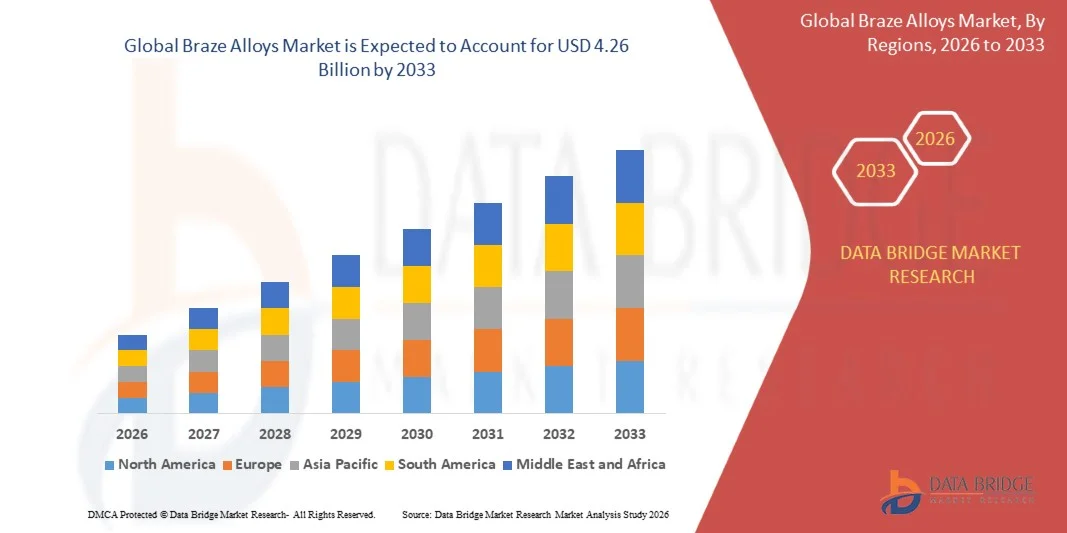
As per Data Bridge Market Research Analysis the Braze Alloys Market was valued at USD 2.93 Billion in 2025 and is projected to reach USD 4.26 Billion by 2033, growing at a CAGR of 4.8% from 2026 to 2033. The market is experiencing consistent growth driven by rising demand for high-performance joining materials across automotive, aerospace, electronics, and industrial manufacturing sectors. Increasing adoption of advanced brazing technologies, growing need for lightweight and durable components, and expansion of electric vehicle production are further supporting market growth across major regions.
The growing emphasis on precision manufacturing, energy efficiency, and material reliability is significantly boosting the adoption of braze alloys in critical applications. Industries are increasingly shifting toward vacuum brazing, nickel-based alloys, and environmentally compliant filler metals to meet stringent performance and regulatory requirements. Rising investments in aerospace modernization, semiconductor manufacturing, and industrial automation are further accelerating demand for advanced brazing solutions globally.
Market Size & Forecast
- Global Market Value (2025): USD 2.93 Billion
- Expected Market Value (2033): USD 4.26 Billion
- Forecast CAGR (2026–2033): 4.8%
- Leading Region in 2025: Asia-Pacific
- Fastest Growing Region: North America
What are the Major Takeaways of Braze Alloys Market ?
- Asia-Pacific dominated the Braze Alloys Market with the largest revenue share of 46.88% in 2025, supported by strong manufacturing activities, expanding automotive production, and increasing demand for advanced joining materials across electronics, aerospace, and industrial sectors
- The 901 °C to 1000 °C segment led the market with a 38.4% share in 2025, driven by its suitability for joining a broad range of industrial metals while maintaining strong mechanical properties
- North America is expected to be the fastest-growing region at a CAGR of 5.1% from 2026 to 2033, fueled by increasing demand for high-performance materials and growing investments in aerospace, defense, and electric vehicle manufacturing
- Vacuum brazing is the fastest-growing technology type, projected to register a CAGR of 10.8% from 2026 to 2033, supported by growing demand for contamination-free and high-strength joints in aerospace, electronics, and medical applications
- The braze rod and wire segment dominated the filler material category with a 34.6% revenue share in 2025, led by its widespread use in manual and automated brazing operations across automotive, construction, and HVAC industries
- Automotive accounted for 32.5% of the market in 2025, preferred by extensive use of brazing alloys in radiators, heat exchangers, fuel systems, and various structural components
- The 1001 °C to 1200 °C segment is the fastest-growing production temperature category, with a CAGR of 10.1% from 2026 to 2033, driven by increasing use of high-strength alloys in aerospace, energy, and heavy industrial equipment
Report Scope and Braze Alloys Market Segmentation
|
Attributes |
Braze Alloys Key Market Insights |
|
Segments Covered |
|
|
Countries Covered |
North America
Europe
Asia-Pacific
Middle East and Africa
South America
|
|
Key Market Players |
|
|
Market Opportunities |
|
|
Value Added Data Infosets |
In addition to the insights on market scenarios such as market value, growth rate, segmentation, geographical coverage, and major players, the market reports curated by the Data Bridge Market Research also include in-depth expert analysis, geographically represented company-wise production and capacity, network layouts of distributors and partners, detailed and updated price trend analysis and deficit analysis of supply chain and demand. |
What is the Key Trend in the Braze Alloys Market ?
Trend: Shift Toward Vacuum and Precision Brazing Technologies
The Braze Alloys market is witnessing a strong shift toward vacuum brazing and precision-controlled joining technologies driven by the need for contamination-free, high-strength, and reliable joints in critical applications. Vacuum brazing is increasingly preferred in aerospace turbine assemblies, semiconductor components, and high-performance heat exchangers due to its ability to eliminate oxidation and improve metallurgical bonding quality. Advancements in controlled atmosphere furnaces, electron beam joining, and automated brazing systems are further improving production consistency and efficiency.
Companies such as Indium Corporation are actively developing advanced brazing materials tailored for semiconductor and high-reliability electronic applications, supporting the transition toward precision manufacturing ecosystems.
Braze Alloys Market Dynamics
Key Market Driver: Rising Demand from Aerospace, Automotive and Electronics Sectors
The growing demand for high-performance joining solutions across aerospace, automotive, and electronics industries is a major driver for the Braze Alloys market. Braze alloys are widely used in turbine engines, heat exchangers, EV battery thermal systems, and electronic assemblies due to their strength, corrosion resistance, and thermal stability. Increasing production of electric vehicles and expansion of semiconductor manufacturing are further strengthening material demand across precision engineering applications.
Companies such as Lucas-Milhaupt, Inc. and Harris Products Group are expanding product portfolios to meet rising demand from automotive and electronics manufacturers, supporting large-scale industrial adoption.
Key Restraint/Challenge: High Material Cost and Process Complexity
A key challenge in the Braze Alloys market is the high cost of raw materials such as silver, nickel, and cobalt, along with the technical complexity of advanced brazing processes. Precise temperature control, controlled atmospheres, and specialized equipment requirements increase production costs and limit adoption among small and mid-scale manufacturers. In addition, stringent quality standards in aerospace and electronics applications add further process validation and operational complexity.
Manufacturers such as Morgan Advanced Materials are addressing these challenges by optimizing alloy compositions and improving process efficiency to reduce cost pressures while maintaining performance standards.
Key Market Opportunity: Renewable Energy Equipment Adoption
The increasing deployment of renewable energy systems is creating significant opportunities for braze alloys in applications such as solar thermal systems, wind turbines, hydrogen energy infrastructure, and power electronics cooling systems. Braze alloys are essential for ensuring leak-proof, high-strength joints in heat exchangers and energy transmission components used in renewable installations. Growing global investments in clean energy infrastructure are further expanding the use of advanced joining materials.
Companies such as OC Oerlikon Management AG are focusing on advanced material engineering solutions that support high-efficiency energy systems, enabling broader adoption of brazing technologies in renewable energy equipment manufacturing.
How is the Braze Alloys Market Segmented ?
The braze alloys market is segmented on the basis of metal, filler material, technology, form, production temperature, and end use.
- By Metal
On the basis of metal, the Braze Alloys Market is segmented into nickel, cobalt, silver, gold, aluminum, copper, steel, iron, magnesium, titanium, and others. The Silver segment dominated the market with the largest share of 31.8% in 2025, driven by its excellent wettability, superior electrical conductivity, and ability to form strong and corrosion-resistant joints across a wide range of base metals. Silver-based braze alloys are extensively utilized in HVAC systems, electrical components, and automotive assemblies due to their reliability and ease of application. Their compatibility with different joining environments and capability to deliver high mechanical strength support widespread industrial adoption. Strong demand from electronics and refrigeration equipment manufacturers further reinforces segment leadership. Continuous developments in high-performance silver alloy compositions are also enhancing efficiency and service life.
The Nickel segment is projected to register the fastest growth at a CAGR of 8.9% from 2026 to 2033, driven by rising demand for high-temperature and corrosion-resistant joining materials across aerospace, energy, and industrial equipment applications. Nickel-based alloys offer excellent oxidation resistance and are increasingly used in turbine engines, heat exchangers, and critical assemblies exposed to harsh operating conditions. Growing investments in aerospace manufacturing and advanced power generation systems are expanding application scope. Technological advancements in vacuum brazing and precision joining are supporting wider adoption. Increasing preference for durable materials with superior metallurgical properties is accelerating segment growth.
- By Filler Material
On the basis of filler material, the Braze Alloys Market is segmented into braze powder, braze paste, braze tape, braze preform, braze foil, and braze rod and wire. The Braze Rod and Wire segment dominated the market with a share of 34.6% in 2025, supported by its widespread use in manual and automated brazing operations across automotive, construction, and HVAC industries. These materials offer flexibility, ease of handling, and consistent alloy distribution during joining processes. Their suitability for repair and maintenance applications contributes to strong industrial demand. Availability in multiple alloy compositions enables usage across diverse manufacturing requirements. Increasing adoption in large-scale fabrication activities further strengthens segment dominance.
The Braze Paste segment is projected to register the fastest growth at a CAGR of 9.7% from 2026 to 2033, driven by increasing demand for precision joining in electronics, medical devices, and miniature components. Braze paste enables controlled material application and improves process efficiency in automated manufacturing environments. Growing adoption of compact electronic devices and advanced assemblies is creating significant growth opportunities. Advancements in paste formulations and dispensing technologies are enhancing joining accuracy and reducing waste. Rising investments in high-precision manufacturing processes are supporting rapid segment expansion.
- By Technology
On the basis of technology, the Braze Alloys Market is segmented into torch brazing, furnace brazing, induction brazing, dip brazing, resistance brazing, infrared brazing, exothermic brazing, blanket brazing, electron beam/laser brazing, braze welding, dissociated ammonia, vacuum brazing, hydrogen brazing, fuel gas brazing, and others. The Furnace Brazing segment dominated the market with the largest share of 28.9% in 2025, driven by its ability to provide uniform heating and high-volume production efficiency. The technology is extensively employed in automotive heat exchangers, aerospace components, and industrial equipment manufacturing. It offers excellent joint quality and repeatability, making it suitable for complex assemblies. Increasing automation in manufacturing facilities has strengthened its adoption across developed economies. Consistent product quality and reduced labor requirements further support segment leadership.
The Vacuum Brazing segment is projected to register the fastest growth at a CAGR of 10.8% from 2026 to 2033, driven by growing demand for contamination-free and high-strength joints in aerospace, electronics, and medical applications. Vacuum brazing eliminates oxidation and enables superior metallurgical bonding for critical components. Rising production of lightweight and high-performance systems is encouraging wider adoption of this technology. Advancements in vacuum furnace equipment and process control are improving operational efficiency. Increasing focus on precision manufacturing and product reliability is accelerating market growth.
- By Form
On the basis of form, the Braze Alloys Market is segmented into pipe, tube, sheet, strip, plate, round bar, flat, bar, wire, and others. The Wire segment dominated the market with a share of 26.7% in 2025, supported by its extensive use in automated brazing systems and industrial fabrication processes. Wire forms provide accurate alloy feeding and are highly suitable for continuous production environments. Their ease of storage and compatibility with robotic operations enhance manufacturing efficiency. Growing utilization in automotive and electrical applications contributes to sustained demand. Increasing investments in advanced joining technologies further strengthen segment dominance.
The Strip segment is projected to register the fastest growth at a CAGR of 9.2% from 2026 to 2033, driven by rising demand for customized and precision-engineered brazing materials. Strip forms enable improved dimensional accuracy and consistent material distribution in high-performance assemblies. Increasing applications in aerospace and electronic manufacturing are supporting market expansion. Technological developments in alloy rolling and processing are enhancing product quality. Growing preference for efficient and material-saving joining solutions is accelerating segment growth.
- By Production Temperature
On the basis of production temperature, the Braze Alloys Market is segmented into less than 900 °C, 901 °C to 1000 °C, 1001 °C to 1200 °C, and above 1200 °C. The 901 °C to 1000 °C segment dominated the market with the largest share of 38.4% in 2025, driven by its suitability for joining a broad range of industrial metals while maintaining strong mechanical properties. This temperature range is widely utilized in automotive, electrical, and HVAC applications due to its balance between performance and process efficiency. Manufacturers prefer these operating conditions to minimize distortion and energy consumption. Strong demand from mass production industries supports widespread adoption. Continuous improvements in alloy formulations further reinforce segment leadership.
The 1001 °C to 1200 °C segment is projected to register the fastest growth at a CAGR of 10.1% from 2026 to 2033, driven by increasing use of high-strength alloys in aerospace, energy, and heavy industrial equipment. Higher temperature brazing enables superior joint integrity and enhanced resistance to extreme operating conditions. Growing production of advanced turbines and heat-resistant components is supporting segment expansion. Developments in controlled atmosphere and vacuum brazing technologies are improving process reliability. Rising demand for durable and high-performance assemblies is accelerating growth.
- By End Use
On the basis of end use, the Braze Alloys Market is segmented into aerospace and defense, electronics and electrical, automotive, marine, chemicals, building and construction, and others. The Automotive segment dominated the market with a share of 32.5% in 2025, driven by extensive use of brazing alloys in radiators, heat exchangers, fuel systems, and various structural components. Growing vehicle production and increasing emphasis on lightweight assemblies are supporting demand for advanced joining materials. Braze alloys provide strong and leak-proof joints that enhance component durability and efficiency. Expanding electric vehicle manufacturing is further increasing consumption across battery and thermal management systems. Continuous advancements in automotive manufacturing technologies reinforce segment dominance.
The Aerospace and Defense segment is projected to register the fastest growth at a CAGR of 11.4% from 2026 to 2033, driven by rising demand for high-temperature resistant materials and precision-engineered components. Braze alloys are widely used in aircraft engines, turbine blades, and critical assemblies requiring exceptional strength and reliability. Increasing investments in commercial aviation and defense modernization programs are creating significant growth opportunities. Advancements in nickel-based and vacuum brazing technologies are enhancing performance standards. Growing focus on lightweight and fuel-efficient aircraft systems is accelerating segment expansion.
Which Region Holds the Largest Share of the Braze Alloys Market ?
Asia-Pacific dominated the braze alloys market and accounted for the largest revenue share of 46.88% in 2025, supported by strong manufacturing activities, expanding automotive production, and increasing demand for advanced joining materials across electronics, aerospace, and industrial sectors. The region benefits from the presence of large-scale metal processing facilities, cost-effective production capabilities, and rising investments in precision manufacturing technologies. Growing demand for heat exchangers, electrical components, and high-performance assemblies is accelerating regional market expansion. Increasing infrastructure development and industrial automation are further supporting long-term growth.
China Braze Alloys Market Insight
China held the largest share in the Asia-Pacific Braze Alloys market in 2025, supported by its extensive manufacturing base and strong demand from automotive, electronics, and heavy industrial sectors. The country has a well-established metallurgical industry and advanced production infrastructure that enable large-scale manufacturing of brazing materials. Strong consumption from HVAC systems, electrical equipment, and machinery manufacturing industries is further supporting market growth. In addition, increasing investments in electric vehicles and industrial automation are reinforcing China’s leadership in regional and global braze alloy production.
India Braze Alloys Market Insight
India is witnessing the fastest growth in the Asia-Pacific region, driven by expanding automotive production, rising infrastructure development, and increasing adoption of advanced metal joining technologies. Growing utilization of braze alloys in electrical equipment, refrigeration systems, and industrial machinery is significantly supporting market expansion. The country is also benefiting from rising investments in aerospace manufacturing and renewable energy projects. In addition, increasing localization of component manufacturing and expansion of metal fabrication industries are accelerating long-term market growth.
Europe Braze Alloys Market Insight
The Europe Braze Alloys market is expanding steadily, supported by increasing demand from aerospace, automotive, and industrial equipment manufacturing industries. Manufacturers across the region are increasingly focusing on high-performance joining solutions to improve product durability and efficiency. Strong demand for lightweight materials and precision-engineered components is further contributing to market expansion. In addition, growing investments in advanced manufacturing technologies and sustainable industrial processes are supporting regional market development.
Germany Braze Alloys Market Insight
Germany accounted for the largest share in the Europe Braze Alloys market in 2025, driven by its strong automotive, machinery, and aerospace manufacturing industries. The country has a highly developed engineering sector that extensively utilizes brazing materials for heat exchangers, turbine components, and electrical assemblies. Rising demand for lightweight vehicles and energy-efficient systems is further strengthening market growth. In addition, continuous investments in industrial automation and precision manufacturing are reinforcing Germany’s leading market position.
U.K. Braze Alloys Market Insight
The U.K. market is supported by growing demand for advanced joining materials across aerospace, defense, and industrial equipment applications. Increasing emphasis on lightweight component production and high-performance manufacturing processes is driving adoption of braze alloys across various sectors. The country is also witnessing rising utilization of brazing technologies in energy systems and precision engineering applications. In addition, expanding investments in aerospace programs and modernization of industrial infrastructure are further supporting market growth.
North America Braze Alloys Market Insight
North America is projected to grow at the fastest CAGR of 5.1% from 2026 to 2033, driven by increasing demand for high-performance materials and growing investments in aerospace, defense, and electric vehicle manufacturing. Rising adoption of advanced brazing technologies in precision engineering and industrial automation is significantly supporting market expansion across the region. Strong utilization in turbine engines, heat exchangers, and electronic assemblies is further accelerating demand. In addition, increasing focus on energy efficiency and technological innovation is boosting regional consumption of premium braze alloys.
U.S. Braze Alloys Market Insight
The U.S. accounted for the largest share in the North America Braze Alloys market in 2025, supported by strong demand from aerospace, automotive, electronics, and industrial manufacturing sectors. The country benefits from extensive utilization of braze alloys in aircraft engines, power generation equipment, and advanced thermal management systems. Growing investments in electric vehicles, defense modernization, and precision manufacturing are further strengthening market growth. In addition, increasing adoption of vacuum brazing technologies and high-performance alloys is reinforcing the U.S. leadership position in the regional market.
Which are the Top Companies in Braze Alloys Market ?
The braze alloys industry is primarily led by well-established companies, including:
- Johnson Matthey (U.K.)
- OC Oerlikon Management AG (Switzerland)
- Sulzer Ltd (Switzerland)
- Belmont Metals (U.S.)
- Harris Products Group (U.S.)
- Morgan Advanced Materials (U.K.)
- Aimtek, Inc. (U.S.)
- Prince & Izant Company (U.S.)
- Lucas-Milhaupt, Inc. (U.S.)
- Esprix Technologies (U.S.)
- Indium Corporation (U.S.)
- AMETEK, Inc. (U.S.)
- TSI Technologies (U.S.)
- ESAB (U.S.)
- Umicore (Belgium)
- Indian Solder and Brazing Alloys (India)
- SAXONIA Edelmetalle GmbH (Germany)
- Saru Silver Alloy Private Limited (India)
- Cupro Alloys Corporation (India)
- KRANTI METALLURGY PVT LTD. (India)
- K. METAL (India)
What are Latest Developments in Braze Alloys Market ?
- In February 2025, Wall Colmonoy promoted its Nicrobraz 5027 nickel-based filler metal as a preferred solution for exhaust and muffler joining applications in outdoor power equipment. The development highlighted the increasing demand for brazing materials capable of delivering superior sealing performance and durability under demanding operating conditions. The enhanced focus on high-performance nickel-based alloys is supporting broader adoption across industrial and transportation sectors. This initiative is expected to strengthen market opportunities for premium brazing materials designed for extreme environments
- In January 2025, Lucas-Milhaupt introduced Silvaloy 560, a cadmium-free silver filler metal that complies with AWS A5.8 standards and supports European lead-exposure regulations without requiring modifications to existing furnace systems. This product launch strengthened the transition toward environmentally compliant brazing solutions and enabled manufacturers to reduce production costs associated with equipment upgrades. The development is expected to accelerate adoption of sustainable braze alloys across automotive, HVAC, and industrial applications while enhancing the company's competitive position in premium filler materials
- In January 2025, Harris Products Group announced the introduction of a new portfolio of environmentally friendly brazing alloys designed to comply with increasingly stringent environmental regulations. The launch reflects the industry's growing emphasis on sustainable manufacturing practices and reduced hazardous material usage. By offering eco-conscious products, the company is expanding its customer base among manufacturers seeking regulatory compliance and improved environmental performance. This development is supporting broader market demand for lead-free and low-emission brazing materials
- In October 2024, Materion invested USD 12 million to expand its eutectic powder production facility in Ohio, increasing silver-copper alloy capacity by approximately 40% to address growing requirements from electric vehicle inverter and aerospace applications. The expansion improved supply availability for high-performance brazing materials and strengthened the company's ability to support rapidly expanding end-use industries. Rising electrification trends and increasing aircraft production are expected to further enhance demand for these advanced alloy solutions. The investment also reinforces North America's manufacturing capabilities within the Braze Alloys Market
- In August 2024, Indium Corporation entered into a strategic partnership with a leading electronics manufacturer to develop advanced brazing materials specifically for semiconductor applications. The collaboration highlighted the increasing importance of customized alloy solutions for high-precision and high-reliability industries. Through this partnership, the company strengthened its innovation capabilities and expanded its presence within the rapidly growing electronics sector. The initiative is contributing to increased demand for specialized brazing materials used in next-generation semiconductor and electronic devices

- Interactive Data Analysis Dashboard
- Company Analysis Dashboard for high growth potential opportunities
- Research Analyst Access for customization & queries
- Competitor Analysis with Interactive dashboard
- Latest News, Updates & Trend analysis
- Harness the Power of Benchmark Analysis for Comprehensive Competitor Tracking
Global Braze Alloys Market, Supply Chain Analysis and Ecosystem Framework
To support market growth and help clients navigate the impact of geopolitical shifts, DBMR has integrated in-depth supply chain analysis into its Global Braze Alloys Market research reports. This addition empowers clients to respond effectively to global changes affecting their industries. The supply chain analysis section includes detailed insights such as Global Braze Alloys Market consumption and production by country, price trend analysis, the impact of tariffs and geopolitical developments, and import and export trends by country and HSN code. It also highlights major suppliers with data on production capacity and company profiles, as well as key importers and exporters. In addition to research, DBMR offers specialized supply chain consulting services backed by over a decade of experience, providing solutions like supplier discovery, supplier risk assessment, price trend analysis, impact evaluation of inflation and trade route changes, and comprehensive market trend analysis.
Data collection and base year analysis are done using data collection modules with large sample sizes. The stage includes obtaining market information or related data through various sources and strategies. It includes examining and planning all the data acquired from the past in advance. It likewise envelops the examination of information inconsistencies seen across different information sources. The market data is analysed and estimated using market statistical and coherent models. Also, market share analysis and key trend analysis are the major success factors in the market report. To know more, please request an analyst call or drop down your inquiry.
The key research methodology used by DBMR research team is data triangulation which involves data mining, analysis of the impact of data variables on the market and primary (industry expert) validation. Data models include Vendor Positioning Grid, Market Time Line Analysis, Market Overview and Guide, Company Positioning Grid, Patent Analysis, Pricing Analysis, Company Market Share Analysis, Standards of Measurement, Global versus Regional and Vendor Share Analysis. To know more about the research methodology, drop in an inquiry to speak to our industry experts.
Data Bridge Market Research is a leader in advanced formative research. We take pride in servicing our existing and new customers with data and analysis that match and suits their goal. The report can be customized to include price trend analysis of target brands understanding the market for additional countries (ask for the list of countries), clinical trial results data, literature review, refurbished market and product base analysis. Market analysis of target competitors can be analyzed from technology-based analysis to market portfolio strategies. We can add as many competitors that you require data about in the format and data style you are looking for. Our team of analysts can also provide you data in crude raw excel files pivot tables (Fact book) or can assist you in creating presentations from the data sets available in the report.













