



Segmentação do mercado de equipamentos globais de processamento de café e chá, por tipo de máquina (máquinas de triagem de grãos de café, máquinas de polimento de café, planta de processamento de café, Huller de café, máquina de processamento de chá CTC, e máquina de processamento de chá ortodoxa), Automação (Automática, Semi-Automática e Manual), Processo (Separação, Separação, Rolamento, Fermentação e Secagem), Canal de Distribuição (Online, Desligado e Outros)- Tendências e Previsão da Indústria para 2033
O que é o equipamento de processamento de café e chá Tamanho do mercado e taxa de crescimento
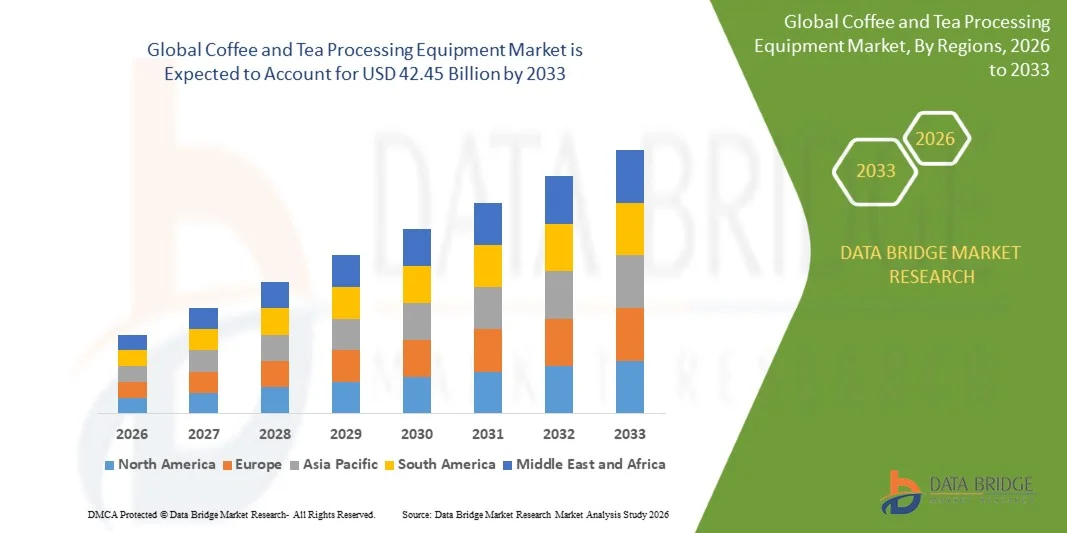
- De acordo com a análise Data Bridge Market Research, o mercado de equipamentos de processamento de café e chá foi avaliado em26,04 mil milhões de USD em 2025e é projetado para alcançar42,45 mil milhões de USD até 2033, crescendo emCAGR de 6,30% de 2026 a 2033.
- O mercado está experimentando crescimento consistente impulsionado pelo aumento da demanda por produtos de café e chá de alta qualidade, particularmente em regiões em desenvolvimento, crescente interesse do consumidor em especialidades e café e chá artesanal, avanços tecnológicos em equipamentos de processamento e crescente adoção de automação e robótica na indústria.
- O crescente foco na produção eficiente, digitalização de processos, design sofisticado de equipamentos, manutenção operacional e expansão de portfólios de produtos está incentivando os processadores a investir em máquinas avançadas de processamento de café e chá. O mercado também está sendo apoiado pela adoção acelerada de plataformas on-line para compras de equipamentos, enquanto as perturbações na cadeia de suprimentos, regulamentos rigorosos de segurança alimentar, inflação e flutuação dos preços de matérias-primas continuam a ser desafios fundamentais.
Tamanho e previsão do mercado
- Valor de Mercado Global (2025): USD 26,04 Bilhões
- Valor de mercado esperado (2033): USD 42,45
- Previsões CAGR (2026-2033): 6,30%
- Região líder em 2025: América do Norte
- Região de crescimento mais rápido: Ásia Pacífico
Quais são os principais takeaways do mercado de equipamentos de processamento de café e chá
- A América do Norte dominou o mercado de equipamentos de processamento de café e chá com a maior parcela de receita de 35,84% em 2025, apoiada pela infraestrutura de processamento estabelecida, alta adoção de equipamentos avançados e forte demanda dos produtores de café e chá especializados.
- Asia-Pacific é esperado para ser a região de crescimento mais rápido em um CAGR de 6,2% de 2026 a 2033, alimentado pelo aumento do consumo de café e chá, urbanização rápida, e crescente adoção de máquinas avançadas de processamento de alimentos.
- O segmento de máquinas de triagem de grãos de café liderou o mercado com uma participação de 34% em 2025, impulsionada pela crescente necessidade de qualidade consistente de grãos, remoção de grãos defeituosos e melhoria da eficiência de processamento.
- Máquina de processamento de chá CTC são o tipo de máquina de crescimento mais rápido, projetado para registrar um CAGR de 6,5%, refletindo o aumento na demanda de chá preto eficientemente processado e modernização de instalações de processamento de chá.
- O segmento automático dominou a categoria de automação com uma participação de 48% na receita em 2025, liderada pelo aumento da demanda por maior eficiência de processamento, qualidade consistente do produto e redução da dependência do trabalho manual.
- A classificação representou 38% da quota de mercado em 2025, preferencialmente pela importância de remover materiais defeituosos e manter a qualidade consistente das matérias-primas antes das fases de processamento subsequentes.
- O segmento de secagem é a categoria de processo de crescimento mais rápido, com um CAGR de 6,3%, impulsionado pelo seu papel crítico no controle do teor de umidade e preservação da qualidade do café e do chá.
Segmentação do mercado de equipamentos de processamento de café e chá
|
Atributos |
Equipamento de processamento de café e chá Insights mercado chave |
|
Segmentos Cobertos |
|
|
Países abrangidos |
América do Norte
Europa
Ásia- Pacífico
Médio Oriente e África
América do Sul
|
|
Jogadores do mercado chave |
|
|
Oportunidades de Mercado |
|
|
Informações sobre o Valor Adicionado |
Além dos insights sobre cenários de mercado, como valor de mercado, taxa de crescimento, segmentação, cobertura geográfica e principais atores, os relatórios de mercado curados pela Data Bridge Market Research também incluem análise de especialistas em profundidade, análise de preços, análise de compartilhamento de marca, inquérito ao consumidor, análise demografia, análise da cadeia de suprimentos, análise da cadeia de valor, visão geral da matéria-prima/consumíveis, critérios de seleção de fornecedores, Análise de PESTLE, Análise de Porter e marco regulatório. |
Qual é a tendência chave no mercado de equipamentos de processamento de café e chá
- Os processadores de café e chá estão adotando cada vez mais equipamentos automatizados e avançados para melhorar a eficiência de produção, controle de qualidade, consistência e desempenho operacional em todas as instalações de processamento.
- Por exemplo, em fevereiro de 2024, um estudo publicado em Trends in Food Science & Technology destacou o crescente uso de tecnologias inteligentes em cultivo de chá, processamento, triagem e avaliação de qualidade, apoiando a mudança para o equipamento de processamento de chá automatizado e orientado a dados.
- Digitalização e automação de processos estão ganhando importância à medida que os fabricantes usam sistemas inteligentes para monitorar parâmetros de processamento, reduzir a intervenção manual, melhorar a produtividade e otimizar a utilização de recursos em linhas de produção.
- A sustentabilidade está se tornando cada vez mais importante, incentivando os fabricantes de equipamentos a desenvolver tecnologias de processamento que reduzam o consumo de água, as necessidades energéticas, a geração de resíduos e o impacto ambiental global durante a produção.
- O crescente interesse do consumidor em especialidade, premium e café e chá artesanal está aumentando a demanda por equipamentos especializados capazes de fornecer qualidade consistente, perfis de sabor distintivos e capacidades de processamento flexíveis.
- Por exemplo, em fevereiro de 2025, um estudo publicado em Sustentabilidade descobriu que integrar tecnologias de recuperação de energia no processamento de café poderia reduzir as emissões de gases com efeito de estufa em até 40% e o esgotamento de combustíveis fósseis em 36%, apoiando a tendência para equipamentos de processamento eficientes em termos energéticos
- A expansão dos produtos prontos para beber café e chá está incentivando o investimento em extração integrada, clarificação, mistura, tratamento térmico, enchimento, embalagem e equipamentos de controle de processo para produção de bebidas comerciais.
Quais são os principais motoristas do mercado de equipamentos de processamento de café e chá
- A crescente demanda global por produtos de café e chá está incentivando os processadores a expandir e modernizar as instalações de produção, aumentando os requisitos para equipamentos eficientes, de alta capacidade e tecnologicamente avançados de processamento em todo o mundo.
- Por exemplo, em junho de 2024, o Westrock Coffee abriu uma instalação de processamento de USD 315 milhões, 570.000 pés quadrados em Arkansas com robótica e automação de ponta a ponta cobrindo recebimento de café verde, torrefação, moagem, extração, engarrafamento e embalagem, demonstrando investimento em processamento automatizado de alta capacidade para atender à crescente demanda.
- O crescente consumo de café e chá especializados e premium está impulsionando o investimento em máquinas avançadas capazes de manter qualidade consistente, perfis de sabor, eficiência de produção e padrões de produto durante o processamento.
- Aumentar a adoção de automação e robótica está apoiando o crescimento do mercado, permitindo processamento mais rápido, melhor controle de qualidade, intervenção manual reduzida e maior eficiência operacional em instalações de produção de café e chá.
- Por exemplo, em junho de 2025, a Spider Robots relatou a automação da paletização em 14 linhas de produção em uma grande empresa de processamento de café usando robôs de gantry centralizados, demonstrando como a robótica está sendo implantada para melhorar a eficiência e reduzir os requisitos operacionais na produção de café.
- Expansão de cafés, cafés, lojas especiais de chá e bebidas prontas para beber está aumentando os requisitos de processamento e suportando a demanda por equipamentos flexíveis capazes de atender diversas necessidades de produtos e produção.
Que fatores estão desafiando o crescimento do mercado de equipamentos de processamento de café e chá
- Os elevados custos iniciais de investimento associados a máquinas de processamento sofisticadas podem restringir a adopção, nomeadamente entre as empresas e os pequenos transformadores com capital limitado disponível para modernização e expansão de equipamentos.
- Por exemplo, em novembro de 2023, um estudo publicado em Sustentabilidade descobriu que a criação de uma estação de lavagem de café de capacidade de 200 toneladas em Ruanda exigia um investimento inicial substancial, incluindo 69.395 dólares americanos para uma máquina de pasta de café, demonstrando que altos custos de capital de equipamento podem restringir o investimento entre processadores de café menores.
- Avanços tecnológicos rápidos exigem atualizações frequentes de equipamentos, aumentando os requisitos de capital para os processadores e criando pressão financeira adicional, especialmente para instalações menores de processamento de café e chá.
- O aumento dos custos energéticos e as preocupações ambientais estão a levar os fabricantes e os transformadores para equipamentos e processos mais sustentáveis, o que pode exigir um investimento adicional significativo em tecnologias eficientes em termos energéticos e respeitadoras do ambiente.
- As despesas de manutenção e reparação contínuas criam pressão financeira adicional para os processadores, especialmente porque equipamentos automatizados cada vez mais sofisticados requerem experiência técnica especializada, manutenção e componentes de substituição.
- Por exemplo, em setembro de 2025, a GEA informou que sistemas automatizados de extração de café podem reduzir os riscos de intervenção e contaminação do operador, destacando os requisitos técnicos associados à obtenção de qualidade consistente e conformidade regulatória nas modernas instalações de processamento
- Regulações rigorosas de segurança alimentar e qualidade exigem que os processadores mantenham equipamentos, sistemas de saneamento, processos de monitoramento e padrões operacionais compatíveis, aumentando os requisitos de investimento e os custos operacionais relacionados à conformidade.
Como é o mercado de equipamentos de processamento de café e chá segmentado
O mercado de equipamentos de processamento de café e chá é segmentado com base no tipo de máquina, automação, processo e canal de distribuição.
- Por tipo de máquina
Com base no tipo de máquina, o mercado de equipamentos de processamento de café e chá é segmentado em máquinas de triagem de grãos de café, máquinas de polpa de café, planta de processamento de café, huller de café, máquina de processamento de chá CTC, e máquina de processamento de chá ortodoxa. O segmento de máquinas de triagem de grãos de café dominou o mercado com uma participação estimada de 34% em 2025, apoiada pela crescente necessidade de qualidade consistente de grãos, remoção de grãos defeituosos e melhoria da eficiência de processamento. Essas máquinas permitem aos processadores classificar os grãos de café de acordo com características como cor, tamanho, forma e qualidade. O crescente consumo especializado de café está aumentando a importância da triagem precisa e controle de qualidade. A triagem automatizada também reduz a intervenção manual e melhora o rendimento do processamento. O aumento da modernização das instalações comerciais de processamento de café está apoiando a demanda por sistemas avançados de triagem.
O segmento de máquina de processamento de chá CTC é projetado para ser a categoria de máquina de crescimento mais rápido, com um CAGR estimado de 6,5% durante o período de previsão, impulsionado pelo aumento da demanda por chá preto eficientemente processado e modernização de instalações de processamento de chá. A tecnologia CTC permite o processamento contínuo e suporta a produção de chá comercial de alto volume. O crescente consumo de chá na Ásia-Pacífico está criando demanda adicional para máquinas modernas de processamento de chá. O aumento da substituição de equipamentos convencionais está apoiando a adoção de sistemas CTC mais eficientes. As capacidades de automação também podem reduzir os requisitos de trabalho e melhorar a consistência do processamento.
- Por Automação
Com base na automação, o mercado é segmentado em equipamentos automáticos, semi-automáticos e manuais. O segmento automático dominou o mercado com uma participação estimada de 48% em 2025, impulsionada pelo aumento da demanda por maior eficiência de processamento, qualidade consistente do produto e redução da dependência do trabalho manual. Sistemas automatizados podem controlar múltiplos parâmetros de processamento com maior precisão e repetibilidade. Os grandes processadores comerciais exigem cada vez mais sistemas de produção contínuos de alta produtividade. Automação também suporta processamento padronizado e monitoramento operacional melhorado. A integração de controlos digitais e tecnologias inteligentes está a melhorar ainda mais o desempenho dos equipamentos. A crescente ênfase na produtividade, consistência e eficiência laboral está apoiando a posição de liderança do equipamento automático.
O segmento semiautomático é projetado para testemunhar um crescimento significativo em um CAGR estimado de 5,8% durante o período de previsão, particularmente entre pequenos e médios processadores de café e chá buscando modernização sem os requisitos de capital associados com linhas de produção totalmente automatizadas. As máquinas semi-automáticas proporcionam maior flexibilidade ao mesmo tempo que reduzem os requisitos de processamento manual. Permite aos processadores atualizar as fases individuais das instalações de produção existentes. O segmento é particularmente relevante nas economias emergentes, onde as pequenas empresas de transformação continuam a ser importantes. A crescente disponibilidade de máquinas relativamente acessíveis está a apoiar a adopção. O equipamento semi-automático também pode fornecer uma via de transição do processamento manual para o processamento totalmente automatizado.
- Por Processo
Com base em componentes de processo, o mercado é segmentado em triagem, peneiração, laminação, fermentação e secagem. O segmento de triagem dominou o mercado com uma participação estimada de 38% em 2025, refletindo a importância da remoção de materiais defeituosos e manutenção de qualidade consistente de matéria-prima antes das etapas de processamento subsequentes. A triagem automatizada melhora a precisão da separação e reduz a dependência do trabalho manual. Os processadores de café exigem cada vez mais sistemas de classificação para classificar o feijão de acordo com as características de qualidade. Os processadores de chá também usam equipamentos de triagem e classificação para melhorar a uniformidade do produto. Aumentar a demanda por produtos premium e especiais está aumentando a importância da triagem precisa. A melhoria das tecnologias ópticas e automatizadas de triagem apoia ainda mais a adopção do mercado.
O segmento de secagem é projetado para registrar o crescimento mais rápido em um CAGR estimado de 6,3% durante o período de previsão, devido ao seu papel crítico no controle do teor de umidade e preservação da qualidade do café e chá. O moderno equipamento de secagem proporciona maior controle sobre os níveis de umidade do que os métodos convencionais de secagem. O aumento da ênfase na eficiência de processamento e consistência do produto está incentivando o investimento em sistemas avançados de secagem. As tecnologias eficientes em termos energéticos estão a tornar-se cada vez mais importantes à medida que os transformadores procuram controlar as despesas operacionais. Aumento da produção de café e chá em economias emergentes está expandindo o requisito de capacidade de secagem comercial. Tecnologias avançadas de secagem também podem suportar qualidade de produto mais consistente e reduzir as perdas de processamento.
- Por Canal de Distribuição
Com base no canal de distribuição, o mercado é segmentado em on-line, offline, e outros. O segmento offline dominou o mercado com uma parte estimada de 72% em 2025, porque o equipamento de processamento de café e chá normalmente envolve especificações técnicas, instalação, comissionamento, manutenção e suporte pós-venda. Compradores de grandes sistemas de processamento muitas vezes exigem consulta técnica direta e demonstrações de equipamentos. Distribuidores e fabricantes off-line podem fornecer serviços de instalação e treinamento do operador. A disponibilidade de peças sobressalentes e o suporte à manutenção também são considerações importantes na compra de máquinas industriais. O valor relativamente alto e a complexidade técnica dos equipamentos de processamento favorecem ainda mais a compra direta e offline. Por conseguinte, as redes de distribuição de equipamento industrial criadas continuam a ser responsáveis pela maior parte das vendas de equipamento.
O segmento online é projetado para ser o canal de distribuição de crescimento mais rápido em um CAGR estimado de 7,0% durante o período de previsão, apoiado pelo aumento da digitalização e o uso crescente de plataformas online para a descoberta e aquisição de equipamentos. Os canais online permitem que os processadores comparem fornecedores, especificações de equipamentos, preços e características técnicas de forma mais eficiente. Os fabricantes podem usar plataformas digitais para alcançar clientes além de seus mercados geográficos tradicionais. O aumento da penetração da Internet nas economias em desenvolvimento está também a melhorar o acesso aos fornecedores internacionais de equipamentos. A compra online é particularmente adequada para máquinas menores, componentes, peças de reposição e equipamentos padronizados.
Qual região detém a maior parte do mercado de equipamentos de processamento de café e chá
- América do Norte dominou o mercado de equipamentos de processamento de café e chá com a maior parcela de receita de 35,84% em 2025, apoiada por infraestrutura de processamento estabelecida, alta adoção de equipamentos avançados, e forte demanda de produtores de café e chá especiais
- A região também se beneficia do aumento do consumo de café especializado, da inovação tecnológica e da presença de fabricantes líderes de equipamentos, que apoiam o investimento contínuo em sistemas de processamento modernos. De acordo com os dados da National Coffee Association 64% dos adultos americanos bebem café diariamente, criando uma demanda substancial subjacente para produtos de café processados e infra-estrutura de processamento relacionada. O mercado dos EUA é ainda apoiado pela sua alta concentração de torrefadores especiais de café e cafés
U.S. Cafe and Tea Processing Equipment Market Insight
O mercado de equipamentos de processamento de café e chá dos EUA está testemunhando forte crescimento devido ao alto consumo de café, uma indústria de café especializada madura, e crescente adoção de tecnologias de processamento avançadas. De acordo com a National Coffee Association, 66% dos adultos americanos relataram beber café todos os dias em 2025, demonstrando forte demanda subjacente por produtos de café e apoiando o investimento contínuo em toda a cadeia de valor de processamento. O país também possui um grande setor de café especializado, incentivando os processadores a adotar equipamentos que melhorem a consistência, qualidade e eficiência de produção. A crescente demanda por produtos de café premium e melhorias tecnológicas na torrefação, moagem, triagem e embalagem estão apoiando ainda mais a adoção de equipamentos.
Ásia-Pacífico café e chá processamento de equipamentos do mercado Insight
Espera-se que o mercado de equipamentos de processamento de café e chá Ásia-Pacífico testemunhe um rápido crescimento, impulsionado pelo aumento do consumo de café e chá, expansão das indústrias de bebidas e modernização de instalações de processamento em países como China, Índia e Japão. A Food and Agriculture Organization relata que o consumo global de chá aumentou 2,0% em 2022, com forte demanda nos principais mercados asiáticos que consomem chá. A China e a Índia permanecem entre os principais países produtores de chá do mundo, criando requisitos substanciais para triagem, laminação, fermentação, secagem e outros equipamentos de processamento. Aumentar a mecanização e a modernização tecnológica das fábricas de chá estão apoiando ainda mais a demanda regional. O crescente consumo de café nos mercados asiáticos também está criando oportunidades para o processamento moderno de café
Japão Equipamento para processamento de café e chá
O mercado de equipamentos de processamento de café e chá do Japão está testemunhando um crescimento consistente devido ao consumo estabelecido de café e chá, infraestrutura sofisticada de processamento de alimentos e forte demanda do consumidor por bebidas de alta qualidade. Segundo o Departamento de Agricultura dos EUA, o consumo de café do Japão foi de aproximadamente 7,18 milhões de sacos de 60 kg em 2024/25, demonstrando uma demanda substancial por produtos de café processados. A indústria de bebidas maduras do Japão também incentiva os processadores a manter altos padrões de consistência, qualidade e eficiência de produção. Aumento da procura de produtos de café e chá premium está a apoiar o investimento em modernas tecnologias de processamento. Automação, processamento de precisão e sistemas avançados de controle de qualidade estão contribuindo ainda mais para a modernização dos equipamentos
China Café e chá processamento de equipamentos do mercado Insight
O mercado de equipamentos de processamento de chá e café da China está crescendo rapidamente, apoiado pela posição do país como um grande produtor de chá e consumidor e crescente modernização da indústria de processamento de chá. A Food and Agriculture Organization identifica a China como a maior produtora e consumidora de chá do mundo, criando requisitos extensivos para a moderna infraestrutura de processamento. Em abril de 2024, a FAO e a China lançaram o Programa de Chá de Produto Prioritário One Country, com foco na integração tecnológica, melhoria da produtividade e transformação verde e de baixo carbono da indústria do chá. Estas iniciativas incentivam a modernização em toda a cadeia de valor do chá e criam a procura de máquinas de processamento eficientes. O crescente consumo de café e expansão do setor de café especializado da China também estão apoiando a demanda de equipamentos de processamento de café.
U.K. Equipamento de processamento de café e chá Insight
O mercado de equipamentos de processamento de café e chá do Reino Unido está experimentando crescimento constante, apoiado pelo consumo estabelecido de café e chá, um setor de bebidas especiais maduro, e crescente demanda por produtos premium. De acordo com a British Coffee Association, a indústria de café do Reino Unido contribui significativamente para os setores de hospitalidade e serviço alimentar do país, enquanto o café continua sendo uma das bebidas mais consumidas do país. A contínua expansão do café especializado e a demanda por produtos diferenciados estão incentivando processadores e torrefadores a melhorar as capacidades de produção. O aumento da ênfase na consistência, eficiência e processamento sustentável está apoiando a adoção de equipamentos modernos. O crescimento nos formatos de bebidas prontas para beber e premium também está criando requisitos de processamento adicionais.
Alemanha Equipamento de processamento de café e chá
O mercado alemão de equipamentos de processamento de café e chá está se expandindo constantemente devido ao forte consumo de café, uma indústria de processamento de alimentos estabelecida, e crescente demanda por produtos de bebidas processadas de alta qualidade. Segundo a Associação Alemã do Café, o consumo de café na Alemanha atingiu aproximadamente 169 litros per capita em 2024, demonstrando a forte cultura do café do país e a demanda substancial por café processado. O sofisticado ambiente de fabricação do país também apoia a adoção de tecnologias eficientes de torrefação, moagem, embalagem e controle de qualidade. Aumentar o interesse do consumidor em especialidade e café premium está incentivando os processadores a melhorar a consistência do produto e capacidades de processamento. O foco da Alemanha na eficiência dos recursos e na fabricação sustentável está apoiando ainda mais a demanda por equipamentos avançados de processamento
Quais são as principais empresas no mercado de equipamentos de processamento de café e chá
A indústria de equipamentos de processamento de café e chá é liderada principalmente por empresas bem estabelecidas, incluindo:
- Bühler AG(Suíça)
- PROBAT SE(Alemanha)
- Grupo GEA Aktiengesellschaft(Alemanha)
- ALFA LAVAL(Suécia)
- Sistemas TOMRA ASA(Noruega)
- Brambati S.p.A. (Itália)
- Diedrich Roasters, LLC (EUA)
- T&I Global Pvt (Índia)
- Grupo Selmi SRL (Itália)
- Modern Process Equipment Corporation (EUA)
- JOPER (Portugal)
- Giesen Roasting Solutions (Países Baixos)
- Pinhalense Máquinas Agrícolas (Brasil)
- Toper Roasters (Türkiye)
- Coffee-Tech Engineering Ltd. (Israel)
- Ambex Café Roasters (EUA)
- Indústrias PCD (Índia)
- Maquinaria Gem & Indústrias Aliadas (Índia)
- Satake Corporation (Japão)
Quais são as últimas evoluções no mercado de equipamentos de processamento de café e chá
- Em março de 2025, a NEUHAUS NEOTEC introduziu sua nova série GOURMET de torradeiras de café, baseada na tecnologia de torrefação RFB e projetada para capacidades de até 2.000 kg/h. Os novos sistemas de torrefação modulares estão disponíveis em vários tamanhos e também podem processar produtos como nozes, sementes e grãos, destacando o movimento da indústria para equipamentos de processamento flexíveis, de alta capacidade e eficientes em recursos.
- Em março de 2025, a PROBAT introduziu o NEPTUNE 4000, descrito como o maior torrefador de tambor do mundo, estendendo seu portfólio de torrefação para capacidades de até 880 kg e enfatizando otimização de processos, modularização, padronização, eficiência energética e produtividade. O desenvolvimento demonstra o avanço tecnológico contínuo em equipamentos de torrefação de café em grande escala.
- Por exemplo, em abril de 2024, Diedrich lançou o DR3-E, seu primeiro torrefador de café aquecido elétrico, com uma capacidade de 3 kg, expandindo seu portfólio de equipamentos de torrefação com uma alternativa elétrica aos sistemas convencionais de torrefação a gás. O lançamento reflete o crescente foco da indústria em tecnologias de torrefação elétrica e opções de equipamentos mais flexíveis para produtores especiais de café.
- Em agosto de 2022, Shanghai EasyReal Machinery completou o comissionamento de uma planta piloto UHT/HTST para o Grupo Internacional Ting Hsin, na China, projetado para ensaios de infusão de chá, experimentos de alimentos fluidos, desenvolvimento de formulação, testes térmicos, otimização de receitas e preparação de amostra asséptica. O sistema incorporou um esterilizador tubular piloto, homogeneizador em linha e armário de enchimento asséptico
- Em março de 2022, a KTDA anunciou planos para fornecer, instalar e encomendar diversas máquinas e equipamentos de processamento de chá em suas fábricas gerenciadas sob um arranjo de framework. A iniciativa abrangeu as máquinas de processamento de chá e os equipamentos associados, demonstrando o investimento contínuo na modernização da infra-estrutura de processamento de chá e apoiando a mecanização dentro da indústria de chá.
SKU-
Obtenha acesso online ao relatório sobre a primeira nuvem de inteligência de mercado do mundo

- Painel interativo de análise de dados
- Painel de análise da empresa para oportunidades de elevado potencial de crescimento
- Acesso de analista de pesquisa para personalização e customização. consultas
- Análise da concorrência com painel interativo
- Últimas notícias, atualizações e atualizações Análise de tendências
- Aproveite o poder da análise de benchmark para um rastreio abrangente da concorrência
Metodologia de Investigação
A recolha de dados e a análise do ano base são feitas através de módulos de recolha de dados com amostras grandes. A etapa inclui a obtenção de informações de mercado ou dados relacionados através de diversas fontes e estratégias. Inclui examinar e planear antecipadamente todos os dados adquiridos no passado. Da mesma forma, envolve o exame de inconsistências de informação observadas em diferentes fontes de informação. Os dados de mercado são analisados e estimados utilizando modelos estatísticos e coerentes de mercado. Além disso, a análise da quota de mercado e a análise das principais tendências são os principais fatores de sucesso no relatório de mercado. Para saber mais, solicite uma chamada de analista ou abra a sua consulta.
A principal metodologia de investigação utilizada pela equipa de investigação do DBMR é a triangulação de dados que envolve a mineração de dados, a análise do impacto das variáveis de dados no mercado e a validação primária (especialista do setor). Os modelos de dados incluem grelha de posicionamento de fornecedores, análise da linha de tempo do mercado, visão geral e guia de mercado, grelha de posicionamento da empresa, análise de patentes, análise de preços, análise da quota de mercado da empresa, normas de medição, análise global versus regional e de participação dos fornecedores. Para saber mais sobre a metodologia de investigação, faça uma consulta para falar com os nossos especialistas do setor.
Personalização disponível
A Data Bridge Market Research é líder em investigação formativa avançada. Orgulhamo-nos de servir os nossos clientes novos e existentes com dados e análises que correspondem e atendem aos seus objetivos. O relatório pode ser personalizado para incluir análise de tendências de preços de marcas-alvo, compreensão do mercado para países adicionais (solicite a lista de países), dados de resultados de ensaios clínicos, revisão de literatura, mercado remodelado e análise de base de produtos . A análise de mercado dos concorrentes-alvo pode ser analisada desde análises baseadas em tecnologia até estratégias de carteira de mercado. Podemos adicionar quantos concorrentes necessitar de dados no formato e estilo de dados que procura. A nossa equipa de analistas também pode fornecer dados em tabelas dinâmicas de ficheiros Excel em bruto (livro de factos) ou pode ajudá-lo a criar apresentações a partir dos conjuntos de dados disponíveis no relatório.











