


What is the Coffee and Tea Processing Equipment Market Size and Growth Rate?
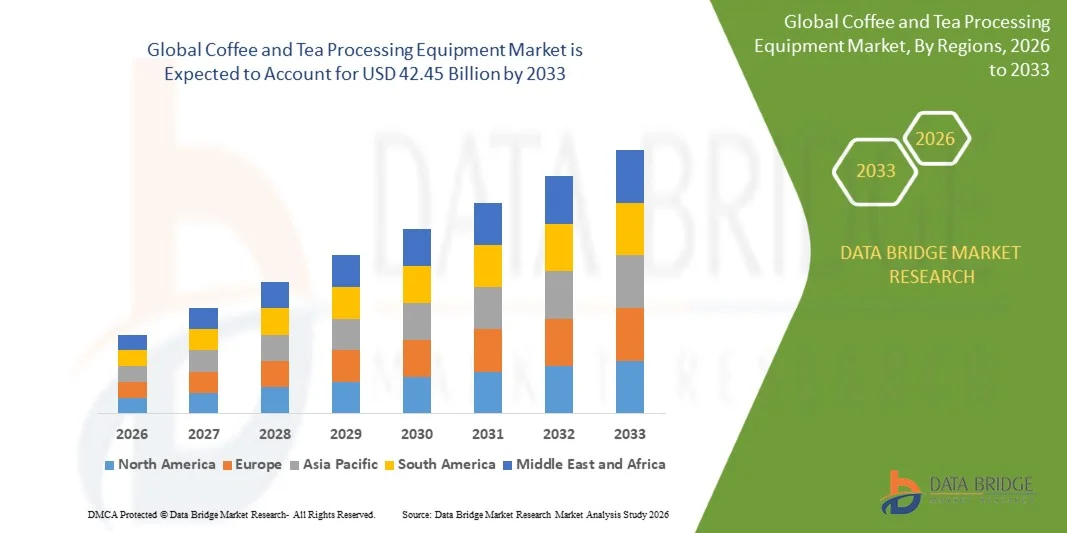
- As per Data Bridge Market Research analysis, the coffee and tea processing equipment market was valued at USD 26.04 billion in 2025 and is projected to reach USD 42.45 billion by 2033, growing at a CAGR of 6.30% from 2026 to 2033.
- The market is experiencing consistent growth driven by increasing demand for high-quality coffee and tea products, particularly in developing regions, growing consumer interest in specialty and artisanal coffee and tea, technological advancements in processing equipment, and increasing adoption of automation and robotics in the industry.
- The increasing focus on efficient production, digitalization of processes, sophisticated equipment design, operational maintenance, and expanding product portfolios is encouraging processors to invest in advanced coffee and tea processing machinery. The market is also being supported by the accelerated adoption of online platforms for equipment purchases, while supply-chain disruptions, stringent food-safety regulations, inflation, and fluctuating raw-material prices remain key challenges.
Market Size & Forecast
- Global Market Value (2025): USD 26.04 Billion
- Expected Market Value (2033): USD 42.45 Billion
- Forecast CAGR (2026–2033): 6.30%
- Leading Region in 2025: North America
- Fastest Growing Region: Asia Pacific
What are the Major Takeaways of the Coffee and Tea Processing Equipment Market?
- North America dominated the coffee and tea processing equipment market with the largest revenue share of 35.84% in 2025, supported by established processing infrastructure, high adoption of advanced equipment, and strong demand from specialty coffee and tea producers.
- Asia-Pacific is expected to be the fastest-growing region at a CAGR of 6.2% from 2026 to 2033, fueled by rising coffee and tea consumption, rapid urbanization, and increasing adoption of advanced food processing machinery.
- The coffee bean sorting machines segment led the market with a 34% share in 2025, driven by the increasing need for consistent bean quality, removal of defective beans, and improved processing efficiency.
- CTC tea processing machine are the fastest-growing machine type, projected to register a CAGR of 6.5%, reflecting the surge in demand for efficiently processed black tea and modernization of tea-processing facilities.
- The automatic segment dominated the automation category with a 48% revenue share in 2025, led by increasing demand for higher processing efficiency, consistent product quality, and reduced dependence on manual labor.
- Sorting accounted for 38% of the market share in 2025, preferred by importance of removing defective materials and maintaining consistent raw-material quality before subsequent processing stages.
- The drying segment is the fastest-growing process category, with a CAGR of 6.3%, driven by its critical role in controlling moisture content and preserving coffee and tea quality.
Report Scope and Coffee and Tea Processing Equipment Market Segmentation
|
Attributes |
Coffee and Tea Processing Equipment Key Market Insights |
|
Segments Covered |
|
|
Countries Covered |
North America
Europe
Asia-Pacific
Middle East and Africa
South America
|
|
Key Market Players |
|
|
Market Opportunities |
|
|
Value Added Data Infosets |
In addition to the insights on market scenarios such as market value, growth rate, segmentation, geographical coverage, and major players, the market reports curated by the Data Bridge Market Research also include in-depth expert analysis, pricing analysis, brand share analysis, consumer survey, demography analysis, supply chain analysis, value chain analysis, raw material/consumables overview, vendor selection criteria, PESTLE Analysis, Porter Analysis, and regulatory framework. |
What is the Key Trend in the Coffee and Tea Processing Equipment Market?
- Coffee and tea processors are increasingly adopting automated and advanced equipment to improve production efficiency, quality control, consistency, and operational performance across processing facilities.
- For instance, in February 2024, a study published in Trends in Food Science & Technology highlighted the growing use of intelligent technologies across tea cultivation, processing, sorting, and quality assessment, supporting the shift toward automated and data-driven tea processing equipment.
- Digitalization and process automation are gaining importance as manufacturers use intelligent systems to monitor processing parameters, reduce manual intervention, improve productivity, and optimize resource utilization across production lines.
- Sustainability is becoming increasingly important, encouraging equipment manufacturers to develop processing technologies that reduce water consumption, energy requirements, waste generation, and overall environmental impact during production.
- Growing consumer interest in specialty, premium, and artisanal coffee and tea is increasing demand for specialized equipment capable of delivering consistent quality, distinctive flavor profiles, and flexible processing capabilities.
- For instance, in February 2025, a study published in Sustainability found that integrating energy-recovery technologies into coffee processing could reduce greenhouse-gas emissions by up to 40% and fossil-fuel depletion by 36%, supporting the trend toward energy-efficient processing equipment
- The expansion of ready-to-drink coffee and tea products is encouraging investment in integrated extraction, clarification, blending, thermal treatment, filling, packaging, and process-control equipment for commercial beverage production.
What are the Key Drivers of the Coffee and Tea Processing Equipment Market?
- The rising global demand for coffee and tea products is encouraging processors to expand and modernize production facilities, increasing requirements for efficient, high-capacity, and technologically advanced processing equipment worldwide.
- For instance, in June 2024, Westrock Coffee opened a USD 315 million, 570,000-square-foot processing facility in Arkansas with robotics and end-to-end automation covering green coffee receiving, roasting, grinding, extraction, bottling, and packaging, demonstrating investment in high-capacity automated processing to meet growing demand.
- Growing consumption of specialty and premium coffee and tea is driving investment in advanced machinery capable of maintaining consistent quality, flavor profiles, production efficiency, and product standards during processing.
- Increasing adoption of automation and robotics is supporting market growth by enabling faster processing, improved quality control, reduced manual intervention, and greater operational efficiency across coffee and tea production facilities.
- For instance, in June 2025, Spider Robots reported the automation of palletizing across 14 production lines at a large coffee processing company using centralized gantry robots, demonstrating how robotics are being deployed to improve efficiency and reduce operational requirements in coffee production.
- Expansion of coffee shops, cafés, specialty tea stores, and ready-to-drink beverages is increasing processing requirements and supporting demand for flexible equipment capable of meeting diverse product and production needs.
Which Factors are Challenging the Growth of the Coffee and Tea Processing Equipment Market?
- High initial investment costs associated with sophisticated processing machinery can restrict adoption, particularly among smaller processors and businesses with limited capital available for equipment modernization and expansion.
- For instance, in November 2023, a study published in Sustainability found that establishing a 200-ton-capacity coffee washing station in Rwanda required substantial initial investment, including USD 69,395 for a coffee pulper machine, demonstrating that high equipment capital costs can constrain investment among smaller coffee processors.
- Rapid technological advancements require frequent equipment upgrades, increasing capital requirements for processors and creating additional financial pressure, particularly for smaller coffee and tea processing facilities.
- Rising energy costs and environmental concerns are pushing manufacturers and processors toward more sustainable equipment and processes, which can require significant additional investment in energy-efficient and environmentally friendly technologies.
- Ongoing maintenance and repair expenses create additional financial pressure for processors, particularly as increasingly sophisticated automated equipment requires specialized technical expertise, servicing, and replacement components.
- For instance, in September 2025, GEA reported that automated coffee extraction systems can reduce operator intervention and contamination risks, highlighting the technical requirements associated with achieving consistent quality and regulatory compliance in modern processing facilities
- Stringent food-safety and quality regulations require processors to maintain compliant equipment, sanitation systems, monitoring processes, and operational standards, increasing investment requirements and compliance-related operating costs.
How is the Coffee and Tea Processing Equipment Market Segmented?
The coffee and tea processing equipment market is segmented on the basis of machine type, automation, process, and distribution channel.
- By Machine Type
On the basis of machine type, the coffee and tea processing equipment market is segmented into coffee bean sorting machines, coffee pulping machines, coffee processing plant, coffee huller, CTC tea processing machine, and orthodox tea processing machine. The coffee bean sorting machines segment dominated the market with an estimated share of 34% in 2025, supported by the increasing need for consistent bean quality, removal of defective beans, and improved processing efficiency. These machines enable processors to classify coffee beans according to characteristics such as color, size, shape, and quality. Growing specialty coffee consumption is increasing the importance of precise sorting and quality control. Automated sorting also reduces manual intervention and improves processing throughput. Increasing modernization of commercial coffee-processing facilities is supporting demand for advanced sorting systems.
The CTC tea processing machine segment is projected to be the fastest-growing machine-type category, with an estimated CAGR of 6.5% during the forecast period, driven by increasing demand for efficiently processed black tea and modernization of tea-processing facilities. CTC technology enables continuous processing and supports high-volume commercial tea production. Growing tea consumption in Asia-Pacific is creating additional demand for modern tea-processing machinery. Increasing replacement of conventional equipment is supporting adoption of more efficient CTC systems. Automation capabilities can also reduce labor requirements and improve processing consistency.
- By Automation
On the basis of automation, the market is segmented into automatic, semi-automatic, and manual equipment. The automatic segment dominated the market with an estimated share of 48% in 2025, driven by increasing demand for higher processing efficiency, consistent product quality, and reduced dependence on manual labor. Automated systems can control multiple processing parameters with greater precision and repeatability. Large commercial processors increasingly require continuous, high-throughput production systems. Automation also supports standardized processing and improved operational monitoring. Integration of digital controls and intelligent technologies is further improving equipment performance. The growing emphasis on productivity, consistency, and labor efficiency is supporting the leading position of automatic equipment.
The semi-automatic segment is projected to witness significant growth at an estimated CAGR of 5.8% during forecast period, particularly among small and medium-sized coffee and tea processors seeking modernization without the capital requirements associated with fully automated production lines. Semi-automatic machinery provides greater flexibility while reducing manual processing requirements. It allows processors to upgrade individual stages of existing production facilities. The segment is particularly relevant in emerging economies where smaller processing businesses remain important. Growing availability of relatively affordable machinery is supporting adoption. Semi-automatic equipment can also provide a transition pathway from manual to fully automated processing.
- By Process
On the basis of process components, the market is segmented into sorting, sifting, rolling, fermenting, and drying. The sorting segment dominated the market with an estimated share of 38% in 2025, reflecting the importance of removing defective materials and maintaining consistent raw-material quality before subsequent processing stages. Automated sorting improves separation accuracy and reduces dependence on manual labor. Coffee processors increasingly require sorting systems to classify beans according to quality characteristics. Tea processors also use sorting and grading equipment to improve product uniformity. Rising demand for premium and specialty products is increasing the importance of precise sorting. Improvements in optical and automated sorting technologies are further supporting market adoption.
The drying segment is projected to register the fastest growth at an estimated CAGR of 6.3% during forecast period, owing to its critical role in controlling moisture content and preserving coffee and tea quality. Modern drying equipment provides greater control over moisture levels than conventional drying methods. Increasing emphasis on processing efficiency and product consistency is encouraging investment in advanced drying systems. Energy-efficient technologies are becoming increasingly important as processors seek to control operating expenses. Rising coffee and tea production in emerging economies is expanding the requirement for commercial drying capacity. Advanced drying technologies can also support more consistent product quality and reduce processing losses.
- By Distribution Channel
On the basis of distribution channel, the market is segmented into online, offline, and others. The offline segment dominated the market with an estimated share of 72% in 2025, because coffee and tea processing equipment typically involves technical specifications, installation, commissioning, maintenance, and after-sales support. Buyers of large processing systems often require direct technical consultation and equipment demonstrations. Offline distributors and manufacturers can provide installation and operator training services. Spare-parts availability and maintenance support are also important considerations when purchasing industrial machinery. The relatively high value and technical complexity of processing equipment further favor direct and offline purchasing. Established industrial-equipment distribution networks therefore continue to account for the majority of equipment sales.
The online segment is projected to be the fastest-growing distribution channel at an estimated CAGR of 7.0% during forecast period, supported by increasing digitalization and the growing use of online platforms for equipment discovery and procurement. Online channels allow processors to compare suppliers, equipment specifications, prices, and technical features more efficiently. Manufacturers can use digital platforms to reach customers beyond their traditional geographic markets. Increasing internet penetration in developing economies is also improving access to international equipment suppliers. Online purchasing is particularly suitable for smaller machinery, components, spare parts, and standardized equipment.
Which Region Holds the Largest Share of the Coffee and Tea Processing Equipment Market?
- North America dominated the coffee and tea processing equipment market with the largest revenue share of 35.84% in 2025, supported by established processing infrastructure, high adoption of advanced equipment, and strong demand from specialty coffee and tea producers
- The region also benefits from increasing specialty coffee consumption, technological innovation, and the presence of leading equipment manufacturers, which support continued investment in modern processing systems. According to the National Coffee Association data 64% of U.S. adults drink coffee daily, creating a substantial underlying demand for processed coffee products and related processing infrastructure. The U.S. market is further supported by its high concentration of specialty coffee roasters and coffee shops
U.S. Coffee and Tea Processing Equipment Market Insight
The U.S. coffee and tea processing equipment market is witnessing strong growth due to high coffee consumption, a mature specialty coffee industry, and increasing adoption of advanced processing technologies. According to the National Coffee Association, 66% of U.S. adults reported drinking coffee every day in 2025, demonstrating strong underlying demand for coffee products and supporting continued investment across the processing value chain. The country also has a large specialty coffee sector, encouraging processors to adopt equipment that improves consistency, quality, and production efficiency. Growing demand for premium coffee products and technological improvements in roasting, grinding, sorting, and packaging are further supporting equipment adoption.
Asia-Pacific Coffee and Tea Processing Equipment Market Insight
The Asia-Pacific coffee and tea processing equipment market is expected to witness rapid growth, driven by rising coffee and tea consumption, expanding beverage industries, and modernization of processing facilities across countries such as China, India, and Japan. The Food and Agriculture Organization reports that global tea consumption increased by 2.0% in 2022, with strong demand in major Asian tea-consuming markets. China and India remain among the world's leading tea-producing countries, creating substantial requirements for sorting, rolling, fermenting, drying, and other processing equipment. Increasing mechanization and technological modernization of tea factories are further supporting regional demand. Growing coffee consumption in Asian markets is also creating opportunities for modern coffee-processing
Japan Coffee and Tea Processing Equipment Market Insight
The Japan coffee and tea processing equipment market is witnessing consistent growth due to established coffee and tea consumption, sophisticated food-processing infrastructure, and strong consumer demand for high-quality beverages. According to the U.S. Department of Agriculture, Japan's coffee consumption was approximately 7.18 million 60-kg bags in 2024/25, demonstrating substantial demand for processed coffee products. Japan's mature beverage industry also encourages processors to maintain high standards of consistency, quality, and production efficiency. Increasing demand for premium coffee and tea products is supporting investment in modern processing technologies. Automation, precision processing, and advanced quality-control systems are further contributing to equipment modernization
China Coffee and Tea Processing Equipment Market Insight
The China coffee and tea processing equipment market is growing rapidly, supported by the country's position as a major tea producer and consumer and increasing modernization of the tea-processing industry. The Food and Agriculture Organization identifies China as the world's largest tea producer and consumer, creating extensive requirements for modern processing infrastructure. In April 2024, the FAO and China launched the One Country One Priority Product Tea Programme, focusing on technology integration, productivity improvement, and green and low-carbon transformation of the tea industry. These initiatives are encouraging modernization across the tea value chain and creating demand for efficient processing machinery. Growing coffee consumption and expansion of China's specialty coffee sector are also supporting coffee-processing equipment demand.
U.K. Coffee and Tea Processing Equipment Market Insight
The U.K. coffee and tea processing equipment market is experiencing steady growth, supported by established coffee and tea consumption, a mature specialty beverage sector, and increasing demand for premium products. According to the British Coffee Association, the U.K. coffee industry contributes significantly to the country's hospitality and food-service sectors, while coffee remains one of the country's most widely consumed beverages. The continued expansion of specialty coffee and demand for differentiated products are encouraging processors and roasters to improve production capabilities. Increasing emphasis on consistency, efficiency, and sustainable processing is supporting adoption of modern equipment. Growth in ready-to-drink and premium beverage formats is also creating additional processing requirements.
Germany Coffee and Tea Processing Equipment Market Insight
The Germany coffee and tea processing equipment market is expanding steadily due to strong coffee consumption, an established food-processing industry, and increasing demand for high-quality processed beverage products. According to the German Coffee Association, coffee consumption in Germany reached approximately 169 liters per capita in 2024, demonstrating the country's strong coffee culture and substantial demand for processed coffee. The country's sophisticated manufacturing environment also supports adoption of efficient roasting, grinding, packaging, and quality-control technologies. Increasing consumer interest in specialty and premium coffee is encouraging processors to improve product consistency and processing capabilities. Germany's focus on resource efficiency and sustainable manufacturing is further supporting demand for advanced processing equipment
Which are the Top Companies in Coffee and Tea Processing Equipment Market?
The coffee and tea processing equipment industry is primarily led by well-established companies, including:
- Bühler AG (Switzerland)
- PROBAT SE (Germany)
- GEA Group Aktiengesellschaft (Germany)
- ALFA LAVAL (Sweden)
- TOMRA Systems ASA (Norway)
- Brambati S.p.A. (Italy)
- Diedrich Roasters, LLC (U.S.)
- T&I Global Pvt (India)
- Selmi Group SRL (Italy)
- Modern Process Equipment Corporation (U.S.)
- JOPER (Portugal)
- Giesen Roasting Solutions (Netherlands)
- Pinhalense Máquinas Agrícolas (Brazil)
- Toper Roasters (Türkiye)
- Coffee-Tech Engineering Ltd. (Israel)
- Ambex Coffee Roasters (U.S.)
- PCD Industries (India)
- Gem Machinery & Allied Industries (India)
- Satake Corporation (Japan)
What are Latest Developments in Coffee and Tea Processing Equipment Market?
- In March 2025, NEUHAUS NEOTEC introduced its new GOURMET series of coffee roasters, based on RFB roasting technology and designed for capacities of up to 2,000 kg/h. The new modular roasting systems are available in multiple sizes and can also process products such as nuts, seeds, and grains, highlighting the industry's move toward flexible, high-capacity, and resource-efficient processing equipment.
- In March 2025, PROBAT introduced the NEPTUNE 4000, described as the world's largest drum roaster, extending its roasting portfolio to capacities of up to 880 kg and emphasizing process optimization, modularization, standardization, energy efficiency, and productivity. The development demonstrates continued technological advancement in large-scale coffee roasting equipment.
- For instance, in April 2024, Diedrich launched the DR3-E, its first electric-heated coffee roaster, with a 3-kg capacity, expanding its roasting equipment portfolio with an electric alternative to conventional gas-powered roasting systems. The launch reflects the industry's increasing focus on electric roasting technologies and more flexible equipment options for specialty coffee producers.
- In August 2022, Shanghai EasyReal Machinery completed commissioning of a pilot UHT/HTST plant for Ting Hsin International Group in China, designed for tea-beverage trials, fluid-food experiments, formulation development, thermal testing, recipe optimization, and aseptic sample preparation. The system incorporated a pilot tubular sterilizer, inline homogenizer, and aseptic filling cabinet
- In March 2022, KTDA announced plans to supply, install, and commission assorted tea-processing machinery and equipment across its managed factories under a framework arrangement. The initiative covered tea-processing machinery and associated equipment, demonstrating continued investment in modernizing tea-processing infrastructure and supporting mechanization within the tea industry.

- Interactive Data Analysis Dashboard
- Company Analysis Dashboard for high growth potential opportunities
- Research Analyst Access for customization & queries
- Competitor Analysis with Interactive dashboard
- Latest News, Updates & Trend analysis
- Harness the Power of Benchmark Analysis for Comprehensive Competitor Tracking
Global Coffee And Tea Processing Equipment Market, Supply Chain Analysis and Ecosystem Framework
To support market growth and help clients navigate the impact of geopolitical shifts, DBMR has integrated in-depth supply chain analysis into its Global Coffee And Tea Processing Equipment Market research reports. This addition empowers clients to respond effectively to global changes affecting their industries. The supply chain analysis section includes detailed insights such as Global Coffee And Tea Processing Equipment Market consumption and production by country, price trend analysis, the impact of tariffs and geopolitical developments, and import and export trends by country and HSN code. It also highlights major suppliers with data on production capacity and company profiles, as well as key importers and exporters. In addition to research, DBMR offers specialized supply chain consulting services backed by over a decade of experience, providing solutions like supplier discovery, supplier risk assessment, price trend analysis, impact evaluation of inflation and trade route changes, and comprehensive market trend analysis.
Data collection and base year analysis are done using data collection modules with large sample sizes. The stage includes obtaining market information or related data through various sources and strategies. It includes examining and planning all the data acquired from the past in advance. It likewise envelops the examination of information inconsistencies seen across different information sources. The market data is analysed and estimated using market statistical and coherent models. Also, market share analysis and key trend analysis are the major success factors in the market report. To know more, please request an analyst call or drop down your inquiry.
The key research methodology used by DBMR research team is data triangulation which involves data mining, analysis of the impact of data variables on the market and primary (industry expert) validation. Data models include Vendor Positioning Grid, Market Time Line Analysis, Market Overview and Guide, Company Positioning Grid, Patent Analysis, Pricing Analysis, Company Market Share Analysis, Standards of Measurement, Global versus Regional and Vendor Share Analysis. To know more about the research methodology, drop in an inquiry to speak to our industry experts.
Data Bridge Market Research is a leader in advanced formative research. We take pride in servicing our existing and new customers with data and analysis that match and suits their goal. The report can be customized to include price trend analysis of target brands understanding the market for additional countries (ask for the list of countries), clinical trial results data, literature review, refurbished market and product base analysis. Market analysis of target competitors can be analyzed from technology-based analysis to market portfolio strategies. We can add as many competitors that you require data about in the format and data style you are looking for. Our team of analysts can also provide you data in crude raw excel files pivot tables (Fact book) or can assist you in creating presentations from the data sets available in the report.













