Global Dermatology Small Molecule API Market Segmentation, By Drug Class (Anti-Infectives, Corticosteroids, Anti-Acne, Calcineurin Inhibitors, Retinoids, and Others), Application (Acne, Psoriasis, Atopic Dermatitis, and Others), Route of Administration (Oral, Parenteral, and Topical), Distribution Channel (Hospital Pharmacies, Retail Pharmacies, and Online Pharmacies), End-Use (Hospitals, Skin Clinics, and Others) - Industry Trends and Forecast to 2032
Dermatology Small Molecule API Market Analysis
The dermatology small molecule API market is experiencing steady growth driven by the increasing incidence of skin disorders such as acne, psoriasis, eczema, and atopic dermatitis. The rising awareness about skin health, coupled with the demand for more affordable treatment options, is propelling the market forward. Small molecule drugs, particularly those targeting inflammatory pathways, are being increasingly adopted due to their cost-effectiveness and ease of use compared to biologics.
A key driver for the market is the growing preference for topical small molecule therapies over systemic treatments, particularly for conditions such as acne and psoriasis. Topical drugs such as tretinoin, a retinoid, and topical corticosteroids continue to dominate the treatment of mild to moderate skin conditions due to their efficacy and relatively lower cost. Additionally, the development of novel small molecules targeting specific molecular pathways such as JAK inhibitors for atopic dermatitis and psoriasis is creating new opportunities for growth. The continued shift towards personalized medicine, where treatments are tailored to an individual's specific skin condition and genetic profile, is further boosting demand for dermatology small molecule APIs, offering promising market prospects.
Dermatology Small Molecule API Market Size
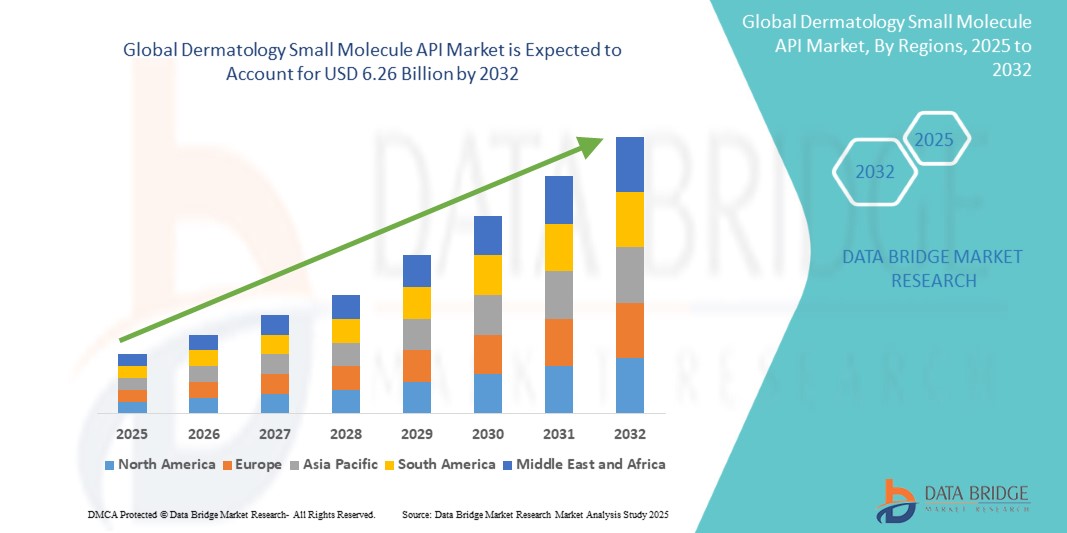
The global dermatology small molecule API market size was valued at USD 3.64 billion in 2024 and is projected to reach USD 6.26 billion by 2032, with a CAGR of 7.00% during the forecast period of 2025 to 2032. In addition to the insights on market scenarios such as market value, growth rate, segmentation, geographical coverage, and major players, the market reports curated by the Data Bridge Market Research also include depth expert analysis, patient epidemiology, pipeline analysis, pricing analysis, and regulatory framework.
Dermatology Small Molecule API Market Trends
“Rising Prevalence of Chronic Skin Disorders”
The main reason for the growth of the dermatology small molecule API market is the rising prevalence of chronic skin disorders such as acne, psoriasis, eczema, and atopic dermatitis, coupled with increasing patient demand for more effective and affordable treatments. As these conditions become more common worldwide, there is a growing need for both topical and systemic therapies that can manage symptoms and improve quality of life.
Small molecule drugs are gaining traction due to their cost-effectiveness, accessibility, and proven efficacy, particularly in the treatment of mild to moderate skin conditions. For instance, topical retinoids such as tretinoin and corticosteroids remain first-line treatments for acne and psoriasis, offering patients targeted relief at a lower cost compared to biologics. Additionally, the development of newer, more advanced small molecule therapies, such as JAK inhibitors for inflammatory skin diseases, is expanding the treatment options available, fueling further market growth. The shift towards personalized dermatology treatments is also driving demand, with tailored therapies increasingly sought after.
Report Scope and Dermatology Small Molecule API Market Segmentation
|
Attributes |
Dermatology Small Molecule API Key Market Insights |
|
Segments Covered |
|
|
Countries Covered |
U.S., Canada and Mexico in North America, Germany, France, U.K., Italy, Spain, Denmark, Sweden, Norway, Rest of Europe in Europe, China, Japan, India, South Korea, Australia, Thailand, Rest of Asia-Pacific (APAC) in the Asia-Pacific (APAC), Saudi Arabia, U.A.E., South Africa, Egypt, Kuwait, Rest of Middle East and Africa (MEA) as a part of Middle East and Africa (MEA), Brazil, Argentina and Rest of South America as part of South America |
|
Key Market Players |
Abbott (U.S.), AbbVie Inc. (U.S.), Amgen Inc. (U.S.), Arcutis Biotherapeutics, Inc. (U.S.), BIOCAD HK Ltd (China), Bristol-Myers Squibb Company (U.S.), Can-Fite (Israel), CELLTRION INC. (Republic of Korea), Coherus BioSciences (U.S.), DermBiont, Inc. (U.S.), Galectin Therapeutics, Inc. (U.S.), Galderma (Switzerland), ILTOO Pharma (France), GSK plc. (U.K.), Johnson & Johnson Services, Inc. (U.S.), LEO Pharma A/S (Denmark), Pfizer Inc. (U.S.), Roivant Sciences Ltd. (U.K.), Sun Pharmaceutical Industries Ltd. (India), and Viatris Inc. (U.S.) |
|
Market Opportunities |
|
|
Value Added Data Infosets |
In addition to the insights on market scenarios such as market value, growth rate, segmentation, geographical coverage, and major players, the market reports curated by the Data Bridge Market Research also include depth expert analysis, patient epidemiology, pipeline analysis, pricing analysis, and regulatory framework. |
Dermatology Small Molecule API Market Definition
Dermatology small molecule API refers to active pharmaceutical ingredients (APIs) that are small molecules specifically developed for the treatment of dermatological conditions. These molecules are typically low molecular weight compounds that interact with specific biological targets in the body to treat skin diseases or conditions.
Dermatology Small Molecule API Market Dynamics
Drivers
- Advancements in Drug Delivery Systems
Technological advancements in drug delivery systems, including sustained-release formulations, transdermal systems, and nano-drug delivery technologies, have significantly enhanced the effectiveness and bioavailability of small molecule drugs. These innovations not only improve patient compliance but also optimize treatment outcomes, particularly for chronic dermatological conditions. For instance, Tretinoin (Retin-A), a widely used treatment for acne and aging signs, is now available in sustained-release formulations that boost its therapeutic efficacy while minimizing irritation. By enabling a controlled release of the drug, sustained-release technologies provide consistent therapeutic effects over time, enhancing long-term patient outcomes. These advancements in drug delivery systems serve as a major driver for the growth of the Dermatology Small Molecule API Market.
- Cost-Effectiveness of Small Molecule Drugs
Small molecule drugs are typically more cost-effective than biologic treatments, making them a preferred choice for both patients and healthcare systems, particularly in emerging markets. Their affordability helps improve access to essential treatments, driving market growth in countries with limited healthcare budgets. For instance, in regions such as India and Brazil, topical corticosteroids such as Hydrocortisone and Betamethasone continue to be widely prescribed for treating conditions such as eczema, acne, and psoriasis, primarily due to their lower costs compared to biologic alternatives such as anti-TNF drugs. This cost-effectiveness serves as a key driver for the growth of the Dermatology Small Molecule API Market, as it enables broader patient access and adoption, particularly in developing regions, fostering the market's expansion.
Opportunities
- Rise in Dermatological Conditions
ニキビ、湿疹、乾癬、酒さなどの一般的な皮膚疾患の増加により、低分子治療薬の需要が高まっています。世界中の人々がこれらの慢性的な皮膚疾患に対するより効果的で長期的な解決策を求めているため、皮膚科における低分子 API のニーズは高まり続けています。たとえば、尋常性ざ瘡は世界人口の 9.4% に影響を与えると推定されており (出典: 世界疾病負担研究、2019 年)、かなりの患者数を占めています。トレチノインや過酸化ベンゾイルなどの治療薬に対する需要の高まりは、皮膚科における低分子薬の明確な市場機会を浮き彫りにしています。世界中で皮膚疾患の負担が増大する中、皮膚科低分子 API 市場は大幅な拡大が見込まれており、製薬会社が大規模で多様な患者層に効果的なソリューションを開発して提供する多くの機会を生み出しています。
- 医薬品製剤の革新
徐放性製剤、ナノドラッグデリバリーシステム、経皮パッチなどの薬物送達技術の進歩により、皮膚科における低分子医薬品の新たな機会が生まれています。これらの革新により、治療の有効性が高まり、患者のコンプライアンスが向上し、副作用が最小限に抑えられます。たとえば、ニキビ治療によく使用される低分子のトレチノイン (レチン A) は、現在、皮膚の炎症を軽減しながら治療効果を高める徐放性製剤で提供されています。これらの改善は、より効率的で患者に優しく、刺激の少ない治療に対する高まる需要と一致しています。薬物送達技術が進化し続けるにつれて、皮膚科の低分子 API 市場は恩恵を受ける態勢が整っており、製薬会社がより便利で効果的で安全な治療を求める患者のニーズに対応する新たな機会を提供します。
制約/課題
- 規制と承認の課題
皮膚科用小分子 API 市場は、特に新しい処方や適応症の場合、製品承認を遅らせる可能性がある規制上のハードルに直面しています。FDA や EMA などの規制当局は、臨床試験、有効性、安全性、製造基準に厳しい要件を課しており、開発期間とコストが増加する可能性があります。たとえば、局所薬の承認を得るには、ニキビ、乾癬、湿疹などの特定の皮膚疾患の治療における有効性を証明するための広範な臨床データが必要になる場合があります。たとえば、ニキビの局所治療に広く使用されている過酸化ベンゾイルは、当初は厳格な承認プロセスの対象であったため、規制の複雑さは市場にとって大きな制約となっています。
- 生物学的療法との競争
皮膚科の低分子 API 市場は、中等度から重度の乾癬やアトピー性皮膚炎などの重度または治療抵抗性の症状に優れた有効性を示す生物学的製剤との厳しい競争に直面しています。TNF 阻害剤やモノクローナル抗体などの生物学的療法は、より的を絞った強力な効果を提供することが多いため、コストが高いにもかかわらず、複雑な皮膚疾患の治療に好まれています。たとえば、モノクローナル抗体のデュピルマブ (デュピクセント) は、中等度から重度のアトピー性皮膚炎 (AD) の治療に優れた有効性が実証されており、慢性疾患の管理における長期的な利点から、低分子治療よりも使用されることが増えています。副作用の少ない標的治療を提供する生物学的療法の好まれつつある傾向は、皮膚科の低分子 API 市場にとって大きな課題となっています。
この市場レポートでは、最近の新しい開発、貿易規制、輸出入分析、生産分析、バリュー チェーンの最適化、市場シェア、国内および現地の市場プレーヤーの影響、新たな収益源の観点から見た機会の分析、市場規制の変更、戦略的市場成長分析、市場規模、カテゴリ市場の成長、アプリケーションのニッチと優位性、製品の承認、製品の発売、地理的拡大、市場における技術革新などの詳細が提供されます。市場に関する詳細情報を取得するには、アナリスト ブリーフについて Data Bridge Market Research にお問い合わせください。当社のチームが、情報に基づいた市場決定を行い、市場の成長を実現できるようお手伝いします。
皮膚科用低分子API市場の範囲
市場は、薬物クラス、用途、投与経路、流通チャネル、最終用途に基づいてセグメント化されています。これらのセグメントの成長は、業界におけるわずかな成長セグメントの分析に役立ち、ユーザーに貴重な市場概要と市場洞察を提供し、コア市場アプリケーションを特定するための戦略的決定を下すのに役立ちます。
薬物クラス
- 抗感染薬
- コルチコステロイド
- ニキビ予防
- カルシニューリン阻害剤
- レチノイド
- その他
応用
- ニキビ
- 乾癬
- アトピー性皮膚炎
- その他
投与経路
- オーラル
- 非経口
- 話題
流通チャネル
- 病院薬局
- 小売薬局
- オンライン薬局
最終用途
- 病院
- 皮膚科クリニック
- その他
皮膚科用小分子API市場の地域分析
市場は分析され、市場規模の洞察と傾向は、上記のように国、薬物クラス、用途、投与経路、流通チャネル、および最終用途別に提供されます。
市場レポートでカバーされている国は、北米では米国、カナダ、メキシコ、ヨーロッパではドイツ、フランス、イギリス、イタリア、スペイン、デンマーク、スウェーデン、ノルウェー、その他のヨーロッパ、アジア太平洋地域 (APAC) では中国、日本、インド、韓国、オーストラリア、タイ、その他のアジア太平洋地域 (APAC)、中東およびアフリカ (MEA) の一部としてサウジアラビア、UAE、南アフリカ、エジプト、クウェート、その他の中東およびアフリカ (MEA)、南米の一部としてブラジル、アルゼンチン、その他の南米です。
北米は、医療費の増加、皮膚疾患に対する意識の高まり、大手皮膚科製薬会社の堅調な存在などの要因により、大きな市場シェアを維持すると予想されています。皮膚疾患の発生率の増加は、この地域の市場成長を推進すると予想される重要な要因です。たとえば、2023年3月に発行された世界アレルギー機構ジャーナルのレポートでは、米国におけるアトピー性皮膚炎の有病率は4.9%から10.2%の範囲であると強調されています。この皮膚疾患の有病率の高さは、国内の皮膚科治療薬の需要を大幅に促進すると予想されます。
アジア太平洋地域は、予測期間を通じて最も高い成長率を達成すると予測されています。この地域は、皮膚疾患の罹患率の増加、人口の高齢化、医療費の上昇などの要因により、皮膚科業界の主要な商業拠点として浮上しています。さらに、さまざまな政府の取り組みや協力により、皮膚科の問題への関心を高めるための取り組みが積極的に行われており、この地域の市場潜在力の拡大に貢献しています。
レポートの国別セクションでは、市場の現在および将来の動向に影響を与える国内市場における個別の市場影響要因と規制の変更も提供しています。下流および上流のバリュー チェーン分析、技術動向、ポーターの 5 つの力の分析、ケース スタディなどのデータ ポイントは、各国の市場シナリオを予測するために使用される指標の一部です。また、国別データの予測分析を提供する際には、グローバル ブランドの存在と可用性、および地元および国内ブランドとの競争が激しいか少ないために直面する課題、国内関税と貿易ルートの影響も考慮されます。
皮膚科用低分子API市場シェア
市場競争環境では、競合他社ごとの詳細が提供されます。詳細には、会社概要、会社の財務状況、収益、市場の可能性、研究開発への投資、新しい市場への取り組み、世界的なプレゼンス、生産拠点と施設、生産能力、会社の強みと弱み、製品の発売、製品の幅と広さ、アプリケーションの優位性などが含まれます。提供される上記のデータ ポイントは、市場に関連する会社の焦点にのみ関連しています。
市場で活動する皮膚科用小分子 API の市場リーダーは次のとおりです。
- アボット(米国)
- アッヴィ社(米国)
- アムジェン社(米国)
- アルクティス・バイオセラピューティクス社(米国)
- BIOCAD HK Ltd (中国)
- ブリストル・マイヤーズスクイブ社(米国)
- カンフィット(イスラエル)
- CELLTRION INC.(韓国)
- コヒーラス・バイオサイエンス(米国)
- ダームバイオント社(米国)
- ガレクチン・セラピューティクス社(米国)
- ガルデルマ(スイス)
- ILTOO Pharma(フランス)
- GSK plc. (英国)
- ジョンソン・エンド・ジョンソン・サービス社(米国)
- LEO Pharma A/S(デンマーク)
- ファイザー社(米国)
- ロイヴァント・サイエンシズ社(英国)
- サン・ファーマシューティカル・インダストリーズ(インド)
- ビアトリス社(米国)
皮膚科用小分子API市場の最新動向
- 2024年10月、LEO Pharmaは2024年の最初の9か月間の財務ハイライトを発表しました。同社は、為替レート一定(CER)で11%の収益成長を達成しました。皮膚科ポートフォリオは13%の収益成長を示しました。また、欧州委員会による中等度から重度の慢性手湿疹(CHE)の成人に対するAnzupgo(デルゴシチニブ)クリームの承認など、世界中でいくつかの重要なイベントが含まれていました。
- 2024年10月、オルガノンはロイヴァントからダーマヴァント・サイエンシズ社を買収したことを発表しました。ダーマヴァントは、免疫皮膚科における革新的な治療ソリューションの開発と商品化を専門とする企業です。買収には、軽度、中等度、重度の尋常性乾癬の治療薬として米国食品医薬品局(FDA)に承認された、新しい非生物学的、非ステロイド性の局所療法であるVTAMA(タピナロフ)クリーム1%の買収も含まれています。
- 2024年8月、DermBiontは、基底細胞がん(BCC)の治療を目的とした現在進行中のオープンラベル多施設第2a相試験から、肯定的な初期データを発表しました。試験結果によると、SM-020 1%ゲルをBID(1日2回)で28日間治療した病変は、6週目における最大腫瘍径のベースラインからのパーセント変化に基づく主要評価項目に基づき、SM-020 1%ゲルの適用に対して迅速(治療開始から数日以内に)かつ強力な臨床反応を示し、SM-020の疾患修飾能を明確に実証しました。
- 2024年5月、 ジョンソン・エンド・ジョンソンは、免疫関連疾患に対する二重特異性抗体を専門とする非上場バイオテクノロジー企業であるプロテオロジックス社を現金8億5,000万ドルで買収することで最終合意に達したと発表しました。追加のマイルストーン支払いの可能性もあります。プロテオロジックスのパイプラインには、IL-13とTSLPを標的とする二重特異性抗体PX128が含まれており、中等度から重度のアトピー性皮膚炎(AD)と中等度から重度の喘息の治療薬としてフェーズ1開発に入る準備ができています。
- 2024年3月、アムジェンは、中等度から重度の尋常性乾癬を患う6~17歳の小児および青年を対象としたオテズラ(アプレミラスト)の使用を検討する第3相SPROUT試験の52週間の新しい結果を発表しました。オテズラの継続的な使用により、患者の乾癬の重症度と皮膚症状が最大1年間持続的に改善しました。
SKU-
Obtenha acesso online ao relatório sobre a primeira nuvem de inteligência de mercado do mundo
- Painel interativo de análise de dados
- Painel de análise da empresa para oportunidades de elevado potencial de crescimento
- Acesso de analista de pesquisa para personalização e customização. consultas
- Análise da concorrência com painel interativo
- Últimas notícias, atualizações e atualizações Análise de tendências
- Aproveite o poder da análise de benchmark para um rastreio abrangente da concorrência
Metodologia de Investigação
A recolha de dados e a análise do ano base são feitas através de módulos de recolha de dados com amostras grandes. A etapa inclui a obtenção de informações de mercado ou dados relacionados através de diversas fontes e estratégias. Inclui examinar e planear antecipadamente todos os dados adquiridos no passado. Da mesma forma, envolve o exame de inconsistências de informação observadas em diferentes fontes de informação. Os dados de mercado são analisados e estimados utilizando modelos estatísticos e coerentes de mercado. Além disso, a análise da quota de mercado e a análise das principais tendências são os principais fatores de sucesso no relatório de mercado. Para saber mais, solicite uma chamada de analista ou abra a sua consulta.
A principal metodologia de investigação utilizada pela equipa de investigação do DBMR é a triangulação de dados que envolve a mineração de dados, a análise do impacto das variáveis de dados no mercado e a validação primária (especialista do setor). Os modelos de dados incluem grelha de posicionamento de fornecedores, análise da linha de tempo do mercado, visão geral e guia de mercado, grelha de posicionamento da empresa, análise de patentes, análise de preços, análise da quota de mercado da empresa, normas de medição, análise global versus regional e de participação dos fornecedores. Para saber mais sobre a metodologia de investigação, faça uma consulta para falar com os nossos especialistas do setor.
Personalização disponível
A Data Bridge Market Research é líder em investigação formativa avançada. Orgulhamo-nos de servir os nossos clientes novos e existentes com dados e análises que correspondem e atendem aos seus objetivos. O relatório pode ser personalizado para incluir análise de tendências de preços de marcas-alvo, compreensão do mercado para países adicionais (solicite a lista de países), dados de resultados de ensaios clínicos, revisão de literatura, mercado remodelado e análise de base de produtos . A análise de mercado dos concorrentes-alvo pode ser analisada desde análises baseadas em tecnologia até estratégias de carteira de mercado. Podemos adicionar quantos concorrentes necessitar de dados no formato e estilo de dados que procura. A nossa equipa de analistas também pode fornecer dados em tabelas dinâmicas de ficheiros Excel em bruto (livro de factos) ou pode ajudá-lo a criar apresentações a partir dos conjuntos de dados disponíveis no relatório.