



Sistemas de Braquiterapia Eletrônica Global Segmentação de Mercado, Por Tipo de Produto (Sistemas de Braquiterapia Eletrônica, Aplicadores e Acessórios, Software e Serviços), Tecnologia (Braquiterapia de Raios-X, Braquiterapia de Radionuclídeo Eletrônico), Dosagem (Alta Taxa de Dose, Baixa Taxa de Dose), Aplicação (Câncer de Mama, Câncer de Pele Não-Melanoma, Câncer Ginecológico, Câncer de Próstata, Outros), Usuário Final (Hospitais, Clínicas Especiais, Centros Cirúrgicos Ambulatórios, Outros) – Tendências e Previsão da Indústria para 2033
Qual é o Tamanho e a Taxa de Crescimento dos Sistemas Eletrônicos de Braquiterapia
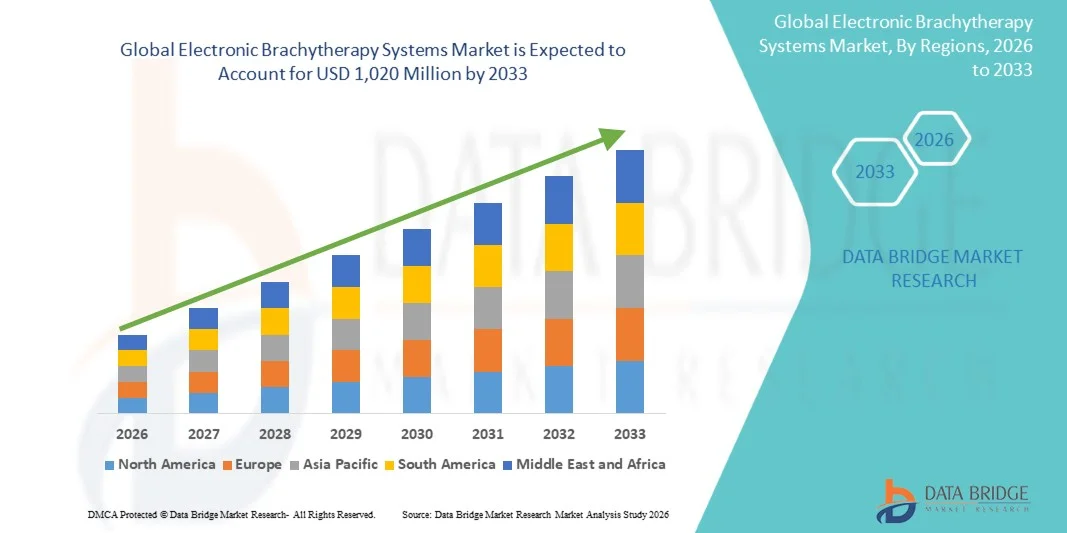
- De acordo com Data Bridge Market Research Analysis the Braquiterapia eletrônica global A dimensão do mercado dos sistemas foi avaliada em460 milhões de USDem 2025 e espera-se alcançar1020 milhões de USDaté 2033, num CAGR de5%durante o período de previsão.
- O crescimento do mercado é impulsionado principalmente pelo aumento da carga global do cancro – especialmentemama, pele, próstata ecancro ginecológicos – aumento da preferência do paciente por terapias de radiação minimamente invasivas e localizadas, e adoção crescente de braquiterapia eletrônica em ambientes ambulatoriais e ambulatoriais, onde a entrega livre de isótopos simplifica a conformidade regulatória e fluxos de trabalho operacionais.
- Além disso, avanços tecnológicos contínuos em raios-Xbraquiterapia eletrônica, políticas favoráveis de reembolso em mercados desenvolvidos, expansão de centros especializados em oncologia em economias emergentes e integração de ferramentas de planejamento de tratamento orientadas por IA estão apoiando coletivamente robusta expansão global do mercado.
Tamanho e previsão do mercado
- Valor de mercado global (2025):460 milhões de USD
- Valor de mercado previsto (2033):1020 milhões de USD
- Previsões CAGR (2026-2033):5%
Quais são os principais takeaways do mercado de sistemas eletrônicos de braquiterapia
- A braquiterapia eletrônica (eBx) utiliza fontes de raios X miniaturizadas colocadas em locais tumorais ou próximos para fornecer radiação de alta dose precisamente direcionada, permitindo que os profissionais de saúde tratem cânceres localizados de forma eficaz, minimizando a exposição à radiação em tecidos saudáveis circundantes.
- A crescente demanda por sistemas eletrônicos de braquiterapia é impulsionada pelo aumento da incidência de câncer em todo o mundo, por uma crescente população geriátrica altamente suscetível ao câncer, pela expansão global da infraestrutura oncológica e pela distinta vantagem clínica da eBx em relação à tradicional braquiterapia baseada em isótopos, em termos de redução das exigências de blindagem e fácil manejo regulatório.
- A América do Norte dominou o mercado de Sistemas Eletrônicos de Braquiterapia em 2025, com uma participação de 49,02%, apoiado pela infraestrutura de cuidados avançados contra o câncer, a presença de principais atores do mercado, como Xoft Inc. (iCAD) e Sensus Healthcare, fortes quadros de reembolso e altos volumes processuais para tratamentos de câncer de pele e mama.
- Espera-se que a Ásia-Pacífico seja a região de crescimento mais rápido, com um cagr de 9,52%, impulsionada pelo aumento rápido da prevalência de câncer na China, Índia, Japão e Coreia do Sul, expansão dos gastos com saúde, crescentes investimentos em infraestrutura de radiação oncológica e crescente conscientização das modalidades avançadas de tratamento do câncer entre clínicos e pacientes.
- O segmento Electronic Brachytherapy Hardware Systems dominou o mercado com uma participação de 55,00% devido à demanda contínua de hospitais e centros de oncologia para instalações completas do sistema eBx, incluindo unidades de fonte de raios X miniaturizadas e plataformas de controle integradas. Seu papel crítico como principal aquisição de equipamentos de capital em novos ciclos de aquisição e substituição reforça a liderança de segmentos.
Report Scope e Sistemas Eletrônicos de Braquiterapia Segmentação de Mercado
|
Atributos |
Sistemas Eletrônicos de Braquiterapia Principais Insights do Mercado |
|
Segmentos Cobertos |
|
|
Países abrangidos |
América do Norte:
Europa:
Ásia- Pacífico:
Médio Oriente e África:
América do Sul:
|
|
Jogadores do mercado chave |
|
|
Oportunidades de Mercado |
|
|
Informações sobre o Valor Adicionado |
|
Qual é a tendência chave no mercado de sistemas eletrônicos de braquiterapia
"Integração do planejamento de tratamento guiado por IA e entrega guiada por imagem está transformando a precisão eletrônica da braquiterapia"
- A integração da inteligência artificial e do aprendizado de máquina em planejamento de tratamento de braquiterapia eletrônica está emergindo rapidamente como uma tendência transformadora, melhorando a precisão dosimétrica, reduzindo o tempo de planejamento e permitindo abordagens terapêuticas personalizadas.
- As ferramentas de contorno e planejamento adaptativo a IA permitem aos clínicos definir melhor os volumes alvo e as estruturas críticas, minimizando as margens de tratamento e reduzindo a exposição à radiação a tecidos saudáveis adjacentes.
- As soluções de braquiterapia guiada por imagem (IGBT), incorporando a RM em tempo real e a orientação da TC com a entrega de eBx, estão sendo cada vez mais adotadas em tratamentos ginecológicos e de câncer de próstata para melhorar a acurácia terapêutica.
- A ênfase crescente no atendimento ambulatorial ao câncer e nos modelos de tratamento centrados no paciente está acelerando a adoção de sistemas portáteis de braquiterapia eletrônica sem isótopos que podem ser implantados em centros cirúrgicos ambulatoriais sem blindagem por radiação pesada.
- O foco crescente no tratamento do câncer de pele – particularmente o câncer de pele não melanoma (NMSC) – está impulsionando a demanda por soluções de eBx que oferecem resultados não invasivos, cosméticos superiores em comparação com a cirurgia para tumores faciais e extremos.
- Os principais jogadores do mercado estão investindo em plataformas de braquiterapia eletrônica de última geração com taxas de dose mais elevadas, miniaturização de fonte melhorada e ampla gama de aplicações, acelerando o crescimento do mercado.
Sistemas Eletrônicos de Braquiterapia Dinâmica de Mercado
Controlador
"O aumento da carga global do câncer e a adoção ampliada de terapias de radiação minimamente invasivas estão conduzindo a demanda eletrônica de braquiterapia"
- A crescente incidência global de câncer, particularmente de mama, pele não melanoma, câncer ginecológico e de próstata, é a principal fonte de demanda por sistemas eletrônicos de braquiterapia, que oferecem radiação direcionada e localizada com efeitos sistêmicos mínimos.
- Segundo a International Agency for Research on Cancer (IARC), estima-se que a incidência global de câncer exceda 28,4 milhões de casos novos anualmente até 2040, ampliando significativamente o pool de pacientes, exigindo opções de tratamento alvo avançadas, como a braquiterapia eletrônica.
- O aumento da preferência do médico e do paciente por procedimentos minimamente invasivos com menor tempo de internação hospitalar, redução do perfil de efeitos colaterais e tempo de recuperação mais rápido está direcionando a adoção clínica para o eBx em relação à radioterapia externa tradicional para casos elegíveis.
- Políticas de reembolso favoráveis para procedimentos eletrônicos de braquiterapia nos Estados Unidos, apoiadas pela Medicare e cobertura de seguradoras privadas para tratamento de APBI (Irradiação Parcial Acelerada) e NMSC, sustentam altos volumes processuais e adoção do sistema.
- Expansão de centros especializados em oncologia de radiação e centros cirúrgicos ambulatoriais equipados com sistemas avançados de eBx está ampliando o acesso do paciente e aumentando as instalações do sistema globalmente.
Restrição / Desafio
"Os altos custos de capital e a cobertura limitada do reembolso em mercados emergentes são a adoção da Braquiterapia Eletrônica"
- Os altos custos de aquisição e operacional dos sistemas eletrônicos de braquiterapia, incluindo investimento em capital em dispositivos, software de planejamento de tratamento e treinamento de pessoal, representam barreiras significativas à adoção, particularmente em ambientes de saúde sensíveis aos custos em economias emergentes.
- Quadros de reembolso limitados ou ausentes para procedimentos eletrônicos de braquiterapia em vários mercados asiático-pacíficos, latino-americanos e do Oriente Médio restringem significativamente a captação de tecnologia fora de centros privados especializados de câncer.
- Competição das tecnologias estabelecidas de radioterapia de feixe externo (EBRT) e radioterapia corporal estereotáxica (SBRT), que gozam de familiaridade clínica mais ampla e dados de desfechos mais extensos, cria inércia de adoção para braquiterapia eletrônica em determinadas indicações.
- A escassez de especialistas treinados em oncologia por radiação capazes de realizar e planejar procedimentos de eBx, especialmente em países de baixa e média renda, limita ainda mais a expansão do mercado para além dos sistemas de saúde de alta renda.
Como é segmentado o mercado de sistemas eletrônicos de braquiterapia
O mercado é segmentado com base no tipo de produto, tecnologia, dosagem, aplicação e usuário final.
Por tipo de produto
Com base no Tipo de Produto, o mercado global de Sistemas Eletrônicos de Braquiterapia é segmentado em Sistemas Eletrônicos de Braquiterapia, Aplicadores e Acessórios e Software e Serviços. O segmento de Sistemas Eletrônicos de Braquiterapia dominou o mercado com a maior parcela de receita de 55,00% em 2025, impulsionada pela demanda contínua de hospitais e centros de oncologia para instalações completas do sistema eBx, incluindo unidades de fonte de raios X miniaturizadas e plataformas de controle integradas. Seu papel crítico como principal aquisição de equipamentos de capital em novos ciclos de aquisição e substituição reforça a liderança de segmentos.
Espera-se que o segmento Software & Serviços testemunhe o crescimento mais rápido de 11,00% durante o período de previsão, alimentado pelo aumento da adoção de software de planejamento de tratamento alimentado por IA, ferramentas de dosimetria em tempo real e soluções de fluxo de trabalho digital que melhorem a eficiência processual e os resultados clínicos. A ênfase crescente nos modelos de assinatura de software como serviço (SaaS) em oncologia de radiação e a crescente demanda por serviços de monitoramento e suporte de sistemas remotos estão acelerando ainda mais a expansão do segmento.
Por Tecnologia
Com base na Tecnologia, o mercado global de Sistemas Eletrônicos de Braquiterapia é segmentado em Braquiterapia de Raios X e Braquiterapia de Radionuclídeos Eletrônicos. O segmento de Braquiterapia por Raios X dominou o mercado com uma participação de 45,00% em 2025, uma vez que os sistemas miniaturizados de eBx baseados em raios X representam a tecnologia de braquiterapia eletrônica mais madura e amplamente adotada comercialmente. Sua entrega livre de isótopos reduz significativamente a carga regulatória, elimina o gerenciamento de resíduos radioativos e permite a implantação em salas clínicas padrão sem blindagem pesada – todos os fatores que sustentam a quota de mercado dominante.
Espera-se que o segmento de Braquiterapia por Radionuclídeo Eletrônico testemunhe o crescimento mais rápido de 10,50%, impulsionado pelo crescente interesse clínico em plataformas isotópicas-alternativas de última geração que ofereçam melhores perfis de distribuição de dose e aplicabilidade mais ampla em vários tipos de tumores. O investimento contínuo em P&D e os esforços de validação clínica estão apoiando a expansão do segmento.
Por Dosagem
Com base na Dosagem, o mercado global de Sistemas Eletrônicos de Braquiterapia é segmentado em alta taxa de dose (HDR) e baixa taxa de dose (LDR). O segmento de Alta Taxa de Dose (HDR) dominou o mercado com a maior participação de receita com uma participação de 71,79% em 2025, impulsionada por suas vantagens clínicas, incluindo sessões mais curtas de tratamento, capacidade de entrega ambulatorial, otimização precisa da dose e redução do risco de exposição à radiação para os profissionais de saúde. Protocolos HDR para tratamentos de câncer de mama, ginecológico e de pele são bem estabelecidos e amplamente reembolsados em grandes mercados.
Espera-se que o segmento de Baixa Taxa de Dose (LDR) testemunhe crescimento consistente com um cagr de 8,50%, particularmente na braquiterapia do câncer de próstata, onde os implantes permanentes de sementes permanecem uma opção padrão de cuidados. A preferência clínica contínua pela LDR em casos selecionados de câncer de próstata de baixo a intermediário suporta volume procedimental sustentado e demanda do dispositivo.
Por Aplicação
Com base na Aplicação, o mercado global de Sistemas Eletrônicos de Braquiterapia é segmentado em Câncer de Mama, Câncer de Pele Não-Melanoma (NMSC), Câncer Ginecológico, Câncer de Próstata e Outros. O segmento Não-Melanoma Skin Cancer (NMSC) dominou o mercado com a maior participação de receita com uma participação de 36,70% em 2025, impulsionada pela prevalência global extremamente alta de NMSC (o tipo de câncer mais comum globalmente), os resultados cosméticos superiores oferecidos pela eBx sobre a excisão cirúrgica para áreas faciais e cosméticamente sensíveis, e forte adoção em clínicas de dermatologia e radiação oncológica.
Espera-se que o segmento de Câncer de Mama testemunhe o crescimento mais rápido com um cagr de 7,80% durante o período de previsão, alimentado pelo aumento da incidência de câncer de mama globalmente, aumentando a adoção de protocolos de irradiação parcial acelerada da mama (IAP) pós-lumpectomia, aumentando a preferência por abordagens de tratamento de conservação da mama e ampliando as evidências clínicas que apoiam o APBI baseado em eBx como uma alternativa eficaz à irradiação de peito inteiro.
Por Usuário Final
Com base no Usuário Final, o mercado global de Sistemas Eletrônicos de Braquiterapia é segmentado em Hospitais, Clínicas Especiais, Centros Cirúrgicos Ambulatórios e Outros. O segmento de Hospitais dominou o mercado com uma participação de 38,00% em 2025, impulsionado por suas amplas capacidades de tratamento do câncer, equipes multidisciplinares de oncologia, capacidade para procedimentos complexos de multi-indicação eBx e capacidade de lidar com volumes elevados de pacientes que necessitam de braquiterapia eletrônica interna e ambulatorial em diversos tipos de câncer.
Espera-se que o segmento Centros Cirúrgicos Ambulatórios (CAA) testemunhe o crescimento mais rápido com um cagr de 10,00% durante o período de previsão, alimentado pela tendência crescente para o atendimento ambulatorial ao câncer, as características livres de isótopos e de baixa exigência dos sistemas eBx que os tornam altamente compatíveis com as configurações de CAE, e o aumento das pressões de custo-eficiência impulsionando a migração do paciente de ambientes hospitalares para ambientes ambulatoriais de tratamento do câncer.
Qual é a região que detém a maior parte do mercado de sistemas eletrônicos de braquiterapia
- A América do Norte dominou o mercado de Sistemas Eletrônicos de Braquiterapia com a maior participação de receita em 2025, apoiado pela infraestrutura avançada de saúde, uma alta prevalência de cânceres de mama, pele e ginecológicos, forte reembolso de Medicare e pagador privado para procedimentos eBx, e a presença dominante de principais jogadores do mercado, incluindo Xoft Inc. (iCAD) e Sensus Healthcare.
- A região se beneficia de redes de radiação oncológica bem estabelecidas, ampla familiaridade clínica com a tecnologia eBx, altos volumes processuais para tratamentos APBI e NMSC e quadros regulatórios favoráveis que apoiam a adoção de tecnologia e expansão do mercado.
- Essa forte posição de mercado é ainda apoiada pela robusta atividade de pesquisa e desenvolvimento, inovação contínua nas capacidades do sistema eBx, crescente utilização do planejamento de tratamento integrado a IA e ampliação da adoção em centros cirúrgicos ambulatoriais em todos os Estados Unidos.
U.S. Electronic Brachytherapy Systems Market Insight
O mercado de Sistemas Eletrônicos de Braquiterapia dos EUA ocupa uma posição global dominante, impulsionado pela alta incidência de câncer de mama e pele, estabeleceu o reembolso da Medicare para tratamento de câncer de pele APBI e não melanoma, e a implantação generalizada de sistemas de eBx em hospitais, clínicas especializadas e CSAs. A adoção crescente de modelos ambulatoriais de atenção ao câncer, a inovação contínua de produtos por fabricantes domésticos e a crescente integração do planejamento de tratamento orientado por IA estão fortalecendo ainda mais a expansão do mercado.
Europe Electronic Brachytherapy Systems Market Insight
O mercado Europe Electronic Brachytherapy Systems está testemunhando um crescimento constante, impulsionado pelo aumento da incidência de câncer, forte infraestrutura de oncologia e crescente adoção de terapias de radiação minimamente invasivas em toda a Alemanha, França, Reino Unido e Itália. Ampliar a cobertura de reembolso para procedimentos de eBx, aumentar o investimento em melhorias no centro de oncologia de radiação e aumentar as evidências clínicas que apoiam a eficácia do eBx estão apoiando o desenvolvimento do mercado em toda a região.
U.K. Electronic Brachytherapy Systems Market Insight
O mercado de Sistemas Eletrônicos de Braquiterapia do Reino Unido está experimentando crescimento constante, impulsionado pelo aumento da TAN e adoção do setor privado de braquiterapia eletrônica para tratamento de câncer de pele e mama, crescente conscientização clínica das vantagens do eBx e ampliação da capacidade do serviço de oncologia. O aumento do foco no cuidado centrado no paciente e a menor entrega do ciclo de tratamento está apoiando a expansão contínua do mercado.
Alemanha Electronic Brachytherapy Systems Market Insight
Espera-se que o mercado de Sistemas Eletrônicos de Braquiterapia da Alemanha cresça de forma constante, apoiado por um sistema de cuidados oncológicos bem desenvolvido, com forte foco em medicina de precisão e tecnologias avançadas de radioterapia, e com crescente utilização de eBx tanto em ambiente hospitalar quanto ambulatorial. A liderança da Alemanha em pesquisa clínica e seu robusto quadro de reembolso de cuidados de saúde estão contribuindo para a adoção sustentada de sistemas eletrônicos de braquiterapia.
Japão Electronic Brachytherapy Systems Market Insight
O mercado Japan Electronic Brachytherapy Systems está testemunhando crescimento constante, impulsionado pelo envelhecimento da população do país, alta carga de câncer e avançada cultura de adoção de dispositivos médicos. O crescente uso do eBx no tratamento ginecológico e do câncer de próstata, juntamente com o forte foco do Japão na oncologia de precisão e procedimentos minimamente invasivos, está apoiando a expansão do mercado. O aumento do investimento nas plataformas de radioterapia de próxima geração está a aumentar a captação do sistema.
Índia Electronic Brachytherapy Systems Market Insight
O mercado India Electronic Brachytherapy Systems está experimentando forte crescimento, impulsionado pelo rápido aumento da incidência de câncer, expansão da infraestrutura privada e pública de oncologia, e crescente conscientização das opções avançadas de radioterapia. Iniciativas governamentais como o esquema de saúde Ayushman Bharat e o aumento do investimento privado em saúde estão apoiando a adoção de tecnologia. A crescente procura de soluções de tratamento do cancro em ambulatório, de baixo custo, está a tornar a braquiterapia electrónica uma opção cada vez mais atraente para os fornecedores indianos de oncologia.
Quais são as principais empresas no mercado de sistemas eletrônicos de braquiterapia
A indústria de Sistemas Eletrônicos de Braquiterapia é liderada principalmente por empresas bem estabelecidas, incluindo:
- Xoft Inc. (subsidiária da iCAD Inc.) (EUA)
- Sensus Healthcare Inc. (EUA)
- Varian Medical Systems Inc. (a Siemens Healthineers Company) (EUA)
- Elekta AB (Suécia)
- Hologic Inc. (EUA)
- Eckert & Ziegler AG (Alemanha)
- CivaTech Oncoology Inc. (EUA)
- IsoAid LLC (EUA)
- Panacea Medical Technologies Pvt. Ltd. (Índia)
- Argon Medical Devices Inc. (EUA)
Quais são as últimas evoluções no mercado de sistemas eletrônicos de braquiterapia
- Em janeiro de 2025, a Sensus Healthcare anunciou uma expansão de suas capacidades de plataforma SRT-100 Vision, incorporando ferramentas de integração de imagem aprimoradas e ampla gama de aplicadores de tratamento para abordar um espectro mais amplo de aplicações de oncologia superficial, reforçando sua liderança no tratamento de câncer de pele não melanoma.
- Em Março de 2025, o iCAD Inc. (Xoft) relatou um aumento da adopção clínica do seu sistema Axxent eBx para irradiação mamária parcial acelerada (APBI), apoiado por dados de resultados clínicos actualizados de vários anos que demonstram eficácia comparável à irradiação de peito inteiro com redução significativa do tempo de tratamento.
- Em outubro de 2024, Elekta fez parceria com um desenvolvedor líder de software de planejamento de tratamento de IA para integrar o contorno automatizado e capacidades de planejamento adaptativo em suas soluções de fluxo de trabalho de braquiterapia, visando a melhoria da eficiência processual em indicações ginecológicas e de câncer de próstata.
- Em junho de 2024, a GT Medical Technologies e a Theragenics Corporation anunciaram uma parceria para ampliar a disponibilidade da Terapia GammaTile para o tratamento do tumor cerebral, combinando a entrega eletrônica de radiação com portadores de azulejos bioabsorvíveis especializados para fornecer braquiterapia localizada imediatamente após a ressecção.
SKU-
Obtenha acesso online ao relatório sobre a primeira nuvem de inteligência de mercado do mundo

- Painel interativo de análise de dados
- Painel de análise da empresa para oportunidades de elevado potencial de crescimento
- Acesso de analista de pesquisa para personalização e customização. consultas
- Análise da concorrência com painel interativo
- Últimas notícias, atualizações e atualizações Análise de tendências
- Aproveite o poder da análise de benchmark para um rastreio abrangente da concorrência
Metodologia de Investigação
A recolha de dados e a análise do ano base são feitas através de módulos de recolha de dados com amostras grandes. A etapa inclui a obtenção de informações de mercado ou dados relacionados através de diversas fontes e estratégias. Inclui examinar e planear antecipadamente todos os dados adquiridos no passado. Da mesma forma, envolve o exame de inconsistências de informação observadas em diferentes fontes de informação. Os dados de mercado são analisados e estimados utilizando modelos estatísticos e coerentes de mercado. Além disso, a análise da quota de mercado e a análise das principais tendências são os principais fatores de sucesso no relatório de mercado. Para saber mais, solicite uma chamada de analista ou abra a sua consulta.
A principal metodologia de investigação utilizada pela equipa de investigação do DBMR é a triangulação de dados que envolve a mineração de dados, a análise do impacto das variáveis de dados no mercado e a validação primária (especialista do setor). Os modelos de dados incluem grelha de posicionamento de fornecedores, análise da linha de tempo do mercado, visão geral e guia de mercado, grelha de posicionamento da empresa, análise de patentes, análise de preços, análise da quota de mercado da empresa, normas de medição, análise global versus regional e de participação dos fornecedores. Para saber mais sobre a metodologia de investigação, faça uma consulta para falar com os nossos especialistas do setor.
Personalização disponível
A Data Bridge Market Research é líder em investigação formativa avançada. Orgulhamo-nos de servir os nossos clientes novos e existentes com dados e análises que correspondem e atendem aos seus objetivos. O relatório pode ser personalizado para incluir análise de tendências de preços de marcas-alvo, compreensão do mercado para países adicionais (solicite a lista de países), dados de resultados de ensaios clínicos, revisão de literatura, mercado remodelado e análise de base de produtos . A análise de mercado dos concorrentes-alvo pode ser analisada desde análises baseadas em tecnologia até estratégias de carteira de mercado. Podemos adicionar quantos concorrentes necessitar de dados no formato e estilo de dados que procura. A nossa equipa de analistas também pode fornecer dados em tabelas dinâmicas de ficheiros Excel em bruto (livro de factos) ou pode ajudá-lo a criar apresentações a partir dos conjuntos de dados disponíveis no relatório.











