Global Frontal Sinusitis Treatment Market Segmentation, By Causes (Viral Infection, Bacterial Infection, Allergies, Deviated Nasal Septum, Nasal Polyps, and Others), Treatment (Diagnosis, Medication, Home Remedies, and Others), End-Users (Hospitals, Specialty Clinics, Home Healthcare, and Others), Distribution Channel (Direct Tender, Hospital Pharmacy, Retail Pharmacy, Online Pharmacy, and Others) – Industry Trends and Forecast to 2032
Frontal Sinusitis Treatment Market Analysis
The frontal sinusitis treatment market focuses on managing inflammation or infection in the frontal sinuses caused by viral, bacterial, or fungal infections. Common treatments include antibiotics, decongestants, corticosteroids, and surgical interventions for severe cases. Recent advancements emphasize minimally invasive surgery such as endoscopic sinus surgery and drug-eluting stents, improving patient outcomes and recovery time. The market is influenced by the rising prevalence of sinusitis, advancements in diagnostic tools, and increasing awareness of effective treatments. The growing preference for non-invasive methods and innovative drug delivery systems, such as nasal sprays and topical medications, also drive market expansion. Recent developments include the introduction of biologics targeting chronic sinusitis and improved imaging technologies for precise diagnosis. Key players, including Pfizer Inc., Teva Pharmaceutical Industries Ltd., and GSK plc, are investing in R&D to cater to unmet medical needs, fostering competition and innovation within the market.
Frontal Sinusitis Treatment Market Size
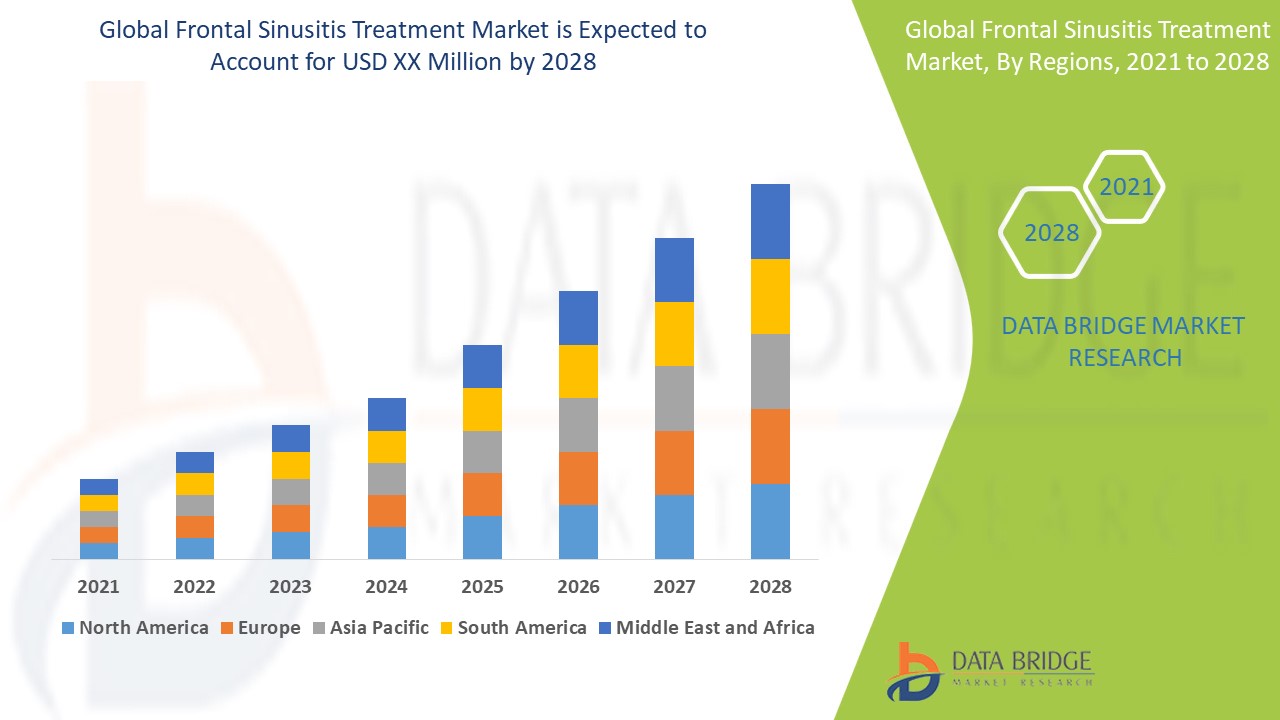
The global frontal sinusitis treatment market size was valued at USD 1.41 billion in 2024 and is projected to reach USD 2.10 billion by 2032, with a CAGR of 5.06% during the forecast period of 2025 to 2032. In addition to the insights on market scenarios such as market value, growth rate, segmentation, geographical coverage, and major players, the market reports curated by the Data Bridge Market Research also include depth expert analysis, patient epidemiology, pipeline analysis, pricing analysis, and regulatory framework.
Frontal Sinusitis Treatment Market Trends
“Adoption of Drug-Eluting Stents and Endoscopic Sinus Surgery”
The frontal sinusitis treatment market is evolving due to increasing cases of sinusitis caused by infections, allergies, and environmental factors. Innovations such as biologics, advanced imaging technologies, and minimally invasive surgical techniques are revolutionizing treatment approaches. One notable trend is the rising adoption of drug-eluting stents and endoscopic sinus surgery, which enhance treatment precision and reduce recovery time. These advancements cater to patient demands for non-invasive and effective solutions. The market overview highlights the growing focus on personalized medicine and improved diagnostic tools. Key players are leveraging technological advancements and investing in R&D to develop innovative products, addressing unmet needs and fostering significant market growth globally.
Report Scope and Frontal Sinusitis Treatment Market Segmentation
|
Attributes |
Frontal Sinusitis Treatment Key Market Insights |
|
Segments Covered |
|
|
Countries Covered |
U.S., Canada and Mexico in North America, Germany, France, U.K., Netherlands, Switzerland, Belgium, Russia, Italy, Spain, Turkey, Rest of Europe in Europe, China, Japan, India, South Korea, Singapore, Malaysia, Australia, Thailand, Indonesia, Philippines, Rest of Asia-Pacific (APAC) in the Asia-Pacific (APAC), Saudi Arabia, U.A.E., South Africa, Egypt, Israel, Rest of Middle East and Africa (MEA) as a part of Middle East and Africa (MEA), Brazil, Argentina and Rest of South America as part of South America. |
|
Key Market Players |
Pfizer Inc. (U.S.), Merck & Co., Inc. (U.S.), AstraZeneca (U.K.), Bayer AG (Germany), Boehringer Ingelheim International GmbH (Germany), Teva Pharmaceutical Industries Ltd. (Israel), Lupin (India), Hikma Pharmaceuticals PLC (U.K.), Alkem (India), Sandoz AG (Switzerland), GSK plc (U.K.), Amneal Pharmaceuticals LLC (U.S.), Viatris Inc. (U.S.), Sun Pharmaceutical Industries Ltd. (India), Dr. Reddy’s Laboratories Ltd. (India), Aurobindo Pharma (India), Perrigo Company plc (Ireland), Akron Inc. (U.S.), Envision Pharma Group (U.S.) |
|
Market Opportunities |
|
|
Value Added Data Infosets |
In addition to the insights on market scenarios such as market value, growth rate, segmentation, geographical coverage, and major players, the market reports curated by the Data Bridge Market Research also include depth expert analysis, patient epidemiology, pipeline analysis, pricing analysis, and regulatory framework. |
Frontal Sinusitis Treatment Market Definition
Frontal sinusitis treatment refers to the medical and therapeutic approaches used to manage and alleviate inflammation or infection in the frontal sinuses, located above the eyes. Treatment options include medications such as antibiotics, decongestants, corticosteroids, and antihistamines for mild to moderate cases. For chronic or severe conditions, interventions such as endoscopic sinus surgery, sinus irrigation, and drug-eluting stents may be employed. The goal is to reduce symptoms, eliminate infection, and prevent complications.
Frontal Sinusitis Treatment Market Dynamics
Drivers
- Rising Prevalence of Sinusitis
The increasing incidence of frontal sinusitis, driven by factors such as infections, allergies, and rising air pollution levels, significantly fuels the market's growth. Viral and bacterial infections remain primary causes, often exacerbated by seasonal changes and weakened immune systems. Allergies, particularly to dust, pollen, and pet dander, contribute to recurrent sinus inflammation. In addition, air pollution, including particulate matter and industrial pollutants, irritates nasal passages and triggers sinus issues. As these factors become more prevalent globally, the demand for effective and advanced treatments rises, positioning the growing cases of frontal sinusitis as a critical driver of the treatment market's expansion.
- Advancements in Diagnostic Tools
Improved imaging technologies, such as high-resolution CT scans and advanced MRI techniques, have revolutionized the diagnosis of frontal sinusitis. These technologies allow for more accurate visualization of sinus cavities, enabling healthcare providers to identify the exact location, severity, and underlying causes of the condition. By offering precise diagnostic insights, these innovations help in tailoring personalized treatment plans, ensuring higher treatment success rates and reducing unnecessary procedures. As a result, the growing adoption of advanced imaging tools significantly enhances treatment efficiency, making them a crucial driver in the frontal sinusitis treatment market, as more patients seek precise and effective care.
Opportunities
- Rise of Telemedicine Platforms
The rise of telemedicine platforms offers a significant opportunity for expanding the accessibility and treatment of frontal sinusitis. Remote consultations allow patients to receive timely diagnoses and treatment recommendations without the need to visit healthcare facilities, making care more convenient, especially in rural or underserved areas. Telemedicine also facilitates continuous monitoring and follow-up care, enhancing patient outcomes. By enabling healthcare professionals to provide consultations, prescribe medications, and guide at-home treatments virtually, telemedicine has become a key enabler of more widespread, efficient care. This shift toward remote healthcare presents a valuable market opportunity for the frontal sinusitis treatment sector.
- Development of Biologics Targeting
The development of biologics targeting chronic sinusitis presents a significant market opportunity by offering innovative treatment options for patients who do not respond well to traditional therapies. Biologics, which are engineered to target specific molecular pathways involved in inflammation, provide a more personalized approach to treating chronic sinusitis. These treatments can address the underlying causes of the condition, reducing recurrence and improving long-term outcomes. With increasing awareness of the benefits of biologics, this approach is gaining traction among both patients and healthcare providers. As research and development continue to progress, biologics are poised to become a vital solution, opening new avenues for growth in the frontal sinusitis treatment market.
Restraints/Challenges
- Variable Treatment Effectiveness
A significant challenge in the frontal sinusitis treatment market is that not all patients respond to available treatments, especially those with chronic sinusitis. This condition often requires long-term management, and many patients experience persistent symptoms despite using conventional therapies such as antibiotics, corticosteroids, or nasal sprays. This lack of effectiveness leads to frustration and dissatisfaction, as patients continue to suffer from recurrent or ongoing sinus infections and discomfort. The variability in treatment response highlights the need for more targeted, personalized therapies that can address the underlying causes of chronic sinusitis, presenting an ongoing challenge in improving patient outcomes within the market.
- High Cost of Advanced Treatments
The high cost of advanced treatments for frontal sinusitis, such as biologics, surgery, and long-term medications, poses a significant barrier to treatment accessibility. These therapies, while effective, can be prohibitively expensive, especially in regions with limited healthcare budgets or for individuals without adequate insurance coverage. This cost factor restricts a large portion of the population from accessing optimal care, leading to delayed treatment or reliance on less effective, over-the-counter options. As a result, the affordability of these advanced treatments remains a key restraint in the frontal sinusitis treatment market, limiting their widespread adoption and patient access.
This market report provides details of new recent developments, trade regulations, import-export analysis, production analysis, value chain optimization, market share, impact of domestic and localized market players, analyses opportunities in terms of emerging revenue pockets, changes in market regulations, strategic market growth analysis, market size, category market growths, application niches and dominance, product approvals, product launches, geographic expansions, technological innovations in the market. To gain more info on the market contact Data Bridge Market Research for an Analyst Brief, our team will help you take an informed market decision to achieve market growth.
Frontal Sinusitis Treatment Market Scope
The market is segmented on the basis of causes, treatment, end-users, and distribution channel. The growth amongst these segments will help you analyse meagre growth segments in the industries and provide the users with a valuable market overview and market insights to help them make strategic decisions for identifying core market applications.
Causes
- Viral infection
- Bacterial infection
- Allergies
- Deviated nasal septum
- Nasal polyps
- Others
Treatment
- Diagnosis
- Medication
- Home remedies
- Others
End-Users
- Hospitals
- Specialty clinics
- Home healthcare
- Others
Distribution Channel
- Direct tender
- Hospital pharmacy
- Retail pharmacy
- Online pharmacy
- Others
Frontal Sinusitis Treatment Market Regional Analysis
The market is analysed and market size insights and trends are provided by country, causes, treatment, end-users, and distribution channel as referenced above.
The countries covered in the market report are U.S., Canada and Mexico in North America, Germany, France, U.K., Netherlands, Switzerland, Belgium, Russia, Italy, Spain, Turkey, Rest of Europe in Europe, China, Japan, India, South Korea, Singapore, Malaysia, Australia, Thailand, Indonesia, Philippines, Rest of Asia-Pacific (APAC) in the Asia-Pacific (APAC), Saudi Arabia, U.A.E., South Africa, Egypt, Israel, Rest of Middle East and Africa (MEA) as a part of Middle East and Africa (MEA), Brazil, Argentina and Rest of South America as part of South America.
North America dominates the frontal sinusitis treatment market, driven by significant healthcare spending and strong research and development activities. The region’s advanced healthcare infrastructure and high investment in medical innovations support the adoption of cutting-edge treatments. In addition, the growing awareness of sinusitis and its treatments further contributes to the region’s dominant position in the market.
Asia-Pacific region is projected to hold the largest market share in the coming years for frontal sinusitis treatment, driven by rapid technological advancements and increased healthcare spending. Rising investment in healthcare infrastructure and innovations in treatment options are fostering growth in the region. In addition, the expansion of awareness programs is contributing to greater recognition and demand for effective sinusitis treatments across Asia-Pacific.
The country section of the report also provides individual market impacting factors and changes in regulation in the market domestically that impacts the current and future trends of the market. Data points such as down-stream and upstream value chain analysis, technical trends and porter's five forces analysis, case studies are some of the pointers used to forecast the market scenario for individual countries. Also, the presence and availability of global brands and their challenges faced due to large or scarce competition from local and domestic brands, impact of domestic tariffs and trade routes are considered while providing forecast analysis of the country data.
Frontal Sinusitis Treatment Market Share
The market competitive landscape provides details by competitor. Details included are company overview, company financials, revenue generated, market potential, investment in research and development, new market initiatives, global presence, production sites and facilities, production capacities, company strengths and weaknesses, product launch, product width and breadth, application dominance. The above data points provided are only related to the companies' focus related to market.
Frontal Sinusitis Treatment Market Leaders Operating in the Market Are:
- Pfizer Inc. (U.S.)
- Merck & Co., Inc. (U.S.)
- AstraZeneca (U.K.)
- Bayer AG (Germany)
- Boehringer Ingelheim International GmbH (Germany)
- Teva Pharmaceutical Industries Ltd. (Israel)
- Lupin (India)
- Hikma Pharmaceuticals PLC (U.K.)
- Alkem (India)
- Sandoz AG (Switzerland)
- GSK plc (U.K.)
- Amneal Pharmaceuticals LLC (U.S.)
- Viatris Inc. (U.S.)
- Sun Pharmaceutical Industries Ltd. (India)
- Dr. Reddy’s Laboratories Ltd. (India)
- Aurobindo Pharma (India)
- Perrigo Company plc (Ireland)
- Akron Inc. (U.S.)
- Envision Pharma Group (U.S.)
Latest Developments in Frontal Sinusitis Treatment Market
- In July 2022, Optinose announced the results of pre-planned analyses from the ReOpen trial program, which evaluated XHANCE for treating chronic sinusitis patients. XHANCE is a drug-device combination that pairs fluticasone propionate nasal spray with Optinose's proprietary Exhalation Delivery System (EDS), designed to deliver medication deep into the nasal passages. This innovative delivery system aims to provide effective anti-inflammatory treatment for chronic sinusitis by targeting the upper nasal airways more precisely
- In August 2021, GlaxoSmithKline received approval from the U.S. Food and Drug Administration for Nucala (mepolizumab) as a treatment for chronic rhinosinusitis with nasal polyps. Nucala, an injectable monoclonal antibody, works by targeting and inhibiting interleukin-5, a key protein involved in the inflammation associated with this condition. This approval offers a new treatment option for patients with chronic rhinosinusitis and nasal polyps, addressing an unmet need in managing severe cases
SKU-
Obtenha acesso online ao relatório sobre a primeira nuvem de inteligência de mercado do mundo
- Painel interativo de análise de dados
- Painel de análise da empresa para oportunidades de elevado potencial de crescimento
- Acesso de analista de pesquisa para personalização e customização. consultas
- Análise da concorrência com painel interativo
- Últimas notícias, atualizações e atualizações Análise de tendências
- Aproveite o poder da análise de benchmark para um rastreio abrangente da concorrência
Metodologia de Investigação
A recolha de dados e a análise do ano base são feitas através de módulos de recolha de dados com amostras grandes. A etapa inclui a obtenção de informações de mercado ou dados relacionados através de diversas fontes e estratégias. Inclui examinar e planear antecipadamente todos os dados adquiridos no passado. Da mesma forma, envolve o exame de inconsistências de informação observadas em diferentes fontes de informação. Os dados de mercado são analisados e estimados utilizando modelos estatísticos e coerentes de mercado. Além disso, a análise da quota de mercado e a análise das principais tendências são os principais fatores de sucesso no relatório de mercado. Para saber mais, solicite uma chamada de analista ou abra a sua consulta.
A principal metodologia de investigação utilizada pela equipa de investigação do DBMR é a triangulação de dados que envolve a mineração de dados, a análise do impacto das variáveis de dados no mercado e a validação primária (especialista do setor). Os modelos de dados incluem grelha de posicionamento de fornecedores, análise da linha de tempo do mercado, visão geral e guia de mercado, grelha de posicionamento da empresa, análise de patentes, análise de preços, análise da quota de mercado da empresa, normas de medição, análise global versus regional e de participação dos fornecedores. Para saber mais sobre a metodologia de investigação, faça uma consulta para falar com os nossos especialistas do setor.
Personalização disponível
A Data Bridge Market Research é líder em investigação formativa avançada. Orgulhamo-nos de servir os nossos clientes novos e existentes com dados e análises que correspondem e atendem aos seus objetivos. O relatório pode ser personalizado para incluir análise de tendências de preços de marcas-alvo, compreensão do mercado para países adicionais (solicite a lista de países), dados de resultados de ensaios clínicos, revisão de literatura, mercado remodelado e análise de base de produtos . A análise de mercado dos concorrentes-alvo pode ser analisada desde análises baseadas em tecnologia até estratégias de carteira de mercado. Podemos adicionar quantos concorrentes necessitar de dados no formato e estilo de dados que procura. A nossa equipa de analistas também pode fornecer dados em tabelas dinâmicas de ficheiros Excel em bruto (livro de factos) ou pode ajudá-lo a criar apresentações a partir dos conjuntos de dados disponíveis no relatório.