


Global Marine Salvage Services Market Segmentação, Por Serviços (Remoção de Destroços, Resgate Geral, Resposta de Emergência, Controle de Poluição e Recuperação de Carga), Usuário final (Proprietários de Navios Privados, Companhias de Seguros, Agências do Governo e Empresas de Envio) Tendências e Previsão da Indústria para 2033
O que é o tamanho e a taxa de crescimento do mercado de serviços de Salvagem Marinha
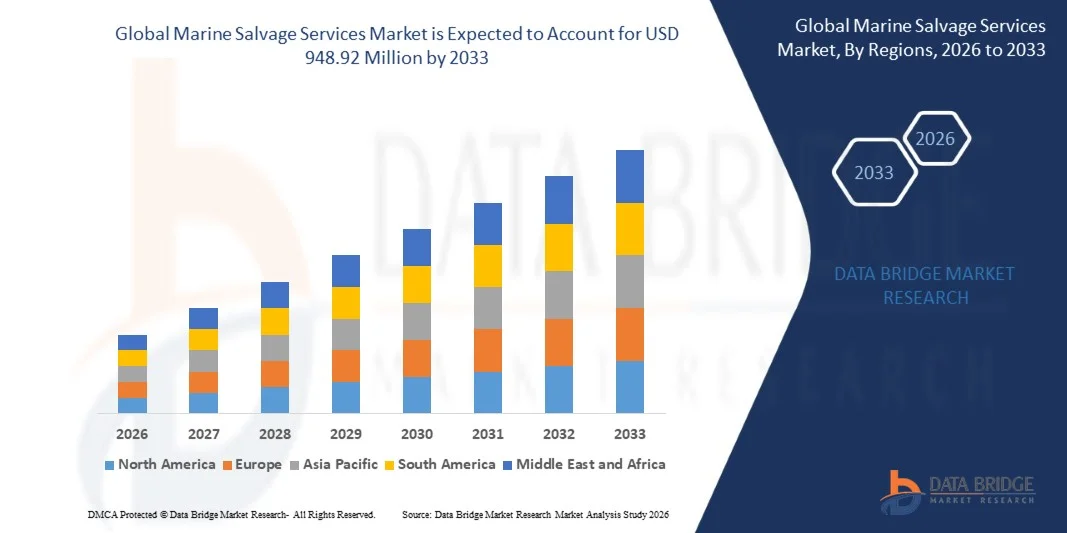
- Segundo a Data Bridge Market Research Analysis, o tamanho global dos serviços de salvamento marítimo foi avaliado emUSD 474,48 milhões em 2025e espera-se alcançar948,92 milhões de USD em 2033, em umaCAGR de 9,05%durante o período de previsão
- O crescimento do mercado é, em grande medida, alimentado pelo aumento do número de acidentes e naufrágios marítimos, pelo aumento das actividades comerciais e marítimas mundiais e por regulamentações ambientais mais rigorosas que exigem uma remoção segura dos navios encalhados
- A crescente demanda por operações de salvamento especializadas e adoção de tecnologia avançada na recuperação de destroços ainda apoia a expansão do mercado
Tamanho e previsão do mercado
- Valor de mercado global (2025):474,48 milhões de USD
- Valor de mercado previsto (2033):948,92 milhões de USD
- Previsões CAGR (2026-2033): 9.05%
O que são os principais takeaways do mercado de serviços de salvamento naval
- O mercado está a assistir a um crescimento constante devido ao aumento da sensibilização para a segurança marítima e a protecção do ambiente
- Aumento dos investimentos em infra-estruturas de salvamento e modernização de equipamentos estão a aumentar a eficiência operacional
- A América do Norte dominou o mercado de serviços de salvamento marítimo com a maior parcela de receita de 38,45% em 2025, impulsionada pela presença de uma grande frota de navegação comercial, regulamentos rigorosos de segurança marítima e aumento de investimentos em infraestrutura de salvamento avançado
- A região Ásia-Pacífico deverá testemunhar a maior taxa de crescimento no mundoServiços de salvamento marítimomercado, impulsionado pela rápida expansão do comércio marítimo, aumento das atividades de navegação, iniciativas de modernização portuária e aumento do foco regulatório na proteção ambiental e segurança marítima
- O segmento de Remoção de Danos detinha a maior quota de receita de mercado em 2025, impulsionada pelo crescente número de acidentes marítimos e naufrágios, assim como pela crescente ênfase na limpeza de rotas de navegação e minimização do impacto ambiental. As operações de remoção de destroços muitas vezes envolvem embarcações especializadas, equipamentos avançados e pessoal certificado, tornando-os um serviço crítico e de alta demanda entre os setores de navegação comercial e governamental
Relatório Âmbito e Serviços de Salvagem Marinha Segmentação do Mercado
|
Atributos |
Serviços de Salvagem Marinha Principais Insights do Mercado |
|
Segmentos Cobertos |
|
|
Países abrangidos |
América do Norte
Europa
Ásia- Pacífico
Médio Oriente e África
América do Sul
|
|
Jogadores do mercado chave |
|
|
Oportunidades de Mercado |
• Expansão das atividades de transporte offshore |
|
Informações sobre o Valor Adicionado |
Além dos insights de mercado, como valor de mercado, taxa de crescimento, segmentos de mercado, cobertura geográfica, atores de mercado e cenário de mercado, o relatório de mercado curado pela equipe de Pesquisa do Mercado da Ponte de Dados inclui análise de especialistas em profundidade, análise de importação/exportação, análise de preços, análise de consumo de produção e análise de pilão. |
Qual é a tendência chave no mercado de serviços de salvação marinha
“Demanda crescente para operações de resgate avançadas e conformidade ambiental”
• A crescente complexidade das operações marítimas e o aumento do tráfego marítimo global está moldando significativamente o mercado de serviços de salvamento marítimo, já que empresas e governos de navegação buscam soluções de recuperação eficientes, seguras e ambientalmente responsáveis. Os serviços de salvamento naval estão ganhando tração devido à sua capacidade de mitigar perdas financeiras, prevenir danos ambientais e restaurar a segurança de navegação. Essa tendência fortalece sua adoção em setores de navegação comercial, offshore e governo, incentivando os prestadores de serviços a investir em tecnologias avançadas e equipes especializadas
• O aumento da pressão regulamentar sobre a segurança marítima e a protecção do ambiente acelerou a procura de operações de salvamento profissionais. Autoridades e companhias de seguros exigem ativamente que os prestadores de salvamento certificados tratem de naufrágios, derrames de petróleo e navios encalhados, incentivando a colaboração entre prestadores de serviços e autoridades portuárias para melhorar a eficiência de resposta e padrões de conformidade
• As tendências de segurança e sustentabilidade estão influenciando as decisões operacionais, com empresas de navegação enfatizando procedimentos certificados, técnicas de recuperação ecológicas e estratégias de mitigação de riscos. Esses fatores estão ajudando os provedores de serviços a diferenciar ofertas em um mercado competitivo, ao mesmo tempo em que criam confiança com os clientes e impulsionam a adoção de tecnologias avançadas de monitoramento e salvamento
• Por exemplo, em 2024, Titan Salvage nos EUA e Smit Salvage na Holanda expandiram seus portfólios de serviços incorporando operações assistidas pela ROV e soluções de remoção de destroços ambientalmente seguras. Esses projetos foram executados em resposta aos crescentes requisitos regulamentares e de seguros, com operações que abrangem o transporte comercial, plataformas offshore e autoridades portuárias. Os serviços também foram promovidos como seguros, eficientes e compatíveis com o ambiente, aumentando a lealdade dos clientes e contratos a longo prazo
• Embora a procura de serviços de salvamento marítimo esteja a aumentar, a expansão sustentada do mercado depende do investimento contínuo em tecnologia, formação especializada e cumprimento das normas internacionais de segurança e ambiente. Os prestadores de serviços também estão focados em melhorar a escalabilidade operacional, reduzir o tempo de resposta e desenvolver soluções inovadoras para lidar com cenários de salvamento complexos de forma eficiente
Serviços de Salvagem Marinha Dinâmica do Mercado
Controlador
“Cuidar da segurança marítima e da conformidade ambiental”
• Aumentar o tráfego marítimo global, os acidentes marítimos e as actividades offshore é um dos principais motores do mercado dos serviços de salvamento marítimo. Empresas e governos estão investindo ativamente em operações de resgate profissional para minimizar o impacto ambiental e perda financeira, garantindo a segurança de navegação. Esta tendência está também a incentivar a investigação sobre novos equipamentos, tecnologia e protocolos operacionais, apoiando a diversificação dos serviços
• Expansão de aplicações na remoção de naufrágios, recuperação de derramamento de óleo, salvamento de plataformas offshore e operações de reboque de emergência estão influenciando o crescimento do mercado. Os serviços de salvamento marítimo ajudam a prevenir riscos ambientais, reduzir perdas econômicas e manter rotas de navegação, permitindo que os clientes atendam às expectativas regulatórias e operacionais. O número crescente de regulamentos marítimos internacionais reforça ainda mais esta tendência
• Os prestadores de serviços de salvação estão a promover activamente operações tecnologicamente avançadas através de ROVs, mapeamento de sonar e embarcações especializadas. Esses esforços são apoiados pelo aumento da demanda dos clientes por serviços rápidos, seguros e ambientalmente responsáveis, e também incentivam parcerias entre empresas de salvamento, empresas de seguros e autoridades portuárias para aumentar a eficiência operacional e conformidade
• Por exemplo, em 2023, Smit Salvage nos Países Baixos e Resolve Marine Group nos EUA relatou maior adoção de tecnologias avançadas de salvamento e operações compatíveis com o ambiente. Esta expansão seguiu o aumento do tráfego marítimo global e regulamentos marítimos mais rigorosos, conduzindo contratos repetidos e diferenciação operacional. Ambas as empresas também destacaram a segurança, rastreabilidade e proteção ambiental nas comunicações de clientes para fortalecer a confiança e parcerias de longo prazo
• Embora a crescente atividade marítima e as regulamentações ambientais apoiem o crescimento, a adoção mais ampla depende do investimento em equipamentos especializados, pessoal treinado e adesão a normas internacionais complexas. Melhorar a eficiência operacional, a capacidade de resposta rápida e a tecnologia avançada de monitoramento serão fundamentais para atender à demanda global e manter a vantagem competitiva
Restrição/Desafio
“Elevados custos operacionais e requisitos regulamentares complexos”
• O custo relativamente elevado das operações de salvamento marítimo, em comparação com os serviços de reboque ou reparação normalizados, continua a ser um desafio fundamental, limitando a adopção por parte das pequenas empresas marítimas. Altos custos de equipamentos, mão-de-obra e seguros contribuem para preços elevados. Além disso, o cumprimento das regulamentações marítimas internacionais e locais pode aumentar ainda mais a complexidade operacional e os custos
• A consciencialização e a disponibilidade de serviços de salvamento profissional certificados continuam a ser desiguais, em especial em regiões marítimas em desenvolvimento onde a aplicação da regulamentação é limitada. O conhecimento limitado dos procedimentos especializados de salvamento restringe a adoção em determinadas rotas de navegação ou operações offshore. Isto conduz igualmente a um crescimento mais lento do mercado nas regiões que carecem de quadros de segurança marítima estabelecidos
• Desafios logísticos e ambientais também impactam o crescimento do mercado, uma vez que operações de resgate requerem embarcações especializadas, pessoal treinado e estrita adesão às normas de segurança e ambiental. Locais remotos, condições meteorológicas imprevisíveis e condições complexas de destruição aumentam os riscos operacionais e os custos. As empresas devem investir em planejamento, monitoramento e coordenação avançados para manter a confiabilidade dos serviços
• Por exemplo, em 2024, os operadores de salvamento no Sudeste Asiático que lidam com embarcações offshore e incidentes de plataformas offshore relataram custos mais elevados e atrasos operacionais devido a regulamentações ambientais rigorosas e infraestrutura local limitada. Locais remotos, disponibilidade de equipamentos certificados e mão-de-obra especializada foram barreiras adicionais. Estes factores também levaram algumas companhias de navegação a atrasar as operações de salvamento, afectando as receitas do mercado
• Superar estes desafios exigirá investimentos em tecnologias eficientes em termos de custos, infra-estruturas regionais e programas de formação especializados. A colaboração com companhias de seguros, autoridades governamentais e operadores portuários pode ajudar a desbloquear o potencial de crescimento a longo prazo do mercado global de serviços de salvamento marítimo. Além disso, melhorar a eficiência operacional e o cumprimento das normas ambientais será essencial para uma adopção mais ampla
Como é segmentado o mercado de serviços de salvação naval
O mercado é segmentado com base em serviços e no utilizador final.
• Por Serviços
Com base em serviços, o mercado de serviços de salvamento marítimo é segmentado em remoção de destroços, salvamento geral, resposta de emergência, controle de poluição e recuperação de carga. O segmento de Remoção de Danos detinha a maior quota de receita de mercado em 2025, impulsionada pelo crescente número de acidentes marítimos e naufrágios, assim como pela crescente ênfase na limpeza de rotas de navegação e minimização do impacto ambiental. As operações de remoção de destroços muitas vezes envolvem embarcações especializadas, equipamentos avançados e pessoal certificado, tornando-os um serviço crítico e de alta demanda entre os setores de navegação comercial e governamental.
Espera-se que o segmento de Resposta de Emergência testemunhe a taxa de crescimento mais rápida de 2026 para 2033, impulsionada pelo aumento do tráfego marítimo global e pela necessidade de intervenção rápida durante os acidentes marítimos. Os serviços de resposta às emergências são particularmente valorizados pela sua capacidade de prestar assistência imediata, prevenir riscos ambientais e reduzir as perdas financeiras, muitas vezes operando sob cenários de alta pressão que exigem rápida mobilização e coordenação de especialistas.
• Pelo utilizador final
Com base no utilizador final, o mercado de serviços de salvamento marítimo está segmentado em proprietários de navios privados, companhias de seguros, agências governamentais e companhias de navegação. O segmento Shipping Companies detinha o maior market share em 2025, impulsionado pelo alto volume de operações marítimas comerciais e pela necessidade de salvaguardar ativos, cumprir com as normas de segurança e manter rotas comerciais ininterruptas.
Espera-se que o segmento Companhias de Seguros testemunhe a taxa de crescimento mais rápida de 2026 para 2033, alimentada pelo aumento das reivindicações relacionadas a acidentes marítimos e crescente dependência de serviços de resgate profissional para minimizar a exposição financeira. As operações de salvamento apoiadas por seguros são cada vez mais coordenadas com fornecedores certificados para garantir a mitigação dos riscos, a conformidade ambiental e a recuperação eficiente dos ativos.
Qual é a região que detém a maior parte do mercado de serviços de salvamento naval
• A América do Norte dominou o mercado de serviços de salvamento marítimo com a maior quota de receita de 38,45% em 2025, impulsionada pela presença de uma grande frota de navegação comercial, regulamentos rigorosos de segurança marítima e aumento de investimentos em infraestrutura de salvamento avançada
• As partes interessadas na região valorizam as capacidades de resposta rápida, conformidade ambiental e implantação avançada de tecnologia, incluindo operações assistidas pela ROV e embarcações de salvamento especializadas
• Esta adopção generalizada é ainda apoiada por quadros regulamentares fortes, elevado tráfego marítimo e pela ênfase crescente na minimização do impacto ambiental, estabelecendo os serviços de salvamento marítimo como um requisito crítico para as operações privadas e comerciais
U.S. Marine Salvage Services Market Insight
O mercado de serviços de salvamento marítimo dos EUA captou a maior parte de receita em 2025 na América do Norte, alimentada pelas extensas operações de navegação do país, portos movimentados e regulamentos ambientais rigorosos. Os proprietários de navios e as companhias de seguros estão cada vez mais confiando em provedores de resgate profissionais para lidar com emergências, remoção de destroços e controle de poluição. A crescente integração de tecnologias avançadas de salvamento, tais como mapeamento de sonar e veículos operados à distância, aumenta ainda mais a eficiência operacional. Além disso, a colaboração entre empresas de salvamento, agências governamentais e operadores privados está fortalecendo a adoção de serviços e impulsionando o crescimento do mercado.
Europe Marine Salvage Services Market Insight
Espera-se que o mercado europeu de serviços de salvamento marítimo testemunhe a taxa de crescimento mais rápida de 2026 para 2033, impulsionada principalmente pelo aumento do tráfego marítimo, por políticas ambientais rigorosas e por investimentos crescentes em segurança portuária e preparação para emergências. Os países europeus sublinham a rápida resposta aos acidentes e às operações de salvamento ambientalmente responsáveis. O mercado está crescendo através da navegação comercial, plataformas offshore e iniciativas marítimas lideradas pelo governo, com serviços de salvamento cada vez mais integrados em programas de segurança portuária e costeira.
U.K. Marine Salvage Services Market Insight
Espera-se que o mercado de serviços de salvamento marítimo do Reino Unido testemunhe a taxa de crescimento mais rápida de 2026 para 2033, impulsionada pelo aumento da atividade de navegação, pelo aumento da conscientização da conformidade ambiental e pela adoção de tecnologias avançadas de salvamento. As preocupações com os acidentes marítimos e os riscos ambientais estão incentivando os proprietários de navios privados, companhias de navegação e agências governamentais a garantir contratos de resgate profissional. A infraestrutura marítima bem desenvolvida do país e o quadro regulatório robusto apoiam a rápida resposta e operações de recuperação especializadas.
Alemanha Marine Salvage Services Market Insight
Espera-se que o mercado de serviços de salvamento marítimo da Alemanha testemunhe a taxa de crescimento mais rápida de 2026 para 2033, alimentada pelo alto tráfego marítimo no Mar do Norte e nos portos do Báltico, adoção tecnológica avançada e ênfase crescente na segurança ambiental. As fortes regulamentações marítimas da Alemanha, combinadas com o seu foco na inovação e nas operações sustentáveis, estão a promover a utilização de serviços de salvamento profissional, em especial para plataformas offshore e rotas de navegação comercial. Equipamento avançado e pessoal qualificado são cada vez mais implantados para garantir uma recuperação segura e eficiente.
Asia-Pacific Marine Salvage Services Market Insight
Espera-se que o mercado de serviços de salvamento marinho Ásia-Pacífico testemunhe a taxa de crescimento mais rápida de 2026 para 2033, impulsionada pelo aumento do comércio marítimo, urbanização rápida em cidades portuárias e crescente consciência do cumprimento ambiental. Países como China, Japão e Índia estão investindo em serviços de salvamento profissional para mitigar riscos de acidentes, naufrágios e poluição. A região também está emergindo como um centro de fabricação de equipamentos de salvamento, melhorando a disponibilidade de serviços e reduzindo os custos operacionais, ampliando assim a adoção em setores de navegação privada e comercial.
Japão Marine Salvage Services Market Insight
Espera-se que o mercado japonês de serviços de salvamento marítimo testemunhe a taxa de crescimento mais rápida de 2026 para 2033 devido ao alto tráfego marítimo do país, foco na proteção ambiental e infraestrutura tecnológica avançada. As operações de salvamento são cada vez mais integradas com protocolos de segurança portuária, recuperação de plataformas offshore e planejamento de resposta de emergência. A antiga infraestrutura de transporte marítimo do Japão e a forte supervisão do governo também devem estimular a demanda por serviços de salvamento eficientes, orientados para a tecnologia e compatíveis com o ambiente.
China Marine Salvage Services Market Insight
O mercado de serviços de salvamento marítimo da China representou a maior quota de receita de mercado na Ásia-Pacífico em 2025, atribuída à expansão da frota de navegação do país, desenvolvimento rápido dos portos e exigências regulatórias crescentes. A China está investindo fortemente em operações de salvamento profissional para lidar com naufrágios, recuperação de carga e controle de poluição. O crescimento de portos inteligentes, a adoção de embarcações de salvamento avançadas e a disponibilidade de serviços eficientes em termos de custos são fatores fundamentais que impulsionam a expansão do mercado tanto nas operações de navegação comercial como offshore.
Quais são as Principais Empresas no Mercado de Serviços de Salvagem Marinha
A indústria de serviços de salvação naval é liderada principalmente por empresas bem estabelecidas, incluindo:
- Grupo de Soluções Marinhas Africanas (Pty) Ltd (AMSOL) (África do Sul)
- Boluda Towage & Salvage SL (Espanha)
- CPT Reboque (África do Sul)
- Detek Offshore Technology Ltd. (U.K.)
- Donjon Marine Co., Inc. (EUA)
- Fratelli Neri S.p.A. (Itália)
- Hongkong Salvage & Towage Services Ltd (Hong Kong)
- T&T Salvage LLC (EUA)
- SMIT Salvage BV (Países Baixos)
- chttps://unitedsalvage.com.au/
- Ocean Infinity Group Limited (U.K.)
Quais são as últimas evoluções no Mercado de Serviços de Salvagem Marinha
- Em Fevereiro de 2024, a Boluda Towage & Salvage SL concluiu a aquisição da Resolve Salvage and Fire (Gibraltar), uma operadora de reboque que operava em ambos os lados do Estreito de Gibraltar. Esta aquisição estratégica visa ampliar a pegada internacional de Boluda Towage e fortalecer suas capacidades operacionais em corredores marítimos de alto tráfego. A integração reforça a presença da empresa no Estreito de Gibraltar, uma porta de entrada crítica entre o Oceano Atlântico e o Mar Mediterrâneo. Além disso, a aquisição apoia um acesso mais amplo às principais rotas comerciais globais ligadas através do Canal de Suez e do Mar Vermelho ao Oceano Índico. Espera-se que esse desenvolvimento melhore a disponibilidade de serviços, a eficiência de resposta e o posicionamento competitivo no mercado global de serviços de salvamento e reboque marítimo.
SKU-
Obtenha acesso online ao relatório sobre a primeira nuvem de inteligência de mercado do mundo

- Painel interativo de análise de dados
- Painel de análise da empresa para oportunidades de elevado potencial de crescimento
- Acesso de analista de pesquisa para personalização e customização. consultas
- Análise da concorrência com painel interativo
- Últimas notícias, atualizações e atualizações Análise de tendências
- Aproveite o poder da análise de benchmark para um rastreio abrangente da concorrência
Metodologia de Investigação
A recolha de dados e a análise do ano base são feitas através de módulos de recolha de dados com amostras grandes. A etapa inclui a obtenção de informações de mercado ou dados relacionados através de diversas fontes e estratégias. Inclui examinar e planear antecipadamente todos os dados adquiridos no passado. Da mesma forma, envolve o exame de inconsistências de informação observadas em diferentes fontes de informação. Os dados de mercado são analisados e estimados utilizando modelos estatísticos e coerentes de mercado. Além disso, a análise da quota de mercado e a análise das principais tendências são os principais fatores de sucesso no relatório de mercado. Para saber mais, solicite uma chamada de analista ou abra a sua consulta.
A principal metodologia de investigação utilizada pela equipa de investigação do DBMR é a triangulação de dados que envolve a mineração de dados, a análise do impacto das variáveis de dados no mercado e a validação primária (especialista do setor). Os modelos de dados incluem grelha de posicionamento de fornecedores, análise da linha de tempo do mercado, visão geral e guia de mercado, grelha de posicionamento da empresa, análise de patentes, análise de preços, análise da quota de mercado da empresa, normas de medição, análise global versus regional e de participação dos fornecedores. Para saber mais sobre a metodologia de investigação, faça uma consulta para falar com os nossos especialistas do setor.
Personalização disponível
A Data Bridge Market Research é líder em investigação formativa avançada. Orgulhamo-nos de servir os nossos clientes novos e existentes com dados e análises que correspondem e atendem aos seus objetivos. O relatório pode ser personalizado para incluir análise de tendências de preços de marcas-alvo, compreensão do mercado para países adicionais (solicite a lista de países), dados de resultados de ensaios clínicos, revisão de literatura, mercado remodelado e análise de base de produtos . A análise de mercado dos concorrentes-alvo pode ser analisada desde análises baseadas em tecnologia até estratégias de carteira de mercado. Podemos adicionar quantos concorrentes necessitar de dados no formato e estilo de dados que procura. A nossa equipa de analistas também pode fornecer dados em tabelas dinâmicas de ficheiros Excel em bruto (livro de factos) ou pode ajudá-lo a criar apresentações a partir dos conjuntos de dados disponíveis no relatório.











