


Global Metalworking Fluid Additives Market, By Additive Type (Surfactant Additives and Emulsifiers, Corrosion Inhibitors, Extreme Pressure Additives, Stabilizers, Antifoamers, Alkanolamines, Antimist Agents, Colorants/Dyes, and Others), Application (Soluble Oils, Straight Oils, Semisynthetic Fluids, and Synthetic Fluids), Metalworking Activity (Milling, Drilling, Grinding, Honing, Tapping, and Others), End Use (Automotive, Aerospace, Machinery and Equipment Manufacturing, Power and Energy, Marine, and Others) - Industry Trends and Forecast to 2030.
Análise e Insights do Mercado de Aditivos Fluidos Metalúrgicos
A expansão dos setores automotivo, aeroespacial e de máquinas é o fator chave para a expansão do mercado. A escalada dos padrões de qualidade e a crescente integração da automação nas indústrias são fundamentais para promover oportunidades de crescimento do mercado.
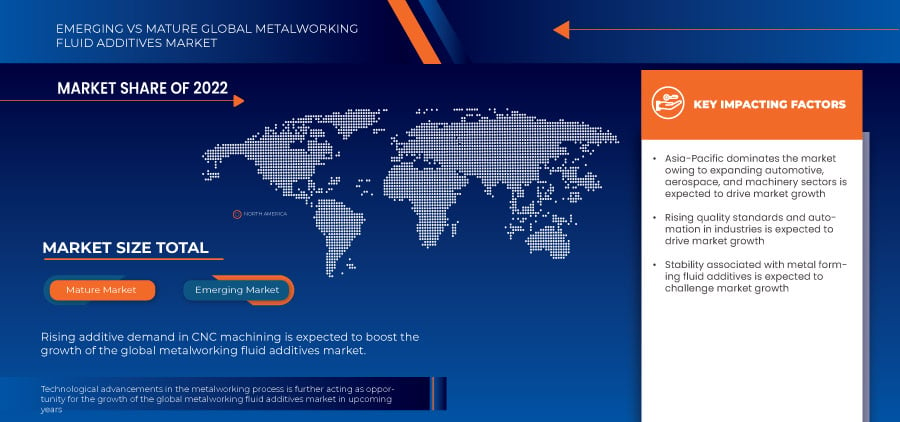
A crescente adoção de usinagem a seco em todas as indústrias serve como uma restrição notável que afeta o mercado. Além disso, as flutuações dos preços das matérias-primas e da disponibilidade representam um desafio substancial para o crescimento do mercado. A mudança para aditivos ecológicos parece ser uma oportunidade crescente que tem potencial para levar ao crescimento do mercado. A regulamentação ambiental e os fatores de sustentabilidade têm surgido como desafios significativos que impactam a trajetória de crescimento do mercado.
O relatório global de mercado de aditivos fluídos de metalurgia fornece detalhes de market share, novos desenvolvimentos e análise de pipeline de produtos, o impacto de atores de mercado nacionais e localizados, analisa oportunidades em termos de bolsas de receita emergentes, mudanças na regulamentação de mercado, aprovações de produtos, decisões estratégicas, lançamentos de produtos, expansões geográficas e inovações tecnológicas no mercado. Para entender a análise e o cenário de mercado entre em contato conosco para um Analyst Brief, nossa equipe irá ajudá-lo a criar uma solução de impacto de receita para alcançar seu objetivo desejado.
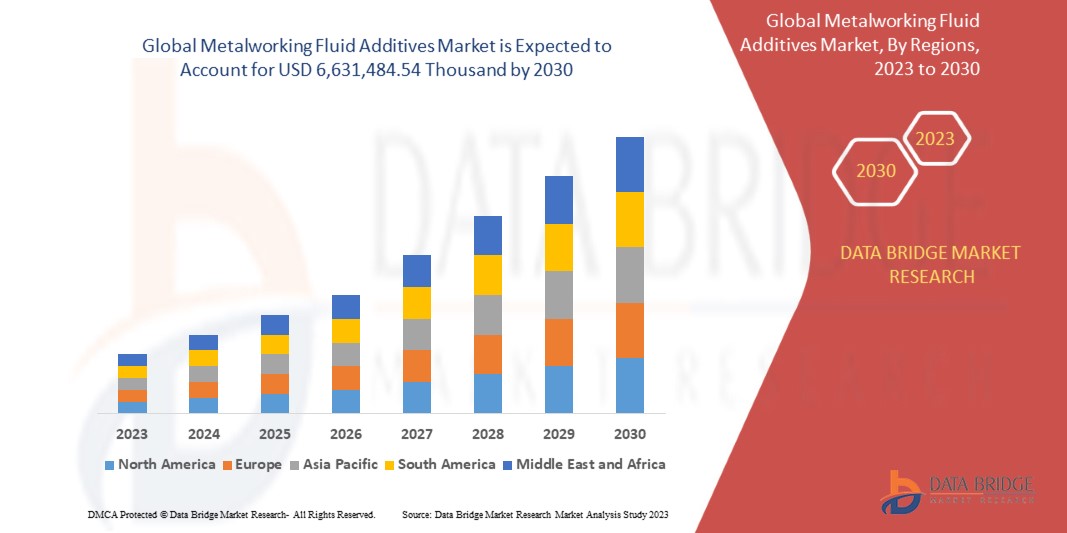
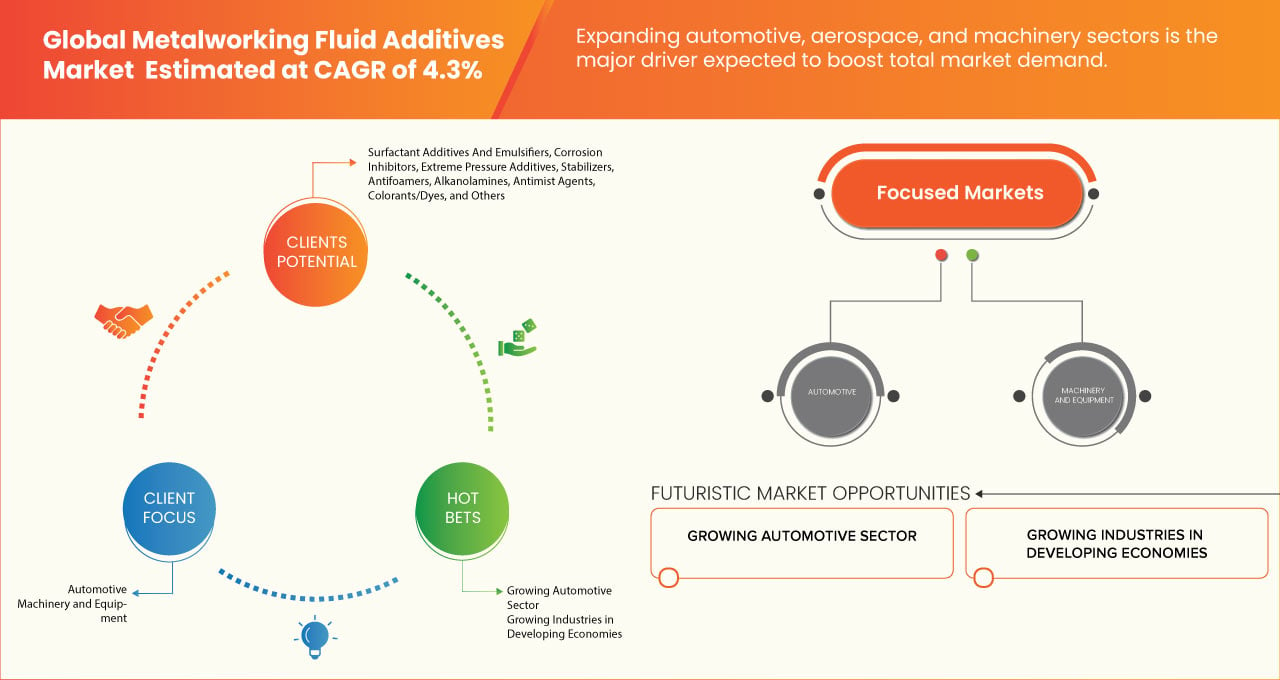
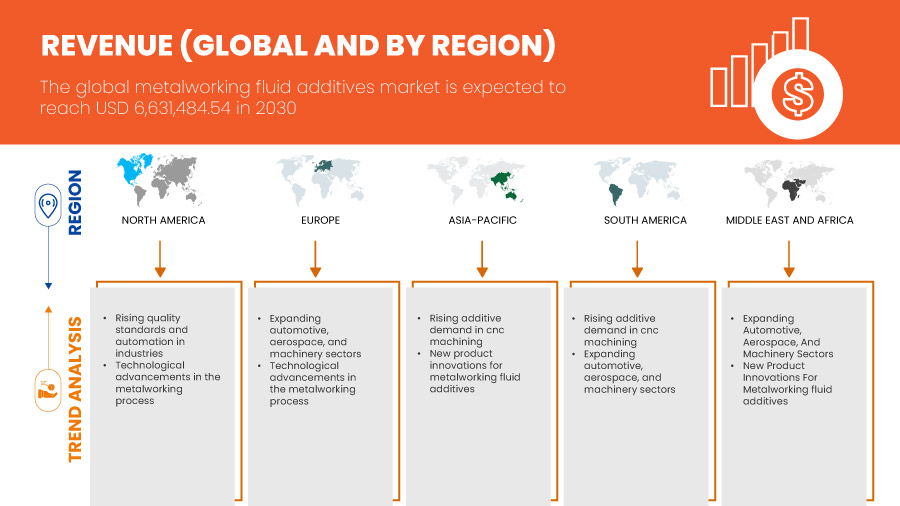
Espera-se que o mercado global de aditivos de fluidos para metalurgia aumente o mercado no período previsto de 2023 a 2030. Data Bridge Market Research analisa que o mercado está crescendo em um CAGR de 4,3% no período de previsão de 2023 a 2030 e espera-se atingir US$ 6.631.484 mil até 2030. A crescente demanda aditiva na usinagem CNC são alguns dos fatores motores esperados para impulsionar o crescimento do mercado.
|
Metric de Relatório |
Detalhes |
|
Período de previsão |
2023 a 2030 |
|
Ano de base |
2022 |
|
Anos Históricos |
2021 (personalizável até 2015-2020) |
|
Unidades quantitativas |
Receitas em milhares de dólares |
|
Segmentos Cobertos |
Tipo de aditivo (Aditivos e Emulsificantes desurfactante,Inibidores da corrosão, Aditivos de Pressão Extrema, Estabilizadores, Antiespumantes, Alcanolaminas, Agentes Antimistas, Colorantes/Dyes e Outros), Aplicação (Óleos Sólidos, Óleos Heteros, Fluidos Semissintéticos e Fluidos Sintéticos), Atividade de Metalurgia (Milling, Perfuração, Moagem, Honing, Tapping, e Outros), Uso Final (Automotivo, Aeroespacial, Fabricação de Máquinas e Equipamentos, Energia, Marinha e Outros) |
|
Países abrangidos |
EUA, Canadá, México, Alemanha, França, Espanha, Reino Unido, Itália, Rússia, Bélgica, Holanda, Turquia, Suécia, Suíça, Dinamarca, Noruega, Finlândia, resto da Europa, China, Índia, Japão, Coreia do Sul, Cingapura, Austrália, Taiwan, Tailândia, Indonésia, Malásia, Hong Kong, Nova Zelândia, Filipinas, resto da Ásia-Pacífico, Brasil, Argentina, resto da América do Sul, Arábia Saudita, Egito, África do Sul, Catar, U.A.E., Israel, Omã, Kuwait, Bahrein e resto do Oriente Médio e África |
|
Jogadores de mercado cobertos |
A Lubrizol Corporation, Dow, Evonik Industries AG, FUCHS, Solvay, LANXESS, BP p.l.c., CLARIANT, Ingevity e suas entidades afins, Ashland, Italmatch Chemicals S.p.A., Kao Corporation, Umicore, Colonial Chemical, Biosynthetic Technologies, DOVER CHEMICAL CORPORATION, Emery Oleochemicals, Pilot Chemical Corp., R.T. Vanderbilt Holding Company, Inc. e ZSCHIMMER & SCHWARZ, INC. |
Definição do mercado
Os aditivos líquidos de metalurgia (PFPE) são um fluido sintético fluorado de baixo peso molecular. Os aditivos de fluido metalúrgico não são tóxicos e não inflamáveis em seu estado natural. É utilizado em temperaturas graves que variam de 80°C a 200°C. A estrutura molecular da PFPE pode ser linear, ramificada ou uma combinação de ambos, dependendo da aplicação. Resistência à temperatura, lubricidade, resistência ao desgaste e volatilidade de fluidos são todos fornecidos pela PFPE.
Global Metalworking Fluid Additives Market Dynamics
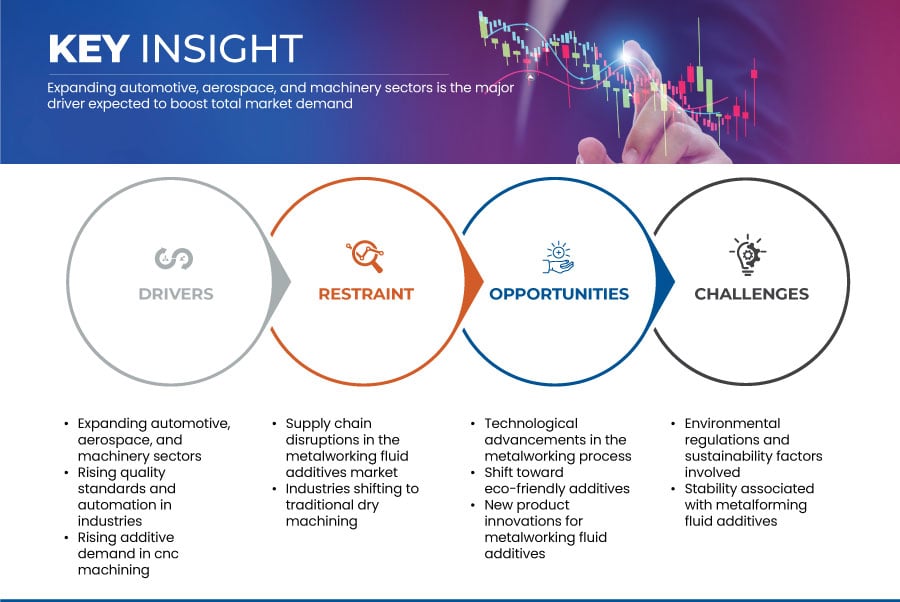
Controladores
- Expandindo Setores Automotivo, Aeroespacial e Maquinaria
No mercado global, a demanda por aditivos de fluidos metalúrgicos está sendo impulsionada pelo rápido crescimento e expansão de importantes setores da indústria, incluindo o automotivo, aeroespacial e máquinas. Estas indústrias representam a indústria transformadora moderna no seu conjunto, empurrando continuamente as fronteiras da inovação e do desenvolvimento técnico.
O setor automóvel, que é um pilar de economias em todo o mundo, está constantemente procurando maneiras de aumentar o desempenho, segurança e eficiência dos veículos. Para produzir componentes de precisão, esta atividade requer procedimentos de usinagem complexos. Os aditivos fluídos de metalurgia desempenham um papel crucial para garantir operações suaves e permitir a produção de peças automotivas de alta qualidade, oferecendo lubrificação, resfriamento e remoção de chips.
- Aumento de padrões de qualidade e automação nas indústrias
A escalada dos padrões de qualidade e a crescente integração da automação nas indústrias são fundamentais para promover oportunidades de crescimento do mercado. Esses dois fatores, em conjunto, iniciaram uma mudança de paradigma nas práticas de fabricação e estão reformulando a dinâmica da demanda por aditivos de fluidos metalúrgicos. Os elevados padrões de qualidade tornaram-se fundamentais nos processos de fabrico modernos. As indústrias estão sob pressão para manter precisão, consistência e aderência a especificações rigorosas para garantir integridade e desempenho do produto. Os aditivos fluídos de metalurgia desempenham um papel fundamental na consecução destes objectivos. Os aditivos que melhoram as propriedades de lubrificação, resfriamento e anticorrosão tornaram-se imperativos para otimizar processos de usinagem, melhorar a longevidade da ferramenta e alcançar acabamentos de produtos superiores. A procura de aditivos de fluidos avançados para metalurgia deverá aumentar à medida que as indústrias se esforçam por satisfazer ou exceder estes parâmetros de referência de qualidade, o que resulta em aumentar o crescimento do mercado.
Oportunidades
- Avanços tecnológicos no processo de metalurgia
Os avanços tecnológicos surgiram como um motor fundamental para o crescimento do mercado. Estes desenvolvimentos tecnológicos influenciaram significativamente a formulação, aplicação e desempenho de aditivos de fluidos metalúrgicos, criando uma série de oportunidades de expansão do mercado.
Uma área chave do avanço tecnológico é o refinamento das formulações aditivas. Os fabricantes estão alavancando a pesquisa de ponta e a inovação para desenvolver aditivos que oferecem propriedades de lubrificação superior, proteção contra corrosão e resfriamento. Tais aditivos projetados com precisão melhoram os processos de usinagem, melhoram a vida útil da ferramenta e contribuem para produtos acabados de alta qualidade. Este nível de otimização de desempenho cria uma proposta de valor convincente para os usuários finais, impulsionando a demanda por aditivos de fluidos metalúrgicos. Além disso, os avanços nananotecnologiaabriram novas vias para aumentar a eficiência dos aditivos de fluidos de metalurgia. Nanopartículas, devido às suas propriedades únicas, podem conferir maior lubrificação, transferência de calor e características anti-desgaste a fluidos metalúrgicos.
- Mudança para os aditivos eco-amigáveis
O mercado está passando por uma mudança transformadora impulsionada pela crescente ênfase na sustentabilidade ambiental. À medida que as indústrias em todo o espectro se esforçam para reduzir sua pegada ecológica, a adoção de aditivos eco-friendly dentro de processos de metalworking tem emergido como um motor fundamental moldando a trajetória do mercado.
A paisagem tradicional de aditivos líquidos metalúrgicos tem sido dominada por formulações que contêm compostos à base de petróleo e aditivos com potenciais riscos para a saúde e o ambiente. No entanto, a crescente sensibilização para estes perigos, aliada a regulamentações rigorosas e crescentes demandas dos consumidores por produtos sustentáveis, introduziu uma mudança de paradigma para alternativas mais ambientalmente responsáveis.
Restrições/Desafios
- Indústrias que mudam para a tradicional usinagem a seco
A crescente adoção de usinagem a seco em todas as indústrias serve como uma restrição notável que afeta o mercado. A usinagem a seco, uma técnica onde pouco ou nenhum refrigerante ou lubrificante é utilizado durante o processo de usinagem, ganhou tração devido ao seu potencial para custos reduzidos, benefícios ambientais e melhores condições de trabalho. Essa transição não é sem seus desafios, e seu impacto reverbera através do mercado.
Um dos principais fatores que levam a mudança para usinagem a seco é a economia de custos potencial. Os fluidos tradicionais de metalurgia, juntamente com os aditivos associados, requerem esforços de aquisição, manutenção e eliminação. A usinagem a seco elimina esses custos, tornando-se uma opção atraente para indústrias conscientes do custo. Além disso, a usinagem a seco reduz a geração de resíduos, simplificando a eliminação de resíduos e contribuindo para um processo de fabricação mais magro.
- Flutuação em preços de matérias-primas
Esse fator, intrincadamente ligado à dinâmica econômica, geopolítica e da cadeia de suprimentos, impacta diretamente os custos de produção, os preços e a estabilidade global do mercado. Os aditivos de fluidos para trabalhar metais são formulados utilizando uma combinação de matérias-primas-chave, incluindo óleos de base, embalagens de aditivos que abrangem agentes de pressão extrema, compostos anti-desgaste, agentes antiespumosos, inibidores da corrosão, eprodutos químicos especiaistais como emulsionantes,Biocidas, esolventes.
Esses componentes aumentam coletivamente a lubrificação, o resfriamento, a resistência à corrosão e o desempenho global de fluidos de trabalho de metal, impactando crucialmente os processos de usinagem. A composição da formulação é adaptada a aplicações específicas e requisitos de usinagem, tornando-a uma solução versátil para uma gama de operações de metalurgia. A partir disso, podemos inferir que as matérias-primas, como óleos de base, aditivos e produtos químicos especializados, constituem uma parcela significativa da estrutura de custo para aditivos de fluidos metalúrgicos. A susceptibilidade do mercado às flutuações de preços dessas matérias-primas é resultado de fatores como tensões geopolíticas, mudanças na dinâmica oferta-demanda e rupturas nas rotas comerciais globais. Mudanças rápidas nos preços podem levar a aumentos de custos imprevisíveis para os fabricantes, exercendo pressão sobre as margens de lucro. Tal volatilidade não só aumenta as incertezas operacionais, como também dificulta a capacidade de oferecer preços competitivos aos utilizadores finais.
- Regulamentos ambientais e fatores de sustentabilidade envolvidos
A regulamentação ambiental e os fatores de sustentabilidade têm surgido como desafios significativos que impactam a trajetória de crescimento do mercado. Esses fatores decorrem de um crescente foco global na redução da pegada ambiental de processos industriais e alinhamento com práticas sustentáveis.
Este desafio de conformidade regulamentar pode impedir o crescimento do mercado, aumentando a margem de entrada e aumentando as complexidades operacionais. Além disso, o imperativo de sustentabilidade está forçando as indústrias a adotar práticas mais ecológicas, impactando na escolha de aditivos de fluidos metalúrgicos. Os utilizadores finais estão agora a exigir aditivos ecológicos que se alinham aos seus objectivos de sustentabilidade. A biodegradabilidade, a toxicidade reduzida e a fonte renovável estão se tornando critérios fundamentais na seleção de aditivos. Essa mudança representa um desafio para os fabricantes reformularem seus produtos, muitas vezes necessitando de investimentos substanciais em pesquisa e desenvolvimento. Equilibrar o desempenho com a sustentabilidade aumenta ainda mais a complexidade, diminuindo potencialmente a expansão do mercado à medida que os fabricantes trabalham para atender essas novas demandas.
Em conclusão, regulamentos ambientais e fatores de sustentabilidade apresentam desafios intrincados para o mercado. A evolução do panorama regulatório, a necessidade de se alinhar com os objetivos de sustentabilidade, a demanda por embalagens ecológicas e o surgimento de conceitos de economia circular desafiam coletivamente os fabricantes em termos de conformidade, formulação, custo e inovação. A navegação bem sucedida destes desafios exigirá uma adaptação estratégica e uma concentração nas soluções ambientalmente responsáveis, que deverão desafiar o crescimento do mercado.
Evolução recente
- Em agosto de 2023, Boecore selecionou Colorado Springs para expansão, impulsionada pela experiência em segurança cibernética. Os incentivos ao crescimento e o ecossistema aeroespacial reforçam o apelo de Colorado em meio a considerações de Huntsville, Alabama, e Weber County, Utah
- Em julho de 2023, Godrej Aerospace desempenhou um papel crucial nas missões espaciais da Índia, fornecendo componentes para Chandrayaan-3. A expertise da empresa mostra seu compromisso com o avanço aeroespacial e a inovação, apoiando tanto a exploração espacial quanto as indústrias de aviação comercial
- Em junho de 2023, segundo a BBC, a OPEP controla quase 40% do suprimento mundial de reservas de petróleo. Para além da anterior redução da produção em Abril de 2003, a Arábia Saudita e outros produtores de petróleo da OPEP+ anunciaram novos cortes na produção de petróleo de cerca de 1,16 milhões de barris por dia. A OPEP pode afectar o abastecimento mundial de petróleo e, consequentemente, influenciar os preços do petróleo e do gás em todo o mundo, o que irá afectar em última análise o custo dos produtos que utilizam o petróleo bruto como matéria-prima
- Em julho de 2023, de acordo com um artigo publicado pela LNG, a Agência Europeia de Produtos Químicos está propondo um período de transição de sete anos para parafina clorada de cadeia média e outras substâncias contendo cloroalcanos com comprimentos de cadeia de carbono C14 a C17. A restrição visa avaliar os riscos potenciais para a saúde humana ou o ambiente decorrentes do fabrico, utilização ou comércio destas substâncias. Parafina clorada de cadeia média é usada em fluidos de metalurgia como agente de pressão extrema para operações difíceis, protegendo ferramentas e componentes de atrito, desgaste e superaquecimento em altas velocidades e pressões
Global Metalworking Fluid Aditives Market Scope
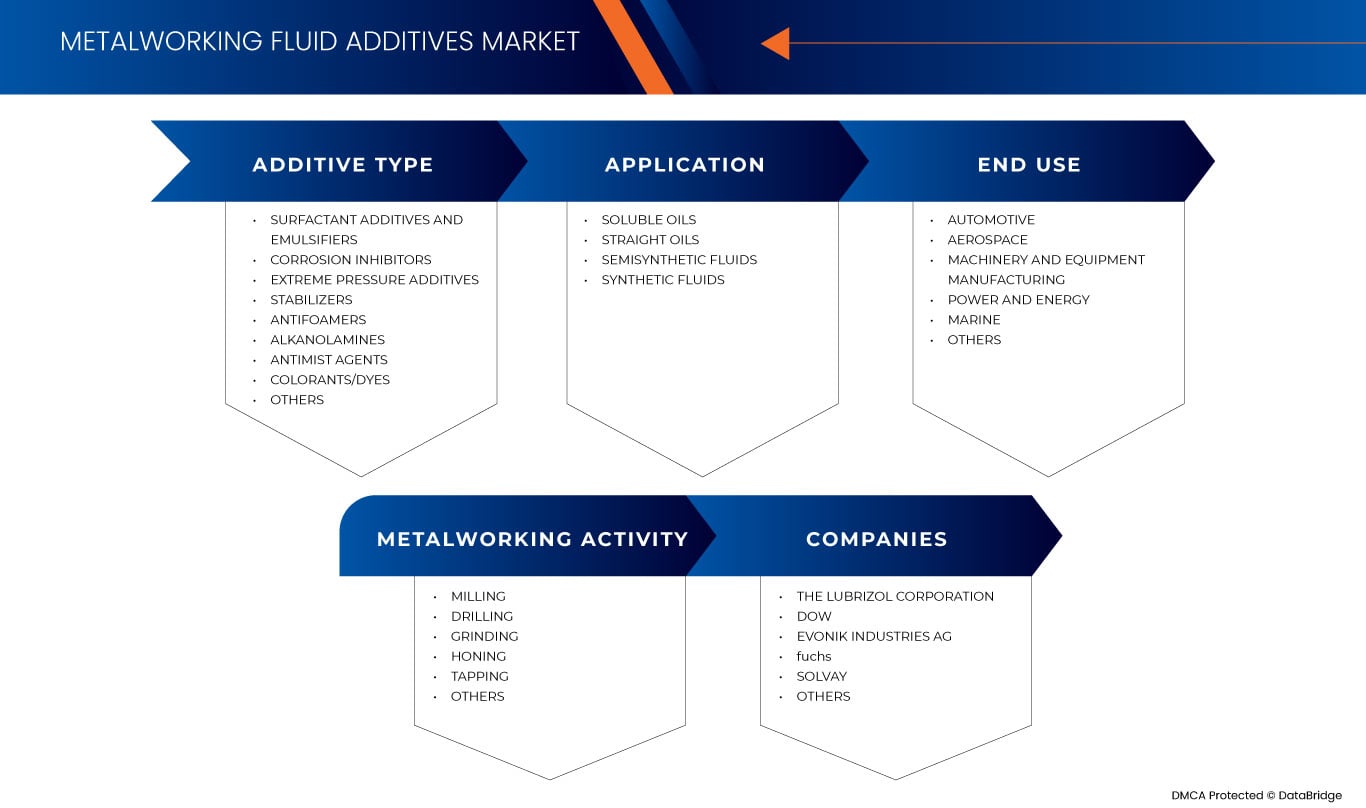
O mercado global de aditivos líquidos metalúrgicos é segmentado em quatro segmentos notáveis com base no tipo de aditivo, aplicação, atividade de metalúrgico e uso final. O crescimento entre segmentos ajuda você a analisar nichos de crescimento e estratégias para se aproximar do mercado e determinar suas áreas de aplicação principais e a diferença em seus mercados-alvo.
Tipo de aditivo
- Aditivos e Emulsionantes Surfactantes
- Inibidores da corrosão
- Aditivos de extrema pressão
- Estabilizadores
- Antiespuma
- Alcanolaminas
- Agentes antimistas
- Corantes/dyes
- Outros
Com base no tipo aditivo, o mercado é segmentado em aditivos surfactantes e emulsionantes, inibidores de corrosão, aditivos de extrema pressão, estabilizadores, antiespumantes, alcanolaminas, agentes antimistas, corantes/dyes, entre outros.
Aplicação
- Óleos Solúvel
- Óleos retos
- Fluidos semissintéticos
- Fluidos sintéticos
Com base na aplicação, o mercado é segmentado em óleos solúveis, óleos retos, fluidos semissintéticos e fluidos sintéticos.
Actividade de Metalurgia
- Moagem
- Perfuração
- Moagem
- Honing
- Tapping
- Outros
Com base na atividade de metalurgia, o mercado é segmentado em moagem, perfuração, moagem, brunimento, tapagem, entre outros.
Uso Final
- Automóvel
- Aeroespaço
- Fabricação de máquinas e equipamentos
- Energia e Energia
- Marinho
- Outros
Com base no uso final, o mercado é segmentado em automotiva, aeroespacial, fabricação de máquinas e equipamentos, energia e energia, marinha, entre outros.
Análise Regional do Mercado de Aditivos Fluidos Metalúrgicos Global
O mercado global de aditivos de fluidos metalúrgicos é analisado e as informações de tamanho do mercado são fornecidas pelo tipo aditivo, aplicação, atividade metalúrgica e uso final como referenciado acima.
Os países abrangidos neste relatório de mercado são os EUA, Canadá, México, Alemanha, França, Espanha, Reino Unido, Itália, Rússia, Bélgica, Holanda, Turquia, Suécia, Suíça, Dinamarca, Noruega, Finlândia, resto da Europa, China, Índia, Japão, Coreia do Sul, Singapura, Austrália, Taiwan, Tailândia, Indonésia, Malásia, Hong Kong, Nova Zelândia, Filipinas, resto da Ásia-Pacífico, Brasil, Argentina, resto da América do Sul, Arábia Saudita, Egito, África do Sul, Catar, U.A.E., Israel, Omã, Kuwait, Bahrein e resto do Oriente Médio e África.
Espera-se que a região Ásia-Pacífico domine o mercado devido à rápida industrialização e forte demanda por manufatura na região. A China é o país em crescimento mais rápido nesta região tem forte base industrial, setor de fabricação robusto e alta demanda por fluidos de metalurgia. Os EUA na América do Norte são o país que mais cresce nesta região devido ao seu rápido crescimento da indústria transformadora, expansão do setor automotivo e aumento das atividades de metalurgia. A Alemanha na Europa domina este mercado devido à sua infra-estrutura de fabrico bem estabelecida, à adopção de tecnologias avançadas.
A secção «país» do relatório também fornece factores individuais de impacto no mercado e alterações da regulamentação no mercado nacional que afectam as tendências actuais e futuras do mercado. Pontos de dados como novas vendas, vendas de substituição, dados demográficos dos países, atos regulatórios e tarifas de importação-exportação são alguns dos principais indicadores usados para prever o cenário de mercado para cada país. Além disso, a presença e disponibilidade de marcas globais e seus desafios enfrentados devido à grande ou escassa concorrência de marcas locais e nacionais, e o impacto dos canais de vendas são considerados ao fornecer análise de previsão dos dados do país.
Paisagem Competitiva e Análise Global de Aditivos Fluidos para Metalúrgicos
O cenário competitivo do mercado global de aditivos fluídos para metalurgia fornece detalhes dos concorrentes. Detalhes incluídos são visão geral da empresa, finanças da empresa, receita gerada, potencial de mercado, investimento em pesquisa e desenvolvimento, novas iniciativas de mercado, presença global, locais de produção e instalações, pontos fortes e fracos da empresa, lançamento de produtos, ensaios clínicos pipelines, análise de marca, aprovações de produtos, patentes, largura do produto e respiração, dominância de aplicação, curva de linha de vida tecnológica. Os dados acima apresentados estão relacionados apenas com o foco da empresa relacionado com o mercado.
Os principais intervenientes abrangidos neste relatório são The Lubrizol Corporation, Dow, Evonik Industries AG, FUCHS, Solvay, LANXESS, BP p.l.c., CLARIANT, Ingevity e suas entidades afins, Ashland, Italmatch Chemicals S.p.A., Kao Corporation, Umicore, Colonial Chemical, Biosynthetic Technologies, DOVER CHIMICAL CORPORATION, Emery Oleochemicals, Pilot Chemical Corp., R.T. Vanderbilt Holding Company, Inc., e ZSCHIMMER & SCHWARZ, INC., entre outros.
SKU-
Obtenha acesso online ao relatório sobre a primeira nuvem de inteligência de mercado do mundo

- Painel interativo de análise de dados
- Painel de análise da empresa para oportunidades de elevado potencial de crescimento
- Acesso de analista de pesquisa para personalização e customização. consultas
- Análise da concorrência com painel interativo
- Últimas notícias, atualizações e atualizações Análise de tendências
- Aproveite o poder da análise de benchmark para um rastreio abrangente da concorrência
Índice
1 INTRODUÇÃO
1.1 OBJECTIVOS DO ESTUDO
1.2 DEFINIÇÃO DE MERCADO
1.3 VISÃO GERAL DO MERCADO DE ADITIVOS DE MATERIAIS GLOBAIS
1.4 LIMITAÇÕES
1.5 MERCADOS ABRANGADOS
2 SEGMENTAÇÃO DO MERCADO
2.1 MERCADOS COBERTOS
2.2 ÂMBITO GEOGRÁFICO
2.3 ANOS CONSIDERADOS PARA O ESTUDO
2.4 MOEDA E PREÇOS
2.5 MODELO DE VALIDAÇÃO DE DADOS TRIPOD DBRR
2.6 MODELIZAÇÃO MULTIVARIADA
2.7 INTERVENÇÕES PRIMÁRIAS COM OPINIÇÕES-CHAVE
2.8 GRIDE DE POSIÇÃO DO MERCADO DA DBRR
2.9 Utilização final do mercado
2.1 FONTES SEGUNDARES
2.11 ASSUNTOS
3 RESUMO
4 INSIGHTS PRÉMIO
5 VISÃO GERAL DO MERCADO
5. 1 CONDUTORES
5.1.1 Expandindo Setores Automotivos, AEROSPACE E MACHINERIA
5.1.2 NORMAS DE QUALIDADE E AUTOMAÇÃO DAS INDÚSTRIAS
5.1.3 RISING DEMANDA ADITIVA EM MÁQUINA CNC
5.2 RESTRUÇÕES
5.2.1 DIVULGAÇÕES DE CHAIN NO MERCADO DE ADITIVOS DE FUNCIONAMENTO DE METAIS
5.2.2 INDÚSTRIAS QUE SE REFEREM À MÁQUINA TRADICIONAL DE Secas
5.2.3 FLUTUAÇÃO EM PREÇOS MATERIAIS RAW
5.3 OPORTUNIDADES
5.3.1 Avançamentos tecnológicos no processo de tratamento de metais
5.3.2 ADITIVOS ECONÓMICOS
5.3.3 NOVAS INOVAÇÕES DE PRODUTO PARA OS ADITIVOS DE FLUÍDOS DE METALHO
5.4 DESAFIOS
5.4.1 REGULAMENTOS AMBIENTAIS E FATORES DE SUSTENTABILIDADE ENVOLVIDOS
5.4.2 ESTABILIDADE ASSOCIADA AOS ADITIVOS FLUÍDOS DE METALFORMAÇÃO
6 ANÁLISE GEOGRÁFICA
6.1 GLOBAL
6.2 EUROPA
6. 3 ÁSIA PACIFIC
6.4 AMÉRICA DO NORTE
6.5 MÉDIO ORIENTE E ÁFRICA
6.6 AMÉRICA DO SUL
7 MERCADO DE ADITIVOS DE METAIS GLOBAIS: PAÍSES DA EMPRESA
7.1 ANÁLISE PARTICIPAL
7.2 ANÁLISE PARTICIPAL DA EMPRESA: EUROPA
7.3 ANÁLISE PARTICIPAL DA EMPRESA: ÁSIA-PACÍFICO
7.4 ANÁLISE DA COMPANHIA: AMÉRICA DO NORTE
7.5 PARCERIAS & CONTRATOS
7.6 EVENTO
7.7 PRÉMIO
8 ANÁLISE SWOT
9 PROFISSÕES DAS SOCIEDADES
9.1 A CORPORAÇÃO LUBRIZOL
9.1.1 EMPRESA SNAPSHOT
9.1.2 ANÁLISE PARTICIPAL
9.1.3 PRODUTO PORTFÓLIO
9.1.4 DESENVOLVIMENTO RECENTE
9.2 INDÚSTRIAS EVÓNICAS AG
9.2.1 EMPRESA SNAPSHOT
9.2.2 ANÁLISE DAS RECEITAS
9.2.3 ANÁLISE PARTICIPAL
9.2.4 PRODUTO PORTFÓLIO
9.2.5 DESENVOLVIMENTO RECENTE
9.3 DOW
9.3.1 EMPRESA SNAPSHOT
ANÁLISE DAS RECEITAS
9.3.3 ANÁLISE PARTICIPAL
9.3.4 PRODUTO PORTFÓLIO
9.3.5 DESENVOLVIMENTO RECENTE
9.4 FUCHS
9.4.1 EMPRESA SNAPSHOT
9.4.2 ANÁLISE DE RECEITAS
9.4.3 ANÁLISE PARTICIPAL
9.4.4 PRODUTO PORTFÓLIO
9.4.5 DESENVOLVIMENTO RECENTE
9.5 SOLVAY
9.5.1 EMPRESA SNAPSHOT
ANÁLISE DAS RECEITAS
9.5.3 ANÁLISE PARTICIPAL
9.5.4 PRODUTO PORTFOLIO
9.5.5 DESENVOLVIMENTO RECENTE
9.6 ASHLAND
9.6.1 EMPRESA SNAPSHOT
ANÁLISE DAS RECEITAS
9.6.3 PRODUTO PORTFOLIO
9.6.4 DESENVOLVIMENTO RECENTE
9.7 Tecnologias biossintéticas
9.7.1 EMPRESA SNAPSHOT
9.7.2 PRODUTO PORTFÓLIO
9.7.3 EVOLUÇÃO RECENTE
9,8 BP P.L.C.
9.8.1 EMPRESA SNAPSHOT
ANÁLISE DAS RECEITAS
9.8.3 PRODUTO PORTFÓLIO
9.8.4 DESENVOLVIMENTO RECENTE
9.9 CLARIANTE
9.9.1 EMPRESA SNAPSHOT
ANÁLISE DAS RECEITAS
9.9.3 PRODUTO PORTFÓLIO
9.9.4 EVOLUÇÃO RECENTE
9.1 QUÍMICA COLONIAL
9.10.1 EMPRESA SNAPSHOT
9.10.2 PRODUTO PORTFÓLIO
9.10.3 DESENVOLVIMENTO RECENTE
9.11 CORPORAÇÃO QUÍMICA DA DURA
9.11.1 EMPRESA SNAPSHOT
9.11.2 PRODUTO PORTFÓLIO
9.11.3 DESENVOLVIMENTO RECENTE
9.12 OLEOQUÉMICAS EMERGENTES
9.12.1 EMPRESA SNAPSHOT
9.12.2 PRODUTO PORTFÓLIO
9.12.3 DESENVOLVIMENTO RECENTE
9.13 INGEVIDADE E SUAS ENTIDADES RELACIONADAS
9.13.1 EMPRESA SNAPSHOT
ANÁLISE DE RECEITAS
9.13.3 PRODUTO PORTFÓLIO
9.13.4 DESENVOLVIMENTO RECENTE
9.14 PRODUTOS QUÍMICOS DE ESTALMAGEM S.P.A
9.14.1 EMPRESA SNAPSHOT
ANÁLISE DE RECEITAS
9.14.3 PRODUTO PORTFÓLIO
9.14.4 DESENVOLVIMENTO RECENTE
9.15 CORPORAÇÃO KAO
9.15.1 EMPRESA SNAPSHOT
ANÁLISE DE RECEITAS
9.15.3 PRODUTO PORTFÓLIO
9.15.4 DESENVOLVIMENTO RECENTE
9.16 LANXESS
9.16.1 EMPRESA SNAPSHOT
ANÁLISE DAS RECEITAS
9.16.3 PRODUTO PORTFOLIO
9.16.4 DESENVOLVIMENTO RECENTE
9.17 QUÍMICA DO PILOTO
9.17.1 EMPRESA SNAPSHOT
9.17.2 PRODUTO PORTFÓLIO
9.17.3 DESENVOLVIMENTO RECENTE
9.18 R.T. Vanderbilt Holding Company, Inc.
9.18.1 EMPRESA SNAPSHOT
9.18.2 PRODUTO PORTFÓLIO
9.18.3 DESENVOLVIMENTO RECENTE
9.19 UMICORE
9.19.1 EMPRESA SNAPSHOT
ANÁLISE DE RECEITAS
9.19.3 PRODUTO PORTFÓLIO
9.19.4 DESENVOLVIMENTO RECENTE
9,2 ZSCHIMM ER & SCHWARZ, INC.
9.20.1 EMPRESA SNAPSHOT
9.20.2 PRODUTO PORTFÓLIO
9.20.3 DESENVOLVIMENTO RECENTE
10 QUESTIONÁRIO
11 RELATÓRIOS RELACIONADOS
Lista de Figura
FIGURA 1 MERCADO DE ADITIVOS FLUÍDOS DE METAIS GLOBAIS: SEGMENTAÇÃO
FIGURA 2 MERCADO DE ADITIVOS DE METAIS GLOBAIS: TRIANGULAÇÃO DE DADOS
FIGURA 3 MERCADO DE ADITIVOS FLUÍDOS DE METAIS GLOBAIS: ANÁLISE DROC
FIGURA 4 MERCADO DE ADITIVOS FLUÍDOS DE METAIS GLOBAIS: ANÁLISE DO MERCADO REGIONAL VS
FIGURA 5 MERCADO DE ADITIVOS EM MATÉRIA DE METAIS GLOBAIS: ANÁLISE DE INVESTIGAÇÃO DA EMPRESA
FIGURA 6 MERCADO DE ADITIVOS DE METAIS GLOBAIS: DEMOGRÁFICOS DE ENTREVISTA
FIGURA 7 MERCADO DE ADITIVOS DE MATÉRIA DE METAIS GLOBAIS: GRIDE DE POSIÇÃO DO MERCADO DA DBRM
FIGURA 8 MERCADO DE ADITIVOS DE MATERIAL DE TRABALHADORES DE METAIS GLOBAIS:
FIGURA 9 MERCADO DE ADITIVOS DE METAIS GLOBAIS: SEGMENTAÇÃO
FIGURA 10 REFORÇADA PARA A INDÚSTRIA DE PHARMA CONDUTA O CRESCIMENTO DO MERCADO DE ADITIVOS FLUÍDOS PARA O METÁLCOLO GLOBAL NO PERÍODO PREVISTO
FIGURA 11 O SEGMENTO DE ADITIVOS SURFACTORES E EMULSIFICADORES ESPERA-SE EM CONTA PARA A PARTICIPAÇÃO MAIS LARGESTA DO MERCADO DE ADITIVOS EM MATÉRIA DE METAIS GLOBAIS EM 2023 E 2030
FIGURA 12 DIRECTORES, RESTRUMENTOS, OPORTUNIDADES E DESAFIOS DO MERCADO DE ADITIVOS DE METAIS GLOBAIS
FIGURA 13 MERCADO DE ADITIVOS DE METAIS GLOBAIS: SNAPSHOT (2022)
FIGURA 14 MERCADO DE ADITIVOS EM MATÉRIA DE METALHO DA EUROPA: SNAPSHOT (2022)
FIGURA 15 ASIA PACIFIC METALKING FLUID ADDITIVOS MERCADO: SNAPSHOT (2022)
FIGURA 16 MERCADO DE ADITIVOS FLUÍDOS DE TRABALHADORES DE AMÉRICA DO NORTE: SNAPSHOT (2022)
FIGURA 17 MÉDIO ORIENTE E MERCADO DE ADITIVOS DE METALHO DE ÁFRICA: SNAPSHOT (2022)
FIGURA 18 MERCADO DE ADITIVOS FLUÍDOS DA AMÉRICA DO SUL: SNAPSHOT (2022)
FIGURA 19 MERCADO DE ADITIVOS EM MATÉRIA DE METAIS GLOBAIS: COMPANHIA COMPARTILHE 2022 (%)
FIGURA 20 EUROPE METALKING FLUID ADDITIVES MERCADO: COMPANHIA PARTICIPAÇÃO 2022 (%)
FIGURA 21 MERCADO DE ADITIVOS EM MATÉRIA DE TRABALHADORES DE PAÍSES DA ÁSIA: COMPANHIA COMPARTILHE 2022 (%)
FIGURA 22 MERCADO DE ADITIVOS EM MATÉRIA DE AMÉRICA DO NORTE

Metodologia de Investigação
A recolha de dados e a análise do ano base são feitas através de módulos de recolha de dados com amostras grandes. A etapa inclui a obtenção de informações de mercado ou dados relacionados através de diversas fontes e estratégias. Inclui examinar e planear antecipadamente todos os dados adquiridos no passado. Da mesma forma, envolve o exame de inconsistências de informação observadas em diferentes fontes de informação. Os dados de mercado são analisados e estimados utilizando modelos estatísticos e coerentes de mercado. Além disso, a análise da quota de mercado e a análise das principais tendências são os principais fatores de sucesso no relatório de mercado. Para saber mais, solicite uma chamada de analista ou abra a sua consulta.
A principal metodologia de investigação utilizada pela equipa de investigação do DBMR é a triangulação de dados que envolve a mineração de dados, a análise do impacto das variáveis de dados no mercado e a validação primária (especialista do setor). Os modelos de dados incluem grelha de posicionamento de fornecedores, análise da linha de tempo do mercado, visão geral e guia de mercado, grelha de posicionamento da empresa, análise de patentes, análise de preços, análise da quota de mercado da empresa, normas de medição, análise global versus regional e de participação dos fornecedores. Para saber mais sobre a metodologia de investigação, faça uma consulta para falar com os nossos especialistas do setor.
Personalização disponível
A Data Bridge Market Research é líder em investigação formativa avançada. Orgulhamo-nos de servir os nossos clientes novos e existentes com dados e análises que correspondem e atendem aos seus objetivos. O relatório pode ser personalizado para incluir análise de tendências de preços de marcas-alvo, compreensão do mercado para países adicionais (solicite a lista de países), dados de resultados de ensaios clínicos, revisão de literatura, mercado remodelado e análise de base de produtos . A análise de mercado dos concorrentes-alvo pode ser analisada desde análises baseadas em tecnologia até estratégias de carteira de mercado. Podemos adicionar quantos concorrentes necessitar de dados no formato e estilo de dados que procura. A nossa equipa de analistas também pode fornecer dados em tabelas dinâmicas de ficheiros Excel em bruto (livro de factos) ou pode ajudá-lo a criar apresentações a partir dos conjuntos de dados disponíveis no relatório.











