


Global Oil and Gas Separation Equipment Market, By Product (Two Phase Separator, Three Phase Separator, Degasser, Scrubber, Deliqulizer, Heat Treaters, Others), Technology (Gravitational Separation, Centrifugal Separation, Others), Application (Onshore, Offshore, Refineries, Others), Vessel Type (Horizontal, Vertical, Spherical) – Industry Trends and Forecast to 2030.
Oil and Gas Separation Equipment Market Analysis and Size
Two fundamental substances—oil and gas—come from the same source, which is frequently referred to as fuel or crude oil. The equipment used to separate gas and liquids from their raw forms, such as high-pressure containers or oppression kettles, is referred to as oil and gas separation equipment.
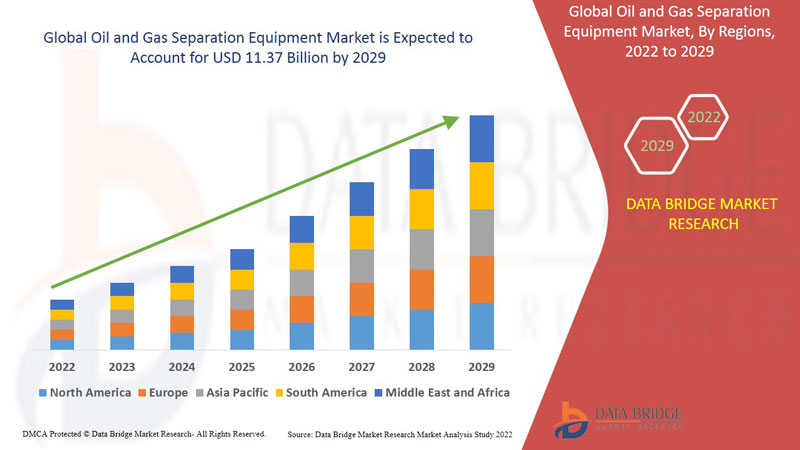
Data Bridge Market Research analyzes that the global oil and gas separation equipment market, which was USD 8.24 billion in 2022, would rocket up to USD 11.90 billion by 2030, and is expected to undergo a CAGR of 4.7% during the forecast period. “Three phase separator” dominates the product segment of the market in terms of ideal pressure and liquid sealing. This separation device provides additional benefits over two-phase separators.
In addition to the insights on market scenarios such as market value, growth rate, segmentation, geographical coverage, and major players, the market reports curated by the Data Bridge Market Research also include in-depth expert analysis, geographically represented company-wise production and capacity, network layouts of distributors and partners, detailed and updated price trend analysis and deficit analysis of supply chain and demand.
Oil and Gas Separation Equipment Market Scope and Segmentation
|
Report Metric |
Details |
|
Forecast Period |
2023 to 2030 |
|
Base Year |
2023 |
|
Historic Years |
2021 (Customizable to 2015-2020) |
|
Quantitative Units |
Revenue in USD Million, Volumes in Units, Pricing in USD |
|
Segments Covered |
By Product (Two Phase Separator, Three Phase Separator, Degasser, Scrubber, Deliqulizer, Heat Treaters, Others), Technology (Gravitational Separation, Centrifugal Separation, Others), Application (Onshore, Offshore, Refineries, Others), Vessel Type (Horizontal, Vertical, Spherical) |
|
Countries Covered |
U.S., Canada, Mexico, Brazil, Argentina, Rest of South America, Germany, France, Italy, U.K., Belgium, Spain, Russia, Turkey, Netherlands, Switzerland, Rest of Europe, Japan, China, India, South Korea, Australia, Singapore, Malaysia, Thailand, Indonesia, Philippines, Rest of Asia-Pacific, U.A.E., Saudi Arabia, Egypt, South Africa, Israel, and Rest of Middle East and Africa |
|
Market Players Covered |
ALFA LAVAL (Sweden), AMACS (U.S.), Worthington Industries, Inc. (U.S.), Honeywell International Inc. (U.S.), ACS Manufacturing Inc. (U.S.), Godrej Process Equipment (India), HAT International Ltd. (U.K.), ATLAS Oil & Gas Process Systems Inc. (Canada), SNC-Lavalin Group (Canada), FENIX PROCESS TECHNOLOGIES PVT LTD (India), eProcess Technologies (Australia), Pentair (U.S.), GEA Group Aktiengesellschaft (Germany), Enviro Technologies, Inc. (India), TechnipFMC plc (U.K.), ANDRITZ (Australia), Prosep, Inc. (U.S.), NOV Inc. (U.S.), Frames Group (Netherlands), Halliburton Energy Services, Inc. (U.S.), and SLB (U.S.) among others |
|
Market Opportunities |
|
Market Definition
To fulfil the enormous demand for oil and gas, oil companies are concentrating on improving the well's total production efficiency. Gas, oil, water, sluggish fluid, muck, and other particles can be found in extracted hydrocarbon. Before using them, these particles must be separated. Oil and gas are largely separated from the entire fluid stream generated by a well using pressure vessels. The major separation section, baffles, oil settling and water drain sections, oil, water, and gas outputs, and mist extractor are all included in the separator. Since oil and gas must be stored separately, oil and gas separation is crucial for effective oil and gas transportation and storage.
Global Oil and Gas Separation Equipment Market Dynamics
Drivers
- Exploration and production are increasing, and there has been a significant investment in refining
The installation of additional Group Gathering Stations (GGS) at the sites is necessary due to the growth in the number of wells at new fields and deepwater explorations. So, to separate hydrocarbons before their storage or transit, more separators are needed. Oil firms are investing in new projects and extending their current ones in ways that will benefit the market for oil and gas separation equipment. The U.A.E., Saudi Arabia, Iran, Iraq, and Qatar, among other oil-rich nations, are some of the major hydrocarbon producers in the Middle East and Africa. Leading oil and gas producers like Saudi Aramco regularly spend on exploration and production projects. These factors are expected to accelerate the market growth.
- Demand for refining capacity is growing, and industrialization is accelerating.
The greatest amount of crude oil intended to flow into a refinery's distillation unit is referred to as the crude unit or the refinery's capacity. The demand for gasoline is growing as the number of cars on the road rises. Demand for polymer products and other hydrocarbon derivative products is also rising. Refineries are more necessary as industry spreads quickly around the world. The need for refinery capacity is rising as a result of these causes. The refinery businesses are making investments and increasing their refineries' capacity. This will propel the market growth.
Opportunity
- Technological advancements to handle the intricate processing setbacks
The development of technology, the rise in the demand for oil and gas separation equipment to meet growing market demand, and an increase in market R&D efforts extend profitable opportunities to the market players during the forecast period of 2023 to 2030. In addition, concentrating on developing innovative technology for the creation of gas hydrates will further expand the future market growth.
Restraint/Challenge
- Strict guidelines for the reuse and disposal of generated water
On-site processing of formation fluids is required due to strict laws governing the disposal and reuse of generated water for various uses. Increasing the TDS concentration of generated water might have negative environmental effects as well. Therefore, it is becoming increasingly necessary for oil and gas producers to properly treat formation fluids prior to disposal or reuse of the waste stream. This is anticipated to support market expansion during the anticipated time frame.
The global oil and gas separation equipment market report provides details of new recent developments, trade regulations, import-export analysis, production analysis, value chain optimization, market share, impact of domestic and localized market players, analyses opportunities in terms of emerging revenue pockets, changes in market regulations, strategic market growth analysis, market size, category market growths, application niches and dominance, product approvals, product launches, geographic expansions, technological innovations in the market. To gain more info on this market, contact Data Bridge Market Research for an Analyst Brief. Our team will help you make an informed market decision to achieve market growth.
Recent Development
- In January 2022, for its Floating Production Unit (FPU) in offshore Western Australia, Woodside, acting as the operator on behalf of Scarborough Joint Venture, won a contract with McDermott International for engineering, procurement, construction, installation, and commissioning (EPCIC) services. Design, manufacturing, gas separation, transportation, and other services are all included in the integrated scope
- In January 2021, at the Keskesi East-1 well, in Block 58, off the Suriname Coast, Total and Apache Corporation said that they had found a substantial new offshore oil and gas discovery. This is in line with earlier findings at Maka Central, Sapakara West, and Kwaskwasi
Global Oil and Gas Separation Equipment Market Scope
The global oil and gas separation equipment market is segmented into four notable segments based on product, technology, application, and vessel type. The growth amongst these segments will help you analyze meager growth segments in the industries and provide the users with a valuable market overview and market insights to help them make strategic decisions for identifying core market applications.
Product
- Two Phase Separator
- Three Phase Separator
- Degasser
- Scrubber
- Deliqulizer
- Heat Treaters
- Others
Technology
- Gravitational Separation
- Centrifugal Separation
- Others
Application
- Onshore
- Offshore
- Refineries
- Others
Vessel Type
- Horizontal
- Vertical
- Spherical
Global Oil and Gas Separation Equipment Market Regional Analysis/Insights
The global oil and gas separation equipment market is analyzed and market size insights and trends are provided by country, product, technology, application, and vessel type as referenced above.
The countries covered in this market report are U.S., Canada, Mexico, Brazil, Argentina, Rest of South America, Germany, France, Italy, U.K., Belgium, Spain, Russia, Turkey, Netherlands, Switzerland, Rest of Europe, Japan, China, India, South Korea, Australia, Singapore, Malaysia, Thailand, Indonesia, Philippines, Rest of Asia-Pacific, U.A.E, Saudi Arabia, Egypt, South Africa, Israel, and Rest of Middle East and Africa.
North America dominates the market in terms of market share and market revenue and will continue to flourish its dominance during the forecast period of 2023-2030. This is due to the region's shifting focus toward shale gas development and rising gas output.
The country section of the report also provides individual market impacting factors and changes in regulation in the market domestically that impacts the current and future trends of the market. Data points like down-stream and upstream value chain analysis, technical trends and porter's five forces analysis, case studies are some of the pointers used to forecast the market scenario for individual countries. Also, the presence and availability of global brands and their challenges faced due to large or scarce competition from local and domestic brands, impact of domestic tariffs and trade routes are considered while providing forecast analysis of the country data.
Competitive Landscape and Oil and Gas Separation Equipment Market Share Analysis
The global oil and gas separation equipment market competitive landscape provides details of competitors. Details included are company overview, company financials, revenue generated, market potential, investment in research and development, new market initiatives, global presence, production sites and facilities, production capacities, company strengths and weaknesses, product launch, product width and breadth, application dominance. The above data points provided are only related to the companies' focus related to the market.
Some of the major players operating in the global oil and gas separation equipment market are:
- ALFA LAVAL (Sweden)
- AMACS (U.S.)
- Worthington Industries, Inc. (U.S.)
- Honeywell International Inc. (U.S.)
- ACS Manufacturing Inc. (U.S.)
- Godrej Process Equipment (India)
- HAT International Ltd. (U.K.)
- ATLAS Oil & Gas Process Systems Inc. (Canada)
- SNC-Lavalin Group (Canada)
- FENIX PROCESS TECHNOLOGIES PVT LTD (India)
- eProcess Technologies (Australia)
- Pentair (U.S.)
- GEA Group Aktiengesellschaft (Germany)
- Enviro Technologies, Inc. (India)
- TechnipFMC plc (U.K.)
- ANDRITZ (Australia)
- Prosep, Inc. (U.S.)
- NOV Inc. (U.S.)
- Frames Group (Netherlands)
- Halliburton Energy Services, Inc. (U.S.)
- SLB (U.S.)
SKU-
Obtenha acesso online ao relatório sobre a primeira nuvem de inteligência de mercado do mundo

- Painel interativo de análise de dados
- Painel de análise da empresa para oportunidades de elevado potencial de crescimento
- Acesso de analista de pesquisa para personalização e customização. consultas
- Análise da concorrência com painel interativo
- Últimas notícias, atualizações e atualizações Análise de tendências
- Aproveite o poder da análise de benchmark para um rastreio abrangente da concorrência
Metodologia de Investigação
A recolha de dados e a análise do ano base são feitas através de módulos de recolha de dados com amostras grandes. A etapa inclui a obtenção de informações de mercado ou dados relacionados através de diversas fontes e estratégias. Inclui examinar e planear antecipadamente todos os dados adquiridos no passado. Da mesma forma, envolve o exame de inconsistências de informação observadas em diferentes fontes de informação. Os dados de mercado são analisados e estimados utilizando modelos estatísticos e coerentes de mercado. Além disso, a análise da quota de mercado e a análise das principais tendências são os principais fatores de sucesso no relatório de mercado. Para saber mais, solicite uma chamada de analista ou abra a sua consulta.
A principal metodologia de investigação utilizada pela equipa de investigação do DBMR é a triangulação de dados que envolve a mineração de dados, a análise do impacto das variáveis de dados no mercado e a validação primária (especialista do setor). Os modelos de dados incluem grelha de posicionamento de fornecedores, análise da linha de tempo do mercado, visão geral e guia de mercado, grelha de posicionamento da empresa, análise de patentes, análise de preços, análise da quota de mercado da empresa, normas de medição, análise global versus regional e de participação dos fornecedores. Para saber mais sobre a metodologia de investigação, faça uma consulta para falar com os nossos especialistas do setor.
Personalização disponível
A Data Bridge Market Research é líder em investigação formativa avançada. Orgulhamo-nos de servir os nossos clientes novos e existentes com dados e análises que correspondem e atendem aos seus objetivos. O relatório pode ser personalizado para incluir análise de tendências de preços de marcas-alvo, compreensão do mercado para países adicionais (solicite a lista de países), dados de resultados de ensaios clínicos, revisão de literatura, mercado remodelado e análise de base de produtos . A análise de mercado dos concorrentes-alvo pode ser analisada desde análises baseadas em tecnologia até estratégias de carteira de mercado. Podemos adicionar quantos concorrentes necessitar de dados no formato e estilo de dados que procura. A nossa equipa de analistas também pode fornecer dados em tabelas dinâmicas de ficheiros Excel em bruto (livro de factos) ou pode ajudá-lo a criar apresentações a partir dos conjuntos de dados disponíveis no relatório.











