



Global Packaged Water Treatment Market, By Technology Type (Extended Aeration, Moving Bed Biofilm Reactor, Membrane Bioreactor, Sequential Batch Reactor, Reverse Osmosis, Other Technologies), Application (Municipal Waste water, Industrial Waste water, Drinking Water) – Industry Trends and Forecast to 2029
Packaged Water Treatment Market Analysis and Size
With a growing global population and pollution levels, demand for potable water is increasing at an exponential rate. Water bodies, which have traditionally served as traditional sources of drinking water for individuals, are also being impacted by alarming rates of ecological burden. Water treatment systems are reasonably priced to ensure that they are accessible to people from all economic backgrounds.
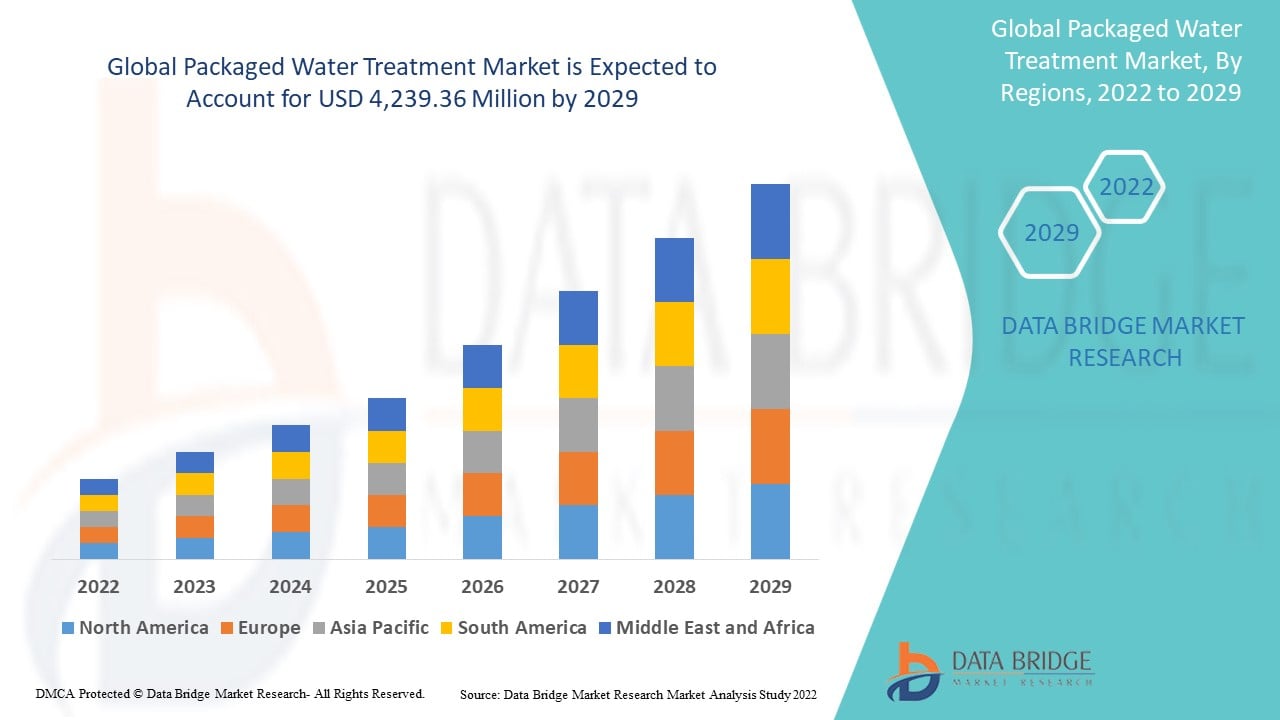
Global packaged water treatment market was valued at USD 2,783.40 million in 2021 and is expected to reach USD 4,239.36 million by 2029, registering a CAGR of 5.40% during the forecast period of 2022-2029. In addition to the market insights such as market value, growth rate, market segments, geographical coverage, market players, and market scenario, the market report curated by the Data Bridge Market Research team also includes in-depth expert analysis, import/export analysis, pricing analysis, production and sales, and pestle analysis.
Report Scope and Market Segmentation
|
Report Metric |
Details |
|
Forecast Period |
2022 to 2029 |
|
Base Year |
2021 |
|
Historic Years |
2020 (Customizable to 2014 - 2019) |
|
Quantitative Units |
Revenue in USD Million, Volumes in Units, Pricing in USD |
|
Segments Covered |
Technology Type (Extended Aeration, Moving Bed Biofilm Reactor, Membrane Bioreactor, Sequential Batch Reactor, Reverse Osmosis, Other Technologies), Application (Municipal Waste water, Industrial Waste water, Drinking Water) |
|
Countries Covered |
U.S., Canada and Mexico in North America, Germany, France, U.K., Netherlands, Switzerland, Belgium, Russia, Italy, Spain, Turkey, Rest of Europe in Europe, China, Japan, India, South Korea, Singapore, Malaysia, Australia, Thailand, Indonesia, Philippines, Rest of Asia-Pacific (APAC) in the Asia-Pacific (APAC), Saudi Arabia, U.A.E, South Africa, Egypt, Israel, Rest of Middle East and Africa (MEA) as a part of Middle East and Africa (MEA), Brazil, Argentina and Rest of South America as part of South America |
|
Market Players Covered |
General Electric (U.S.), WPL (U.K.), Veolia (France), Fluence Corporation Limited (U.S.), WesTech Engineering, LLC (U.S.), Smith & Loveless (U.S.), Napier Reid (Canada), Enviroquip (U.S.), Corix (Canada), Fluence Corporation Limited (U.S.), BI Pure Water (Canada), Inc., (Canada), Global Scientific and Procurement Services Limited (Spain), Associated Pack Tech Engineers (India), All Pack Engineers (India), Waterman Engineers (India) and Hydro Tech Engineers (India) |
|
Market Opportunities |
|
Market Definition
Packaged water treatment systems are used to make water safe to drink at various levels. For example, some plants remove suspended particles from water, while others improve its overall flavor, odour, and transparency. Each system has benefits and drawbacks, and no single system can meet all of the market's requirements.
Global Packaged Water Treatment Market Dynamics
This section deals with understanding the market drivers, advantages, opportunities, restraints and challenges. All of this is discussed in detail as below:
Drivers
- high utilization and growing awareness regarding clean drinking water
As water contamination levels rise, so will demand for packaged water treatment systems. Small towns and villages, remote mining areas, construction sites, and educational institutions all use the package water treatment extensively.
Growing public awareness of the benefits of clean water is expected to drive market value growth. Furthermore, as education, literacy, and income levels have increased around the world, people have become more aware of the importance of clean water in disease prevention and health maintenance. Rapid urbanization, combined with the expansion of the industrial and commercial sectors, has demonstrated that centralized treatment facilities are insufficient for managing the increasing supply of treated wastewater.
Opportunities
- Innovation and Initiatives
Furthermore, countries' increasing investments in wastewater treatment creates profitable opportunities for market participants from 2022 to 2029. Furthermore, stringent environmental regulatory and sustainability mandates, combined with technological advancements in packaged water and wastewater treatment, will drive future growth in the packaged water treatment market.
Restraints/Challenges
- High Costs
The high cost of packaged water treatment will limit the growth of the packaged water treatment market. The water treatment procedure is costly, requiring regular maintenance as well as proper disposal or further stabilization of the sludge formed during the process. The need for eco-friendly formulations, meeting the demand for fresh water, and zero liquid discharge (ZLD) are all expected to be a detriment to the packaged water treatment market. As a result, the growth rate of the packaged water treatment market will be challenged.
This packaged water treatment market report provides details of new recent developments, trade regulations, import-export analysis, production analysis, value chain optimization, market share, impact of domestic and localized market players, analyses opportunities in terms of emerging revenue pockets, changes in market regulations, strategic market growth analysis, market size, category market growths, application niches and dominance, product approvals, product launches, geographic expansions, technological innovations in the market. To gain more info on the packaged water treatment market contact Data Bridge Market Research for an Analyst Brief, our team will help you take an informed market decision to achieve market growth.
COVID-19 Impact on the Packaged Water Treatment Market
The recent coronavirus outbreak had a negative impact on the packaged water treatment market. The severe disruptions in various operations caused by government-imposed precautionary lockdowns resulted in a massive financial setback for the market. Markets have been experiencing a scarcity of resources and qualified personnel, limiting their ability to meet the increasing demands of their target audience. The aforementioned determinants will have an impact on the market's revenue trajectory over the forecast period. On the plus side, the market is expected to rebound as individual regulatory bodies begin to relax these imposed lockdowns, and the market is expected to recover post-COVID. Furthermore, global markets and governments are increasing their investments in research and development departments aimed at preventing water contamination.
Global Packaged Water Treatment Market Scope
The packaged water treatment market is segmented on the basis of technology type and application. The growth amongst these segments will help you analyze meagre growth segments in the industries and provide the users with a valuable market overview and market insights to help them make strategic decisions for identifying core market applications.
Technology Type
- Extended Aeration
- Moving Bed Biofilm Reactor
- Membrane Bioreactor
- Sequential Batch Reactor
- Reverse Osmosis
- Other Technologies
Application
- Municipal Waste water
- Industrial Waste water
- Drinking Water
Packaged Water Treatment Market Regional Analysis/Insights
The packaged water treatment market is analyzed and market size insights and trends are provided by country, technology type and application as referenced above.
The countries covered in the packaged water treatment market report are U.S., Canada and Mexico in North America, Germany, France, U.K., Netherlands, Switzerland, Belgium, Russia, Italy, Spain, Turkey, Rest of Europe in Europe, China, Japan, India, South Korea, Singapore, Malaysia, Australia, Thailand, Indonesia, Philippines, Rest of Asia-Pacific (APAC) in the Asia-Pacific (APAC), Saudi Arabia, U.A.E, South Africa, Egypt, Israel, Rest of Middle East and Africa (MEA) as a part of Middle East and Africa (MEA), Brazil, Argentina and Rest of South America as part of South America.
North America dominates the packaged water treatment market due to the presence of many major key players and increased investment by various private and public enterprises to improve the region's water quality.
Asia-Pacific, on the other hand, is expected to show profitable growth from 2022 to 2029 as a result of increasing urbanization, increased initiatives by governments of various nations to improve water purification systems, and the establishment of well-maintained drainage systems across the region's emerging economies.
The country section of the report also provides individual market impacting factors and changes in regulation in the market domestically that impacts the current and future trends of the market. Data points like down-stream and upstream value chain analysis, technical trends and porter's five forces analysis, case studies are some of the pointers used to forecast the market scenario for individual countries. Also, the presence and availability of global brands and their challenges faced due to large or scarce competition from local and domestic brands, impact of domestic tariffs and trade routes are considered while providing forecast analysis of the country data.
Competitive Landscape and Packaged Water Treatment Market Share Analysis
The packaged water treatment market competitive landscape provides details by competitor. Details included are company overview, company financials, revenue generated, market potential, investment in research and development, new market initiatives, global presence, production sites and facilities, production capacities, company strengths and weaknesses, product launch, product width and breadth, application dominance. The above data points provided are only related to the companies' focus related to packaged water treatment market.
Some of the major players operating in the packaged water treatment market are
- General Electric (U.S.)
- WPL (U.K.)
- Veolia (France)
- Fluence Corporation Limited (U.S.)
- WesTech Engineering, LLC (U.S.)
- Smith & Loveless (U.S.)
- Napier Reid (Canada)
- Enviroquip (U.S.)
- Corix (Canada)
- Fluence Corporation Limited (U.S.)
- BI Pure Water (Canada), Inc., (Canada)
- Global Scientific and Procurement Services Limited (Spain)
- Associated Pack Tech Engineers (India)
- All Pack Engineers (India)
- Waterman Engineers (India)
- Hydro Tech Engineers (India)
SKU-
Obtenha acesso online ao relatório sobre a primeira nuvem de inteligência de mercado do mundo

- Painel interativo de análise de dados
- Painel de análise da empresa para oportunidades de elevado potencial de crescimento
- Acesso de analista de pesquisa para personalização e customização. consultas
- Análise da concorrência com painel interativo
- Últimas notícias, atualizações e atualizações Análise de tendências
- Aproveite o poder da análise de benchmark para um rastreio abrangente da concorrência
Metodologia de Investigação
A recolha de dados e a análise do ano base são feitas através de módulos de recolha de dados com amostras grandes. A etapa inclui a obtenção de informações de mercado ou dados relacionados através de diversas fontes e estratégias. Inclui examinar e planear antecipadamente todos os dados adquiridos no passado. Da mesma forma, envolve o exame de inconsistências de informação observadas em diferentes fontes de informação. Os dados de mercado são analisados e estimados utilizando modelos estatísticos e coerentes de mercado. Além disso, a análise da quota de mercado e a análise das principais tendências são os principais fatores de sucesso no relatório de mercado. Para saber mais, solicite uma chamada de analista ou abra a sua consulta.
A principal metodologia de investigação utilizada pela equipa de investigação do DBMR é a triangulação de dados que envolve a mineração de dados, a análise do impacto das variáveis de dados no mercado e a validação primária (especialista do setor). Os modelos de dados incluem grelha de posicionamento de fornecedores, análise da linha de tempo do mercado, visão geral e guia de mercado, grelha de posicionamento da empresa, análise de patentes, análise de preços, análise da quota de mercado da empresa, normas de medição, análise global versus regional e de participação dos fornecedores. Para saber mais sobre a metodologia de investigação, faça uma consulta para falar com os nossos especialistas do setor.
Personalização disponível
A Data Bridge Market Research é líder em investigação formativa avançada. Orgulhamo-nos de servir os nossos clientes novos e existentes com dados e análises que correspondem e atendem aos seus objetivos. O relatório pode ser personalizado para incluir análise de tendências de preços de marcas-alvo, compreensão do mercado para países adicionais (solicite a lista de países), dados de resultados de ensaios clínicos, revisão de literatura, mercado remodelado e análise de base de produtos . A análise de mercado dos concorrentes-alvo pode ser analisada desde análises baseadas em tecnologia até estratégias de carteira de mercado. Podemos adicionar quantos concorrentes necessitar de dados no formato e estilo de dados que procura. A nossa equipa de analistas também pode fornecer dados em tabelas dinâmicas de ficheiros Excel em bruto (livro de factos) ou pode ajudá-lo a criar apresentações a partir dos conjuntos de dados disponíveis no relatório.











