


Global Photochromic for Smart Window Market Segmentation, By Technology (Suspended Particle Display, Electrochromic, and Liquid Crystal), Application (Architecture, Transportation, and Consumer Electronics) - Industry Trends and Forecast to 2033
What is the Global Photochromic for Smart Window Market Size and Growth Rate?
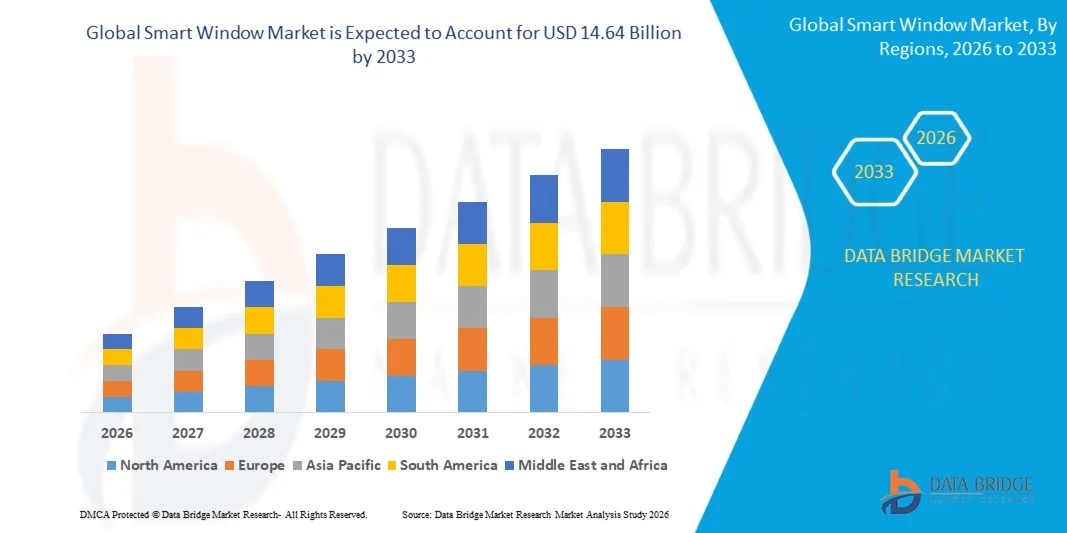
- The global photochromic for smart window market size was valued at USD 4.03 billion in 2025 and is expected to reach USD 14.64 billion by 2033, at a CAGR of 17.50% during the forecast period
- Rise in the stringent government regulations to control risk-oriented incidents is a crucial factor accelerating the market growth, also rise in the smart glass compensating artificial expenditure and increase in the smart glass influencing automobiles and aviation industry are the major factors among others boosting the photochromic for smart window market
What are the Major Takeaways of Photochromic for Smart Window Market?
- Rise in the new advancements in the technology, decline in the price of electrochromic materials and increase in the material influencing will further create new opportunities for photochromic for smart window market in the forecast period mentioned above
- However, high cost of smart glass limiting the usage and lack of awareness on Long-term benefits acts as the major factor among others restraining the market growth, and will further challenge the photochromic for smart window market
- Europe dominated the photochromic for smart window market with a 40.8% revenue share in 2025, driven by stringent energy-efficiency regulations, strong green building standards, and widespread adoption of sustainable architectural solutions across Germany, France, the U.K., and the Nordic countries
- Asia-Pacific is projected to register the fastest CAGR of 11.2% from 2026 to 2033, driven by rapid urbanization, expanding construction activities, and strong growth in automotive manufacturing across China, Japan, India, and South Korea
- The Electrochromic segment dominated the market with a 46.2% share in 2025, driven by its superior tint control, energy efficiency, and suitability for large architectural installations
Report Scope and Photochromic for Smart Window Market Segmentation
|
Attributes |
Photochromic for Smart Window Key Market Insights |
|
Segments Covered |
|
|
Countries Covered |
North America
Europe
Asia-Pacific
Middle East and Africa
South America
|
|
Key Market Players |
|
|
Market Opportunities |
|
|
Value Added Data Infosets |
In addition to the insights on market scenarios such as market value, growth rate, segmentation, geographical coverage, and major players, the market reports curated by the Data Bridge Market Research also include in-depth expert analysis, pricing analysis, brand share analysis, consumer survey, demography analysis, supply chain analysis, value chain analysis, raw material/consumables overview, vendor selection criteria, PESTLE Analysis, Porter Analysis, and regulatory framework. |
What is the Key Trend in the Photochromic for Smart Window Market?
“Increasing Shift Toward Energy-Efficient, Self-Tinting, and Sustainable Smart Glazing Solutions”
- The photochromic for smart window market is witnessing strong adoption of self-tinting glass technologies that automatically adjust transparency in response to sunlight, reducing glare and indoor heat gain without external power sources
- Manufacturers are introducing advanced photochromic coatings and nanomaterial-based films that offer faster transition speeds, improved durability, and enhanced UV-blocking performance
- Growing demand for energy-efficient buildings and green construction standards is driving integration of smart glazing solutions across commercial offices, airports, hospitals, and residential complexes
- For instance, companies such as Saint-Gobain, AGC Inc., NSG Group, and View Inc. are investing in dynamic glazing and high-performance architectural glass technologies
- Increasing focus on carbon emission reduction, indoor comfort, and smart city infrastructure is accelerating market adoption
- As sustainability regulations tighten globally, photochromic smart windows will remain vital for enhancing building efficiency, occupant comfort, and environmental performance
What are the Key Drivers of Photochromic for Smart Window Market?
- Rising implementation of green building regulations and energy-efficiency mandates is significantly boosting demand for smart glazing solutions that reduce HVAC loads
- For instance, in 2025, leading glass innovators such as Gentex Corporation and Central Glass Co., Ltd. expanded research into advanced dimmable and photo-reactive window technologies
- Growing adoption of smart homes, commercial real estate modernization, and automotive sunroof glazing is strengthening application scope across the U.S., Europe, and Asia-Pacific
- Advancements in nanotechnology, material chemistry, and thin-film coating processes have improved optical clarity, response time, and long-term stability
- Rising awareness regarding UV protection, occupant well-being, and energy cost savings is encouraging property owners and developers to invest in smart windows
- Supported by infrastructure development and sustainable construction investments, the photochromic for smart window market is expected to witness steady long-term growth
Which Factor is Challenging the Growth of the Photochromic for Smart Window Market?
- High installation and manufacturing costs associated with advanced photochromic coatings and laminated smart glass panels limit adoption in price-sensitive markets
- For instance, during 2024–2025, fluctuations in specialty chemical prices and supply chain disruptions increased production costs for smart glazing manufacturers globally
- Slower transition speeds compared to electrochromic alternatives may impact performance perception in certain high-end commercial applications
- Limited awareness among residential consumers regarding long-term energy savings and return on investment restrains broader adoption
- Competition from electrochromic, thermochromic, and suspended particle device (SPD) technologies creates pricing pressure and technological substitution risks
- To address these challenges, companies are focusing on cost-efficient coating technologies, improved material durability, strategic partnerships with construction firms, and large-scale production capabilities to expand global adoption of photochromic smart window solutions
How is the Photochromic for Smart Window Market Segmented?
The market is segmented on the basis of technology and application.
• By Technology
On the basis of technology, the photochromic for smart window market is segmented into Suspended Particle Display (SPD), Electrochromic, and Liquid Crystal. The Electrochromic segment dominated the market with a 46.2% share in 2025, driven by its superior tint control, energy efficiency, and suitability for large architectural installations. Electrochromic smart windows allow gradual light modulation through low-voltage electrical input, making them highly suitable for commercial buildings, airports, hospitals, and premium residential projects. Their durability, improved switching cycles, and integration with building automation systems further strengthen segment dominance.
The Suspended Particle Display (SPD) segment is expected to grow at the fastest CAGR from 2026 to 2033, supported by rising adoption in luxury automotive sunroofs, aircraft windows, and high-end architectural projects. Faster switching speeds and enhanced light-blocking capability are accelerating SPD technology deployment globally.
• By Application
On the basis of application, the photochromic for smart window market is segmented into Architecture, Transportation, and Consumer Electronics. The Architecture segment dominated the market with a 52.8% share in 2025, driven by increasing adoption of energy-efficient glazing solutions in commercial offices, smart homes, and green buildings. Rising compliance with energy conservation regulations and sustainability certifications is encouraging builders and developers to integrate dynamic glazing technologies to reduce HVAC loads and improve indoor comfort.
The Transportation segment is projected to grow at the fastest CAGR from 2026 to 2033, fueled by increasing integration of smart glazing in automotive sunroofs, side windows, rail cabins, and aircraft windows. Growing demand for passenger comfort, glare reduction, UV protection, and premium vehicle features is accelerating adoption across the global transportation sector.
Which Region Holds the Largest Share of the Photochromic for Smart Window Market?
- Europe dominated the photochromic for smart window market with a 40.8% revenue share in 2025, driven by stringent energy-efficiency regulations, strong green building standards, and widespread adoption of sustainable architectural solutions across Germany, France, the U.K., and the Nordic countries. Increasing retrofitting of commercial buildings and modernization of public infrastructure significantly fuel demand for energy-saving smart glazing technologies across offices, airports, healthcare facilities, and residential complexes
- Leading European manufacturers such as Saint-Gobain, AGC Inc., and NSG Group are expanding advanced glazing portfolios, enhancing light modulation efficiency, UV protection, and durability to strengthen regional competitiveness
- Strong policy support for carbon neutrality, high awareness of sustainable construction, and continuous investment in smart city projects further reinforce Europe’s leadership position in the global market
Germany Photochromic for Smart Window Market Insight
Germany represents the largest contributor within Europe, supported by strong emphasis on energy-efficient construction, advanced automotive engineering, and industrial modernization. Strict building energy codes and rising demand for low-carbon infrastructure encourage integration of dynamic smart glazing systems. Growing adoption in premium automotive sunroofs and commercial real estate developments strengthens domestic market growth.
France Photochromic for Smart Window Market Insight
France shows steady expansion driven by green building certifications, renovation of public infrastructure, and increasing investment in sustainable housing projects. Strong presence of architectural glass innovators and government-backed environmental initiatives promotes widespread adoption of photochromic smart window technologies.
U.K. Photochromic for Smart Window Market Insight
The U.K. market benefits from rising focus on net-zero construction targets and commercial building retrofits. Increasing demand for glare reduction, occupant comfort, and energy-efficient office spaces accelerates deployment of smart glazing solutions across urban developments.
Asia-Pacific Photochromic for Smart Window Market
Asia-Pacific is projected to register the fastest CAGR of 11.2% from 2026 to 2033, driven by rapid urbanization, expanding construction activities, and strong growth in automotive manufacturing across China, Japan, India, and South Korea. Large-scale infrastructure projects, smart city initiatives, and rising middle-class housing demand are accelerating adoption of energy-efficient window technologies. Increasing focus on sustainable buildings and premium vehicle features further fuels regional expansion.
China Photochromic for Smart Window Market Insight
China leads the Asia-Pacific market due to massive construction output, strong domestic glass manufacturing capabilities, and government emphasis on green infrastructure. Growing demand for smart residential complexes and commercial skyscrapers significantly boosts adoption.
Japan Photochromic for Smart Window Market Insight
Japan demonstrates consistent growth supported by advanced material innovation, automotive integration of smart glazing, and modernization of urban infrastructure. Focus on energy optimization and high-performance building materials sustains long-term demand.
India Photochromic for Smart Window Market Insight
India is emerging rapidly due to expanding smart city programs, increasing commercial construction, and rising awareness of energy-saving technologies. Government initiatives promoting domestic manufacturing further support market penetration.
South Korea Photochromic for Smart Window Market Insight
South Korea contributes significantly through strong automotive production, high-tech infrastructure projects, and increasing demand for premium residential developments. Technological advancement and sustainable design trends continue to support steady growth across the country.
Which are the Top Companies in Photochromic for Smart Window Market?
The photochromic for smart window industry is primarily led by well-established companies, including:
- Saint-Gobain (France)
- AGC Inc. (Japan)
- NSG Group (Japan)
- Research Frontiers (U.S.)
- Gentex Corporation (U.S.)
- View Inc. (U.S.)
- Polytronix (U.S.)
- AGP Americas (U.S.)
- Smartglass International (Ireland)
- Innovative Glass Corp (U.S.)
- Hitachi Chemicals (Japan)
- SPD Control Systems (U.S.)
- Fuyao Glass (China)
- Central Glass Co., Ltd. (Japan)
SKU-
Obtenha acesso online ao relatório sobre a primeira nuvem de inteligência de mercado do mundo

- Painel interativo de análise de dados
- Painel de análise da empresa para oportunidades de elevado potencial de crescimento
- Acesso de analista de pesquisa para personalização e customização. consultas
- Análise da concorrência com painel interativo
- Últimas notícias, atualizações e atualizações Análise de tendências
- Aproveite o poder da análise de benchmark para um rastreio abrangente da concorrência
Metodologia de Investigação
A recolha de dados e a análise do ano base são feitas através de módulos de recolha de dados com amostras grandes. A etapa inclui a obtenção de informações de mercado ou dados relacionados através de diversas fontes e estratégias. Inclui examinar e planear antecipadamente todos os dados adquiridos no passado. Da mesma forma, envolve o exame de inconsistências de informação observadas em diferentes fontes de informação. Os dados de mercado são analisados e estimados utilizando modelos estatísticos e coerentes de mercado. Além disso, a análise da quota de mercado e a análise das principais tendências são os principais fatores de sucesso no relatório de mercado. Para saber mais, solicite uma chamada de analista ou abra a sua consulta.
A principal metodologia de investigação utilizada pela equipa de investigação do DBMR é a triangulação de dados que envolve a mineração de dados, a análise do impacto das variáveis de dados no mercado e a validação primária (especialista do setor). Os modelos de dados incluem grelha de posicionamento de fornecedores, análise da linha de tempo do mercado, visão geral e guia de mercado, grelha de posicionamento da empresa, análise de patentes, análise de preços, análise da quota de mercado da empresa, normas de medição, análise global versus regional e de participação dos fornecedores. Para saber mais sobre a metodologia de investigação, faça uma consulta para falar com os nossos especialistas do setor.
Personalização disponível
A Data Bridge Market Research é líder em investigação formativa avançada. Orgulhamo-nos de servir os nossos clientes novos e existentes com dados e análises que correspondem e atendem aos seus objetivos. O relatório pode ser personalizado para incluir análise de tendências de preços de marcas-alvo, compreensão do mercado para países adicionais (solicite a lista de países), dados de resultados de ensaios clínicos, revisão de literatura, mercado remodelado e análise de base de produtos . A análise de mercado dos concorrentes-alvo pode ser analisada desde análises baseadas em tecnologia até estratégias de carteira de mercado. Podemos adicionar quantos concorrentes necessitar de dados no formato e estilo de dados que procura. A nossa equipa de analistas também pode fornecer dados em tabelas dinâmicas de ficheiros Excel em bruto (livro de factos) ou pode ajudá-lo a criar apresentações a partir dos conjuntos de dados disponíveis no relatório.











